Will Eurovision uphold Israel’s colonial genocide?

Spread the love

This work by Middle East Monitor is licensed under a Creative Commons Attribution-NonCommercial-ShareAlike 4.0 International License


This photograph shows the logo of the Eurovision Song Contest 2025 displayed on a screen at the end of the dress rehearsal for the second semi-final of the Eurovision Song Contest 2025 at the St. Jakobshalle arena in Basel on May 14, 2025. [Photo by FABRICE COFFRINI/AFP via Getty Images]

by Ramona Wadi

Spain, Ireland, Slovenia, the Netherlands and Iceland have declared their intention to not participate in the Eurovision Song Contest if Israel is allowed to take part. In response, Eurovision’s director Martin Green issued a weak statement that can only be classified as impunity for Israel. “We understand the concerns and deeply held views around the ongoing conflict in the Middle East,” Green stated. “It is up to each member to decide to take part in the contest, and we would respect any decision broadcasters make.”

The statement completely misses the point. Five countries have declared they will not participate in the contest if Israel takes part, because Israel is committing genocide in Gaza. This not an opinion, but a stance. To distance Eurovision from the intentions declared by these five participating countries is not a sign of respect, but a decision to exclude a principled stance in order to accommodate a genocidal colonial entity’s inclusion. In the name of neutrality, which only serves impunity for genocide in this case, Israel is being allowed unquestioned access to the competition while those calling for accountability are being excluded on account of taking a principled stance.

In 2022, the European Broadcasting Union banned Russia in a bid to support Ukraine. Yet despite almost two years of Israel’s genocide in Gaza, the EBU has not sought to ban Israel from participating in the context. The EBU is mirroring the general political stance that has prevailed not only since 7 October, but since the 1947 Partition Plan – Zionism can get away with anything because it derives its support from European colonial ideology and the institutions and initiatives promoting the colonial interpretation of neutrality. 

READ: Spain to officially boycott Eurovision if Israel remains in contest amid Gaza war

According to Green, the EBU is consulting “to gather views on how we manage participation and geopolitical tensions” in relation to Eurovision.

But consulting is merely a euphemism for stalling on accountability and strengthening Israel’s impunity. By mid-December this year, all countries need to confirm or decline participation in the next Eurovision Song Contest. There is still time for countries to take a principled stance against Israel’s genocide in Gaza and change the levels of impunity in the name of neutrality from within.

Participating countries can make or break Eurovision. While the politics directly supporting Israel’s genocide in Gaza are what needs to be altered, because diplomatic, economic and military support for Israel are enabling the annihilation of Palestinians in Gaza, Eurovision sets the scene for a heavily publicised stance against genocide, and one that cannot be easily ignored. 

The EBU may dictate the rules, but as Green stated, it is up to each member to decide to participate. This can be an opportunity to highlight autonomy over neutrality, and more importantly, to illustrate the presence of politics in every event. There is no neutrality in the EBU allowing Israel to participate, and there is no neutrality in countries deciding not to participate based on Israel’s participation in Eurovision. However, this also creates a level playing field if neutrality is acknowledged to be non-existent. Without the illusion, the truth is revealed – that of institutions creating space for colonialism and genocide and the opportunity to rise against complicity in the annihilation of Palestinians in Gaza. 

BLOG: Genocide admissions and international silence

The views expressed in this article belong to the author and do not necessarily reflect the editorial policy of Middle East Monitor.

This work by Middle East Monitor is licensed under a Creative Commons Attribution-NonCommercial-ShareAlike 4.0 International License

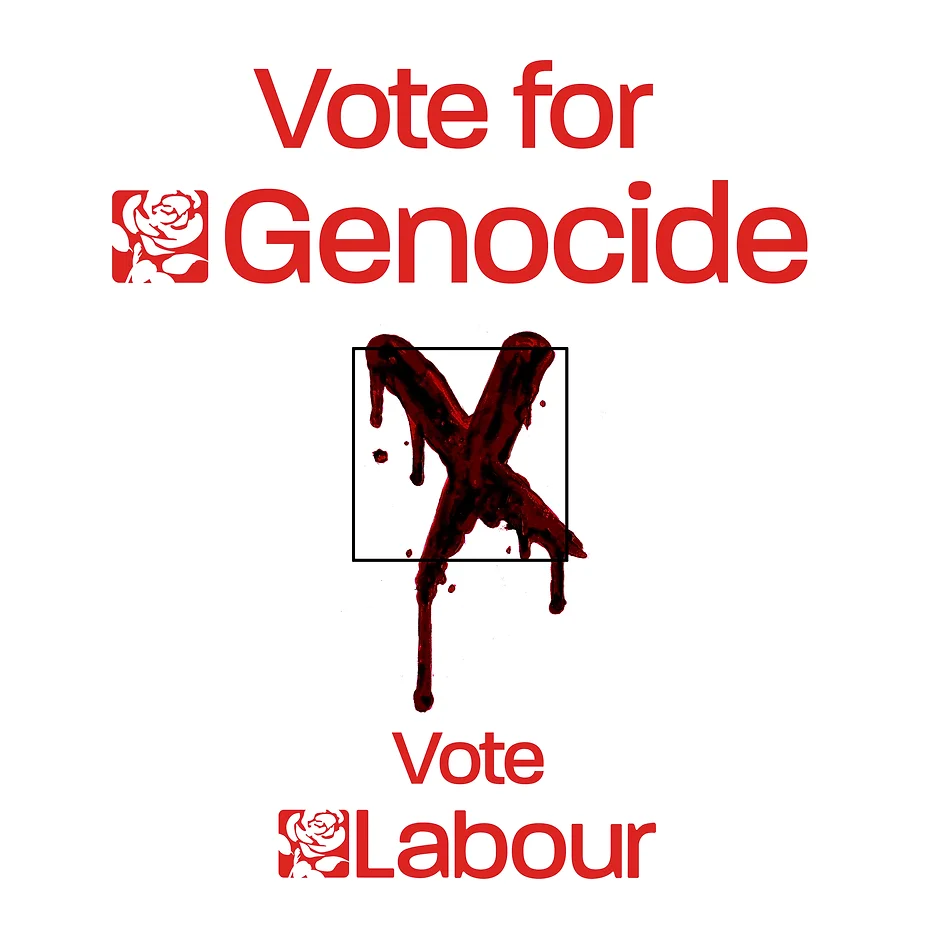
Experiencing issues with this image not appearing. I suspect because it's so critical of Zionist Keir Starmer's support of and complicity in Israel's genocides.
Genocide denier and Current UK Prime Minister Keir Starmer is quoted that he supports Zionism without qualification. He also confirms that UK air force support has been essential in Israel’s mass-murdering genocide. Includes URLs https://www.declassifieduk.org/keir-starmers-100-spy-flights-over-gaza-in-support-of-israel/ and https://youtu.be/O74hZCKKdpA
Keir Starmer objects to criticism of the IDF. He asks how could anyone object to them starving people to death, forced marches like the Nazis did, bombing Gaza's hospitals and universities, mass-murdering journalists, healthworkers and starving people queuing for food, killing and raping prisoners and murdering children. He calls for people to stop obstructing his genocide for Israel.
Keir Starmer objects to criticism of the IDF. He asks how could anyone object to them starving people to death, forced marches like the Nazis did, bombing Gaza’s hospitals and universities, mass-murdering journalists, healthworkers and starving people queuing for food, killing and raping prisoners and murdering children. He calls for people to stop obstructing his genocide for Israel.
Vote Labour for Genocide.

Continue ReadingWill Eurovision uphold Israel’s colonial genocide?

12 countries commit to arms embargo on Israel to stop its attacks on Gaza

Spread the love

Original article by Pablo Meriguet republished from peoples dispatch under a Creative Commons Attribution-ShareAlike 4.0 (CC BY-SA) license.

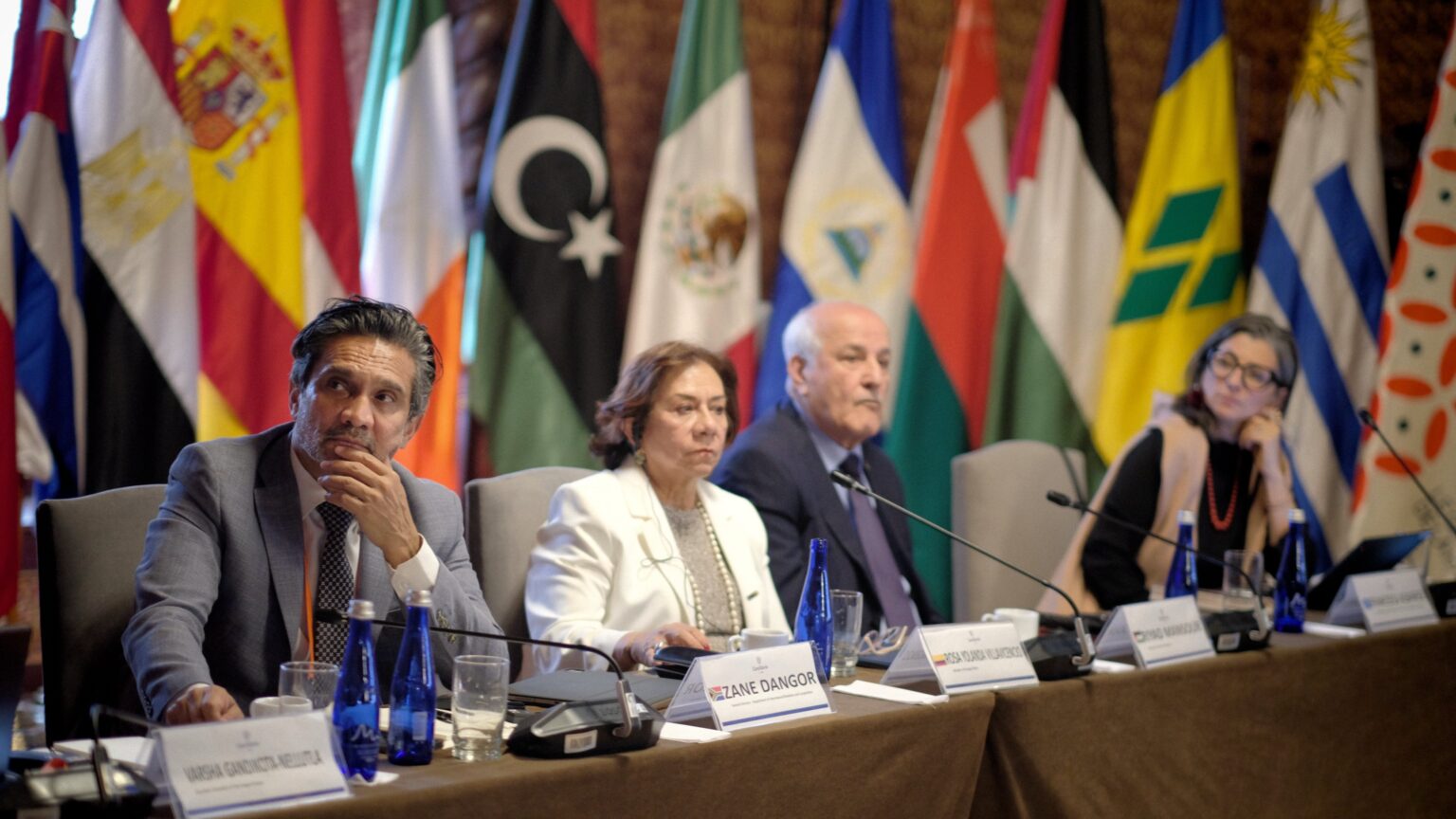
Hague Group Summit in Bogotá, Colombia. Photo: Abby Martin

In the final document, the signatory countries commit, among other things, to cease arms trade with Israel, review public contracts with that country, and seek accountability for war crimes.

Countries of the Global South have expressed their solidarity with the Palestinian people at the Emergency Ministerial Conference on Palestine organized by The Hague Group, which took place on July 15 and 16 in Bogotá, Colombia. The multilateral meeting was attended by representatives from Algeria, Bangladesh, Botswana, Brazil, Chile, China, Djibouti, Egypt, Slovenia, Spain, Honduras, Indonesia, Iraq, Ireland, Lebanon, Libya, Malaysia, Mexico, Namibia, Nicaragua, Norway, Oman, Pakistan, Palestine, Qatar, Saint Vincent and the Grenadines, South Africa, Turkey, Uruguay, and Venezuela.

Regarding the meeting, Colombia’s deputy secretary of state, Mauricio Jaramillo, said: “This conference is being convened by the Hague Group, but it is not an exclusive meeting of this group. Given the urgency of what is happening in the occupied territories, especially in Gaza, where today, for example, we have passed the threshold of 58,000 fatalities, we must commit ourselves to action.”

The conference, which was organized by the governments of Colombia and South Africa and attended by 30 countries, agreed that: “The era of impunity must end – and that international law must be enforced without fear or favor through immediate domestic policies and legislation – along with a unified call for an immediate ceasefire.”

The agreements

According to an official press release, the meeting laid out several measures to stop the genocide in Gaza:

  1. Prevent the provision or transfer of arms, munitions, military fuel, related military equipment, and dual-use items to Israel.
  2. Prevent the transit, docking, and servicing of vessels at any port … in all cases where there is a clear risk of the vessel being used to carry arms, munitions, military fuel, related military equipment, and dual-use items to Israel.
  3. Prevent the carriage of arms, munitions, military fuel, related military equipment, and dual-use items to Israel on vessels bearing our flag … and ensure full accountability, including de-flagging, for non-compliance with this prohibition.
  4. Commence an urgent review of all public contracts to prevent public institutions and funds from supporting Israel’s illegal occupation of the Palestinian Territory and entrenching its unlawful presence.
  5. Comply with obligations to ensure accountability for the most serious crimes under international law, through robust, impartial, and independent investigations and prosecutions at national or international levels, to ensure justice for all victims and the prevention of future crimes.
  6. Support universal jurisdiction mandates, as and where applicable in national legal frameworks and judiciaries, to ensure justice for victims of international crimes committed in the Occupied Palestinian Territory.

Although 30 countries attended the meeting, only 12 countries committed to immediately complying with the agreements outlined in the final declaration: Bolivia, Cuba, Colombia, Indonesia, Iraq, Libya, Malaysia, Namibia, Nicaragua, Oman, Saint Vincent and the Grenadines, and South Africa. The others expected to join them by September 20, 2025 – the date of the 80th UN General Assembly. The group will also be consulting various other states on an ongoing basis for participation in the measures against Israel.

Colombia’s President Gustavo Petro stated: “We came to Bogotá to make history — and we did … Together, we have begun the work of ending the era of impunity. These measures show that we will no longer allow international law to be treated as optional, or Palestinian life as disposable.”

“What we have achieved here is a collective affirmation that no state is above the law … The Hague Group was born to advance international law in an era of impunity. The measures adopted in Bogotá show that we are serious — and that coordinated state action is possible,” said South African Secretary of State Ronald Lamola.

The final agreement is historic as it is the first multilateral agreement that seeks to influence the Israeli government’s actions in its offensive against Gaza. In this sense, it is the first time that several countries have challenged the apparent immunity of the Israeli state in its actions in Gaza, which could have unpredictable diplomatic repercussions. It could also become the starting point for other countries to demand an end to the violence in Palestine jointly.

Original article by Pablo Meriguet republished from peoples dispatch under a Creative Commons Attribution-ShareAlike 4.0 (CC BY-SA) license.

Continue Reading12 countries commit to arms embargo on Israel to stop its attacks on Gaza