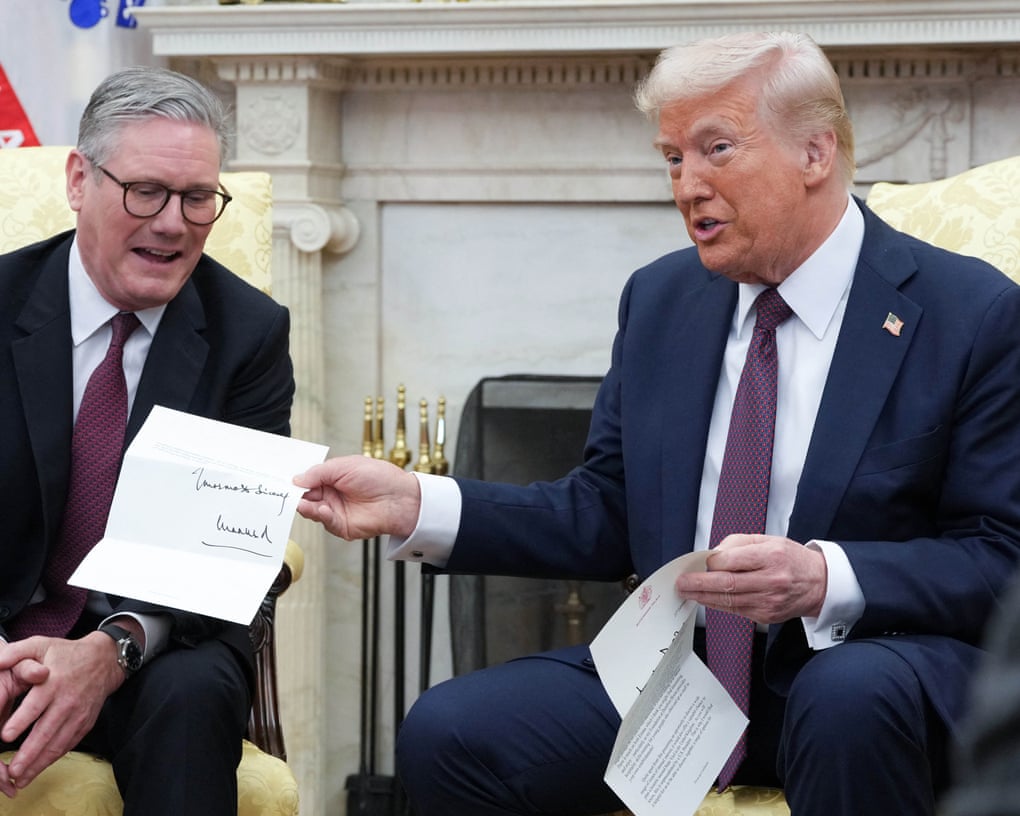
Donald Trump shows off a letter from King Charles that Keir Starmer has just handed him, Washington, 27 February 2025. Photograph: ABACA/REX/Shutterstock
We need a ‘coalition of the willing’ capable of bringing together those in Europe and the global south. Britain should facilitate that
There are only so many times Donald Trump can be offered a state and royal visit to temper his political tantrums. With his latest attacks on Volodymyr Zelenskyy and the halting of aid to Ukraine, it’s already clear that not even the offer of a bed for the night at Balmoral has worked.
The silver lining of the Trump experience over the past fortnight is hopefully that it leads to a more realistic appraisal not just of the implications of the re-election of this narcissistic, bullying, corporate thug, but an understanding of the role the US has played over generations. Trump and his gang members JD Vance and Elon Musk are just the ugliest of faces of the US global policy pursued for a century at least.
In 1992 Noam Chomsky published a bestselling booklet, What Uncle Sam Really Wants. A read of Chomsky may help Labour’s policymakers overcome their apparent naivety so worryingly displayed in the constant references to the special relationship between the UK and US.
Trump’s “America First” policy is simply a more blatant articulation of the role the US has pursued globally since at least the second world war.
…
There is an opening now for a much greater and more longer-sighted “coalition of the willing” capable of bringing together those in Europe and the global south to create the alliances and institutions needed to pursue the political and economic agenda that the US now resiles from.
This includes an economic cooperation agenda not based upon tariffs and protectionism for the wealthy, but one that is mutually beneficial and tackles both the grotesque inequalities between north and south and the common threat of the climate emergency.
…
Unwise and immoral plans to cut British overseas aid, undermining soft power, are a legacy of a sort, but how much better it would be to see our prime minister using our influence and heft to bring together all those who want to discuss and construct a world reordered without the malign influences of Trump and China. That really would be a place in history worth having.
Neo-Fascist Climate Science Denier Donald Trump says Burn, Baby, Burn.Elon Musk urges you to be a Fascist like him, says that you can ignore facts and reality then.
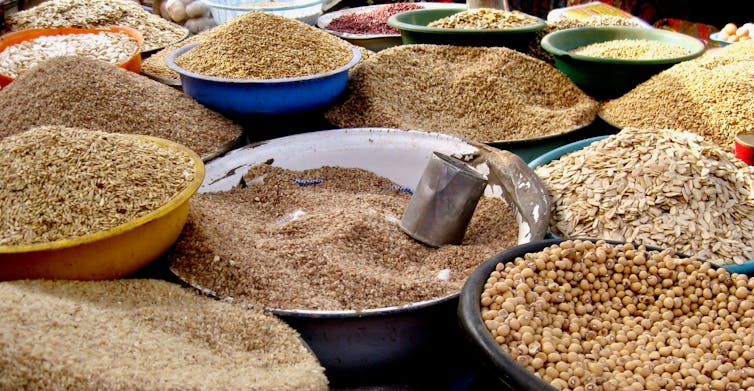
Climate change, and specifically rising temperatures, may cause food prices to increase by 3.2% per year, according to a new study by researchers in Germany. As climate change continues to worsen, this price inflation will mean more and more people around the world don’t have a varied and healthy diet, or simply don’t have enough food.
The new analysis shows that global warming could cause food price inflation to increase by between 0.9 and 3.2 percentage points per year by 2035. The same warming will cause a smaller rise in overall inflation (between 0.3 and 1.2 percentage points), so a greater proportion of household income would need to be spent on buying food.
This effect will be felt worldwide, by high and low-income countries alike, but nowhere more so than in the global south. As with various other consequences of climate change, Africa will be worst affected despite contributing little to its causes.
Our own research on food security in Ghana, west Africa, gives a sense of what price inflation might mean in practice. The The Intergovernmental Panel on Climate Change describes west Africa as a “hotspot” of climate change, with models predicting extreme rising temperatures and reduced rainfall. With more than half of the population being directly dependent on rain-fed agriculture, Ghana is particularly vulnerable to climate change.
We recently carried out a study in Mion, a rural district in the north of the country. We spoke to almost 400 people, and very single one of them told us they had experienced some level of food insecurity in the previous 12 months. Some 99% said climate change was at least partly to blame.
Additionally, 62% were moderately or severely food insecure, with 26% experiencing severe food insecurity (going without food for an entire day). These percentages are much worse than Ghana’s national averages (39% and 6% respectively), but similar to some of the poorest countries in west Africa such as Togo, Burkina Faso and Benin.
We also carried out a similar study among refugees from neighbouring Burkina Faso who fled across the border to the upper east region of Ghana. Again, 100% had experienced food insecurity.
Mion isn’t suffering from a sudden famine, and nothing particularly unusual has happened to cause this food insecurity. This situation is considered to be a “normal phenomenon” due to the effects of climate change.
Climate-related food inflation can be broken down into two interlinked problems.
Shifting seasons, pests and diseases
The first is that the same climate change effects that are causing the inflation are already making food harder to get hold of. For instance, higher temperatures can cause long-established and predictable farming seasons to shift and so may hinder crop production.
Other consequences can include more pest and disease outbreaks that deplete livestock and food reserves, and heat stress to already-poor roads which makes it harder to access rural communities.
All of these factors push prices higher and reduce the purchasing power of affected households. The drivers of food inflation are already worsening food insecurity.
The second part of this problem is the rise in inflation itself. A 3% annual price increase would mean households are less able to purchase what they need.
They would likely need to compromise on quality or perhaps even culturally important foods. This in turn makes people more vulnerable to disease and other health issues. Malnutrition is the leading cause of immunodeficiency globally.
In Ghana, we found that those who reported more knowledge of climate change were more likely to be food secure. This is despite few people having any formal education. This is evidence that affected populations are very aware of the changing temperatures and unpredictability of the climate, and are perhaps engaging in proactive mitigation practices.
Those without any schooling are more likely to engage in a climate-sensitive occupations such as farming, and so would be more immediately exposed. Teaching people about climate change might provide some capacity to adapt to it, and therefore increase food security.
Alterations in the climate are a hunger-risk multiplier for those populations with entrenched vulnerability. In light of this, 134 countries at COP28 signed a declaration to incorporate food systems into their climate action, to ensure everyone has enough to eat in light of climate change.
The researchers behind the new study suggest that reducing greenhouse gas emissions could limit any impacts on the global economy. We also suggest that diversifying economies would serve as some protection for those communities reliant on agriculture for both their food and income.
Government intervention could also ensure financial protection and nutritional aid for those vulnerable to becoming trapped in the poverty cycle by inflation and diminished accessibility to food.