Fears of a global energy crisis grow as Strait of Hormuz remains closed

Spread the love

https://morningstaronline.co.uk/article/fears-global-energy-crisis-grow-strait-hormuz-remains-closed

 Fire and plumes of smoke rises after a drone struck a fuel tank forcing the temporary suspension of flights near Dubai International Airport, in United Arab Emirates, early March 16, 2026

FEARS of a global energy crisis rose today as the war in the Middle East raged on.

The United States and Israel continued their illegal and unprovoked war on Iran as they bombarded the Iranian capital Tehran and Israel maintained its assault on Lebanon.

An Iranian drone strike temporarily shut Dubai’s airport, a crucial global travel hub, underscoring the threats to the world economy.

The war, which began on February 28, has seen Iran hit back by attacking Israel and US bases in the region, and Gulf Arab countries’ energy infrastructure.

The Iranians have also closed the Strait of Hormuz through which a fifth of the world’s oil is transported. That has dramatically increased the price of oil and put pressure on Washington to do something to ease the pain for consumers.

Brent crude, the international standard, remained more than $100 (£75) a barrel on Monday.

US President Donald Trump said that he has sent a demand to seven countries to send warships to keep the Strait of Hormuz open.

The US president said on Sunday that he wanted these other nations to help police the strait to make it safe for shipping, with his party increasingly concerned that rising prices for US consumers will hurt the Republicans in November’s mid-term elections.

Article continues at https://morningstaronline.co.uk/article/fears-global-energy-crisis-grow-strait-hormuz-remains-closed

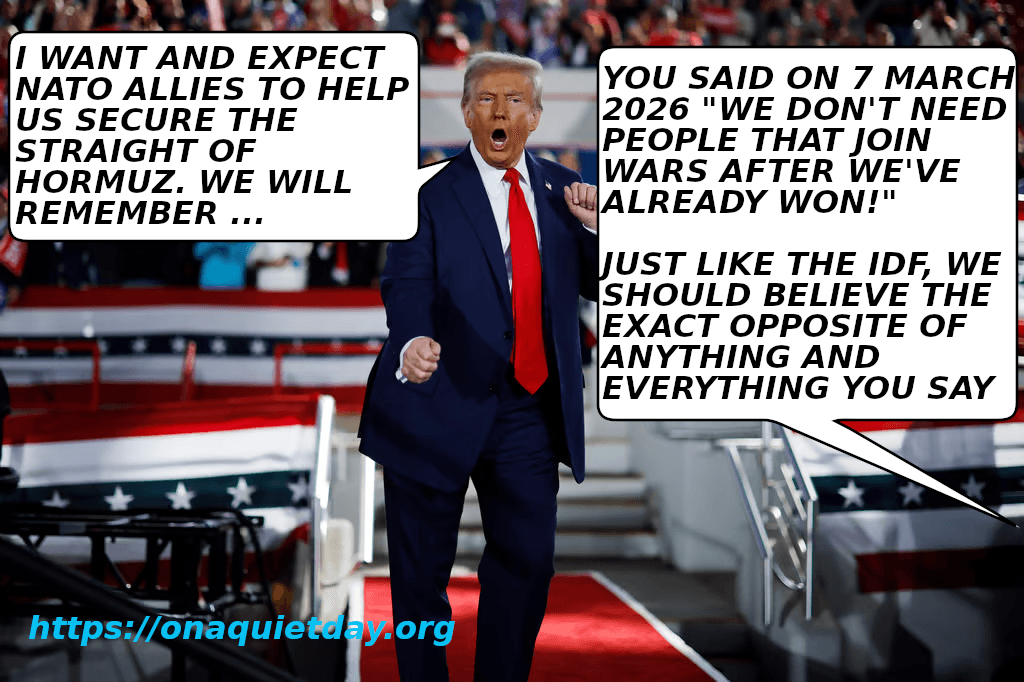
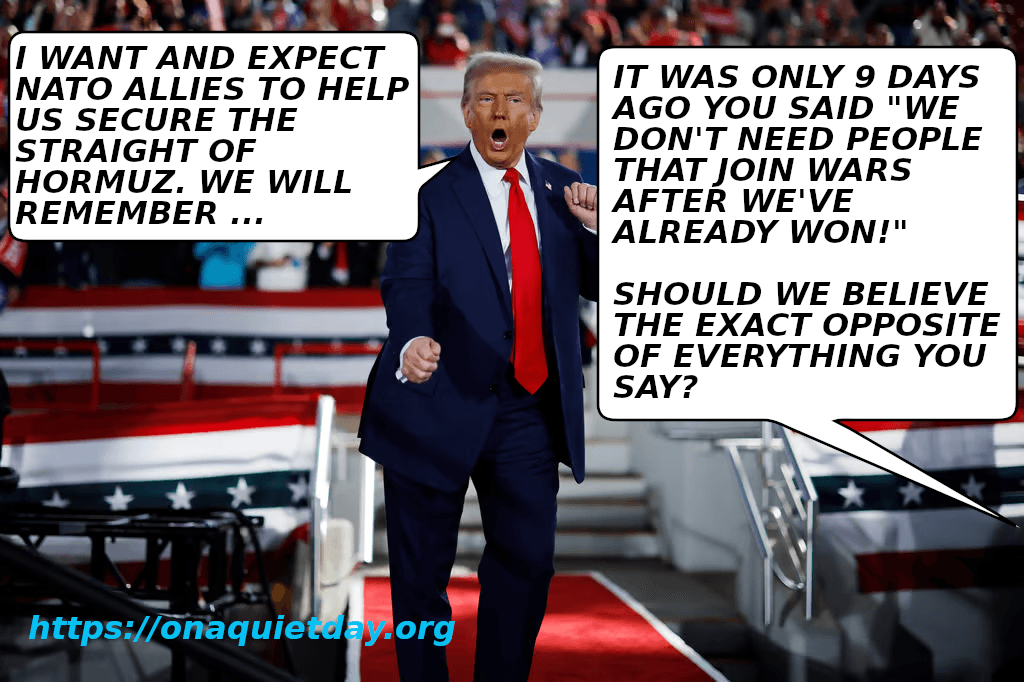
Donald Trump calls for help from NATO allies in securing the Straight of Hormuz despite saying only 9 days ago that they don't need people to join wars after they've already won.
Donald Trump calls for help from NATO allies in securing the Straight of Hormuz despite saying only 9 days ago that they don’t need people to join wars after they’ve already won.
Donald Trump sings and dances, says that it's fun to kill everyone ...
Donald Trump sings and dances, says that it’s fun to kill everyone …
Climate science denier Donald Trump confirms that he knows nothing about democracy and that more liquid gold is being secured according to his policy of global privateering.
Continue ReadingFears of a global energy crisis grow as Strait of Hormuz remains closed

Trump fell into Iran’s trap

Spread the love

This work by Middle East Monitor is licensed under a Creative Commons Attribution-NonCommercial-ShareAlike 4.0 International License.

United States President Donald Trump departs the White House en route to Hebron, Kentucky in Washington DC, United States, on March 11, 2026. [Celal Güneş – Anadolu Agency]

by Tamer Ajrami

President Trump is not only failing to learn from history. He is also failing to learn from what is happening right now.

This was not a small tactical mistake. Trump walked into a war with no exit plan, then realised too late that Iran had set the battlefield for a war of exhaustion, not a quick victory. Washington is now stuck between two costly choices: it cannot pull back because that would look like failure, and it cannot go deeper because that risks a long war with no guaranteed results.

As the war moves into its third week, harder questions are rising inside Washington: what does “victory” even mean; and how can it be achieved while Iran still holds the strongest pressure point in this confrontation: the Strait of Hormuz?

The Strait of Hormuz is Trump’s weak point

Trump’s biggest miscalculation was believing that firepower alone could force Iran to surrender before Iran turned Hormuz into a global pressure tool. Reality is different. Control of the strait is not an American decision. It is an Iranian one.

READ: US spent $12B since start of strikes on Iran, says White House economic adviser

And the worst part is that disruption does not require a large army in the traditional sense. One incident, one strike (by an Iranian soldier on a small boat, with an RPG on his shoulder), or even a rise in perceived risk can panic markets and push up oil prices, shipping insurance, and transport costs.

That puts Washington in a double trap:

If it declares “mission accomplished” and withdraws while Hormuz is still under threat, it will look like it lost the war economically.

If it escalates to force the strait open, it enters a wider war with higher costs and no clear guarantees.

The Israeli promise that pulled Washington into trouble

A major part of the trap was set before the first strike. The war was built on an Israeli assumption: if Iran’s top leadership is hit, the state will collapse and the public will rise in the streets to bring down the system. This was sold to Trump as a shortcut: one decisive blow, rapid internal collapse, and political change without a long war.

That assumption failed. The system did not collapse, and the streets did not explode as expected. Iran reorganized leadership quickly and blocked any political vacuum that outsiders were counting on. This has also created tension inside the alliance. Washington wants to focus on Iran and Hormuz. Israel pushes to widen the war, including major escalation in Lebanon. That spreads military and political effort and raises the cost.

The Gulf wants a quick win, but the war is not in Trump’s hands

Some Gulf states want a fast end; on Washington and Tel Aviv’s terms; because they see that as the return of stability and manageable energy prices. That creates political pressure on Trump to intensify strikes. 

But more strikes do not solve the Hormuz problem. Firepower can destroy targets, but it cannot restore market confidence overnight, and it cannot stop Iran from keeping the strait under constant risk.

Worse still, a prolonged war may open other maritime fronts, such as Bab al-Mandab. That would mean the crisis moves from one chokepoint to another; from one shock to the next.

Conflicting goals: Open Hormuz or SOLVE the nuclear file?

Washington is now trying to achieve two competing goals:

  • Secure the Strait of Hormuz enough to calm markets. And, 
  • Deal with nuclear materials and enriched uranium stored in complex, fortified sites.

But talk of a “quick solution” to the nuclear issue points to dangerous scenarios: forces on the ground, technical operations, long timelines, and huge risks. This brings Washington back to the same problem: Trump entered expecting a short campaign, then found himself facing a war that demands costs he does not want to pay.

READ: Iran: We did not ask for negotiations or ceasefire

The real exhaustion: Weapons, defenses, and endless involvement

A war is not measured only by how many strikes are launched. It is measured by what is burned each day: air defences, expensive ammunition, and the political room to keep going.

As attacks continue, the key questions become: can Washington sustain this pace? Can its allies absorb the economic and security backlash?

Iran, meanwhile, is betting on time. It does not need to defeat the US militarily. It only needs to keep the war going long enough to turn it into a global burden: higher oil prices, higher inflation, weaker investment, and a political crisis inside Washington that cannot be covered by victory speeches.

Therefore, Trump entered a war with no exit

Trump fell into Iran’s trap because he bet on a quick collapse that never happened, and he tried to “close the file” by force without having the tools to close it. Now he faces a clear dilemma:

  • He cannot declare victory while Hormuz remains under pressure.
  • He cannot end the war without concessions, guarantees, or a settlement.
  • And every new escalation risks wider fronts and deeper economic damage.

This is not a war that will be decided by tough speeches. It will be decided by who can carry the cost longer. Iran, at least so far, is trying to make that cost global, not local, and to show that in this war, economics may be stronger than missiles in deciding when it ends.

OPINION: The war on Iran started with missiles, but oil price can end it

The views expressed in this article belong to the author and do not necessarily reflect the editorial policy of Middle East Monitor.

This work by Middle East Monitor is licensed under a Creative Commons Attribution-NonCommercial-ShareAlike 4.0 International License.

Donald Trump sings and dances, says that it's fun to kill everyone ...
Donald Trump sings and dances, says that it’s fun to kill everyone …
Climate science denier Donald Trump confirms that he knows nothing about democracy and that more liquid gold is being secured according to his policy of global privateering.
Donald Trump explains why he established his Bored of Peace

Continue ReadingTrump fell into Iran’s trap

Iran refutes Trump’s claim it sought ceasefire with US and Israel as chaos continues

Spread the love

https://morningstaronline.co.uk/article/iran-refutes-trumps-claim-it-sought-ceasefire-us-and-israel-chaos-continues

A fire and plume of smoke rise after, according to authorities. debris from an intercepted Iranian drone struck an oil facility in Fujairah, United Arab Emirates, March 14, 2026

IRAN denied today that it had called on the United States and Israel to cease fire as the war in the Middle East continued to spread death and destruction.

US President Donald Trump claimed on NBC News that Iran had wanted to make a deal to end the US-Israeli assault, but that he had refused to negotiate because “the terms are not good enough yet.”

He did not specify what those terms should be, but he did say that Iran must commit to abandoning its nuclear ambitions, which the two countries were already discussing in high-level talks before the US and Israel launched their surprise attack on February 28.

Iran’s response has been to launch drone and missile strikes on Israel and Persian Gulf states that host US forces or are otherwise allied with Washington, while also blocking ships from sailing through the Strait of Hormuz, halting the follow of fossil fuels and global trade.

At the weekend, Mr Trump called on Britain, France, China and other nations to help reopen the strategic waterway. He claimed today that several countries had committed to do so, but he has yet to name them.

The US president also said that his country’s forces may bomb Kharg Island, where Iran’s most important oil export facilities are located, again “just for fun,” after the US targeted military installations there on Friday.

Iranian Foreign Minister Abbas Araghchi told CBS News: “No, we never asked for a ceasefire and we have never asked even for negotiation. We are ready to defend ourselves as long as it takes.

“There are people being killed only because President Trump wants to have fun.”

See the original article at https://morningstaronline.co.uk/article/iran-refutes-trumps-claim-it-sought-ceasefire-us-and-israel-chaos-continues

Climate science denier Donald Trump confirms that he knows nothing about democracy and that more liquid gold is being secured according to his policy of global privateering.
Donald Trump explains why he established his Bored of Peace
Elon Musk urges you to be a Fascist like him, says that you can ignore facts and reality then.
Continue ReadingIran refutes Trump’s claim it sought ceasefire with US and Israel as chaos continues

Israel-US and Iran War: A geostrategic transformation

Spread the love

This work by Middle East Monitor is licensed under a Creative Commons Attribution-NonCommercial-ShareAlike 4.0 International License

U.S. Navy warplane takes off from the aircraft carrier USS Abraham Lincoln during Operation Epic Fury targeting Iran in the Gulf of Oman, on March 01, 2026. [U.S. Navy / Handout – Anadolu Agency]

by Dr Zakir Hussain

After the 12-day war in May last year, it was clear that both sides would be face-to-face soon. They restarted on 28th February 2026. Israel-US adopted the same pattern of targeting the top brass, including the Grand Leader, Ayatollah Ali Khamenei, on the very first day, thinking that in the absence of these officials, the Iranian administration would be like a rudderless ship. This would create confusion and provide an easy opportunity for regime change.

Thirteen days have passed, yet there are no visible signs of either the fall of the regime or a pause or ceasefire. Despite US-Israel’s anguish, Iran selected Mojtaba Khamenei as the new supreme leader – an act of defiance.

Both sides continue to bombard each other’s vital infrastructure, including civilian and military targets. Energy installations such as oil depots and refineries have become primary targets. Under a tit-for-tat policy, Iran has also declared that financial centers, banks, and offices of major technology companies such as Google, YouTube, and Microsoft could be the next targets. Already 26 US bases have been targeted. Following the assassination of Ayatollah Ali Khamenei, the conflict rapidly expanded from a limited confrontation into a regional war, and with the blockade of the Strait of Hormuz, its effects are now visible in the global economy and in the daily lives of ordinary people. Approximately 130 oil ships are anchored, stopping 20% oil which passes through the narrow strait of 33 km. Already four ships were targeted which tried to bypass the warning.

Among the GCC countries, the UAE faced the highest number of attacks.

Iran’s aggressive response and selection of Mojtaba, a hardliner, as Ayatollah, appear to indicate that Iran is prepared for a prolonged conflict, whereas the United States and Israel seem eager to conclude the war quickly. Meanwhile, President Trump’s plan to send Kurdish Peshmerga into Iran via Iraq seems like another disaster.

READ: Trump says US ‘ahead of schedule’ in Iran war, claims most missiles destroyed

Tehran had been closely and patiently observing military buildups in the Indian Ocean, the Gulf of Oman, and the Mediterranean Sea for several weeks. The United States mobilized a substantial part of its defence capabilities, including naval armadas and two aircraft carriers, Abraham Lincoln and Gerald Ford. Hundreds of fifth-generation stealth fighter jets were deployed along with advanced air-defence systems such as THAAD and large stockpiles of interceptors.

In addition, the United States strengthened its military presence across several bases in the Gulf region, including Qatar, Bahrain, Oman, the United Arab Emirates, Kuwait, Saudi Arabia, Jordan, and Iraq.

Israel also appeared determined to launch what it described as a “fight-to-the-finish” war with the Islamic Republic. Prime Minister Benjamin Netanyahu repeatedly stated that he had been waiting for such a war for nearly forty years. Iran, on the other hand, has long maintained that it began preparing for such a scenario after the 2003 US-led invasion of Iraq and the fall of Saddam Hussein.

The earlier conflict in May had already revealed the strengths and weaknesses of both sides. However, the current course of the war suggests that the US–Israel alliance underestimated Iran’s military capabilities, particularly its missile and drone systems, careful planning, and effective use of its military resources.

Compared with the US–Israel alliance, Tehran appears to possess a clearer understanding of its adversaries’ strengths, limitations, and operational constraints.

Iran was also aware of its own limitations. Its air force cannot match the capabilities of US and Israeli fighter jets, and its airspace remains vulnerable to aerial attacks. As the conflict expanded, these vulnerabilities became evident. At the same time, the United States and Israel appeared to have an incomplete assessment of Iran’s capabilities. Although they possessed precise intelligence about the locations of Iranian leaders and senior officials—they killed several commanders and Ayatollah Ali Khamenei-they appeared to lack detailed knowledge of Iran’s missile infrastructure, drone networks, and underground silos developed over several decades.

It also appears that the US–Israel side underestimated the possibility of indirect assistance from Russia and China, relying heavily instead on air superiority and defensive shield systems.

Iran’s war strategy

A detailed military assessment would require expert analysis, but developments in the conflict suggest that Iran followed a three-stage strategy.

First, Iran responded to the US-Israel attacks by deploying large numbers of drones, many reportedly stored since 2011 and 2013. These drones forced US–Israel defence systems to respond with expensive interceptors. In financial terms, this created an asymmetric dynamic: Iranian drones costing between $20,000 and $50,000 were intercepted by missiles costing between $1 million and $2 million. As the wave of drone attacks continued, interceptor stocks began to decline, gradually exposing the airspace of US bases and Israel to greater risk.

Second, once defensive systems were strained, Iran launched more advanced missiles targeting radar installations, communication centres, satellites, and data facilities. Reports indicate damage to communication and data infrastructure at the Al Udeid Air Base in Qatar and at military installations in Bahrain. Such attacks disrupted surveillance and communication systems that coordinate missile defence networks such as THAAD, David’s Sling, Arrow, and Iron Dome. Command and monitoring centres that once gathered and transmitted military data across thousands of kilometres became severely limited in their operations.

Third,

Iran escalated its attacks using hypersonic missiles while adopting a tit-for-tat strategy. These strikes targeted refineries, military bases, and strategic infrastructure in Israel. Some reports suggest the use of the Khorramshahr-1 missile equipped with submunitions capable of dispersing dozens of warheads over a wide area, complicating interception efforts.

Meanwhile, attacks on naval assets reportedly forced aircraft carriers operating in the Gulf of Oman to reposition farther from the Iranian coastline.

READ: Two weeks in, Iran strikes inflict nearly $4B in US military losses

Hormuz blockade and its impact

After weakening regional defence systems, Iran announced a blockade of the Strait of Hormuz. This strait is one of the world’s most critical energy corridors, through which roughly 20 percent of global crude oil and a similar share of liquefied natural gas passes.

At present, around 130 oil tankers are reportedly anchored in the strait. Iran claims effective control over the Hormuz chokepoint.

It has targeted four vessels, including one linked to India, that attempted to pass through. Iran has reportedly deployed underwater tunnels and small, agile boats to intercept or attack ships that violate the blockade.

At the same time, attacks on energy facilities in Saudi Arabia and the temporary closure of Qatar’s Ras Laffan gas facilities disrupted global energy supplies. As a result, gas prices in Europe rose sharply while crude oil prices increased from about $62 per barrel to more than $100. Some analysts warn that if the conflict continues, oil prices could rise further, potentially reaching $200 per barrel. Such developments could trigger inflation, supply-chain disruptions, and rising unemployment worldwide.

Future of the War

Iran appears determined to pursue its objectives and may not halt operations even if a ceasefire is proposed by the United States or Israel. The selection of Mojtaba Khamenei as the new supreme authority signals continuity of leadership, consolidation of political control, and a claim of legitimacy within the existing system.

Large public gatherings during funeral processions and demonstrations suggest that, at least during wartime, sections of the population have rallied around the leadership.

Reports have also mentioned proposals to deploy Kurdish Peshmerga forces into Iran through Iraq. However, the region’s history suggests that such operations would face significant geographical and logistical difficulties. During the Iran–Iraq War, Saddam Hussein also attempted to advance through the mountainous terrain of the Zagros region but faced serious constraints.

Some Iranian sources have claimed the capture of US special forces personnel and the killing of several Israeli officials during the conflict, although many of these claims remain difficult to verify independently.

Chances of a Ceasefire

Iranian authorities have reportedly outlined three conditions for a ceasefire. First, all military attacks by the United States and Israel must stop immediately. Second, Tehran seeks assurances that such attacks will not be repeated in the future. Third, Iran demands recognition of its sovereignty and compensation for damages caused during the conflict. These conditions are not easy. Who will ensure that the U.S. and Israel would not attack in the future? Second, who will pay the reconstruction cost, etc.? It is true that regional problems can be resolved only when the issue of Palestine is resolved in a fair and just manner. Lebanon and Yemen, Syria also need attention.

Future Trajectory-Palestine solution is the only solution

Even if the present war stops, regional stability will remain uncertain. Long-standing political and security disputes remain unresolved. Israel is unlikely to abandon its strategic objectives, Greater Israel, while tensions involving Hezbollah and Hamas are likely to persist. The United States may also increase pressure on Gulf states to revise their security arrangements so that regional partners become more directly involved in future conflicts.

Implications for India

For India, energy security remains a major concern. Disruptions in the Strait of Hormuz could affect oil supplies and trade routes. Approximately 50% oil passes through the route, while Houthis are there to choke off the Red Sea navigation. 

India must also prepare contingency plans for the evacuation of its 9 million workers from the region and strengthen logistical arrangements to safeguard trade and shipping routes in the event of prolonged instability. Chemical fertilizers are another major concern for India. The region provides the bulk of fertilizers and ensures food security. Disruption in supply line has significantly affected the supply of fresh vegetables, perishable items including agriproducts , poultry and meat products 

In the long term, India is to sign a long term energy agreement with the US. At the same time, India needs a more coherent West Asia policy and must avoid being drawn into the region’s strategic conflicts. The region is sensitive as well as vital to India’s economy and geostrategy. India needs a careful policy.

OPINION: Iran is not Venezuela: Gen-Z would fail to defeat diehard ayatollahs

The views expressed in this article belong to the author and do not necessarily reflect the editorial policy of Middle East Monitor.

This work by Middle East Monitor is licensed under a Creative Commons Attribution-NonCommercial-ShareAlike 4.0 International License

Climate science denier Donald Trump says that more liquid gold is being secured according to his policy of global privateering
Donald Trump explains why he established his Bored of Peace
Donald Trump warns against following the https://onaquietday.org blog, says that it's easy atm, she only needs to report war crimes supporting Israel's genocidal expansion.
Donald Trump warns against following the https://onaquietday.org blog, says that it’s easy atm, she only needs to report war crimes supporting Israel’s genocidal expansion.
Continue ReadingIsrael-US and Iran War: A geostrategic transformation

For Trump and Netanyahu, the Iran war is a problem of their own making

Spread the love

Original article by Paul Rogers republished from OpenDemocracy under a Creative Commons Attribution-NonCommercial 4.0 International licence

Trump and Netanyahu have a problem of their own making in Iran | Joe Raedle/Getty Images

The US president’s claim that the war is ‘very complete’ was little more than wishful thinking

“I think the war is very complete, pretty much,” was Donald Trump’s assessment of the Israeli-American war in Iran earlier this week, after nearly a fortnight of death and destruction.

“[Iran has] no navy, no communications, they’ve got no air force,” the US president continued. “Their missiles are down to a scatter. Their drones are being blown up all over the place, including their manufacturing of drones.”

Iran thinks otherwise: it struck three merchant ships near the Strait of Hormuz days later.

The US military’s recent actions are also in contradiction with Trump’s boasts of success. Having depleted its stocks of missiles and anti-drone weapons, the Pentagon is making plans to move reserves from South Korea, to the evident concern of the government in Seoul. In a further unexpected twist, the US is even turning to Ukraine to supply it with cheap anti-drone defences made locally and costing a tiny fraction of the commercial systems.

For Israel and the US, which began the war with surprise airstrikes on Iran on 28 February, Tehran’s ability to survive is proving far greater than expected. More than 1,000 Iranians have been killed, including the former supreme leader, but the regime is still able to respond to attacks.

As the war intensifies with no end in sight, two key elements are emerging.

The first is that Binyamin Netanyahu, in particular, has fallen into a trap of his own making.

Israel’s prime minister likely imagined Israel and the US would be able to quickly declare victory after assassinating Iran’s supreme leader, bolstering his approval ratings ahead of this year’s Israeli general election.

But with the supreme leader’s son now appointed as his successor, a victory for Israel can only involve completely destroying Iran’s ability to resurrect a nuclear weapon programme. Anything short of this, and its resurrection will be the first aim of any surviving regime – leaving Israel in an even less secure position than before it attacked Tehran.

This total destruction is proving harder than expected, not least because of Iran’s extensive network of tunnels, which I noted in openDemocracy last week. Footage released by Iran’s Islamic Revolutionary Guard Corps last year, which purportedly shows a tunnel full of naval drones, anti-ship missiles, and sea mines, resurfaced this week after the attacks on the merchant ships.

The second issue is more surprising and has emerged only in the past few days.

Having failed to terminate the Iranian regime in the first leadership assassination, Israel and the US are falling back on the Dahiya Doctrine, an Israeli military tactic rooted in wrecking a neighbourhood, a city or even a country to undermine public support for a recalcitrant leadership. In theory, it forces the enemy leadership to give up and thereby lose the war.

The two nations have embarked on an expanded bombing campaign that increasingly targets Iran’s civilian population. As well as the spiralling death toll, thousands of residential properties have been destroyed, displacing more than a million people from their homes.

Civil infrastructure has also been targeted, including banks needed to pay wages. There are numerous reports of hospitals and health centres being hit.

Israel and the US’s use of the Dahiya Doctrine is unsurprising; Israel first used the tactic to attack Hezbollah’s stronghold district of Dahiya in southern Beirut in 2006, and it has since become a valuable tool in its arsenal. Despite Hezbollah’s survival – indeed, 20 years on, Israel is again pummelling Dahiya – Israel used the same approach in four assaults on Hamas in Gaza between 2007 and 2021, and it has been its main policy in the devastating war in Gaza since 2023.

In Iran, expect many more attacks from Israel and the US, killing or maiming many thousands more. Yet a remarkable sting in the tail is emerging that is already changing everything.

Put bluntly, Iran is using Israel’s Dahiya Doctrine against Israel itself.

Iran cannot defeat the combined military power of the US and Israel, but what it can do, and is already doing, is engage in economic warfare on a global scale by targeting the 20% of the world’s oil and gas that originates in the Persian Gulf and passes through the Strait of Hormuz.

Its aim is simple: cause such problems in world energy markets that, in a matter of weeks, there will be huge pressure on Trump and his people to force a pause in the fighting, whatever Netanyahu says.

And the International Energy Agency has already described the situation as one of “dire straits’, warning that “the war in the Middle East is creating the largest supply disruption in the history of the global oil market”.

It continued: “With crude and oil product flows through the Strait of Hormuz plunging from around 20 mb/d before the war to a trickle currently, limited capacity available to bypass the crucial waterway, and storage filling up, Gulf countries have cut total oil production by at least 10 mb/d. In the absence of a rapid resumption of shipping flows, supply losses are set to increase.”

The implication is that a very difficult time of global energy shortages lies ahead.

So while Trump may say the war is “very complete”, it’s far from it.

Original article by Paul Rogers republished from OpenDemocracy under a Creative Commons Attribution-NonCommercial 4.0 International licence.


Donald Trump explains why he established his Bored of Peace

Continue ReadingFor Trump and Netanyahu, the Iran war is a problem of their own making