This work by Middle East Monitor is licensed under a Creative Commons Attribution-NonCommercial-ShareAlike 4.0 International License.
White House press secretary Karoline Leavitt speaks at the White House Press Briefing room in Washington DC., United States, on March 10, 2026. [Celal Güneş – Anadolu Agency]
US President Donald Trump favors a peaceful resolution with Iran but is prepared to escalate sharply if Tehran fails to accept the “reality of the current moment,” the White House said Wednesday, Anadolu reports.
Washington postponed planned strikes on Iranian power plants and energy infrastructure after “productive conversations” in the last three days, spokesperson Karoline Leavitt told reporters.
She said if Iran fails to accept that it has “been defeated militarily,” Trump will ensure the country is “hit harder than they have ever been hit before.” She added that the president “does not bluff and he is prepared to unleash hell.”
Leavitt also warned Tehran against “miscalculation,” claiming its last miscalculation had cost Iran its senior leadership, navy, air force and air defense system. Any further violence, she said, would be the result of Iran refusing to accept defeat and come to a deal.
She said the administration does not consider congressional authorization “necessary” for strikes against Iran, and acknowledged no specific timeline exists for the first oil tanker to pass through the Strait of Hormuz, though officials are working to realize it “as quickly as” possible.
Leavitt said the US has destroyed more than 140 Iranian naval vessels, including nearly 50 mine layers, in “the largest elimination of a Navy on the face of the planet in a three-week period since World War II.”
She added that during the weekend, the US dropped several 5,000-pound bombs on an underground facility used to store anti-ship cruise missiles and mobile missile launchers positioned along the Strait of Hormuz coastline.
Trump, Leavitt added, wants to see a Iranian leadership that is “much more favorable” to Washington, willing to cooperate with the US and no longer chanting “Death to America!”
Asked about Iranian state television reports that Tehran rejected a US 15-point plan to end the war, Leavitt said talks have not broken down. “They have not. Talks continue. They are productive, as the president said on Monday, and they continue to be,” she said.
On the reported plan, Leavitt urged caution, saying she had seen a plan “floated in the media” but that the White House had never confirmed it. “There are elements of truth to it, but some of the stories I read were not entirely factual,” she added.
The US has reportedly sent Iran a 15-point plan, outlining steps on Tehran’s nuclear and ballistic missile programs, as well as maritime security in the Strait of Hormuz. Iran rejected the proposal, saying any ceasefire would occur on its terms and timeline, and outlined five conditions for ending the war, including a complete halt to “aggression and assassinations.”
On possible face-to-face talks, including reports of a potential meeting in Pakistan, Leavitt said nothing should be considered official until formally announced by the White House, cautioning against getting “ahead of our skis” on any talks planned for the weekend.
She also dismissed claims by former counterterrorism director Joe Kent, who alleged the US had shifted its red line from preventing a nuclear weapon to preventing nuclear enrichment to justify the war. She said Kent “resigned in disgrace,” calling his assertions “ridiculous and laughable,” and saying his accusations carry “zero credibility.”
The US and Israel have struck Iran since Feb. 28, killing more than 1,300 people, including then-Supreme Leader Ali Khamenei, prompting Iranian retaliatory strikes across the region and a severe disruption to global oil flows.
Orcas discuss rotting brain. Front Orca says “Wish someone would lock him up”.Donald Trump warns against following the https://onaquietday.org blog, says that it’s easy atm, she only needs to report war crimes supporting Israel’s genocidal expansion.Keir Starmer explains that UK is participating defensively in Trump and Israel’s criminal war for Israel’s genocidal expansion in Iran and states that he supports Zionism “without qualification”. Keir Starmer said “I said it loud and clear – and meant it – that I support Zionism without qualification.” here: https://www.jewishnews.co.uk/keir-starmer-interview-i-will-work-to-eradicate-antisemitism-from-day-one/
The United States today finds itself ensnared in a war it cannot win, yet cannot leave. What appears, at first glance, as a familiar display of military dominance in West Asia is, in fact, a deeper crisis of strategy, legitimacy, and control. The conflict involving the United States, Israel, and Iran has exposed a paradox at the heart of American power: the more force it projects, the fewer viable options it retains. Nowhere is this contradiction more sharply visible than in the battle over the Strait of Hormuz—a narrow passage that has become the fulcrum of a widening geopolitical confrontation.
At the core of this crisis lies a strategic bind. The United States cannot credibly exit the conflict without first securing what it can claim as a “victory.” Yet, in this theatre, victory is narrowly defined: ensuring unimpeded passage through the Strait of Hormuz. That objective, however, is precisely what Iran is positioned to deny. Geography, in this case, has become a weapon. Iran does not need to defeat the United States militarily; it merely needs to retain the capacity to disrupt, threaten, or selectively control access to the Strait. In doing so, it transforms a superpower’s overwhelming military advantage into a liability.
This is the cruel logic of asymmetry. For Washington to guarantee maritime security in the Strait, it would have to escalate—potentially by occupying strategic islands at its mouth, intensifying naval deployments, or even targeting Iranian coastal infrastructure. Such moves would not only expand the war but also risk drawing the United States into a deeper and more protracted conflict. Exit, paradoxically, demands escalation. And escalation offers no guarantee of resolution.
This is the cruel logic of asymmetry. For Washington to guarantee maritime security in the Strait, it would have to escalate—potentially by occupying strategic islands at its mouth, intensifying naval deployments, or even targeting Iranian coastal infrastructure.
The strategic importance of the Strait of Hormuz cannot be overstated. A significant portion of the world’s oil supply passes through this narrow corridor. Control over it is not simply about trade; it is about leverage over the global economy. Iran’s proximity to the Strait gives it a natural advantage—one that no amount of distant military power can easily neutralize. Even limited disruption can trigger global economic tremors, placing pressure not only on the United States but on its allies and adversaries alike.
Compounding this dilemma is the collapse of allied consensus. Unlike previous conflicts where the United States rallied a coalition under the banner of collective security or shared values, this war appears strikingly unilateral. Key allies have refrained from offering meaningful support. The reasons are not difficult to discern. This was a war initiated without broad consultation, lacking a clear legal or moral mandate, and unfolding against the backdrop of widespread global disillusionment with Western interventions.
The absence of allies is not merely a logistical setback; it is a profound indicator of declining legitimacy. Military power, in the modern world, is sustained as much by perception as by capability. Without diplomatic backing, even the most formidable force appears isolated. The United States, once the architect of multilateral action, now finds itself acting alone, its calls for support met with hesitation or silence.
This isolation intersects with another structural reality: the conflict is not binary. As James M. Dorsey astutely observes, “it takes three to tango.” The United States is not the sole protagonist. Israel and Iran are independent actors with their own strategic imperatives, neither of which aligns neatly with American objectives.
The absence of allies is not merely a logistical setback; it is a profound indicator of declining legitimacy. Military power, in the modern world, is sustained as much by perception as by capability.
Israel, in particular, has undergone a significant shift in doctrine. Since the events of 2023, its strategy appears to have moved beyond deterrence toward the systematic weakening—if not outright incapacitation—of its regional adversaries. This includes not only Iran but also actors in Lebanon and Syria. The goal is no longer stability through balance, but dominance through disruption. Such a strategy inherently resists de-escalation. For Israel, a prolonged conflict may serve broader regional ambitions.
Iran, for its part, views the confrontation through the lens of survival and resistance. Despite suffering significant losses, it has demonstrated resilience and internal cohesion. Its strategy does not depend on outright victory but on endurance. By sustaining pressure—whether through control of the Strait, targeted strikes, or regional proxies—it ensures that the conflict remains costly and unresolved.
Caught between these two actors, the United States finds itself in a reactive posture. Even a partial withdrawal would not guarantee disengagement. Continued hostilities between Israel and Iran could easily draw Washington back into the conflict, whether through strategic commitments, regional security concerns, or the imperative to maintain credibility.
Adding another layer of complexity is the parallel war being waged in the realm of information. Modern conflicts are no longer confined to battlefields; they unfold equally in the domain of perception. Narratives, legitimacy, and global opinion play decisive roles. In this arena, the United States and Israel face an increasingly uphill battle.
The conduct of the war in Gaza has already inflicted significant damage on Israel’s global standing. Images of devastation, civilian casualties, and humanitarian crises have circulated widely, shaping international opinion in ways that military victories cannot easily counterbalance. In this context, Iran’s information strategy need not be sophisticated; it merely needs to amplify existing doubts and criticisms.
This erosion of narrative control has tangible consequences. It weakens diplomatic support, fuels domestic dissent, and complicates efforts to justify continued engagement. War, in the twenty-first century, is as much about legitimacy as it is about firepower. And legitimacy, once lost, is difficult to reclaim.
The notion that the conflict can be resolved through decisive military action is, therefore, increasingly untenable. Even the targeted elimination of senior Iranian officials or the degradation of military infrastructure does not fundamentally alter the dynamics at play. This is not a war that can be won through attrition alone. It is, as Dorsey suggests, a contest of endurance—a test of which side can “hold its breath” the longest.
Such wars tend to favour those with less to lose and more to prove. For Iran, survival itself constitutes victory. For the United States, anything short of clear dominance risks being perceived as defeat. This asymmetry in expectations further entrenches the strategic bind.
Meanwhile, domestic politics within the United States are beginning to reflect the strain. Segments of the political spectrum that once supported assertive foreign policy are now expressing dissent. Voices such as Tucker Carlson and Candace Owens have questioned the rationale for continued involvement, highlighting fractures within the broader support base. Public opinion, too, appears increasingly wary of another prolonged and costly conflict.
These internal divisions are not incidental; they are symptomatic of a deeper fatigue. After decades of military engagements in the Middle East, the American public is less inclined to accept the human and economic costs of war, particularly when the objectives remain obscure or shifting. In a midterm election context, such sentiments carry significant political weight, further constraining the administration’s options.
What emerges, then, is a picture of a superpower caught in a narrowing corridor. To escalate is to risk deeper entanglement and unforeseen consequences. To withdraw is to concede strategic ground and undermine credibility. Neither path offers a clear or satisfactory resolution.
The crisis in the Strait of Hormuz is thus emblematic of a broader transformation in global power dynamics. It underscores the limits of unilateral action in an increasingly multipolar world, where regional actors possess both the will and the means to resist external dominance. It reveals the fragility of alliances built on expediency rather than shared purpose. And it highlights the enduring importance of legitimacy as a foundation of effective power.
The notion that the conflict can be resolved through decisive military action is, therefore, increasingly untenable. Even the targeted elimination of senior Iranian officials or the degradation of military infrastructure does not fundamentally alter the dynamics at play.
For the United States, this moment demands a reckoning. The instruments of power—military, economic, and diplomatic—remain formidable. But their efficacy is contingent upon context, perception, and restraint. In the absence of these, power becomes self-defeating, generating the very constraints it seeks to overcome.
The Strait of Hormuz, narrow and contested, has become more than a strategic chokepoint. It is a mirror reflecting the contradictions of contemporary geopolitics. It shows an empire struggling to reconcile its ambitions with its limitations, its capabilities with its credibility.
In the end, the question is not whether the United States can control the Strait, but whether it can redefine what control means in a world where dominance no longer guarantees compliance. Until that question is answered, the path forward will remain fraught—an uneasy passage through turbulent waters, with no clear exit in sight.Top of FormBottom of Form
This work by Middle East Monitor is licensed under a Creative Commons Attribution-NonCommercial-ShareAlike 4.0 International License.
[dizzy: Uncertain whether that “Top of FormBottom of Form” belongs. It appears simultaneously quite surreal and almost belonging. I am supposed to copy unaltered according to the licence so it is as it is presented to me. A powerful, well-argued and well-presented article that can be republished under its creative commons licence.)
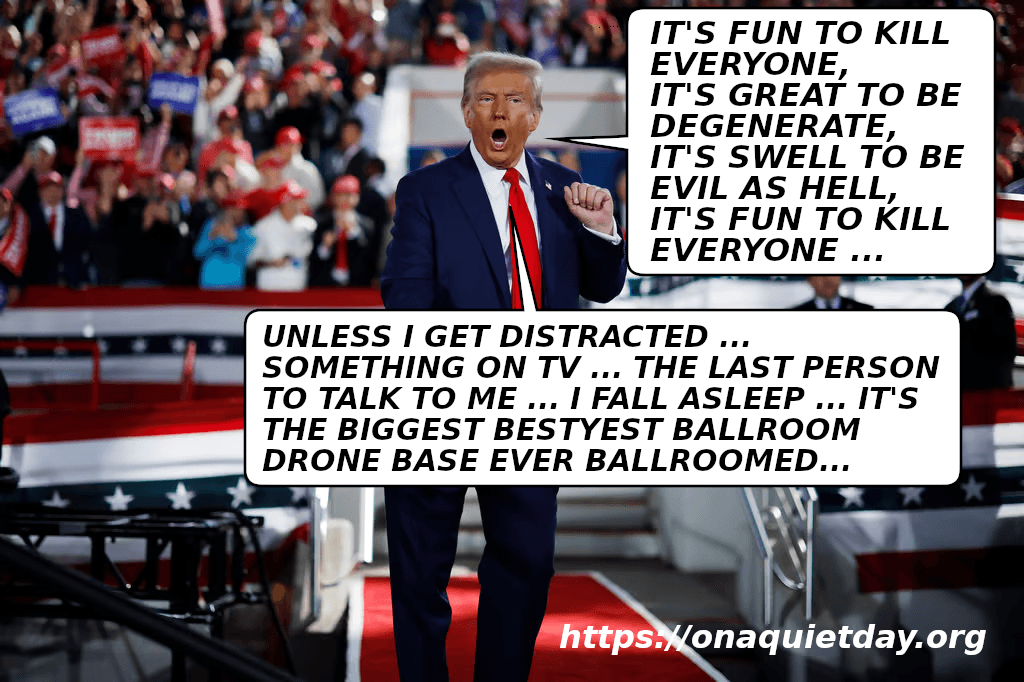
Climate science denier Donald Trump confirms that he knows nothing about democracy and that more liquid gold is being secured according to his policy of global privateering.Donald Trump sings and dances, says that it’s fun to kill everyone …Donald Trump calls for help from NATO allies in securing the Straight of Hormuz despite saying only 9 days ago that they don’t need people to join wars after they’ve already won.
US President Donald Trump speaks during a bilateral meeting with the Taoiseach of Ireland Micheál Martin in the Oval Office of the White House in Washington, DC on March 17, 2026. (Photo by Jim Watson / AFP via Getty Images)
The absence of any US strategy becomes clearer by the day. Trump has thrown everything at the wall in the hope that something will stick. So far, nothing has.
President Donald Trump is a victim of his own success. After a quick strike against Iran’s nuclear facilities last June and the capture of Venezuela’s president and First Lady in January, the US military, the illegality of those operations notwithstanding, made war look easy and Trump feel omnipotent.
Three weeks into a more daunting excursion into Iran, Trump is now a desperate leader.
With Trump, everything is personal. A growing body of evidence suggests that a principal objective in attacking Iran was the assassination of the country’s Supreme Leader, Ayatollah Ali Khamenei. For example:
When the CIA learned that the Ayatollah and top Iranian officials would be meeting in a militarily accessible location, a previously planned nighttime strike was moved up to the middle of the day.
On Sunday night, March 1, shortly after reports that the US-Israeli attack had killed the Ayatollah, Trump said, “I got him before he got me.” He was referring to an alleged plot to kill Trump during the 2024 presidential campaign as retribution for the January 2020 US strike that killed Iran’s military leader Qasem Soleimani, the commander of the Quds Force of the Islamic Revolutionary Guards Corps,
The desire to downplay Trump’s desire for vengeance explains why he and his minions have offered more noble—and contradictory—justifications for the war, including:
To help the Iranian people secure their freedom (Trump);
To attack Iran because Israel was going to do it and that would result in Iran’s attack on US assets in the Middle East (Secretary of State Marco Rubio);
To attack Iran first, not because Israel was going to do it anyway, but because Trump had a gut feeling that Iran was going to attack the US (Trump). But Pentagon officials informed Congress that no intelligence supported Trump’s opinion;
To eliminate Iran’s nuclear capability (although Trump claimed to have done that with the June attack).
Mission Accomplished?
Whatever his motivations, deploying the might of the military force was the beginning and the end of Trump’s thinking. He and his advisors are now flailing in the aftermath.
Iran has divided its global adversaries by holding the world’s economy hostage. Closing the Strait of Hormuz to the US and its allies sent world markets reeling as the price of oil increased by 40 percent and the price of gasoline in the US rose by almost $1.00 per gallon. Trump is trying to sell the line that such costs in the short run will pay off in the long run, but few are buying it.
Trump’s Desperate Ploys
The absence of any US strategy becomes clearer by the day. Trump has thrown everything at the wall in the hope that something will stick. So far, nothing has.
He floated a $200 million insurance guarantee for ships traveling through the Strait of Hormuz – but not everyone lives in Trump’s world in which everything has a price.
He suggested using US military escorts for the tankers but offered no timeline; the risks to US military personnel and equipment would be enormous.
He tried shaming oil tanker crews to “show some guts” and continue sailing through the Strait – even as tankers burst into flames when trying to do so. Maybe Trump should go first.
He pleaded with world leaders to join his “team” to reopen the Strait for shipping, saying, “Some are very enthusiastic about it, and some aren’t. Some are countries that we’ve helped for many, many years. We’ve protected them from horrible outside sources, and they weren’t that enthusiastic. And the level of enthusiasm matters to me.”
He ridiculed allies refusing his requests to join a war that he started without consulting them: “We have some countries where we have 45,000 soldiers, great soldiers, protecting them from harm’s way, and we have done a great job. And when we want to know, ‘Do you have any mine sweepers?’ ‘Well, would rather not get involved, sir.’”
He made threats that are not-so-veiled: “If there’s no response or if it’s a negative response I think it will be very bad for the future of NATO.”
Attacking the Messenger
In a futile effort at damage control, Trump accused media outlets of dispensing “fake news” about the growing Iran debacle. They “should be brought up on charges of TREASON,” he posted. In the same tirade, he said that he was “thrilled to see Brendan Carr, the Chairman of the Federal Communications Commission (FCC), looking at the licenses of some of these Corrupt and Highly Unpatriotic ‘News’ Organizations.”
Hearing and heeding his master’s voice, Carr shared another Trump post criticizing news coverage of the Iran war and issued this hollow threat: “Broadcasters that are running hoaxes and news distortions – also known as the fake news – have a chance now to correct course before their license renewals come up… Broadcasters must operate in the public interest, and they will lose their licenses if they do not.”
Defense Secretary Pete Hegseth’s lengthy criticism of Iran war coverage included a special message for CNN: “The sooner David Ellison [the son of billionaire Trump supporter Larry Ellison] takes over that network, the better.”
This much is certain: Trump will never take responsibility for any failure of his policies, including the Iran war. When his deportation operation became a scandal and one of his worst political liabilities, Kristi Noem became a casualty. If Trump’s Iran war continues to go badly, he’ll need another scapegoat. Hegseth has been living on borrowed time since the Signalgate scandal. He should have been fired long ago.
But make no mistake. Hegseth is just Trump’s useful idiot. This is and always has been Trump’s war. It began as his personal war of retribution, ignored predictable consequences for the world, and never had an endgame strategy.
Climate science denier Donald Trump confirms that he knows nothing about democracy and that more liquid gold is being secured according to his policy of global privateering.Donald Trump sings and dances, says that it’s fun to kill everyone …Orcas discuss rotting brain. Front Orca says “Wish someone would lock him up”.
This work by Middle East Monitor is licensed under a Creative Commons Attribution-NonCommercial-ShareAlike 4.0 International License.
United States President Donald Trump departs the White House en route to Hebron, Kentucky in Washington DC, United States, on March 11, 2026. [Celal Güneş – Anadolu Agency]
US President Donald Trump on Wednesday suggested “finishing off” what is left of the “Iranian Terror State” and urged countries relying on the Strait of Hormuz to take responsibility, criticizing “non-responsive” allies, Anadolu reports.
“I wonder what would happen if we ‘finished off’ what’s left of the Iranian Terror State, and let the Countries that use it, we don’t, be responsible for the so called ‘Straight?’ That would get some of our non-responsive ‘Allies’ in gear, and fast!!!,” Trump wrote in a Truth Social post.
His remarks came as the tensions in the region have escalated since the US and Israel launched a joint offensive on Iran on Feb. 28, killing around 1,300 people so far, including then-Supreme Leader Ayatollah Ali Khamenei.
Iran has retaliated with drone and missile strikes targeting Israel, along with Jordan, Iraq, and Gulf countries, which it says are targeting US military assets, causing casualties and damage to infrastructure while disrupting global markets and aviation.
Tehran has also effectively closed the Strait of Hormuz since March 1, forcing Trump to urge US allies, as well as China, to help reopen the strategic waterway.
This work by Middle East Monitor is licensed under a Creative Commons Attribution-NonCommercial-ShareAlike 4.0 International License.
Climate science denier Donald Trump confirms that he knows nothing about democracy and that more liquid gold is being secured according to his policy of global privateering.Donald Trump sings and dances, says that it’s fun to kill everyone … https://www.youtube.com/shorts/cNKBW5LLMlsDonald Trump calls for help from NATO allies in securing the Straight of Hormuz despite saying only 9 days ago that they don’t need people to join wars after they’ve already won. https://www.bbc.com/news/articles/c9dn3j04lydo
This work by Middle East Monitor is licensed under a Creative Commons Attribution-NonCommercial-ShareAlike 4.0 International License.
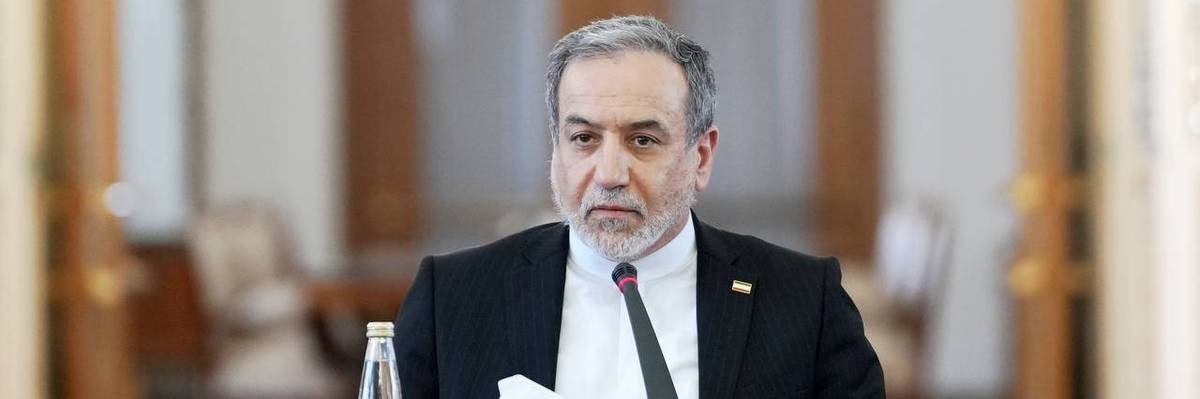
Iranian Foreign Minister Abbas Araghchi (C) participates in the traditional Quds Day rally in the capital Tehran on March 13, 2026. [Fatemeh Bahrami – Anadolu Agency]
Iran’s Foreign Minister Abbas Araghchi has declared that the Strait of Hormuz remains open to global shipping, but warned that access is effectively closed to the United States and its allies amid escalating regional tensions.
Speaking at a press conference in Tehran, Araghchi said Iran was exercising its right to self-defence in response to the American-Israeli aggression.
“From our perspective, the strait is open, but it is closed only to our enemies and their allies,” he said, adding that Iran would continue to resist “with pride”.
Araghchi rejected suggestions that Tehran had sought a ceasefire, stating that Iran had not initiated any such request.
“We did not send any message, nor did we request a ceasefire, but this war must end in a way that makes the enemies think a thousand times before committing any aggression again,” he said.
He added that Iran would continue to fight as long as necessary, stressing that the country would not hesitate to defend itself.
The foreign minister also said that the United States had initially demanded Iran’s “unconditional surrender” at the outset of the conflict before later shifting its position.
The remarks come as the conflict involving Iran, the United States and Israel continues to intensify, with the Strait of Hormuz—through which a significant share of global oil supplies passes—emerging as a central point of tension.
This work by Middle East Monitor is licensed under a Creative Commons Attribution-NonCommercial-ShareAlike 4.0 International License.
Donald Trump sings and dances, says that it’s fun to kill everyone … https://www.youtube.com/watch?v=aSUp-NdHd88Donald Trump calls for help from NATO allies in securing the Straight of Hormuz despite saying only 9 days ago that they don’t need people to join wars after they’ve already won. https://youtu.be/KIKaT7rMClYClimate science denier Donald Trump confirms that he knows nothing about democracy and that more liquid gold is being secured according to his policy of global privateering.