Washington says it wants a deal. Its actions point to a ground war

Spread the love

This work by Middle East Monitor is licensed under a Creative Commons Attribution-NonCommercial-ShareAlike 4.0 International License

A view of the US aircraft carrier USS Gerald R. Ford at a US Navy base in Souda Bay, Crete, where it is set to undergo repairs on March 23, 2026. [Stefanos Rapanis – Anadolu Agency]

Americans have heard this script before. A president says he wants a deal, insists he does not want a wider war, and then quietly builds the military architecture for one anyway. That is where the United States now stands in its war with Iran. Even as Donald Trump talks about a possible settlement and claims there are “major points of agreement,” the Pentagon is preparing to send thousands more troops from the 82nd Airborne Division to the Middle East, adding to a military buildup that already looks less like leverage and more like preparation for a deeper phase of the war. A government serious about winding down a conflict does not keep expanding the force package behind it.

The gap between Washington’s words and Washington’s actions is no longer small enough to dismiss as ordinary diplomatic theater. Trump says contacts with Iran are promising. Tehran has publicly denied direct talks, and Reuters has reported that Iran’s negotiating position has hardened during the war, with demands for guarantees against future attacks and refusal to place new limits on its missile program. That does not look like a near-term diplomatic breakthrough. It looks like an administration using the language of negotiation to buy time while keeping military options open. The question is no longer whether Washington prefers a deal in the abstract. The question is whether “talks” are becoming political cover for continued escalation.

That matters because coalition reluctance does not usually restrain Washington. More often, it leaves Washington compensating with more American assets, more American risk, and eventually more American ownership of a war that was sold as limited.

There is another sign that this war is moving in a more dangerous direction: America is having trouble persuading others to own it. When Trump asked allies to help keep the Strait of Hormuz open, several of them declined to send ships. Japan and Australia publicly said they had no immediate plans to participate, and Reuters reported similar hesitation from other partners. That matters because coalition reluctance does not usually restrain Washington. More often, it leaves Washington compensating with more American assets, more American risk, and eventually more American ownership of a war that was sold as limited. A conflict that begins as a joint project can become an overwhelmingly American burden simply because nobody else wants to get pulled in deeper.

This is how mission creep actually happens. It rarely arrives with a formal declaration that the United States is entering a ground war. It comes in pieces: reinforcements to protect bases, troops to secure shipping lanes, special operations contingencies for sensitive sites, and a standing insistence that “all options remain on the table.” Reuters reported last week that U.S. officials were weighing reinforcements that could support operations connected to Hormuz and other possible next steps, while experts warned that securing Iran’s uranium stockpiles would be highly complex and risky even for special operations forces. That is not the language of a conflict staying neatly contained. It is the language of a war searching for its next rationale.

When power becomes a trap: America’s strategic deadlock in Iran

The American public, importantly, is not asking for this. A Reuters/Ipsos poll published last week found that 65 percent of Americans believe Trump will order troops into a large-scale ground war in Iran, but only 7 percent support such an idea. An AP-NORC poll published found that most Americans believe recent U.S. military action against Iran has gone too far, and about six in ten oppose deploying U.S. ground troops to fight there. Those numbers matter because they expose the fiction that a deeper war would rest on any real democratic consensus. Washington is not moving toward a broader conflict because the public has embraced one. It is moving there in spite of the public’s clear warning.

That should disturb Americans even if they have no sympathy at all for the Iranian government. One does not have to romanticise Tehran to see the danger of what Washington is doing. The United States and Israel may share the current war effort, but any ground phase would be paid for primarily by Americans, fought primarily by Americans, and politically owned in Washington long after today’s rhetoric about quick outcomes has faded. That is the part of “supporting an ally” that the White House prefers to leave vague. Air campaigns can be sold as controlled and temporary. Ground commitments are different. They create their own logic, their own momentum, and their own excuses for staying longer than promised.

Even now, after weeks of US-Israeli strikes, the Strait of Hormuz remains a live strategic problem, negotiations remain uncertain, and military planners are still talking in terms of options rather than outcomes.

Nor is there any reason to think a ground phase would solve the political problem that air power has failed to solve. Iran is not a target that can simply be bullied into strategic surrender by adding more American bodies to the region. Even now, after weeks of US-Israeli strikes, the Strait of Hormuz remains a live strategic problem, negotiations remain uncertain, and military planners are still talking in terms of options rather than outcomes. That is usually a sign that the advertised strategy has stalled. When that happens, Washington has a long habit of treating escalation not as proof of failure but as the remedy for failure. That is how bad wars become bigger wars.

What makes this moment especially dangerous is that the administration still wants the political benefits of sounding restrained while preparing for the military benefits of going further. It wants to say “deal” and move troops at the same time. It wants to claim this is not another open-ended American war while creating precisely the conditions from which open-ended American wars emerge. For Middle East Monitor readers, this should be understood clearly: Washington is not standing outside this conflict trying to calm it. It is deep inside it, helping shape the next phase while pretending the next phase may never come. If the White House truly wanted to prevent a ground war, it would stop building one. Until then, Americans should call this what it is—not prudence, not deterrence, but a familiar and dangerous drift toward a war the country has not chosen and does not want.

The views expressed in this article belong to the author and do not necessarily reflect the editorial policy of Middle East Monitor.

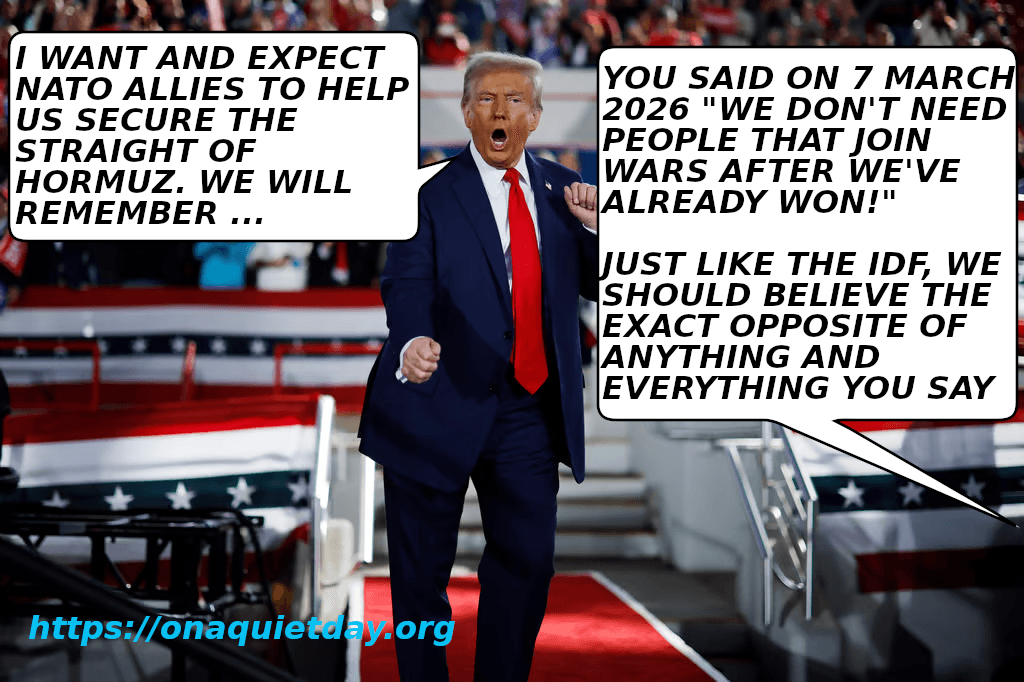
Donald Trump calls for help from NATO allies in securing the Straight of Hormuz despite saying on 7 March 2026 that they don't need people to join wars after they've already won.
Donald Trump calls for help from NATO allies in securing the Straight of Hormuz despite saying on 7 March 2026 that they don’t need people to join wars after they’ve already won.
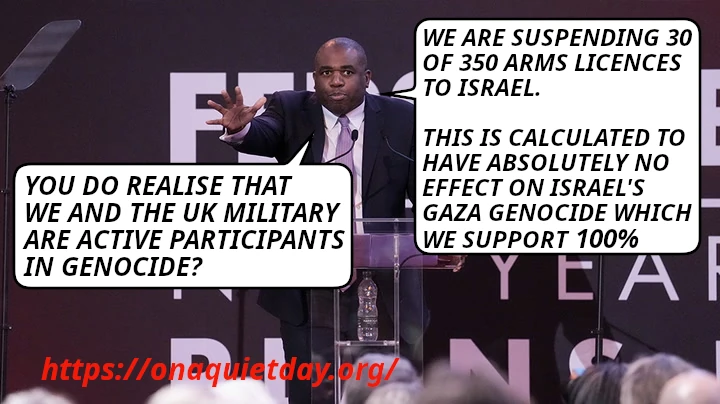
Keir Starmer explains that UK is participating defensively in Trump and Israel's criminal war for Israel's genocidal expansion in Iran and states that he supports Zionism "without qualification". Keir Starmer said "I said it loud and clear – and meant it – that I support Zionism without qualification.” here: https://www.jewishnews.co.uk/keir-starmer-interview-i-will-work-to-eradicate-antisemitism-from-day-one/
Keir Starmer explains that UK is participating defensively in Trump and Israel’s criminal war for Israel’s genocidal expansion in Iran and states that he supports Zionism “without qualification”. Keir Starmer said “I said it loud and clear – and meant it – that I support Zionism without qualification.” here: https://www.jewishnews.co.uk/keir-starmer-interview-i-will-work-to-eradicate-antisemitism-from-day-one/
Orcas discuss how Trump was re-elected and him being an obviously insane, xenophobic Fascist.
Continue ReadingWashington says it wants a deal. Its actions point to a ground war

No Kings, no exceptions: How Trump’s Iran war exposes the death of American democracy

Spread the love

This work by Middle East Monitor is licensed under a Creative Commons Attribution-NonCommercial-ShareAlike 4.0 International License.

by Greg Pence

Demonstrators hold a protest against the war on Iran next to Recruting Station in Times Square, New York City, United States, on Sunday, March 22, 2026. [Selçuk Acar – Anadolu Agency]

On 28th February 2026, the United States went to war. No congressional debate. No public deliberation. No formal declaration. Just a midnight operation, with top lawmakers notified only minutes before the bombs fell, announcing that American aircraft were already striking Tehran. This is not how a republic wages war. This is how a king does.

The strikes on Iran — codenamed Operation Epic Fury— killed Iranian Supreme Leader Ali Khamenei and multiple senior officials, put American lives in harm’s way without a single vote of the people’s representatives, and shook global energy markets to their foundations.

Article I of the Constitution gives Congress, not the president, the power to declare war. Trump did it anyway. And in doing so, he did not merely break a rule — he broke the foundational compact of American self-governance.

The White House’s legal rationale was collective self-defence under the UN Charter. But the United States was not under attack. Iran had not struck American soil. Administration officials released conflicting statements about the aims of the operation, ranging from ending Iran’s nuclear program to outright regime change — language that has no grounding in any congressional mandate or democratic debate. As Senator Andy Kim told TIME, lawmakers and the American public were being asked to accept military escalation without understanding the endgame: “The President has really boxed us in and put us on the hook for things that we haven’t discussed as a country.” When senators demanded classified briefings, they largely received stonewalling. What followed was not strategic clarity but performative chaos: on the same day his administration surged forces to the region, Trump posted on social media about winding down. He threatened to bomb Iranian power plants if the Strait of Hormuz was not opened on his timetable.

And when asked about rising gas prices, he shrugged: *”If they rise, they rise.”* These are not the words of a commander-in-chief accountable to a republic. They are the words of a man who believes he answers to no one.

Dissent has come from across the political spectrum, which is precisely what makes the administration’s contempt for Congress so damning. [Senator Chris Van Hollen]() called it plainly: “Trump is lying to the American people as he launches an illegal, regime-change war against Iran. This is endangering American lives and has already resulted in mass civilian casualties.” Kentucky Republican Thomas Massie declared: “This is not ‘America First.’ The Constitution conferred the power to declare or initiate war to Congress for a reason — to make war less likely.” Army veteran and Ohio Republican Warren Davidson said simply: “War requires Congressional authorization.” These are conservatives honouring their oath, not partisans playing politics. And yet the war powers resolutions they championed failed to override a presidential veto, as most Republicans fell in line. Senator Tim Kaine’s warning now hangs over every future presidency: “Don’t hide under your desk and just let the president do it on his own. Because if you do, you’re opening the door for presidents of either party into the future just to wage war willy-nilly.”

The U.S.–Israeli War on Iran: Gains and Losses

The human cost is already devastating — over 1,400 Iranians killed, thirteen American soldiers dead — and the economic cost is being borne by the entire world. Brent crude surpassed $126 per barrel at its peak, its highest level in years. The Strait of Hormuz — through which 20 percent of global oil supplies flow — was effectively closed, and QatarEnergy, responsible for 20 percent of the world’s LNG supply, declared force majeure on all exports. Global stocks fell 5.5 percent in the war’s opening days. Inflation is forecast to rise across the eurozone, the United States, and Asia simultaneously, presenting central banks with the spectre of stagflation — while the president who lit the fuse demands that the Federal Reserve cut interest rates.

Families in Chicago and Chennai, in Lagos and London, are absorbing the price of a decision made by one man without asking anyone’s permission.

The World Economic Forum put the deeper betrayal into words: the United States “has imposed enormous costs on many of the same economies it relies on as trading and strategic partners.” Allies were not consulted. The democratic world was not asked. And yet it is paying, country by country, household by household, for a war it did not vote for and cannot stop. This matters far beyond economics. The United States built the post-war international order on the premise that even the most powerful nation would operate within rules and seek legitimacy before using force. When that premise collapses, the argument for democratic governance in an age of strongmen collapses with it. A world with kings — whether in Moscow, Beijing, or Washington — is a more dangerous world for everyone.

The phrase “No Kings” is not a slogan invented by the left. It is the founding premise of the American republic, inscribed in the separation of powers and in a Constitution written by men who had lived under a monarchy and refused to recreate one. This war is the most dramatic breach of that premise yet — but not the first. Trump launched strikes on Iranian nuclear facilities last year without a congressional vote. He ordered the capture of Venezuela’s president without one.

Each unchallenged act of unilateral power makes the next easier. This is how republics die — not in a single dramatic moment, but in the slow accumulation of precedents no one stopped in time.

On March 28, over 3,000 No Kings protests are scheduled across every state in this country. Join them. Bring your neighbors. Bring your children, so they can see what democracy looks like when citizens defend it. This is not a partisan call — it is a constitutional one, and it belongs to everyone who believes that in America, the people decide. Not one man. Not a king.

We have tried kings before. We know how it ends.

When presidents lie, diplomacy dies: The global cost of post-truth under Trump

The views expressed in this article belong to the author and do not necessarily reflect the editorial policy of Middle East Monitor.

Keir Starmer explains that UK is participating defensively in Trump and Israel's criminal war for Israel's genocidal expansion in Iran and states that he supports Zionism "without qualification". Keir Starmer said "I said it loud and clear – and meant it – that I support Zionism without qualification.” here: https://www.jewishnews.co.uk/keir-starmer-interview-i-will-work-to-eradicate-antisemitism-from-day-one/
Keir Starmer explains that UK is participating defensively in Trump and Israel’s criminal war for Israel’s genocidal expansion in Iran and states that he supports Zionism “without qualification”. Keir Starmer said “I said it loud and clear – and meant it – that I support Zionism without qualification.” here: https://www.jewishnews.co.uk/keir-starmer-interview-i-will-work-to-eradicate-antisemitism-from-day-one/
Donald Trump calls for help from NATO allies in securing the Straight of Hormuz despite saying on 7 March 2026 that they don't need people to join wars after they've already won.
Donald Trump calls for help from NATO allies in securing the Straight of Hormuz despite saying on 7 March 2026 that they don’t need people to join wars after they’ve already won.
Climate science denier Donald Trump confirms that he knows nothing about democracy and that more liquid gold is being secured according to his policy of global privateering.

Continue ReadingNo Kings, no exceptions: How Trump’s Iran war exposes the death of American democracy

As Trump Threatens to Escalate Further, Majority of Americans Say Iran War Has Already ‘Gone Too Far’: Poll

Spread the love

Original article by Stephen Prager republished from Common Dreams under Creative Commons (CC BY-NC-ND 3.0).

Demonstrators hold a protest against the war on Iran next to a military recruiting station in New York City on March 22, 2026. (Photo by Selcuk Acar/Anadolu via Getty Images)

Trump is considering putting US troops on the ground in Iran. Only 12% of Americans want that to happen, according to a new Associated Press-NORC poll.

Nearly six in ten Americans say President Donald Trump’s war in Iran has gone too far, according to a poll out Wednesday from the Associated Press-NORC Center for Public Affairs Research.

The war launched late last month by the US and Israel has led to the deaths of more than 1,400 Iranian civilians, according to the Human Rights Activist News Agency (HRANA), and the displacement of more than 3 million. It has spiraled out across the region while creating a global economic crisis that has caused gas prices to spike to nearly $4 per gallon in the US.

RECOMMENDED…

Donald Trump

‘Cracks Are Beginning to Show’: Even 79% of Trump Voters Want Quick End to Iran War

Protesters rally outside White House against US and Israeli strikes on Iran

Only 25% of Americans Support Trump Attack on Iran: Poll

Now, 59% of American adults say it’s “gone too far,” compared to just 26% who say it’s “been about right” and 13% who say it’s “not gone far enough,” according to the survey of 1,150 people.

Those opposed to continuing the president’s war of choice include 90% of Democrats and 63% of independents. Most Republicans, 52%, say the amount of force used by Trump has been “about right.” Just 20% want him to go further, while 26% say he’s gone too far.

In recent days, as Iran’s closure of the Strait of Hormuz has wreaked havoc on global oil prices, Trump has sent thousands more servicemembers to the region and reportedly mulled deploying American ground troops in hopes of reopening the crucial waterway.

Experts have warned that a ground deployment could turn the war into an even greater quagmire. Already, 13 US soldiers have been killed since February 28.

An even larger share of Americans, 62%, said they oppose the idea of deploying US troops on the ground in Iran, while just 12% say they support it and 26% say they have no opinion.

While a minority says it is very important for the US to stop Iran from threatening Israel or to replace its government with one more favorable to the US, Americans are prioritizing issues at home.

Ninety-three percent said it was very or somewhat important for the US to keep oil and gas prices low, which has so far not happened—in less than a month, they have spiked by about a dollar and have not shown signs of coming down, even as Trump has deployed emergency fuel reserves and lifted sanctions on some Iranian oil to juice supply.

A majority of Americans, 65%, also said they felt that preventing Iran from obtaining a nuclear weapon—one of Trump’s stated objectives for the war—was a very important foreign policy goal.

However, as journalist and commentator Adam Johnson pointed out in a piece for The Real News on Tuesday, the US public is “grossly misinformed” about the subject—25% wrongly believe Iran already possesses a nuke while 45% believe they are working towards developing one, which has been refuted by US intelligence assessments and reporting based on the testimony of US officials.

The unpopularity of the war with Iran is in line with previous polls showing that the majority of Americans believe the war benefits Israel more than the US and want the war to end quickly.

With Trump having returned to office on the explicit pledge to avoid war with Iran and the cost of living already at the center of the president’s near-historic unpopularity, Republicans’ outlook for this year’s midterm elections looks as grim as ever.

Polling aggregators predict Democrats will easily flip the House, and the Senate is now a toss-up, though Republicans still hold a slight edge.

According to polls, Republicans’ midterm chances truly began to tank in January amid outrage over federal immigration agents’ killings of two US citizens in Minneapolis. Though surveys haven’t shown GOP numbers getting markedly worse since the war began, recent opinion polling suggests it is not a non-factor.

A poll last week from the Institute of Middle East Understanding found that 43% of voters said they’re less likely to support Republicans in the midterms as a result of the war, compared to 31% who said they’re more likely.

Original article by Stephen Prager republished from Common Dreams under Creative Commons (CC BY-NC-ND 3.0).

Donald Fuhrump says that Amerikkka doesn't bother with crimes or charges anymore, not being 100% Amerikkkan and opposing his real estate intentions is enough.
Donald Fuhrump says that Amerikkka doesn’t bother with crimes or charges anymore, not being 100% Amerikkkan and opposing his real estate intentions is enough.
Donald Trump sings and dances, says that it's fun to kill everyone ...
Donald Trump sings and dances, says that it’s fun to kill everyone …
Orcas discuss Donald Trump and the killer apes' concept of democracy. Front Orca warns that Trump is crashing his country's economy and that everything he does he does for the fantastically wealthy.
Orcas discuss Donald Trump and the killer apes’ concept of democracy. Front Orca warns that Trump is crashing his country’s economy and that everything he does he does for the fantastically wealthy.
Continue ReadingAs Trump Threatens to Escalate Further, Majority of Americans Say Iran War Has Already ‘Gone Too Far’: Poll

Rejecting Trump Plan, Iran Calls for War Reparations in Ceasefire Counterproposal

Spread the love

Original article by Jessica Corbett republished from Common Dreams under Creative Commons (CC BY-NC-ND 3.0).

Two members of the Iranian Red Crescent Society stand among others on the ruins of buildings in a residential area in Tehran, Iran, on March 15, 2026. (Photo by Morteza Nikoubazl/NurPhoto via Getty Images)

“The end of the war will occur when Iran decides it should end, not when Trump envisions its conclusion,” said an Iranian official.

Iranian state media reported Wednesday that Iran has rejected the Trump administration’s 15-point ceasefire plan, and a senior official outlined five conditions for ending the war, which the US and Israel launched late last month.

As President Donald Trump sent thousands more troops to the Middle East, the ceasefire plan “was submitted to Iran by intermediaries from Pakistan, who have offered to host renewed negotiations between Washington and Tehran,” The Associated Press reported early Wednesday, citing an unnamed source briefed on the US proposal.

RECOMMENDED…

Tehran's Cemetery Amid U.S.-Israeli Military Campaign

Amid Alarm That Trump Has No Plan for Iran, Critic Contends None ‘Could Possibly Justify This’

Abbas Araghchi

Denying Claim of Talks, Iran Says Trump ‘Backed Down’ After Threat of Power Plant Retaliation

As experts warn that a global recession could occur if Iran continues to restrict the flow of fossil fuels through the Strait of Hormuz, Reuters highlighted that elevated “oil prices sank about 5% on Wednesday after reports the United States had sent Iran a 15-point proposal aimed at ending the war.”

However, “Iran has responded negatively to an American proposal aimed at ending the ongoing imposed war,” according to the Iranian state-run Press TV, which spoke with a senior political-security official.

Characterizing previous negotiations with the US—including nuclear talks in the lead-up to the current war—as deceptive, the official said that “Iran will end the war when it decides to do so and when its own conditions are met.”

In addition to the Iranian government’s demands from the recent negotiations in Geneva, the official said, the five conditions under which Iran would now agree to end the war are:

  • A complete halt to “aggression and assassinations” by the enemy;
  • The establishment of concrete mechanisms to ensure that the war is not reimposed;
  • Guaranteed and clearly defined payment of war damages and reparations;
  • The conclusion of the war across all fronts and for all resistance groups involved throughout the region; and
  • Iran’s exercise of sovereignty over the Strait of Hormuz is and will remain Iran’s natural and legal right, and it constitutes a guarantee for the implementation of the other party’s commitments, and must be recognized.

A ceasefire is contingent upon acceptance of those conditions, and “no negotiations will be held prior to that,” the official told Press TV. “The end of the war will occur when Iran decides it should end, not when Trump envisions its conclusion.”

The Iranian government this week put the death toll from the US-Israeli assault at over 1,500. According to Reuters, the news agency of the US-based Human Rights Activists in Iran said at least 3,291 people, including 1,455 civilians, are dead. US and Israeli bombings have also damaged tens of thousands of civilian locations, including homes, schools, medical facilities, energy installations, courthouses, and United Nations Educational, Scientific, and Cultural Organization World Heritage sites.

There have also been civilian and military casualties across the region, including more than 1,000 people slaughtered in Israel’s bombing of Lebanon, 16 killed in Israel, and 13 confirmed deaths of US service members, according to the AP.

Speaking at UN headquarters in New York on Wednesday, Secretary-General António Guterres renewed his call for the US and Israel to end their war on Iran, which he said is “out of control” and “has broken past the limits even leaders thought unimaginable.”

“The world is staring down the barrel of a wider war, a rising tide of human suffering, and a deeper global economic shock. This has gone too far,” Guterres said. “It is time to stop climbing the escalation ladder—and start climbing the diplomatic ladder, and return to full respect of international law.”

“I have remained in close contact with many from the region and around the world. A number of initiatives for dialogue and peace are underway. They must succeed,” he continued. “My message to the United States and Israel is that it is high time to end the war—as human suffering deepens, civilian casualties mount, and the global economic impact is increasingly devastating. My message to Iran is to stop attacking their neighbors that are not parties to the conflict.”

The UN chief then turned to Lebanon, which he recently visited: “There, too, the war must stop. Hezbollah must stop launching attacks into Israel. And Israel must stop its military operations and strikes in Lebanon, which are hitting civilians the hardest. The Gaza model must not be replicated in Lebanon.”

Original article by Jessica Corbett republished from Common Dreams under Creative Commons (CC BY-NC-ND 3.0).

Donald Fuhrump says that Amerikkka doesn't bother with crimes or charges anymore, not being 100% Amerikkkan and opposing his real estate intentions is enough.
Donald Fuhrump says that Amerikkka doesn’t bother with crimes or charges anymore, not being 100% Amerikkkan and opposing his real estate intentions is enough.
Donald Trump sings and dances, says that it's fun to kill everyone ...
Donald Trump sings and dances, says that it’s fun to kill everyone …
Orcas discuss Donald Trump and the killer apes' concept of democracy. Front Orca warns that Trump is crashing his country's economy and that everything he does he does for the fantastically wealthy.
Orcas discuss Donald Trump and the killer apes’ concept of democracy. Front Orca warns that Trump is crashing his country’s economy and that everything he does he does for the fantastically wealthy.

From Your Site Articles

Continue ReadingRejecting Trump Plan, Iran Calls for War Reparations in Ceasefire Counterproposal

Strait of Hormuz situation ‘will not return to the past,’ Iran says amid escalating Mideast tensions

Spread the love

This work by Middle East Monitor is licensed under a Creative Commons Attribution-NonCommercial-ShareAlike 4.0 International License.
Naval units from Iran and Russia carry out to simulation of rescue a hijacked vessel during the joint naval drills held at the Port of Bandar Abbas near the Strait of Hormuz in Hormozgan, Iran on February 19, 2026. [Iranian Army/Handout – Anadolu Agency]

The situation in the Strait of Hormuz will not return to its previous state, an Iranian military spokesman said on Wednesday, asserting Tehran’s control over maritime access as tensions in the Middle East continue to escalate, Anadolu reports.

In remarks carried by Iran’s Mehr News Agency, Ebrahim Zolfaghari, spokesperson for the Iranian military’s Khatam Al-Anbiya Central Headquarters, said new rules governing transit through the strategic waterway have been established, stressing that passage would depend on Iran’s authorization.

“The situation in the strait will not return to the past,” the spokesman said, adding that “permission for transit will be determined by us.”

He added that “the fire beneath oil prices has been ignited, and its level is in our hands,” describing it as one of several variables in the confrontation.

READ: Hebrew media: Iran sets five conditions to end war with US and Israel

Zolfaghari said that “the resistance of our people and the power of our armed forces are increasing moment by moment,” while asserting that adversaries have become “grounded” and are showing increasing signs of weakness.

The US and Israel have been carrying out airstrikes on Iran since Feb. 28, killing more than 1,340 people so far, including then-Supreme Leader Ayatollah Ali Khamenei.

Iran has retaliated with drone and missile strikes targeting Israel, along with Jordan, Iraq, and Gulf countries hosting US military assets, causing casualties and damage to infrastructure while disrupting global markets and aviation.

READ: Japan denies US claim it will deploy naval forces to Strait of Hormuz

This work by Middle East Monitor is licensed under a Creative Commons Attribution-NonCommercial-ShareAlike 4.0 International License.

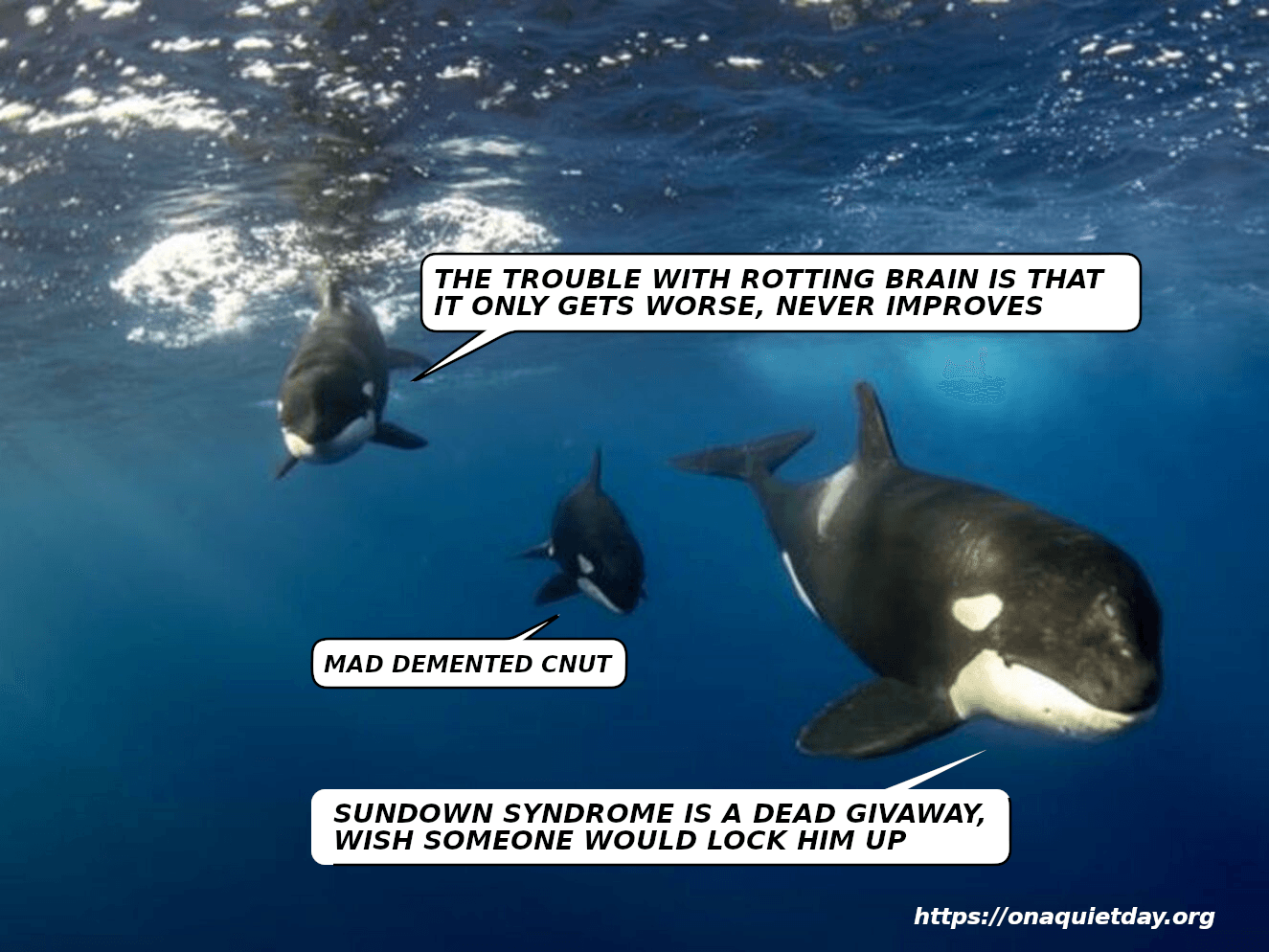
Orcas discuss rotting brain. Front Orca says "Wish someone would lock him up".
Orcas discuss rotting brain. Front Orca says “Wish someone would lock him up”.
Donald Trump warns against following the https://onaquietday.org blog, says that it's easy atm, she only needs to report war crimes supporting Israel's genocidal expansion.
Donald Trump warns against following the https://onaquietday.org blog, says that it’s easy atm, she only needs to report war crimes supporting Israel’s genocidal expansion.
Keir Starmer explains that UK is participating defensively in Trump and Israel's criminal war for Israel's genocidal expansion in Iran and states that he supports Zionism "without qualification". Keir Starmer said "I said it loud and clear – and meant it – that I support Zionism without qualification.” here: https://www.jewishnews.co.uk/keir-starmer-interview-i-will-work-to-eradicate-antisemitism-from-day-one/
Keir Starmer explains that UK is participating defensively in Trump and Israel’s criminal war for Israel’s genocidal expansion in Iran and states that he supports Zionism “without qualification”. Keir Starmer said “I said it loud and clear – and meant it – that I support Zionism without qualification.” here: https://www.jewishnews.co.uk/keir-starmer-interview-i-will-work-to-eradicate-antisemitism-from-day-one/

Continue ReadingStrait of Hormuz situation ‘will not return to the past,’ Iran says amid escalating Mideast tensions