Women walk past a banner depicting the late Iranian Supreme Leader Ayatollah Ali Khamenei, who was killed in the U.S. and Israel strikes on Feb. 28, in northern Tehran, Iran, April 12, 2026
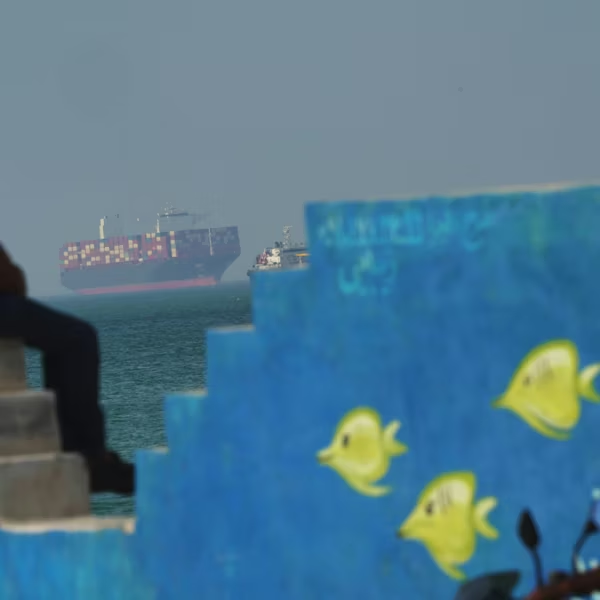
TEHRAN threatened all ports in the Gulf today in retaliation for the US military blockade on Iran’s ports as negotiation talks failed.
…
The US’s restrictions, which include “the entirety of the Iranian coastline, including ports and energy infrastructure,” were expected to begin today.
It was not immediately clear if they had kicked off.
The US military’s Central Command announced that the blockade would be enforced “against vessels of all nations entering or departing Iranian ports and coastal areas.”
It said that it would include all of Iran’s ports on the Persian Gulf and the Gulf of Oman.
…
Iran issued threats of its own, broadcasting today: “Security in the Persian Gulf and the Sea of Oman is either for everyone or for no-one.
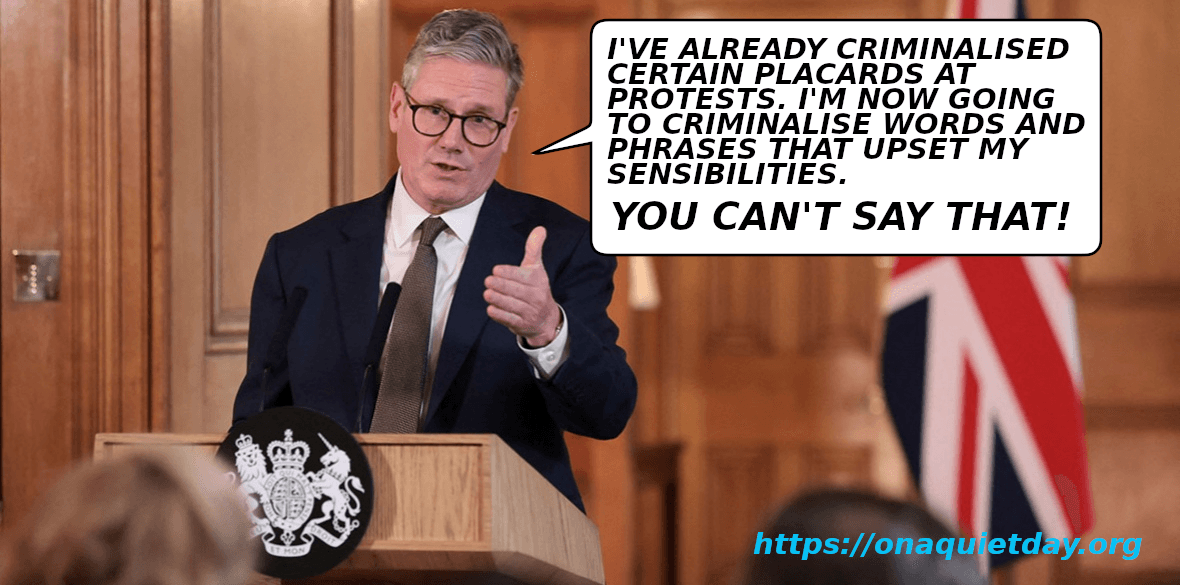
Keir Starmer explains that UK is participating defensively in Trump and Israel’s criminal war for Israel’s genocidal expansion in Iran and states that he supports Zionism “without qualification”. Keir Starmer said “I said it loud and clear – and meant it – that I support Zionism without qualification.” here: https://www.jewishnews.co.uk/keir-starmer-interview-i-will-work-to-eradicate-antisemitism-from-day-one/Climate science denier Donald Trump confirms that he knows nothing about democracy and that more liquid gold is being secured according to his policy of global privateering.Donald Trump warns against following the Onaquietday.org blog, says that he’s heard that she’s a which with a black cat and a dangerous kitchen.
Chinese Defense Minister Dong Jun attends a luncheon in Kuala Lumpur on October 31, 2025. (Photo by Hasnoor Hussain/Pool/AFP via Getty Images)
“We have trade and energy agreements with Iran. We will respect and honor them and expect others not to meddle in our affairs.”
Although President Donald Trump has ordered the US military to enforce a blockade around the Strait of Hormuz, Chinese Defense Minister Dong Jun warned on Monday against any effort to obstruct Chinese vessels.
As reported by Business Today, the Chinese defense minister emphasized that his country and Iran have reached an arrangement allowing the safe transportation of Chinese ships through the strait, and he said the US should not subject them to its blockade.
“Our ships are moving in and out of the waters of the Strait of Hormuz,” the defense minister said. “We have trade and energy agreements with Iran. We will respect and honor them and expect others not to meddle in our affairs. Iran controls the Strait of Hormuz, and it is open for us.”
Chinese Defense Minister Admiral Dong Jun:
"We have trade and energy agreements with Iran; we expect others not to interfere in our affairs. The Strait of Hormuz is open to us."
Trump announced a blockade on the Strait of Hormuz on Sunday, saying the US would not allow any ships that had cut deals with Iran for safe passage to be let through.
The blockade announcement came after US negotiators, led by Vice President JD Vance, failed to reach a peace agreement with their Iranian counterparts to bring an end to the conflict, which Trump launched illegally without any congressional approval six weeks ago.
The failure to reach a peace deal sent the price of oil upward yet again, as the price of Brent crude oil futures and WTI crude oil futures approached $100 per barrel.
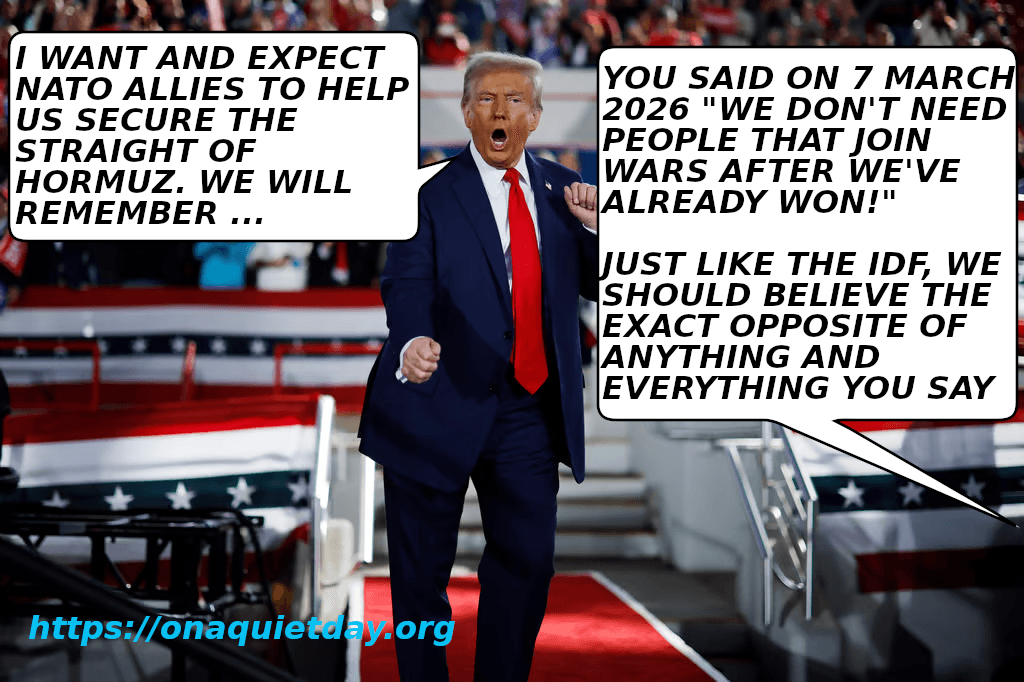
Climate science denier Donald Trump confirms that he knows nothing about democracy and that more liquid gold is being secured according to his policy of global privateering.Donald Trump calls for help from NATO allies in securing the Straight of Hormuz despite saying on 7 March 2026 that they don’t need people to join wars after they’ve already won. He’s challenged with the claim that he lies as much as the IDF.
US Vice President JD Vance, exhausted after fruitless marathon negotiations with Iran, prepares to board Air Force Two on April 12, 2026 in Islamabad, Pakistan. (Photo by Jacquelyn Martin/Pool/Getty Images)
“Blocking the Strait of Hormuz to unblock the Strait of Hormuz is peak Trump foreign policy,” said one observer.
US President Donald Trump on Sunday announced a military blockade of the Strait of Hormuz as Vice President JD Vance’s negotiating team failed to gain the trust of their Iranian counterparts, who have been burned by the United States before and are loath to surrender sovereignty over their nuclear program.
Trump announced in an early morning post on his Truth Social network that, “effective immediately,” the Strait of Hormuz—which was open before the president launched his illegal war of choice—would be closed to all shipping. Around 20% of the world’s oil passed through the waterway before the war.
“At some point, we will reach an ‘ALL BEING ALLOWED TO GO IN, ALL BEING ALLOWED TO GO OUT’ basis, but Iran has not allowed that to happen by merely saying, ‘There may be a mine out there somewhere,’ that nobody knows about but them,” Trump wrote. “THIS IS WORLD EXTORTION, and Leaders of Countries, especially the United States of America, will never be extorted.”
Blocking the Strait of Hormuz to unblock the Strait of Hormuz is peak Trump foreign policy.
“I have also instructed our Navy to seek and interdict every vessel in International Waters that has paid a toll to Iran,” the president continued, referring to one of the concessions reportedly in the cease-fire agreement with Iran that he approved last week. “No one who pays an illegal toll will have safe passage on the high seas. We will also begin destroying the mines the Iranians laid in the Straits. Any Iranian who fires at us, or at peaceful vessels, will be BLOWN TO HELL!”
“Iran will not be allowed to profit off this Illegal Act of EXTORTION,” Trump added. “They want money and, more importantly, they want Nuclear. Additionally and, at an appropriate moment, we are fully ‘LOCKED AND LOADED,’ and our Military will finish up the little that is left of Iran!”
Responding to Trump’s post, Medea Benjamin, co-founder of the peace group CodePink, said: “So get this. Trump wants to open the Strait of Hormuz by closing the Strait of Hormuz. Blow up the world economy to punish Iran. Make sense?”
Ryan Costello, policy director at the National Iranian American Council, also took to social media, writing that “a blockade is an act of war, so Trump is announcing he will reenter the US into a war has been illegal under domestic and international law and has been disastrous for US interests, regional security, and the people of Iran.”
In a social media post, journalist Séamus Malekafzali said: “I have legitimately never heard of a more insane, designed-to-backfire policy under this administration; maybe ever. Not only attempting to blockade Iranian ships, but ANY ship that goes through the Strait of Hormuz by paying the toll.”
While Trump and Secretary of State Marco Rubioattended a UFC match in Miami, Vance was left with the task of marathon negotiations with Iranian officials in Islamabad, Pakistan. It was the first direct high-level talks between the two countries since 1979.
“We need to see an affirmative commitment that [Iran] will not seek a nuclear weapon, and they will not seek the tools that would enable them to quickly achieve a nuclear weapon,” Vance told reporters after the talks. “That is the core goal of the president of the United States, and that’s what we’ve tried to achieve through these negotiations.”
Iran’s government was willing to make unprecedented concessions regarding its nuclear program up until the US and Israel began bombing the country on February 28. Every US administration since that of former President George W. Bush—including Trump’s—has concluded that Iran is not seeking to develop nuclear weapons.
Iran gave its assurance that it would not build nukes in the Joint Comprehensive Plan of Action it signed in 2015 during the presidency of Barack Obama. Trump unilaterally scrapped the agreement, which was also called the Iran nuclear deal, during his first term despite—some say because of—Iran’s full compliance.
So the Trump administration’s two goals in peace talks with Iran are:1. A commitment by Iran not to develop a nuke (This was part of the Obama deal that Trump canceled)2. Opening the Strait of Hormuz. (Was open before war.)
Iranian Parliamentary Speaker Mohammad Baqer Ghalibaf blamed the US for the breakdown in talks.
“My colleagues on the Iranian delegation Minaab168 raised forward-looking initiatives, but the opposing side ultimately failed to gain the trust of the Iranian delegation in this round of negotiations,” Ghalibaf said in a social media post. The Iranian delegation was named after the town where 168 children and staff at an elementary school were massacred in a US cruise missile strike on the first day of the war.
“Before the negotiations, I emphasized that we have the necessary good faith and will, but due to the experiences of the two previous wars, we have no trust in the opposing side,” Ghalibaf explained.
Just hours before Trump announced his decision to bomb Iran in February, Omani Foreign Minister Badr bin Hamad Al Busaidi, the mediator of talks between the US and Iranian governments, said that a “peace deal is within our reach,” prompting Iranian officials and others to accuse the Americans of acting in bad faith. Similar accusations were leveled when the US and Israel launched attacks on Iran in the summer of 2025 amid ongoing nuclear negotiations.
“America has understood our logic and principles,” said Ghalibaf, “and now it’s time for it to decide whether it can earn our trust or not?”
Want to know why negotiations did not succeed?
JD Vance: "they have chosen not to accept our terms."
Bingo.
No negotiations – at least with Iran – will succeed based on "our/your terms."
The US must learn: you can't dictate terms to Iran.
The US and Israel have been bombing Iran for 43 days. They have bombed more than 13,000 targets, assassinated senior political and military figures—including the late Supreme Leader Ayatollah Ali Khamenei—and, according to Iranian medical officials, killed more than 3,000 people, including hundreds of women and children. Israel’s concurrent bombing of Lebanon has also killed hundreds of civilians.
Iran, while weakened militarily, appears to be in a position of strategic strength. But to hear Trump say it, Iran is “LOSING, and LOSING BIG!”
“The Iranians don’t seem to realize they have no cards, other than a short term extortion of the World by using International Waterways,” he wrote on Truth Social as Vance headed to Pakistan. “The only reason they are alive today is to negotiate!”
Iranian Foreign Ministry spokesperson Esmaeil Baghaei advised patience, asserting that a diplomatic breakthrough was highly unlikely after just one round of talks.
“Naturally, from the beginning we should not have expected to reach an agreement in a single session,” Baghaei said. “No one had such an expectation.”
Climate science denier Donald Trump confirms that he knows nothing about democracy and that more liquid gold is being secured according to his policy of global privateering.Donald Trump calls for help from NATO allies in securing the Straight of Hormuz despite saying on 7 March 2026 that they don’t need people to join wars after they’ve already won. He’s challenged with the claim that he lies as much as the IDF.
This work by Middle East Monitor is licensed under a Creative Commons Attribution-NonCommercial-ShareAlike 4.0 International License.
Former US Secretary of State John Kerry in Paris, France on June 8, 2024. [Mustafa Yalçın – Anadolu Agency]
Former US Secretary of State John Kerry said Israeli Prime Minister Benjamin Netanyahu had repeatedly urged US administrations to carry out military strikes on Iran, but previous presidents declined, Anadolu reports.
Speaking in an interview on The Briefing with Jen Psaki on Friday, Kerry said he had participated in multiple discussions with Netanyahu, noting: “He wanted us to strike.”
He said the Israeli premier presented the proposal directly to former President Barack Obama, adding: “President Obama refused. President Joe Biden refused. President George W. Bush refused.”
Kerry said: “The only president who has agreed to this, obviously, is President Trump.”
Referring to recent reporting, Kerry said Netanyahu made a detailed case for military action, describing it as “a four-point pitch.”
He said the proposal included claims that such a strike could “kill the leadership,” “incite a change of regime,” and “destroy the military.”
Kerry said the reporting on the discussions appeared credible, noting it “seemed like good reporting.”
He also indicated that Netanyahu had presented these arguments in meetings involving senior officials, where different views were considered.
The US and Israel launched an offensive against Iran on Feb. 28, killing then Supreme Leader Ali Khamenei and many other senior political and military leaders.
Tehran retaliated with drone and missile strikes targeting Israel as well as Jordan, Iraq and Gulf countries hosting US military assets. Iran also restricted the movement of ships through the Strait of Hormuz.
Pakistan, together with Turkiye, China, Saudi Arabia and Egypt, managed to secure a two-week ceasefire on Wednesday between Washington and Tehran, 40 days after the war began.
As part of the deal, the two sides agreed to meet in Islamabad for talks to negotiate a lasting peace.
Donald Trump calls for help from NATO allies in securing the Straight of Hormuz despite saying on 7 March 2026 that they don’t need people to join wars after they’ve already won. He’s challenged with the claim that he lies as much as the IDF.Orcas discuss Genocide-supporting and complicit Zionists. Donald Trump, Keith Starmer, David Lammy, Rachel Reeves, Angela Rayner and Wes Streeting are acknowledged as evil genocide-complicit and supporting cnuts.
Israeli prime minister Binyamin Netanyahu will block peace in Iran however he can | Ronen Zvulun / POOL / AFP via Getty Images
Israel’s strikes on Lebanon are a reminder that Netanyahu will do whatever he can to avoid a peace deal with Iran
Within hours of Donald Trump accepting a two-week ceasefire in Iran, walking back on his dire threat that “a whole civilisation will die”, Binyamin Netanyahu did his best to wreck any prospect of peace.
Israel launched an intense bombardment of Beirut and other Lebanese towns and cities, with 100 attacks in the first ten minutes. More than 300 people were killed and more than a thousand wounded, according to Lebanon’s Health Ministry.
The Israeli Defence Forces (IDF) also carried out a series of strikes across Gaza, including a precisely targeted armed drone attack on the car of Al Jazeera journalist Mohammed Wishah, the 262nd journalist to be killed by Israel since October 2023.
These massacres serve as a reminder that it was Netanyahu, not Trump, who started the war on Iran and that he continues to pull the strings. For as long as that’s true, the prospects of a lasting peace deal are very low.
Provided the Strait of Hormuz remains open, Trump can now claim victory – even if that claim is far from the truth – but Netanyahu could not.
Trump wanted to kill Ayatollah Khamenei and cripple the Iranian military, including its nuclear ambitions, so Iran could not threaten its neighbours, especially Israel. Of course, the Iranian Revolutionary Guard Corps has not been crippled, but the US president’s self-belief and capacity to lie mean he would likely get away with saying otherwise.
The Israeli PM, however, needed regime change and the irreversible end of theocratic rule. A win over Iran had to be complete, not least to ensure his success at Israel’s general election later in the year.
But the Iranian regime is still intact; the popular Iranian uprising against the theocracy that the US and Israel expected failed to materialise. As such, a peace deal at this point would be a disaster for Netanyahu. If his devastating IDF Lebanon assault fails, he no doubt has more tricks of persuasion up his sleeve.
The extent of Netanyahu’s control of the war agenda, both its origins and its conduct, has been both disguised by Trump’s bombastic attention-seeking and overshadowed by the actions of the IRGC, which has survived intense bombing and developed a clear strategy: attack the eyes and ears of US and Israeli systems.
As Kelly Grieco, a specialist at the Stimson Centre, a Washington-based foreign affairs think tank, puts it, the IRGC is systematically targeting three “distinct functional categories”: radar and communications infrastructure, aerial tankers and airborne early warning.
“Each is a critical enabler of US air operations,” Grieco told Defense News. “That’s not random. That’s a target set derived from an understanding of how US airpower functions and where it is most exposed. The pattern suggests deliberate doctrine, or something close enough to it, not opportunism.”
The IRGC indeed reports that its US targets have included the Bahrain HQ of the US Navy’s Fifth Fleet – the US’s primary hub for coordinating its naval operations in the region – a $1.1bn early warning radar in Qatar, and two radar facilities at sites in the UAE. It also successfully attacked the US’s Prince Sultan Air Base in Saudi Arabia, destroying an E-3 Sentry Airborne Warning and Control plane. Two weeks earlier, it hit and damaged five KC-135 Stratotanker refuelling aircraft at the same base.
It is essential to remember that the IRGC was founded in the immediate aftermath of the 1979 Islamic Revolution and expanded in size and power during the Iran-Iraq War between 1980 and 1988, when as many as half a million young Iranians died resisting Saddam Hussein’s opportunistic invasion of Iran.
Back then, the IRGC managed to prevent Hussein from annexing Iran’s oil-rich Khuzestan province and gaining total control over the disputed Shatt al-Arab waterway. It has evolved into an ideological entity rooted in the defence of the revolution and is much stronger than Iran’s conventional armed forces.
The IRGC’s strength continues to lie in asymmetric defensive warfare. It has training, arsenals and weapons suited to survival and the wearing down of its much stronger opponents. The success of this approach against the US and Israel is clear, despite the thousands of Iranians killed or maimed and the billions of dollars of damage inflicted across the country.
Taking control of the Strait of Hormuz has been an obvious move, and even the repeated attacks on neighbouring states have a purpose. They may have shocked and angered leaders in Saudi Arabia, the UAE, Kuwait, and Qatar, but they sent a clear message: we are facing an existential threat from the US and Israel, and you are either with us or against us.
Iran could now continue the conflict with the US and Israel for weeks, if not months, if it so chooses. Despite the claims of the US president, the IRGC is not running out of missiles and armed drones – far from it.
CNN reports that around half of its missile launchers are still intact, as are thousands of one-way attack drones, while armed drones are being produced in backstreet workshops. Even Israel assesses that Iran still has more than 1,000 missiles capable of reaching it, while Hezbollah’s arsenal in Lebanon includes as many as 10,000 shorter-range rockets, according to military briefings cited by Israeli media last weekend.
Given all of this, can the peace talks succeed? Probably not, meaning the US may embark on a huge bombing campaign against the Iranian infrastructure and its very society, to the relief of Netanyahu.
There are still two avenues for hope, though. One is that Trump or the US public comes to realise that Netanyahu has been pulling the strings all along, which would undoubtedly dent the US president’s ego. The other is through the objection of external agents of influence; superpowers such as China or India could make clear that destroying Iranian society is not acceptable.
Extraordinarily, given its small size, the UK is also an external agent with specific influence. A sustained US bombing campaign of Iran requires the mass use of strategic air power – for the US Air Force, that must include the fleet of B-1B Lancer long-range bombers. Only 21 of those are reported to be “mission ready”, 15 of which are at RAF Fairford in Gloucestershire, each carrying more than 30 tons of a wide range of ordnance.
The loss of Fairford wouldn’t stop the war, but it would seriously hinder Trump’s plans. No other comparable European bases are available; only Fairford has the necessary and complex equipment to house the B-2 Spirit stealth bomber and the easy access to a huge munitions depot, which is located at the nearby RAF Welford. In any case, the UK is likely the only European state that would want a US air base like this right now.
A private word from Keir Starmer that the UK may follow Spain and others in closing its airspace to American war planes would have a direct impact. It would certainly help explain Starmer’s unexpected visit this week to the Middle East.
Keir Starmer explains that UK is actively supporting Israel’s genocidal expansion and repeats his previous quotation that he supports Zionism “without qualification”. Keir Starmer said “I said it loud and clear – and meant it – that I support Zionism without qualification.” here: https://www.jewishnews.co.uk/keir-starmer-interview-i-will-work-to-eradicate-antisemitism-from-day-one/Keir Starmer explains that UK is defensively bombing Iraq in support of Israel’s genocidal expansionism. He explains that while his bombs still kill people that they are especially called defensive for the gullible and to be harder to convict of war crimes.Genocide denying UK Foreign Secretary David Lammy says that UK is suspending 30 of 350 arms licences to Israel. He also confirms the UK government’s support for Israel’s Gaza genocide and the UK government and military’s active participation in genocide.