Iran says most missile capabilities ‘unused’ in war with US: Report

Spread the love

This work by Middle East Monitor is licensed under a Creative Commons Attribution-NonCommercial-ShareAlike 4.0 International License.

Missiles launched by Iran in retaliation for US and Israeli attacks are seen over the skies of Jerusalem, on March 24, 2026. [Mostafa Alkharouf – Anadolu Agency]

A Defense Ministry’s spokesperson said most of Iran’s missile capabilities have been “unused” on the war with the US, Tasnim News reported Saturday.

Gen. Reza Talaei-Nik said Iran’s “significant portion of the missile capabilities remains unused,” according to the report by the semi-official news agency.

Arguing that Iranian forces maintained the upper hand throughout the conflict, he said, “Our forces maintained complete air superiority over the occupied territories of the Zionist (Israeli) territory, and a portion of our missile capabilities were utilized during the 40-day war.”

Regarding naval confrontations, he claimed that hostile warships repeatedly retreated hundreds of kilometers from the Sea of Oman in response to decisive actions by Iranian forces.

Shipping through the Strait of Hormuz has been severely disrupted since the US and Israel initiated a war against Iran beginning Feb. 28, rattling global energy markets and raising fears of prolonged economic damage.

READ: Iran seizes 2 cargo vessels in Strait of Hormuz for alleged links to Israel

Nigel Farage objects to criticism of the IDF. He asks how could anyone object to them starving people to death, forced marches like the Nazis did, bombing Gaza's hospitals and universities, mass-murdering journalists, healthworkers and starving people queuing for food, killing and raping prisoners and murdering children. He calls for people to stop obstructing his genocide for Israel.
Nigel Farage objects to criticism of the IDF. He asks how could anyone object to them starving people to death, forced marches like the Nazis did, bombing Gaza’s hospitals and universities, mass-murdering journalists, healthworkers and starving people queuing for food, killing and raping prisoners and murdering children. He calls for people to stop obstructing his genocide for Israel.
Keir Starmer explains that UK is actively supporting Israel's genocidal expansion and repeats his previous quotation that he supports Zionism "without qualification". Keir Starmer said “I said it loud and clear – and meant it – that I support Zionism without qualification.” here: https://www.jewishnews.co.uk/keir-starmer-interview-i-will-work-to-eradicate-antisemitism-from-day-one/
Keir Starmer explains that UK is actively supporting Israel’s genocidal expansion and repeats his previous quotation that he supports Zionism “without qualification”. Keir Starmer said “I said it loud and clear – and meant it – that I support Zionism without qualification.” here: https://www.jewishnews.co.uk/keir-starmer-interview-i-will-work-to-eradicate-antisemitism-from-day-one/
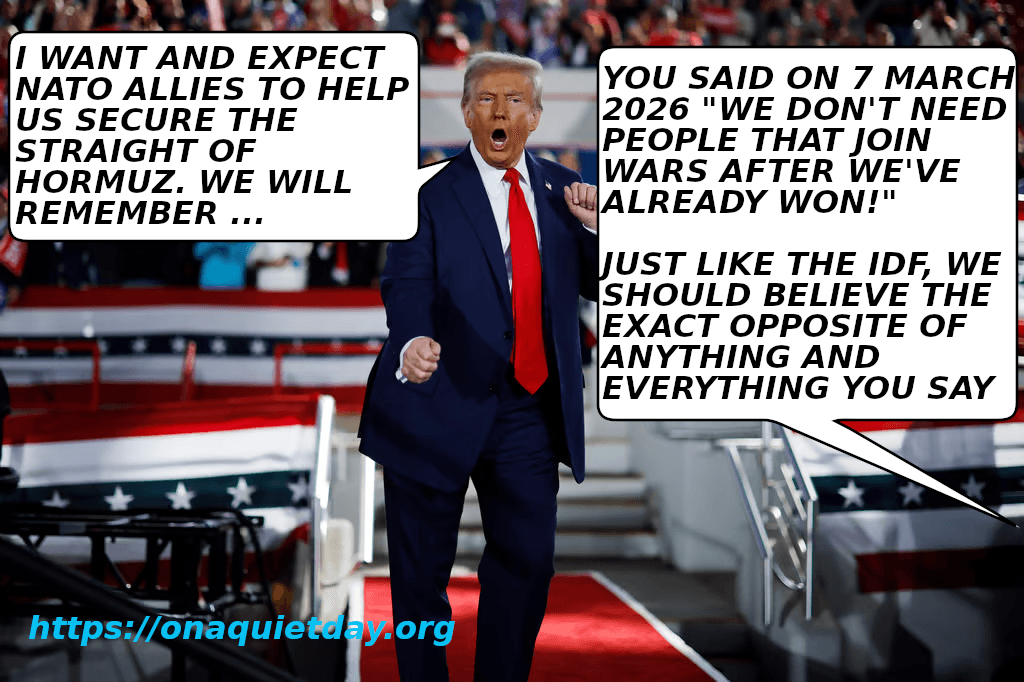
Donald Trump calls for help from NATO allies in securing the Strait of Hormuz despite saying on 7 March 2026 that they don't need people to join wars after they've already won. He's challenged with the claim that he lies as much as the IDF.
Donald Trump calls for help from NATO allies in securing the Strait of Hormuz despite saying on 7 March 2026 that they don’t need people to join wars after they’ve already won. He’s challenged with the claim that he lies as much as the IDF.

Continue ReadingIran says most missile capabilities ‘unused’ in war with US: Report

Turkish delegation plays key role in Global Sumud Flotilla’s Spring 2026 Mission

Spread the love

This work by Middle East Monitor is licensed under a Creative Commons Attribution-NonCommercial-ShareAlike 4.0 International License.
Fatih Varol, attorney and Member of the Board of Directors of the Global Sumud Flotilla, is seen during an exclusive interview, where she evaluates the preparations of the Global Sumud Flotilla’s “2026 Spring Mission”, in Sicily, Italy, on April 24, 2026. [Barış Seçkin – Anadolu Agency]

Turkish activists participating in the Global Sumud Flotilla’s Spring 2026 Mission have reaffirmed their determination to break the blockade on Gaza and deliver humanitarian assistance, Anadolu reports.

Fatih Varol, a board member of the Global Sumud Flotilla, told Anadolu that the Turkish delegation is among the initiative’s most significant components.

“Turkiye has deep-rooted historical ties with Palestine. As a people, we feel the tragedy unfolding in Gaza much more profoundly. In this regard, both public support in Turkiye and the backing of Turkish civil society organizations are very strong,” he said.

Varol said the Turkish delegation has contributed not only to the fleet’s administration and coordination, but also to vessel preparations at Mediterranean ports through financial support.

He also noted that more than 10 lawmakers from both governing and opposition parties in Turkiye attended the Global Sumud Parliamentarians Congress in Brussels on April 22, forming the diplomatic arm of the mission.

According to Varol, lawmakers from around the world agreed during the meeting to raise calls in their respective parliaments to end the genocide in Gaza, lift the blockade on Palestine, ensure Israel complies with international law, and activate international criminal justice mechanisms.

READ: Global Sumud Flotilla continues journey toward Gaza

He said the initiative would help increase international political pressure on Israel and grow through coordinated efforts aimed at paving the way for a freer world.

Gorkem Duru, another Turkish activist, said participants are preparing to sail toward Gaza as part of the 2026 mission, stressing that a “fake ceasefire” has not ended occupation, blockade, or violence.

“Last year, the Global Sumud Flotilla set sail. This year, despite the ceasefire, the blockade and occupation continue, so we are setting out again, stronger and more numerous, to break the blockade,” he said.

Duru added that final preparations are underway at Italy’s Augusta Port, while vessels departing from Barcelona have already arrived.

Activist Omer Aslan, known as the “Local John Wick” due to his resemblance to the character portrayed by Keanu Reeves, said he joined the mission out of humanitarian responsibility.

“While innocent babies and civilians in Gaza suffer oppression and violence, I could not live comfortably in my own country. I joined this peaceful humanitarian action to raise awareness both among my followers and globally,” he said.

Aslan said activists from across the world have joined the flotilla regardless of language, religion, or nationality, united by a common cause.

Flotilla’s Spring 2026 Mission

The Global Sumud Flotilla was created to break Israel’s blockade of Gaza, deliver humanitarian aid, and draw international attention to the situation in the enclave.

Created in 2025 by NGO representatives, activists and volunteers from various countries, the flotilla launched its second mission to Gaza.

Its Spring 2026 Mission departed from Barcelona on April 12 with around 70 vessels and nearly 1,000 participants from 70 countries, significantly larger than a previous mission in September 2025, which included 42 boats and 462 participants.

READ: Poland raises Gaza humanitarian concerns, UN troop safety in Lebanon in talks with Israel

This work by Middle East Monitor is licensed under a Creative Commons Attribution-NonCommercial-ShareAlike 4.0 International License.

Nigel Farage objects to criticism of the IDF. He asks how could anyone object to them starving people to death, forced marches like the Nazis did, bombing Gaza's hospitals and universities, mass-murdering journalists, healthworkers and starving people queuing for food, killing and raping prisoners and murdering children. He calls for people to stop obstructing his genocide for Israel.
Nigel Farage objects to criticism of the IDF. He asks how could anyone object to them starving people to death, forced marches like the Nazis did, bombing Gaza’s hospitals and universities, mass-murdering journalists, healthworkers and starving people queuing for food, killing and raping prisoners and murdering children. He calls for people to stop obstructing his genocide for Israel.
Keir Starmer explains that UK is actively supporting Israel's genocidal expansion and repeats his previous quotation that he supports Zionism "without qualification". Keir Starmer said “I said it loud and clear – and meant it – that I support Zionism without qualification.” here: https://www.jewishnews.co.uk/keir-starmer-interview-i-will-work-to-eradicate-antisemitism-from-day-one/
Keir Starmer explains that UK is actively supporting Israel’s genocidal expansion and repeats his previous quotation that he supports Zionism “without qualification”. Keir Starmer said “I said it loud and clear – and meant it – that I support Zionism without qualification.” here: https://www.jewishnews.co.uk/keir-starmer-interview-i-will-work-to-eradicate-antisemitism-from-day-one/
Donald Trump calls for help from NATO allies in securing the Strait of Hormuz despite saying on 7 March 2026 that they don't need people to join wars after they've already won. He's challenged with the claim that he lies as much as the IDF.
Donald Trump calls for help from NATO allies in securing the Strait of Hormuz despite saying on 7 March 2026 that they don’t need people to join wars after they’ve already won. He’s challenged with the claim that he lies as much as the IDF.

Continue ReadingTurkish delegation plays key role in Global Sumud Flotilla’s Spring 2026 Mission

Israel tells US it wants to resume war with Iran

Spread the love

This work by Middle East Monitor is licensed under a Creative Commons Attribution-NonCommercial-ShareAlike 4.0 International License.

Israeli Defense Minister Yisrael Katz holds a security situation assessment meeting with Chief of Staff Eyal Zamir, Head of the Israeli Military Intelligence Directorate (AMAN) Shlomi Binder and other senior commanders in Tel Aviv, Israel, on March 07, 2026. [Israeli Ministry of Defense – Anadolu Agency]

Israel and the United States are preparing to resume the war with Iran, despite ongoing behind-the-scenes efforts to arrange a meeting between US and Iranian officials in Pakistan this week.

Kan reported that Iran is refusing to make concessions on its nuclear programme. Following tensions around the Strait of Hormuz, Israel is waiting for the green light from US President Donald Trump to restart the fighting. Israel has sent a message to Washington saying: “We are interested in resuming the campaign against Iran.”

Over the past 24 hours, the United States has reinforced its presence in the region by sending an additional squadron of F/A-18 fighter jets to the Middle East, deploying more refuelling aircraft, and moving defence systems and interceptor missiles across the region.

An Israeli source told the Hebrew channel: “We are on maximum alert, awaiting President Trump’s decision.”

READ: Israeli minister says army awaiting US approval for potential strike on Iran

Regarding Iran, Israel has threatened to assassinate Iran’s Supreme Leader Mojtaba Khamenei, stating openly that he is among the targets awaiting Trump’s approval.

US President Donald Trump sparked confusion about the coming days in a series of posts earlier yesterday.

Regarding Lebanon, US President Donald Trump announced on Thursday a three-week extension of the ceasefire after Israeli and Lebanese representatives met at the White House. Iran-backed Hezbollah and Israel exchanged attacks during the talks, underlining the fragility of the truce, according to CNN.

The conflict between Israel and Iran-backed Hezbollah remains one of the main obstacles to US-Iran peace efforts.

READ: Iran announces tolls for Hormuz transit as nuclear talks remain stalled

This work by Middle East Monitor is licensed under a Creative Commons Attribution-NonCommercial-ShareAlike 4.0 International License.

Keir Starmer explains that UK is actively supporting Israel's genocidal expansion and repeats his previous quotation that he supports Zionism "without qualification". Keir Starmer said “I said it loud and clear – and meant it – that I support Zionism without qualification.” here: https://www.jewishnews.co.uk/keir-starmer-interview-i-will-work-to-eradicate-antisemitism-from-day-one/
Keir Starmer explains that UK is actively supporting Israel’s genocidal expansion and repeats his previous quotation that he supports Zionism “without qualification”. Keir Starmer said “I said it loud and clear – and meant it – that I support Zionism without qualification.” here: https://www.jewishnews.co.uk/keir-starmer-interview-i-will-work-to-eradicate-antisemitism-from-day-one/
Donald Trump calls for help from NATO allies in securing the Straight of Hormuz despite saying on 7 March 2026 that they don't need people to join wars after they've already won. He's challenged with the claim that he lies as much as the IDF.
Donald Trump calls for help from NATO allies in securing the Straight of Hormuz despite saying on 7 March 2026 that they don’t need people to join wars after they’ve already won. He’s challenged with the claim that he lies as much as the IDF.

Continue ReadingIsrael tells US it wants to resume war with Iran

A Delusional Trump, Backed by Israel, Drives the Iran War

Spread the love

Article by Jamal Kanj republished from Common Dreams under Creative Commons (CC BY-NC-ND 3.0).

Protesters in opposition to the war with Iran gather outside of Lafayette Park across from the White House on April 7, 2026 in Washington, DC. As the protest was held, U.S. President Donald Trump was announcing a two-week ceasefire with Iran at the behest of Pakistan, which has been serving as an intermediary during the conflict. (Photo by Andrew Leyden/Getty Images)

Trump continues to issue maximalist demands for conditions he helped create. The American president’s lack of strategic and emotional maturity only promises more war.

The closure of the Strait of Hormuz following the temporary ceasefire is the culmination of an American policy defined by strategic incoherence. At the center stands Donald Trump, whose shifting positions, confused war objectives, and conflicting actions have not only failed to ease regional tensions but have actively deepened them.

Nowhere is this clearer than in Trump’s threats to blow up the whole country, including its bridges and power plants. At the same time, he touted a military “big day,” presenting potential war crimes as diplomatic tool, aggression as diplomacy, and destruction as leverage.

RECOMMENDED…

As Trump Prepares Iran Ground Assault, Expert Warns He's 'Run Out of Options' for Victory

As Trump Prepares Iran Ground Assault, Expert Warns He’s ‘Run Out of Options’ for Victory

Demonstrator protests Trump wars

‘This Depraved Idiot Is Out of Control’: With Middle East in Flames, Trump Eyes ‘Next Conquest’

Trump inflated, almost delusional, promises ahead of potential talks come across less as statesmanship and more as a calculated sales pitch to the American public. His vows “to end up with a great deal,” coupled with an almost obsessive focus on Barack Obama by insisting his agreement will be “far better” than the one negotiated over a decade ago. An approach that reflects a tendency toward messaging driven less by policy depth and more by projection, comparison, and to frame outcomes in terms of self-aggrandizement and personal glory. Instead of articulating clear strategic objectives, his policy relies on distinguishing himself and image cultivation to project authority and superiority, leaving the underlying substance vague and open to question.

By manufacturing optimism and exaggerating progress while promising an imminent “great deal,” Trump appears to be negotiating with himself—or detached from reality—seeking to construct a narrative of success regardless of the facts on the ground. The performative optimism stands in sharp contrast to his simultaneous threats and pompous rhetoric, suggesting not confidence but a measure of desperation.

This yo-yoing of positions does more than create confusion; it erodes the credibility. Diplomacy depends on a baseline of predictability and mental stability.

Trump’s rationale for extending the ceasefire because of “internal divisions” within Iran is unconvincing. If internal debate within Iran is seen as warranting a pause, what should be said of a policy where direction shifts from one moment to the next? Differing political views are the essence of a normally functioning political system, whereas impulsive, erratic, personalized decision-making is not.

All of this unfolds as Trump continues issuing maximalist demands for conditions he helped create. For instance, he demands the surrender of enriched uranium that would not exist had he not abandoned the Joint Comprehensive Plan of Action (JCPOA). Likewise, the Strait of Hormuz was closed as a consequence of his and Netanyahu’s war, not as its cause.

The consequences of these Israel-driven U.S. policies are felt by ordinary Americans at the gas pump and in grocery stores. The Strait of Hormuz has become a battleground, destabilizing global energy supply chains and economies worldwide. Yet despite these cascading effects, the core strategy remains unchanged. Trump continues to operate within an echo chamber of Israel-first sycophants that assume military might alone can deliver results, even as the policy falters and the war spills across the region, threatening roughly one-fifth of the world’s energy infrastructure.

This is not merely a political flaw or a matter of mismanagement. It is rather a strategic vulnerability shaped by Israel-first loyalists pulling U.S. strategy in directions that ultimately undermine U.S. national interests. In the absence of clearly defined national objectives, as in the first Israel’s war in Iraq, each step risks drawing the U.S. deeper into the polluted water of the Gulf, while simultaneously advancing an environment of chaos that serves only Israel’s calculated aims.

In this framework, was Israeli Prime Minister Benjamin Netanyahu’s recent statement that the war with Iran is “not over” an embedded message to Trump ahead of the proposed peace talks in Pakistan?

Negotiation between countries, especially in the context of war is not selling real estate deals, where haggling and the threat of retracting an offer are routine tactics. The craft of negotiation in this case operates on an entirely different level. Culture, national dignity, historical memory, and political positioning shape both the process and the outcome. Leaders are not merely bargaining over financial assets or credit ratings, they are navigating domestic demands, legitimacy, and the perception of strength or weakness on the global stage.

In this regard, threats or the constant withdrawal and reintroduction of proposals are not leverage, they are weakness. Unlike commercial transactions where the “Art of the Deal” is largely concluded at the moment of signing, international agreements mark the beginning of an ongoing, often long-term relationship. What may pass as hard-nosed bargaining in business can, in international diplomacy, be interpreted as bad faith, an approach that tends to invite resentment and resistance instead of compromise. This is why since last Tuesday, Trump was left waiting for Iran to come to the negotiation table.

Effective diplomacy requires serious leadership, consistency, and an understanding of the symbolic as much as the substantive. Agreements endure not because one side is pressured into submission, but because all parties can present the outcome as preserving their dignity and advancing mutual interests.

The lack of strategic maturity is indicative in a proclamation in the morning signaling openness to de-escalation; by midday, the message splinters, issuing threats and ultimatums while simultaneously hinting at imminent breakthrough deals; by the middle of the night, amid his insomnia, it escalates to threats of total destruction. This constant shifting of positions is not a minor stylistic quirk. It is possible that, at least some of this, is associated with his nocturnal communications with Netanyahu, who is apparently wagging him left and right.

This yo-yoing of positions does more than create confusion; it erodes the credibility. Diplomacy depends on a baseline of predictability and mental stability. When signals shift faster than the wind, uncertainty breeds mistrust, and negotiations drift from closed rooms into fiery statements played out for public consumption, creating an opening for Israel to drive the war and breed destruction and more chaos.

Article by Jamal Kanj republished from Common Dreams under Creative Commons (CC BY-NC-ND 3.0).

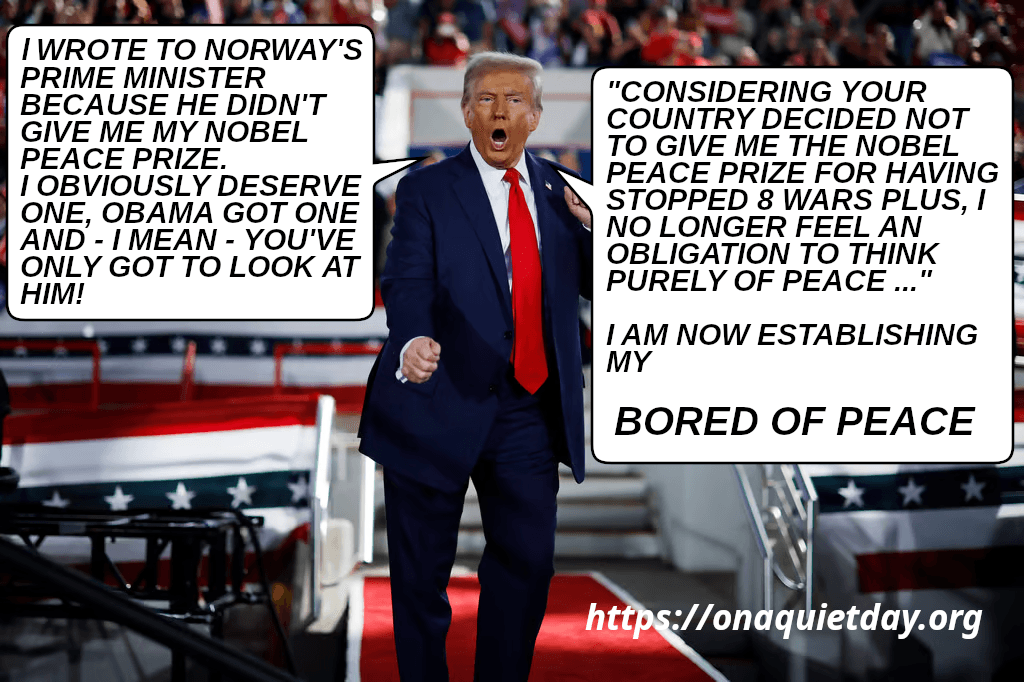
Donald Trump explains why he established his Bored of Peace
Orcas discuss rotting brain. Front Orca says "Wish someone would lock him up".
Orcas discuss rotting brain. Front Orca says “Wish someone would lock him up”.
Continue ReadingA Delusional Trump, Backed by Israel, Drives the Iran War

Risk of ‘Significant and Severe’ Food Crisis If Strait of Hormuz Remains Shut, Says Top UN Official

Spread the love

Article by Brad Reed republished from Common Dreams under Creative Commons (CC BY-NC-ND 3.0).

A farmer sprinkles fertilizer on crops in a field on the outskirts of Amritsar on April 9, 2026. (Photo by Narinder Nanu / AFP via Getty Images)

Trump’s Iran War has caused “a massive disruption in the supply chain of fertilizers,” and “clearly we are seeing a crisis emerging” in the agricultural industry, said one UN expert.

A top United Nations official on Tuesday warned that there is a real risk of a global food crisis if the Strait of Hormuz remains closed to shipments of fertilizer.

Jorge Moreira da Silva, executive director of the UN Office for Project Services (UNOPS), said in an interview with UN News that roughly one-third of global fertilizer shipments flow through the Strait of Hormuz, and its closure has caused “a massive disruption in the supply chain of fertilizers,” and “clearly we are seeing a crisis emerging” in the agricultural industry.

RECOMMENDED…

A man seen checking the meat price at a Woolworths supermarket in Melbourne, Australia

US-Israeli War on Iran Fuels Higher Global Food Prices, Mideast Poverty: UN Agencies

IRAN-US-ISRAEL-WAR

Ceasefire Collapsing as Iran Shuts Down Strait of Hormuz Again, Accusing US of ‘Piracy’

The UN official also emphasized the need for a fast resolution to the crisis to prevent catastrophic food shortages as tensions continued to escalate in the strait in recent days, with both the US and Iran seizing vessels in the area.

“We can’t wait until everything is fixed to at least get something fixed in time for the planting season,” he emphasized. “The planting season has already started, and in most countries in Africa it will end in May. So, if we don’t get some solution immediately, the crisis will be very significant and severe, particularly for the poorest countries and for the poorest citizens.”

While poorer nations are most vulnerable to fertilizer supply shocks, wealthy nations like the US are taking a hit as well.

survey released last week by the American Farm Bureau Federation (AFBF) found that 70% of US farmers say the price of fertilizer has grown so high that they will not be able to afford all they need for the 2026 planting season.

Analysis conducted by AFBF found that, since President Donald Trump illegally launched his war with Iran in late February without any congressional approval, “nitrogen fertilizer prices have risen more than 30%, while combined fuel and fertilizer costs have increased roughly 20% to 40%.”

AFBF also found that the cost of widely used urea fertilizers “have increased by 47% since the end of February, marking the largest month-to-month percentage increase” ever.

Zippy Duvall, president of AFBF, warned that “without the necessary fertilizers, we’ll face lower yields and some farmers will reduce acres altogether, which will impact food and feed supplies.”

An analysis published by Bloomberg’s Tracy Alloway on Wednesday found that “all the signs are already pointing to higher prices” for food in the coming weeks thanks to Trump’s Iran War.

“Bank of America’s Commodity Inflation Trendspotter for food and beverage companies shows March input costs up a whopping 373 basis points to 7.9% year-on-year,” explained Alloway. “That jump was driven mostly by diesel and heating oil, meaning we haven’t even seen much impact from things like higher plastics prices or fertilizer just yet.”

Alloway pointed to the skyrocketing price of urea as particularly worrisome for food prices, as once Midwestern farmers start paying more for the fertilizer, “you start seeing higher prices for everything from actual grains to beef, chicken, eggs, ethanol,” and more.

The bottom line, Alloway wrote, is “rising fertilizer prices are now hitting farmers, and eventually those will translate into higher wholesale food prices which will (assuming higher costs are passed onto consumers) eventually land at grocery stores too.”

“The inflationary impulse doesn’t arrive all at once,” she added, “it builds.”

Article by Brad Reed republished from Common Dreams under Creative Commons (CC BY-NC-ND 3.0).

Donald Trump explains why he established his Bored of Peace
Donald Trump sings and dances, says that it's fun to kill everyone ...
Donald Trump sings and dances, says that it’s fun to kill everyone …
Continue ReadingRisk of ‘Significant and Severe’ Food Crisis If Strait of Hormuz Remains Shut, Says Top UN Official