‘Across the Board, We Need Peace,’ Says UN Chief as War Rages in Gaza, Lebanon, Sudan and Ukraine

Spread the love

Original artilce by Edward Carver republished from Common Dreams under Creative Commons (CC BY-NC-ND 3.0).
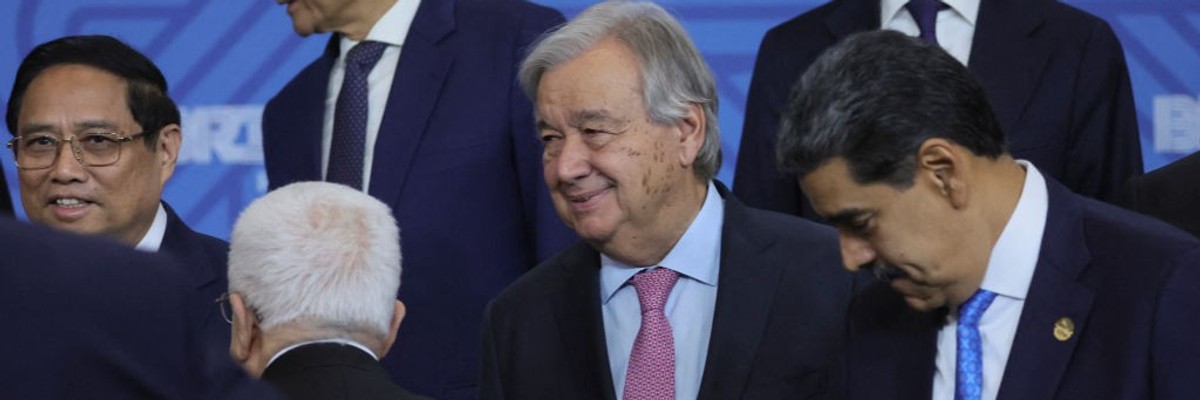
United Nations Secretary-General Antonio Guterres, center, stands with other dignitaries at the BRICS Plus conference in Kazan, Russia, on October 24. 2024. 
(Photo: Maxim Shipenkov/POOL/AFP via Getty Images)

“We need peace in Ukraine,” U.N. Secretary General Antonio Guterres said, speaking before Russian President Vladimir Putin.

United Nations Secretary-General Antonio Guterres, speaking in Russia on Thursday, called for peace in Ukraine and “across the board” as wars also rage in Gaza, Lebanon, and Sudan.

Guterres spoke before Russian President Vladimir Putin and other leaders from “BRICS Plus” countries gathering in Kazan, a city roughly 500 miles east of Moscow.

“Across the board, we need peace,” Guterres said.

“We need peace in Ukraine,” he added. “A just peace in line with the U.N. Charter, international law, and U.N. General Assembly resolutions.”

After the speech, Guterres renewed his call for a cease-fire in Lebanon and Gaza.

“We need a cease-fire in Lebanon—as we need a cease-fire in Gaza and the immediate release of all hostages,” he wrote on social media. “Escalation after escalation is leading to the unimaginable for the people of the region.”

Putin presided over the closing ceremonies of the BRICS conference on Thursday, saying the group provided a counterbalance to the “perverse methods” of the West. Brazil, Russia, India, and China formed the group in the 2000s, with South Africa joining in 2010; BRICS recently expanded to include a number of other developing countries.

The conference drew the largest gathering of international diplomats into Russia since Putin’s forces invaded Ukraine in February 2022, escalating a conflict that had begun in 2014.

Ukraine’s foreign ministry criticized Guterres for attending the conference and noted that he did not attend Ukraine’s global peace summit in Switzerland in June.

“This is a wrong choice that does not advance the cause of peace,” according to the ministry’s social media account. “It only damages the U.N.’s reputation.”

Guterres has repeatedly called for a cease-fire in Gaza in the last year. The Israeli government declared him persona non grata earlier this month, barring him from entering the country on the grounds that he had not strongly condemned an Iranian barrage of missiles into Israel—an accusation Guterres denied, saying he did forcefully condemn the Iranian attack.

For U.N. Day, celebrated annually on October 24, Guterres issued a video statement calling for the world’s nations to keep the “beacon of hope” that is the U.N. “shining.”

The U.N. has had only limited success in stopping or slowing the wars in Ukraine, Gaza, Lebanon, and Sudan, which are among many dozens of conflicts across the world and have brought mass death and destruction.

The total number of Ukrainians and Russians who’ve died since February 2022 has reached roughly one million, The Wall Street Journalreported last month.

In Gaza, more than 42,000 people have been killed by Israeli forces in roughly the last year, following the Hamas-led October 7 attack that killed about 1,200 Israelis. More than 2,500 people have been killed by Israeli forces in Lebanon over the same period, including 1,900 in the escalation that’s occurred in the last five weeks, according to Lebanon’s health ministry. Dozens of Israelis have also died in that conflict.

A U.N. official said last month that the death toll in Sudan, which has been ravaged by civil war since April 2023, is at least 20,000 and could be much higher. The country is facing the prospect of a large-scale famine, with Save the Children on Tuesday raising the alarm that conditions there are worsening.

Original artilce by Edward Carver republished from Common Dreams under Creative Commons (CC BY-NC-ND 3.0).

Continue Reading‘Across the Board, We Need Peace,’ Says UN Chief as War Rages in Gaza, Lebanon, Sudan and Ukraine

15 Arab and African countries sound the alarm on the risks of famine in Sudan

Spread the love

Original article by Aseel Saleh republished from peoples dispatch under a Creative Commons Attribution-ShareAlike 4.0 (CC BY-SA) license.

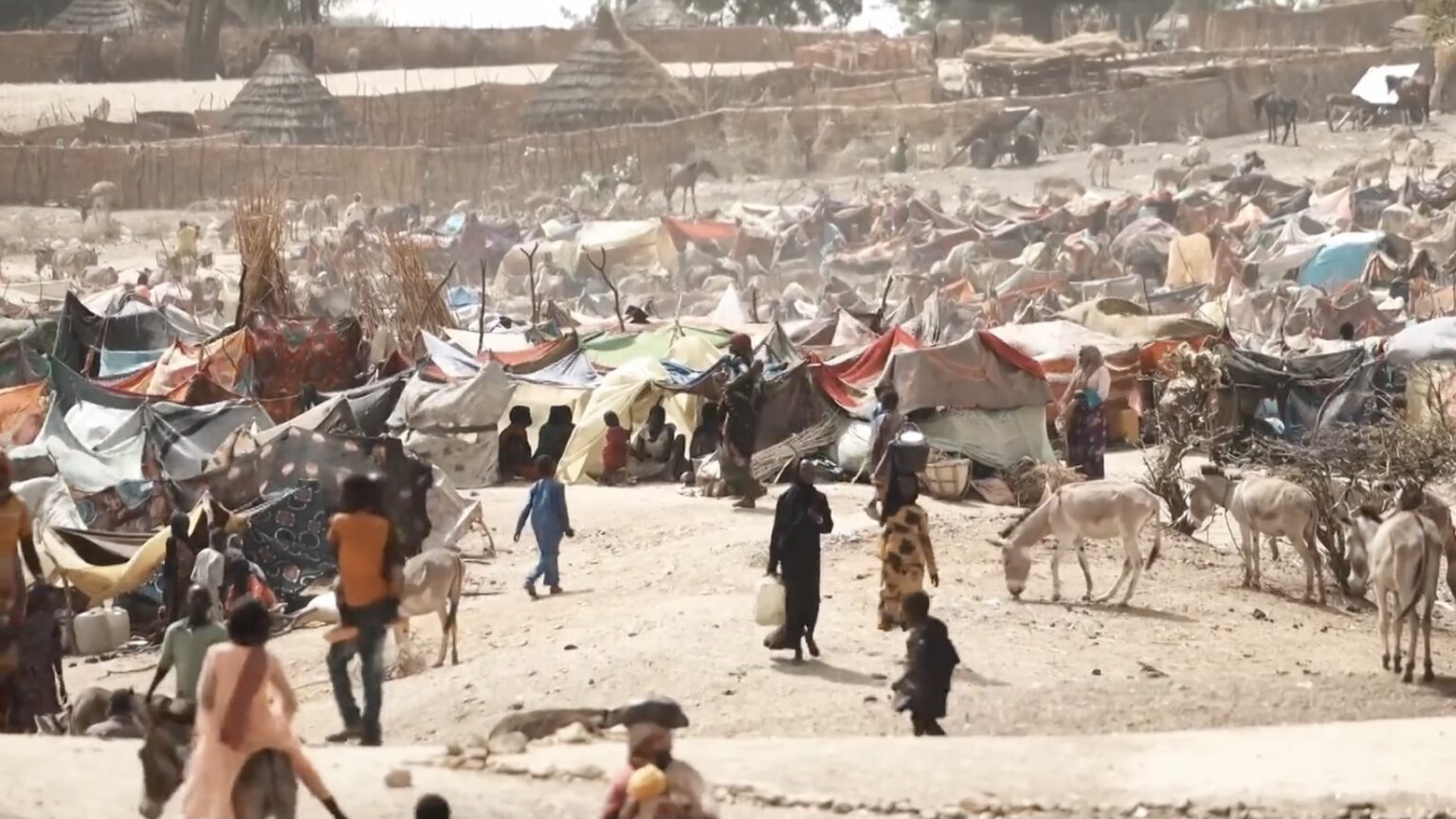
Sudanese refugees in Chad. Over 10 million people have been forcibly displaced in over a year of war in Sudan. Photo: Wikimedia commons

Famine looms in Sudan, forcing people to flee to neighboring countries, while talks between warring parties and a UN envoy are still under way in Geneva

The governments of 15 Arab and African countries issued a statement on Tuesday, July 16, expressing their deep concerns regarding the escalating food security crisis in war-torn Sudan. The countries included the United Arab Emirates, Jordan, Morocco, Mauritania, Chad, Comoros, Guinea-Bissau, Benin, Seychelles, Senegal, Kenya, Sierra Leone, Uganda, Mozambique and Nigeria.

The statement came as a reaction to the Integrated Food Security Phase Classification (IPC) report, which was published on June 27, 2024. “Fourteen months into the conflict, Sudan is facing the worst levels of acute food insecurity ever recorded by the IPC in the country,” the report said, pointing out that more than half of the population in Sudan have experienced severe hunger, which makes Sudan the world’s largest hunger crisis

The number of starving people is estimated at 25.6 million people, with 14 areas at the risk of famine including greater Darfur, Greater Kordofan, Al Jazirah and some hotspots in Sudan’s capital Khartoum. Many starving Sudanese people have been reportedly fleeing Sudan to seek asylum in neighboring countries due to hunger and looming famine. 

The countries who issued the statement expressed their concern about what was set out in the IPC report as a “stark and rapid deterioration” in food security, and its dire impact on the safety and well-being of civilians, including thousands of children, who have suffered from severe acute malnutrition.

According to a Save the Children report published on July 7, due to the war in Sudan 30% of children are acutely malnourished and 20% of the overall population is facing extreme food shortages.

Since the conflict between the Sudanese Armed Forces (SAF) and the Rapid Support Forces (RSF) began in April 2023, the destruction caused by the fighting resulted in a sharp decrease in the agricultural production, and therefore a hike in food prices and food scarcity. The hunger crisis in Sudan has been further deepened by the severe restriction on the movement of food and aid convoys due to the ongoing conflict.

Reiterating the United Nations Security Council’s call from June of 2023, the countries urged all the parties to the conflict to ensure immediate, safe, and unrestricted access to civilian humanitarian aid. They also called on the conflicting parties to adhere to international humanitarian law and to comply with all relevant Security Council resolutions. 

The statement also addressed foreign actors requesting them to stop providing armed or material support to the parties involved in the conflict and to refrain from any action which may ignite the conflict. Furthermore, it called on the international community for immediate and coordinated international response to tackle the urgent needs of the affected Sudanese population. The countries encouraged the international community to scale up the humanitarian assistance it provides, and to support the IPC recommendations for increasing nutrition interventions, restoring productive systems and improving data collection.

While the humanitarian situation in Sudan is constantly deteriorating, talks between a United Nations envoy and delegations from both conflicting parties continue in Geneva this week. The talks started last Thursday, focusing on humanitarian aid and the protection of civilians.

There were a few “promising signs” emerging from Monday’s talks in Geneva, the Representative of the World Health Organization (WHO) in Sudan, Shible Sahbani commented. “Let’s wait for the coming hours and days, and we hope that if we don’t get a ceasefire, at least we can get the protection of civilians and the opening of humanitarian corridors,” he added. 

Original article by Aseel Saleh republished from peoples dispatch under a Creative Commons Attribution-ShareAlike 4.0 (CC BY-SA) license.

Continue Reading15 Arab and African countries sound the alarm on the risks of famine in Sudan

Jeremy Corbyn: Our leaders seem determined to give war a chance. Their thirst for conflict endangers us all

Spread the love

https://www.theguardian.com/commentisfree/2024/apr/23/leaders-war-gaza-jeremy-corbyn

Image of Jeremy Corbyn MP, former leader of the Labour Party
Jeremy Corbyn MP, former leader of the Labour Party

We seek peace in Gaza, Ukraine, Yemen, Sudan, the DRC and elsewhere, but we’re ignored. History will damn the warmongers

“The protagonists of 1914 were sleepwalkers, watchful but unseeing, haunted by dreams, yet blind to the reality of the horror they were about to bring into the world.”

Christopher Clark’s The Sleepwalkers retells the story of the outbreak of the first world war. Mapping a multipolar world enthralled by imperialism and paranoia, Clark refuses to pin the blame on a single power. Instead, he explains how political leaders narrowed the prospects for peace one misstep at a time, and sleepwalked into a global catastrophe that left around 20 million people dead.

Today, once more, our political leaders are stumbling through crisis after crisis to convince themselves that war is the only solution. The principal difference is that this time they are not sleepwalking into war. They are doing so with their eyes wide open.

For months, millions of us have demonstrated for a ceasefire in Gaza to stop the loss of life, end the perpetual cycle of violence and prevent a wider escalation. We have been ignored, maligned and demonised. Last week, Israel conducted missile strikes against Iran in a fast-widening conflict across the Middle East. Even without the involvement of more global players, the human, economic and environmental consequences of all-out war with Iran would be catastrophic for the entire world.

We need not imagine the worst-case scenario in order to put the brakes on. As the Israeli government weighed up its options in response to Iran’s attack on 14 April, bombs continued to fall on Palestinians in Gaza. Over the past few months, human beings have been forced to endure a level of horror that should haunt us for ever. Entire families have been wiped out – and survivors will face lifelong mental health consequences for generations to come. Neighbourhoods have been completely obliterated, strewn with corpses and limbs. Doctors are performing amputations without anaesthesia. Children are gathering sticks and leaves from the ground and fashioning “bread” from animal feed to stay alive. If the unfolding genocide of the Palestinian people does not already constitute a worst-case scenario, what does?

https://www.theguardian.com/commentisfree/2024/apr/23/leaders-war-gaza-jeremy-corbyn

Continue ReadingJeremy Corbyn: Our leaders seem determined to give war a chance. Their thirst for conflict endangers us all