MetropolitanRepublic staff celebrating at the Silverback Awards, November 2023. (Credit: MetropolitanRepublic Uganda)
MetropolitanRepublic enlisted social media influencers to promote giant oil project as climate campaigners suffered beatings and arrests.
Last November, a beaming group of staff from MetropolitanRepublic collected their gorilla-shaped trophy at the Silverback Awards, Uganda’s top advertising and public relations gala.
The South African PR agency had won its prize for promoting the “sustainable development” of Uganda’s untapped oil reserves by French oil company TotalEnergies.
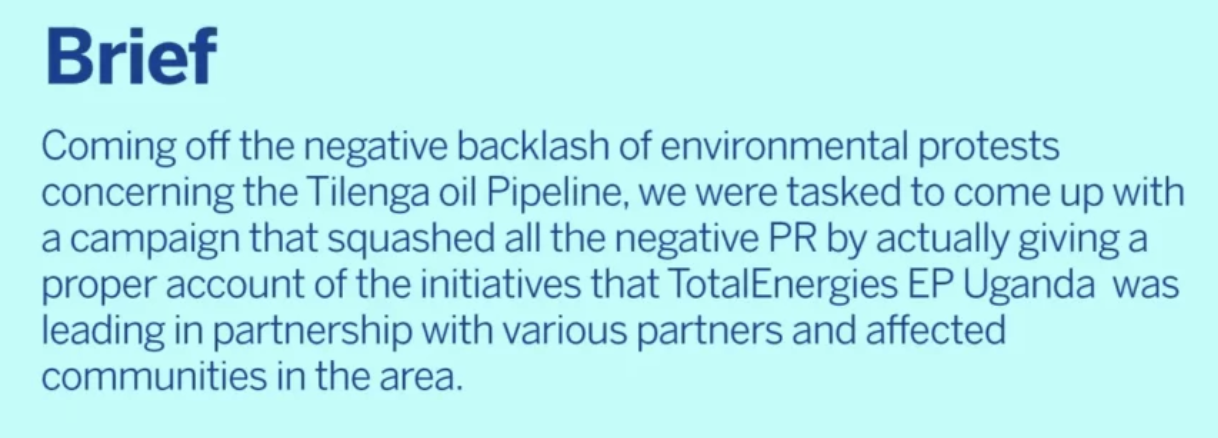
MetropolitanRepublic — which is part-owned by British communications giant WPP — described the brief for the award-winning “Action for Sustainability” campaign in its entry to the Silverback Awards: to devise an approach that “squashed all the negative PR” from protests against TotalEnergies’ plans for a 1,443-kilometre pipeline to export oil from Uganda’s Lake Albert via neighbouring Tanzania.
An accompanying video featured photographs of Ugandan anti-pipeline campaigners to illustrate this “backlash” and described them as “haters”.
“How do you launch a successful project off the back of this?” asks the narrator in the video. “Well, you develop a 360 PR campaign that retells your story the way it should be told.”
A screenshot from the award submission published on the Silverback Awards’ website. The Tilenga pipeline is a feeder pipeline under construction to carry oil from the Tilenga oilfields to the start of EACOP. (Credit: Silverback Awards)
Now, DeSmog can reveal that Ugandan police or military personnel have arrested, beaten, threatened, or harassed at least eight of the 15 campaigners pictured in MetropolitanRepublic’s award submission video.
These incidents — documented via video taken at protests, interviews with the campaigners, and police records — took place both before and after the video was published on the Silverback website in March.
There is no indication that MetropolitanRepublic’s campaign or the award submission led directly to any specific incidents affecting the activists. Nevertheless, DeSmog found that the agency engaged a network of social media influencers to post hundreds of times in support of TotalEnergies’ plans to mitigate the impact of the pipeline — even as protestors were being beaten and harassed.
“These PR firms are sponsoring our oppression,” said Hillary Innocent Taylor Seguya, one of the campaigners pictured in MetropolitanRepublic’s award submission video. “The more you push misinformation to the rest of the world, the more it means that you don’t care about our rights.”
Protestors from student human rights group Justice Movement Uganda opposing the East Africa Crude Oil Pipeline. (Credit: Bruce Nahabwe)
Since the pipeline project was first announced in 2017, advocacy groups have highlighted concerns over the displacement of communities in Uganda and Tanzania, damage to ecosystems and wildlife, and the climate impact of burning Uganda’s oil. The outcry has prompted some banks, insurers, and the PR company Edelman — which has represented oil companies for decades — to shun the project, known as the East Africa Crude Oil Pipeline, or EACOP.
In June this year, UN Secretary-General Antonio Guterres urged communications agencies to stop working for fossil fuel companies, saying PR campaigns run by “Mad Men fuelling the madness” were making the climate crisis harder to address.
MetropolitanRepublic, however, defended its role in promoting the pipeline — a joint venture between TotalEnergies and state oil companies from Uganda, Tanzania, and China.
One Saturday in April, Dutch engineers manoeuvred a giant drill into position in the reclaimed, industrial extension of the Port of Rotterdam, and began boring a hole under the seawall. Nearby, sections of metal pipe waited to be lowered into the breach.
The operation was a step forward for Europe’s most advanced scheme to capture carbon dioxide (CO2) from industry, then bury the planet-heating gas under the North Sea.
After years of delay, a joint venture known as Porthos, an acronym for Port of Rotterdam CO2 Transport Hub and Offshore Storage, is due to begin operating in 2026. It’s a 1.3-billion-euro joint venture between state-owned gas companies Energie Beheer Nederland (EBN) and Gasunie, and the Port of Rotterdam Authority. The CEOs of these organisations are due to join Sophie Hermans, the Netherlands’ minister of climate policy and green growth, and senior European Union officials, for a ceremony on Monday to toast the start of construction work at the site.
At full capacity, Porthos is expected to handle 2.5 million tonnes of CO2 captured annually from facilities operated by its four dedicated customers: Shell, ExxonMobil, and the hydrogen producers Air Liquide and Air Products. That total is equivalent to roughly 10 percent of the port’s emissions, and 1.5 percent of the Netherlands’ current CO2 output. Once captured, the gas will be pumped under the North Sea throughout a 15-year period, or until the storage space reaches a maximum estimated capacity of 37.5 million tonnes.
The cost to the Dutch taxpayer: up to 4 billion euros in subsidies.
Credit: Leon de Korte/Follow the Money.
Porthos relies on a technology known as carbon capture and storage, or CCS, which uses a chemical process to capture some of the CO2 that spews from a customer’s industrial chimneys. This trapped gas is then condensed and pumped through pipelines to underground storage sites, such as certain kinds of geological formations, or disused oil and gas wells.
Nevertheless, the backers of Porthos, and its much larger sister project Aramis — also being developed by EBN and Gasunie, along with Shell and French oil giant TotalEnergies — see them as the first nodes in a planned network of pan-European CCS infrastructure. The aim is to eventually funnel CO2 captured in the industrial heartlands of Germany, as well as throughout the Netherlands, to hundreds of storage sites under the seabed.
To its critics, however, Porthos is emblematic of the way oil and gas companies are securing subsidies for CCS schemes that present an appearance of climate action — but are never likely to attain the massive scale needed to make a dent in global emissions.
As Europe’s flagship project, Porthos is emerging as a litmus test for a critical question in the fight against climate change: Will carbon capture actually help reduce the emissions fuelling the crisis? Or will government backing for these technologies instead serve to preserve the fossil fuel business models that caused it?
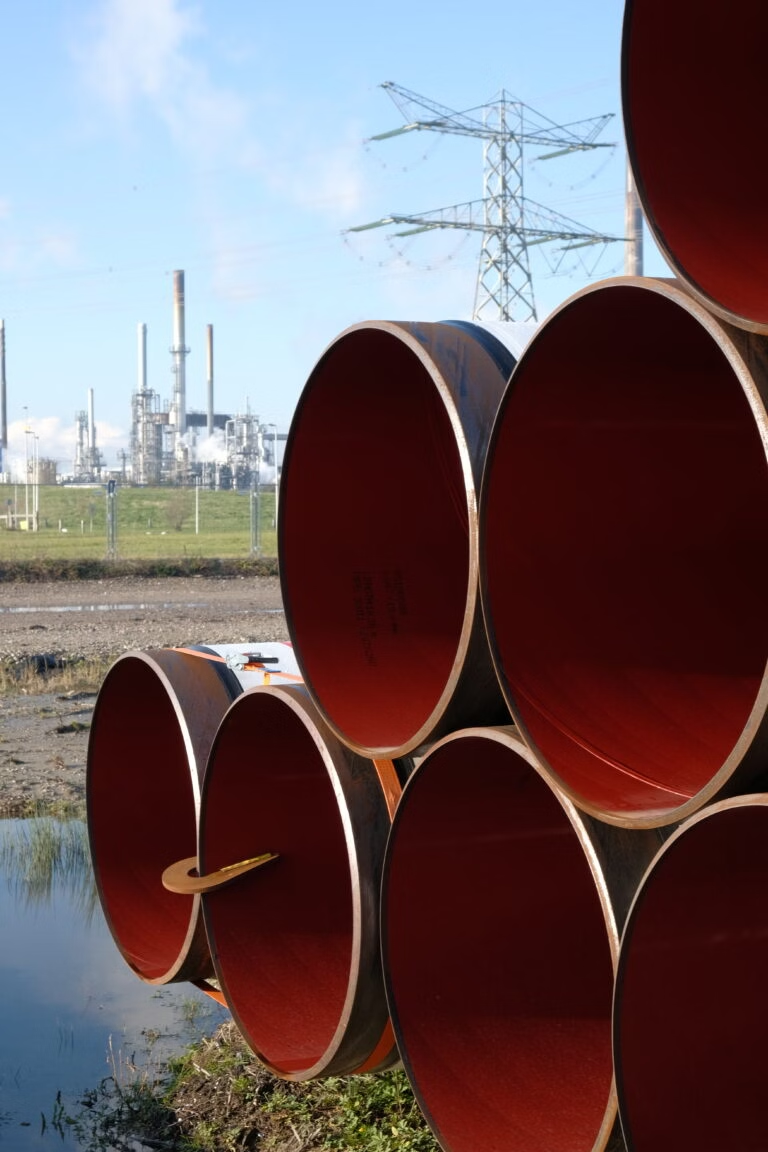
Sections of pipe for the Porthos CO2 pipeline, intended to take captured carbon emissions and inject them under the North Sea, await burial at the Port of Rotterdam. Credit: Michael Buchsbaum.
Ambitious Plans
With intensifying heatwaves, floods and fires underscoring the threat the climate crisis poses to Europe, the EU has agreed to slash its carbon emissions to net zero by 2050, with an interim target of a 90-percent reduction relative to 1990 levels by 2040. Given the scale of that challenge, and in line with lobbying by the fossil fuel industry, policy-makers have assumed a major role for carbon capture projects in cleaning up industry.
“Reducing emissions is not enough,” reads a European Commission website on CCS. “To achieve our climate ambitions, we will also need to capture, utilise and store carbon.”
Climate campaigners argue, however, that the technology has secured official backing in large part because it helps governments persuade voters they are taking climate action, while stopping short of the kind of rapid, fundamental transformation of economies needed to end the use of fossil fuels.
In May, the EU adopted the Net Zero Industry Act, obligating oil and gas producers to develop 50 million tonnes of annual CO2 storage capacity across the continent by 2030 — roughly equivalent to today’s global total. More ambitiously, the act targets approximately 280 million tonnes of annual CO2 storage capacity by 2040, increasing to a staggering 450 million tonnes by 2050.
Environmental groups such as E3G, the Institute for Energy Economics and Financial Analysis and European Environmental Bureau doubt such targets are feasible, given the thousands of kilometres of pipelines that would have to be built, and the dozens of projects that would have to be designed. A lack of technical and geological know-how combined with potential local opposition could also slow fossil fuel companies’ plans.
“The industry needs to commit to genuinely helping the world meet its energy needs and climate goals —which means letting go of the illusion that implausibly large amounts of carbon capture are the solution,” said Fatih Birol, executive director of the Paris-based International Energy Agency (IEA), in the introduction to a report on clean energy transitions for oil companies published in November.
Despite the oil industry often citing scenarios from the Intergovernmental Panel on Climate Change that include significant deployments of CCS, the U.N.-backed body also considers the technology the least efficient, and one of the most expensive, climate tools. In their Sixth Assessment report, the IPCC’s scientists wrote that “even if implemented at its full potential, CCS will account for only 2,4% of the world’s carbon mitigation by 2030 due to its low effectiveness and high cost.”
And Europe is nowhere near close to meeting its carbon capture targets. Today, only 2.7 million tonnes of CO2 is being captured annually across the continent, including in Norway and Iceland, according to the IEA. Porthos’ backers are therefore hailing the project as a crucial step towards fulfilling the continent’s decarbonisation plans — starting with its largest port.
“If we want to reach our climate target, we will need CCS,” Willemien Terpstra, CEO of Gasunie, told DeSmog.
Still, even backers of the technology acknowledge that deployment is lagging. To meet the EU’s target of capturing 280 million tonnes of CO2 annually by 2040 would require 651 projects, said Chris Davies, director of industry group CCS Europe. Each would have to capture more than 400,000 tonnes per year, he told DeSmog.
To date, 50 years after the first CCS projects were started in a Texas oilfield, only about 40 projects are operating globally, with the combined potential to capture just over 50 million tonnes of CO2 per year. However, almost 80 per cent of the CO2 being captured is injected underground to pump more oil — which when refined and burned, adds more CO2 into the atmosphere.
While there is no estimate as to how long it would take to construct hundreds of projects, it is clear that time is running out, Davies said.
Capturing this amount by 2040 requires that construction on all these projects begin no later than early 2038: “So we have less than 5,000 days,” said Davies.
Since Porthos’ backers took a final investment decision last year, no other CCS project “has been given the green light to put a shovel in the ground”, he added.
Cleaning up the Quayside
With docks and quays stretching from its old town centre to the ocean over 40 kilometres away, the Port of Rotterdam covers an area almost twice the size of Manhattan, and handles nearly 440 million tonnes of freight each year, roughly the equivalent of more than 1,200 Empire State Buildings stacked on top of each other.
Not only is Rotterdam a massive cargo port, it’s also one of the largest hubs for energy in Europe, including oil. Counting oil, coal, and liquefied natural gas, the port boasts that some 13 per cent of all the energy used throughout Europe passes through it.
Most of the oil is destined for one of the port’s four refineries, including the giant Shell Pernis facility, as well as sites run by BP and Exxon. (Reducing emissions from the refineries is one of Porthos’ key aims).
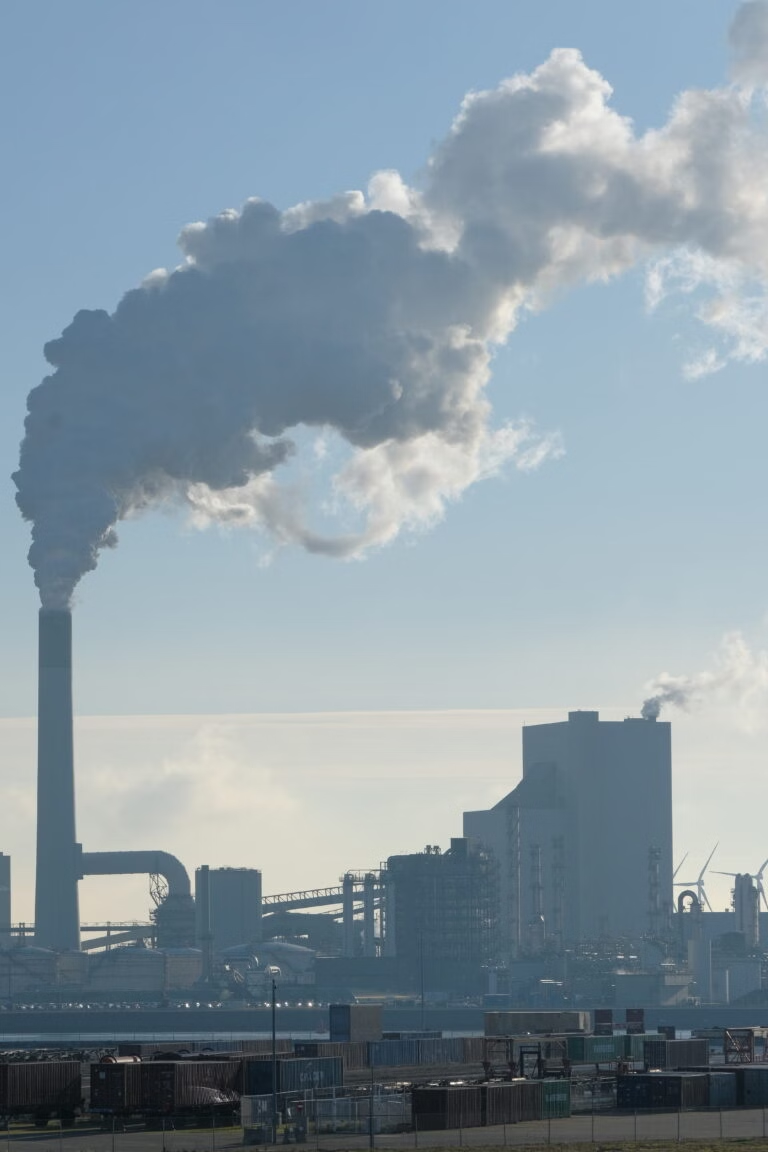
All this activity generates tremendous amounts of carbon pollution: The port emitted 20.3 million tonnes of CO2 in 2023.
The port intends to slash its emissions by 55 per cent by 2030, then achieve climate neutrality by 2050.
The port argues that it can reduce its emissions to its target of 9.3 million tonnes by 2030 by:
Storing up to 5.8 million tonnes of emissions annually by the end of the decade through its Porthos and Aramis projects
Reducing emissions by another 5.7 million tonnes by shutting down, as legally required, itsremaining coal-fired power plants by 2030, building on savings made by previous coal plant closures
Greening its operations with electrification, and “green” hydrogen made with wind and solar
“Porthos and Aramis by far contribute the most to the Netherlands’ CO2 reduction targets…the Dutch goals cannot be met without those projects,” Hans Coenen, Executive Board member of energy company Gasunie, told Follow the Money, the Dutch investigative journalism platform that co-published this story with DeSmog.
The Port of Rotterdam’s only real CO2 reductions so far stem from the shuttering of several coal-fired power plants . Credit: Michael Buchsbaum.
Taxpayers Foot the Bill
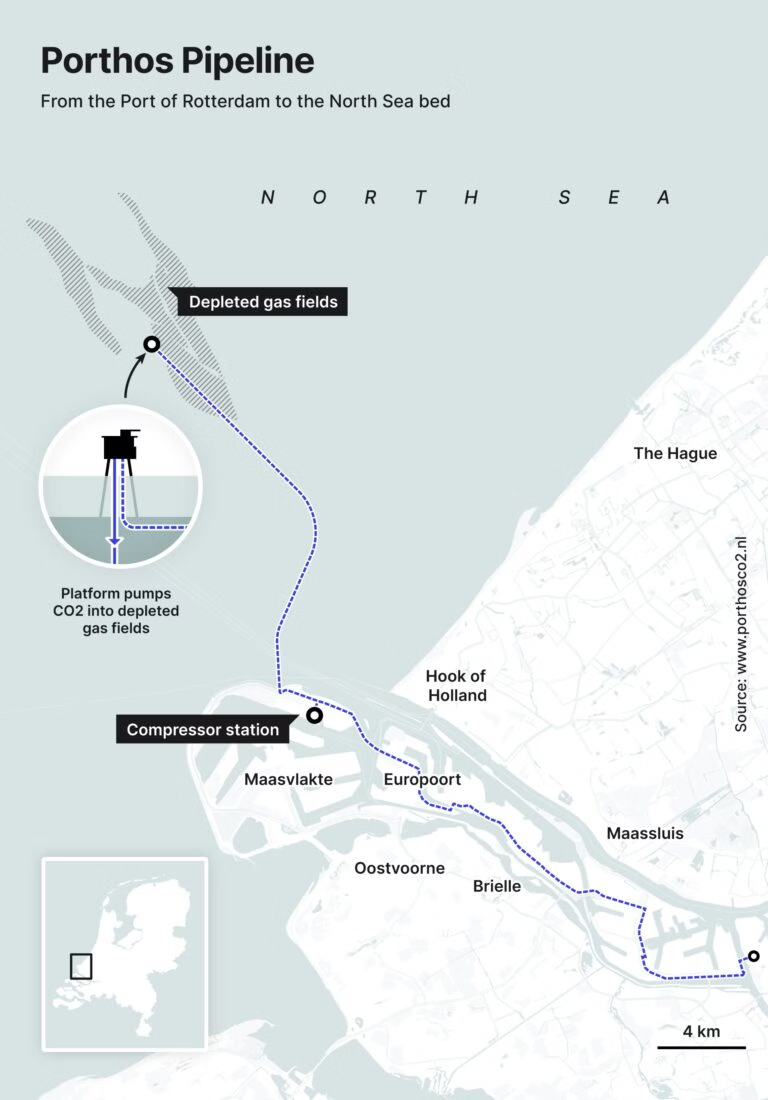
Crucially, Porthos will not be capturing any CO2 itself, instead handling and storing CO2 captured by Shell, Exxon, Air Liquide and Air Products. Porthos itself consists of a new 30-kilometre pipeline system leading to a compression station. From there, CO2 will be pumped to a repurposed gas drilling platform 20 kilometres offshore, and injected into a depleting gas field for final storage.
To ensure emissions are captured, in 2021, the Dutch government allocated Shell, Exxon, Air Liquide and Air Products a combined 2.1 billion euros via its SDE++ scheme to subsidise company decarbonisation projects.
As it stands, under a long-running scheme known as the European Emissions Trading System (ETS), these companies are already required to buy credits for each tonne of CO2 they emit.
Although the credits currently trade at just under 69 euros per tonne, the price could almost triple by 2035, according to BloombergNEF.
By disposing of some of their emissions via Porthos, its customers save money by having to purchase fewer credits.
But, if buying ETS “emission certificates” is cheaper for them than storing the gas via Porthos, then the Dutch government will make up the cost difference using up to 2.1 billion euros allocated under the SDE++ scheme.
This means that whatever happens, the companies face limited risk, and potentially large savings, if they capture emitted CO2 instead.
The port says this arrangement enables the companies “to cut back their carbon emissions without weakening their respective competitive positions.”
Alternatively, without state support, “Porthos would not have gotten off the ground and this project would not have been able to contribute to achieving the climate objectives,” Ellen Ehmen, Exxon’s community relations manager in the Netherlands, told DeSmog.
Combining various other EU and Dutch government subsidies associated with the project, with the 1.3 billion euro cost to state-owned companies to build it, and up to 2.1 billion in carbon capture subsidies, the overall cost to the state could approach or even exceed 4 billion euros.
In other words, Dutch and European taxpayers are picking up the bill for cleaning up these highly profitable companies’ carbon pollution.
In March, the Netherlands Court of Audit warned in a report that the way the project has been structured means that the state has assumed a disproportionate level of risk relative to industry.
Coenen, of Gasunie, says that he wasn’t surprised by these findings: “We decided deliberately to accept a low return on investment on Porthos, because we find it important to kickstart the project.”
Experimental Projects
Many climate advocacy groups, academics and policy experts have long warned of the dangers of relying on carbon capture projects, arguing that they provide fossil fuel companies with a justification for pumping ever more oil and gas.
Seeking to allay those fears, the European Commission advised in February that carbon capture should only be used in sectors where industry argues that emissions are particularly difficult or costly to cut, for example steel, cement, aluminium, chemicals and waste-to-energy.
But Porthos’ customers are using carbon capture for very different purposes: they’re either developing never-before attempted “low-carbon” projects that may be deployed at some point in future, or capturing a portion of the emissions now being generated by producing hydrogen used in the port’s oil refineries.
Shell, the first company to agree to partner with Porthos, is slated to become the project’s largest single customer, having committed to deliver 1.2 million tonnes of CO2 annually — captured mainly from its sprawling Pernis refinery complex, Rotterdam’s biggest. Shell also pledged to capture 820,000 tonnes a year from its to-be constructed biofuels facility, which is designed to produce so-called sustainable aviation fuel, as well as renewable diesel made from waste oil.
This so-called HEFA (hydroprocessed esters and fatty acids) plant is “essentially where the Porthos project starts,” said Nico van Dooren, director new business, hydrogen infrastructure, transport and storage with the Port of Rotterdam, during a media tour of the Porthos project in May.
Carbon capture “is the low hanging fruit,” Shell spokesperson Marc Potma said during the tour. “We have always said we believe in CCS for the future, but it’s never going to be the only answer. One must also invest in renewable sources, which is why we invested in the biofuels factory.”
Fellow oil and gas major Exxon’s CCS plans at Porthos are also highly experimental. Exxon says it plans to capture CO2 from a pilot project to test a new technology known as carbonate fuel cells — which the company says could help capture CO2 from industry more efficiently than existing methods, while also generating electricity, heat and hydrogen. This technology has never been proved at scale.
Also the recipient of EU funds, Exxon’s pilot plant is expected to be constructed in 2025, and start operations in 2026. Unlike Shell, Exxon has not announced any plans to use Porthos to capture emissions from its own oil refinery at the port.
Porthos’ two other customers are both large-scale hydrogen manufacturers who are producing the gas for use in oil refining — today one of hydrogen’s main uses.
As part of its participation in Porthos, U.S.-based Air Products announced in November it would build a carbon capture project at its existing hydrogen production facility in Rotterdam. Billed as the largest such facility in Europe, the project aims to help the company more than halve its CO2 emissions within the Port, while supplying most of the resulting hydrogen (known as “blue” hydrogen since some of the CO2 generated during the production process will be captured) for use in the nearby Exxon refinery.
Just weeks later, in December 2023, French rival Air Liquide announced it would also retrofit the company’s existing hydrogen facility in Rotterdam with carbon capture, using a proprietary technology that has only been tested at a smaller facility in Port-Jérôme-sur-Seine, France.
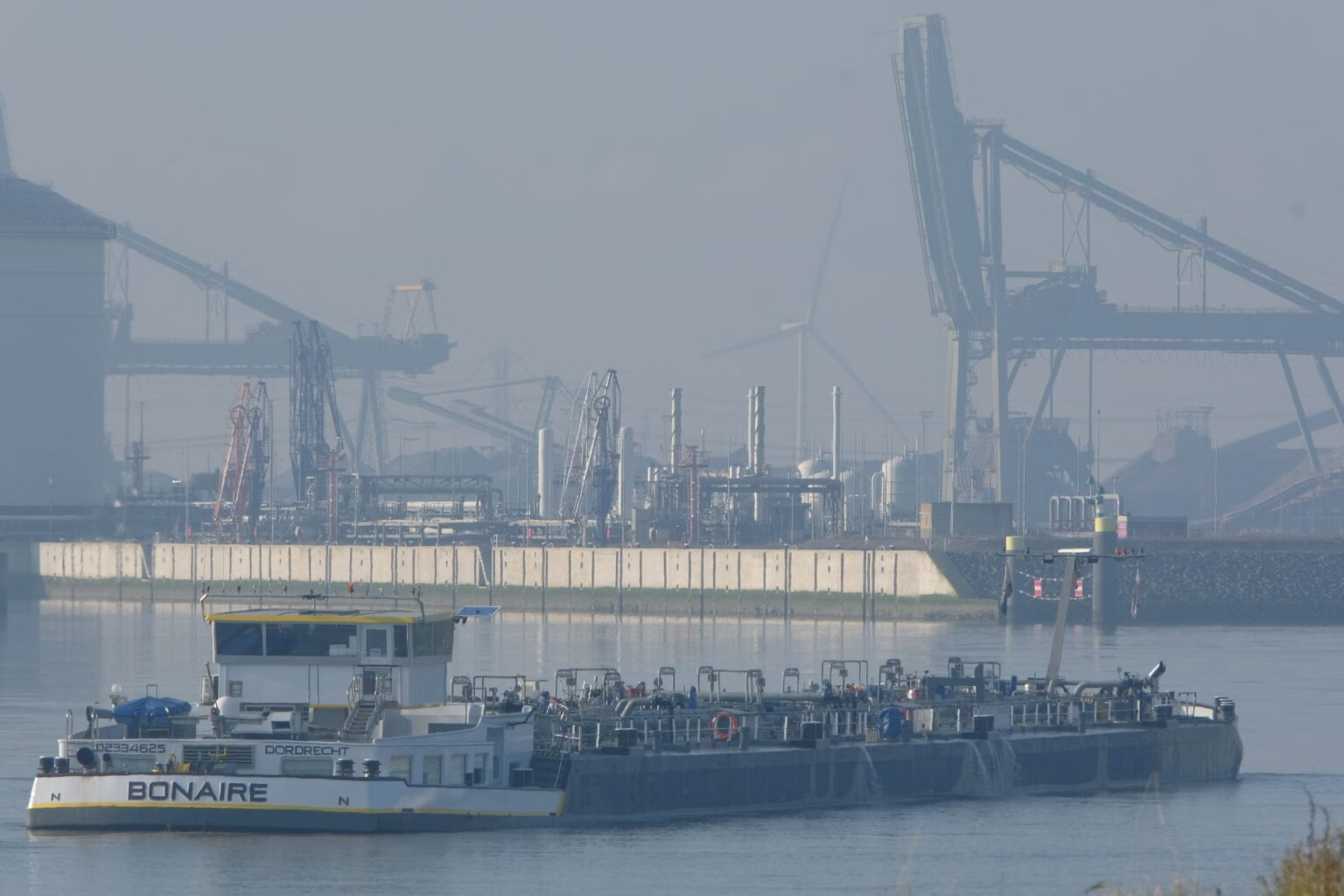
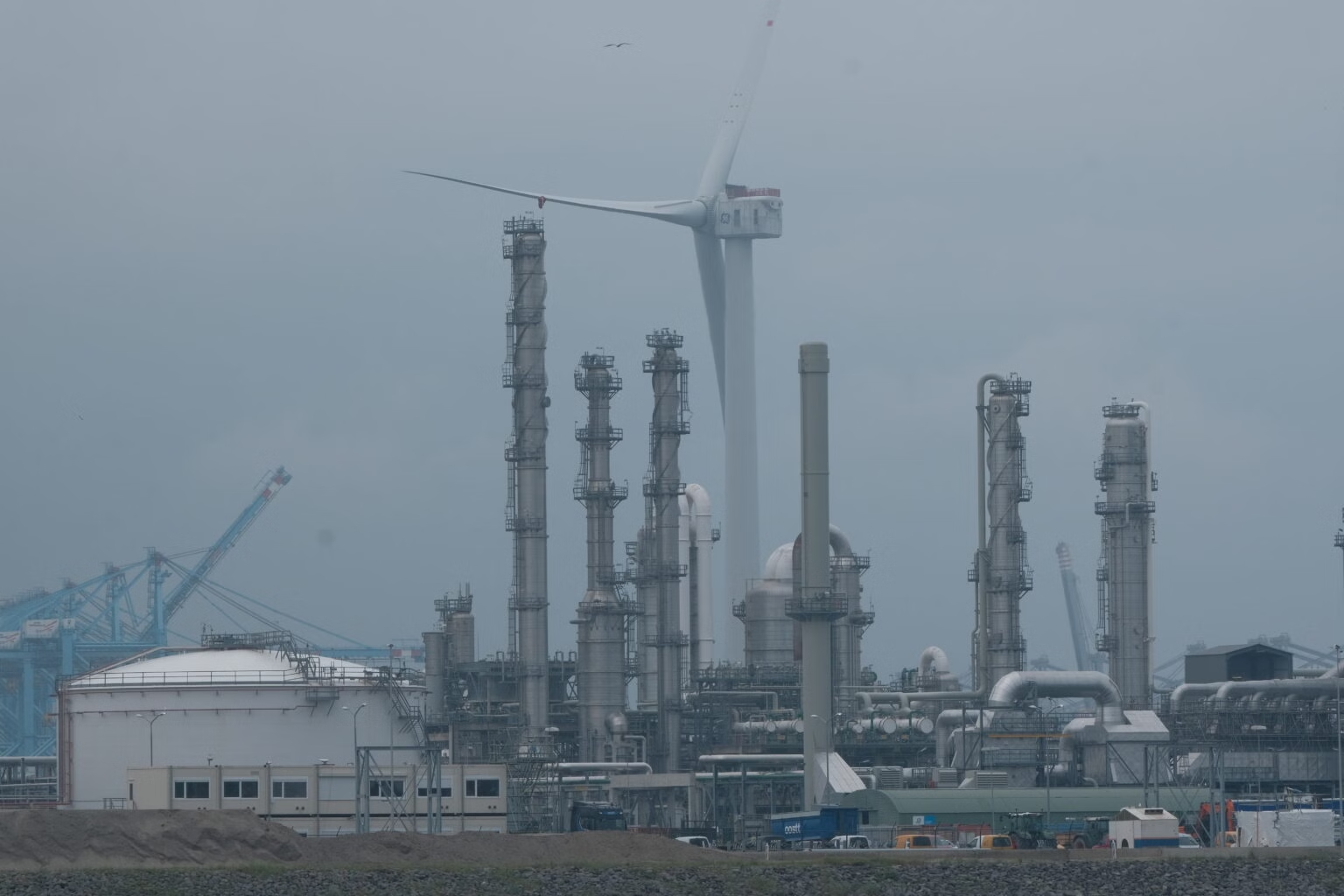
Giant new wind turbines tower over Rotterdam’s oil refineries, holding out the promise of an emissions-free future as they replace coal-fired power. Credit: Michael Buchsbaum.
Aramis Following Porthos
As workers dig trenches and bury Porthos’ pipelines around Rotterdam’s port, Shell and TotalEnergies — together with Gasunie and EBN — are working on the larger Aramis project. They want to funnel and bury CO2 emissions captured in Germany, Europe’s biggest emitter, and send them via a yet-to-be-built pipeline project known as the Delta Rhine Corridor.
By 2028, two years after Porthos is due to come online, the first phase of Aramis is scheduled to transport up to 7.5 million tonnes of CO2 for storage — also thanks in part to EU subsidies.
To connect Rotterdam to Belgium, Gasunie is also working on a so-called Delta Schelde Corridor. “It’s going to be one interconnected system in order to help our industry,” Gasunie’s Coenen told Follow the Money.
Signalling EU support, in mid-June, the European Climate, Infrastructure and Environment Executive Agency, or CINEA, awarded Aramis 124 million euros in subsidies under the CEF Energy fund. CINEA also granted 33 million euros in funds to another planned Rotterdam CCS hub, known as CO2next.
The bigger question, however, is whether these projects will be completed on time.
At the end of June, the then Dutch Minister of economic affairs and climate policy, Rob Jetten, told parliament that the Delta Rhine Corridor pipelines wouldn’t be completed before 2032 — dealing a blow to the pace of CCS development.
In early July, Shell “temporarily” paused construction of its crucial biofuels plant that is supposed to produce 820,000 tonnes a year. Shell now says production will only begin “towards the end of the decade,” said Shell spokesperson Wendel Broere.
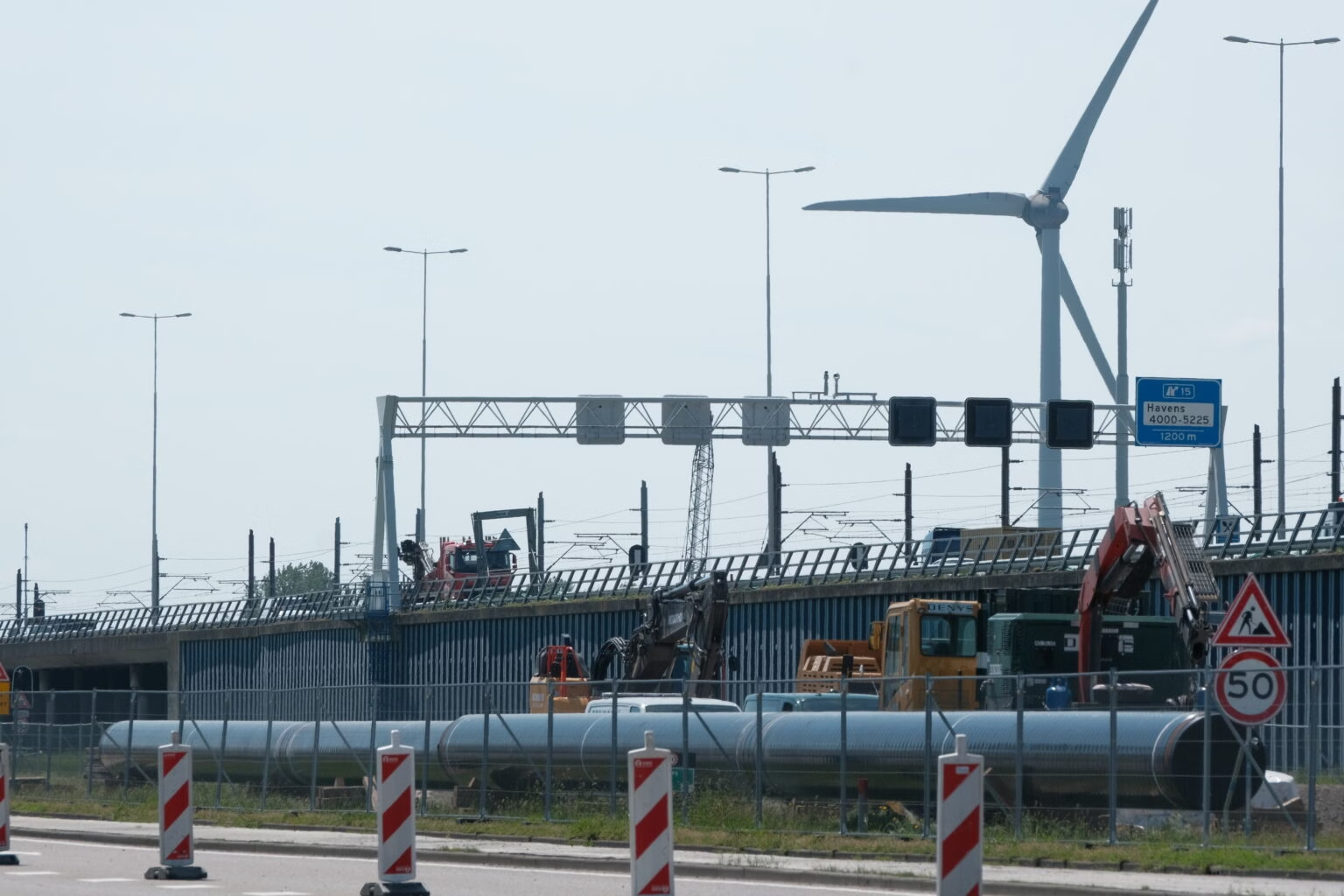
Sections of the Porthos CO2 pipeline are now being buried around Rotterdam’s industrial port. Credit: Michael Buchsbaum.
A Temporary Solution?
Regardless of when they come online, Porthos and the other planned Dutch CCS projects are generally presented as temporary solutions giving industry time to wean itself off fossil fuels — but how long that transformation will take remains unclear.
With billions of euros being invested, “you just have to count on a few decades,” Gasunie’s Coenen said.
Even as Porthos, Aramis and similar projects inch forward, further questions loom: Who will pay the enormous cost of rolling out the network of carbon capture facilities and pipelines needed to ferry CO2 from Europe’s industry to disposal sites in the North Sea via Rotterdam? And can such a project be completed in anything like the timeline demanded by the EU’s carbon capture targets?
Another unknown is how investing in these and other CCS projects will lead to a reduction in overall emissions — particularly since so many planned CCS projects involve building new fossil fuel infrastructure, such as gas-fired power stations or blue hydrogen facilities, rather than retrofitting existing industries. It is also unclear how subsidising industries to adopt CCS will compel fossil fuel companies to accelerate the shift to renewables.
Berte Simons, business unit director of CO2 transport and storage systems at EBN, the Dutch state-owned gas company, said that companies not only have to start capturing emissions, but stop producing them.
“There needs to be an end date to using CCS from fossil sources,” she said. “The sooner [fossil fuel companies] are able to green their portfolio, the quicker they can start with that, the better.”
For many climate advocates, the danger is that carbon capture will simply prolong business as usual — while soaking up billions of euros in subsidies.
Relying on CCS “isn’t a sensible climate mitigation strategy or even a proper carbon management strategy,” Lili Fuhr, deputy director of the Washington D.C.-based Center for International Environmental Law’s Climate and Energy Program, told DeSmog. “It’s really an escape hatch for an industry with its back against the wall faced with an energy transition that is gaining support and is becoming a reality because renewable energies are so cheap.”
This story was corrected on August 29, 2024 to clarify that the cost to taxpayers could be “up to” 4 billion euros (rather than “at least”), and show the various forms of subsidy included in that figure.
A new report shows oil majors fall short of meeting Paris Agreement targets while fueling global military conflicts.
Oil majors are not on track to hit Paris Agreement climate targets that limit global temperature rise to 1.5°C, a new report reveals.
Eight fossil fuel giants – Chevron, ExxonMobil, Shell, TotalEnergies, BP, Eni, Equinor, and ConocoPhillips – are on course to use 30 percent of the world’s remaining carbon budget for that 1.5°C goal, according to the Big Oil Reality Check report by nonprofit Oil Change International (OCI).
Combined, the oil and gas companies’ extraction plans are consistent with a temperature rise of over 2.4°C, the report found.That level of warming, according to the Intergovernmental Panel on Climate Change, will reduce food security, risk irreversible loss of ecosystems, and increase heat waves, rainfall, and extreme weather events.
“We analyzed the climate promises and plans of the largest eight international oil and gas companies that are owned in North America and Europe. What would it take for an oil and gas producer to align their production with limiting warming to 1.5?” David Tong, global industry campaign manager at OCI and co-author of the report, told DeSmog.
“If an oil and gas company were serious about transitioning its business model, the first step would be ending all new production and then setting a Paris-aligned phaseout plan,” he added.
‘No New Fossil’ Standard
A recent paper by academics at University College London and the International Institute for Sustainable Development, published in Science in May, calls for stopping fossil fuel expansion and building a “No New Fossil” global norm. According to the authors, this would make it “easier to phase down fossil fuels” and achieve the Paris Agreement climate goals.
No new fossil fuel projects would be needed in a 1.5°C world, they wrote, because the “existing fossil fuel capital stock” is sufficient to meet energy demand. The authors also note that preventing new fossil fuel projects is, in general, more feasible than closing existing projects from an economic, political, and legal viewpoint.
In the face of continuing global pressure to stop fossil fuel expansion, Chevron, ConocoPhillips, Equinor, Eni, ExxonMobil, and TotalEnergies have goals to increase oil and gas production within the next three years or beyond, the OCI report finds. While Shell does not quantify a target, the company plans to keep oil production steady while growing gas production in the near future, OCI said.
#BigOil has, in recent years, made splashy climate pledges to cut their greenhouse gas emissions & take on the climate crisis, but those plans don't stand up to scrutiny.
— Center for International Environmental Law (@ciel_tweets) May 27, 2024
“None of those companies came anywhere close to alignment [with climate goals],” said Tong. “Six of the eight companies we analyzed have explicit plans to increase their oil and gas production in this critical decade when we need to be cutting our reliance on fossil fuels, cutting oil, gas, and oil production.”
Plateauing oil and expanding gas production, like some of these companies plan to do, is “grossly insufficient” compared with the action that’s needed, Tong added. Even commitments to make businesses more efficient aren’t going to cut it alone, he said.
“It’s like a cigarette company claiming that it will solve lung cancer by producing cigarettes more efficiently,” he noted. “That’s not just not a credible claim. It’s a promise to become a more efficient climate breaker.”
Big Oil and War
According to the OCI report, all the oil majors fail to meet basic criteria for just transition plans for workers and communities where they operate.
“A number of these companies also face significant ongoing, unresolved allegations of human rights … and Indigenous people’s rights violations,” Tong told me.
A March 2024 investigation, commissioned by OCI and conducted by DataDesk, revealed that ExxonMobil, Chevron, TotalEnergies, BP, Shell, and Eni are “complicit in facilitating the supply of crude oil to Israel.” These findings are particularly noteworthy in the context of “Israel’s mounting evidence of war crimes” against Palestinians in Gaza, the OCI states in its new report.
Diesel and gasoline for tanks and other military vehicles are supplied by Israel’s refineries, which rely on regular imports of crude oil by these companies and, since October 2023, supplies mainly from Azerbaijan, Kazakhstan/Russia, Gabon, and Brazil, the research has found.
The fossil fuel industry is “fueling war and military conflicts” in many regions of the world, said Svitlana Romanko, a prominent Ukrainian activist and founder and director of Razom We Stand, a Ukrainian organization campaigning to ban all imports of fossil fuels from Russia.
According to Romanko, the OCI Big Oil Reality Check report “reinforces the importance of moving away from fossil fuels and investing into distributed renewable energy.”
A new analysis by a group of climate experts estimates that the first two years of Russia’s war on Ukraine resulted in greenhouse gas emissions equivalent to around 175 million tonnes of carbon dioxide. The estimated global cost of this warming in extreme weather impacts: $32 billion.
After Russia launched its full-scale invasion of Ukraine in February 2022, Russia earned over 681 billion euros in revenue from fossil fuel exports. European Union countries purchased fossil fuels from Russia for more than 195 billion euros.
Big Oil, as well as Russia, is profiting from the war, Romanko said. After the invasion, BP, Chevron, Equinor, ExxonMobil, Shell, and TotalEnergies raked in $219 billion, more than double their profits compared to the previous year.
“Most [governments] subsidize fossil fuels, and these subsidies are accounting for trillions of U.S. dollars annually,” Romanko said. “This is a big part of fossil fuel profits, and the more fossil fuels are subsidized, [the] less investments are made available for renewable energies.”
She pointed out that the partnership between TotalEnergies and Russia’s largest private gas producer, Novatek, was also “instrumental” in helping Russia get access to technologies and engineering services to launch Novatek’s Yamal LNG and Arctic LNG 2 projects.
Romanko notes that fossil fuel infrastructure can also constitute a liability for military attacks and quickly become a target.
“Centralized infrastructure endangers energy supply and overall safety of the supply,” she said. In Ukraine, a massive effort to install solar power plants in schools and hospitals helped decentralize this key resource, Romanko explained. “Decentralized energy supply is essential to building true energy independence,” she added. “And this is the future.”
Pressure for Accountability
Some of the eight oil majors in OCI’s report have faced more international and national scrutiny than others. Such pressure can facilitate accountability, but that’s less likely when the fossil fuel company is closely intertwined with the institutional, political, and economic life of its country.
“We need to look at what has succeeded in putting so much pressure on companies like Shell and BP,” OCI’s Tong said.
One factor: when communities in a company’s home country work closely in partnership with communities in fossil fuel-producing countries. Tong said that positive results also happen when campaigners use a range of strategies to expose producers, from nonviolent direct action to op-eds, research, and court action.
“This is particularly challenging with Eni, TotalEnergies, and Equinor in different ways because of the close interactions that each of the companies have with their home states,” he added.
Public, political, and legal pressure for accountability must also be coupled with industry regulation, according to Tong.
“We concluded that there is no evidence that the oil and gas sector will voluntarily transition to renewable energy, or voluntarily act to align their production with what’s needed for the Paris Agreement,” Tong said. Instead, governments must no longer license new production sites.
The strong right-wing result in the latest EU Parliament elections could also affect Big Oil’s energy transition.
“The more the links between the state and big polluters are overt, the more people get out in the streets and protest,” Tong said.
What is safe to say is that Big Oil’s business as usual will increase climate change effects.
“Floods, hurricanes, extreme weather events, and the millions of human lives affected and lost – this damage to nature, to human lives and to life on earth will only mount,” Romanko said. “What will be lost in a few more years will also mount if fossil fuel companies are allowed to continue with business as usual.”
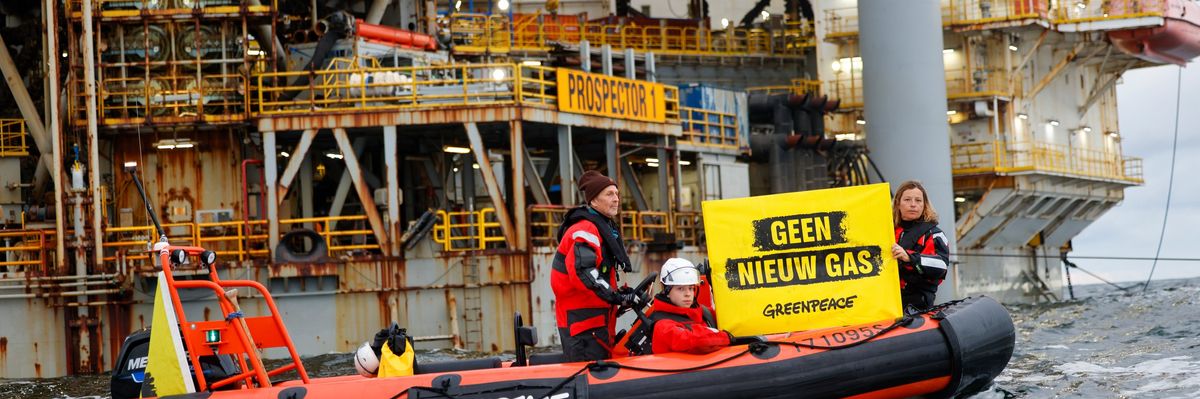
Greenpeace activists from Germany and the Netherlands hold up a “No New Gas” placard next to an gas drilling platform that they occupied on June 4, 2024. (Photo: Axel Heimken/Greenpeace)
“Today’s events show that people power works!” a campaigner said. “Whether it is occupying a gas rig or challenging it in court, people will not be silent, we are standing up to the fossil fuel industry.”
A Dutch court on Tuesday ordered a pause to a gas drilling initiative in the North Sea after Greenpeace activists occupied a platform owned by the company behind the project, leading the environmental group to declare “victory” as it pushes for an end to new fossil fuel infrastructure in Europe.
The activists sought to disrupt the work of Dutch energy company ONE-Dyas, which had just received the go-ahead for offshore drilling from the Dutch government last week and quickly sent the drilling platform to the site, which is about 12 miles from the German island of Borkum and straddles Dutch and German waters.
“The science is clear, we must stop digging and drilling for fossil fuels if we are to avoid the worst of climate chaos,” Mira Jaeger, energy expert from Greenpeace Germany, said in a statement released earlier on Tuesday, before the court decision. “We cannot afford any new fossil fuel extraction projects. Not in the North Sea or anywhere else.”
“Today’s events show that people power works!” Jaeger said in another statement following the ruling. “Whether it is occupying a gas rig or challenging it in court, people will not be silent, we are standing up to the fossil fuel industry.”
🔊VICTORY: The gas drilling platform currently occupied by @greenpeace_de and @greenpeaceNL activists has been ordered to stop their drilling activities by a Dutch court.
— Greenpeace International (@Greenpeace) June 4, 2024
Greenpeace, an environmental group that engages in nonviolent direct action, has previously occupied oil and gas rigs in the North Sea and elsewhere. Last year, the group’s campaigners occupied a platform contracted by Shell, a multinational oil and gas company, as it made its way to work in U.K. waters.
The planned Borkum drilling project, which Greenpeace has said would threaten rocky reefs and a local nature reserve, has been the subject of a legal and regulatory fight in recent years. Environmental and community groups filed a lawsuit against it in Dutch court, and a judge halted the project for over a year starting in April 2023. However, following court-ordered changes, the Dutch state secretary for economic affairs and climate approved the project last week. On Monday, Offshore Energy, a trade publication, declared that the project, which it said involves an investment of more than $500 million, had “no more legal woes” and would produce gas by the end of the year. A Dutch official noted the importance of a domestic supply of natural gas in approving the project, Offshore Energy reported.
With the company moving quickly, Greenpeace activists aimed to block the installation of the platform on Tuesday. Five of the 21 who went to sea for the action occupied the platform, called Prospector 1, and tied themselves to pillars, according to Greenpeace. The occupation lasted 8 hours, ending when news came of the court ruling.
Tuesday’s ruling suspended the approval granted by the Dutch state secretary for economic affairs, and is to be followed by a hearing on June 12. The decision came at the request of environmental and community groups, which submitted an application on Friday for “provisional relief.” The groups aim to block the drilling initiative entirely, arguing that ONE-Dyas should abandon its “legal tricks” and “accept reality and abandon the project.”
Greenpeace, which was one of the plaintiffs in the application, reiterated its demand on Tuesday that the project be permanently canceled, while calling for the E.U. to abandon all fossil fuel infrastructure projects.
“The Borkum project is just the tip of the iceberg: in Europe, fossil fuel companies are pushing European states into such massive, unnecessary investments just like TotalEnergies’ LNG terminal in France, or OMV’s Neptun Deep gas drilling project in Romania,” the first Greenpeace statement said. “But the European Union can and must put its member states on a path away from fossil fuels, by banning new fossil fuel projects and investing in an energy system based on renewables and energy sufficiency.”
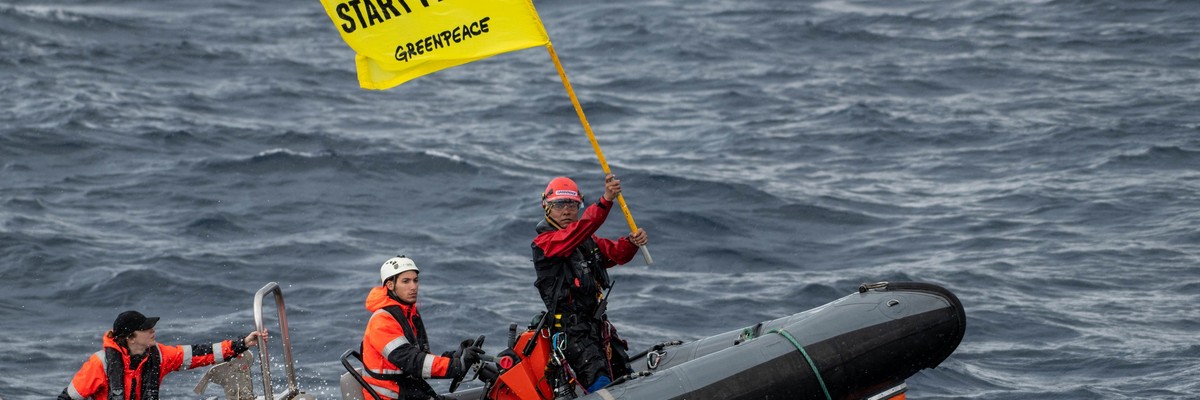
Greenpeace climate justice activists approaching Shell platform en route to major oilfield (Photo: Chris J Ratcliffe / Greenpeace)
“It has become clear: Eni is trying to silence anyone who dares to speak up and denounce the company’s contribution to the fueling of the climate crisis,” says Chiara Campione of Greenpeace Italy.
Greenpeace Italy revealed Wednesday that the Italian multinational energy company Eni is threatening a libel suit against it over reports the organization published about oil and gas companies.
Greenpeace said the potential lawsuit is related to a report on temperature-related premature deaths that may be caused by emissions from oil and gas companies like Eni and a report on the concept of “climate homicide.”
“We face yet another act of intimidation by Eni; it seems that threatening defamation lawsuits is the new sport which the company has decided to pursue most enthusiastically. But we won’t be silenced,” said Chiara Campione of Greenpeace Italy. “This new potential defamation lawsuit follows a similar case initiated by Eni against Greenpeace Italia only a few months ago.”
OOOPS ENI DID IT AGAIN! It seems that threatening defamation lawsuits is the new sport which the company has decided to pursue most enthusiastically. https://t.co/zZjhRdCa0f
Eni was given an opportunity to respond to the findings of the Greenpeace reports, but the group said Eni offered “no substantive rebuttal” and threatened legal action. The organization claimed other oil and gas companies mentioned in these reports have not threatened legal action.
Greenpeace Italy and the climate advocacy group ReCommon are currently suing Eni over its alleged contributions to the climate crisis. The first hearing for that case occurred last month.
“It has become clear: Eni is trying to silence anyone who dares to speak up and denounce the company’s contribution to the fueling of the climate crisis,” Campione said.
The multinational oil giant Shell sued Greenpeace in November for alleged damages related to Greenpeace activists boarding one of the company’s oil platforms. Shell is trying to get as much as $8.6 million in damages, which Greenpeace says would greatly threaten its ability to campaign.
The French multinational oil and gas company TotalEnergies is also suing Greenpeace France over a report that claimed it underestimated its 2019 greenhouse gas emissions.
Greenpeace said Wednesday that these companies are trying to “stop Greenpeace and other organizations from denouncing the damage the fossil fuel industry is causing to people and the planet.”