Seabirds: 40% of UK species in trouble – bird flu, climate change and overfishing to blame

Spread the love

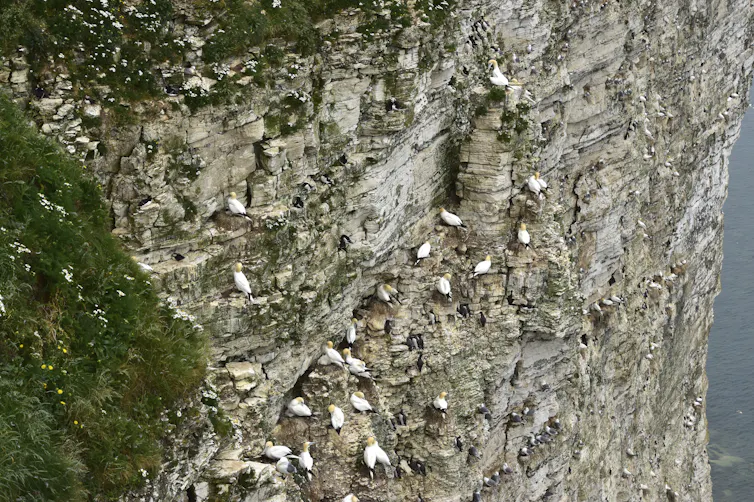
Nesting northern gannets, guillemots and razorbills at the RSPB Bempton Cliffs reserve on the Yorkshire coast. Robert Simmons

Richard Gregory, UCL

A visit to a seabird colony in summer is an assault on the senses. First there’s the noise, then the overwhelming ammonia smell that stains the memory, and then the swirl of colour and activity on the white-washed cliffs.

When you’re standing hundreds of metres above the crashing sea, there can be hundreds or thousands of breeding seabirds in the air or on the sea below, or precariously perched on poorly made nests or ridiculously narrow ledges.

In these seabird cities you can spot tender moments, like an auk delicately turning its single egg for incubation while another feeds its oversized youngster. Brutality is never far either: a chick snatched to feed a bigger brood, an incoming parent robbed of its hard-won fish supper by a piratical gull, a dead bird bobbing face down on the sea.

All life is here in the seabird colony, and the British Isles is particularly rich.

This string of islands in the North Atlantic is home to nearly 30 species of seabird and hosts large portions of their total populations. Most of the world’s Manx shearwaters (90%), northern gannets (70%) and great skuas (60%) nest here, as do more than 20% of the European population of nine seabird species.

British people have a special responsibility to protect these birds that are a harbinger of ocean health, sitting as they do at the top of a delicate food chain.

Sadly, a new scientific assessment has reported alarming declines over the last 25 years in the UK’s seabird populations. Five new species have joined the “red List”, which denotes the highest category of conservation concern: Leach’s storm-petrels, common gulls, great black-backed gulls, Arctic terns and great skuas. These join the already listed kittiwakes, herring gulls, roseate terns, Arctic skuas and puffins, which are all highly threatened.

On the upside, if there is an upside, two seabirds were judged to be less threatened based on new data. Shags and black guillemots moved to the amber and green list respectively, though both are gradually declining. Nearly 40% of breeding seabirds are now red-listed in the UK – and 73 bird species overall (30% of the UK total).
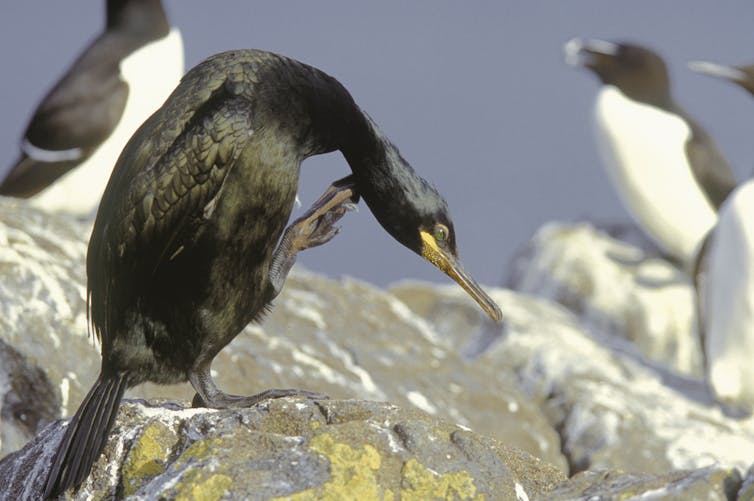
A large black bird scratching its neck with a webbed foot.
A silver lining: shags have recovered enough to be removed from the red list. Andy Hay

Looking down

Seabirds face many threats. Among the gravest are changes to their food supply linked to overfishing and climate change.

Ocean warming disrupts and shifts the life cycles of seabird prey, such as sandeels, and the resulting scarcity can cause populations to collapse. Increasingly severe winter storms and summer heatwaves also kill seabirds.

The broader effects of climate change and the warming of the ocean are difficult to predict, but the associated increase in acidification and lower oxygen levels are certain to upset food webs.

Entanglement in fishing gear, invasive predators and collisions with offshore turbines present yet more challenges.

On top of all this came the highly pathogenic HPAI H5N1, a new strain of the avian influenza virus that was first detected in the UK in 2021 and has resulted in the deaths of tens of thousands of seabirds and affected almost every seabird species.

HPAI H5N1 was first identified in domestic waterfowl in southern China in 1996 and rapidly spread into their wild relatives. Migratory species carried the virus around the world, and still do. Thankfully, human deaths remain extremely rare. The jump into seabirds was unexpected as, until then, it was found mostly in wild waterfowl and domestic poultry.

Seabirds such as terns, gulls, auks and northern gannets were hit hard but the impact on great skuas was most striking. Their numbers are down by over 70% from the last census, which was taken between 2015 and 2021.
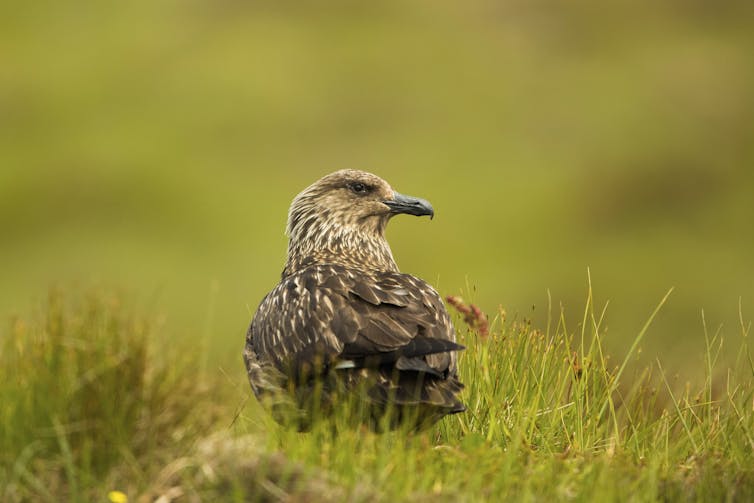
A large brown seabird.
A great skua at nest on Handa Island off the west coast of Scotland. Louise Greenhorn

Seabird lifestyles predispose them to infectious disease and make it hard for them to recover. Seabirds typically produce just a few young (often only one) in a single brood each year. At least these birds are long-lived and can continue to breed throughout their lives. But living in dense, crowded colonies at a few sites that they can fly between means diseases can easily spread and take hold.

Looking up

The story is not all doom and gloom – much is happening to aid their recovery.

The UK and Scottish government decided to close sandeel fisheries in the English North Sea and all Scottish waters from 2024. Many seabirds, including kittiwakes and puffins, depend on sandeels to feed their chicks, and so the moratorium is a positive move that should be sustained.

Far-sighted projects to remove invasive predators, especially rats, from seabird islands across the UK are also showing great results. The removal of brown and black rats from Lundy Island, Devon, led to the immediate return of breeding Manx shearwaters and puffins after an absence of many years.
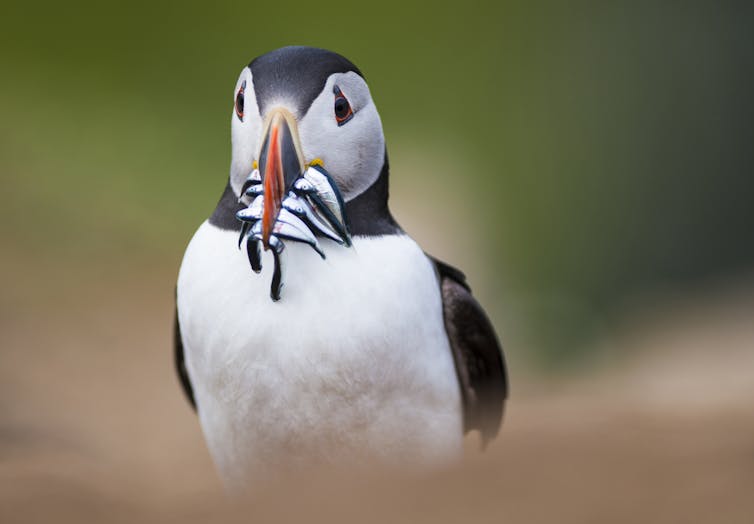
A puffin with a beak full of sand eels.
Atlantic puffins remain on the red list, but will benefit from a sandeel fishing ban. Katie Nethercoat

Marine protected areas such as Lyme Bay on the south coast of England are proof that sustainable fishing and conservation can go hand in hand (even if these sites are typically tiny). Trawlers were excluded from Lyme Bay in 2008 and the area has been managed by the local fishing industry and conservationists. A decade on from the ban, bottom-living seafans, rare corals, shellfish and fishes have all bounced back wonderfully.

More is needed to reverse the fortunes of seabirds. Well-resourced national seabird conservation strategies should protect colonies from invasive predators, extend and improve the country’s patchwork of marine protected areas, encourage more nature-friendly marine development (including for renewables) and better manage fisheries to ensure there is enough for seabirds to eat and less accidental bycatch in fishing gear, which kills thousands of seabirds in UK waters each year.

Our seabirds are special in many ways. I’d recommend a visit to a seabird colony, to drink in the spectacle and reflect on the lives of these birds and our responsibilities to them.


Imagine weekly climate newsletter

Don’t have time to read about climate change as much as you’d like?
Get our award-winning weekly roundup in your inbox instead. Every Wednesday, The Conversation’s environment editor writes Imagine, a short email that goes a little deeper into just one climate issue. Join the 35,000+ readers who’ve subscribed so far.


Richard Gregory, Honorary Professor of Genetics, Evolution & Environment, UCL

This article is republished from The Conversation under a Creative Commons license. Read the original article.


Continue ReadingSeabirds: 40% of UK species in trouble – bird flu, climate change and overfishing to blame

Rishi Sunak is wrong: we polled the British public and found it largely supports strong climate policies

Spread the love
Campaigners take part in a Stop Rosebank emergency protest outside the U.K. Government building in Edinburgh, after the controversial Equinor Rosebank North Sea oil field was given the go-ahead Wednesday, September 27, 2023. (Photo: Jane Barlow/PA Images via Getty Images)

Christian Bretter, University of Leeds and Felix Schulz, University of Leeds

The UK’s Tory government is rolling back climate legislation and is continuing to fund the expansion of domestic oil and gas reserves. Our new research suggests this might be based on a misreading of public opinion.

Since winning a July 2023 by-election in the London suburb of Uxbridge, the UK government has made polarising voters on climate policy one of its main strategies. The Tory campaign had focused on opposing a new low emission zone for cars, and prime minister Rishi Sunak took its victory as vindication of a clear “pro-motorist” and anti-climate policy stance.

The apparent lack of public support for strict climate policies such as a ban of fossil-fuelled cars is now being used as an excuse to roll back policies urgently necessary to reach net zero targets.

In a recently study in the journal Climate Policy, we demonstrate that, by betting on a public tired of stringent climate policies, the government is backing the wrong horse.

We asked 1,911 people that are representative of the UK population in terms of age, gender and ethnicity to indicate the extent to which they support different climate policy instruments. Almost two thirds support the most stringent climate policies, while others receive even higher support.

In short, people in the UK favour all kinds of policy instruments to tackle climate change, even the most stringent ones. There is a lesson here for the opposition too, which should put forward more effective climate policies, and not shy away from regulation.

A vote in favour of UK climate politics

In our study, we asked people about actual policy proposals by UK government bodies and political parties (as opposed to hypothetical ones).

We put each into one of four categories based on the type of policy instrument: regulation (such as banning the sale of fossil-fuel-powered cars or stopping drilling for oil and gas), market instruments (carbon trading, stopping fossil fuel subsidies), informational tools (consumer labels, advertising campaigns), and voluntary initiatives (carbon offsets, non-binding product standards).

Cars in traffic jam on wet day
The UK public is mostly happy to support measures like phasing out petrol cars.
Kittipong33 / shutterstock

Contrary to the government’s rhetoric, our findings point towards a more optimistic view of the UK’s future climate politics – at least from a voter perspective. A large majority supports strict regulations that mandate or prohibit specific behaviour. An even larger share backs market-based initiatives (78%), information tools (86%) and voluntary measures (87%).

While the important thing here is that the UK public wants a package of different policy instruments to decarbonise the economy and reach net zero, one could rightly argue that more still needs to be done to increase support for stricter measures. So what drives public support for climate policies?

Drivers of public support

In line with previous research, our study found that free market and environmental beliefs have the biggest impact on whether someone supports climate policies.

The more people believed that a free market acts in the interests of the public, the less they supported all climate policies. Similarly, people that believe nature is important voiced stronger support for all policies.

Interestingly, support for regulatory and market-based policies didn’t change according to a person’s income. This is important because the current government usually tries to appeal to working class voters in its attempts to demonise ambitious climate policies.

These are important findings that highlight the need to challenge free market ideologies by publicly and repeatedly scrutinising their validity for a functioning and just society. We also should start recognising their detrimental effect on climate policy preferences.

Regional variations in public support

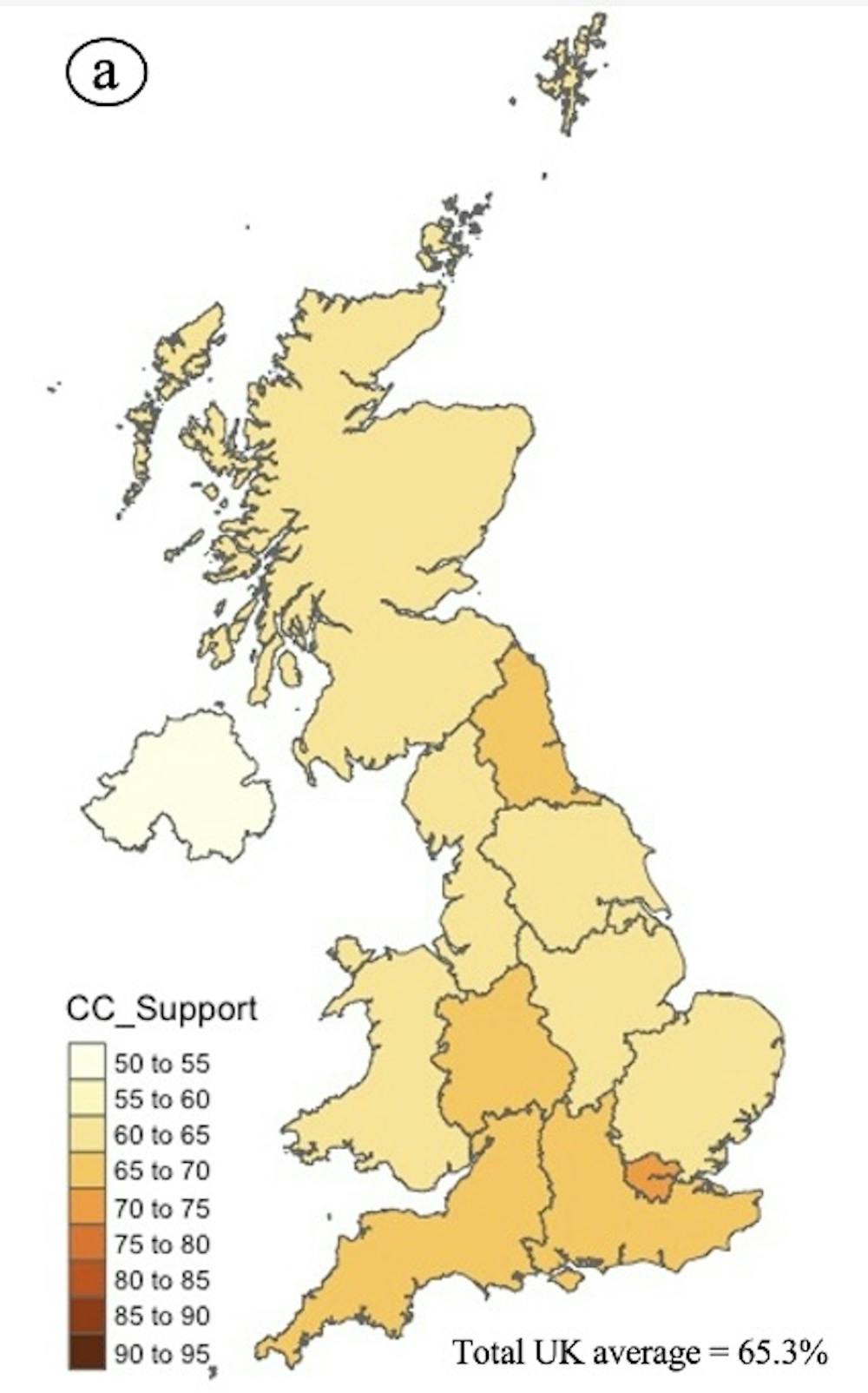
However, only looking at national results might hide important differences. Our research found important regional variation, with London often being an exception compared to the rest of the UK.

People living in other regions were about 30% less likely to support regulatory and market-based climate policies compared to people in Greater London, for instance.

Shaded map of UK
Regulatory measures were the least popular around the country, though still had majority support everywhere and a strong majority in London.
Bretter and Schulz, CC BY-SA

Drivers of these differences are both ideological and structural. People living in Greater London tend to believe less in the free market system compared to people in regions which had significantly lower support for climate policies. This indicates that neoliberal ideology favouring free markets is discouraging climate action.

Yet it is not only what people believe in. Those in more rural regions with higher emissions show less support for stricter climate policies. These tend to be regions with less access to public transport where people have to rely more heavily on high-emitting cars.

More needs to be done to improve public infrastructure in rural areas. This will require investment in affordable, low-carbon transport networks rather than championing the continuation of the combustion engine.

How the media may shape policy support

Of course, our study only captured a snapshot of people’s policy preferences. We are constantly confronted by news stories, particularly through social media.

These often act as echo chambers to reinforce existing ideologies (and by extension, policy preferences), thereby strengthening existing polarisations. This will make it harder to engage people with contrasting beliefs in a discussion on climate policies.

On the other hand, being repeatedly confronted with particular views and ideas can shift one’s beliefs. In psychology, this is referred to as “repeated priming”. In Germany, we have seen how newspaper campaigns against the slow phase-out of gas boilers have further undermined public support for this specific climate policy.

Could something similar happen in the UK? To avoid the gradual weakening of support by particular news outlets, the UK opposition parties need to be consistent and persistent in their communication of climate policies and their effects.


Imagine weekly climate newsletter

Don’t have time to read about climate change as much as you’d like?

Get a weekly roundup in your inbox instead. Every Wednesday, The Conversation’s environment editor writes Imagine, a short email that goes a little deeper into just one climate issue. Join the 20,000+ readers who’ve subscribed so far.The Conversation


Christian Bretter, Research Fellow in Environmental Psychology, University of Leeds and Felix Schulz, Research Fellow, University of Leeds

This article is republished from The Conversation under a Creative Commons license. Read the original article.
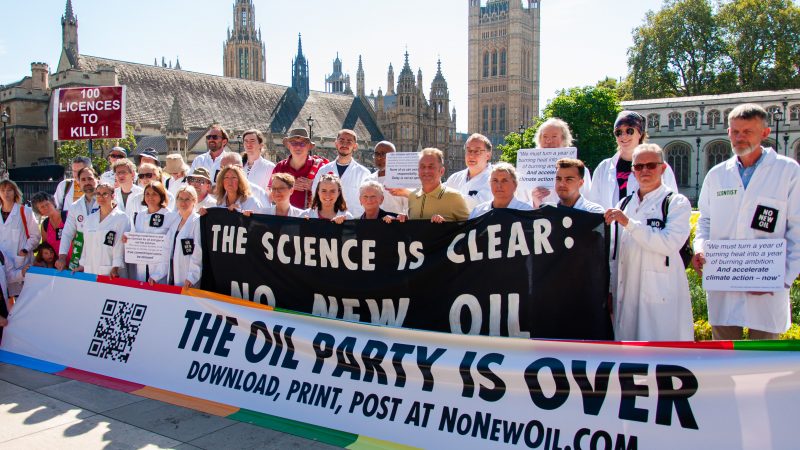
Scientists protest at UK Parliament 5 September 2023.
Continue ReadingRishi Sunak is wrong: we polled the British public and found it largely supports strong climate policies