Secretary of State for Wales Stephen Kinnock (left) and Prime Minister Andy Burnham arrive for a visit to Tata Steel in Port Talbot, on the next leg of his summer tour meeting local communities outside Westminster, ahead of Parliament’s return next week,
ANDY BURNHAM’S visit to Wales coincided with today’s announcement of current youth unemployment. In Wales 17 per cent of young people available for employment are without work. Figures are worse in London and north-east England. Overall they are higher by 30,000 than the same figures this time last year.
Earlier in the week the Prime Minister announced he was convening the National Economic Council this October, bringing together the first ministers of Scotland, Wales and Northern Ireland to discuss economic development. This council, re-established shortly after Burnham took over as prime minister, was originally set up by Gordon Brown in 2008 in the face of global financial crisis.
We are not yet in such a crisis. But omens are not good. Values in the London stock exchange are up over a third on where they were a decade ago — for a period when there has been virtually no growth in Britain’s economy. And this is not mentioning Elon Musk, the AI speculators, arms spending and Trump’s wars.
However, for the young people in Wales, and all other places, what really matters will not be what happens next year but during their working lives: the next 40 years. Here three reports published over the last month by the Institute of Public Policy Research (IPPR) are of particular importance.
The first, by William Ellis and Carsten Young, is on “Why We Need a Better Fiscal Framework.” They calculate that, on current projections, interest payments on government debt, will increase from the current 7.6 per cent of tax income to anything between 21 and 47 per cent over the next 40 years — the money going to the very wealthy who hold the bonds and crushing anything that remains of the welfare state.
A Welsh flag before the Six Nations match at the Principality Stadium, Caerdydd
A PETITION to the Senedd seeking to change the country’s name from Wales to just Cymru was up to 412 signatures today.
The petition was started by John Price and says: “With an outward looking government, now is the time for us to assert our own intention for how we are seen across the world, in the language of our nation using the name chosen by our nation.
“Now is also the time for us to stop using two names for places with deeper, older Welsh names. We can sensibly keep some names with other dual and important historical meanings.”
The petition will be live until December 30 and at 250 signatures will be discussed by the Senedd’s petitions committee.
But petitions with more than 10,000 signatures will be considered for a debate in the Senedd.
The petition also explains that other countries that have changed their names include Turkiye and Czechia and notes that national parks using Welsh names have gained wider international attention.
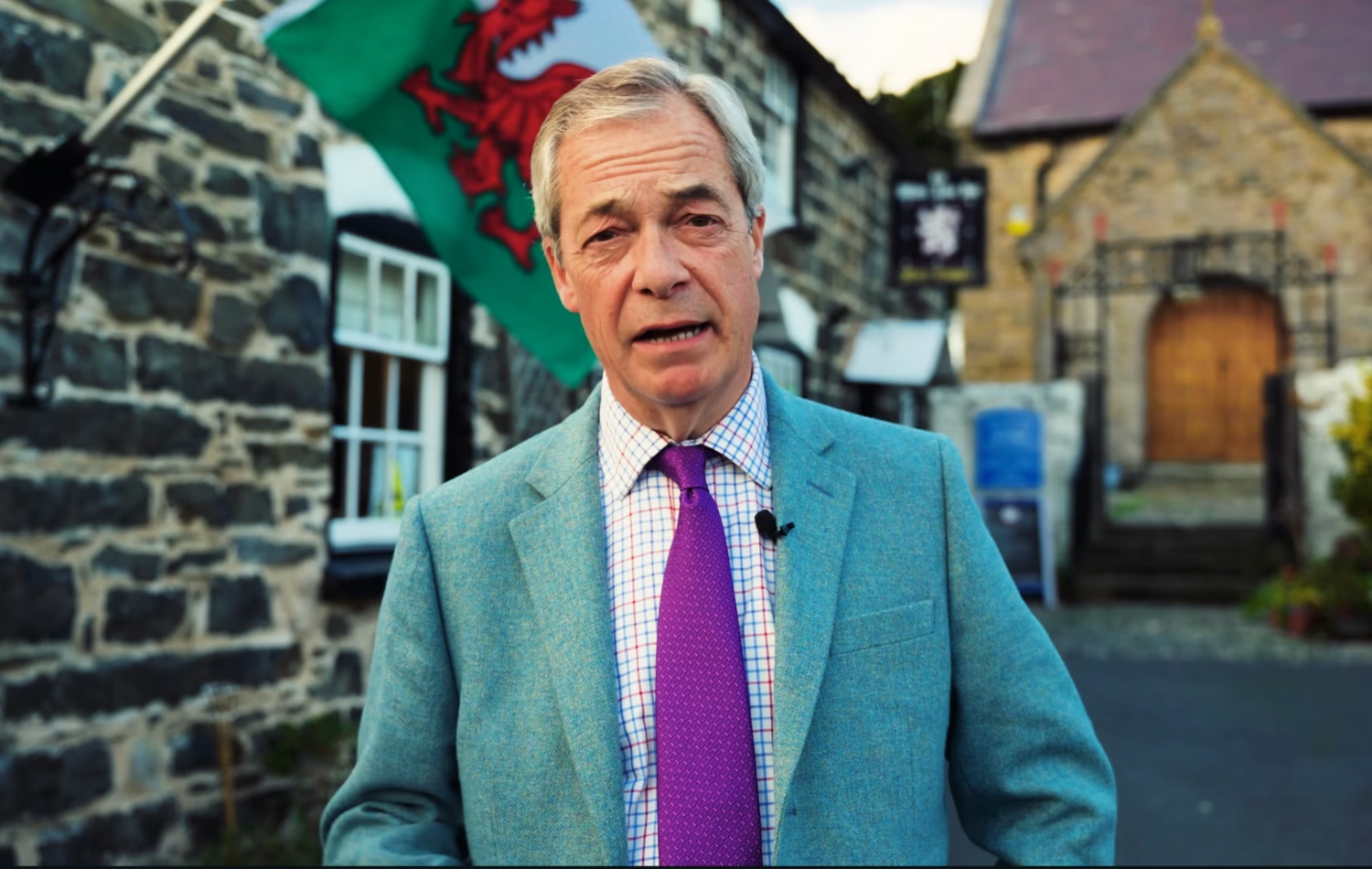
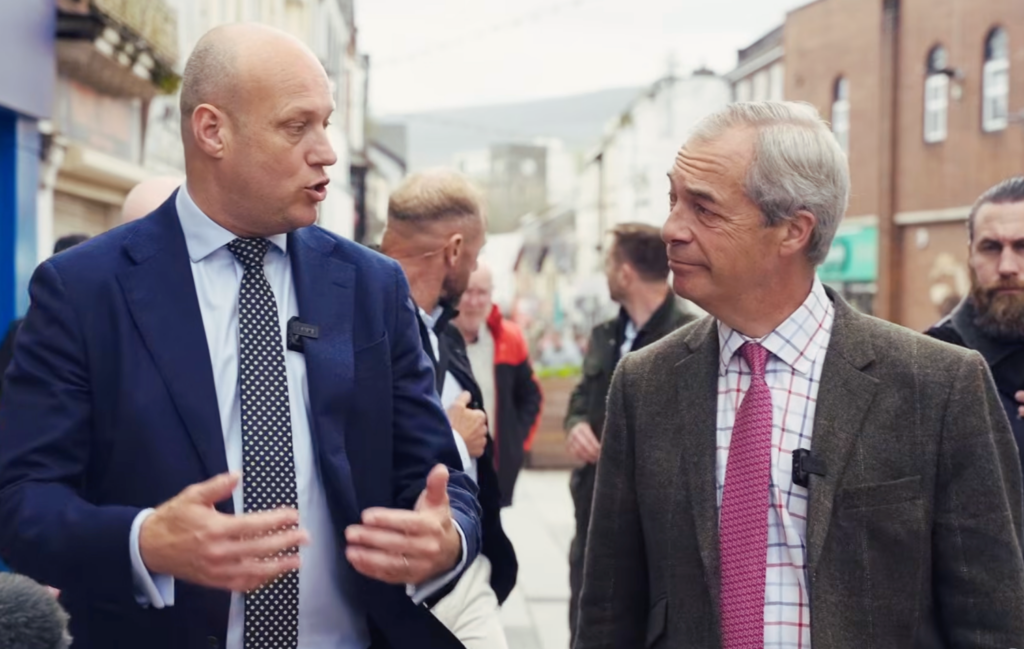
Reform UK leader Nigel Farage campaigning in Wales. Credit: Reform UK / YouTube
Welsh Reform labelled a “retirement home for failed Conservatives”.
The majority of Reform UK’s shadow cabinet in Wales is made up of former Conservative Party politicians, including its leader, chief whip, and shadow economy minister, DeSmog can reveal.
Nigel Farage’s radical right-wing party – which campaigns against climate policies and supports dramatically increased fossil fuel production – became the second largest group in the Senedd following elections on 7 May.
Reform has presented itself as an outsider force and an alternative to the established parties.
However, DeSmog’s analysis finds that almost two thirds (64.2 percent) of Reform’s shadow cabinet posts in Wales are held by individuals who have previously served or stood for the Tories.
That amounts to nine out of Reform’s 14 shadow cabinet members, and includes Reform’s leader in Wales, Dan Thomas, who was Conservative leader of Barnet Council in London before defecting to Farage’s party in June last year.
It also includes the party’s chief whip, Llŷr Powell, a former Tory council candidate, and shadow economy minister Jason O’Connell, a former Tory councillor.
In total, 12 of Reform’s 34 Senedd members are former Conservative politicians – amounting to 35 percent of the party’s representation in the assembly.
A spokesperson for the Wales Green Party said: “In the election campaign, Reform presented themselves as an insurgent anti-establishment party, but it’s looking more like they’re just a retirement home for failed Conservatives.”
Reform’s central party is also replete with ex-Tories. Six of Reform’s eight members of UK Parliament defected from the Conservatives, five while they were serving MPs. This includes Robert Jenrick, a former Tory minister and Reform’s current economic spokesperson, and former Conservative home secretary Suella Braverman, both of whom defected in January.
Of the remaining two – Farage and his deputy Richard Tice – the latter is a former Tory party member and donor.
In Scotland, at least four of Reform’s members of the Scottish Parliament are former Tory politicians, including Max Bannerman in the Highlands and Islands, Thomas Kerr and Kim Schmulian in Glasgow, and Graham Simpson in Central Scot and Lothians West.
Reform’s biggest donor, Thailand-based crypto and jet fuel billionaire Christopher Harborne, was previously a donor to the Conservative Party, giving £1.5 million between 2018 and 2022.
Harborne has donated £22 million to Reform, and gave Farage a £5 million gift in 2024 prior to him reclaiming the Reform leadership and standing for Parliament. Farage did not declare this sum when he was elected as an MP, and it is now the subject of a parliamentary standards investigation.
The Roster
Llŷr Powell, Reform’s chief whip and business manager in Wales, was a Conservative Party candidate for local government in 2022, and supportedKemi Badenoch for Tory leader the same year.
Powell, who was Reform’s unsuccessful candidate in the October 2025 Caerphilly Senedd by-election, used to work for Nathan Gill, the party’s former Welsh leader. Gill is currently serving a 10 and a half year prison sentence for accepting bribes from an agent of the Russian government during his time as a Member of European Parliament (MEP) for the Brexit Party (Reform’s forerunner).
Powell has said he didn’t work for Gill when he committed these offences, and had no knowledge of his crimes, but has refused to say the exact dates when he served under Farage’s former MEP.
James Evans, Reform’s shadow minister for health, prevention and sport, was elected as the Senedd member for Brecon and Radnorshire in 2021 as a Conservative. Before that, he served in Welsh local government as a Tory.
Laura Anne Jones, Reform’s shadow minister for food, farming and rural affairs, was previously a Conservative Senedd member for South Wales East.
Reform UK leader Nigel Farage and Welsh leader Dan Thomas campaigning in Wales.
Credit: Reform UK / YouTube
Sarah Cooper-Lesadd, the party’s shadow minister for children, young people and skills, was a Conservative candidate for Coventry East in the 2024 general election. From 2022 to 2024 she was also a parliamentary assistant to Vicky Ford, Tory MP for Chelmsford.
Louise Emery, Reform’s shadow minister for culture, tourism and hospitality, was elected in 2017 and 2022 as a Conservative councillor in Conwy.
Francesca O’Brien, shadow minister for local government, housing and planning, was a Tory councillor for the Mumbles elected in 2017.
Adrian Mason, Reform’s shadow Counsel General and shadow minister for the constitution, was a Tory council candidate in Wales in 2017.
Jason O’Connell, shadow minister for economy and transport, was briefly a Welsh Conservative councillor in 2018, having been elected as an independent.
Outside of the shadow cabinet, Reform Welsh Senedd members Iain McIntosh and Tom Montgomery were elected to local government in Wales as Conservatives in 2022, while Stephen Senior stood as a Tory in 2022 and 2023.
Nigel Farage explains the politics of Reform UK: Racism, Fake anti-establishmentism, Deregulation, Corporatism, Climate Change Denial, Mysogyny and Transphobia.Nigel Farage urges you to ignore facts and reality and be a climate science denier like him and his Deputy Richard Tice. He says that Reform UK has received £Millions and £Millions from the fossil fuel industry to promote climate denial and destroy the planet.Nigel Farage reminds you that he’s the man that brought you Brexit and asks what could possibly go wrong.
Wales Green Party Leader Anthony Slaughter. Image: NoBeefKieth, CC0, via Wikimedia Commons.
Wales Green Party will be looking to achieve the key manifesto pledges it promised to voters in any forthcoming arrangement with Plaid Cymru, their leader Anthony Slaughter announced today. At the same time, Slaughter welcomed the defeat of the ‘divisive, Trumpian’ Reform Party.
Anthony Slaughter said: “We welcome the defeat of Reform and congratulate Plaid Cymru on their result – this is a victory for everyone who wanted to keep out Reform’s divisive, Trumpian politics out of Wales. We are a welcoming nation – and Wales needs to stay a place where everyone is treated with respect and dignity and can thrive.
“When it comes to the next government of Wales, we are open to having conversations, but no decisions have been made at this point. In any negotiations we will be looking to deliver on the Green objectives that people voted on in this election – including action to address the cost-of-living crisis, protecting our NHS, fixing the renting crisis, and restoring our natural environment.”
The declaration comes after Wales Green Party celebrated its historic breakthrough onto the Senedd with the election of their first ever two MSs – Leader Anthony Slaughter in Caerdydd Penarth and environmentalist Paul Rock in Caerdydd Ffynnon Taf.
Wales Green Party’s key manifesto pledges include:
Replacing council tax with land value tax paid by landlords not tenants
Freezing rents, building 60,000 social homes and ending no-fault evictions
Ending corridor care, addressing the mental health pandemic and putting the NHS on a sustainable footing
Free bus fares for the under 22s, £1 for adults, more bus routes
Extending free childcare from nine months to four years
Taking back control of water to clean up our rivers and bring down bills
Making sure every government decision supports climate and nature recovery
Paul Rock was the second Green Party candidate to win a seat in the Senedd. He will serve in the Caerdydd Ffynnon Taf constituency where he has lived for 30 years. Paul is committed to the sustainability and resilience of Welsh communities, serving as UCU branch Environmental Officer at Cardiff University, and helping create the Gabalfa Library of Things. He has a long history of activism, with interests in sustainable transport, renewable energy and public access to land.
Zack Polanski, Leader of the Green Party of England and Wales said:
“When myself and my deputies Rachel Milward and Mothin Ali were elected a year ago we were very clear that breaking through and gaining representation in the Senedd was our number one priority. If you asked us six months ago no one expected us to get more than one seat but we have doubled that.”
Reform UK leader Nigel Farage being interviewed by the media after an eve of poll photocall at College Green, Westminster, on the last day of campaigning ahead of the local elections on Thursday, May 6, 2026
MILLIONS of votes will be cast on Thursday in Scotland and Wales in the election of these two nations’ devolved governments and in England a cross-section of communities will vote — in six places for regional mayors — and in 5,000 seats where the composition of 136 different councils are up for grabs.
This is the biggest test of electoral opinion since Keir Starmer took office on millions of votes fewer than won by Jeremy Corbyn.
The calamitous fall in Labour’s popularity is the main feature of these elections but we should not discount the scale of the Tory collapse.
You might think that the defection of much of Boris Johnson’s Cabinet to Reform UK would have given Kemi Badenoch the opportunity to recover something of the traditional Tory vote, such as it exists. This, at least would be an innovation but, like Labour, the Tories are no longer a credible party of a future government.
Reform UK is faltering with a certain sense that the Establishment is setting limits on its ambitions. The monopoly media is not so tolerant; opinion polls are less encouraging and the more Nigel Farage’s privately owned electoral vehicle resembles the Tory Party the fewer workers are prepared to swallow its fetishisation of the market and its hostility to public services.
Today the Trump connection plays badly even on the deluded right.

 Secretary of State for Wales Stephen Kinnock (left) and Prime Minister Andy Burnham arrive for a visit to Tata Steel in Port Talbot, on the next leg of his summer tour meeting local communities outside Westminster, ahead of Parliament’s return next week,


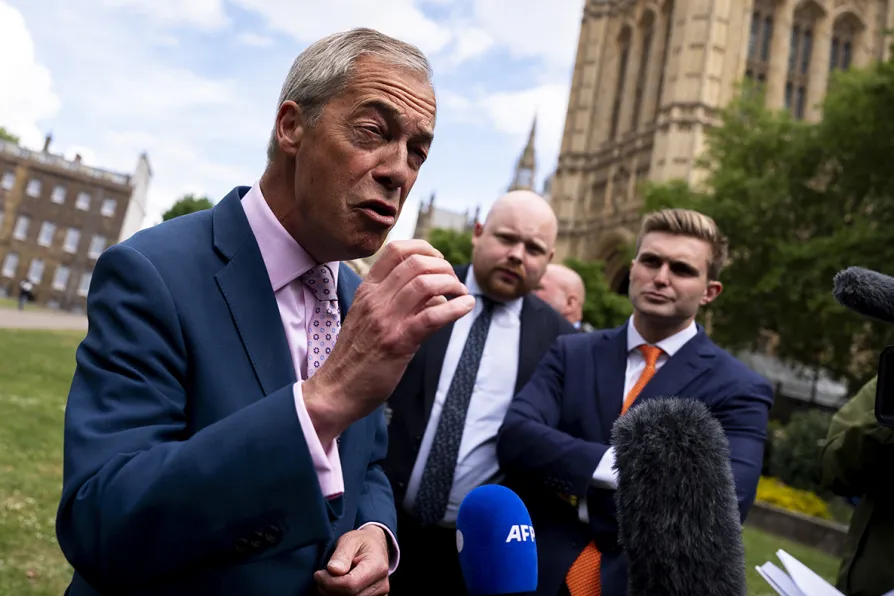
 Reform UK leader Nigel Farage being interviewed by the media after an eve of poll photocall at College Green, Westminster, on the last day of campaigning ahead of the local elections on Thursday, May 6, 2026