PSC Cymru co-chairwoman Bethan Sayed [… and what?]
PALESTINIAN campaigners in Wales were celebrating this weekend after 115 Senedd candidates pledged for Palestine — including backing boycott, divestment and sanctions (BDS) against Israel.
Candidates signing the Palestine Solidarity Campaign (PSC) Cymru pledge include 46 Green candidates, 37 from Plaid Cymru, eight from the Liberal Democrats, six from Labour and five independents.
PSC Cymru co-chairwoman Bethan Sayed said: “Reaching over 100 pledges is a milestone and is a clear message that Palestine is on the ballot in this Senedd election.
“Wales has always aspired to be a nation that stands on the right side of history, a globally responsible nation that holds human rights and international law at its heart.
“Support for Palestinian rights stretches across every community and every constituency in Wales. Polls show public backing for this issue.
“Voters will be watching closely to see who has the conviction to stand with them.”
The pledge commits elected candidates to uphold the inalienable rights of the Palestinian people, stand up to Israel for its crimes of genocide and apartheid — and ensure the Welsh government is not complicit in these crimes.
Keir Starmer objects to criticism of the IDF. He asks how could anyone object to them starving people to death, forced marches like the Nazis did, bombing Gaza’s hospitals and universities, mass-murdering journalists, healthworkers and starving people queuing for food, killing and raping prisoners and murdering children. He calls for people to stop obstructing his genocide for Israel.Nigel Farage objects to criticism of the IDF. He asks how could anyone object to them starving people to death, forced marches like the Nazis did, bombing Gaza’s hospitals and universities, mass-murdering journalists, healthworkers and starving people queuing for food, killing and raping prisoners and murdering children. He calls for people to stop obstructing his genocide for Israel.Orcas discuss Genocide-supporting and complicit Zionists. Donald Trump, Keith Starmer, David Lammy, Rachel Reeves, Angela Rayner and Wes Streeting are acknowledged as evil genocide-complicit and supporting cnuts.
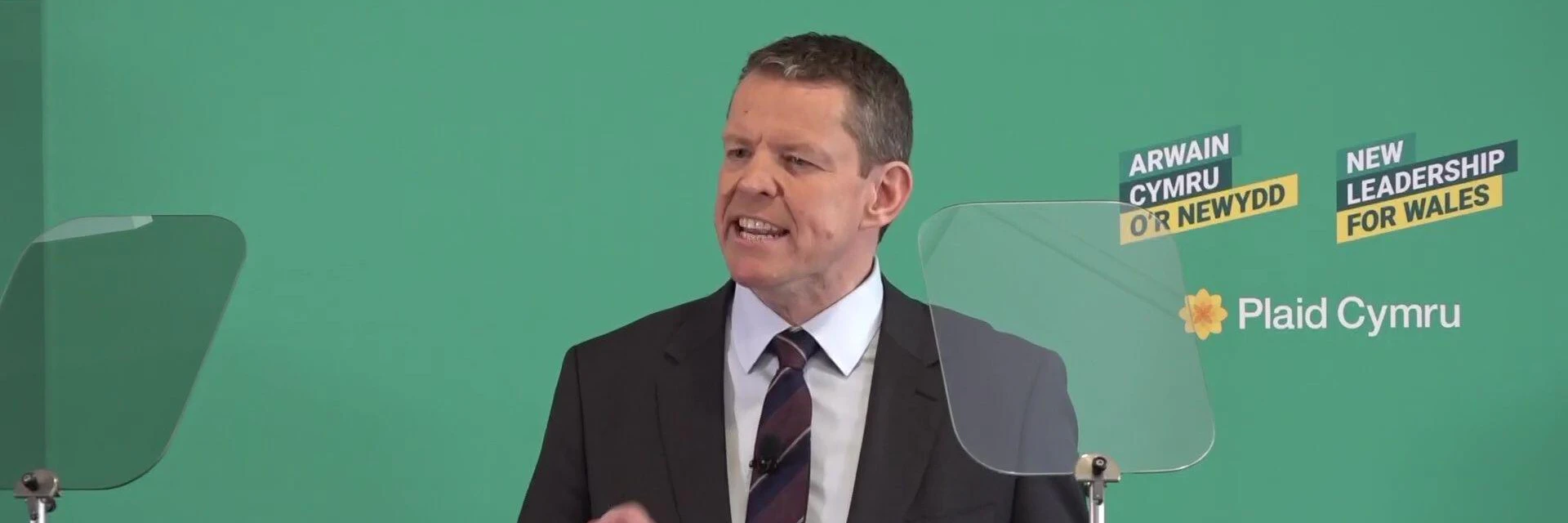
Plaid Cymru’s electoral hopes for May’s Senedd election are high. Polls suggest the party is competing with Reform UK to emerge as the largest group in the next Welsh parliament, putting it, for the first time, within reach of leading a government in Wales.
This marks a striking shift in Plaid’s electoral fortunes. At the first election to what was then the National Assembly for Wales in 1999, the party won 28.4% of the vote. That remains its strongest performance to date in what was widely described at the time as a “quiet earthquake” in Welsh politics.
Since then, Plaid has struggled to match that breakthrough in devolved elections. From 2011 onwards it has consistently been the third-largest party in the Senedd, behind Welsh Labour – which has led every government since devolution – and the Conservatives.
Even so, the arithmetic of Welsh politics has occasionally worked in Plaid’s favour. The party entered government in coalition with Labour between 2007 and 2011, and more recently struck a co-operation agreement from 2021 to 2024. But if Plaid ends up leading a government outright after May 7, it would truly set this election apart.
Positioning itself for power
Plaid Cymru’s strategy is to present itself as a credible government-in-waiting. Its focus is less about being a party of protest and more about delivery. In other words, what it would do in office, how it would tackle Wales’s major policy challenges, and how it would represent Welsh interests at Westminster after nearly three decades of Labour dominance.
In February, the party set out its plan for its first 100 days in government. This focused on improving healthcare, raising education standards, boosting the economy and reforming government.
Alongside these priorities, its manifesto calls for further powers to be devolved to the Senedd. These include greater tax powers, justice and policing, rail services and infrastructure, and the Crown Estate, which oversees things like the sea bed and mineral rights in much of the countryside.
Yet there has also been a noticeable change in tone on the party’s long-term constitutional aims. Our research examined how Plaid Cymru covered these issues in the 2021 Senedd election. Compared with five years ago, Welsh independence is significantly less prominent in both its current manifesto and campaign.
The timetable has softened too. There’s no longer a commitment to holding a referendum on independence in its first term of government. Instead, Plaid describes Wales as being “on a journey” to independence. It has committed to producing a policy on Welsh independence but with no referendum timeframe.
By downplaying its long-term constitutional ambitions in this way, and focusing on the more immediate policy challenges facing Wales, Plaid Cymru is approaching this Senedd election as many other pro-independence parties have done across Europe. A similar strategy helped the Scottish National Party win power in 2007 and remain in government for the next 19 years.
A ‘degradation in belief that Labour stood for Wales,’ says Plaid Cymru leader – Sky News.
From polling strength to political power
Strong polling does not guarantee power, however, and Plaid faces several obstacles. Opponents continue to highlight its commitment to independence.
Support for independence among the Welsh public remains relatively low – only 26% of respondents in a recent YouGov poll agreed that Wales should be an independent country. Plaid’s challenge is to persuade sceptical voters that this isn’t the most important issue in Wales for the next four years.
The new electoral system also presents fresh uncertainties. This election will use a fully proportional model, with 96 members elected across 16 constituencies. Success will now depend on broad support across Wales. That’s a test for a party whose organisational strength has traditionally been concentrated in the north and west.
The new system is also likely to produce a more fragmented Senedd, with a wider range of parties represented. That could make post-election negotiations decisive, shaping who is able to lead a government and how stable it is.
Keir Starmer says that the Labour Party under his leadership is intensely relaxed about assaulting those least able to defend themselves – the very poorest and most vulnerable.Nigel Farage explains the politics of Reform UK: Racism, Fake anti-establishmentism, Deregulation, Corporatism, Climate Change Denial, Mysogyny and Transphobia.Keir Starmer refuses to be outcnuted by Nigel Farage’s chasing the racist bigot vote.
Wales Green Party Leader Anthony Slaughter, Reform UK’s Dan Thomas, Welsh Labour Leader and First Minister Eluned Morgan, Plaid Cymru of leader Rhun ap Iorwerth, Welsh Conservative leader Darren Millar and Welsh Liberal Democrat Leader Jane Dodds
RARELY has Wales featured so prominently in all-Britain election coverage as today in the run-up to polling day on May 7. Certainly, it is difficult recall such media interest in any of the six general elections to the National Assembly of Wales and its successor, the Senedd, over the past quarter of a century.
The London-based mass media usually show little interest in Wales unless a gruesome murder, a royal visit or a sporting spectacle has attracted journalistic attention beyond the M25 bubble.
…
What’s so different this time around? The big story is that the Labour Party is set to be replaced as the biggest electoral force in Wales for the first time in 100 years. The old certainty of a Labour victory (and most often a Labour landslide) is dying.
…
Welsh Labour is suffering from over-familiarity and its all-too-supine relationship with Keir Starmer’s government at Westminster. Many thousands of habitual Labour voters in the south Wales valleys are likely to switch to Plaid Cymru, despite not yet sharing that party’s aspiration for Welsh independence from the UK. A smaller number may go Green, and many more probably won’t vote at all.
They don’t feel the change promised by Starmer’s party. They dislike his lack of honesty and integrity. Many are repelled by his refusal to condemn US-Israeli massacres of the innocent in Palestine, Iran and Lebanon.
Neither do they remember — unless forcefully reminded — of the achievements of Welsh Labour and Labour-Plaid coalition governments despite the lack of powers and resources at the disposal of the Welsh parliament: free NHS prescriptions, free hospital parking, free bus travel for the elderly, the reintroduction of student maintenance grants, free museum entry, primary school breakfast clubs, financial penalties for holiday home ownership, aid for the Welsh steel industry, nationalisations to invest in Cardiff-Wales Airport and Transport for Wales rolling stock, etc.
Keir Starmer says that the Labour Party under his leadership is intensely relaxed about assaulting those least able to defend themselves – the very poorest and most vulnerable.Nigel Farage reminds you that he’s the man that brought you Brexit and asks what could possibly go wrong.
Wales Green Party Leader Anthony Slaughter. Image: NoBeefKieth, CC0, via Wikimedia Commons.
The Wales Green Party has today announced that it will be standing a full slate of candidates in all 16 constituencies on 7 May 2026.
Wales Green Party Leader Anthony Slaughter said:
“I am very proud to be offering every person in Wales an opportunity to vote for a candidate that will make a real difference to their lives. Someone who will take the cost of living seriously by introducing rent controls, start cleaning up our rivers by holding Dŵr Cymru/Welsh Water to account, and stand up for international law and human rights in the face of government complicity in genocide and illegal wars.
“Since the election of Zack Polanski last September, the Green Party has seen rapid growth – with support surging the polls and in our record membership numbers followed by last month’s decisive by-election result in Gorton and Denton.
“With Greens surging in the polls, and the new proportional voting system, we can elect candidates across Wales ready to work hard for the changes we urgently need.”
Wales is the first nation in the UK to scrap the First-Past-The-Post system and the election in May will be the first under the full proportionate representation voting system that was introduced when the Senedd Reform Bill was approved on 9 May 2024.
Green Party MP for Brighton Pavilion Siân Berry. Image by Kelly Hill, Wikimedia CC BY-SA 4.0.
Responding to the government’s new Road Safety Strategy, which was announced on 7th January, Green MP, Siân Berry, said
“The only target for the number of people killed on the road should be zero. With this strategy, the Government has massively overlooked key actions to cut traffic and achieve safer and slower vehicle speeds, which are truly effective at saving lives and essential to reaching this goal.
“The Government should follow the example of Wales, where the national default 20mph limit reduced road casualties on 20mph and 30mph roads by 26 per cent in the first 12 months of its introduction. That represents 630 people in Wales who made it home safely.”

 PSC Cymru co-chairwoman Bethan Sayed [… and what?]