One Year Into Clampdown, WaPo Opinion Cheers for MAGA, Billionaires and AI

Spread the love

Article by Pete Tucker republished from FAIR under a Creative Commons Attribution-NonCommercial-NoDerivs 3.0 Unported License.

It’s been an eventful year since Washington Post owner Jeff Bezos tapped Adam O’Neal for the prestigious job of Post Opinions editor. O’Neal was an unusual hire, a 33-year-old with little by way of managerial experience. But O’Neal had a redeeming quality: He was ready to shill for Bezos, and the man Bezos has been desperately wooing, President Donald Trump.

It’s remarkable how far Bezos has come since 2013, when he said he purchased the Post from the Graham family out of a sense of civic duty.

Bezos was still singing a similar tune nearly midway through Trump’s first term, telling Axel Springer CEO Mathias Döpfner (4/28/18), “I would be humiliated to interfere” with the Post’s coverage. “I would be so embarrassed. I would turn bright red…. It would feel icky; it would feel gross.”

But days before the 2024 election, with Trump looking like he might return to the White House, Bezos apparently got over his queasiness and personally spiked the Post’s endorsement of Kamala Harris (FAIR.org, 10/30/24). “Trump was thrilled, advisers said, and later thanked Bezos,” the Wall Street Journal (7/2/26) reported.

Bezos followed up by declaring that Post Opinions would now promote “personal liberties and free markets,” while “viewpoints opposing those pillars will be left to be published by others.” Coming a month into Trump’s second term, this came across as another gift to the president (FAIR.org, 2/28/25).

‘Unapologetically patriotic’

Washington Post: The Texas Gerrymander freakout vs. Virginia Plunges America Deeper Into the Gerrymandering Abyss

When Texas did a mid-census gerrymander in 2025, the Washington Post (8/20/25) urged Democrats to “hold the apocalyptic warnings about the end of democracy.” When Virginia followed suit in 2026, the Post‘s message (4/21/26) to Democrats was ” spare us the false sanctimony about democratic norms.”

To lead the newly oriented Opinions page, Bezos tapped O’Neal, who had been a correspondent for the Economist, editorial writer for the Wall Street Journal and executive editor at the conservative Dispatch for just one year.

In that last role—apparently O’Neal’s only newsroom managerial experience—he quickly alienated the Dispatch staff. “He was a competent editor who had no idea how to talk to another human being,” a former associate of O’Neal’s told Status (7/18/25):

He was tough on reporters, sure, but that’s common in newsrooms. He just couldn’t express even the most minor thing without being abrasive, hostile or raising his voice.

After being named to his post in June 2025, O’Neal declared that Post Opinions would be “unapologetically patriotic” and “communicate with optimism about this country.” This echoed Bezos, who declared a month into Trump’s second term, “I am of America and for America, and proud to be so.” Bezos was, of course, echoing Trump’s “America first” rhetoric.

O’Neal has demonstrated his patriotism by overseeing an editorial page that has backed Trump in destroying the East Wing of the White House (10/25/25), kidnapping the Venezuelan president (“one of the boldest moves a president has made in years”—1/3/26), militarily taking over DC (8/11/25FAIR.org8/14/25), and unprecedented gerrymandering (8/20/25). (When Democrats responded in kind, the Post decried the “power grab”—4/21/26).

The Post’s pro-Trump boosterism under O’Neal has been so over the top, wrote Chris Lehmann (The Nation2/4/26), it’d “be a stretch for Pravda to pull off.”

“I try to avoid reading what the opinions section publishes,” a current Post staffer told Status (5/10/26). “I can’t tell if some of these arguments are being made in good faith or not. Sometimes it just seems like rage bait.”

‘Being reconciled is not enough’
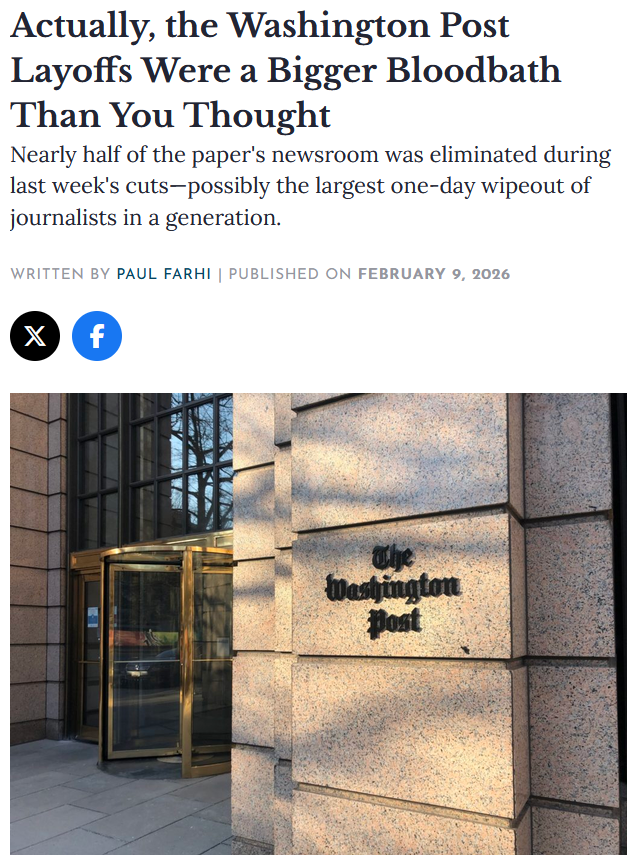
Washingtonian: Actually, the Washington Post Layoffs Were a Bigger Bloodbath Than You Thought

Former Washington Post media writer Paul Farhi (Washingtonian2/9/26) described Bezos’ layoffs as “disfiguring…with whole sections and departments—sports, books, staff photography—wiped away, and devastating cuts inflicted on its Metro section and foreign bureaus.”

While O’Neal’s predecessor, David Shipley, did everything Bezos could have asked for—spiking the Post’s Harris endorsement and a cartoon depicting Bezos and other tech moguls as Trump supplicants (FAIR.org1/7/25)—he did it without zeal, which Bezos found intolerable. “I suggested to him that if the answer wasn’t ‘hell yes,’ then it had to be ‘no,’” Bezos wrote, in explaining Shipley’s February 2025 resignation.

Shipley had voiced concern over the direction Bezos was taking the Post, warning the billionaire that spiking the Harris endorsement days before the election and yanking Opinions rightward could turn off subscribers. “I don’t care,” Bezos replied (New York Times3/14/26). (Shipley proved correct; Bezos’ interventions led to over 375,000 Post readers canceling their subscriptions—NPR1/30/26.)

Replacing Shipley, O’Neal wasted little time in transforming Opinions’ editorial outlook, and its personnel. In his first email to the Opinions desk, O’Neal encouraged his colleagues to get with the program or quit, mimicking Bezos’ message to Shipley. “Simply being reconciled to these changes is not enough,” O’Neal wrote. “We want those who stick with us to be genuinely enthusiastic about the new direction and focus.”

Seeing the writing on the wall, many of the Post’s centrist and left-of-center columnists took the generous buyouts on offer (which some had been contemplating since before O’Neal was hired). Gone in quick succession were Perry Bacon Jr.Philip BumpJonathan CapehartJoe DavidsonMarc FisherGlenn KesslerRuth MarcusDana MilbankCatherine RampellEugene RobinsonEduardo Porter and others. “It’s just an absolute exodus,” a Post staffer told Politico (7/28/25).

The paper’s last full-time Black Opinions columnist, Karen Attiah, was fired in September 2025 (Golden Hour9/15/25FAIR.org9/23/25). (Theodore R. Johnson of New America writes roughly once a week as a contributing columnist, but is not on staff.)

CNBC: Jeff Bezos on The Washington Post: I don’t want it to be a charity

Jeff Bezos (CNBC, 5/20/26): “The [WashingtonPost needs to be a profitable enterprise that stands on its own two feet.” Bezos could cover the Post‘s annual losses by spending 0.04% of his wealth—the equivalent of a typical US household spending $77 a year to maintain a fishtank. Bezos hollowed the Post out further in February when he laid off nearly half of the newsroom, in what “may have been the biggest one-day wipeout of journalists in a generation” (Washingtonian2/9/26).

Publicly, Bezos claimed he was doing this for the long-term viability of the paper. To be relevant, the Post has to be a “profitable enterprise that stands on its own two feet,” Bezos told Andrew Ross Sorkin (CNBC, 5/20/26). Otherwise, “it would be like poetry without rhyming.”

Privately, however, Bezos told Trump that Post employees “are terrible…. They don’t listen. My other companies, they listen,” according to New York Times reporters Maggie Haberman and Jonathan Swan’s new book Regime Change.

To make the Post more like his other companies, Bezos needed “hell yes” management, like Adam O’Neal (and former publisher Will Lewis).

O’Neal, in turn, needed fellow travelers, and seems to have hired exclusively MAGA-friendly columnists. According to media critic Adam Johnson (Real News Network5/22/26), the Post

purged its opinion page of its actually popular writers and replaced them with charmless Economist and Wall Street Journal also-rans so they can spew libertarian cliches [and] tedious anti-woke screeds.

‘A whole bunch of incredible miracles’

Financial Times: Jeff Bezos Says AI Will Bring 'Golden Ages,' Not Mass Job Losses

Jeff Bezos (Financial Times6/11/26): “Six thousand years ago, somebody invented the plow, and we all got wealthier.” Actually, the invention of agriculture impoverished most people, resulting in humans losing 5–6 inches of height due to malnutrition (Discover5/87).

O’Neal’s fealty to Bezos is most blatant in Opinions’ approach to artificial intelligence.

“All of the things that I work on today have something to do with AI,” Bezos told the Financial Times (6/11/26). “We’re in the middle of multiple golden ages right now, certainly with AI,” he continued, sounding every bit the snake oil salesman. “I think you’re going to see a whole bunch of incredible miracles unfold here in the next decade.”

And Bezos is banking on these miracles to expand his empire on earth and in space. Despite being worth a quarter-trillion dollars, Bezos is presently scouring the globe to raise $100 billion for a new fund that plans to buy companies in industrial sectors and improve them using AI (Forbes3/19/26). Bezos’ latest effort aligns neatly with his new role as co-CEO of Project Prometheus, a low-profile AI company that’s raised $18 billion in funding (Morning Brew6/12/26).

Meanwhile, Amazon—the company Bezos founded, where he remains the largest shareholder and executive chair—“recently placed a series of staggeringly expensive bets on artificial intelligence, audacious even by the standards of Silicon Valley’s ongoing trillion-dollar AI bacchanalia,” Bloomberg reported (5/14/26).

With so much on the line, Bezos has little patience for doomsayers who fear AI will cause mass job loss—the very thing Wall Street is salivating over. Sure, AI will be “shrinking the number of people needed by 10x,” Bezos told the Wall Street Journal (6/11/26). But the technology will in fact create “more than 10x” as many jobs, he said. The suggestion seems to be that more than 90% of us will soon be in hitherto unimagined job categories made possible by artificial intelligence. (Bezos’ fellow tech titans recently started following his lead and saying similar things about AI job losses.)

Despite Bezos’ rosy outlook, “the public isn’t so reassured,” the Journal reported (6/13/26) two days later, citing a Pew Research Center survey from March. “Only 17% of Americans say AI will have an overall positive effect on the US over the next 20 years.”

And the data centers needed to power AI fare little better. “Americans have changed their minds about data centers. Decisively,” reported the outlet Heatmap (6/2/26), which conducted a recent poll. “At least seven in 10 Americans would now oppose a data center being built near their home…a record low.”

Opposition to data centers—and their insatiable demand for power and water—has become “The Most Bipartisan Issue Since Beer,” according to a New York Times headline (5/1/26).

‘Data centers don’t deserve so much hate’

WaPo: Don’t forget who wins in the fight against data centers

Billionaire-owned paper warns that blocking data centers will only benefit billionaires. (Original headline: “Halting Data Center Construction Will Entrench Inequality”—Washington Post,  3/24/26.)

With the American people on one side of the AI divide, and Bezos and his fellow tech oligarchs on the other, O’Neal has rushed to his boss’s rescue (FAIR.org11/20/25). Here are some recent Opinions headlines (a couple have been subsequently altered):

  • “Why the AI Jobs Panic Is Misplaced” (2/17/26)
  • “Halting Data Center Construction Will Entrench Inequality” (3/24/26)
  • “High Energy Bills? Blame the Trial Lawyers” (4/24/26)
  • “Blocking the Construction of Data Centers Is a National Security Risk” (5/28/26)
  • “AI Backlash Threatens to Hold Kids Back” (6/21/22)
  • “AI Is Sparking a Boom in Blue-Collar Jobs…” (6/22/26)

Beyond the dutiful headlines themselves, the editorials also fail to disclose Bezos’ AI ties—which is not unusual. “What the Post’s data-center cheerleading only intermittently mentions is its owner’s vested interest in the topic,” noted Paul Farhi (Washingtonian6/23/26), the Post’s former media reporter. “I was unable to find a single editorial or opinion column opposing [AI data centers’] construction over the past six months.”

One of O’Neal’s top deputies, James Hohmann, took things a step further (while also failing to note Bezos’ ties to AI). Hosting an episode (5/26/26) of Opinions’ new flagship podcast, Make It Make Sense—headlined “Why Data Centers Don’t Deserve So Much Hate”—Hohmann “described climate activists as a ‘cult’ and argued that the media is ‘guilty’ of fueling ‘hysteria’ over climate change,” Status (6/7/26) summarized. It’s a jarring listen; like the keys to a once-storied newspaper have been turned over to the manosphere.

Even as Bezos hollows out the rest of the Post, money is flowing to Make It Make Sense, which has a well-appointed new studio. So far, however, “the investment has produced an astonishingly small audience,” Status reported (5/11/26). “It does feel like this is just for an audience of one,” a former Post staffer told the outlet.

Bernie Sanders, ‘leading Luddite’
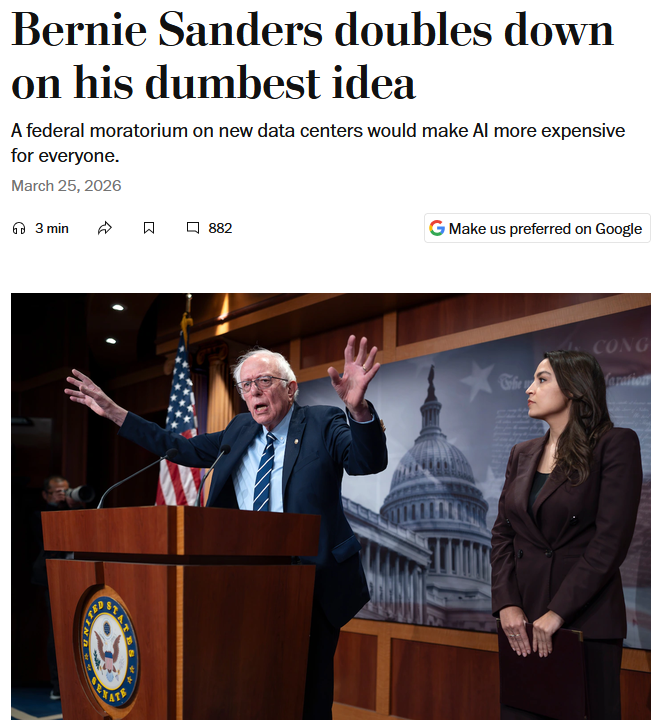
WaPo: Bernie Sanders doubles down on his dumbest idea

The Washington Post (3/25/26) calls Sen. Bernie Sanders “part of the lunatic fringe” because he wants “safeguards” on a technology whose developers routinely warn “could end humanity” (Nature4/21/26).

As grassroots fights against AI data centers spring up from coast to coast, opposition in the Senate is led by Sen. Bernie Sanders, who introduced a bill to place a two-year moratorium on the construction of new data centers.

Already a bête noire of the Post (FAIR.org3/8/16), Sanders’s critique of data centers has led to a renewed thrashing. In a March editorial (3/25/26) headlined “Bernie Sanders Doubles Down on His Dumbest Idea,” the Post placed Sanders at “the lunatic fringe” of society for “throwing sand into the gears of progress.” The editorial also called Sanders “the leading Luddite of the 2020s.”

Two weeks later, the Post (4/8/26) returned to the “L” word, this time in an editorial that didn’t mention Sanders, but did associate opposition to data centers with domestic terrorism:

The mob-like movement against data centers that’s been gaining traction across the country took a dark turn this week. Indianapolis Councilor Ron Gibson (D), who supports a project to build such a facility in his district, woke up early Monday to the sound of 13 gunshots fired at his home. The gunman left a note on the lawmaker’s doorstep: “NO DATA CENTERS.”

No one was injured, but the incident illustrates how opposition to artificial intelligence can metastasize into an irrational frenzy. It wouldn’t be the first time in history that deranged Luddites turn to violence to fight the advancement of frontier technology.

Later that month, the Post’s editorial page was back to attacking Sanders. Under a scowling picture of the senator, a Post editorial (4/30/26) charged that Sanders

is as naive now as he was during the Cold War. Rarely, if ever, has the socialist met an enemy of the United States who he doesn’t think he can partner with to advance his agenda. The same impulse that led Sanders to cozy up to the Soviets, the Sandinistas and Fidel Castro in the 1980s was on display again Wednesday night at the Capitol as he invited two Chinese academics to urge Americans to slow-roll our pursuit of artificial intelligence.

“Of course that’s what Beijing wants Washington to do,” the Post continued, in a brazen attempt to paint skepticism of AI data centers—a view held by most Americans—as anti-American.

The Post’s inflammatory editorial mentioned neither Bezos or Amazon, per usual.

The billionaire project
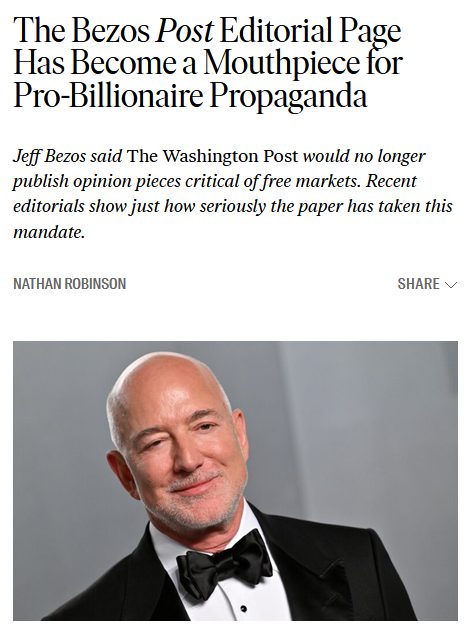
Nation: The Bezos Post Editorial Page Has Become a Mouthpiece for Pro-Billionaire Propaganda

“It’s remarkable how brazen the paper is about shilling for the financial interests of its owner,” writes Nathan Robinson (The Nation4/21/26) . “Some of these headlines might as well read ‘Don’t Tax Jeff Bezos More,’ ‘Don’t Let Unions Threaten Jeff Bezos’ Control Over His Workers,’ ‘Don’t Stop Jeff Bezos From Building Data Centers in Your Town.’”

It’s not just Bezos’ financial interests that are advanced by O’Neal’s Opinions page, but also Bezos’ and his fellow billionaires’ broader ideological project (Real News Network5/22/26).

Under O’Neal’s watch, no tax on the wealthy seems to go uncensured. “The Post has weighed in on tax policy everywhere from Switzerland to Seattle, lambasting every attempt to reduce the grotesque inequality of our times,” Nathan Robinson wrote in a detailed review of the Post Opinions page for The Nation (4/21/26):

Almost no tax on the rich around the world escapes the paper’s notice—one might wonder why capital gains taxes in the Netherlands are a priority for a DC paper.

And no social program appears too small to earn O’Neal’s ire, not even diapers. In providing 400 free diapers to new parents, “California’s nanny state is taking infantilization to a new level,” decried a Post editorial (5/12/26).

Other recent Post editorials have “opposed minimum wage increases, tenant protectionssocial housingrent controlfree buses, caps on credit card interest rates, caps on the prices of staple foodscongestion pricing and even the Railway Safety Act,”  wrote Robinson.

But when government largesse flows to the rich, the Post is more open minded. The Trump administration’s request for another $200 billion for the Iran War, as well as a $1.5 trillion Pentagon budget for next year, both received the Post’s blessing (3/21/265/12/26). “Peace doesn’t come cheap,” the Post wrote.

Left unmentioned in the editorials is that Bezos’ empire—via his space company Blue Origin and Amazon’s cloud computing arm, AWS—holds billions of dollars worth of Pentagon contracts.

FAIR’s work is sustained by our generous contributors, who allow us to remain independent. Donate today to be a part of this important mission.

Article by Pete Tucker republished from FAIR under a Creative Commons Attribution-NonCommercial-NoDerivs 3.0 Unported License.

Continue ReadingOne Year Into Clampdown, WaPo Opinion Cheers for MAGA, Billionaires and AI

Corporate Pundits Panic Over Democratic Voters’ Socialist Preferences

Spread the love

Raina Lipsitz

New Yorkers elected progressives and democratic socialists up and down the ballot in June’s Democratic primary, in what even critics acknowledged was “an historic near-sweep” (New York Daily News, 6/27/26). Alarmed by voters’ rejection of corporate media’s preference for moderates (FAIR.org, 8/21/19), establishment media outlets reacted with panicked op-eds and articles downplaying the significance of the results.

New York City “isn’t reflective of the country,” declared a Washington Post editorial (6/24/26) published the day after the election. The paper, which billionaire Amazon founder Jeff Bezos bought in 2013, added that “the base detests anyone perceived as part of the establishment, no matter how progressive their voting record.”

In the Post’s view, voters’ irrational hatred of the establishment “puts pressure on leadership to lurch leftward”—in other words, respond to voters’ demonstrated needs and preferences. It’s voters’ desires, not politicians who repeatedly defy the will of voters, that “will make it harder for Democrats to win in 2028.”

Even US Rep. Dan Goldman’s “liberal voting record” wasn’t “enough to save him,” the Post lamented. Missing from this editorial was any attempt to define its terms (e.g., what makes a voting record progressive or liberal?) or understand what drove these results (why are voters so angry at the establishment?). Instead, it dismissed Democratic voters as clueless members of the “far left,” fueled by inexplicable anger at their sober-minded betters.

Organizing the ‘reasonable’

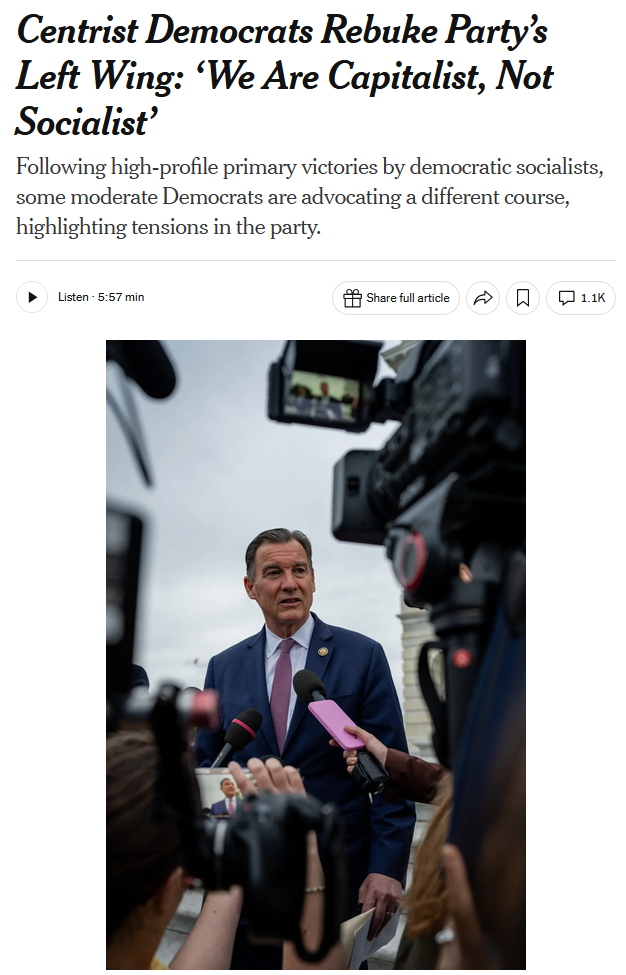
NYT: Centrist Democrats Rebuke Party’s Left Wing: ‘We Are Capitalist, Not Socialist’

The New York Times (6/26/26) quoted a co-founder of the corporate-backed Third Way think tank as saying that DSA victories would allow Republicans to “weaponize the craziest ideas of the activist left.” 

Others in corporate media grasped one key to these wins: the months of organizing and door-knocking that made them possible, some of which I participated in as a member of the Democratic Socialists of America (DSA). But they failed to understand, or pretended not to see, that it’s just as essential to have a policy agenda that excites voters.

CNN political commentator Van Jones tweeted at his fellow moderates that “reasonable” Democrats were going to have to

get off their couches, roll up their sleeves and start organizing…. We can no longer rely only on TV ads, digital spend and endorsements…. If you are a Democrat who believes in opportunity, dignity and democracy for all—but you don’t hate rich people, cops, free enterprise, the West, Israel and the United States of America—I’m talking to you!

Rep. Tom Suozzi of New York, a self-styled moderate, made similar remarks to the New York Times (6/26/26):

The bottom line is that you have to give the DSA and you have to give MAGA credit, because they’re organized…. And the people that don’t agree with their philosophies wring their hands at cocktail parties, but they’re not organized. So we have to get organized.

Can moderates catch up to progressives simply by attending more meetings and fewer cocktail parties? It’s a start, but the election results suggest that their ideas simply do not hold much appeal to rank-and-file Democratic voters. Jones, Suozzi and their fellow “reasonable” Democrats are welcome to go door-to-door to try to interest Democratic voters in policies they see as both pro-rich people, pro-cop, pro-Israel and middle-of-the-road, but recent polls indicate that a majority won’t be interested.

According to a 2026 Siena poll, 54% of all New York voters support a tax increase on New York City residents making over $1 million per year. Support was even higher among New York City voters, 62% of whom favor such a tax hike, and state Democrats, 72% of whom support it.

An exit poll released shortly after New York City’s 2025 mayoral primary revealed that two in three voters listed crime and public safety, along with homelessness, as some of the biggest issues facing the city. But when asked to choose which idea more closely aligned with their views, 75% of respondents said they’d rather address crime and safety by increasing “treatment for mental health and drug addiction and getting illegal guns off the street” versus giving more resources to police, increasing sentences for people convicted of violent crimes and strengthening bail laws.

A 2025 poll conducted by YouGov on behalf of the ACLU also found that 69% of voters think having mental health and addiction specialists rather than cops respond to calls related to mental health, homelessness and substance use would improve community safety.

And according to a 2026 Pew Research Center poll, eight in 10 Democrats and Democratic-leaning independents have an unfavorable view of Israel.

‘Threatening to unleash a debate’

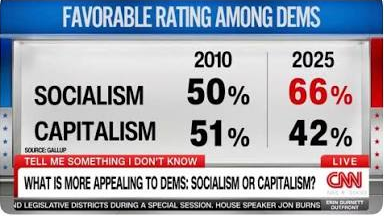
CNN: What is more appealing to Dems: Socialism or Capitalism?

CNN (6/25/26): “Democrats last year had a significantly more favorable view of socialism (66%) than capitalism (42%).”

Despite the fact that solid majorities of Democrats now favor tax hikes on the rich and public safety solutions that reduce the need for cops, prefer socialism to capitalism and hold a negative view of Israel, corporate media outlets are committed to portraying these voters as deeply dividedNew York Times contributor Tim Balk (6/26/26) wrote:

With four months until the midterm elections, the [electoral] outcomes in New York have deepened divisions in the Democratic Party, threatening to unleash a renewed internal debate about electability and how Democrats speak about capitalism.

Speaking of electability, democratic socialists have won races throughout New York City and across the state: in the Hudson Valley, where Sarahana Shrestha has held a state assembly seat since 2023; in Central New York, where Onondaga County legislator Maurice “Mo” Brown just beat one of the area’s longest-serving incumbents in a race for a state assembly seat; and in Western New York, where DSA-backed Buffalo attorney Adam Bojak just won a state assembly seat by a massive margin, and where democratic socialist Brian Nowak has been Cheektowaga town supervisor since 2023.

They are also winning outside of New York: Democratic ⁠socialist Melat Kiros just toppled 15-term US House Rep. Diana DeGette in the primary election in a district that encompasses Denver, Colorado; democratic socialist Janeese Lewis George (FAIR.org6/5/26) is poised to become the mayor of Washington, DC; and Georgia voters sent democratic socialist Gabriel Sanchez to the Georgia General Assembly in 2024.

‘Differed little on policy’

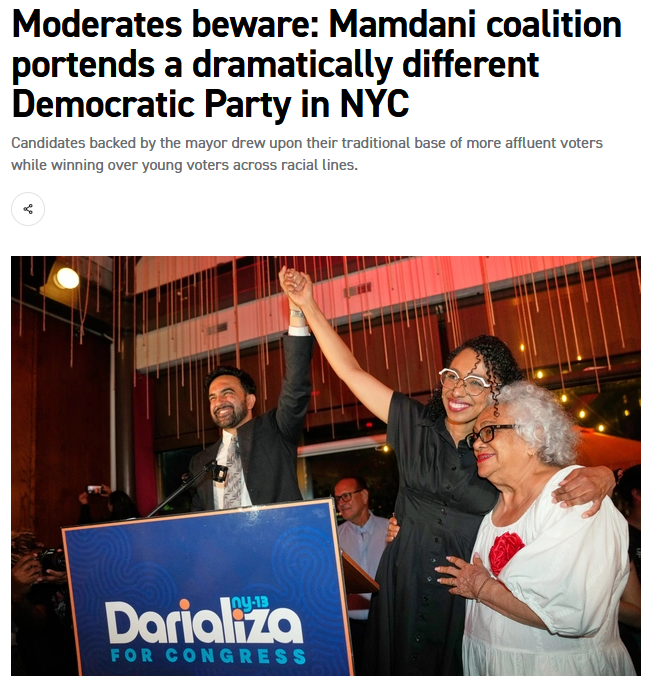
Politico: Moderates beware: Mamdani coalition portends a dramatically different Democratic Party in NYC

Politico (6/26/26) claimed that DSA’s candidates “differed little on policy”—which fails to explain the “staggering” results that ” charted the far left’s broadening appeal and a potential reorientation of the electorate that will influence races for years to come.”

Whether these election results have “deepened” divisions within the Democratic Party or merely exposed them, centrists and their media allies are desperate to neutralize them. According to the Daily News’ Evan Thies (6/27/26):

The issues that the vast majority of those [DSA-aligned] candidates ran on—higher taxes for the wealthy, immigrant rights, a stronger social safety net—are also the issues that ‘establishment’ candidates ran on…. In the congressional races in particular, other than differences on Israel, you would be hard-pressed to find a major part of any insurgent’s platform that was not also a plank of their opponent’s.

Politico (6/26/26) had a similar take:

A series of hotly contested congressional and state elections pit a slate of Mamdani-backed democratic socialists and progressives against establishment candidates who, in several cases, differed little on policy aside from US/Israel relations.

But the “differences on Israel” that pundits are so eager to gloss over were essential, not incidental, to many of these victories. It turns out Democratic voters are really angry at many longtime incumbents for supporting and funding an ongoing genocide, and eager to vote for candidates who have actively worked to stop it.

There were other key differences in policy and governing philosophy between these candidates as well. A New York Times story (6/1/26) about the primary battle between the DSA-backed Claire Valdez and the Working Families Party–backed Antonio Reynoso first stated that “the policy distinctions in the race can be difficult to discern”—before going on to discern:

Where [Reynoso] has advocated reforms within existing systems, [Valdez] wants to shrink the private sector and drastically ramp up the federal government’s role in building housing…. The assemblywoman and her allies have also knocked Mr. Reynoso for accepting tens of thousands of dollars in campaign contributions from people connected to the real estate industry.

In a profile headlined “Like AOC, But to the Left,” City & State (6/15/26) wrote that DSA-backed challenger Darializa Avila Chevalier had “a totally different worldview, with a totally different relationship to the district,” compared with longtime incumbent Adriano Espaillat.

Progressive flukes, centrist acumen

Whether or not these differences mattered to pundits, voters appeared to take note: Valdez won her race by over 20 points, and Chevalier won hers—which many considered a long shot—by a clear but smaller margin.

As usual, corporate media outlets covered these progressive victories as if they were flukes, while treating less significant centrist victories as evidence of political acumen. In his Times story (6/26/26) on centrist Democrats who reject “false choices between extremes on right and left,” Balk described Suozzi as “a New York Democrat who flipped a swing district” on Long Island in 2024.

In 2024, Suozzi beat his Republican opponent by just 3.6 points in the general election; the seat he “flipped” was formerly occupied by Republican George Santos, who was exposed as a serial liar within months of being elected and expelled from Congress about a year later. Santos only won the seat after Suozzi gave it up to challenge Gov. Kathy Hochul from the right in New York’s 2022 gubernatorial primary.

In 2024, Suozzi narrowly regained his old seat by espousing policies that voters in one of the wealthiest congressional districts in the state and country slightly preferred. But when he ran statewide, he won just 13% of the vote—or 6 points less than Jumaane Williams, who also lost to then-Governor Hochul by a wide margin, but earned 56,900 more votes than Suozzi by challenging her from the left.

‘An elite of well-educated professionals’

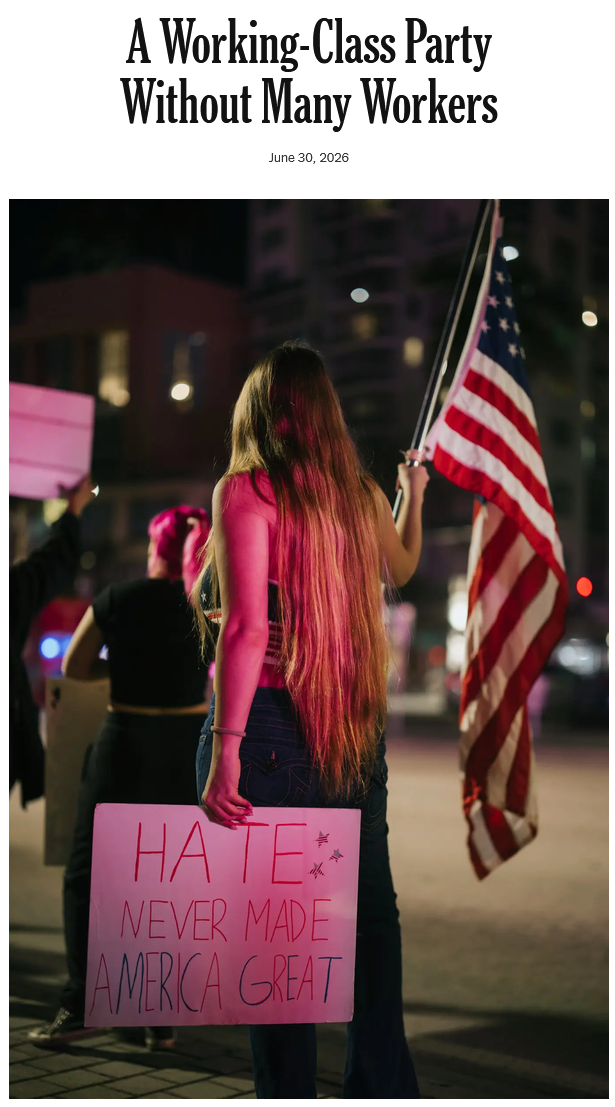
New York Times: A Working-Class Party Without Many Workers

According to the New York Times‘ Thomas Edsall (6/30/26), if you have a college degree, you “are in no way working class.”

Another popular strategy for undermining progressive wins is suggesting that only rich white college kids support them (New York Post6/25/26). As the New York Times’ Thomas Edsall (6/30/26) wrote, “Candidates aligned with the Democratic Socialists of America are surging to victory on the claim that they are proponents of ‘a government by, for and of the working class.’” He countered:

Most of the leadership of the DSA and a majority of voters who back its candidates are in no way working class. Instead, an elite made up of well-educated professionals dominates this insurgency.

Furthermore, he added, DSA’s agenda is

packed with policies supported by left-wing liberals, white progressives in particular, but strongly opposed by both white and minority working-class (defined, in pollster shorthand, as non-college-educated) voters.

Putting aside the larger question of who belongs to “the working class” in the US today, which Edsall addressed only obliquely—when he described DSA’s “key constituency” as “the universe of young people with college degrees struggling to find rewarding work, the so-called precariat,” it sure doesn’t sound like he’s talking about the haute bourgeoisie—it is flatly untrue that voters of color oppose DSA policies and candidates.

As data analyst Michael Lange explained on his blog (Narrative Wars6/29/26), DSA candidate “Darializa Avila Chevalier won Black voters…against a 10-year Democratic incumbent in the historic capital of Black America,” while DSA’s

Claire Valdez won every age bracket and racial group…. This is not the electoral footprint of a gentrifier candidate, squeaking past on margins from Millennial and Gen-Z (white) transplants; it is the signature of a multiracial, cross-generational coalition.

Even Politico (6/26/26) acknowledged that

Congressional candidates backed by the Democratic Socialists of America were able to replicate [Mamdani’s] success by winning younger Latino voters in Brooklyn and a majority of Black voters in Harlem…. The result charted the far left’s broadening appeal and a potential reorientation of the electorate that will influence races for years to come.

The case for cowardice

Edsall declared that DSA’s support for trans rights “would be met with some skepticism if not hostility by working-class voters disdainful” of ideas like “bodily autonomy” and “moving past…conservative norms around gender.” Like many of his colleagues at the Times, Edsall parses voter attitudes toward trans rights at length, without bothering to note that they—like attitudes toward interracial marriage, gay marriage, policing, abortion and immigrants’ rights—have changed quite a bit in the last five to 50 years, in response to movement pressure and shifting social, political and economic conditions.

Should DSA abandon its trans members and siblings because, as Edsall (6/30/26) writes, “surveys consistently show that non-college voters are significantly more opposed to more progressive transgender policies than college-educated voters”? Or should it continue to organize and lead on these and other issues in hopes of building support for human rights across the board?

Even in 2021, when public safety was a top concern of NYC voters, many of whom wanted more cops on the streets, polling showed that the largest share of voters favored reducing crime by “shifting police funding to mental health” (NBC6/14/21). New York elected former cop Eric Adams mayor that year. Four years later, Adams’ support had cratered and, according to Siena College Research Institute’s director, Don Levy, “Crime remain[ed] a concern…but over 90% [of NYC voters surveyed] say just affording life is a problem.”

In 2025, New Yorkers elected democratic socialist Zohran Mamdani in the Democratic mayoral primary by a much larger margin than Adams’. One thing we can learn from the recent wave of progressive wins is that public opinion doesn’t shift in a vacuum; movements and leaders shift it.

FAIR’s work is sustained by our generous contributors, who allow us to remain independent. Donate today to be a part of this important mission.


This work is licensed under a Creative Commons Attribution-NonCommercial-NoDerivs 3.0 Unported License.

Continue ReadingCorporate Pundits Panic Over Democratic Voters’ Socialist Preferences

For US Commentators on Iran, Mass Murder Is Magic

Spread the love

Article by Gregory Shupak republished from FAIR under http://creativecommons.org/licenses/by-nc-nd/3.0/

In the wake of the temporary US/Iran ceasefire, hawkish commentary in leading American newspapers advanced the premise that the US can dictate terms to Iran in negotiations, with a faith in the power of Washington’s military might that was hard to justify by the previous course of the war.

Washington Post editorial (4/8/26) contended:

Despite the massive damage inflicted upon the country by the US in recent weeks, the regime acts like it holds the cards. Its leaders are demanding the US pull all troops out of the Middle East and accept Iran’s right to pursue nuclear weapons. The question is why Trump would bend over backward to keep obviously unserious talks on track.

Whether the Post likes it or not, Iran has a decent hand to play. For instance, Iranian drones cost just $20,000 to produce, and the US uses missiles that cost $4 million each to try and destroy them (Bloomberg3/2/26). Less than three weeks into the war, the US was already estimated to have spent more than $18 billion attacking Iran (Guardian3/19/26). The longer Iran can hold out, the more it financially bleeds the US.

The majority of Americans already consistently oppose the war (NBC News4/1/26) and, as costs spiral, domestic opposition to the US’s assault is likely to grow. In this context, the paper may need to revise its definition of seriousness to include accepting that Iran has the power to resist US bullying and bluster.

‘More work to degrade’

CNN: US intelligence assesses Iran maintains significant missile launching capability, sources say

An intelligence source tells CNN (4/2/26) that Iran is “still very much poised to wreak absolute havoc throughout the entire region.”

The Washington Post editorial also said that there “is still more work to be done to degrade Iran’s offensive capabilities and its capacity to rebuild them.” “Offensive” here is a propaganda term, as Iran has not launched an aggressive war in nearly two centuries—unlike the United States and Israel, which have attacked Iran twice in the last year.

By reversing victim and offender, the Post was transparently calling for the US to resume bombing Iran; after all, it’s through war that one country “degrades” another’s military capacity. But it’s not that the US and Israel didn’t try to destroy Iranian capabilities; rather, they tried and have not succeeded.

Less than a week before the ceasefire, a CNN report (4/2/26) said US intelligence had assessed that

roughly half of Iran’s missile launchers are still intact and thousands of one-way attack drones remain in Iran’s arsenal, despite the daily pounding by US and Israeli strikes against military targets over the past five weeks….

The intelligence, compiled in recent days, also showed a large percentage of Iran’s coastal defense cruise missiles were intact, the sources said, consistent with the US not focusing its air campaign on coastal military assets, though they have been hitting ships. Those missiles serve as a key capability allowing Iran to threaten shipping traffic in the Strait of Hormuz.

Iran retained that capacity despite the US hitting more than 12,300 targets in Iran, according to US Central Command. Israel, for its part, said it had dropped 15,000 bombs on Iran since February 28 (Jerusalem Post3/25/26).

The Post offered no insight into why it believes the US/Israeli assault will suddenly become more effective.

‘Finish the job’

WSJ: Trump Declares Premature Victory in Iran

“If the [Iranian] regime behaves as it always has, it will claim to want to reach a deal but never will,” the Wall Street Journal (4/8/26) writes—stuffing the 2015 Iran nuclear agreement down the memory hole.Wall StreetJournal editorial (4/8/26) echoed the Post, writing that “the Iranian regime remains a threat in the Strait of Hormuz and the job is far from finished.” The Journal insisted that the US should restart the war if it doesn’t get its way:

The next test for Mr. Trump will be whether he takes his two-week ceasefire deadline seriously. If he does, and Iran plays its usual games, then he really will have to “finish the job.”

Such calls overlook the limits to US war-making capacity. Analysts at Colorado’s Payne Institute for Public Policy, cited by the Australian Broadcasting Corporation (4/1/26), “assessed that the US had lost nearly 46% of its Army Tactical Missile Systems (ATACMS),” one of the US’s main tactical ballistic weapons. Likewise, they estimated that

supplies of Terminal High Altitude Area Defense (THAAD) missile systems, used by the US and its partners in the region to defend against Iranian missiles, were also dropping significantly. Projections showed the THAAD interceptors could run out by mid-April.

The US also burned through 850 Tomahawk cruise missiles in the war’s first four weeks, “a rate that has alarmed some Pentagon officials” (Washington Post3/27/26). Meanwhile, the Arrow 2 and Arrow 3 interceptors that Israel used against Iran’s longer-range missiles “were also projected to be exhausted by the end of March” (Australian Broadcasting Corporation4/1/26). Unlike the Journal’s lust for violence, the US/Israeli arsenal is finite.

‘Circle of death’

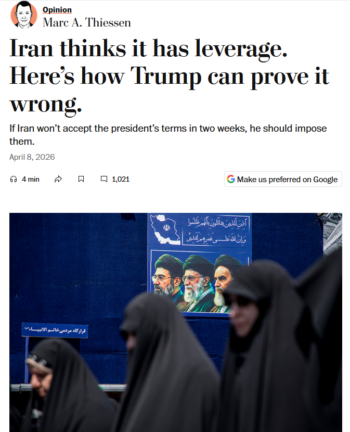
WaPo: Iran thinks it has leverage. Here’s how Trump can prove it wrong.

Marc Thiessen (Washington Post4/8/26) asserts that Trump can “bring the war to a final and decisive conclusion…in a matter of weeks”—disregarding the fact that nearly six weeks of all-out war were far from decisive.

Nor did these constraints prevent the Washington Post‘s Marc A. Thiessen (4/8/26) from calling on Trump to create a “circle of death” around any former nuclear sites in Iran, and enforce it by “killing any Iranian who enters that circle.” He also suggested another round of assassinations, “eliminating the Iranian officials who had been spared for the purpose of negotiations,” so that the country’s leaders understand that if they fail to reach “a negotiated settlement to Trump’s liking…they will be killed.”

Murderous fantasies about the US imposing total domination over Iran are perhaps a symptom of the US being unable to do so in reality. As Thiessen’s own paper (4/3/26) reported, despite the US/Israeli assassinations of high-ranking Iranian officials,

Iran has continued to launch retaliatory attacks, often hitting high-value targets, demonstrating sustained command and control beyond the conflict’s initial days when units largely operated on autopilot under Iran’s “mosaic” defense strategy, which emphasizes decentralized autonomy. In recent weeks, Iranian attacks have struck critical energy infrastructure in the Persian Gulf, industrial and energy sites in Israel, and key US military installations, including a direct strike on an advanced US spy plane.

In other words, decapitating the Iranian government hasn’t caused it to capitulate or prevented it from responding to US/Israeli attacks, but Thiessen—for reasons he did not explain—thinks that doing the same thing again will produce a different result.

Thiessen also said that the US should

develop and implement a covert action plan to support the Iranian opposition…. Such a plan could involve supplying the Iranian opposition with weapons, much as the US once provided arms to anti-Communist “freedom fighters” across the world.

The overriding goal should be to help the Iranian people, over time, bring down this murderous regime.

Set aside that this plan would violate the UN Charter’s principle of nonintervention and that the US has zero right to shape who governs Iran. In reality, multiple US intelligence reports conclude that Iran’s government “is not in danger” of falling (Reuters3/11/26). Israeli officials also think that Iran’s government “isn’t likely to fall soon” (Wall Street Journal3/12/26).

While there’s little reason to believe that Thiessen’s proposal would produce regime change in Iran, we can be fairly confident that flooding Iran with weapons will have the same outcome that flooding countries with arms generally has—namely, a devastating bloodbath for its inhabitants (Electronic Intifada3/16/17Jacobin9/11/21).

‘The easiest method’

NYT: How Trump Can Wrap Up the War

Bret Stephens (New York Times4/14/26) advises Trump to “keep turning the screws on the regime’s leaders”—a torture metaphor from an advocate of actual torture.

Bret Stephens of the New York Times (4/14/26) likewise wrote from an alternate reality where the war showed that the US can impose its will on Iran. Stephens opened by quoting his own piece (4/7/26) from the previous week :

“The easiest method for the United States to reopen Hormuz,” I wrote last Tuesday, “is to start seizing tankers carrying Iranian crude once they reach the Arabian Sea.”

It’s not clear why Stephens thought seizing Iranian ships would cause Iran to back down. After all, assassinating many of the country’s leaders, attacking Iranian health facilities (Al Jazeera4/3/26) and vital civilian infrastructure (BBC3/19/26), and mass-murdering Iranian school girls (Guardian3/3/26) did not compel the country to stop defending itself.

Stephens went on to contend:

Trump should put Iran’s regime to a fundamental choice: It can have an economy. Or the regime can attempt to have a nuclear program while trying to control the Strait of Hormuz. But it can’t have both.

This quote suggests Stephens was unwilling to seriously grapple with Iran’s retaliatory power. For example, Iran has consistently responded to US aggression by attacking the empire’s regional nodes, killing Israelis (BBC3/1/26Reuters4/6/26) and badly damaging Israeli infrastructure (Al Jazeera3/21/26).

Iranian countermeasures have likewise hit energy infrastructure in the US’s client states in the Gulf, leading—for example—to fires at Kuwaiti oil and petrochemical facilities, at a petrochemical plant in the UAE and at a storage tank in Bahrain (AFP4/5/26). In other words, Iran has illustrated that it has a multitude of options for raising the costs of US violence, indicating it would likely continue exercising these in the scenario Stephens advocates.

‘Broke the petrodollar’

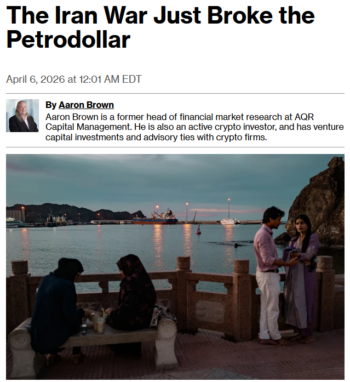
Bloomberg: The Iran War Just Broke the Petrodollar

Aaron Brown (Bloomberg4/6/26) notes that while investment generally flows into the US Treasury in times of crisis, “the calculus changes when the US itself is the belligerent.”

None of these commentators acknowledge what is likely the strongest blow that Iran has landed against the US. The Islamic Republic has undermined what’s called the petrodollar regime, a system in which the US promises to militarily protect the Gulf monarchies in exchange for these states putting money they earn from oil sales into US assets—most notably Treasury bonds. The arrangement, which has been in place since 1974, subsidizes US borrowing costs and keeps the US dollar as the de facto global reserve currency.

Bloomberg (4/6/26) reports that the war on Iran “broke the petrodollar,” because the conflict is “categorically different” from other political, military and economic crises of the post-1974 period:

Gulf producers can’t get their oil out. The Strait of Hormuz closure has stranded their barrels along with everyone else’s.

Gulf states including Kuwait, Iraq, Saudi Arabia and the UAE collectively cut production by at least 10 million barrels per day in March. Saudi Arabia and the UAE can export reduced volumes through alternative pipelines. But those routes handle only about a quarter of normal Strait throughput at full capacity, and they are under active Iranian drone and missile threat. Qatar declared force majeure on exports of liquified natural gas after strikes on its Ras Laffan facility.

Thus, Iran has shown that it can hinder, and possibly destroy, a central plank in the architecture of the US empire. Stephens, Thiessen and the editorial boards of the Journal and the Post appear to be deluding themselves about the gravity of this development. Iran has successfully resisted subjugation, largely by jeopardizing a key instrument of US global hegemony, but these authors have gone on writing as if Washington were in a position to force Iran to surrender to its diktats.

These observers traffic in illusions about a virtually omnipotent US that can indefinitely control the world through force of arms, consequence-free. Op-ed writing is supposed to be persuasive. In that regard, these authors have failed spectacularly.

FAIR’s work is sustained by our generous contributors, who allow us to remain independent. Donate today to be a part of this important mission.

Article by Gregory Shupak republished from FAIR under http://creativecommons.org/licenses/by-nc-nd/3.0/

Donald Trump sings and dances, says that it's fun to kill everyone ...
Donald Trump sings and dances, says that it’s fun to kill everyone …
Keir Starmer explains that UK is actively supporting Israel's genocidal expansion and repeats his previous quotation that he supports Zionism "without qualification". Keir Starmer said “I said it loud and clear – and meant it – that I support Zionism without qualification.” here: https://www.jewishnews.co.uk/keir-starmer-interview-i-will-work-to-eradicate-antisemitism-from-day-one/
Keir Starmer explains that UK is actively supporting Israel’s genocidal expansion and repeats his previous quotation that he supports Zionism “without qualification”. Keir Starmer said “I said it loud and clear – and meant it – that I support Zionism without qualification.” here: https://www.jewishnews.co.uk/keir-starmer-interview-i-will-work-to-eradicate-antisemitism-from-day-one/

Continue ReadingFor US Commentators on Iran, Mass Murder Is Magic

Democracy dies in broad daylight: the Trump administration’s frontal assault on the free press

Spread the love
Trump’s aggressive mouthpiece: White House press secretary, Karoline Leavitt. EPA/Will Oliver

Kristin Skare Orgeret, Oslo Metropolitan University and Lea Hellmueller, City St George’s, University of London

When the billionaire owner of Amazon, Jeff Bezos, bought the Washington Post from the Graham family in 2013, he promised a “golden era to come”. In February 2017, one month into Donald Trump’s first term as US president, the paper adopted the motto: “Democracy Dies in Darkness”, reflecting the perceived threat posed by Trump’s authoritarian leanings and the suggestion that Moscow had interfered in the 2016 election.

That motto was turned against Bezos last week when it was announced that the Post was laying off one-third of its editorial staff, including its sports section and several of its foreign bureaus. The news was greeted with dismay in America’s journalistic circles. Marty Baron, a celebrated former executive editor of the Post, called the layoffs “among the darkest days in the history of one of the world’s greatest news organisations”.

But in the years since Bezos acquired the Post it has become a symbol of a global wave of democratic backsliding in the US which accelerated as the prospect of a second Trump presidency grew through 2024. After an initial period of investing in the Post and hiring more reporters, he has now overseen a long period of decline.

Political concerns began seriously to mount in 2024 when, in the run up to that year’s presidential election, the newspaper broke a 36-year precedent by refusing to endorse a candidate (which most readers, given the paper’s traditionally liberal leanings, had assumed would be Democrat Kamala Harris).

Since Trump has returned to the White House further evidence of this backsliding at the Post includes suppression of a cartoon critical of Trump’s relationship with US tech oligarchs by the Pulitzer Prize winning artist Ann Telnaes and a refocusing of the opinion pages to centre them on “personal liberties and free markets”. The changes have reportedly cost the Post many thousands of subscribers.

A cartoon showing American tech billionaires bowing before a statue of Donald Trump and offering bags of money.
The cartoon that led to Ann Telnaes quitting the Washington Post. Facebook

But the malaise in US journalism is a much broader story than just the travails of the Washington Post. There’s a sustained campaign of cultural and structural violence against a profession that is under economic and political strain, yet essential to democracy.

Trump’s hostility toward certain sections of the press is not new. During his first term he used non-journalistic platforms to brand mainstream media outlets “the enemy of the people”. His hostility was directed at both institutional and personal level, launching attacks against individual journalists and their employers (the “failing New York Times”, his clash with CNN’s Jim Acosta, etc).

In his second term this hostility has intensified, its impact often obscured by the rapid pace of news emanating from the White House. We’re seeing press freedom in the US under attack on three distinct fronts: restricted access to information, threats to the safety of journalists and use of legal pressure to discourage dissenting voices.

Controlling the message

Restrictions began as soon as Trump was inaugurated for his second term in January 2025. Within a month, the Associated Press lost access to the Oval Office and Air Force One (in other words, to direct contact with the president) after refusing to adopt an executive order renaming the Gulf of Mexico the “Gulf of America”.

Accreditation rules soon tightened. In October, the newly minted secretary of war Pete Hegseth announced that henceforth journalists reporting from inside the Pentagon would be allowed to only report official government pronouncements. Many mainstream reporters handed back their Pentagon accreditation in protest. In response, Hegseth announced what he called the “next generation of the Pentagon press corps”, mainly comprising journalist from far-right outlets.

Meanwhile the president’s verbal attacks on journalists have escalated, particularly targeting women and especially women of colour. Incidents such as the “quiet Piggy” remark (directed at Bloomberg journalist Catherine Lucey) exemplify a broader pattern of public humiliation of female journalists. Research suggests that such conduct contributes to the normalisation of hostility toward female journalists, who were already disproportionately quitting journalism.

‘Quiet piggy’: Donald Trump targets a female reporter on Air Force One.

Journalists covering protests also face heightened risks. During the “no kings” demonstrations in October 2025, multiple incidents were reported in which police used force against accredited reporters. In November 2025 the White House escalated the pressure, launching a “Hall of Shame” site naming journalists and outlets it said had misrepresented the administration.

‘Lawfare’

The Trump administration has also brought considerable legal pressure to bear on the news media over the first year of its second term. The US president has filed multiple lawsuits alleging bias on the part of one or another media organisation that had attracted his disfavour.

In July, Paramount reached a US$16 million (£11.69 million) settlement over a 60 Minutes interview with Kamala Harris in 2024 that the president accused of bias. At stake was a US$8.4 billion merger that required approval from the Federal Communications Commission, a public body headed by Trump loyalist Brendan Carr.

The president also has active suits against the Wall Street Journal and the BBC (an episode which led to the resignation of director general, Tim Davie, and its head of news, Deborah Turness). By the middle of 2025, Axios reported that Trump-related media and defamation suits had already matched the annual historical record.

Democratic backsliding

Taken together, these developments reflect a broader pattern of institutional stress affecting US democratic structures. The pressure on these established media organisations has created a situation in which they manage to survive with their independence eroded.

Comparative research consistently demonstrates that journalists are among the first actors targeted in such processes because of their frontline work. Control over information remains central to the success of an authoritarian government.

What, then, should journalists and media organisations do? Standing together matters. We saw that in 2018, when about 350 American newspapers jointly defended press independence against Trump’s “fake news” attacks. This prompted the US Senate to adopt a resolution supporting a free press and declaring that “the press is not the enemy of the people”.

But the danger is that this structural violence against the news media and its attempt to hold power to account becomes normalised. If the Trump administration’s contempt for the fourth estate continues to percolate through to the public at large, a population already struggling to tell truth from lies will be further blindfolded and darkness will fall over American democracy.

Kristin Skare Orgeret, Professor of Journalism and Media Studies, Oslo Metropolitan University and Lea Hellmueller, Associate Professor and Associate Dean of Research, City St George’s, University of London

This article is republished from The Conversation under a Creative Commons license. Read the original article.

Elon Musk urges you to be a Fascist like him, says that you can ignore facts and reality then.
Donald Fuhrump says that Amerikkka doesn't bother with crimes or charges anymore, not being 100% Amerikkkan and opposing his real estate intentions is enough.
Donald Fuhrump says that Amerikkka doesn’t bother with crimes or charges anymore, not being 100% Amerikkkan and opposing his real estate intentions is enough.
Orcas discuss how Trump was re-elected and him being an obviously insane, xenophobic Fascist.

Continue ReadingDemocracy dies in broad daylight: the Trump administration’s frontal assault on the free press

Western Media Manufactured Consent for Israel’s Murder of Palestinian Journalists

Spread the love

Original article by Emma Lucia Llano repblished from FAIR under a Creative Commons Attribution-NonCommercial-NoDerivs 3.0 Unported License.
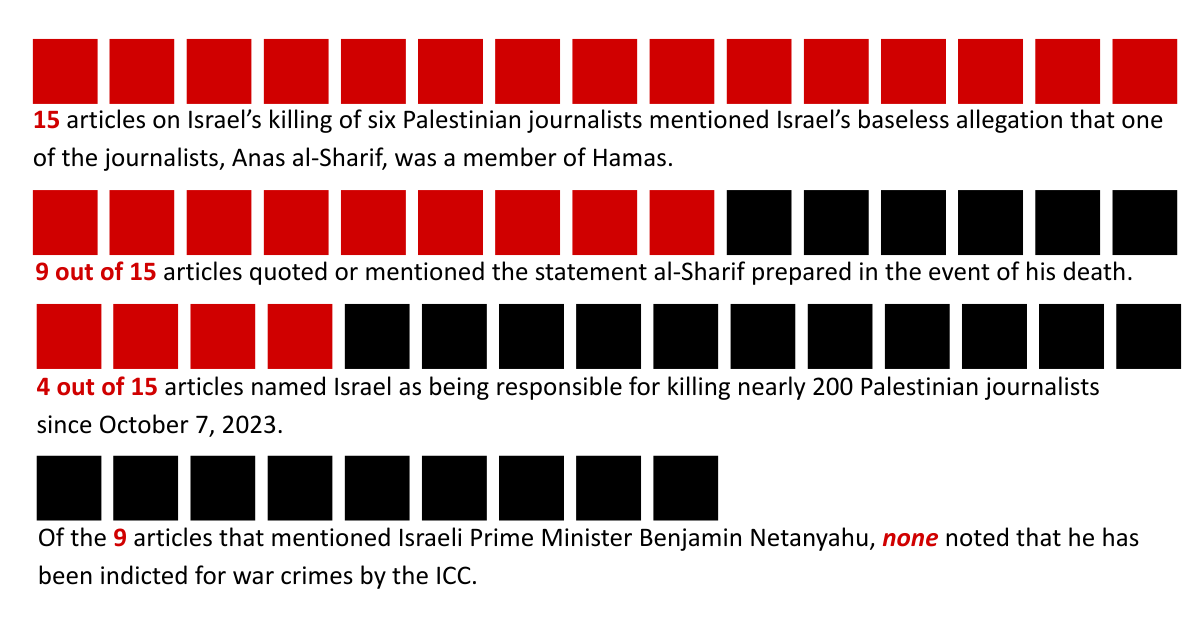
Graphic detailing what was and wasn't included in news reports on Israel's killing of Al Jazeera journalists.

Al Jazeera: Anas al-Sharif among four Al Jazeera journalists killed by Israel in Gaza

In his last dispatch for Al Jazeera (8/10/25), journalist Anas al-Sharif reported, “For the past two hours, the Israeli aggression on Gaza City has intensified.”

Israel’s targeted assassination of six Palestinian media members in the Gaza Strip on August 10 sent shockwaves through the journalism community. Though the murder of journalists has been a common tool of the Israeli’s government’s suppression of information coming out of Gaza, the loss of Al Jazeera‘s Anas al-Sharif was particularly harrowing.

Many of us had been moved by al-Sharif’s heart-wrenching coverage, from watching him remove his press vest in relief when a ceasefire was announced (1/19/25), to seeing a languid al-Sharif reporting on the famine (7/21/25) as people fainted around him. “Keep going, Anas, don’t stop,” said a voice off-camera. “You are our voice.”

Three of the victims were al-Sharif’s colleagues at Al Jazeera, one of the few media outlets that was able to keep journalists reporting in Gaza despite Israel’s blockade. As millions around the world grieved not just for al-Sharif but for his colleagues Mohammed Qreiqeh, Mohammed Noufal and Ibrahim Zaher, and freelancers Moamen Aliwa and Mohammad al-Khaldi, we were also gravely concerned about the vacuum their murders created of on-the-ground coverage of the genocide.

Establishment media, however, used these courageous journalists’ murders as an opportunity to continue parroting the same Zionist talking points that contributed to manufacturing consent for their killings. FAIR looked at 15 different news outlets’ initial coverage of the murders: the New York TimesLos Angeles TimesWashington PostWall Street JournalFinancial TimesABCCBSNBCCNNFoxBBCPoliticoNewsweekAssociated Press and Reuters.

We found that they overwhelmingly centered Israel’s narrative, attempted to delegitimize pro-Palestinian sources, and failed to contextualize the killings within the larger context of the genocide.

Prioritizing Israel’s pretext

Fox: Israel says Al Jazeera journalist killed in airstrike was head of Hamas 'terrorist cell'

Fox News (8/11/25) went farthest in embracing Israel’s “terrorist” narrative.

All of the articles mentioned Israel’s allegation that al-Sharif was a member of Hamas posing as a journalist, a claim that the Committee to Protect Journalists (CPJ), the Foreign Press Association and the United Nations have all found to be baseless.

Four of the 15 articles (New York Times8/10/25NBC, 8/10/25Fox8/11/25Wall Street Journal, 8/11/25) mentioned the allegations in either the headline or subhead. “Israel Kills Al Jazeera Journalists in Airstrike, Claiming One Worked for Hamas,” was NBC‘s headline, with Israel’s smear that al-Sharif “posed as a journalist” in the subhead. Fox offered “Israel Says Al Jazeera Journalist Killed in Airstrike Was Head of Hamas ‘Terrorist Cell.’”

Reuters’ original headline (8/11/25) was “Israel Kills Al Jazeera Journalist It Says Was Hamas Leader,” only later changed to “Israel Strike Kills Al Jazeera Journalists in Gaza.”

Al-Sharif had been targeted and smeared by the Israeli Defense Forces for months prior to his murder, and had written a statement in anticipation of his killing. “If these words reach you, know that Israel has succeeded in killing me and silencing my voice,” he wrote. He asked the world to continue fighting for justice in Palestine: “Do not forget Gaza.”

Six of the articles (ABC8/11/25BBC, 8/11/25New York Times8/10/25NBC8/10/25Fox8/11/25Wall Street Journal, 8/11/25) completely omitted references to or quotes from al-Sharif’s final statement. Of those six articles, the New York TimesBBCNBC and Fox did include quotes from Israeli government representatives—perplexingly choosing to prioritize the voices of al-Sharif’s killers over his own.

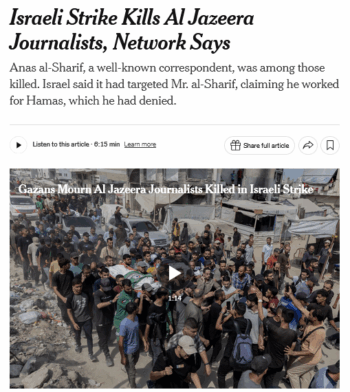
New York Times: Israeli Strike Kills Al Jazeera Journalists, Network Says

The New York Times (8/10/25) gave the Israeli government ample space to smear one of the journalists it had just killed, claiming he was “the head of a terrorist cell” who was “responsible for advancing rocket attacks against Israeli civilians.”

Coverage by the Wall Street Journal and New York Times devoted the most space to advancing Israel’s pretext for the killings. The Journal’s Anat Peled dedicated the first three paragraphs of her article to detailing al-Sharif’s supposed Hamas affiliation. Ephrat Livni of the Times also spent three paragraphs on the bogus allegations, allowing only one paragraph for a rebuttal from Al Jazeera and CPJ.

Every article except the ones from the New York Times (8/10/25) and Fox (8/11/25) cited the historically high number of Palestinian journalists that have been killed since October 7, 2023. The death toll currently stands at 192, according to the CPJ. However, only four articles (ABC8/11/25CNN8/10/25Politico8/11/25Wall Street Journal, 8/11/25) listed Israel as the primary perpetrator of these murders. More typically, the AP (8/11/25) wrote that “at least 192 journalists have been killed since Israel’s war in Gaza began,” leaving the identities of both these journalists and their killers unmentioned.

Six (ABC8/11/25BBC, 8/11/25Newsweek8/10/25Fox8/11/25CBS8/11/25Wall Street Journal8/11/25LA Times8/11/25) of the 15 articles failed to mention Prime Minister Benjamin Netanyahu, and none mentioned the International Criminal Court’s arrest warrant against him for war crimes and crimes against humanity, including murder and intentionally directing attacks against a civilian population.

Critically, only two articles (Wall Street Journal8/11/25Washington Post8/11/25) even noted the fact that the other five slain journalists had not been accused of belonging to Hamas. With this omission, the other outlets accepted and transmitted to audiences Israel’s premise that any number of bystanders can legitimately be killed in order to target a supposed Hamas member.

Unnecessary qualifiers

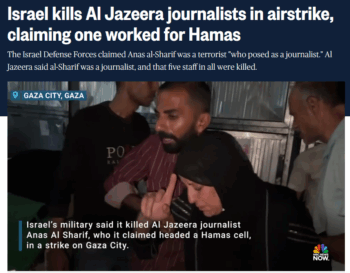
NBC: Israel kills Al Jazeera journalists in airstrike, claiming one worked for Hamas

Including the October 7, 2023, breakout as background for the killing of journalists, NBC (8/10/25) specified that “many of the targets of those attacks were civilians, including people attending a music festival.” Palestinians killed subsequently by Israel, by contrast, were just described as “people…in the Hamas-run enclave.” 

A common practice for Western media has been the use of unnecessary qualifiers to delegitimize information that comes from Palestinian sources. The coverage of al-Sharif’s assassination was no exception.

The BBC (8/11/25) wrote, “More than 61,000 people have been killed in Gaza since the Israeli military operation began, according to the territory’s Hamas-run health ministry.” Western media have taken it upon themselves to seemingly rename the Gaza Health Ministry (GHM) in order to cast doubt on the extent of Israel’s atrocities. They rarely note that a Lancet study (2/8/25) has found that the death toll could be up to 40% higher than what the GHM is reporting. The New York Times (8/10/25) and Reuters (8/11/25) also utilized “Hamas-run” to describe figures from the Gazan government.

These outlets also showed a clear bias as to how they characterize casualties. The New York Times (8/10/25), when reporting on the death toll in Gaza, wrote that the GHM doesn’t “distinguish between civilians and combatants.” Later on, the Times reported on Israeli deaths—and failed to distinguish between Israeli civilian and combatant deaths.

The implication is that some Palestinian deaths might be considered to be of lesser importance, or even justified, based on victims’ potential “combatant” status. Israeli deaths, meanwhile, are to be counted simply as human beings. The Washington Post (8/11/25) exhibited the same double standard in its reporting.

NBC (8/10/25) wrote, “Many of the targets of [the October 7] attacks were civilians, including people attending a music festival.” When reporting Palestinian deaths, NBC made no mention that over half of those killed by Israel have been women, children and the elderly. A more recent investigation found that civilians make up 83% of deaths, according to the IDF’s own data. The report also didn’t describe what Palestinian victims might have been doing when they were killed, such as the almost 1,400 who have been shot while seeking aid.

In addition to the usual rhetoric, eight of the 15 articles cast doubt on Al Jazeera by repeatedly mentioning its ownership by the Qatari government. (Qatar, like Israel, is one of 20 countries worldwide officially designated as a “major non-NATO ally” by the United States.) Three of the articles (New York Times8/10/25Wall Street Journal8/11/25; LA Times8/11/25) mention the Israeli government’s adversarial relationship with Al Jazeera, with the New York Times and the Journal dedicating several paragraphs to the outlet’s alleged ties to Hamas as the presumed basis for the conflict, rather than Al Jazeera‘s critical coverage of Israeli actions.

False equivalences

Reuters:

Reuters‘ original headline (8/11/25) was written from the point of view of al-Sharif’s killers. 

Only three of the articles use the word “famine” (Financial Times8/10/25; CNN8/10/25Newsweek8/10/25), and only the Financial Times mentions the word outside of quotes. Reuters (8/11/25) and the Wall Street Journal (8/11/25) called the situation “a hunger crisis” and “a humanitarian crisis that has pushed many Palestinians toward starvation,” respectively.

Media outlets continue to push the narrative that this so-called conflict began less than two years ago, as when NBC (8/10/25) wrote, “Israel launched the offensive in Gaza, targeting Hamas, after the Hamas-led terror attacks against Israel on October 7, 2023.”

Though the rate of killing greatly escalated after the October 7 operation, Israeli violence against Palestinians goes back to before the founding of the state, as many historians have carefully explained. In the decades immediately prior to the Hamas operation, the Israeli human rights group B’tselem counts more than 10,000 Palestinians killed by Israeli forces between September 2000 and September 2023—most of them noncombatants, over 2,400 of them children under 18. (Over the same period, some 1,300 Israelis—civilians and military—were killed by Palestinians.)

The Financial Times (8/10/25) described the ongoing genocide as “triggered” by the October 7 attacks, as if the al-Aqsa Flood operation were a random act of violence unrelated to the apartheid system that Israel imposes on Palestinians. The BBC (8/11/25) described Israeli violence as a “response to the Hamas-led attack,” completely erasing Israel’s history of occupation and ethnic cleansing of Palestinians that long precedes the existence of Hamas. Obscuring this sort of context is part of the motivation for Israel’s systematic murder of Palestinian journalists, including al-Sharif and his colleagues.

Original article by Emma Lucia Llano repblished from FAIR under a Creative Commons Attribution-NonCommercial-NoDerivs 3.0 Unported License.
Experiencing issues with this image not appearing. I suspect because it's so critical of Zionist Keir Starmer's support of and complicity in Israel's genocides.
Genocide denier and Current UK Prime Minister Keir Starmer is quoted that he supports Zionism without qualification. He also confirms that UK air force support has been essential in Israel’s mass-murdering genocide. Includes URLs https://www.declassifieduk.org/keir-starmers-100-spy-flights-over-gaza-in-support-of-israel/ and https://youtu.be/O74hZCKKdpA
UK Labour Party government ministers Keir Starmer, Angela Rayner and Rachel Reeves explain that they are partners complicit in Israel's Gaza genocide. The UK has provided Israel with arms, military and air force support. They explain that they don't do gas chambers but do do forced marches, starvation, destroy hospitals, mass-murders of journalists and healthcare workers.
UK Labour Party government ministers Keir Starmer, Angela Rayner and Rachel Reeves explain that they are partners complicit in Israel’s Gaza genocide. The UK has provided Israel with arms, military and air force support. They explain that they don’t do gas chambers but do do forced marches, starvation, destroy hospitals, mass-murders of journalists and healthcare workers.
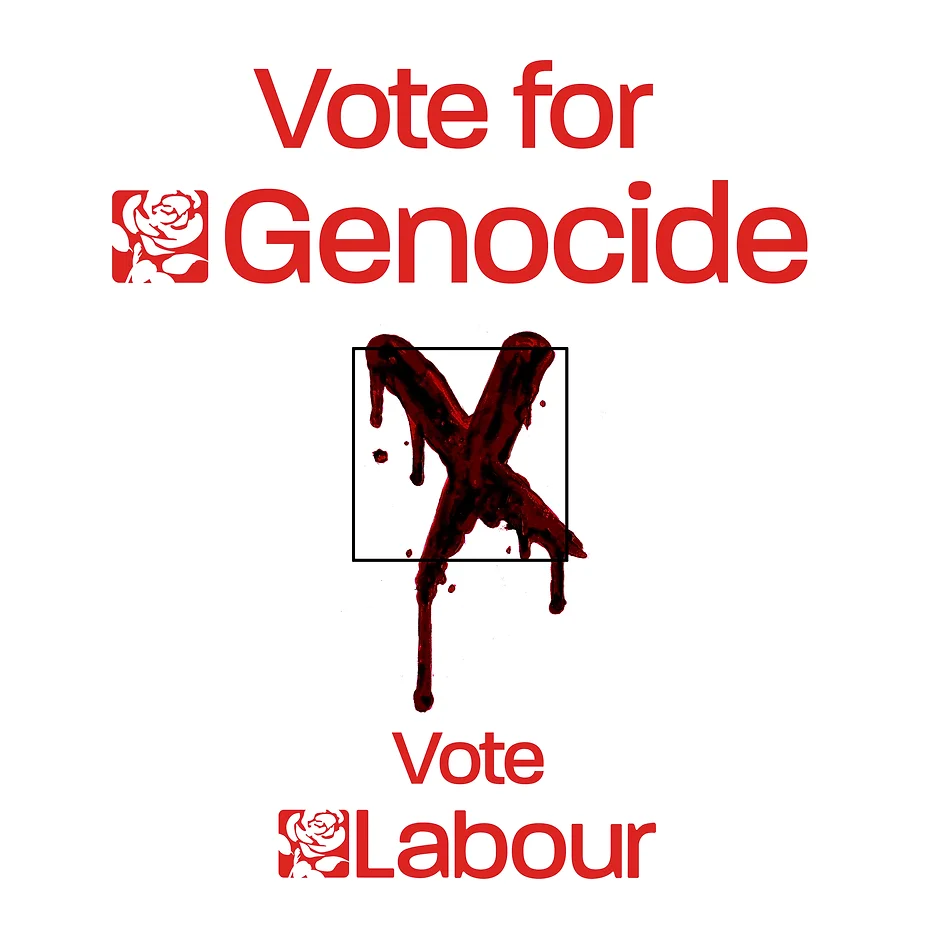
Vote Labour for Genocide.
Continue ReadingWestern Media Manufactured Consent for Israel’s Murder of Palestinian Journalists