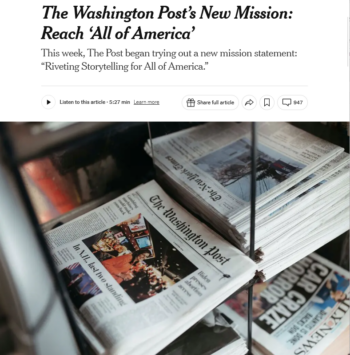
As the Washington Post faces a staff rebellion and plummeting subscription rates, billionaire owner Jeff Bezos has introduced a new mission statement: “Riveting Storytelling for All of America.”
The Washington Post‘s new slogan, “Riveting Storytelling for All of America,” is “meant to be an internal rallying point for employees,” the New York Times (1/16/25) reported.
The new path forward, as introduced in a slide deck to staff by Suzi Watford, the paper’s chief strategy officer, demands that the paper “understand and represent interests across the country,” and “provide a forum for viewpoints, expert perspectives and conversation” (New York Times, 1/16/25). It will do this as “an AI-fueled platform for news” that delivers “vital news, ideas and insights for all Americans where, how and when they want it.”
This appears to mean shifting resources toward opinion, specifically opinions from the right. According to the New York Times report:
Bezos has expressed hopes that the Post would be read by more blue-collar Americans who live outside coastal cities, mentioning people like firefighters in Cleveland. He has also said that he is interested in expanding the Post’s audience among conservatives.
The Post has already begun to consider ways to sharply increase the amount of opinion commentary published on its website, according to two people with knowledge of the talks. An adviser to the Post, Lippe Oosterhof, has conducted brainstorming sessions about a new initiative that would make it easier to receive and publish opinion writing from outside contributors.
How AI is meant to play into this is unclear.
The Post already has more columnists than you can shake a stick at. This new direction sounds like the Foxification of the Washington Post, a move away from any attempt to hold the powerful to account, toward inexpensive clickbait punditry.
‘Make money’
The red area represents the proportion of Jeff Bezos’s total wealth that would be required to cover the Washington Post‘s losses for a year.
Watford’s slide deck presented three pillars of the Post‘s new model: “great journalism,” “happy customers” and “make money.” The Postlost roughly $77 million in 2023. (It also lost some 250,000 subscribers after Bezos killed the paper’s planned endorsement of Kamala Harris—FAIR.org, 10/30/24.)
In order to make money, its new “Big Hairy Audacious Goal” (yes, that’s what the Post slide deck apparently called it) is to reach 200 million “paying users.” The paper currently has about 3 million subscribers, making it an “audacious” goal indeed. As the Times pointed out, even if the Post could achieve the impossible task of monetizing every visit to its website, no major corporate media outlet has been getting more than 100 million monthly unique visits—paying and non-paying—outside of the spike in traffic around the election.
Back in 2019, the Post was claiming 80–90 million unique visitors per month. Those visits peaked in November 2020 at 114 million, but quickly and steadily dropped after Biden’s inauguration. The Post stopped posting its audience numbers online after January 2023, when they were down to 58 million.
Of course, most online corporate media have been struggling. The thing about the Post is that its absurdly wealthy owner, the second-richest person on Earth, can easily afford to lose $77 million a year. That’s 0.03% of Bezos’s current net worth.
‘We are deeply alarmed’
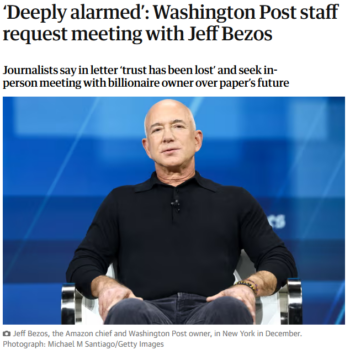
Guardian (1/15/25): “The plea from staff…comes a week after the Post laid off roughly 100 employees…roughly 4% of the publication’s staff.”
No doubt the Post needs help. Just days before the new mission statement was revealed, over 400 staff members signed a letter to Bezos asking for a meeting (Guardian, 1/15/25). The letter read:
We are deeply alarmed by recent leadership decisions that have led readers to question the integrity of this institution, broken with a tradition of transparency, and prompted some of our most distinguished colleagues to leave, with more departures imminent.
Bezos’s response—a slide deck about “riveting storytelling” on “an AI-driven platform” that prioritizes churning out opinions to draw in conservatives—is hardly likely to ease the mind of any serious journalist at the paper.
Nor is trying to “expand the Post audience among conservatives,” while still paying lip service to “great journalism,” likely to solve the Post‘s problems. As CNN‘s former CEO Chris Licht discovered (FAIR.org, 6/8/23), you can’t do good journalism while trying to appeal to both sides in the context of an increasingly radical right, because that side demands acceptance of lies and conspiracy theories that are incompatible with actual journalism.
When Bezos bought the Post (Extra!, 3/14), he assured the paper’s employees that “the paper’s duty will remain to its readers and not to the private interests of its owners.” That sentiment was repeated in Watford’s slide deck this week. But Bezos’s actions in the past months—including the killing of the Harris endorsement, Amazondonating $1 million donation to Trump’s inaugural fund and paying Melania Trump $40 million for her self-produced documentary, and, most recently, Bezos appearing onstage with other multibillionaires at Trump’s inauguration—make clear that the principle is as meaningless to Bezos as the slogan that debuted after Trump’s first election: “Democracy Dies in Darkness.”
That slogan will continue to adorn the front page for the time being, perhaps in the hope that readers searching for an actual news organization that holds those in power to account will be fooled into subscribing.
ACTION ALERT: You can send a message to the Washington Post at letters@washpost.com.
Please remember that respectful communication is the most effective. Feel free to leave a copy of your message in the comments thread here.
FAIR’s work is sustained by our generous contributors, who allow us to remain independent. Donate today to be a part of this important mission.
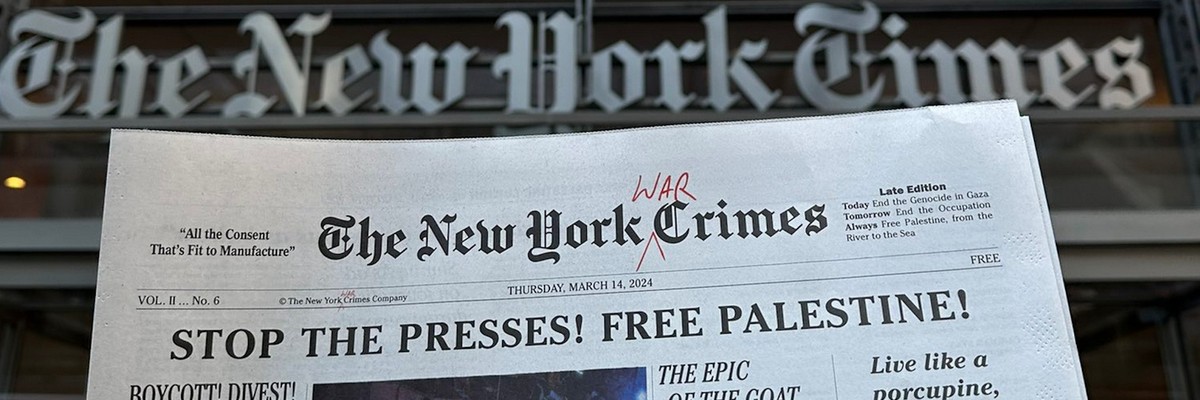
A reader holds up a copy of a satirical paper, “The New York War Crimes,” mocking The New York Times’ biased coverage of the Gaza genocide, on March 14, 2024 in New York City. (Photo: Nicki Kattoura/X)
Despite exceptional coverage at times, what was most profoundly important about war in Gaza—what it was like to be terrorized, massacred, maimed, and traumatized—remained almost entirely out of view.
A few days before the end of 2024, the independent magazine +972 reported that “Israeli army forces stormed the Kamal Adwan Hospital compound in Beit Lahiya, culminating a nearly week-long siege of the last functioning hospital in northern Gaza.” While fire spread through the hospital, its staff issued a statement saying that “surgical departments, laboratory, maintenance, and emergency units have been completely burned,” and patients were “at risk of dying at any moment.”
The magazine explained that “the assault on medical facilities in Beit Lahiya is the latest escalation in Israel’s brutal campaign of ethnic cleansing in northern Gaza, which over the last three months forcibly displaced the vast majority of Palestinians living in the area.” The journalism from +972—in sharp contrast to the dominant coverage of the Gaza war from U.S. media—has provided clarity about real-time events, putting them in overall context rather than episodic snippets.
+972 Magazine is the work of Palestinian and Israeli journalists who describe their core values as “a commitment to equity, justice, and freedom of information”—which necessarily means “accurate and fair journalism that spotlights the people and communities working to oppose occupation and apartheid.” But the operative values of mainstream U.S. news outlets have been very different.
What was sinister about proclaiming “Israel’s 9/11” was what happened after America’s 9/11.
Key aspects of how the U.S. establishment has narrated the “war on terror” for more than two decades were standard in American media and politics from the beginning of the Gaza war in October 2023. For instance:
Routine discourse avoided voices condemning the U.S. government for its role in the slaughter of civilians.
The U.S. ally usually eluded accountability for its high-tech atrocities committed from the air.
Civilian deaths in Gaza were habitually portrayed as unintended.
Claims that Israel was aiming to minimize civilian casualties were normally taken at face value.
Media coverage and political rhetoric stayed away from acknowledging that Israel’s actions might fit into such categories as “mass murder” or “terrorism.”
Overall, news media and U.S. government officials emitted a mindset that Israeli lives really mattered a lot more than Palestinian lives.
The Gaza war has received a vast amount of U.S. media attention, but how much it actually communicated about the human realities was a whole other matter. The belief or unconscious notion that news media were conveying war’s realities ended up obscuring those realities all the more. And journalism’s inherent limitations were compounded by media biases.
During the first five months of the war, the New York Times, Wall Street Journal, and Washington Post applied the word “brutal” or its variants far more often to Palestinians (77%) than to Israelis (23%). The findings, in a study by Fairness and Accuracy In Reporting (FAIR), pointed to an imbalance that occurred “even though Israeli violence was responsible for more than 20 times as much loss of life.” News articles and opinion pieces were remarkably in the same groove; “the lopsided rate at which ‘brutal’ was used in op-eds to characterize Palestinians over Israelis was exactly the same as the supposedly straight news stories.”
Despite exceptional coverage at times, what was most profoundly important about war in Gaza—what it was like to be terrorized, massacred, maimed, and traumatized—remained almost entirely out of view. Gradually, surface accounts reaching the American public came to seem repetitious and normal. As death numbers kept rising and months went by, the Gaza war diminished as a news topic, while most talk shows seldom discussed it.
As with the slaughter via bombardment, the Israeli-U.S. alliance treated the increasing onset of starvation, dehydration, and fatal disease as a public-relations problem. Along the way, official pronouncements—and the policies they tried to justify—were deeply anchored in the unspoken premise that some lives really matter and some really don’t.
The propaganda approach was foreshadowed on October 8, 2023, with Israel in shock from the atrocities that Hamas had committed the previous day. “This is Israel’s 9/11,” the Israeli ambassador to the United Nations told reporters in New York, and he repeated: “This is Israel’s 9/11.” Meanwhile, in a PBS News Weekend interview, Israel’s ambassador to the United States declared: “This is, as someone said, our 9/11.”
What was sinister about proclaiming “Israel’s 9/11” was what happened after America’s 9/11. Wearing the cloak of victim, the United States proceeded to use the horrible tragedy that occurred inside its borders as an open-ended reason to kill in the name of retaliation, self-protection, and, of course, the “war on terror.”
As Israel’s war on Gaza persisted, the explanations often echoed the post-9/11 rationales for the “war on terror” from the U.S. government: authorizing future crimes against humanity as necessary in the light of certain prior events. Reverberation was in the air from late 2001, when the Pentagon’s leader Donald Rumsfeld asserted that “responsibility for every single casualty in this war, whether they’re innocent Afghans or innocent Americans, rests at the feet of the al Qaeda and the Taliban.” After five weeks of massacring Palestinian people, Israel’s Prime Minister Benjamin Netanyahu said that “any civilian loss is a tragedy”—and quickly added that “the blame should be placed squarely on Hamas.”
The licenses to kill were self-justifying. And they had no expiration date.
Incoming White House ‘border czar’ Tom Homan speaks during Turning Point’s annual AmericaFest 2024 in Phoenix, Arizona, on December 22, 2024. (Photo: Josh Edelson/AFP via Getty Images)
“Decent people all over the world will hate this country… and they should,” said one critic.
Adding to alarm over U.S. President-elect Donald Trump’s immigration plans, his “border czar” told The Washington Post in an interview published Thursday that the administration plans to return to detaining migrant families with children.
Tom Homan, who served as acting director of U.S. Immigration and Customs Enforcement during Trump’s first term, said that ICE “will look to hold parents with children in ‘soft-sided’ tent structures similar to those used by U.S. border officials to handle immigration surges,” the Post summarized. “The government will not hesitate to deport parents who are in the country illegally, even if they have young U.S.-born children, he added, leaving it to those families to decide whether to exit together or be split up.”
Since Trump beat Democratic Vice President Kamala Harris last month, migrant rights advocates have reiterated concerns about the Republican’s first-term policies—such as forced separation of families—and his 2024 campaign pledges, from mass deportations to attempting to end birthright citizenship, despite the guarantees of the 14th Amendment to the U.S. Constitution.
Homan—who oversaw the so-called “zero tolerance” policy that separated thousands of migrant kids from their parents—said: “Here’s the issue… You knew you were in the country illegally and chose to have a child. So you put your family in that position.”
Incoming "border czar" Tom Homan on shipping U.S.-born children out of the country with their undocumented parents: “You knew you were in the country illegally and chose to have a child.”"Chose"? That's an odd word choice. The right wants to force women to give birth, not give them a choice.
Harris and President Joe Biden have come under fire for various immigration policies, but their administration did stop family detention—and when it was reported last year that the White House was weighing a revival of the practice, 383 groups urged the president to keep the pledge he made when he took office “to pursue just, compassionate, and humane immigration policies.”
Under Biden, the government ended mass worksite immigration raids and—eventually—the “Remain in Mexico” policy that stopped asylum-seekers from entering the United States. Homan told the Post that the next Trump administration should bring them back.
Less than a month before Trump’s inauguration, Biden is now facing pressure to “use the power of the pen to protect those seeking sanctuary from the coming deportation machine that will crush the human rights of our immigrant neighbors and those who have dreams of finding refuge here,” as Amnesty International USA executive director Paul O’Brien put it earlier this month.
The Post reported that “of all the border hard-liners in the incoming administration, Homan is perhaps the most cognizant of the limits of the government’s ability to deliver on promises of mass deportation—and the potential for a political backlash.”
Those hard-liners include dog-killing Republican South Dakota Gov. Kristi Noem, Trump’s pick to lead the Department of Homeland Security; family separation architect Stephen Miller, the president-elect’s homeland security adviser and deputy chief of staff for policy; and Caleb Vitello, the next acting ICE director whom Miller previously tried to install at the Office of Refugee Resettlement.
“We’re going to need to construct family facilities,” Homan told the newspaper. However, he also said: “We need to show the American people we can do this and not be inhumane about it… We can’t lose the faith of the American people.”
Critics of the next administration have suggested that—although Trump won the Electoral College and the popular vote last month—pursuing the GOP immigration policies, including “concentration camps” for migrant families, will anger the public.
Maximum cruelty is the goal https://www.washingtonpost.com/immigration/2024/12/26/immigration-border-tom-homan-trump/
“Decent people all over the world will hate this country… and they should,” media columnist and Brooklyn College professor Eric Alterman said on social media in response to the Post‘s reporting.
Author and New York University adjunct associate professor Helio Fred Garcia said: “Trump’s next border czar previews performative cruelty. In the first term it included kidnapping of children from their parents and returning the parents to their home countries, with no record of which kids came from which parents. A crime against humanity.”
Lee Gelernt, an ACLU attorney who has argued many major immigration cases, told the Post that “the incoming administration has refused to acknowledge the horrific damage it did to families and little children the first time around and seems determined to once again target families for gratuitous suffering.”
“The public may have voted in the abstract for mass deportations,” he added, referring to the November election, “but I don’t think they voted for more family separation or unnecessary cruelty to children.”
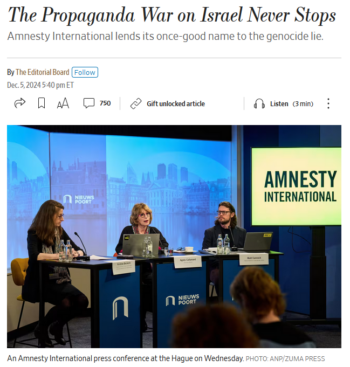
Amnesty International (12/5/24) found that “Israel has persisted in committing genocidal acts, fully aware of the irreparable harm it was inflicting on Palestinians in Gaza.”
Imagine for a moment that a magnitude 8 earthquake occurred somewhere in the world, and the Western corporate media refused to use the word “earthquake” in reporting it, instead talking ambiguously of a “tectonic incident” that had caused buildings to collapse and people to die.
Obviously, reporters would be called out for deliberate linguistic ineptness and a bizarre obfuscation of truth. And yet just such a verbal sleight of hand has been on display for more than 14 months in the Gaza Strip, where corporate media outlets continue to dance around the word “genocide” while the Israeli military carries out the systematic mass killing of Palestinians.
Since October 2023, nearly 45,000 people have officially been killed in Gaza—although as a letter to the Lancet medical journal (7/20/24) pointed out back in July, the true death toll at that time was likely to exceed 186,000. A new report (BBC, 11/8/24) from the Office of the United Nations High Commissioner for Human Rights indicates that almost 70% of the over 8,000 Palestinian fatalities verified by the UN over a six-month period were women and children; a survey of medical volunteers in Gaza found that “44 doctors, nurses and paramedics saw multiple cases of preteen children who had been shot in the head or chest in Gaza” (New York Times, 10/9/24).
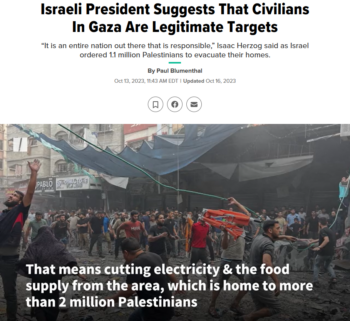
From the beginning of the Israeli assault, officials like President Isaac Herzog (HuffPost, 10/13/23) made it clear that they saw themselves as being at war with a population.
As per Article II of the Genocide Convention, “genocide means…acts committed with intent to destroy, in whole or in part, a national, ethnical, racial or religious group.” These include “killing members of the group,” “causing serious bodily or mental harm to members of the group,” and “deliberately inflicting on the group conditions of life calculated to bring about its physical destruction in whole or in part.”
Israeli leaders again and again have effectively admitted genocidal intent. Defense Minister Yoav Gallant (Times of Israel, 10/9/23), at the beginning of Israel’s assault, declared:
I have ordered a complete siege on the Gaza Strip. There will be no electricity, no food, no fuel, everything is closed…. We are fighting human animals and we are acting accordingly.
Israeli President Isaac Herzog (HuffPost, 10/13/23) likewise insisted, “It is an entire nation out there that is responsible…. It is not true, this rhetoric about civilians not being aware, not involved.”
Prime Minister Benjamin Netanyahu (Mother Jones, 11/3/23) invoked a biblical justification for genocide: “You must remember what Amalek has done to you, says our Holy Bible. And we do remember.” The Bible (1 Samuel 15:3) says of the Amalekites: “Do not spare them; put to death men and women, children and infants.”
And Deputy Knesset speaker Nissim Vaturi couldn’t have been more clear (X, 10/7/23), posting the following comment to X at the outset of hostilities in October 2023: “Now we all have one common goal—erasing the Gaza Strip from the face of the Earth.”
In other words, Gaza is a pretty textbook case of genocide. But the term “genocide” is ostracized by the corporate media world because it violates the political line of the United States, the global superpower that is currently enabling Israel’s genocidal behavior—to the tune of tens of billions of dollars in aid and weaponry. And the media’s refusal to call a spade a spade has produced all manner of linguistic gymnastics.
‘Blistering retaliatory offensive’
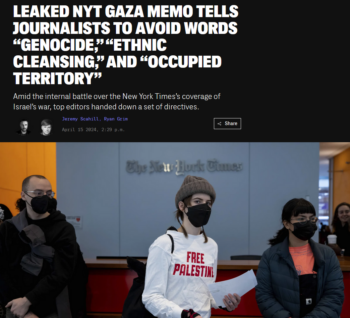
A New York Times memo (Intercept, 4/15/24) said of the word “genocide,” “We should…set a high bar for allowing others to use it as an accusation, whether in quotations or not.” The same memo declared, “It is accurate to use ‘terrorism’ and ‘terrorist’ in describing the attacks of October 7.”
In the eyes of the Associated Press (12/4/24), for example, the genocide in Gaza is merely “Israel’s blistering retaliatory offensive,” while Fox News (11/3/24) detects a “fight against terrorists” and the Washington Post (12/3/24) sees “one of the most deadly and destructive wars in recent memory.”
Or take the New York Times, where a memo (Intercept, 4/15/24) leaked earlier this year explicitly instructed journalists to avoid using words like “genocide,” “ethnic cleansing,” and “occupied territory” when discussing “Palestine”—another word whose use was highly discouraged. On October 7, the one-year anniversary of Israel’s ongoing assault, the US newspaper of record headlined the affair as “The War That Won’t End,” with the G-word appearing only in a fleeting reference to “accusations of genocide and war crimes.”
This particular Times dispatch begins with Yaniv Hegyi, an Israeli who “fled his home last October 7, after terrorists from Gaza overran his village in southern Israel.” As ever, the selectivity with which US media deploys the T-word safely obliterates the chance that domestic audiences will be confronted with the fact that the state of Israel has literally been terrorizing Palestinians since the moment of its foundation on Palestinian land in 1948—or that Zionist terrorism preceded even that moment.
Only after we’ve been introduced to Hegyi, victim of “terrorists,” do we meet Mohammed Shakib Hassan, a Palestinian who “fled his home on October 12, after the Israeli Air Force responded by striking his city in northern Gaza.” Which brings us to another tactic that has been institutionalized in the US political and media establishment alike: the perennial Israeli monopoly on “responding,” “retaliating” and generally engaging in “self-defense” no matter what it does—including genocide.
Never mind that Israel would have nothing to “retaliate” against if it hadn’t up and invented itself on other people’s land, and then spent the next 76 years (and counting) occupying, forcibly displacing and slaughtering Palestinians en masse. Fortuitously for Israel, the corporate media are ever standing by to set the record askew.
‘Propaganda war never stops’
The Wall Street Journal (12/5/24) calls for ethnic cleansing as an alternative to genocide: “Not one of the groups yelling genocide calls on Egypt to let women and children escape to safety by opening its border with Gaza.”
That said, the media have been increasingly unable to abide by a de facto blanket ban on the word “genocide,” given, inter alia, Amnesty International’s recent determination (12/5/24) that Israel is committing just that in the Gaza Strip. In such cases, then, the term inevitably finds its way into news reports—but only as an allegation.
CNN (12/5/24), for instance, reported that Amnesty had “said that it had gathered ‘sufficient evidence to believe’ that Israel’s conduct during the war in Gaza amounts to genocide against the Palestinian people—a charge the Israeli government has vehemently denied.” The rest of the article similarly alternates between Amnesty’s charges and Israel’s vehement rebuttals.
This template was also followed by AP (via ABC, 12/4/24), NBC News (12/5/24) and the other usual suspects. Significantly, this sort of rebuttal option is never extended to Palestinians; you’d never see Yaniv Hegyi fleeing his home from “conduct by Gazans that the Israeli government says amounts to terrorism—a charge the government of Gaza has vehemently denied.”
The Wall Street Journal editorial board (12/5/24) took it upon themselves to pen a diatribe against the organization that had chosen to “lend…its once-good name to the genocide lie,” and thereby “assure… its good standing in the anti-Israel herd.” Bearing the headline “The Propaganda War on Israel Never Stops,” the rant came accompanied by an entirely irrelevant 23-minute documentary on “the worst antisemitic riot in American history” in Crown Heights, Brooklyn, which took place in 1991.
According to the Journal, Amnesty has committed an “inversion of reality”: It’s actually Hamas that is the “genocidal” actor—and, by the way, there are “terrorist headquarters in hospitals” in Gaza. This is just about the most unabashed apology for war crimes you can ask for. Israel has pulverized the bulk of Gaza’s medical infrastructure, and an October UN press release noted that
Israeli security forces have deliberately killed, detained and tortured medical personnel and targeted medical vehicles, while tightening their siege on Gaza and restricting permits to leave the territory for medical treatment.
By converting Israel into the victim not only of “terrorists” but also of a “propaganda war,” the Journal is engaging in its own criminal “inversion of reality.” But for a corporate media committed to complicity in genocide by linguistic omission, it’s all in a day’s work.
Zeynep Tufekci (New York Times, 12/6/24) “can’t think of any other incident when a murder in this country has been so openly celebrated.”
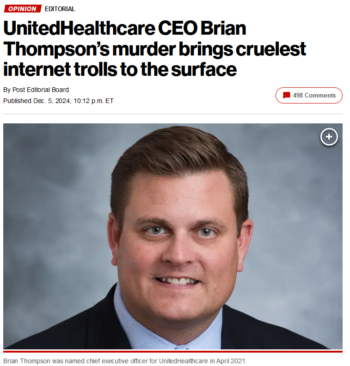
The early morning murder of UnitedHealthcare CEO Brian Thompson was met on social media with a “torrent of hate” for health insurance executives (New York Times, 12/5/24). Memes mocking the insurance companies and their callous disregard for human life abound on various platforms (AFP, 12/6/24).
Internet users are declaring that the man police believe to be the shooter, 26-year-old Luigi Mangione, is certifiably hot (Rolling Stone, 12/9/24; KFOX, 12/10/24). A lookalike contest for the shooter was held in lower Manhattan (New York Times, 12/7/24).
If so many people are unsympathetic at best in response to such a killing, that might be a reason to revisit why health insurance companies are so loathed. The rage “was shocking to many, but it crossed communities all along the political spectrum, and took hold in countless divergent cultural clusters,” the New YorkTimes (12/6/24) noted. Mangione was reportedly found with an anti-insurance manifesto that stated “these parasites had it coming” (Newsweek, 12/9/24), echoing a resentment largely felt by a lot of Americans, and targeted fury at UnitedHealthcare specifically.
UnitedHealthcare has always stood out for exceptionally high rate of claims denial generally in the industry (Boston Globe, 12/5/24; Forbes, 12/5/24). For example, a Senate committee found that “UnitedHealthcare’s prior authorization denial rate for post-acute care jumped from 10.9% in 2020 to 22.7% in 2022” (WNYW, 12/7/24).
The Times (12/5/24) reported that the Senate committee found that “three major companies—UnitedHealthcare, Humana and CVS, which owns Aetna—were intentionally denying claims” related to falls and strokes in order to boost profits. UnitedHealthcare “denied requests for such nursing stays three times more often than it did for other services.”
Increasing dissatisfaction
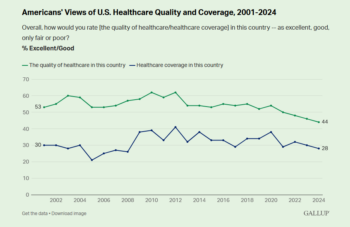
The perception of the quality of US healthcare has been on the decline since 2012 (Gallup, 12/6/24).
On top of that, Americans generally believe their insurance-centered system is a mess. Gallup (12/6/24) reported that “Americans’ positive rating of the quality of healthcare in the US is now at its lowest point in Gallup’s trend dating back to 2001.”
It continued:
The current 44% of US adults who say the quality of healthcare is excellent (11%) or good (33%) is down by a total of 10 percentage points since 2020 after steadily eroding each year. Between 2001 and 2020, majorities ranging from 52% to 62% rated US healthcare quality positively; now, 54% say it is only fair (38%) or poor (16%).
As has been the case throughout the 24-year trend, Americans rate healthcare coverage in the US even more negatively than they rate quality. Just 28% say coverage is excellent or good, four points lower than the average since 2001 and well below the 41% high point in 2012.
Most Americans are unsatisfied with the healthcare system, say the health insurance system is confusing and opaque, and many have skipped or delayed care because of a bad experience or the lack of timely appointments. A small, but not insignificant number, of Americans believe they have had a negative health outcome as result of their experiences within the healthcare system.
When this inefficient system doesn’t literally kill Americans, it can still kill them financially. “Almost a third of all working adults in the United States are carrying some kind of medical debt—that’s about 15% of all US households,” Marketplace (3/27/24) reported. It added: “This debt is also the leading cause of bankruptcies in the country.”
Many news outlets’ pontificators, however, were incensed that anyone would voice frustration with health insurance when an industry CEO has fallen.
‘Not the time to offer criticism’
After Brian Thompson’s killing, the New York Post (12/5/24) condemned those on social media who “swooned over his killer, speculated on his motives, and wondered if Timothée Chalamet would play him in the movie.”
Responding to the memes and the jokes, many of which were more about the unjust health insurance system than support for vigilante murder, the New York Post editorial board (12/5/24) asked:
Do the jokes point to a society that has become so desensitized by the coarseness of online discussion, so disassociated from kindness, that a baying mob cheers a man’s murder and cries out for more?
And upon Mangione’s arrest, the Post (12/9/24) complained that on social media, “tasteless trolls showered praise on the Ivy League grad.” The Post (12/11/24) also fretted about fake “Wanted” posters for insurance company executives that the paper considered a “a fear-mongering social media stunt to incite hysteria,” adding that the “murder has also spawned a stream of merchandise sympathetic towards the 26-year-old being sold by online retailers, forcing Amazon to pull them from its website.”
Fox News (12/6/24) quoted one of its own contributors, Joe Concha, saying, “I think this encapsulates the far left’s worldview: If you run a company that isn’t to their liking, you deserve to die.” The network (12/7/24) praised Democratic Sen. John Fetterman of Pennsylvania for “tearing into” a New York article (12/7/24) that the outlet characterized as saying “resentment over denied insurance claims made…Thompson’s murder inevitable.”
The dismay was felt in other corners of right-wing media. At the Free Press (12/5/24), the brainchild of anti-woke crusader Bari Weiss, Kat Rosenfield wrote:
The people celebrating Brian Thompson’s murder by turning him into an avatar for everything wrong with the American healthcare system remind me of nothing so much as Hollywood screenwriters, cunningly manipulating an audience into cheering on unforgivable acts of fictional violence.
This is not the time to offer your criticisms of the health-insurance industry. And there is never a time to believe that corporate executives are, by their very nature, evil people who deserve to be killed. Yet that is what you’ll see if you go on social media right now and look at comments on news stories about this assassination.
Yet all of these outlets at the same time have run support for Daniel Penny, the man recently acquitted for killing a Black homeless man on the New York City subway (National Review, 6/17/23; Free Press, 10/20/24; New York Post, 12/4/24; Fox News, 12/6/24). These outlets likewise expressed support for Kyle Rittenhouse after he gunned down Black Lives Matter protesters (National Review, 11/19/21; Free Press, 11/17/21; New York Post, 11/19/21; Fox News cited by Media Matters, 11/11/21), and for George Zimmerman when he shot Trayvon Martin (National Review, 6/22/20; New York Post, 7/15/13; Fox News, 7/18/12). In other words, it’s fine to defend vigilantes when they kill unarmed Black people or anti-racist activists, but when a CEO’s life is taken, we must solemnly stay silent on the reasons why such a person might be targeted or why bystanders might not be crying.
Piers Morgan (New York Post, 12/10/24) made this clear when he said “I cheered when I heard” Penny’s acquittal, and felt “shocked and saddened when I saw the footage” of the Thompson shooting. “Those two reactions would surely be the correct and appropriate ones for anyone with an ounce of fairness and humanity in their heart,” he said—because Thompson was “a non-violent, non-threatening, non-criminal man in the street,” whereas Penny’s victim was “a dangerous, mentally ill, homeless man.”
Blame it on Medicare
The Wall Street Journal (12/6/24) made the absurd claim that a medical system based on private insurance is better than any other kind of healthcare system.
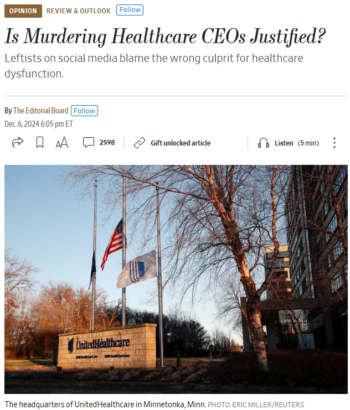
It was the Wall Street Journal, the more erudite of Murdoch’s media properties, that really addressed the question of why people might hate health insurance companies. The anger was misdirected, the editorial board (12/6/24) said. Rather, we should look to federally funded healthcare if we want to get mad: “Medicare and Medicaid, two government programs, cover about 36% of Americans,” the paper observed; because they “pay doctors and hospitals below the cost of providing care…many providers won’t see Medicaid patients, resulting in delayed care.”
It’s an odd argument, given that people who receive Medicaid report being happier with their health insurance than people who get it through their employers or pay for it themselves—and people with Medicare are the happiest of all (KFF, 6/15/23). If the federal programs are underpaying healthcare providers, the obvious solution would be to increase funding for them—an initiative the Journal would be unlikely to support.
The board (Journal, 10/10/24) later dismissed critiques of the health insurance industry and passed off Mangione as a “disturbed individual” radicalized by the Internet and said it is “a dreadful sign of the times that Mr. Mangione is being celebrated.”
Journal editorial board member Allysia Finley (12/8/24) followed up by placing the blame on the Affordable Care Act (aka “Obamacare”). “Having insurance doesn’t change people’s behavior,” she wrote, but does “cause them to use more care.” The situation, she said, “has gotten worse since Obamacare expanded eligibility” for Medicaid. This portrait of US patients overusing healthcare like sweet-toothed children let loose in a candy store is belied by (among other things) the fact that Americans live 4.7 fewer years than the average of comparable countries (KFF, 1/30/24).
The Journal editorial went on to complain that “some providers prescribe treatments and tests that may be medically unnecessary,” and so “insurers have tried to clamp down on such abuse by requiring prior authorization.” While this “can result in delayed care that is medically necessary…it’s also how insurers control costs.”
In reality, doctors are complaining that insurance bureaucrats are impeding their ability to deliver needed healthcare because of this cost-slashing system (Forbes, 3/13/23). The American Medical Association found “94% of doctors say prior authorization leads to delays in patient care” (Chief Medical Executive, 3/14/23); “one in three doctors (33%) say prior authorization has led to serious adverse events with their patients.”
Journal editorialists appear to believe that doctors are jauntily giving away expensive blood pressure medicine and signing up patients for brain surgery for no particular reason, and the only thing that can stop this carnival of care is some bureaucrat who is trained to say “no.” The reality is that the private insurance system “saves insurance companies money by reflexively denying medical care that has been determined necessary by a physician,” as pediatrician William E. Bennett Jr. (Washington Post, 10/22/19) wrote. This is why people are so unsympathetic to Thompson, who was paid an estimated $10 million annually for imposing medical austerity on patients and providers (PBS, 12/7/24).
Pity the insurance giants
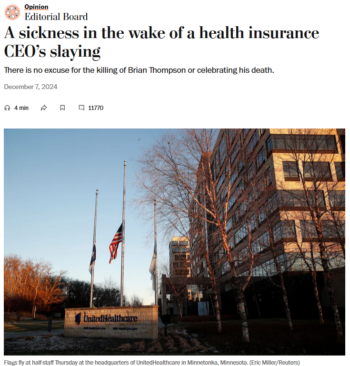
The Washington Post (12/7/24) criticized those who tried to use Thompson’s killing “as an occasion for policy debate about claim denial rates by health insurance companies.” (Note that both the Post and the Wall Street Journal used the same photo of flags at half-mast.)
Right-wing media weren’t the only engaging in scolding. At the Jeff Bezos–owned Washington Post, the editorial board (12/7/24) criticized those “who excuse or celebrate the killing,” as well as those “who do not countenance the killing itself” but “have nevertheless tried to treat it as an occasion for policy debate about claim denial rates by health insurance companies, an admittedly legitimate issue.” The Post added that debate was “fine in principle, but we’re skeptical that this particular moment lends itself to nuanced discussion of a complicated, and heavily regulated, industry.”
The editors nevertheless spent a lengthy paragraph explaining to readers that “controlling healthcare costs requires difficult trade-offs,” and that “even the most generous state-run health systems in other countries also have to face” these trade-offs. The editorial attempted to summon sympathy for
insurers, whose profits are capped by federal law, [and] must contend with consumer demand for ready access to high-priced specialists and prescription drugs—and, at the same time, premiums low enough that people can afford coverage.
Note that insurance company profits are “capped” by requiring them to spend at least 80% of premiums on claims, a percentage known as their loss ratio—but those claims can be paid to providers that are owned by the insurers themselves, “a loophole that makes loss ratio requirements meaningless” (Physicians for a National Healthcare Program, 7/16/21). United Healthcare has been particularly aggressive at this, which is part of the reason its “capped” profits soared to $22.4 billion in 2023.
As for the Post’s assertion that insurance providers should keep “premiums low enough that people can afford coverage,” KFF (10/9/24) found that “Family premiums for employer-sponsored health insurance rose 7% this year to reach an average of $25,572 annually, marking the “second year in a row that premiums are up 7%.” The Center for American Progress (11/29/22) found that employer sponsored insurance “premiums have risen above the rate of inflation and have outpaced wage growth” over the course of a decade. “Escalating grocery bills and car prices have cooled, but price relief for Americans does not extend to health care,” USA Today (10/9/24) reported.
The Post added that all this talk about how Americans are being tortured by the insurance system should wait until next year, “when Congress is to consider whether to keep temporary Obamacare enhancements that have boosted enrollment.”
It is easy to see the material interests of the Washington Post‘s owner at work. Jeff Bezos’ Amazon does not run a health insurance company, but it is fully entrenched in the for-profit medical system. It offers a health insurance marketplace through AmazonFlex, acquired the healthcare provider One Medical last year (NPR, 11/12/23; Forbes, 4/5/24), and offers a pharmacy and other health services.
As one of the world’s richest people, Bezos might have another reason to be worried about people cheering on the murder of CEOs: Amazon is often hated for its monopoly-like grip on online retail (FTC, 9/26/23), as well as charges of price-gouging (Seattle Times, 8/14/24) and union-busting (Guardian, 4/3/24).
‘Last or near last’
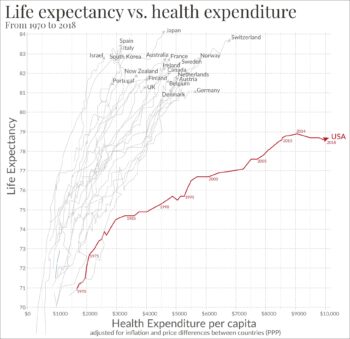
The failure of the US healthcare system in one chart: life expectancy plotted against healthcare spending.
The Washington Post‘s line about the comparable ills of “generous state-run health systems” echoed a similar argument from the Wall Street Journal‘s editorial, which concluded:
Government healthcare is a recipe for more care delays and denials. Witness the fiasco in the United Kingdom, where the Labour government reports that more than 120,000 people died in 2022 while on the National Health Service’s waitlist for treatment. To adapt a famous Winston Churchill phrase, private insurance is the worst form of healthcare, except for all others.
The statement that the British or European health systems are worse for people than the US private insurer–dominated system is simply false. Just months ago, the Commonwealth Fund (NBC, 9/19/24) found that the United States
ranks as the worst performer among 10 developed nations in critical areas of healthcare, including preventing deaths, access (mainly because of high cost) and guaranteeing quality treatment for everyone.
The US “ranked last or near last in every category except one,” precisely because
the complex labyrinth of hospital bills, insurance disputes and out-of-pocket requirements that patients and doctors are forced to navigate put the US second to last in administrative efficiency.
The Commonwealth Fund (CNN, 1/31/23) also found that
the United States spends more on healthcare than any other high-income country, but still has the lowest life expectancy at birth and the highest rate of people with multiple chronic diseases.
Healthcare providers in Mexico and Costa Rica are huge draws for Americans in need of care who can’t make it through America’s Kafkaesque system (NPR, 3/8/23). Spain and Portugal are attracting American retirees, and good low-cost health care is one incentive (Travel + Leisure, 6/20/24).
Retreat to the castle
Apparently the CEOs that Fox News (11/13/24) is so concerned about don’t qualify as “professional elites.”
While the Washington Post’s position clearly falls in line with its material allegiance to a system where its owner sits at the apex, the positions from Murdoch are more interesting. As the Democratic Party has lost support among the working class (NPR, 11/14/24; USA Today, 11/30/24), Murdoch’s outlets have touted Donald Trump and the Republican Party as alternatives for working-class voters.
Murdoch and other purveyors of Republican propaganda have promoted the idea that Democrats serve only financial elites and Hollywood producers, and that protectionist policies under Trump will help US workers (New York Post, 7/16/24; Fox News, 11/13/24). Republicans were able to woo voters by complaining about the high price of gasoline and groceries under the Biden administration (CNBC, 8/7/24).
Now Murdoch outlets are fully retreating into their elite castle and telling the rabble to stop complaining about the lack of access to healthcare. The Republicans and their news outlets have worked hard to recharacterize themselves as something more populist, but the Thompson killing has brought back the old narrative that they are, proudly, the champions of the 1 Percent.
FAIR’s work is sustained by our generous contributors, who allow us to remain independent. Donate today to be a part of this important mission.