When Lights Go Out in Cuba, Media Blame Communism—Not US Sanctions

Spread the love

Original article by Paul Hedreen republished from FAIR under a Creative Commons Attribution-NonCommercial-NoDerivs 3.0 Unported License.

Cuba is in the midst of an ongoing humanitarian crisis, and October’s widespread power outages are only adding to the Cuban people’s troubles. For the last six decades, Cuba has been on the receiving end of myriad sanctions by the United States government. This blockade has proved devastating to human life.

Reporting on Cuba’s blackouts have either omitted or paid brief lip-service to the effects of US sanctions on the Cuban economy, and how those sanctions have created the conditions for the crisis. Instead, media have focused on the inefficient and authoritarian Communist government as the cause of the island’s troubles.

Pulping the economy

The Hill: Cuba’s placement on the State Sponsor of Terrorism list has led to damaging consequences
Michael Galant (The Hill1/5/24): “Businesses and financial institutions, including many from outside the United States, often elect to sever all connections to Cuba rather than risk being sanctioned themselves for association with ‘a sponsor of terror.’”

One of President Donald Trump’s final acts in office was to re-designate Cuba as a State Sponsor of Terrorism, after President Barack Obama had removed them from the list in 2015 as a part of his Cuban thaw. Inclusion on the list subjects a country to restrictions on US foreign aid and financing, but, more importantly, the SSoT list encourages third-party over-compliance with sanctions. “Businesses and financial institutions, including many from outside the United States, often elect to sever all connections to Cuba rather than risk being sanctioned themselves,” The Hill (1/5/24) reported.

Trump reportedly added Cuba to the list for harboring members of FARC and ELN, two left-wing Colombian armed movements. However, Colombian President Gustavo Petro later “noted that Colombia itself, in cooperation with the Obama administration, had asked Cuba to host the FARC and ELN members as part of peace talks,” the Intercept (12/14/23) wrote. Indeed, if Cuba deported the dissidents, they would have been in violation of the protocols of the peace talks, which they were bound to by international law (The Nation2/24/23).

President Joe Biden has not begun the process of reviewing Cuba’s inclusion on the list, despite his campaign promises to the contrary.

The terror designation, plus the many other sanctions imposed by Trump and continued by Biden, are no small potatoes. Ed Augustin wrote at Drop Site (10/1/24) that

the terror designation, together with more than 200 sanctions enacted against the island since Obama left office, has pulped the Cuban economy by cutting revenue to the struggling Cuban state…. The combined annual cost of the Trump/Biden sanctions, [economists] say, amounts to billions of dollars a year.

Augustin argued that the economic warfare regime is a root cause of the rolling blackouts, water shortages and mass emigration that have plagued Cuba in recent years. Even imports that are ostensibly exempt from sanctions, like medication, are caught in the dragnet as multinational companies scramble to cut ties with the island. Banks are so reluctant to run afoul of US sanctions, Augustin wrote, “that often, even when the state can find the money to buy, and a provider willing to sell, there’s simply no way of making the payment.”

Cuba’s pariah status as a SSoT has put a stranglehold on its economy, and its government’s ability to administer public services. However, US restrictions on Cuba are almost never mentioned in US coverage, and reporting on the recent blackouts is no exception.

Cash-strapped Communists
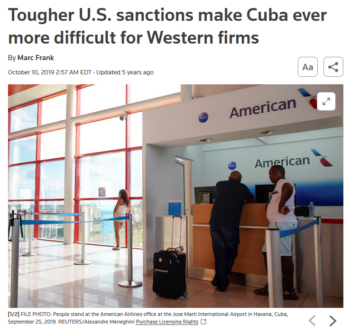
Reuters: Tougher U.S. sanctions make Cuba ever more difficult for Western firms
Reuters (10/10/19): “Tougher US sanctions against Cuba have led international banks to avoid transactions involving the island, while prospective overseas investors put plans on hold.”

Coverage has emphasized the inability of Cuba’s government to pay for necessary fuel imports. The New York Times (10/19/24) reported “the strapped Communist government could barely afford” to pay for fuel. Elsewhere, the Times (10/18/24) claimed “a severe economic crisis and the cash crunch it produced made it harder for Cuba to pay for those fuel imports.”

The Washington Post (10/18/24) made broadly similar arguments, chalking the blackouts up to “a shortage of imported oil and the cash-strapped government’s insufficient maintenance of the creaky grid.”

The “cash crunch” referenced by the Times is not just the result of an abstract economic crisis, as is implied. Instead, it is a direct effect of US sanctions on financial institutions. During the Obama administration, European banks, including ING and BNP Paribas, were fined to the tune of over $10 billion for transacting with Cuba (Jacobin3/27/22). Even before Cuba was choked further as a result of their SSoT designation, reporting by Reuters (10/10/19) showed the extent to which banks were terminating operations with Cuba and Cuban entities:

Many Western banks have long refused Cuba-related business for fear of running afoul of US sanctions and facing hefty fines.… Panama’s Multibank shut down numerous Cuba-related accounts this year and European banks are restricting clients associated with Cuba to their own nationals, if that.…

Businessmen and diplomats said large French banks, including Societe Generale, no longer want anything to do with Cuba, and some are stopping payments to pensioners living on the Caribbean island.… For the first time in years, the island has had problems financing the upcoming sugar harvest. Various joint venture projects, from golf resorts to alternative energy, are finding it nearly impossible to obtain private credit.

This de-risking by financial institutions manufactures a cash-scarce economy. Cuba’s inability to procure cash for imports is not a function of financial mismanagement, or a lack of credit-worthiness. Instead, it is a deliberate effect of American foreign policy. By omitting the actions of the most powerful government on earth, mainstream coverage allows only that only Cuban failures could be the cause of a shortage of cash.

‘Terrorism’ cuts off tourism

Telegraph: Europeans have abandoned Cuba, and it's all America's fault
Britain’s ambassador to Cuba told the Telegraph (11/6/23), “Those who come are profoundly shocked at what the SSOT designation is doing to the people here.”

Cuba has historically used tourism as a way of bringing money into the economy, but lately the Cuban tourism industry has been severely depressed. The explanation employed by corporate media for the decline of this industry is to blame the extended effects of the pandemic recession (New York Times10/19/24Washington Post10/18/24).

This explanation, however, is incomplete. Cuba has indeed had a lackluster rebound in their tourism industry, but the Times and the Post fail to explain why Cuba has faltered while other Caribbean islands have more than re-achieved their pre-pandemic tourist numbers.

Travelers from Britain, Australia, Japan and 37 other countries do not need to procure a visa for travel to the United States. Instead, they can use ESTA, an electronic visa waiver. This greatly reduces the cost and the annoyance of obtaining permission to visit the US. However, since Cuba’s 2021 listing as a SSoT, any visit to the country by an ESTA passport-holder revokes the visa waiver, for life (Telegraph11/6/23). In other words, any Brit (or Kiwi, or Korean, and so on) who visits Cuba must, for the rest of their lives, visit a US embassy and pay $180 before being able to enter the United States. US policy, not a Covid hangover, is hamstringing any possibility of a resurgence in tourism to Cuba.

Blame game

During Cuba’s most recent energy crisis, the New York Times published three stories describing the blackouts. Two of these stories mention the US blockade only as something that the Cuban government blames for the crisis.
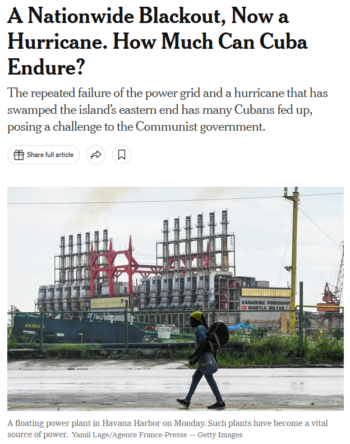
NYT: A Nationwide Blackout, Now a Hurricane. How Much Can Cuba Endure?
The New York Times (10/21/24) presented the idea that the US is punishing Cuba’s economy as a Communist allegation: “The Cuban government blames the power crisis on the US trade embargo, and sanctions that were ramped up by the Trump administration.”

The headline on the Times website (10/21/24) read: “A Nationwide Blackout, Now a Hurricane. How Much Can Cuba Endure?” The paper was right to report on the humanitarian crisis ongoing in Cuba, but it chose to downplay the most important root cause: the decades-long US blockade on Cuba’s economy and its people.

That same story described Cuba as “a Communist country long accustomed to shortages of all kinds and spotty electrical service.” Why is the country so used to shortages? Eleven paragraphs later, the Times gave an explanation, or at least, Cuba’s explanation:

The Cuban government blames the power crisis on the US trade embargo, and sanctions that were ramped up by the Trump administration, which severely restricts the Cuban government’s cash flow. The US Department of the Treasury blocks tankers that have delivered oil to Cuba, which drives up the island’s fuel costs, because Cuba has a limited pool of suppliers available to it.

Earlier coverage by the Times (10/18/24) similarly couched the effects of the blockade as merely a claim by Cuba. The Washington Post (10/22/24) also situated the blockade as something that “the Cuban government and its allies blame” for the ongoing crisis.

To report that Cuban officials blame the US sanctions for the energy crisis is a bit like reporting that fishermen blame the moon for the rising tide. It is of course factual that US trade restrictions–which affect not just US businesses, but also multinational businesses based in other countries–are a blunt weapon, with impact against not just a government, but an entire people.

At the very least, it is incumbent upon journalists to do at least minimal investigation and explanation of the facts concerning the subject of their reporting. None of the coverage in either major paper bothered to investigate whether this was a fair explanation, or even to report generally the effects a 60-year blockade might have on an economy.

Brief—and buried

NYT: Cuba Suffers Second Power Outage in 24 Hours, Realizing Years of Warnings
“Cuban economists and foreign analysts blamed the crisis on several factors,” the New York Times (10/19/24) reported; 18 paragraphs later, the story gets around to mentioning US sanctions.

On October 19, the Times gave its most complete explanation of the relationship between the US sanctions regime and the Cuban blackouts:

Cuba’s economy enjoyed a brief honeymoon with the United States during the Obama administration, which sought to normalize relations after decades of hostility, while keeping a longstanding economic embargo in place. President Donald J. Trump reversed course, leading to renewed restrictions on tourism, visas, remittances, investments and commerce.

This explanation can be found in the 31st paragraph of the 37-paragraph story. Only once the Times has painted a picture of all the ways the Communist government has gone wrong can there be a brief mention of the role of US sanctions. And how brief it is; the Times chose not to detail the extent of blockade against Cuba, nor how Cuba was wrongfully placed on the SSoT list, nor the failure of Biden to reevaluate Cuba’s status as he promised on the campaign trail.

Describing the US starvation of Cuba’s economy in abstract terms like “economic crisis” provides cover for deliberate policy decisions by the US government. By reporting on the embargo only as something that the Cuban government claims, it is easy for readers to dismiss that explanation as simply a Communist excuse. Instead of asking why the United States is choosing to enforce a crippling sanctions regime on another country, outlets like the New York Times find it easier to repeat the line that Cuba’s government has only itself to blame for its problems.

FAIR’s work is sustained by our generous contributors, who allow us to remain independent. Donate today to be a part of this important mission.

Original article by Paul Hedreen republished from FAIR under a Creative Commons Attribution-NonCommercial-NoDerivs 3.0 Unported License.

The blockade on Cuba is a failed policy but still has bipartisan support, says Dr. José R. Cabañas

Continue ReadingWhen Lights Go Out in Cuba, Media Blame Communism—Not US Sanctions

Despite History of Fabrication, Press Uncritically Covers IDF-Provided Documents on Hamas

Spread the love

Original article by Bryce Greene republished from FAIR under a Creative Commons Attribution-NonCommercial-NoDerivs 3.0 Unported License.

The New York Times (10/12/24) says it “verified” supposed Hamas documents provided to the paper by Israel—which turns out to mostly mean that that the Israeli military “concluded the documents were real.”

Earlier this month, the New York Times (10/12/24), Washington Post (10/12/24) and Wall Street Journal (10/12/24) each published front-page articles based on different sets of documents handed to them by the Israeli military.

Israel claims it seized all the documents—in the form of meeting minutes, letters and planning documents—in its ground invasion of Gaza, and that they reveal insights into Hamas’s operations prior to the October 7 attacks. The documents include alleged evidence of Hamas’s pre-10/7 coordination with Iran, plans to blow up Israeli skyscrapers, and even a scheme to use horse-drawn chariots in an attack from Gaza.

Documents received directly from intelligence agencies should always be treated with skepticism, and that’s especially true when their government has a well-documented history of blatant lying. Yet leading newspapers took these Israeli document dumps largely at face value, advancing the agenda of a genocidal rogue state.

A history of lying

Fake “Hamas” documents were being cited in the press as recently as September 2024 (Middle East Eye9/9/24).

Israel’s use of fabrications to shape public perception is well known, and was put on display early in the assault on Gaza that began last October. After an explosion at Al Ahli hospital killed and injured hundreds (misreporting of which caused a great deal of confusion), the media naturally pointed the finger at Israel. The Israeli government, concerned about the public backlash, denied responsibility, claiming that the explosion was caused by a misfired rocket from Palestinian Islamic Jihad. (See FAIR.org11/3/23.)

To back up their claims, Israel released a recording allegedly capturing two Palestinian militants discussing Palestinian Islamic Jihad’s responsibility for the strike. However, an analysis by the firm Earshot found that the audio was the result of two separate channels being edited together (Channel 4, 10/19/23). In other words, Israel engineered a phony audio clip in an attempt to clear itself of war crimes  in the public mind.

Investigations based on open sources have since come to various conclusions about the attack (Guardian, 10/18/23Bellingcat, 10/18/23; Human Rights Watch, 11/26/23AP, 11/22/23; Michael Kobs, 2023New Arab, 2/19/24), but Israel’s fraudulent attempt to manipulate evidence certainly suggests that they had something to hide, and demonstrates their lack of reliability as a media source. Recently, the UN released a report accusing Israel of systematically targeting healthcare infrastructure in Gaza, making their denials of this earlier attack far less credible.

In another instance, Israel presented 3D renderings of a supposed Hamas “command center” beneath Al Shifa hospital, claiming it was based on intelligence. However, no such command center was ever found (FAIR.org12/1/23). Upon storming the hospital, Israel staged scenes in order to bolster claims that the facility was used by militant groups. The deception was so blatant that mainstream outlets were openly calling it out.

Recently Israel was caught actually providing fabricated documents to the press with the aim of manipulating public opinion. Earlier this year, the Israeli government provided documents to both the Jewish Chronicle (9/5/24) and the German paper Bild (9/6/24) that purportedly showed that Hamas had no interest in a ceasefire, and had a plan to sneak the late Hamas chief Yahya Sinwar out of Gaza to Iran, along with some of the remaining hostages. The reports were then uncritically repeated in outlets like the Times of Israel (9/6/24).

Shortly after these documents were published, the Israeli paper Yedioth Ahronoth (9/8/24) reported on an internal IDF investigation that found that they had been leaked to foreign media as part of a campaign to “shape public opinion on Israel.” The documents were determined to be forgeries, after a comprehensive search of all databases containing documents found in the wake of Israel’s operations. The IDF told the paper that an investigation was underway to determine the origin of the leak.

This non-exhaustive list of examples demonstrates a pattern of Israel engineering misleading narratives to shape public opinion, and fabricating the evidence needed to do so.

Questionable authenticity

WaPo: Captured documents reveal Hamas’s broader ambition to wreak havoc on Israel
The Washington Post (10/12/24) reported that “the documents’ authenticity could not be definitively established”—but there’s no trace of that doubt in the story’s headline or subhead.

Whether they are authentic or not, it is clear that the documents leaked to the Wall Street Journal, New York Times and Washington Post serve the same purpose of propagandizing on behalf of Israel. In an attempt to preserve some journalistic integrity, the Post and Times both gave separate justifications for why they believed the respective documents leaked to them were authentic.

The Post was quick to note that “the documents’ authenticity could not be definitively established,” but gave readers the impression there was reason to believe they were real. First, it claimed that the contents of the documents it received were

“broadly consistent” with US and allies’ post–October 7 intelligence assessments about Hamas’s long-range planning and complex relationship with Iran.

Then it wrote that unnamed US and Israeli officials they shared the documents with did not express concerns about their authenticity. (Iranian and Hamas officials they consulted didn’t comment on the documents but accused Israel of having a history of “fabricating documents.”)

The New York Times consulted former Hamas member Salah al-Din al-Awawdeh, whom the paper frequently quotes on matters related to Hamas, and an unnamed Palestinian analyst with “knowledge of Hamas’s inner workings.” It also said an internal Israeli military report concluded the documents were authentic, and the paper “researched details mentioned in the meeting records to check that they corresponded with actual events.” It said “Hamas and Hezbollah did not respond to requests to comment” and that Iran “denied the claims made in the minutes.”

The Wall Street Journal story did not describe any attempt to verify the authenticity, and only reported that the paper “hasn’t independently verified the documents.”

But given Israel’s track record, there is no epistemologically sound way of verifying the validity of documents provided by the Israeli government without confirmation from Hamas itself. Citing sources who say that the documents resemble Hamas documents, without noting Israel’s history of creating credible forgeries, creates a patina of credibility without actually substantiating anything.

Advancing Israel’s agenda

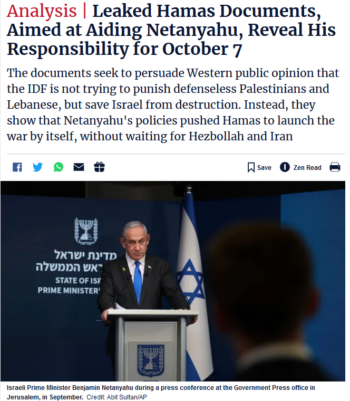
Haaretz: Leaked Hamas Documents, Aimed at Aiding Netanyahu, Reveal His Responsibility for October 7
Haaretz (10/14/24): The documents bolster Netanyahu’s claim that Israel is “fighting a terrifying ‘axis of evil’ led by Iran that threatens to destroy Western culture as a whole.”

The Israeli paper Haaretz (10/14/24), which took the documents as authentic, argued that their release by Israel was “Aimed at Aiding Netanyahu.” While both the Times and the Post have largely advanced Israel’s agenda over the past year of bombing (FAIR.org10/13/232/1/2410/7/24), both papers are considered to be on the critical end of the press spectrum in the US, particularly towards Netanyahu. As Haaretz explained, this perception enhances the propaganda value of the document leak: “The Times and the Post enjoy greater credibility when they fall in line with Israel’s narrative.”

While Haaretz made no note of the leaked documents provided to the Wall Street Journal, the article ironically acknowledged that

having them published by Fox News or even the Wall Street Journal would have looked like an Israeli public diplomacy operation rather than a legitimate journalistic investigative report.

Haaretz noted that the documents promote narratives that “Israel would be happy to burn into the world’s consciousness,” namely the well-known propaganda effort to equate Hamas with organizations that are universally reviled by Americans. The Post documents purportedly outlined a Hamas plan to blow up a skyscraper in Tel Aviv, evoking the September 11 attacks against the World Trade Center:

The Hamas documents are supposed to bolster Netanyahu’s claim that Israel isn’t fighting against a liberation movement seeking to free the occupied Palestinian people, or even against a paramilitary organization that is poorly funded and trained and lacks planes, the Iron Dome anti-missile system, tanks and artillery….

Rather, it is fighting a terrifying “axis of evil” led by Iran that threatens to destroy Western culture as a whole.

Haaretz also argued that this kind of propaganda campaign was designed to ensure that the violence continues to escalate:

In this spirit, the documents are supposed to justify Israel’s counterattack, which has so far caused enormous death and destruction in Gaza and, to an increasing degree, also in Lebanon.

Obvious PR value

WSJ: Israel Says Documents Found in Gaza Show Hamas’s Attack Planning, Iran Ties
Unlike the New York Times or Washington Post, the Wall Street Journal (10/12/24) acknowledged in its headline that the revelations in the documents are what “Israel says” they show.

While Haaretz overlooked the story from the Wall Street Journal, the same logic can be applied to the documents given to that paper as well. The Journal was apparently curious about the political purpose of the documents, noting that “the officials who provided the documents declined to say why they were releasing them now.”

The Journal wrote that the documents “suggest that Hamas leader Yahya Sinwar was negotiating with Iran over funding for a planned large-scale assault on Israel as far back as 2021,” and gave specific dollar amounts that Iran provided to Hamas’s armed wing. The obvious public relations value of these documents was that they boosted the negative image of Iran prior to Israel’s recent attack on that country.

Israel’s campaign of genocide in Gaza and greater war in the Middle East has been successful in part because the Israeli government can count on Western press to present and contextualize facts in a way that advances their narrative. Despite Israel’s long history of fabrications, the corporate media will dutifully republish documents, statements and explanations with complete credulity.

Original article by Bryce Greene republished from FAIR under a Creative Commons Attribution-NonCommercial-NoDerivs 3.0 Unported License.

Continue ReadingDespite History of Fabrication, Press Uncritically Covers IDF-Provided Documents on Hamas

WaPo Says Not to Worry About Climate Disruption’s Disastrous Costs: 

Spread the love

Original article by Julie Hollar republished from FAIR under a Creative Commons Attribution-NonCommercial-NoDerivs 3.0 Unported License.

Reassuring report based on long-debunked climate contrarian

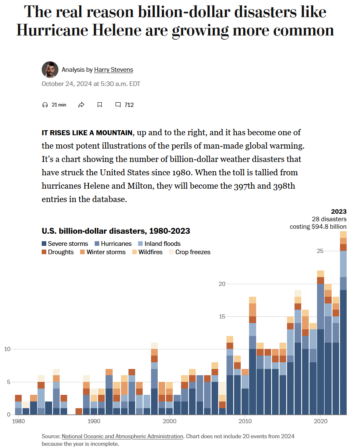
The Washington Post (10/24/24) claims that “the rise in billion-dollar disasters, while alarming, is not so much an indicator of climate change as a reflection of societal growth and risky development.”

As the country begins to vote in an election that will be hugely consequential for the climate crisis, the central task of news outlets’ climate beats should be informing potential voters of those consequences. Instead, the Washington Post‘s “Climate Lab” seems to be working hard to cast doubt on whether climate change is really causing weather disasters to be more expensive.

In a lengthy piece (10/24/24) headlined “The Real Reason Billion-Dollar Disasters Like Hurricane Helene Are Growing More Common,” Post Climate Lab columnist Harry Stevens highlighted a NOAA chart depicting a notable increase in billion-dollar weather disasters hitting the US that he says is widely used by government reports and officials “to help make the case for climate policies.” But, in fact, Stevens tells readers:

The truth lies elsewhere: Over time, migration to hazard-prone areas has increased, putting more people and property in harm’s way. Disasters are more expensive because there is more to destroy.

The takeaway is clear: The (Democratic) government is lying to you about the supposedly devastating impacts of climate change.

Distorting with cherry-picked data

The problem is, it’s Stevens’ story that’s doing the misleading. It relies heavily on the work of one source, Roger Pielke Jr., a longtime climate contrarian beloved by climate denial right-wingers, who cherry-picks data to distort the truth.

What’s worse, from a media critic’s perspective, is that it’s not even a new story; it’s been debunked multiple times over the years. Pielke—a political scientist, not a climate scientist, which Stevens never makes clear—has been promoting this tale since 1998, when he first published a journal article that purported to show that, as Stevens describes, “after adjusting damage to account for the growth in people and property, the trend [of increasing economic costs from weather disasters] disappears.”

A review of Roger Pielke’s book The Climate Fix in the journal Science (11/26/10) accused him of writing “a diatribe against the IPCC and other scientists that is based on highly selective and distorted figures and his own studies.”

When Pielke published the argument in his 2010 book, the journal Science (11/26/10) published a withering response, describing the chapter as “a diatribe against the IPCC and other scientists that is based on highly selective and distorted figures and his own studies.” It detailed the multiple methodological problems with Pielke’s argument:

He makes “corrections” for some things (notably, more people putting themselves in harm’s way) but not others. Some adjustments, such as for hurricane losses for the early 20th century, in which the dollar value goes up several hundred–fold, are highly flawed. But he then uses this record to suggest that the resulting absence of trends in damage costs represents the lack of evidence of a climate component. His record fails to consider all tropical storms and instead focuses only on the rare land-falling ones, which cause highly variable damage depending on where they hit. He completely ignores the benefits from improvements in hurricane warning times, changes in building codes, and other factors that have been important in reducing losses. Nor does he give any consideration to our understanding of the physics of hurricanes and evidence for changes such as the 2005 season, which broke records in so many ways.

Similarly, in discussing floods, Pielke fails to acknowledge that many governing bodies (especially local councils) and government agencies (such as the US Army Corps of Engineers) have tackled the mission of preventing floods by building infrastructure. Thus even though heavy rains have increased disproportionately in many places around the world (thereby increasing the risk of floods), the inundations may have been avoided. In developing countries, however, such flooding has been realized, as seen for instance this year in Pakistan, China and India. Other tenuous claims abound, and Pielke cherry-picks points to fit his arguments.

That year, climate expert Joe Romm (Climate Progress2/28/10) called Pielke “the single most disputed and debunked person in the entire realm of people who publish regularly on disasters and climate change.”

Debunked a decade ago

In response to Pielke, climate scientist Kerry Emanuel (5383/31/14) pointed out that it’s not necessarily appropriate to normalize damages by gross domestic product (GDP) if the intent is to detect an underlying climate trend,” since “GDP increase does not translate in any obvious way to damage increase,” as “wealthier countries can better afford to build stronger structures and to protect assets.”

Pielke peddled the story in 538 (3/19/14) four years later—and lost his briefly held job as a contributor for it, after the scientific community spoke out against it in droves, as not being supported by the evidence.

The backlash led 538 to give MIT climate scientist Kerry Emanuel (3/31/14) a column to rebut Pielke, in which she explained that while it’s of course true that “changing demographics” have impacted the economic costs of weather disasters, Pielke’s data didn’t support his assertion “that climate change has played no role in the observed increase in damages.” She pointed to the same kinds of methodological flaws that Science did, noting that her own research with Yale economist Robert Mendelsohn projected that through the year 2100, “global hurricane damage will about double owing to demographic trends, and double again because of climate change.”

That all happened ten years ago. So why is Pielke’s same old ax-grinding getting a platform at the Washington Post shortly before Election Day?

Stevens does tell readers—quite far down in the article—that Pielke has “clashed with other scientists, journalists and government officials” over his research—though Stevens doesn’t give any details about those clashes, or about Pielke’s reputation among climate scientists more generally.

Stevens also briefly notes that Pielke was recently hired by the American Enterprise Institute, which Stevens characterizes as “center-right,” but more helpfully might have characterized as “taking millions from ExxonMobil since 1998.” But in the same paragraph, Stevens also takes pains to point out that Pielke says he’s planning to vote for Harris, as if to burnish Pielke’s climate-believer bonafides.

Pielke agrees with Pielke

Roger Pielke “agrees with studies that agree with Pielke” (Environmental Hazards10/12/20).

Stevens tells Post readers that the science is firmly on Pielke’s side:

Similar studies have failed to find global warming’s fingerprint in economic damage from hurricanes, floods, tornadoes and crop losses. Of 53 peer-reviewed studies that assess economic damage from weather events, 52 could not attribute damage trends to global warming, according to Pielke’s 2020 review of the literature, the most recent and comprehensive.

You’ll notice Stevens just used Pielke’s own review to bolster Pielke’s argument. But the journal that published that review (Environmental Hazards8/5/20) immediately followed up with the publication of a critique (10/12/20) from researchers who came to the opposite conclusion in their study on US hurricanes. They explained that there are “fundamental shortcomings in this literature,” which comes from a disaster research “field that is currently dominated by a small group of authors” who mostly use the same methodology—adjusting historical economic losses based strictly on “growth in wealth and population”—that Pielke does.

The authors, who wrote a study that actually accounted for this problem and did find that economic losses from hurricanes increased over time after accounting for increases in wealth and population, point out that Pielke dismissed their study and two others that didn’t agree with his own results essentially because they didn’t come to the same conclusions. As the authors of the critique write drily: “Pielke agrees with studies that agree with Pielke.”

A phony ‘consensus’

Stevens includes in his article an obligatory line that experts say

disputing whether global warming’s influence can be found in the disaster data is not the same as questioning whether climate change is real or whether society should switch from fossil fuels.

He also adds that

​​many scientists say that global warming has intensified hurricanes, wildfires, droughts and other extreme weather, which must be leading to greater economic losses.

Note that he frames it as only “many,” and suggests they are only using (faulty, simplistic) logic, not science. But of course, climate change is intensifying extreme weather, as even Stevens has reported as fact recently (in the link he provides in that passage). In contrast, Stevens writes that

the consensus among disaster researchers is that the rise in billion-dollar disasters, while alarming, is not so much an indicator of climate change as a reflection of societal growth and risky development.

But in fact, as mentioned above, there’s not consensus even among disaster researchers (who are primarily economists). And the “many scientists” who disagree with Pielke aren’t the scientists the Post chooses to focus on. While Stevens quotes a number of different experts, including some who disagree with Pielke, they are not given anywhere near the space—or credence—Pielke and his arguments are. (Pielke’s name appears 15 times across the article and its captions.)

When he does get around to quoting some of the scientists, like MIT’s Emanuel, whose research shows that extreme weather events are intensifying, Stevens presents the conflicting conclusions as a back-and-forth of claims and counterclaims, giving the last word in that debate to a disaster researcher whose goal is to refocus blame for disasters on political decisions—like supporting building in vulnerable locations—rather than climate change.

Changes in our built environment, and governments’ impact on those changes, are certainly an important subject when it comes to accounting for and preventing billion-dollar disasters—which virtually no one disputes. (Indeed, the four government reports Stevens links to in his second paragraph as supposedly misusing the NOAA data explicitly name some variation of “increased building and population growth” as a contributing factor to growing costs.) It’s simply not an either/or question, as the Post‘s teaser framed it: “Many blame global warming. Others say disasters are more expensive because there is more to destroy.” So it’s bizarre and frankly dangerous that ten years after climate scientists debunked Pielke’s claim that there’s no evidence climate change is increasing extreme weather costs, Stevens would take, as the “urgent” question of the moment, “Is global warming to blame” for the growing billion-dollar disaster tally?

By giving the impression that the whole thing is basically a government scam to justify climate policies, Stevens’ direct implication is that even if climate change is indisputable, it doesn’t really matter. And it feeds into climate deniers’ claims that the climate change-believing government is lying about climate change and its impacts, at a time when a large number of those deniers are seeking office.

Continue ReadingWaPo Says Not to Worry About Climate Disruption’s Disastrous Costs: 

Vance Dossier Shows Not All Hacks Are Created Equal

Spread the love

Original article by Ari Paul republished from FAIR under https://creativecommons.org/licenses/by-nc-nd/3.0/

Ken Klippenstein, an independent reporter operating on Substack and an investigative alum of the Intercept, announced (Substack9/26/24) that he had been kicked off Twitter (now rebranded as X). His crime, he explained, stemmed from posting the 271-page official dossier of Republican vice presidential candidate’s J.D. Vance’s campaign vulnerabilities; the US government alleges that the information was leaked through Iranian hacking. In other words, the dossier is a part of the “foreign meddling campaign” of “enemy states.”

Klippenstein is not the first reporter to gain access to these papers (Popular Information9/9/24), but most of the reporting about this dossier has been on the intrigue revolving around Iranian hacking rather than the content itself (Daily Beast8/10/24Politico8/10/24Forbes8/11/24). Klippenstein decided it was time for the whole enchilada to see the light of day:

As far as I can tell, it hasn’t been altered, but even if it was, its contents are publicly verifiable. I’ll let it speak for itself.

“The terror regime in Iran loves the weakness and stupidity of Kamala Harris, and is terrified of the strength and resolve of President Donald J. Trump,” Steven Cheung, communications director for the Trump campaign, responded when I asked him about the hack.

If the document had been hacked by some “anonymous”-like hacker group, the news media would be all over it. I’m just not a believer of the news media as an arm of the government, doing its work combating foreign influence. Nor should it be a gatekeeper of what the public should know.

The US Office of the Director of National Intelligence said in a statement that alleged Iranian hacking (9/18/24) was “malicious cyber activity” and “the latest example of Iran’s multi-pronged approach…to stoke discord and undermine confidence in our electoral process.”

Where’s the beef?

Ken Klippenstein (Substack9/26/24) argued that the Vance dossier ” is clearly newsworthy, providing Republican Party and conservative doctrine insight into what the Trump campaign perceives to be Vance’s liabilities and weaknesses.”

The Vance report isn’t as salacious as Vance’s false and bizarre comments about Haitians eating pets (NPR9/15/24), but it does show that he has taken positions that have fractured the right, such as aid for Ukraine; the report calls him one of the “chief obstructionists” to providing assistance to the country against Russia. It dedicates several pages to Vance’s history of criticizing Trump and the MAGA movement, suggesting that his place on the ticket could divide Trump’s voting base.

On the other hand, it outlines many of his extreme right-wing stances that could alienate him with putative moderates. It says Vance “appears to have once called for slashing Social Security and Medicare,” and “is opposed to providing childcare assistance to low-income Americans.” He “supports placing restrictions on abortion access,” and states that “he does not support abortion exceptions in the case of rape.”

And for any voter who values 7-day-a-week service, Vance “appears to support laws requiring businesses to close on Sundays.” It quotes him saying: “Close the Damn Businesses on Sunday. Commercial Freedom Will Suffer. Moral Behavior Will Not, and Our Society Will Be Much the Better for It.” That might not go over well with small business owners, and any worker who depends on their Sunday shifts.

‘Took a deep breath’

The Washington Post (8/13/24) suggested that Vance dossier was different from Hillary Clinton’s hacked emails in 2016 because of “foreign state actors increasingly getting involved” in US elections.

Are the findings in the Vance dossier the story of the century? Probably not, but it’s not nothing that the Trump campaign is aware its vice presidential candidate is loaded with liabilities. There are at least a few people who find that useful information.

And the Washington Post (9/27/24) happily reported on private messages Vance sent to an anonymous individual who shared them with the newspaper that explained Vance’s flip-flopping from a Trump critic to a Trump lover. Are the private messages really more newsworthy than the dossier—or is the issue that the messages aren’t tainted by allegedly foreign fingerprints? Had that intercept of material involved an Iranian, would it have seen the light of day?

In fact, the paper (8/13/24) explained that news organizations, including the Post, were reflecting on the foreign nature of the leak when deciding how deep they should report on the content they received:

“This episode probably reflects that news organizations aren’t going to snap at any hack that comes in and is marked as ‘exclusive’ or ‘inside dope’ and publish it for the sake of publishing,” said Matt Murray, executive editor of the Post. Instead, “all of the news organizations in this case took a deep breath and paused, and thought about who was likely to be leaking the documents, what the motives of the hacker might have been, and whether this was truly newsworthy or not.”

Double standards for leaks

Politico (10/7/16) quoted a Clinton spokesperson: “Striking how quickly concern about Russia’s masterminding of illegal hacks gave way to digging through fruits of hack.” This was immediately followed by: “Indeed, here are eight more e-mail exchanges that shed light on the methods and mindset of Clinton’s allies in Brooklyn and Washington.”

There seems to be a disconnect, however, between ill-gotten information that impacts a Republican ticket and information that tarnishes a Democrat.

Think back to 2016. When “WikiLeaks released a trove of emails apparently hacked from Hillary Clinton’s campaign chairman email account, unleashing thousands of messages,” as Politico (10/7/16) reported, the outlet didn’t just merely report on the hack, it reported on the embarrassing substance of the documents. In 2024, by contrast, when Politico was given the Vance dossier, it wrote nothing about its contents, declaring that “questions surrounding the origins of the documents and how they came to our attention were more newsworthy than the material that was in those documents” (CNN8/13/24).

The New York Times and Washington Post similarly found the Clinton leaks—which were believed at the time to have been given to WikiLeaks by Russia—far more newsworthy than the Vance dossier. The Times “published at least 199 articles about the stolen DNC and Clinton campaign emails between the first leak in June 2016 and Election Day,” Popular Information (9/9/24) noted.

FAIR editor Jim Naureckas (11/24/09) has written about double standards in media, noting that information that comes to light through unethical or illegal means is played up if that information helps powerful politicians and corporations. Meanwhile, if such information obtained questionably is damaging, the media focus tends to be less on the substance, and more on whether the public should be hearing about such matters.

For example, when a private citizen accidentally overheard a cell phone conversation between House Speaker John Boehner, former Speaker Newt Gingrich and other Republican congressmembers, and made a tape that showed Gingrich violating the terms of a ethics sanction against him, news coverage focused on the illegality of taping the conversation, not on the ethics violation the tape revealed (Washington Post1/14/97New York Times1/15/97).

But when climate change deniers hacked climate scientists’ email, that produced a front-page story in the New York Times (11/20/09) scrutinizing the correspondence for any inconsistencies that could be used to bolster the deniers’ arguments.

When Cincinnati Enquirer reporter Michael Gallagher wrote a series of stories about the Chiquita fruit corporation, based in part on listening without authorization to company voicemails, the rest of the media were far more interested in Gallagher’s ethical and legal dilemmas (he was eventually sentenced to five years’ probation) rather than the bribery, fraud and worker abuse his reporting exposed.

Meet the new boss

Musk personally ordered the suspension of the account of antifascist activist Curt Loder, the Independent (1/29/23) revealed, noting that “numerous other accounts of left-leaning activists and commentators have been suspended without warning.”

There’s a certain degree of comedy in the hypocrisy of Klippenstein’s suspension. Since right-wing billionaire Elon Musk bought Twitter, he has claimed that his administration would end corporate censorship, but instead he’s implemented his own censorship agenda (Guardian1/15/24Al Jazeera8/14/24).

The Independent (1/29/23) reported that Musk “oversaw a campaign of suppression that targeted his critics upon his assumption of power at Twitter.” He

personally directed the suspension of a left-leaning activist, Chad Loder, who became known across the platform for his work helping to identify participants in the January 6 attack.

Al Jazeera (2/28/23) noted that “digital rights groups say social media giants,” including X, “have restricted [and] suspended the accounts of Palestinian journalists and activists.” Musk has likewise fulfilled censorship requests by the governments of Turkey (Ars Technica5/15/23) and India (Intercept1/24/233/28/23) officials, and is generally more open to official requests to suppress speech than Twitter‘s previous owners (El Pais5/24/23Washington Post9/25/24).

Meanwhile, Musk’s critics contend, he’s allowed the social network to be a force multiplier for the right. “Elon Musk has increasingly used the social media platform as a megaphone to amplify his political views and, lately, those of right-wing figures he’s aligned with,” AP (8/13/24) reported. (Musk is vocal about his support for former President Donald Trump’s candidacy—New York Times7/18/24.)

Twitter Antisemitism ‘Skyrocketed’ Since Elon Musk Takeover—Jewish Groups,” blasted a Newsweek headline (4/25/23). Earlier this year, Mother Jones (3/13/24) reported that Musk “has been retweeting prominent race scientist adherents…spreading misinformation about racial minorities’ intelligence and physiology to his audience of 176.3 million followers.”

‘Chilling effect on speech’

The message Ken Klippenstein got from X announcing he had been kicked off the platform.

Now Musk’s Twitter is keeping certain information out of the public view—information that just happens to damage the presidential ticket he supports. With Klippenstein having been silenced on the network, anyone claiming X is a bastion of free speech at this point is either mendacious or simply deluded.

Klippenstein (Substack9/26/24) explained that “X says that I’ve been suspended for ‘violating our rules against posting private information,’ citing a tweet linking to my story about the JD Vance dossier.” He added, though, that “I never published any private information on X.” Rather, “I linked to an article I wrote here, linking to a document of controversial provenance, one that I didn’t want to alter for that very reason.”

The journalist (Substack9/27/24) claims that his account suspension, which he reports to be permanent, is political because he did not violate the network’s code about disclosing personal information, and even if he did, he should have been given the opportunity to correct his post to become unsuspended. “So it’s not about a violation of X’s policies,” he said. “What else would you call this but politically motivated?”

Klippenstein is understandably concerned that he is now without a major social media promotional tool. “I no longer have access to the primary channel by which I disseminate primarily news (and shitposts of course) to the general public,” he said. “This chilling effect on speech is exactly why we published the Vance Dossier in its entirety.”

UPDATE: Klippenstein (Substack9/29/24) reports that his publication of the Vance dossier is being censored not only by X, but by Meta (Facebook and Instagram) and Google as well: “The platforms said that the alleged Iranian origin of the dossier — which no one is calling fake or altered — necessitated removing any links to the document.”

FAIR’s work is sustained by our generous contributors, who allow us to remain independent. Donate today to be a part of this important mission.

Original article by Ari Paul republished from FAIR under https://creativecommons.org/licenses/by-nc-nd/3.0/

Continue ReadingVance Dossier Shows Not All Hacks Are Created Equal

Trump Asked for $1 Billion to Do Big Oil’s Dirty Work. Meet the Billionaire Making It Happen

Spread the love

Original article by JESSICA CORBETT republished from Common Dreams under Creative Commons (CC BY-NC-ND 3.0). 

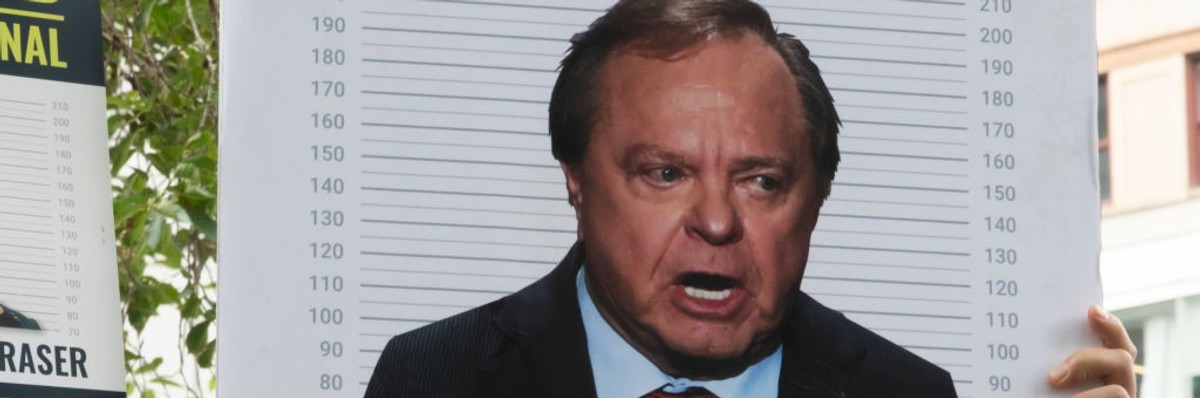
A climate campaign holds a symbolic wanted poster for Harold “Frackenstein” Hamm, CEO of Continental Resources and one of several individuals characterized by a campaign as a top climate criminal, in New York City on July 22, 2024. (Photo: John Senter/UCG/Universal Images Group via Getty Images)

“Oil barons are bankrolling the Trump campaign because Donald Trump promises to impose their policy ‘wish list’ that will make them even richer,” said the Harris campaign.

“Not familiar with Harold Hamm? You should be.”

That’s according to Washington Post climate policy editor Stuart Leavenworth, who shared the newspaper’s Tuesday reporting on the fossil fuel executive’s relationship with former President Donald Trump, the Republican nominee for the November election.

“This oil tycoon is bringing in millions for Trump,” the editor noted, “and is relaying to Trump what the fossil fuel industry wants.”

The Post‘s Josh Dawsey and Maxine Joselow revealed in May that during an event in Florida, Trump vowed to gut the Biden administration’s climate regulations if elected in November as long as the oil and gas industry put $1 billion toward his campaign—a revelation that sparked alarm and even congressional investigations.

In Tuesday reporting described by other journalists as ” great” and “important,” the pair exposed how “Hamm, the billionaire founder of Continental Resources, called other oil executives and encouraged them to attend fundraisers and open their wallets” after the April dinner at Mar-a-Lago, Trump’s Florida residence.

Hamm reportedly described the November contest as “the most important election in our lifetime” and “railed against President Joe Biden’s energy policies.” Following a disastrous debate performance against Trump, the Democratic incumbent passed the torch to Vice President Kamala Harris, who has since secured her party’s nomination.

Donna Brazille, a political strategist and former Democratic National Committee chair, used the new reporting to compare the candidates. As she put it, “This oil tycoon brings in millions for Trump, and may set his agenda.”

Hamm’s top priorities, according to the Post, are “opening up more federal lands to drilling, easing the Endangered Species Act, and curbing numerous regulations at the Environmental Protection Agency.”

Brazille pointed out that “meanwhile, as attorney general in California, Harris prosecuted oil companies for leaks from pipelines and storage tanks, and even sued the Obama administration.”

Harris has quickly garnered support from various organizations concerned about the fossil fuel-driven climate emergency, including some that had declined to endorse Biden. Her running mate is Minnesota Gov. Tim Walz—a choice widely welcomed by green groups, despite his record on the Line 3 oil pipeline—while Trump picked Big Oil-backed Sen. JD Vance (R-Ohio).

Both Trump and Vance have made clear that if they win, they plan to “drill, baby, drill,” a promise that wealthy figures in the fossil fuel industry seem to be buying. The Post reported that thanks in part to introductions by Hamm, “Trump has now ‘called almost everyone in the sector,”” and “the money has been flowing in,” with the industry contributing over $20.3 million.

Harris campaign spokesperson Joseph Costello said in a statement that “oil barons are bankrolling the Trump campaign because Donald Trump promises to impose their policy ‘wish list’ that will make them even richer at the expense of the middle class and a healthy future for our children.”

“Trump’s extreme Project 2025 agenda will give handouts to billionaires, crush jobs, and send costs skyrocketing,” Costello added. “America is more energy independent than ever under the Biden-Harris administration, and Vice President Harris is helping create hundreds of thousands of good paying energy and manufacturing jobs—a boom for working families that Trump would dismantle.”

Hamm—who initially backed two Trump primary challengers: Florida Gov. Ron DeSantis and former South Carolina Gov. Nikki Haley—did not respond to the Post‘s requests for comment while the campaign said that Trump “is proud to be supported by people who share his vision of American energy dominance to protect our national security and bring down the cost of living for all Americans.”

More Perfect Unionnoted in response to the Tuesday reporting that Hamm is among dozens of billionaires backing Trump—who is also expected to push tax cuts for rich individuals and corporations if he returns to the White House.

As Sludgedetailed last month, ultrawealthy contributors to the Trump campaign and related groups include casino mogul Miriam Adelson, bankers Andy Beal and Warren Stephens, GOP donors Scott Bessent and Stephen Schwarzman, real estate investor Richard Kurtz, Jimmy John’s founder James J. Liautaud, and crypto industry twins Cameron and Tyler Winklevoss.

They are joined by associates of billionaire Elon Musk—who created a pro-Trump super political action committee—and others in the tech industry, including Palmer Luckey, Tom Siebel, and Kenny Trout, as well as “New York City retail and oil refinery owner John Catsimatidis, an old friend of Trump’s who has been a public defender of the former president’s character and public record.”

Original article by JESSICA CORBETT republished from Common Dreams under Creative Commons (CC BY-NC-ND 3.0). 

Continue ReadingTrump Asked for $1 Billion to Do Big Oil’s Dirty Work. Meet the Billionaire Making It Happen