Probes Reveal Depth of Big Tech Complicity in Israel’s AI-Driven Gaza Slaughter

Spread the love

Original article by Brett Wilkins republished from Common Dreams under Creative Commons (CC BY-NC-ND 3.0).
An aerial view shows Palestinians walking through the ruins of destroyed buildings in the Jabalia refugee camp, northern Gaza Strip, on February 5, 2025.
 (Photo: Khalil Ramzi Alkahlut/Anadolu via Getty Images

“Many nations are looking to Israel and its use of AI in Gaza with admiration and jealousy,” said one expert. “Expect to see a form of Google, Microsoft, and Amazon-backed AI in other war zones soon.”

Several recent journalistic investigations—including one published Tuesday by The Associated Press—have deepened the understanding of how Israeli forces are using artificial intelligence and cloud computing systems sold by U.S. tech titans for the mass surveillance and killing of Palestinians in Gaza.

The AP‘s Michael Biesecker, Sam Mednick, and Garance Burke found that Israel’s use of Microsoft and OpenAI technology “skyrocketed” following Hamas’ October 7, 2023 attack on Israel.

“This is the first confirmation we have gotten that commercial AI models are directly being used in warfare,” Heidy Khlaaf, chief artificial intelligence scientist at the AI Now Institute and a former senior safety engineer at OpenAI, which makes ChatGPT, told the AP. “The implications are enormous for the role of tech in enabling this type of unethical and unlawful warfare going forward.”

As Biesecker, Mednick, and Burke noted:

Israel’s goal after the attack that killed about 1,200 people and took over 250 hostages was to eradicate Hamas, and its military has called AI a “game changer” in yielding targets more swiftly. Since the war started, more than 50,000 people have died in Gaza and Lebanon and nearly 70% of the buildings in Gaza have been devastated, according to health ministries in Gaza and Lebanon.

According to the AP report, Israel buys advanced AI models from OpenAI and Microsoft’s Azure cloud platform. While OpenAI said it has no partnership with the Israel Defense Forces (IDF), in early 2024 the company quietly removed language from its usage policy that prohibited military use of its technology.

The AP reporters also found that Google and Amazon provide cloud computing and AI services to the IDF via Project Nimbus, a $1.2 billion contract signed in 2021. Furthermore, the IDF uses Cisco and Dell server farms or data centers. Red Hat, an independent IBM subsidiary, sells cloud computing services to the IDF. Microsoft partner Palantir Technologies also has a “strategic partnership” with Israel’s military.

Google told the AP that the company is committed to creating AI “that protects people, promotes global growth, and supports national security.”

However, Google recently removed from its Responsible AI principles a commitment to not use AI for the development of technology that could cause “overall harm,” including weapons and surveillance.

The AP investigation follows a Washington Post probe published last month detailing how Google has been “directly assisting” the IDF and Israel’s Ministry of Defense “despite the company’s efforts to publicly distance itself from the country’s national security apparatus after employee protests against a cloud computing contract with Israel’s government.”

Google fired dozens of workers following their participation in “No Tech for Apartheid” protests against the use of the company’s products and services by forces accused of genocide in Gaza.

“A Google employee warned in one document that if the company didn’t quickly provide more access, the military would turn instead to Google’s cloud rival Amazon, which also works with Israel’s government under the Nimbus contract,” wrote Gerrit De Vynck, author of the Post report.

“As recently as November 2024, by which time a year of Israeli airstrikes had turned much of Gaza to rubble, documents show Israel’s military was still tapping Google for its latest AI technology,” De Vynck added. “Late that month, an employee requested access to the company’s Gemini AI technology for the IDF, which wanted to develop its own AI assistant to process documents and audio, according to the documents.”

Previous investigations have detailed how the IDF also uses Habsora, an Israeli AI system that can automatically select airstrike targets at an exponentially faster rate than ever before.

“In the past, there were times in Gaza when we would create 50 targets per year. And here the machine produced 100 targets in one day,” former IDF Chief of Staff Aviv Kochavi told Yuval Abraham of +972 Magazine, a joint Israeli-Palestinian publication, in 2023. Another intelligence source said that Habsora has transformed the IDF into a “mass assassination factory” in which the “emphasis is on quantity and not quality” of kills.

https://twitter.com/ajplus/status/1856019059537785285?ref_src=twsrc%5Etfw%7Ctwcamp%5Etweetembed%7Ctwterm%5E1856019059537785285%7Ctwgr%5Eed6a56f67053d1de7d6942e13f4f4e92c2b067f1%7Ctwcon%5Es1_c10&ref_url=https%3A%2F%2Fwww.commondreams.org%2Fnews%2Fbig-tech-gaza-genocide

Compounding the crisis, in the heated hours following the October 7 attack, mid-ranking IDF officers were empowered to order attacks on not only senior Hamas commanders but any fighter in the resistance group, no matter how junior. What’s more, the officers were allowed to risk up to 20 civilian lives in each strike, and up to 500 noncombatant lives per day. Days later, that limit was lifted. Officers could order any number of strikes as they believed were legal, with no limits on civilian harm.

Senior IDF commanders sometimes approved strikes they knew could kill more than 100 civilians if the target was deemed important enough. In one AI-aided airstrike targeting one senior Hamas commander, the IDF dropped multiple U.S.-supplied 2,000-pound bombs, which can level an entire city block, on the Jabalia refugee camp in October 2023. According to the U.K.-based airstrike monitor Airwars, the bombing killed at least 126 people, 68 of them children, and wounded 280 others. Hamas’ Qassam Brigades said four Israeli and three international hostages were also killed in the attack.

Then there’s the mass surveillance element. Independent journalist Antony Loewenstein recently wrote for Middle East Eye that “corporate behemoths are storing massive amounts of information about every aspect of Palestinian life in Gaza, the occupied West Bank, and elsewhere.”

https://twitter.com/MiddleEastEye/status/1889669620476383603?ref_src=twsrc%5Etfw%7Ctwcamp%5Etweetembed%7Ctwterm%5E1889669620476383603%7Ctwgr%5Eed6a56f67053d1de7d6942e13f4f4e92c2b067f1%7Ctwcon%5Es1_c10&ref_url=https%3A%2F%2Fwww.commondreams.org%2Fnews%2Fbig-tech-gaza-genocide

“How this data will be used, in a time of war and mass surveillance, is obvious,” Loewenstein continued. “Israel is building a huge database, Chinese-state style, on every Palestinian under occupation: what they do, where they go, who they see, what they like, what they want, what they fear, and what they post online.”

“Palestinians are guinea pigs—but this ideology and work doesn’t stay in Palestine,” he said. “Silicon Valley has taken note, and the new Trump era is heralding an ever-tighter alliance among Big Tech, Israel, and the defense sector. There’s money to be made, as AI currently operates in a regulation-free zone globally.”

“Think about how many other states, both democratic and dictatorial, would love to have such extensive information about every citizen, making it far easier to target critics, dissidents, and opponents,” Loewenstein added. “With the far right on the march globally—from Austria to Sweden, France to Germany, and the U.S. to Britain—Israel’s ethno-nationalist model is seen as attractive and worth mimicking.

Original article by Brett Wilkins republished from Common Dreams under Creative Commons (CC BY-NC-ND 3.0).

Continue ReadingProbes Reveal Depth of Big Tech Complicity in Israel’s AI-Driven Gaza Slaughter

WaPo Provides Cover for Musk’s Government Takeover

Spread the love

Original article by Pete Tucker republished from FAIR under a Creative Commons Attribution-NonCommercial-NoDerivs 3.0 Unported License.

Adam Johnson (Column2/3/25): “The New York TimesWashington Post and CNN ran with the framing that ‘DOGE’ was some good-faith, post-ideological effort to ‘cut costs,’ ‘find savings’ and ‘increase efficiencies.’”

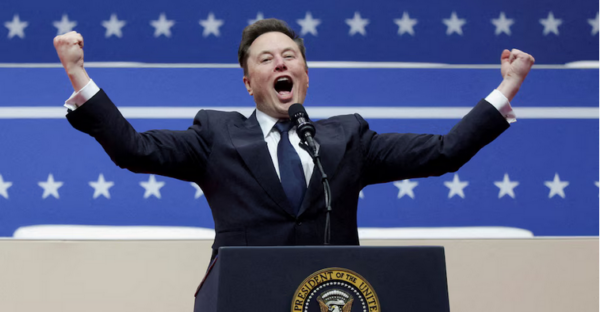
Having spent nearly $300 million to purchase the US presidency for Donald Trump, Elon Musk now feels entitled to do with it as he pleases. Just how radically Musk plans to remake the country was conveyed to the American people only after the election, when Musk stood behind the presidential seal on Inauguration Day and gave a Nazi salute. Then did it again. Maybe that sort of thing was OK to do in apartheid South Africa, where Musk grew up, but it’s jarring to see here in the United States.

Reporters initially struggled to meet the moment (FAIR.org2/4/25), downplaying Musk’s salute (the Washington Post described a “high-energy speech“), as well as his broader agenda, which Musk now openly declares a “revolution,” and consists of an unelected billionaire wresting control of nearly the entire executive branch of government. Early media reports went along with Musk’s “efficiency” mantra (Column2/3/25), but more recently reporters have started to find their footing, and the dangers of Musk’s project are being conveyed. Sort of.

“Reporters on the battlefield are doing what they can” to expose the radical nature of Trump’s second term, writes media columnist Oliver Darcy (Status2/5/25). “The news generals back in the command center, however, are largely abdicating their duties.”

‘Musk’s audacious goal’

Nowhere is this discrepancy more apparent than at the Washington Post, a newspaper famed for opposing a prior Republican president with an expansive view of executive power. These days, however, even as Post reporters like Jeff Stein are busy breaking stories (e.g., 1/28/252/8/25) about the Trump power grab, the paper’s higher-ups are careful not to offend the president or Musk. The Post is even, incredibly, calling on the Constitution-defying billionaire duo to push further.

As Elon Musk seizes extraconstitutional control of the federal budget, Washington Post editors (2/7/25) urge him to use that power to go after Social Security and Medicare.

“To have any chance of achieving Musk’s audacious goal of $2 trillion in cuts,” the Post editorial board (2/7/25) wrote, “Trump will need to work with elected representatives in Congress to reform entitlement programs such as Social Security and Medicare before they become insolvent.”

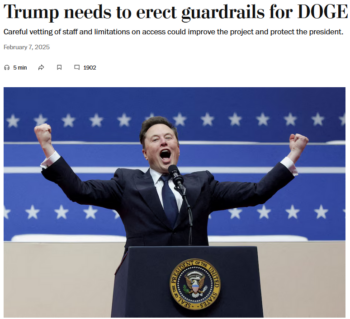
While claiming it wants Trump to “erect guardrails” for Musk, the Post urges the president to abandon one of the only guardrails he established—the cutting of Social Security and Medicare, which Trump repeatedly said he wouldn’t do, but recently started waffling on.

To be clear, the Post has long called for cutting so-called entitlements (FAIR.org11/1/116/15/23). But to do so at this moment—by encouraging a coup attempt to push further—is quite extraordinary.

The Post’s move comes as its billionaire owner, Amazon founder Jeff Bezos, is lavishing praise and millions of dollars on Trump and his family, while coaching his paper to take a less critical approach in its coverage (FAIR.org1/22/25). Bezos’s ingratiation toward Trump started prior to the election, when Bezos personally spiked the Post’s endorsement of Kamala Harris (FAIR.org10/30/24).

Good news for X from Amazon

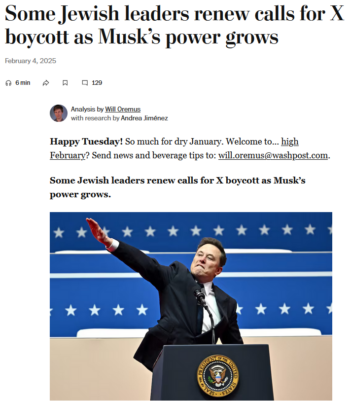
The Washington Post (2/4/25) reports on “divergent views among Jewish leaders in how to respond to Musk”: Some object to his ” Nazi-esque salute and Holocaust jokes,” others appreciate his censorship of criticism of Israel.

Bezos has also been busy making nice with Musk, his longtime rival for most powerful man on Earth and in space. On both fronts, Musk now has a decided edge, aided by his control over much of the US government, which both men’s sprawling empires rely on for billions of dollars in contracts.

With Musk’s hand on the public-money spigot, Bezos apparently did him a favor. After Musk openly heiled Hitler, Jewish leaders renewed calls to boycott Musk’s social media platform, (Washington Post2/4/25). “To advertisers—including GoogleAmazon and the ADL: Pull your ads now,” the Jewish leaders wrote. “The pressure is working. X’s financial difficulties prove it.”

But the boycott’s pressure was countered by Bezos’s company. “[X] got good news last week, with Amazon reportedly planning to hike its advertising on the site,” the Post (2/4/25) reported, without mentioning Bezos.

While X’s finances “were once so bad that Musk floated the idea of filing for bankruptcy,” things are suddenly looking up, the Financial Times (2/12/25) reported:

Musk famously admitted to overpaying for Twitter after he bought the social media platform known now as X for $44 billion in 2022. But the billionaire’s foray into government has coincided with a turnaround in X’s fortunes, as advertisers, including Amazon, flock back to the platform.

‘Lemmings leaping in unison’

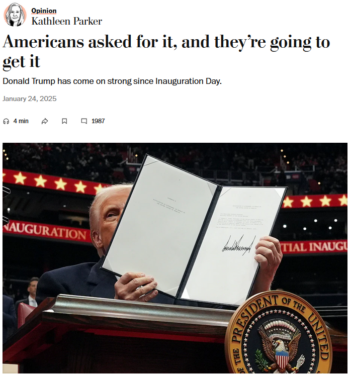
Kathleen Parker (Washington Post1/24/25) likened those who condemned Musk’s Nazi gesture to “lemmings leaping in unison from a cliff”—because it’s suicidal to notice fascism in high places?

It wasn’t just Bezos’s company that threw Musk a lifeline, but also his newspaper. An initial Post headline (1/20/25), which omitted mention of Musk’s Nazi salute, read “Elon Musk Gives Exuberant Speech at Inauguration.” The following day, Post columnist Megan McArdle, echoing the ADL, downgraded Musk’s salute to an “awkward gesture,” the same phrase Post columnist Kathleen Parker used to dismiss those who saw something more sinister as “lemmings leaping in unison from a cliff” (Washington Post1/24/25).

Interestingly, one of the most vociferous “lemmings” was Post columnist Catherine Rampell, who brilliantly called out Musk’s Nazi salute, but on CNN, and noticeably not in the Post, except once in passing (1/30/25).

Musk responded to Rampell’s CNN appearance by threatening to sue her in a post (1/27/25) to his over 200 million X followers.

I noted at the top that Musk spent nearly $300 million to elect Trump, but that’s only part of the story. Musk also provided inestimable support by transforming X into a pro-Trump bullhorn. Personally, when I logged onto X during the campaign, I routinely saw Musk’s pro-Trump tweets at the top of my feed, even though I didn’t follow Musk at the time.

Since the election, Musk ’s gifts to Trump have continued. X recently agreed to pay Trump $10 million to settle Trump’s 2021 lawsuit against the company, even though the case was dismissed in 2022. Trump was still appealing the ruling two-and-a-half years later when a deal was cut. “The settlement talks with X began after the election and were more informal, with both Trump and Musk personally involved in hammering out the $10 million number,” the Wall Street Journal (2/13/25) reported.

‘Cheering for change’

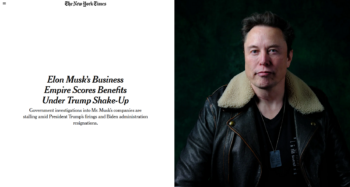
New York Times (2/11/25): Many of the federal agencies targeted by Musk “were leading investigations, enforcement matters or lawsuits pending against Mr. Musk’s companies.”

It’s quite something for Elon Musk—the world’s richest human and one of the largest government contractors—to gleefully slash public spending benefiting others. Especially when, by one measure, “virtually all of his net worth can be pinned to government help,” CNN (11/20/24) reported.

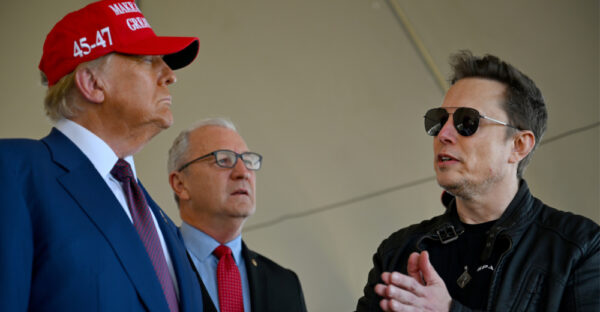
While Musk claims to wield a populist’s pitchfork as he attacks “the bureaucracy,” a closer look reveals the work of an oligarch’s scalpel. Musk’s coup team—called DOGE, and consisting mostly of twentysomething male engineers, several of whom appear to share Musk’s racist ideology (New York Times2/7/25)—is targeting the federal agencies investigating Musk’s companies, which in addition to X, include Tesla and SpaceX.

“President Trump has been in office less than a month, and Elon Musk’s vast business empire is already benefiting—or is now in a decidedly better position to benefit,” read the opening lines of a New York Times story (2/11/25):

At least 11 federal agencies that have been affected by [Trump’s] moves have more than 32 continuing investigations, pending complaints or enforcement actions into Mr. Musk’s six companies.

While Trump claims Musk is “not gaining anything” from the arrangement, and Musk says the same, Wall Street sees things differently. Even as Musk says he’s turning his “efficiency” revolution to the Pentagon—the only federal agency never to pass an audit, and where any honest attempt to rein in government spending would begin—stocks for armsmaking companies associated with Musk are surging, while those without ties to him languish. “Palantir, as well as Musk’s SpaceX, OpenAI and robotics and AI specialist Anduril Industries, are cheering for change,” the Wall Street Journal (2/10/25) reported.

In other words, having seized control of the levers of government, an oligarch will now be directing funding to himself and his cronies. That’s Wall Street’s view, anyhow.

It seems to be Bezos’s as well. With Amazon and Blue Origin, Bezos’s space company, competing for billions in government contracts, it makes perfect business sense for Bezos to cozy up to Musk and Trump. From a journalistic perspective, however, it’s nothing short of a disaster, one that’s playing out daily in the pages of the Washington Post.


You can send a message to the Washington Post at letters@washpost.com (or via Bluesky@washingtonpost.com).

Please remember that respectful communication is the most effective. Feel free to leave a copy of your message in the comments thread on FAIR.org.

FAIR’s work is sustained by our generous contributors, who allow us to remain independent. Donate today to be a part of this important mission.

Original article by Pete Tucker republished from FAIR under a Creative Commons Attribution-NonCommercial-NoDerivs 3.0 Unported License.

Elon Musk urges you to be a Fascist like him, says that you can ignore facts and reality then.
Climate Science Denier Donald Trump says Burn, Baby, Burn.

Continue ReadingWaPo Provides Cover for Musk’s Government Takeover

As Constitutional Crises Mount, US Press Sleepwalks Into Autocracy

Spread the love

Original article by Julie Hollar republished from FAIR under a Creative Commons Attribution-NonCommercial-NoDerivs 3.0 Unported License.

CNN (1/31/25) framed Elon Musk’s extra-constitutional power grab as part of “the war over federal spending.”

When President Donald Trump announced an unprecedented freeze on federal grants and loans last week, some of the most prominent US news outlets proved themselves largely uninterested in whether it was legal. Meanwhile, a few braver journalists called out the move as the constitutional crisis that it was (FAIR.org1/29/25).

When Democratic attorneys general rushed to challenge the move in court, with positive results, Trump rescinded the order. But the crisis is hardly over.

On the contrary: Elon Musk, the unelected centibillionaire who threw Nazi salutes at the inauguration, has wrested control of the Treasury Department’s payment system, after forcing out its most senior career civil servant, David Lebryk. As CNN (1/31/25) reported, the Treasury takeover happened after Trump’s team had repeatedly asked about the department’s ability to stop payments, to which Lebryk had insisted, “We don’t do that.”

These payments include everything from Social Security checks to tax refunds, federal employee salaries to contractor payments. It’s over $5 trillion a year, a fifth of the US economy. The database Musk and his tech bro allies in the non–congressionally approved “Department of Government Efficiency” (DOGE) have access to also contains enormous amounts of sensitive personal information for most Americans, including Social Security numbers. And Musk and a 25-year-old former X employee have access to the code that controls the payment systems, allowing them to make irreversible changes to it, according to Wired (2/4/25).

At the same time, Musk has infiltrated the General Services Administration and the Office of Personnel Management—two other rather obscure and nonpolitical but hugely consequential agencies that manage federal offices, technology and employees (Wired1/28/251/31/25).

‘An idea that crosses party lines’

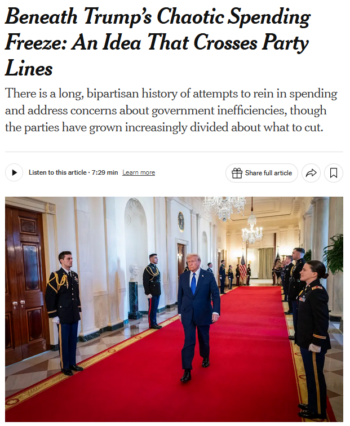
The New York Times (1/31/25) put its seal of approval on Trump’s illegal attempt to freeze federal spending, calling the idea behind it “bipartisan.”

Instead of appropriately pushing the increasing lawlessness and opacity to the forefront of their reporting, the New York Times and Washington Post largely buried these stories, downplaying their earth-shattering break from democratic norms.

As Musk took over the Treasury system, the Times (1/31/25) did point out:

Control of the system could give Mr. Musk’s allies the ability to unilaterally cut off money intended for federal workers, bondholders and companies, and open a new front in the Trump administration’s efforts to halt federal payments.

And yet somehow this story struck editors as page 13 material.

Meanwhile, a piece (1/31/25) by the Times‘ Michael Shear published online the same day was deemed front-page material, causing even seasoned media critics to spit out their morning beverage at its breathtaking ability to bothsides the situation: “Beneath Trump’s Chaotic Spending Freeze: An Idea That Crosses Party Lines.”

Shear wrote that Trump is simply “continuing a mostly failed effort by a long series of presidents and Congress” to “somehow reverse the seemingly inexorable growth of the federal government, an issue that resonates with some Democrats as well as most Republicans.” He thus clearly communicated that he is not up for the task of reporting on this administration.

The Times published Musk’s Treasury takeover on page 18, under the rather nonchalant headline: “Elon Musk’s Team Now Has Access to Treasury’s Payments System.” The subhead read:

Treasury Secretary Scott Bessent gave Mr. Musk’s representatives at the so-called Department of Government Efficiency a powerful tool to monitor and potentially limit government spending.

And hey, don’t worry, the article suggests:

Mr. Musk’s initiative is intended to be part of a broader review of the payments system to allow improper payments to be scrutinized, and is not an effort to arbitrarily block individual payments, the people familiar with the matter said.

At the Post, readers got language like, “The clash reflects an intensifying battle between Musk and the federal bureaucracy” (1/31/25), and “it is extremely unusual for anyone connected to political appointees to access” the payment systems (2/1/25). (In fact, it appears to be unprecedented—Independent2/3/25.)

‘Reminiscent of Stalin’

Wired (1/31/25): Musk’s team is “attempting to use White House security credentials to gain unusual access to GSA tech, deploying a suite of new AI software, and recreating the office in X’s image.”

There is another way to do journalism. It’s called connecting dots, asking questions, not accepting anonymous claims of benevolent intent—and helping people understand the gravity of the situation when unprecedented end-runs around democracy are happening before our very eyes. And it’s heartening to see quite a few news outlets engaging in it.

For instance, Wired has been doing a tenacious job following Musk’s assault on the government, connecting the dots between his actions and explaining the dangers to the country. It broke the news (1/28/25) that Musk workers from his various companies had taken over management positions at the Office of Personnel Management—well before Trump’s nominee to take over the OPM has even had a confirmation hearing. Its subhead noted: “One expert found the takeover reminiscent of Stalin.”

Wired explained that the installation of AI experts at OPM suggests a forthcoming effort to use AI on the reams of data it has access to in order to target federal employees for removal.

Regarding the GSA infiltration, Wired reported (1/31/25):

The access could give Musk’s proxies the ability to remote into laptops, listen in on meetings, read emails, among many other things, a former Biden official told Wired on Friday.

“Granting DOGE staff, many of whom aren’t government employees, unfettered access to internal government systems and sensitive data poses a huge security risk to the federal government and to the American public,” the Biden official said. “Not only will DOGE be able to review procurement-sensitive information about major government contracts, it’ll also be able to actively surveil government employees.”

Wired again put that danger (“the potential [for Musk minions] to remote into laptops, read emails, and more”) into its subhead—unlike the Times‘ muted headlines.

‘Incredibly dangerous’

Rolling Stone (2/3/25) pointed out that “the danger of operational access to the payments system is precisely that there are very little safeguards for its improper use or manipulation.”

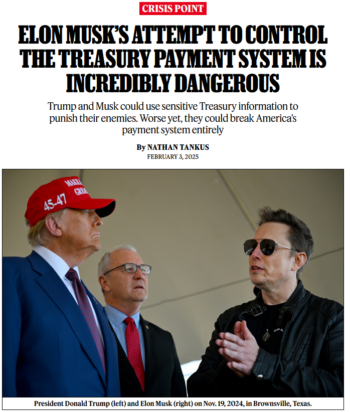
Others are also raising alarms in their headlines, as at Rolling Stone (2/3/25): “Elon Musk’s Attempt to Control the Treasury Payment System Is Incredibly Dangerous.” The subhead explained: “Trump and Musk could use sensitive Treasury information to punish their enemies. Worse yet, they could break America’s payment system entirely.”

The piece, by Nathan Tankus, pointed out that there are glaring reasons to disbelieve administration claims about this being about “improper payments,” such as:

At 3:14 a.m. Sunday, Musk pledged to shut down supposedly “illegal payments” to Global Refuge, a faith-based organization that exists to provide “safety and support to refugees, asylum seekers and immigrants from across the world.”

Tankus also points out what the Post and Times won’t, which is that the seizure of the payment system means Trump and Musk

can just impound agency payments themselves. They could also possibly stop paying federal employees they have forced on paid administrative leave, coercing them to resign.

Even in bigger media, some critical voices could be heard. CNN‘s Zachary Wolf (2/1/25) asked some appropriate journalistic questions: “Has [Musk] taken an oath, like the federal workers he apparently has plans to fire, to uphold the Constitution?…. What are Musk’s conflicts of interests?”

Accessories to the coup

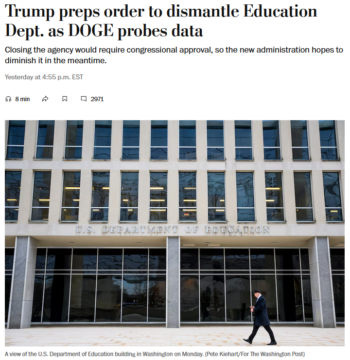
The Washington Post (2/4/25) assures readers that “the Education Department was created by Congress, and only Congress can eliminate it.”

The Washington Post put news about Musk’s takeovers on the front page today (2/4/25), as it reported on Trump preparing an executive order to dismantle the Department of Education, which Musk has apparently also infiltrated. But it still managed to sound rather sanguine about the threat: “The expected executive order would not shut down the agency, as there is widespread agreement in both parties that doing so would require congressional action.” Despite reporting daily on actions Trump and Musk have taken that have usurped congressional authority, the paper still seems to believe—and want readers to believe—against all evidence that our Constitution’s constraints on executive power continue to hold.

And the New York Times finally published an article (2/3/25) taking a deeper look “Inside Musk’s Aggressive Incursion Into the Federal Government,” as the headline stated. Still, it seemed to find it difficult to use language in its early framing paragraphs any stronger than to say that Musk’s actions “have challenged congressional authority and potentially breached civil service protections,” as it explains in the third paragraph. These moves are “creating major upheaval,” the fifth paragraph allowed, and the sixth said it “represented an extraordinary flexing of power by a private individual.”

The piece was not published in the print newspaper the next day; FAIR has yet to see it rise to the top of the paper’s homepage.

As Musk and Trump continue to behave like kings, it’s incumbent upon news media to not just report on their actions, but put them in the proper context for the public to understand the threat level they represent; otherwise, we can’t respond appropriately.

That kind of reporting takes real bravery in the kind of moment we are in: Musk has already (falsely) called it a crime to reveal the names of those working for him at the agencies DOGE is targeting, which Wired and others have done. The Trump-installed interim US attorney for DC has obsequiously promised Musk to go after those who identify his underlings—and to prosecute “anyone who impedes your work or threatens your people” (New Republic2/3/25).

While that might sound laughable, media outlets have already paid Trump handsome settlements to settle lawsuits that should have been seen as similarly laughable (FAIR.org12/16/24PBS1/29/25New York Times1/30/25). When prominent news outlets won’t summon the courage to vigorously oppose this descent into autocracy, they are accessories to the coup. We must demand better from them, and support the outlets and journalists doing the critical work we as citizens require to defend our democracy.

ACTION: Tell the New York Times and Washington Post to treat Musk’s actions like the existential threat to democracy that they are.

CONTACT:

New York Times
Letters: letters@nytimes.com
Bluesky@NYTimes.com

Washington Post
Letters: letters@washpost.com,
Bluesky@washingtonpost.com

Please remember that respectful communication is the most effective. Feel free to leave a copy of your message in the comments thread here.


Correction (2/5/25): An earlier version of this article misstated the title of the official who threatened to prosecute those who revealed the names of DOGE employees. He is the interim US attorney for the District of Columbia.

FAIR’s work is sustained by our generous contributors, who allow us to remain independent. Donate today to be a part of this important mission.

Original article by Julie Hollar republished from FAIR under a Creative Commons Attribution-NonCommercial-NoDerivs 3.0 Unported License.

Elon Musk urges you to be a Fascist like him, says that you can ignore facts and reality then.
Climate Science Denier Donald Trump says Burn, Baby, Burn.
Continue ReadingAs Constitutional Crises Mount, US Press Sleepwalks Into Autocracy

As Trump II Begins, Bezos Swaps Scrutiny for ‘Storytelling’

Spread the love

Original article by Julie Hollar republished from FAIR under a Creative Commons Attribution-NonCommercial-NoDerivs 3.0 Unported License.

As the Washington Post faces a staff rebellion and plummeting subscription rates, billionaire owner Jeff Bezos has introduced a new mission statement: “Riveting Storytelling for All of America.”

The Washington Post‘s new slogan, “Riveting Storytelling for All of America,” is “meant to be an internal rallying point for employees,” the New York Times (1/16/25) reported.

The new path forward, as introduced in a slide deck to staff by Suzi Watford, the paper’s chief strategy officer, demands that the paper “understand and represent interests across the country,” and “provide a forum for viewpoints, expert perspectives and conversation” (New York Times1/16/25). It will do this as “an AI-fueled platform for news” that delivers “vital news, ideas and insights for all Americans where, how and when they want it.”

This appears to mean shifting resources toward opinion, specifically opinions from the right. According to the New York Times report:

Bezos has expressed hopes that the Post would be read by more blue-collar Americans who live outside coastal cities, mentioning people like firefighters in Cleveland. He has also said that he is interested in expanding the Post’s audience among conservatives.

The Post has already begun to consider ways to sharply increase the amount of opinion commentary published on its website, according to two people with knowledge of the talks. An adviser to the Post, Lippe Oosterhof, has conducted brainstorming sessions about a new initiative that would make it easier to receive and publish opinion writing from outside contributors.

How AI is meant to play into this is unclear.

The Post already has more columnists than you can shake a stick at. This new direction sounds like the Foxification of the Washington Post, a move away from any attempt to hold the powerful to account, toward inexpensive clickbait punditry.

‘Make money’

The red area represents the proportion of Jeff Bezos’s total wealth that would be required to cover the Washington Post‘s losses for a year.

Watford’s slide deck presented three pillars of the Post‘s new model: “great journalism,” “happy customers” and “make money.” The Post lost roughly $77 million in 2023. (It also lost some 250,000 subscribers after Bezos killed the paper’s planned endorsement of Kamala Harris—FAIR.org10/30/24.)

In order to make money, its new “Big Hairy Audacious Goal” (yes, that’s what the Post slide deck apparently called it) is to reach 200 million “paying users.” The paper currently has about 3 million subscribers, making it an “audacious” goal indeed. As the Times pointed out, even if the Post could achieve the impossible task of monetizing every visit to its website, no major corporate media outlet has been getting more than 100 million monthly unique visits—paying and non-paying—outside of the spike in traffic around the election.

Back in 2019, the Post was claiming 80–90 million unique visitors per month. Those visits peaked in November 2020 at 114 million, but quickly and steadily dropped after Biden’s inauguration. The Post stopped posting its audience numbers online after January 2023, when they were down to 58 million.

Of course, most online corporate media have been struggling. The thing about the Post is that its absurdly wealthy owner, the second-richest person on Earth, can easily afford to lose $77 million a year. That’s 0.03% of Bezos’s current net worth.

‘We are deeply alarmed’

Guardian (1/15/25): “The plea from staff…comes a week after the Post laid off roughly 100 employees…roughly 4% of the publication’s staff.”

No doubt the Post needs help. Just days before the new mission statement was revealed, over 400 staff members signed a letter to Bezos asking for a meeting (Guardian1/15/25).  The letter read:

We are deeply alarmed by recent leadership decisions that have led readers to question the integrity of this institution, broken with a tradition of transparency, and prompted some of our most distinguished colleagues to leave, with more departures imminent.

Bezos’s response—a slide deck about “riveting storytelling” on “an AI-driven platform” that prioritizes churning out opinions to draw in conservatives—is hardly likely to ease the mind of any serious journalist at the paper.

Nor is trying to “expand the Post audience among conservatives,” while still paying lip service to “great journalism,” likely to solve the Post‘s problems. As CNN‘s former CEO Chris Licht discovered (FAIR.org6/8/23), you can’t do good journalism while trying to appeal to both sides in the context of an increasingly radical right, because that side demands acceptance of lies and conspiracy theories that are incompatible with actual journalism.

When Bezos bought the Post (Extra!3/14), he assured the paper’s employees that “the paper’s duty will remain to its readers and not to the private interests of its owners.” That sentiment was repeated in Watford’s slide deck this week. But Bezos’s actions in the past months—including the killing of the Harris endorsement, Amazon donating $1 million donation to Trump’s inaugural fund and paying Melania Trump $40 million for her self-produced documentary, and, most recently, Bezos appearing onstage with other multibillionaires at Trump’s inauguration—make clear that the principle is as meaningless to Bezos as the slogan that debuted after Trump’s first election: “Democracy Dies in Darkness.”

That slogan will continue to adorn the front page for the time being, perhaps in the hope that readers searching for an actual news organization that holds those in power to account will be fooled into subscribing.


ACTION ALERT: You can send a message to the Washington Post at letters@washpost.com.

Please remember that respectful communication is the most effective. Feel free to leave a copy of your message in the comments thread here.

FAIR’s work is sustained by our generous contributors, who allow us to remain independent. Donate today to be a part of this important mission.

Original article by Julie Hollar republished from FAIR under a Creative Commons Attribution-NonCommercial-NoDerivs 3.0 Unported License.

Continue ReadingAs Trump II Begins, Bezos Swaps Scrutiny for ‘Storytelling’

How US Media Hide Truths About the Gaza War

Spread the love

Original article by Norman Solomon republished from Common Dreams under Creative Commons (CC BY-NC-ND 3.0).

A reader holds up a copy of a satirical paper, “The New York War Crimes,” mocking The New York Times’ biased coverage of the Gaza genocide, on March 14, 2024 in New York City. (Photo: Nicki Kattoura/X)

Despite exceptional coverage at times, what was most profoundly important about war in Gaza—what it was like to be terrorized, massacred, maimed, and traumatized—remained almost entirely out of view.

A few days before the end of 2024, the independent magazine +972 reported that “Israeli army forces stormed the Kamal Adwan Hospital compound in Beit Lahiya, culminating a nearly week-long siege of the last functioning hospital in northern Gaza.” While fire spread through the hospital, its staff issued a statement saying that “surgical departments, laboratory, maintenance, and emergency units have been completely burned,” and patients were “at risk of dying at any moment.”

The magazine explained that “the assault on medical facilities in Beit Lahiya is the latest escalation in Israel’s brutal campaign of ethnic cleansing in northern Gaza, which over the last three months forcibly displaced the vast majority of Palestinians living in the area.” The journalism from +972—in sharp contrast to the dominant coverage of the Gaza war from U.S. media—has provided clarity about real-time events, putting them in overall context rather than episodic snippets.

+972 Magazine is the work of Palestinian and Israeli journalists who describe their core values as “a commitment to equity, justice, and freedom of information”—which necessarily means “accurate and fair journalism that spotlights the people and communities working to oppose occupation and apartheid.” But the operative values of mainstream U.S. news outlets have been very different.

What was sinister about proclaiming “Israel’s 9/11” was what happened after America’s 9/11.

Key aspects of how the U.S. establishment has narrated the “war on terror” for more than two decades were standard in American media and politics from the beginning of the Gaza war in October 2023. For instance:

  • Routine discourse avoided voices condemning the U.S. government for its role in the slaughter of civilians.
  • The U.S. ally usually eluded accountability for its high-tech atrocities committed from the air.
  • Civilian deaths in Gaza were habitually portrayed as unintended.
  • Claims that Israel was aiming to minimize civilian casualties were normally taken at face value.
  • Media coverage and political rhetoric stayed away from acknowledging that Israel’s actions might fit into such categories as “mass murder” or “terrorism.”
  • Overall, news media and U.S. government officials emitted a mindset that Israeli lives really mattered a lot more than Palestinian lives.

The Gaza war has received a vast amount of U.S. media attention, but how much it actually communicated about the human realities was a whole other matter. The belief or unconscious notion that news media were conveying war’s realities ended up obscuring those realities all the more. And journalism’s inherent limitations were compounded by media biases.

During the first five months of the war, the New York TimesWall Street Journal, and Washington Post applied the word “brutal” or its variants far more often to Palestinians (77%) than to Israelis (23%). The findings, in a study by Fairness and Accuracy In Reporting (FAIR), pointed to an imbalance that occurred “even though Israeli violence was responsible for more than 20 times as much loss of life.” News articles and opinion pieces were remarkably in the same groove; “the lopsided rate at which ‘brutal’ was used in op-eds to characterize Palestinians over Israelis was exactly the same as the supposedly straight news stories.”

Despite exceptional coverage at times, what was most profoundly important about war in Gaza—what it was like to be terrorized, massacred, maimed, and traumatized—remained almost entirely out of view. Gradually, surface accounts reaching the American public came to seem repetitious and normal. As death numbers kept rising and months went by, the Gaza war diminished as a news topic, while most talk shows seldom discussed it.

As with the slaughter via bombardment, the Israeli-U.S. alliance treated the increasing onset of starvation, dehydration, and fatal disease as a public-relations problem. Along the way, official pronouncements—and the policies they tried to justify—were deeply anchored in the unspoken premise that some lives really matter and some really don’t.

The propaganda approach was foreshadowed on October 8, 2023, with Israel in shock from the atrocities that Hamas had committed the previous day. “This is Israel’s 9/11,” the Israeli ambassador to the United Nations told reporters in New York, and he repeated: “This is Israel’s 9/11.” Meanwhile, in a PBS News Weekend interview, Israel’s ambassador to the United States declared: “This is, as someone said, our 9/11.”

What was sinister about proclaiming “Israel’s 9/11” was what happened after America’s 9/11. Wearing the cloak of victim, the United States proceeded to use the horrible tragedy that occurred inside its borders as an open-ended reason to kill in the name of retaliation, self-protection, and, of course, the “war on terror.”

As Israel’s war on Gaza persisted, the explanations often echoed the post-9/11 rationales for the “war on terror” from the U.S. government: authorizing future crimes against humanity as necessary in the light of certain prior events. Reverberation was in the air from late 2001, when the Pentagon’s leader Donald Rumsfeld asserted that “responsibility for every single casualty in this war, whether they’re innocent Afghans or innocent Americans, rests at the feet of the al Qaeda and the Taliban.” After five weeks of massacring Palestinian people, Israel’s Prime Minister Benjamin Netanyahu said that “any civilian loss is a tragedy”—and quickly added that “the blame should be placed squarely on Hamas.”

The licenses to kill were self-justifying. And they had no expiration date.

This piece was originally published by MediaNorth. It is adapted from the afterword in the paperback edition of Norman Solomon’s latest book, War Made Invisible: How America Hides the Human Toll of Its Military Machine (The New Press).

Original article by Norman Solomon republished from Common Dreams under Creative Commons (CC BY-NC-ND 3.0).

Continue ReadingHow US Media Hide Truths About the Gaza War