Wellbeing ‘Beyond GDP’: How Humanity Can Benefit From Alternatives to Capitalism
Original article by JON QUEALLY republished from Common Dreams under Creative Commons (CC BY-NC-ND 3.0).
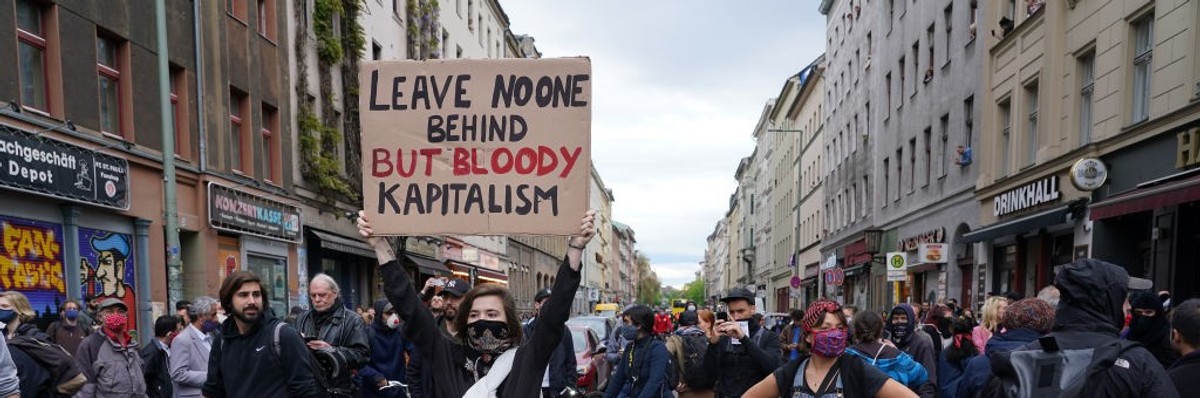
“Whenever it’s claimed that there are no alternatives to capitalism, it really exposes the lack of imagination and willingness to develop a better future, not the lack of alternatives.”
“Can you imagine a place where growth is linked to life and justice rather than profit and the economy?”
That’s one of the key questions at the heart of a new publication by Greenpeace which lays out a series of detailed alternatives to rapacious capitalism that dominates the global economy and ruling governments worldwide.
Titled Growing the Alternatives: Societies for a Future Beyond GDP, the report puts a target on neoliberalism’s obsession with gross domestic product and how skewed understandings of what’s considered valuable undermine efforts to build happier, more equitable, and efficient societies.
“Today, a country’s economic growth is used as an indicator of living standards,” the report states. “In other words, the higher a country ranks on the Gross Domestic Product (GDP) list, the better the prospects for that country. But that is far from reality when the wellbeing of people and nature is considered.”
The report argues that “the focus on economic growth has led to an anachronism that prioritizes planet-depleting activities and inequalities while overlooking wellbeing.”
According to Paula Tejón Carbajal, the Alternative Futures Campaign lead at Greenpeace International, “Whenever it’s claimed that there are no alternatives to capitalism, it really exposes the lack of imagination and willingness to develop a better future, not the lack of alternatives.”
Greenpeace says that even while GDP remains the economic index most countries use to measure economic health, “its one-size-fits-all approach rewards waste and pollution and does not take into account vital aspects such as people’s wellbeing or the limits of nature.”
The report states:
The world today faces multiple crises that pose an existential threat to the future of human civilization. The modern industrialised world depends on the over-exploitation of nature, which is destroying the Earth’s ecosystems, triggering catastrophic climate change, biodiversity loss, and pollution. These are related problems with devastating consequences that have been building for decades. This is due to the collective failure of governments and businesses to act with sufficient urgency to counter the status quo of a system based on infinite growth, and dependent on fossil fuels, extraction, overproduction, overconsumption, and waste.
Across three detailed chapters, the group’s publication focuses on numerous principles for “wellbeing economies” that challenge the supremacy of economic growth GDP, including: “people and planet over profit and growth”; “equitable distribution of wealth and power”; “wellbeing at the core”; “the common good”; “circular economies”; “nature restoration”; and “real participatory democracy.”
In a world beset by war, human rights abuses, astronomical levels of inequality, and the fast-moving threat of rising temperatures and the climate crisis, Greenpeace argues that the alternatives to profit-at-all-costs capitalism are not only available but plentiful.
“All the examples we have gathered exist, work, and prove that there is a dynamic landscape for many alternative futures,” Tejón Carbajal said.
While the Greenpeace report was made available online last month, it was officially presented Wednesday during a virtual event attended by more than 160 people worldwide.
“In a world wracked by polarization, inequality, climate change, ecological breakdown, and a crisis of hope and imagination, we can’t use the same thinking that created the problem in the first place. Greenpeace calls for governments and global institutions to drive their decision-making according to sufficiency and the wellbeing of people and planet, so that what we really value becomes the new measure of success and can thrive and flourish across the world,” added Tejón Carbajal.
“To create a sustainable and just future for all,” one section of the report concludes, “we must move beyond GDP and develop a measurement framework for wellbeing, inclusion, and sustainability.”
Original article by JON QUEALLY republished from Common Dreams under Creative Commons (CC BY-NC-ND 3.0).