As the U.S. faces another potentially record heat wave this week, the Middle East and Europe’s Mediterranean have endured extreme temperatures that have proven deadly.
The big picture: Multiple heat-related deaths have been reported in Greece during the country’s earliest heat wave on record and Jordan’s official news agency said Sunday “14 Jordanian pilgrims died and 17 others were missing” in the searing heat while on the Islamic Hajj pilgrimage to Mecca in Saudi Arabia.
Tourists outside the Acropolis during high temperatures in Athens, Greece, on June 12, when authorities announced the closure of the ancient site for five hours due to soaring temperatures that also shut schools. Photo: Hilary Swift/Bloomberg via Getty Images
The heat waves sweeping these regions this month have been made “at least five times more likely” because of human-caused climate change, per new Climate Central analysis.
Context: Climate Central’s analysis is based on the group’s Climate Shift Index (CSI), which compares observed or forecast temperatures with simulations of the same weather conditions minus excess atmospheric greenhouse gases, per Alex Fitzpatrick.
The idea is to compare real-world conditions with what might have been the case had human-caused climate change been absent.
Saudi Arabia had a CSI of 5, meaning that human-caused climate change made a given daily average temperature five times more likely as of Monday morning. Greece, which has endured two weeks of extreme heat, had a CSI of 5 last week and 2 on Monday. Parts of Turkey had a CSI of 5.
A joint report by UN and European Union agencies found in April that Europe’s temperatures are rising about twice as fast the global average due to human-caused climate change — making it the fastest-warming continent on Earth.
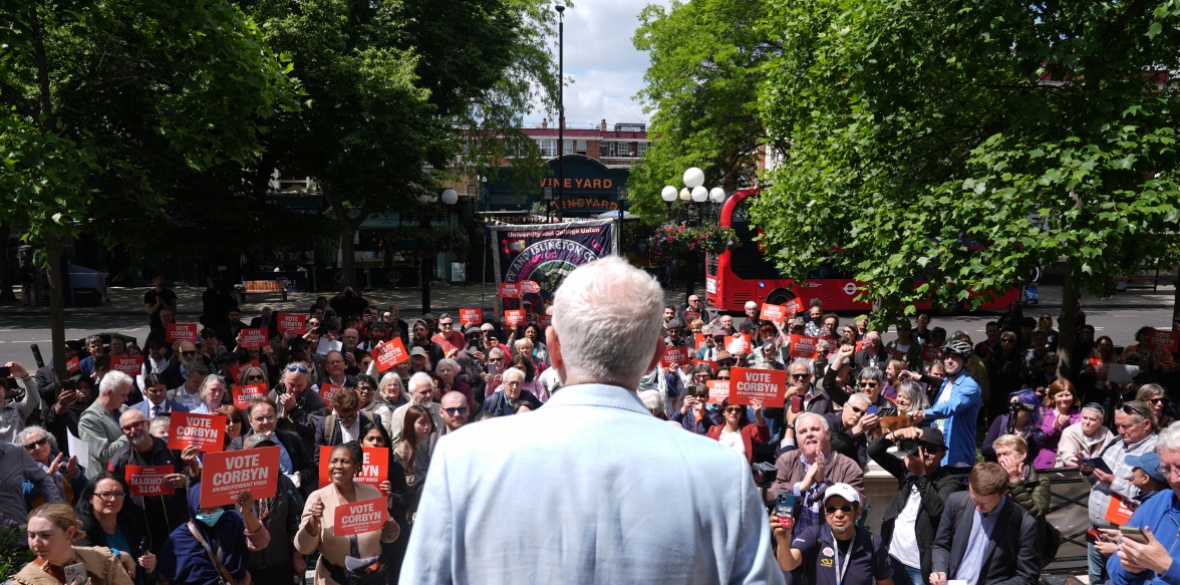
Jeremy Corbyn addresses supporters outside Islington Town Hall, north London, after handing in his nomination papers for the General Election on July 4, June 5, 2024
Praful Nargund, who is bidding to unseat Mr Corbyn, is a private health entrepreneur and has said privatisation is needed in the NHS
LABOUR’S imposed candidate in Islington North, Praful Nargund, has refused to attend hustings organised by Keep our NHS Public, forcing their cancellation.
The move is no surprise since Mr Nargund, bidding to unseat Jeremy Corbyn, is a private health entrepreneur who has said privatisation is needed in the NHS.
The no-hope Tory candidate for the seat also decided to duck the debate, forcing its cancellation.
Mr Corbyn, by way of contrast, spoke to hundreds at a rally in support of the NHS held in the constituency at the weekend.
Canvassing reports indicate massive support for the former Labour leader, particularly in the working-class areas of the constituency.
And in neighbouring Holborn and St Pancras, held by Mr Corbyn’s successor as Labour leader, independent challenger Andrew Feinstein is outgunning Sir Keir Starmer on the streets.
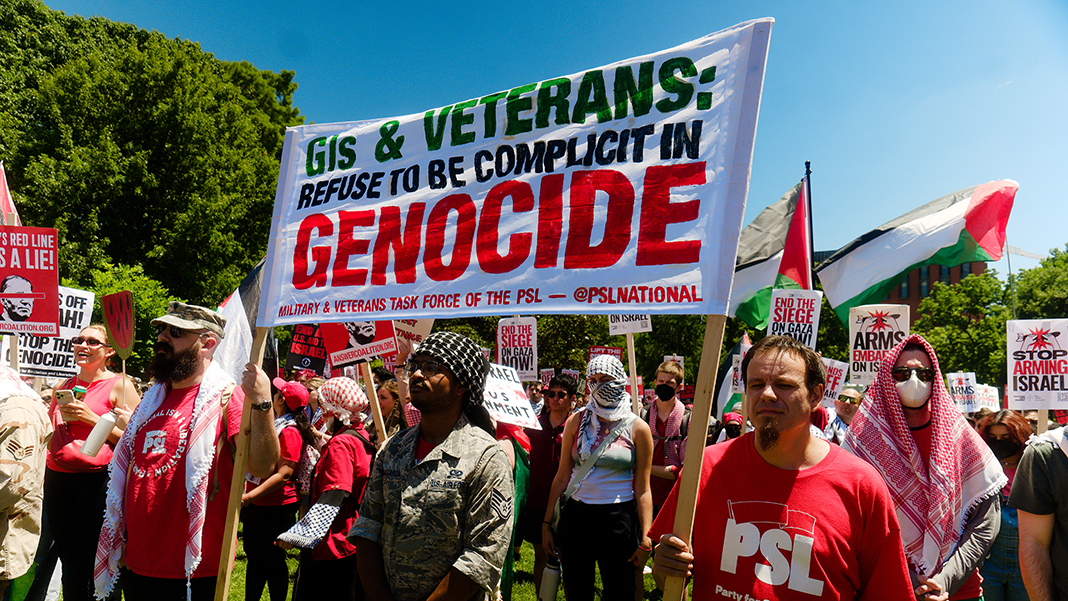
Veterans mobilize in front of the White House on June 8. (Photo: Mandy Wilkens)
Peoples Dispatch speaks to US veterans who are standing against their government’s complicity in genocide and organizing more to do the same
On February 25, US Air Force member Aaron Bushnell became the first active duty US soldier to earn the title of “martyr” among oppressed people worldwide. The 25-year-old set himself on fire in front of the Israeli embassy in Washington DC in protest of the US government’s complicity in the genocide in Gaza, declaring, “this is what our ruling class has decided will be normal,” before self-immolating.
Bushnell’s sacrifice was the most high-profile action by member of the US army in solidarity with Palestine and signaled an enormous sea change among active duty military as well as veterans—who are increasingly taking a bold step to denounce their government’s involvement in genocide.
According to Mike Prysner, who was an active duty soldier during the Iraq War and has been organizing veterans and active duty military ever since, the momentum among current and former members of the US military “hasn’t been this high since the Bush era.”
“The sector of service members who have turned against the US/Israeli policy in a profound way is undoubtedly much bigger than we can see at the moment—one the Pentagon is no doubt aware of as well,” Prysner wrote.
As Prysner told Peoples Dispatch, although the anti-war veterans movement is not as big as it was during the Iraq invasions, it is significant that veterans are organizing at such a high level today because unlike Iraq, the genocide in Palestine is “not a direct US war.”
“Most service members haven’t had direct experience with supporting Israel,” Prysner said. “They’re just disgusted by the fact that the military they served in and are serving in is playing a support and a propaganda role.”
However, Prysner notices significant anti-war momentum in the US Air Force in particular, which “does have more of a direct role in the other branches” in Gaza, in terms of “all the logistics that Israel needs” to carry out genocide. “I have noticed the active duty of the Air Force becoming more engaged because of their direct role,” Prysner says, including Bushnell.
“The potential for there to be unrest within the military is historically something that plays a major impact in adding to the pressure on Washington to end the war,” Prysner told Peoples Dispatch.
Shortly after Bushnell’s self-immolation, Prysner worked with other veterans of the Vietnam, Iraq, and Afghanistan wars to organize an action in Portland in which former US military members burned their uniforms collectively in protest. This type of action was later repeated throughout the country as other veterans and active duty military drew inspiration from the momentum.
Veterans in Portland, Oregan also recently organized a massive projection of anti-war imagery on a US Navy warship docked for “Fleet Week”. The images had slogans such as “Stop the US war machine” and “Blood is on your hands”.
Not only do veterans organizing within the anti-war movement inspire active duty military to take further action as well, but they also galvanize the entire anti-imperialist movement, says Prysner. He references the contingent of veterans who attended the recent 100,000-strong protest in front of the White House on June 8. Prysner noticed “a lot of excitement among the attendees” of the protest that veterans had mobilized.
On June 8, Peoples Dispatch spoke to two of the veterans who attended the mass mobilization in front of the White House to declare a “people’s red line” against genocide. Adrian served in the Air Force from 2002 to 2009, and went to Iraq. He now openly identifies as both an anti-imperialist and Marxist, organizing with the Party for Socialism and Liberation, and credits his time in the military as contributing to his shift in consciousness.
“War is a profit-making business,” US vet declares
“As a person who served in the United States Air Force, I’m very familiar with how the imperialist war machine works. Naturally, this isn’t something that one joins the military knowing. It was part of the whole radicalization process for me, being in the military, realizing that it functions very much like a corporate entity, and that war is a profit-making business,” Adrian told Peoples Dispatch.
“It was part of my being a working class person in the military, coming from the background that I came from, going to a foreign country to fight other poor and oppressed people, that created such a cognitive dissonance in me, that I had to address it in some sort of way.”
Adrian continued, “there are many things that active duty people, reservists and guardsmen can do. They can conscientiously object and thus separate from the military, but they can also organize outside of the military. They can attend rallies. They can organize with professional revolutionary organizations such as our own. They can do many other things to raise consciousness and awareness among their fellow servicemen.”
Chris Stevens, who was an infantryman in the US Army from 2007 and 2013, told Peoples Dispatch what his message is to prospective, current, and former service members who are disgusted by US complicity in genocide.
“Don’t be seduced in the first place. If you’ve yet to sign a contract, you should turn the other way. Your recruiter’s lying to you about everything, whether it be the job that you can have or the life that you’ll lead, the benefits that they promise you are not cast in stone and they will take anything they can from you,” Stevens said, referencing the predatory US military recruitment process.
Military recruiters in the US notoriously prey on working class and oppressed youth to lead them into military careers, luring them with promises of free college education. This phenomenon is part of what anti-war activists dub the “poverty draft,” in which poor young people have few opportunities apart from joining the US military, risking life and limb, and participating in the imperialist machine.
“For those who are already involved, my message is that you don’t have to listen to what they tell you to do,” Stevens continued. “There are significant historical examples from the Vietnam and Iraq wars, where entire units have decided to say no to their orders. As long as it’s not you alone resisting, if you can get a squad or a company together to say, we will not participate in this, there’s not much that the army can do.”
“So if you’re in a position where you are actively supporting this genocide that’s happening in Israel, you don’t have to,” Stevens said.
The issue of Palestine was particularly galvanizing, as Adrian mentioned: “I don’t want to see children murdered anymore. This is beyond the pale of what can be justified in the name of nationalism, in the name of anything that would be any semblance of what one would call the sovereignty of a so-called nation. The self-determination of the Palestinian people is paramount to humanity. And their fight is our fight.”
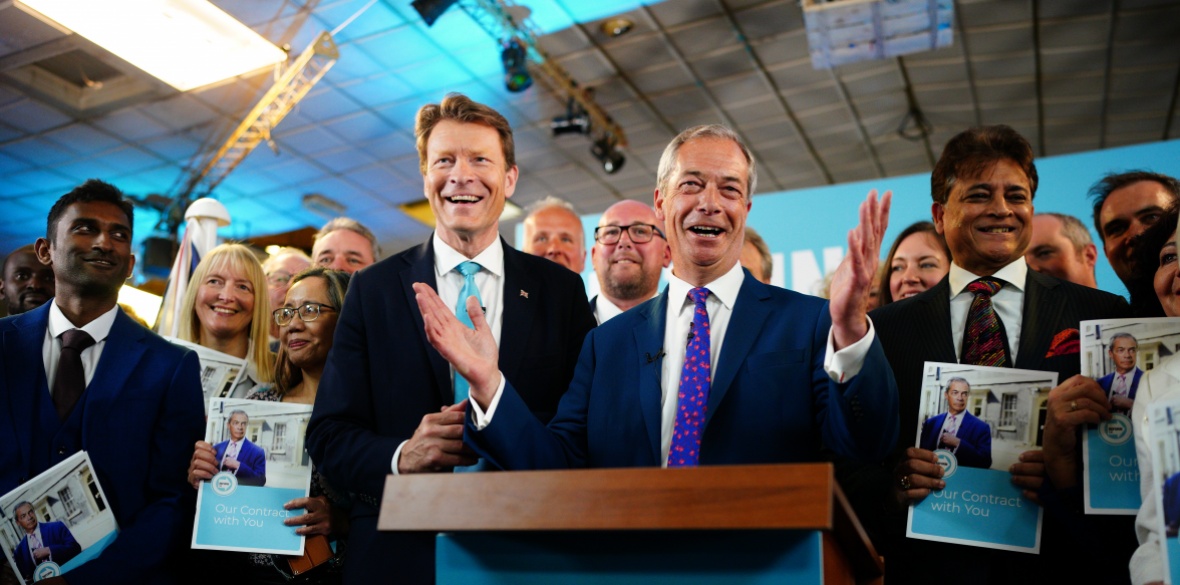
Reform UK chairman Richard Tice (left) and party leader Nigel Farage launch ‘Our Contract with You’ in Merthyr Tydfil while on the General Election campaign trail, June 17, 2024
REFORM started targeting Labour “red wall” voters today as the hard-right party launched its reactionary election manifesto in Wales.
The party’s owner and leader Nigel Farage went to Merthyr Tydfil, once represented by Labour pioneer Keir Hardie, to tell voters that “Labour is not very different to the Conservatives … it is just more incompetent.”
And he restated his aim of being the main challenger to Labour for government by 2029, likely date of the next general election following July 4.
The nationalist party’s platform is anti-migrant, opposed to climate action and supportive of NHS privatisation while cutting foreign aid and leaving the European Court of Human Rights.
It aims to take advantage of muted enthusiasm for Sir Keir Starmer’s Labour in working-class communities by rekindling the Brexit divisions it skilfully exploited in 2019.
Reform’s increasing prominence in the general election comes as the Tory Party’s campaign looks on the verge of expiring.
Nigel Farage, a man who has never been elected to the House of Commons despite years of trying, has again been allowed to set the agenda in the UK.
Ten years after Ukip won the European parliament elections, throwing the Conservative party into turmoil and leading David Cameron to promise a referendum on the UK’s membership of the European Union, Farage is at it again. Or more precisely, he is being allowed to go at it again.
The mainstream elite in the media and in politics who claim to oppose Farage, and who pretend to stand as a bulwark against far-right politics, are again duly buying into the hype he has created for himself.
We could already feel that hype bubbling as Farage took over as leader of Reform. He’d seen the party’s fortunes rising and started to think there could be something in it for him to step into the campaign.
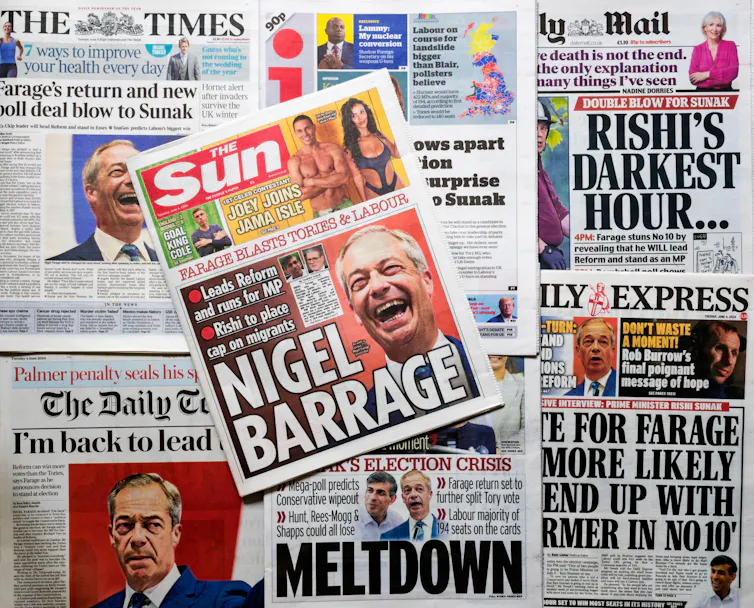
We could see it in the coverage of every move he made thereafter – every milkshake thrown, every inflammatory quip quoted and beer drunk, snapped and plastered all over the news as some kind of morbid excitement set in among the media. Finally, something exciting is happening in this otherwise rather dull campaign, where offers of “change” and pledges to be “bold” are hollow slogans for the sides of battle buses.
To understand how a party which only received 2% of the registered votes in the 2019 general election, failing to get even one MP elected, can get such attention, we must travel back in time.
Ukip was a party created by a eurosceptic elite, for a eurosceptic elite, to put pressure on the Conservatives via the EU elections. It all seemed a rather desperate move at the time, as the issue was marginal at best.
The party received 15.6% of the vote in the 2004 European elections and 16% in 2009. But these are second order elections, prone to low turnout and high protest vote. In these settings, Ukip really only received a mere 6% and 5.6% of the registered vote, once turnout was taken into account. Hardly the voice of the “silent majority”.
The 2005 and 2010 general elections clearly showed the limits of Ukip’s appeal. In 2005, the party received 1.4% of the vote and in 2010, it took 2%.
Ukip’s election vote share
Ukip results in general elections (GE) and European elections (EU). A Mondon., CC BY-ND
Still, the first “breakthrough” was in 2014 when Ukip won the EU elections with 26.6%. An “earthquake”, we were told. This was the start of the “left behind” myth which served Farage well as it diverted attention away from his elitist stance. The fantasised “white working class” would come to play a key role in shaping the narrative after the victories of both Donald Trump in the US and Brexit. Proper scrutiny of Ukip’s (and Reform’s) programmes (or Trump’s for that matter) would have also shown that beyond typical far-right measures and other gimmicks, their project was always deeply skewed in favour of the wealthy.
Yet even though Ukip really only received the support of one out of ten registered voters (9.5%) in 2014, in particularly favourable circumstances, the mainstream elite could not get enough of Farage. Finally, the UK had a “populist” contender worthy of the name. They too could feel the same voyeuristic thrills as their European counterparts, watching the “irresistible” rise of the far right (or “populism” to be politically correct, as we would not want to offend the far right, no matter how clear Farage has made his views).
What is striking is that it is this election which set in motion the 2016 referendum, even though Ukip was the only party running on a platform demanding that the UK leave the EU. For all the talk of “taking back control” and “sovereignty”, this reactionary experiment was decided based on the support of less than 10% of voters. Even in terms of votes cast, the referendum was forced onto almost three out of four voters who had decided to vote for parties who were not formally demanding the country leave the EU.
In case you missed it… Alamy/Urban images
All this is to say, Farage has simply never been that popular. This is despite him campaigning in incredibly fertile environments in which parts of the media are dedicated to propping him up, and where even those who seemingly oppose his politics cannot get enough of him – as demonstrated by his record number of appearances on the BBC or the countless articles on “populism” in the Guardian.
Just look at how much coverage a press conference given after one single poll has received, when other parties fail to get issues such as climate change, poverty or social care on the agenda.
And if you think this is because immigration is people’s key concern, think again. Indeed, as I explored with Lancaster university’s Aaron Winter in a report for the Runnymede Trust, the “immigration issue” is one that is clearly constructed in a top-down manner. Unsurprisingly, when people are asked about the key concerns in their personal lives, immigration doesn’t rate. Ironically, the exaggerated focus on immigration could be argued to be elite manipulation rather than the other way around.
So, what’s behind the rise of Farage? Well, the same processes which have been at play across much of Europe: the hyping of far-right politics as a diversion. As has become abundantly clear, there is no mainstreaming or rise of far-right politics without the active involvement of mainstream forces who normalise and platform them.
Want more election coverage from The Conversation’s academic experts? Over the coming weeks, we’ll bring you informed analysis of developments in the campaign and we’ll fact check the claims being made.
Sign up for our new, weekly election newsletter, delivered every Friday throughout the campaign and beyond.
The far right then plays a convenient role, serving to scare the electorate at a time when distrust in governing parties is sky high. The message is: “we are bad but they are worse”.
Yet this strategy is exhausted. Patience has run out and the far right is no longer as repulsive as it once was, now that most mainstream parties mimic its discourse.
The solution is simple. Stop fighting it on its turf. Instead, turn to issues which are not only core to people’s concerns, but far less amenable to far right hijacking. This takes bold actions and real change though – both being in short supply in our mainstream parties.