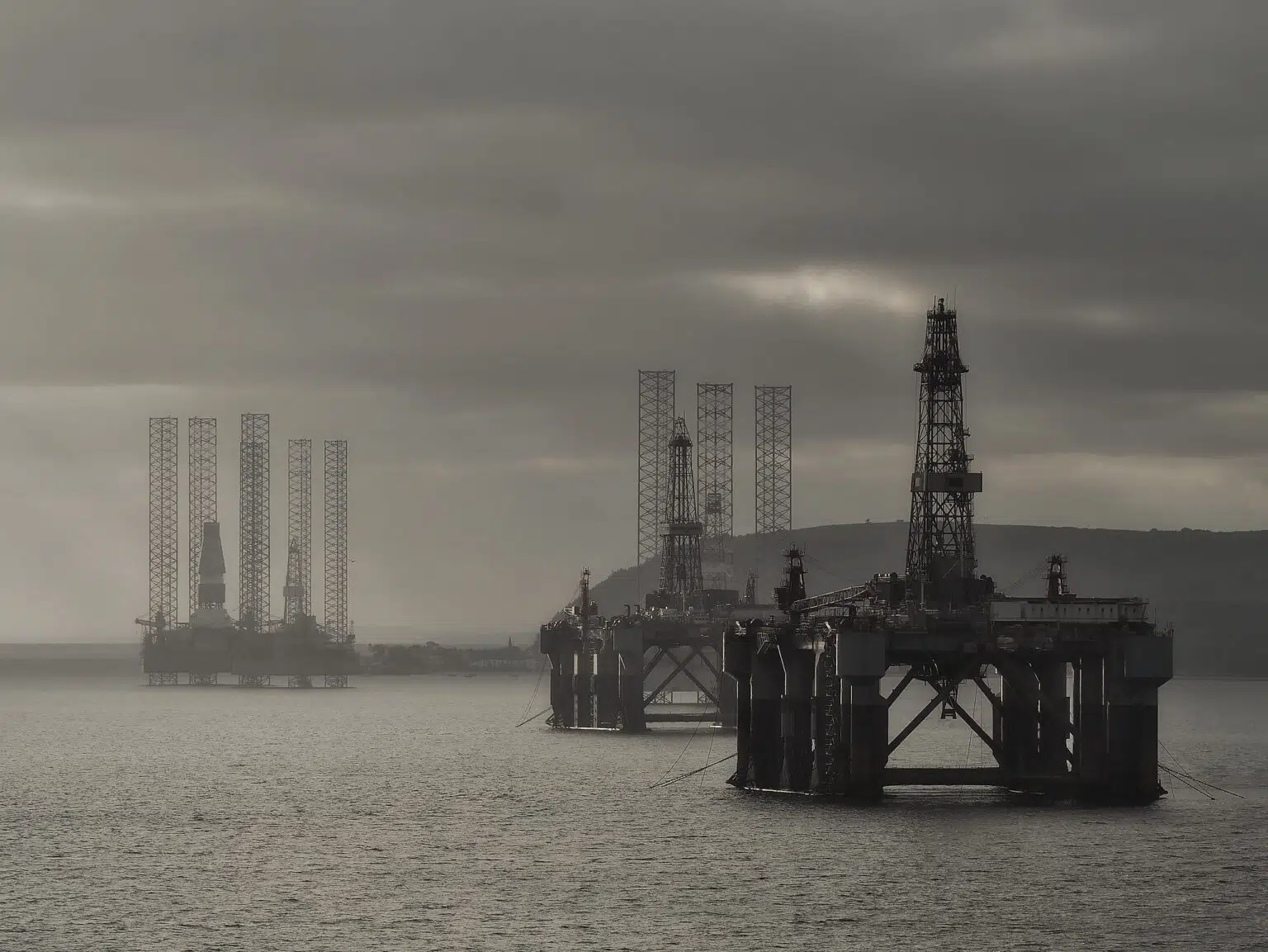
North Sea oil rigs in Cromarty Firth, Scotland. Credit: joiseyshowaa (CC BY-SA 2.0)
The Supreme Court has ruled a local council should have considered the full climate impact of burning oil from new wells – a landmark decision which could put future UK oil and gas projects in question.
Under planning law the assumption has always been that only the impacts from constructing the wells and not the use of the final oil products should be considered.
The case brought against Surrey County Council by Sarah Finch, on behalf of campaigners could threaten new UK fossil fuels projects.
…
Lawyers acting for Ms Finch said that as part of the Environmental Impact Assessment the council should have considered not just the greenhouse gas emissions from building the wells but also burning any oil that was then used – known as downstream emissions.
In a three-to-two majority the Supreme Court judges agreed.
Summing up the case Lord Leggatt said it was “inevitable” that oil from the site will be burned, and the resulting greenhouse emissions were “straightforwardly results of the project” which should be considered.
This warmth has continued into 2024, meaning that this year is also on track to potentially pass 1.5C in one or more datasets.
Crossing 1.5C in one or even two years is not the same as exceeding the 1.5C limit under the Paris Agreement. The goal is generally considered to refer to long-term warming, rather than annual temperatures that include the short-term influence of natural fluctuations in the climate, such as El Niño.
Here, Carbon Brief provides an updated analysis of when the world will likely exceed the Paris 1.5C limit (in a scenario where emissions are not rapidly cut), using both the latest global surface temperature data and climate model simulations.
…
There is no single best way to assess when the world will likely pass 1.5C. But both Carbon Brief’s approach and those of other groups all agree it will most likely happen in the late 2020s or early 2030s in a world (SSP2-4.5) where global emissions remain around current levels.
The UK’s energy bills were £22bn higher over the past decade than they would have been if Conservative governments had not cut “green crap” climate policies.
In 2013, then-prime minister David Cameron was infamously reported to have asked colleagues to “get rid of the green crap”, referring to climate policies supporting better home insulation.
His government later scrapped a “zero-carbon homes” (ZCH) standard for new-build homes, ended support for solar power and blocked the expansion of onshore wind.
The number of homes getting insulated each year is now 98% below 2012 levels, while the growth of onshore wind and solar remains far below previous peaks.
Carbon Brief’s new analysis updates figures published in January 2022, showing that the “green crap” rollbacks left UK billpayers more exposed to record gas prices during the energy crisis.
The £22bn added to energy bills since 2015 as a result of the rollbacks includes £9bn due to not having built more cheap onshore wind, £5bn due to poorly insulated homes, £5bn due to low solar deployment and another £3bn because new homes were less efficient than the ZCH standard.
In total, the UK’s gas demand is 99 terawatt hours (TWh, 14%) higher than it would have been if climate measures had been added at earlier rates, the analysis shows. This means the UK’s net gas imports are 31% higher than they would have been with more “green crap” in place.
‘Green crap’ cuts
In November 2013, a Sun frontpage reported then-prime minister David Cameron’s “solution to soaring energy price[s]” with the headline: “Get rid of the green crap.”
Cameron’s government, in coalition with the Liberal Democrats, went on to make a series of changes, including cutting spending on energy-efficiency improvements and introducing the “green deal” efficiency scheme, later described by the National Audit Office as a “fail[ure]”.
The number of homes getting their lofts or cavity walls insulated each year plummeted almost immediately – by 92% and 74% in 2013, respectively – and has never recovered.
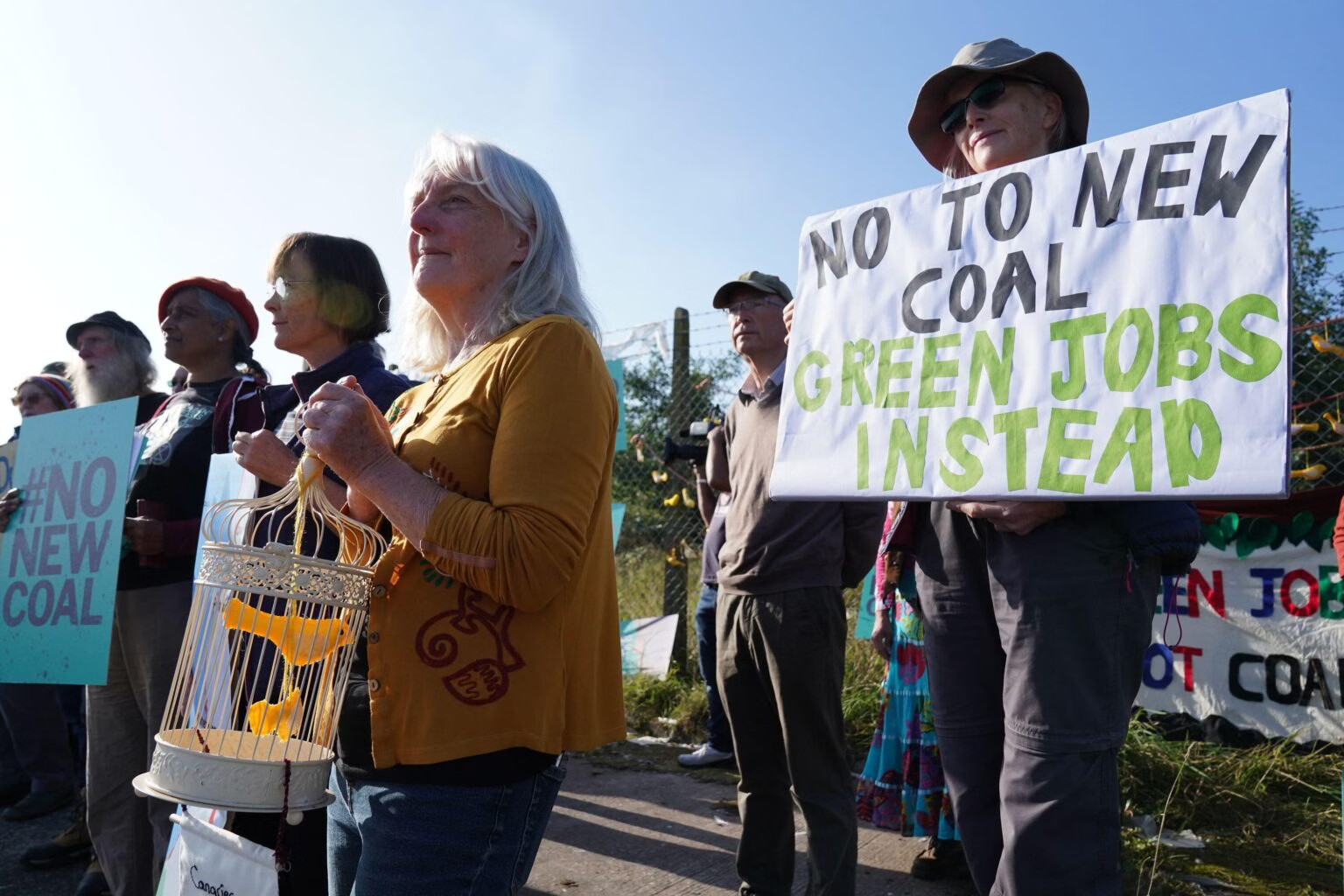
Demonstrators outside the proposed Woodhouse Colliery, south of Whitehaven, September 2021. Credit: PA Images / Alamy Stock Photo
Questions over compensation and employment could make it politically difficult for Labour to scrap the Whitehaven project, experts told DeSmog.
Labour has been urged to clarify its stance on the UK’s first deep coal mine in more than 30 years – as it fights an election campaign that has put clean energy at the fore.
The proposed mine in Whitehaven, Cumbria, would extract 2.8 million tonnes of coking coal a year from under the Irish sea to produce steel, emitting an estimated 220 millions tonnes of greenhouse gases over its lifetime.
The mine has become a political flashpoint in discussions over the UK’s commitment to reach net zero by 2050. In 2021, the International Energy Agency concluded that any new fossil fuel extraction was incompatible with global decarbonisation targets.
Ahead of a widely predicted victory at the 4 July election, Labour’s lack of clarity on the polluting mine poses awkward questions for a party that has based its manifesto on making Britain “a clean energy superpower”.
In the new manifesto, launched last week, Labour says it will not revoke existing oil and gas licences, but will also not grant any new licences. The party has explicitly ruled out issuing licences for new coal mines and says it will ban fracking for good.
The Woodhouse Colliery was granted planning permission by then Conservative levelling up secretary Michael Gove in December 2022, but has been plagued by controversy over its environmental impact and beset by legal delays.
So far, Labour has failed to address whether it would seek to overturn planning permission for the project, and has not responded to DeSmog’s requests for clarification.
In contrast, the party’s parliamentary candidate for the new Workington and Whitehaven constituency, where the mine would be built, has been vocal in his opposition.
Speaking to his local newspaper the News & Star last week, prospective MP Josh MacAlister said the mine was “a risky bet for new jobs”. “The easiest thing in the world would be to tell you the mine will solve our problems – but it won’t,” he said.
DeSmog understands that MacAlister has also addressed the issue at a number of local meetings, including to a mining heritage group in Whitehaven.
According to a source, he told dozens of residents in November that the area was better off without the mine. However, he reportedly stopped short of clarifying whether he would oppose the national party if it backed the scheme’s development.
When approached by DeSmog for comment, MacAlister’s team referred DeSmog to his views expressed in the News & Star, adding that they were “consistent with what he has said since being selected”.
A projection released by YouGov on 5 June shows that MacAlister is expected to win the seat in a landslide, with a predicted 53 percent of the vote to the Conservatives’ 25 percent.
Rebecca Willis, professor in energy and climate governance at the University of Lancaster, told DeSmog that “the mine has huge symbolic importance” both domestically and in terms of climate diplomacy.
“You can’t be a leading climate nation and provide consent for new coal mines,” she said. “Those two things are fundamentally incompatible.”
‘Non-Committal’
Despite Labour’s silence, MacAlister’s position appears to align with that of Ed Miliband, the party’s shadow climate change secretary.
Shortly after the mine was approved, Miliband co-authored an opinion piece for the News & Star with Cumberland’s council leader Mark Fryer. In the article, they argued that the mine would be “obsolete by the 2030s and 2040s at the latest, because of changes to the global steel industry which is rapidly moving towards clean steel production”.
Miliband reiterated this message at a March 2023 Cumberland Economic Summit event in west Cumbria.
Since then, the national Labour party has revealed little on its position.
Karl Conor, a former Labour councillor for Copeland, told DeSmog that given the controversies surrounding the scheme and the interest of the local community, MacAlister and Labour will be unable “to get through the campaign without having to nail their colours to the mast”.
In contrast to MacAlister, prospective Conservative MP Andrew Johnson has strongly backed the mine, telling the News & Star: “It offers the best prospect in years to create new jobs, attract significant investment into West Cumbria and help to deliver the upgrade to the coastal railway.
“If elected I will work tireless[ly] to fight for the mine to open and those jobs delivered”.
Claims by West Cumbria Mining that the project will create around 500 jobs have been strongly disputed.
Campaign group South Lakes Action on Climate Change (SLACC) group, which is bringing a legal challenge against the decision to greenlight the scheme, said that “no methodology” had been provided by the mining firm to support these claims.
A source in the new joint Cumberland authority told DeSmog they thought the local Conservative party would “try to make it [the local election campaign] about the mine”.
“In the same way they made the Uxbridge by-election all about ULEZ [London’s Ultra Low Emission Zone], Sadiq Khan’s flagship policy, the Tories’ electoral strategy will be to make it about the mine,” they said. “… If I was in their position, it’s what I’d be doing.”
Compensation Conundrum
Any new administration looking to block the Cumbria coal mine may be hit with a compensation claim that runs into the tens of millions, according to a well-placed legal expert.
Matthew McFeeley, a lawyer with Richard Buxton Solicitors, has been advising SLACC on its legal challenge. He told DeSmog that much will depend on the judicial review, which is scheduled to be heard on 16 July, less than a fortnight after the general election.
“If the court were to find that the planning permission had been unlawfully granted, then it would all have to go back to the secretary of state for a new decision,” McFeeley said.
In this scenario, he explained, a Labour administration could argue that the climate and environmental impacts of the project are too great, and refuse to grant permission.
If campaigners can successfully argue the mine’s planning permission is unlawful, the company behind the coaling scheme – West Cumbria Mining (WCM) – would not be able to issue any kind of compensation claim.
However, if the next government decided to revoke planning permission without a legal ruling, the taxpayer would be legally obliged to pay compensation, McFeeley said. The amount would depend on an assessment of how much WCM stood to lose from the permission being revoked.
The legal challenge is one of a number of hurdles WCM has to jump over before it can begin work at the site. McFeeley also indicated that the compensation claim could run into the tens of millions, or higher. “They’re investing their money at risk at this point,” he said.
WCM vacated its offices in west Cumbria on the eve of the 2021 public inquiry after the Singapore-based EMR Capital, one of the mine’s major financial backers, oversaw a “cost-saving” programme. The company has until the end of 2025 to get shovels in the ground.
Other hurdles also stand in the way of the mine’s construction – including approval of marine licences, habitat monitoring and a risk assessment.
Despite the many issues associated with the mine, Professor Willis, of the University of Lancaster, said that scrapping the plans may still prove awkward for an incoming government.
“There’s a timing issue for Labour here,” she said. “They’ve promised a lot in terms of green industrial policy through Great British Energy [Labour’s proposed state-owned energy company] and publicly-backed investment in green industries. But that will take a while to get going.
“So, at least over the next year, you’ll have the situation where they’ll be saying no to the mine but they’re not saying yes to anything else in the area. That’s quite difficult politically.
“Until the community actually sees a physical project with attached jobs being offered to them, they’re going to be pretty cynical about it.”
West Cumbria Mining did not respond to DeSmog’s request for comment.
One expert called Nigel Farage’s policies a contract to “bankrupt Britain and condemn future generations to climate catastrophe”.
Nigel Farage’s Reform UK, which is funded by climate science deniers and fossil fuel interests, has launched its manifesto with a pledge to expand oil and gas exploration and open new coal mines.
The document repeats the party’s policy to “scrap net zero”, the UK’s legally-binding target to reduce greenhouse gas emissions. It says Reform would “fast-track licences of North Sea gas and oil” and introduce two-year “test sites” for the controversial practice of fracking for shale gas, followed by “major production when safety is proven”.
It says Reform would “increase and incentivise UK lithium mining for electric batteries, combined cycle gas turbines, clean synthetic fuel and clean coal mining”.
Coal emits the most carbon dioxide (CO2) of any fossil fuel. The world’s foremost climate science body, the UN’s Intergovernmental Panel on Climate Change (IPCC), has stated that stated that carbon dioxide “is responsible for most of global warming” since the late 19th century, which has increased the “severity and frequency of weather and climate extremes, like heat waves, heavy rains, and drought”.
The International Energy Agency (IEA) has said that any new fossil fuel projects would be incompatible with limiting warming to 1.5°C.
Earlier this month, DeSmog revealed that Reform had received more than £2.3 million from oil and gas interests, highly polluting industries, and climate science deniers since December 2019 – amounting to 92 percent of the party’s donations during that period.
Reform’s manifesto also says it would impose billions of pounds’ worth of taxes on renewable energy, claiming that renewables have increased energy bills. The party says that scrapping net zero would save the UK £30 billion a year – a claim that contradicts the views of scientists and economists.
The Climate Change Committee, which advises the government on its net zero policies, has estimated that the cost of achieving net zero will be less than 1 percent of the UK’s annual economic output. The government independent spending watchdog – the Office for Budget Responsibility – has said that, “the costs of failing to get climate change under control would be much larger than those of bringing emissions down to net zero”.
Ed Matthew, campaigns director at the energy think tank E3G, said: “Nigel Farage’s pitch to obliterate net zero investment would damage the UK’s economic recovery and keep UK households hooked on high-cost gas.
“Net zero is the economic opportunity of the century. Farage is a climate change denier, in the pocket of fossil fuel vested interests, and he has presented a ‘contract’ to bankrupt Britain and condemn future generations to climate catastrophe.”
Dirty Donors
Reform has received a fortune from wealthy donors who either deny climate science or have interests in polluting industries.
Since 2019, Reform has received more than £1.1 million in donations from Richard Tice, the party’s former leader and current chairman, plus more than 50 loans collectively worth around £1.4 million from a Tice-owned company called Tisun Investments.
Tice is one of the UK’s most prominent climate science deniers, using his presenting role on the right-wing broadcaster GB News to attack net zero policies and the science behind them. Tice has claimed that “there is no climate crisis” and expressed the view that “CO2 isn’t a poison. It’s plant food”.
Reform has received more than £500,000 since the last general election from Jeremy Hosking, whose investment firm Hosking Partners had more than $134 million (around £108 million) invested in the energy sector at the close of 2021, two thirds of which was in the oil industry, along with millions in coal and gas.
Hosking previously told DeSmog: “I do not have millions in fossil fuels; it is the clients of Hosking Partners who are the beneficiaries of these investments.”
Farage also has a history of denying the science of climate change and attacking green policies. Speaking on GB News in August 2021, he said that he was “very much an environmentalist” and that he couldn’t “abide things like plastics in our seas, pollution in our rivers.” However, on the issue of climate change, he added: “What annoys me though, is this complete obsession with carbon dioxide almost to the exclusion of everything else, the alarmism that comes with it, based on dodgy predictions and science.”
The IPCC has stated that it is “unequivocal that human influence has warmed the atmosphere, ocean and land”.
Reform has also received £200,000 from First Corporate Consultants, a firm owned by Terence Mordaunt, a director and former chair of the Global Warming Policy Foundation (GWPF), the UK’s leading climate science denial group.
‘Problematic’ Policies
Reform’s previous manifesto, which was on the party’s website as of last week, said the government’s windfall tax on oil and gas companies should be “scrapped”. It is not clear whether this is still Reform policy, as it does not appear in the new manifesto.
“Everyone can see that the oil and gas companies have raked in billions in profits since the start of the energy crisis and that it is the soaring price of gas – and our high dependency on it – that lies at the root of our high energy bills”, said Tessa Khan, executive director of environmental campaign group Uplift.
She added: “Our energy system is broken, but the only way to fix it is to phase out gas, not double down on new drilling, while scrapping support for insulation and renewables, as Reform is proposing.”
Analysis by the independent research group, the Institute for Fiscal Studies (IFS), today called the numbers in Reform’s manifesto “problematic”, adding: “Spending reductions would save less than stated, and the tax cuts would cost more than stated, by a margin of tens of billions of pounds per year.”
In May, a Reform spokesperson told DeSmog: “Climate change is real, Reform UK believes we must adapt, rather than foolishly think you can stop it.
“We are proud to be the only party to understand that economic growth depends on cheap domestic energy and we are proud that we are the only party that are climate science realists, realising you can not stop the power of the sun, volcanoes or sea level oscillation.”
In May, DeSmog revealed that the Conservative Party had received £8.4 million from fossil fuel interests, highly polluting industries, and climate science deniers since the 2019 election. The party received an additional £225,000 from fossil fuel interests during the first week of the 2024 campaign – equivalent to 40 percent of its funding during this period.
An investigation last week mapped the Conservatives’ ties to a network of climate denial and fossil fuel interests, and the party last week launched its manifesto by promising to issue more oil and gas licences.