‘Insane Torture’: Israeli Soldiers Confirm Horrific Abuse of Palestinians at Sde Teiman

Spread the love

Original article by BRETT WILKINS repulished from Common Dreams under Creative Commons (CC BY-NC-ND 3.0).

Palestinians imprisoned at Sde Teiman are shackled and blindfolded 24 hours a day and are forced to sit still and silent in painful positions for hours on end. (Photo: Whistleblower)

“Teeth were broken, bones were broken,” said one soldier. “You notice how easy it is to lose your humanity,” said another.

An Israeli newspaper on Friday published interviews with Israel Defense Forces reservists and medical staff who witnessed the “day-to-day torture” of Palestinian prisoners at the notorious Sde Teiman prison in the Negev Desert, where dozens of detainees have died and others were allegedly raped.

The Israelis described seeing torture and abuse of Palestinians detained in Sde Teiman, who included everyone from Hamas fighters to innocent civilians, and ranged in age from children to octogenarians.

“We said, ‘It’s torture.’ But you don’t get into it; you change the subject immediately.”

“What’s happening there is total dehumanization. You don’t really relate to them as if they’re real human beings,” said one public hospital physician who worked at Sde Teiman. “In the end it’s no less than torture. There are ways to administer even poor treatment, or even to torture a person, without crushing cigarettes on them.”

One female former medical staffer said that “the place was totally unimaginable, I had never considered anything like it.”

“My first thought was: What have I done?” she said, describing prisoners being forced to relieve themselves in diapers and take their meals through straws.

“The conditions there were described as torture,” she added. “Maybe. In many senses, yes, I agree with that. Maybe even insane torture.”

A 37-year-old male reservist said some of the worst abuse was committed by members of Force 100, the unit of the nine Israelis recently arrested for allegedly gang-raping a Sde Teiman prisoner.

“They took… guys aside and really laid into them,” he said. “I think that each time teeth were broken, bones were broken… And there was also a dog.”

Former Sde Teiman prisoners have described dogs attacking and performing “vile acts” on them.

Another IDF reservist said that “when you come to the camp, the first thing that hits you is the smell… of dozens of people who have been sitting in close quarters for more than a month in the same clothes and in insane heat.”

“They let them shower for a few minutes around twice a week, but I don’t remember ever seeing that they gave them a change of clothes, in any case not on my shifts,” he added.

The Haaretz interviewees said that much of the abuse occurred in the open.

“It wasn’t something that was done in the dark,” the 37-year-old reservist said. “Everyone saw what was going on… It’s not something that was done behind the back of the commander of the camp.”

“Most of the guys were just fine with what was happening,” he continued. “There were some who were a little bothered by it, and there were others who were bothered by it at the start and then they toed the line with the system.”

“There were people who in conversations suddenly mentioned the word ‘torture,'” he added. “And then we said, ‘It’s torture.’ But you don’t get into it; you change the subject immediately.”

Some of those interviewed by Haaretz expressed misgivings about what they did or saw at Sde Teiman.

“When I was there, I wrestled with myself about whether to stay on and try to do the right thing, the best I could as a moral person, or whether I should just get up and declare that I refused to take part in it,” said one male reservist and student. “I came out with a heavy feeling of guilt.”

Another reservist said, “The more distance I have from the place, the more my eyes have opened up.”

“What most disturbed me was to see how easily and how quickly ordinary people can disconnect themselves and not see the reality right in front of their eyes when they’re in the midst of a shocking human situation,” he added.

There were also rare moments of mercy.

“Sometimes the military police gave the minors candy, like in the evening, before sleep,” the 37-year-old reservist said. “One time a detainee started to cry. He was older, 60 years old. So the duty officer tried to speak to him and cheer him up a little.”

But more often, guards were “filled with rage,” said one reservist, who added that “there’s a desire for revenge.”

“What most disturbed me was to see how easily and how quickly ordinary people can disconnect themselves and not see the reality right in front of their eyes.”

One reservist said that “there was a female officer who gave us a briefing on the day we arrived. She said, ‘It will be hard for you. You’ll want to pity them, but it’s forbidden. Remember that they aren’t people.”

“You notice how easy it is to lose your humanity in a second, how easy it is to come up with justifications for treating people as if they’re not people,” he added.

One 27-year-old female reservist said that upon arriving at Sde Teiman—where she was welcomed with popcorn and cotton candy—she was alarmed to find that “good people whom I know talked about being cruel and abusive to people, like they were talking about something routine.”

“The dehumanization frightened me,” she said. “I couldn’t understand how a group of young people who were around me every day underwent such a dangerous process in such a short time.”

Another reservist said that some Sde Teiman staff—especially the volunteers—were “sadists” who “really enjoy beating up Arabs.”

The Haaretz interviews add to a growing body of evidence of torture and other war crimes perpetrated by Israelis against Palestinian prisoners at Sde Teiman and other lockups.

Former Palestinian detainees and Israeli personnel have described beatings, rape and sexual torture by male and female soldiers, routine amputations due to constant shackling, burnings, electrocutions, attacks by dogs, ice-water dousings, denial of food and water, sleep deprivation, constant loud music, and other abuse.

The Israeli military is investigating the deaths of at least 36 Sde Teiman detainees, including one who died after allegedly being sodomized with an electric baton.

On Friday, Alice Jill Edwards, the United Nations special rapporteur on torture, said that “there are no circumstances in which sexual torture or sexualized inhuman and degrading treatment can be justified.”

“I am troubled by recent attempts by Israeli citizens—including reportedly one member of Parliament—to intervene violently after the arrests of soldiers on these abuse charges,” she said of the recent storming of Sde Teiman and another base by a far-right mob in response to the arrests of the alleged rapists.

“Criminal proceedings into all allegations must proceed unhindered,” Edwards added. “No one is above the law. No one is immune from prosecution for torture.”

Original article by BRETT WILKINS repulished from Common Dreams under Creative Commons (CC BY-NC-ND 3.0).

Continue Reading‘Insane Torture’: Israeli Soldiers Confirm Horrific Abuse of Palestinians at Sde Teiman

‘Enough Is Enough’: Indian Doctors Stage Nationwide Strike After Rape, Murder of Trainee

Spread the love

Original article by BRETT WILKINS republished from Common Dreams under Creative Commons (CC BY-NC-ND 3.0).

Indian doctors take part in an August 17, 2024 protest in Guwahati, Assam against the rape and murder of a trainee physician in a Kolkata hospital. (Photo: David Talukdar/Anadolu via Getty Images)

“This is both about the Kolkata doctor who was brutalized and every woman who has faced sexual violence or harassment in the country,” said one protester.

Indian doctors and healthcare workers on Saturday ramped up a nationwide strike in response to the rape and murder of a trainee physician in a state-run hospital in Kolkata, shutting down all hospital services except for emergency care in a bid to force action to protect women from sexual assault.

The August 9th murder of the 31-year-old doctor at R.G. Kar Medical College and Hospital in Kolkata sparked massive demonstrations that began Monday and continued throughout the week. On Wednesday, protesters at a “Reclaim the Night” march attacked the hospital where the woman was killed. Protests also took place in cities including Delhi, Hyderabad, Mumbai, and Pune.

Saturday’s strike, which was organized by the Indian Medical Association, is set to last for 24 hours, during which all treatment in government hospitals and outpatient clinics has been canceled. The IMA condemned the “crime of barbaric scale and the lack of safe spaces for women” in the world’s most populous nation.

“This is both about the Kolkata doctor who was brutalized and every woman who has faced sexual violence or harassment in the country,” one Kolkata protester toldThe Guardian. Other demonstrators in the West Bengal capital shouted slogans including, “We want justice,” “Enough is enough,” and “Hands that heal shouldn’t bleed.”

“We don’t feel safe,” Antara Das, a medical student who joined the Kolkata protest, told Al Jazeera. “If this happened inside a hospital that is second home to us, where are we safe now?”

Indian physicians called for the implementation of the Central Protection Act, a proposed law meant to shield healthcare workers from violence.

“We just want to be safe while we are doing our duty,” Sapna Rani, a 27-year-old female doctor in New Delhi, told Al Jazeera.

One man has been arrested in connection with the doctor’s rape and murder. According to the Indian Express, the suspect’s wife filed multiple complaints with police accusing him of assault, including while she was pregnant. The suspect is reportedly a “civic volunteer” who worked closely with police.

In stark contrast to the nationwide protests, local police and the principal at the victim’s medical college, Dr. Sandip Ghosh, claimed the murdered doctor, who was sleeping in the hospital’s seminar hall when she was attacked, killed herself.

Ghosh then claimed that the victim—who was found bleeding from her eyes, mouth, and genitals, and who had extensive traumatic injuries to her body—was still to blame for her own death.

“It was irresponsible of the girl to go to the seminar hall alone at night,” he said, according to The Wire.

Ghosh was interrogated Saturday by India’s Central Bureau of Investigation. Earlier in the week, he tendered his resignation from R.G. Kar. Instead of accepting his resignation, the government transferred him to serve as principal of Calcutta National Medical College, where students staged a protest against the move.

India Today reported Saturday that the West Bengal government has canceled Ghosh’s transfer.

Original article by BRETT WILKINS republished from Common Dreams under Creative Commons (CC BY-NC-ND 3.0).

Continue Reading‘Enough Is Enough’: Indian Doctors Stage Nationwide Strike After Rape, Murder of Trainee

Contaminated blood victims confused and angered over changes to compensation plan

Spread the love

https://morningstaronline.co.uk/article/contaminated-blood-victims-confused-and-angered-over-changes-to-compensation-plan

Campaigners, including many who are personally infected and affected by infected blood, gather in Westminster, London, July 26, 2024

CONTAMINATED blood victims expressed confusion and anger after the government announced changes to a multibillion-pound compensation plan today.

Paymaster General and Cabinet Office Minister Nick Thomas-Symonds said survivors of the biggest treatment disaster in NHS history will get life-long support with up to £15,000 extra for those subjected to “unethical” research.

Payouts under the scheme will start by the end of the year for survivors and by next year for affected people such as family members under a second set of regulations.

Mr Thomas-Symonds said the total estimate of the cost of scandal compensation will be set out in the Budget red book, with more than £1 billion had already been paid out.

“We know no amount of compensation can fully address the damage to people who suffered as a result of this scandal,” he said.

The £15,000 payout was, however, branded as “derisory and insulting” and a “kick in the teeth” by a victim who was infected with HIV and other viruses while subjected to unethical medical testing at a specialist school.

https://morningstaronline.co.uk/article/contaminated-blood-victims-confused-and-angered-over-changes-to-compensation-plan

Continue ReadingContaminated blood victims confused and angered over changes to compensation plan

Baby bull sharks are thriving in Texas and Alabama bays as the Gulf of Mexico warms

Spread the love

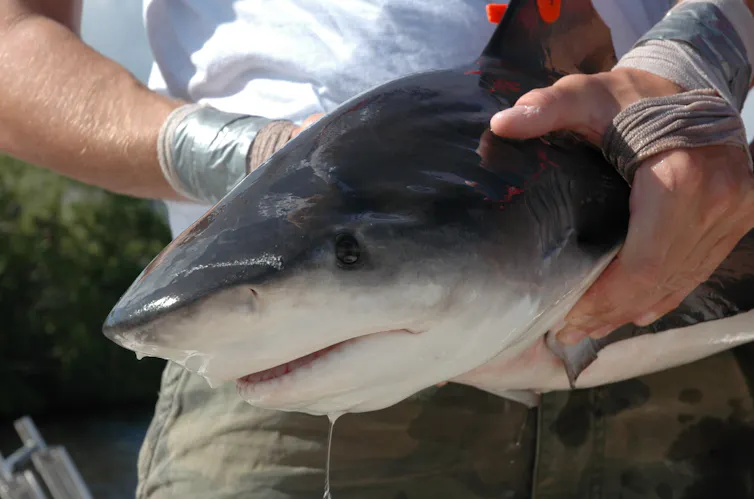
A scientist checks on a young bull shark in Texas. Philip Matich

James Marcus Drymon, Mississippi State University; Lindsay Mullins, Mississippi State University, and Philip Matich, Texas A&M University

In late spring, estuaries along the U.S. Gulf Coast come alive with newborn fish and other sea life. While some species have struggled to adjust to the region’s rising water temperatures in recent years, one is thriving: juvenile bull sharks.

We study this iconic shark species, named for its stout body and matching disposition, along the Gulf of Mexico. Over the past two decades, we have documented a fivefold increase in baby bull sharks in Mobile Bay, Alabama, and a similar rise in several Texas estuaries, as our new study shows.

Despite the bull shark’s fearsome reputation, baby bull sharks are not cause for concern for humans in these waters.

While adult bull sharks are responsible for an occasional unprovoked attack, baby bull sharks haven’t fully developed the skills needed to hunt larger prey. And you’re still far more likely to be killed by bees, wasps or snakes than sharks.

The fascinating life of a young bull shark

Most sharks are fully marine and spend their entire lives in the ocean. Bull sharks, however, are one of a handful of shark species that use freshwater environments as nurseries.

Baby bull sharks have been found in the Alabama River, 75 miles north of the ocean, and up the Mississippi River as far as Illinois. They have evolved to tolerate fresh water by reducing the need for salts and urea in their bodies compared to marine sharks, and actively taking in more salts through their food and across their gills.

In Texas, young bull shark numbers have been increasing in estuaries like Galveston Bay and Sabine Lake over the past 40 years, particularly where rivers like the Trinity, Sabine and Neches intersect with these ecosystems. These areas may offer protection from predators, such as bigger sharks.

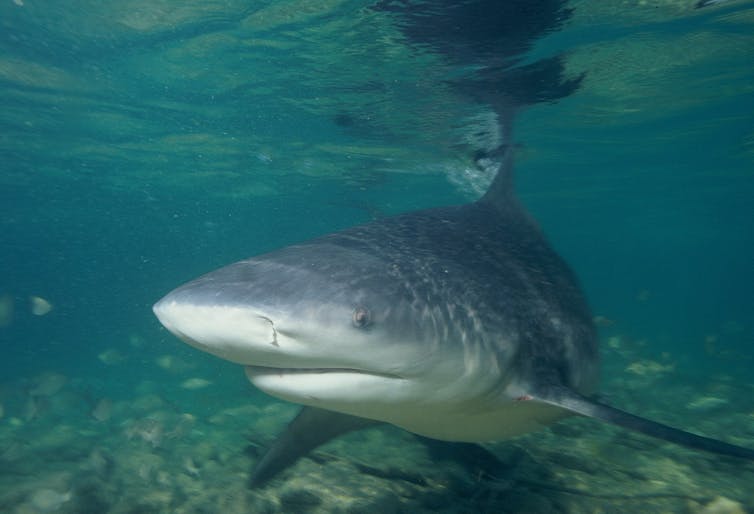
A bull shark swims in shallow water, with its fin just breaking the surface.
In 2012-2023, Texas reported seven shark bites, and Alabama reported two, none of them fatal, according to the International Shark Attack File. After white sharks and tiger sharks, bull sharks have had the most reported unprovoked shark attacks on humans globally. Albert Kok via Wikimedia Commons, CC BY-SA

The presence of bull sharks in these estuaries also contributes to their health and stability.

Because bull sharks frequently move between freshwater and marine ecosystems, they can act as mobile links that connect these two aquatic environments. Bull sharks often feed in one environment, salty water for example, and then rest and excrete nutrients in freshwater bays. Feeding and resting in different locations can improve the ability of these ecosystems to withstand disturbances like warming weather conditions, because if one habitat is disturbed, the other is still supported.

Like a spider web, food webs are connected by many intersecting threads. The more threads, the stronger the web. The use of both freshwater and marine habitats by bull sharks increases the number of these threads through their predator-prey interactions, thereby strengthening the ecosystem.

Waters are warming

As the planet warms, coastal ocean temperatures are rising. In the Gulf of Mexico, water temperatures have risen more than 3 degrees Fahrenheit (more than 1.5 degrees Celsius) due to climate change.

On a global scale, warming waters are harming more fish species than they are helping. Higher temperatures increase food requirements and stress levels, while making fish more susceptible to disease and reducing the survival of their young. A variety of fish populations in the Gulf of Mexico, including mullet and flounder, have declined as warmer conditions affected their spawning.

At the same time, the waters used by baby bull sharks have expanded in part due to this warming, creating a dynamic habitat.

An easy way to understand how sharks use dynamic habitat is to capture them with nets and measure the characteristics of the surrounding environment. In our sampling data, we could see that the mean annual water temperatures on the Alabama and Texas coasts increased at the same time the bull shark populations rose.

In coastal Alabama, we found that the relative abundance of baby bull sharks has increased fivefold over the past 20 years. Slight increases in temperature over that time provided the best explanation for this population increase.

Of all the temperatures recorded in that study, there was no maximum temperature threshold detected for baby bull sharks. So far, at least since 2003, it’s been “the warmer the better” for a baby bull shark.

We observed a similar trend in coastal Texas from Sabine Lake to Matagorda Bay, where warming estuaries supported increased abundances of baby bull sharks up to eightfold over the past 40 years. Warmer waters allowed baby bull sharks to remain in their natal estuaries longer during their first year before overwintering in the Gulf of Mexico, increasing their survival to the next life stage.

Collectively, our recent studies indicate that warming waters are currently beneficial for young bull sharks. But just like your favorite dessert, too much of a good thing can be detrimental.

All animals, including bull sharks, have maximum and minimum temperatures at which they can function. If temperatures get too hot or too cold, this can lead to problems, whether through direct stress on the shark’s bodily functions or on its ecosystem at large.

Some of our previous work from Florida shows that baby bull sharks will leave coastal nurseries in response to episodic cold snaps to avoid cold-stress. Sharks that didn’t leave died. The same may be true for hot temperatures, although conditions have not yet reached that point in the Gulf of Mexico based on our research.

A changing world

It’s clear that climate change is altering coastal ecosystems. Our work shows the direct benefit to young bull sharks, but how the observed population growth is affecting other species in the coastal estuaries remains to be seen.

A gray bull shark almost blends in with the seagrass.
A bull shark swims in a seagrass bed. Saving the Blue

The rise in bull sharks may affect other fish species, including bull shark prey like mullets, drums, herrings and catfish. More bull sharks could eventually mean fewer of the fish that humans rely on. In warmer water, sharks burn more energy.

Ultimately, tracking how the distributions of species like bull sharks change over time remains a critical priority for understanding future shifts in fish populations and the health of our coastal ecosystems.

James Marcus Drymon, Associate Extension Professor in Marine Fisheries Ecology, Mississippi State University; Lindsay Mullins, Ph.D. Student in Marine Science, Mississippi State University, and Philip Matich, Instructional Assistant Professor of Marine Biology, Texas A&M University

This article is republished from The Conversation under a Creative Commons license. Read the original article.

Continue ReadingBaby bull sharks are thriving in Texas and Alabama bays as the Gulf of Mexico warms

Oceans without sharks would be far less healthy – new research

Spread the love

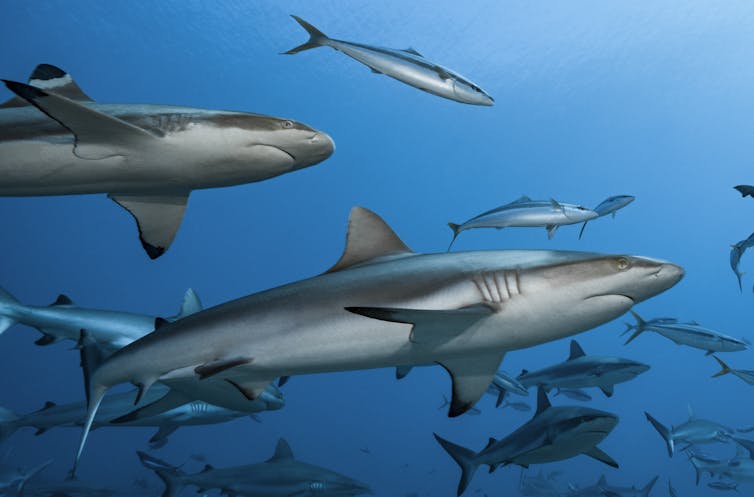
Gray reef sharks and blacktip reef sharks near Tahiti, French Polynesia. Alexis Rosenfeld/Getty Images

Michael Heithaus, Florida International University

There are more than 500 species of sharks in the world’s oceans, from the 7-inch dwarf lantern shark to whale sharks that can grow to over 35 feet long. They’re found from polar waters to the equator, at the water’s surface and miles deep, in the open ocean, along coasts and even in some coastal rivers.

With such diversity, it’s no surprise that sharks serve many ecological functions. For example, the largest individuals of some big predatory species, such as tiger and white sharks, can have an oversized role in maintaining balances among species. They do this by feeding on prey and sometimes by just being present and scary enough that prey species change their habits and locations.

In a newly published study, colleagues and I surveyed decades of research on sharks’ ecological roles and considered their future in oceans dominated by people. We found that because sharks play such diverse and sometimes important functions in maintaining healthy oceans, their current decline is an urgent problem. Since 1970, global populations of sharks and rays have decreased by more than 70%.

People are killing many types of sharks at unsustainable rates, mainly through overfishing. We see a need for nations to rethink where and how to conserve sharks for healthy oceans. https://www.youtube.com/embed/rB4zSDv3oSk?wmode=transparent&start=0 Sharks and rays are overfished as food sources and for oils produced in their livers. Fishing has extended into ever-deeper waters, where many little-studied species live.

How sharks foster seagrasses

Along the remote coast of Western Australia, more than two decades of work shows that the mere presence of tiger sharks shapes the entire seagrass ecosystem by changing where and how big grazers, such as sea turtles and sea cows, feed.

Having tiger sharks nearby protects wide swaths of seagrass from being overgrazed, allowing it to grow into thick underwater meadows that provide habitat for juvenile fish and shellfish. These species are important food for other animals and for humans.

A thick carpet of seagrass underwater with light shining down from the surface.
A healthy seagrass bed in Shark Bay, Western Australia, protected from overgrazing by the presence of tiger sharks. Michael Heithaus, CC BY-ND
A sandy bottom with sparse tufts of seagrass
This seagrass bed in Australia’s Shark Bay is in an area with few sharks. It has been heavily grazed and offers little cover for fish or other species. Michael Heithaus, CC BY-ND

In places where tiger sharks have declined and turtle populations have expanded, seagrasses are being overgrazed. In Bermuda, for example, the exploding turtle population has led to an almost total collapse of seagrasses.

White sharks produce some of the same effects. Along the California coast, where white shark numbers are increasing, otters are spending more time in the safety of protected inland waters and less time in the open waters of Monterey Bay. The otters prey on crabs, which in turn feed on grazing invertebrates such as sea slugs that clean algae from seagrasses. More otters means fewer crabs, more grazers and healthier seagrasses.

Kelp forests and reefs

Kelp forests are dense stands of large brown algae that grow in shallow zones near coasts. Along the U.S. West Coast, overhunting drove local populations of sea otters to extinction by the early 1900s. This caused huge kelp forest losses by allowing sea urchins – a favorite food of otters – to spread and consume kelp.

Over the past 50 years, otter populations have rebounded with federal protection. But as white sharks expand their ranges northward, they are preventing otters from expanding their range because there aren’t kelp forests for the otters to hide in.

The otters will likely expand their ranges only once kelp forests become established. This complicates restoration efforts, since otters won’t be removing enough urchins for kelp to become established.

When sharks are present near coral reefs, fish avoid the sharks by sticking close to the safety of the reef. This reduces grazing on seagrasses and algae across wide areas. There is still much to learn, however, about when, where and how sharks might be important for coral reef health.

Food and nutrient sources

Sharks can also be prey. Some, including large species like white sharks, are important food sources for some killer whale populations around the world. Smaller sharks, including blacktip sharks, can be key menu items for larger sharks, such as great hammerheads.

As sharks consume prey in one place and excrete waste elsewhere, they move nutrients throughout the ocean. In the Pacific, for example, gray reef sharks move nitrogen from the offshore waters where they feed to the coral reefs where they spend their days, providing important fertilizer for ocean food webs.

In Florida’s coastal waters, young bull sharks feed during brief visits to the ocean, then return to safer, nearly freshwater rivers, where they spend most of their time and release nutrients in their waste.

Sometimes sharks’ presence helps other fish. In the open ocean, sharks’ rough scales make perfect scratching posts for fish to remove parasites.

Protecting sharks’ roles

Our review makes clear that sharks play diverse roles in maintaining healthy oceans. We see important implications for shark conservation.

Step 1 would be to set goals beyond simply ensuring that there are sharks in the oceans and to target species that have key ecological roles.

Within populations, it is important to protect certain types of individual sharks. For example, the largest tiger sharks are the ones that shape the behavior of turtles and sea cows, benefiting seagrass ecosystems. Intensive fishing worldwide makes it extremely challenging for large sharks that can live for decades or even centuries to survive and grow to ecologically important sizes.

Working with local communities in coastal areas could build support for protecting these large ocean predators, much as conservationists are working on land to protect iconic predators such as wolves. Nations could build networks of large protected areas that forbid shark fishing, focusing on key areas where individual sharks may roam. https://www.youtube.com/embed/8cQK9b6RAxo?wmode=transparent&start=4 Redesigning fishing gear to target desired species and reduce catch of sharks and other nontarget species can make fishing more sustainable.

Research shows that sharks benefit from creating protected areas, limiting shark catch outside these zones and restricting use of fishing gear that does the most harm to sharks, such as gill nets and longlines. With a clearer understanding of sharks’ ecological value, my colleagues and I hope to see focused action at all levels to protect these essential animals.

Michael Heithaus, Executive Dean of the College of Arts, Sciences & Education and Professor of Biological Sciences, Florida International University

This article is republished from The Conversation under a Creative Commons license. Read the original article.

Continue ReadingOceans without sharks would be far less healthy – new research