Earth has just ended a 13-month streak of record heat – here’s what to expect next

Spread the love

Christopher Merchant, University of Reading

A 13-month streak of record-breaking global warmth has ended.

From June 2023 until June 2024, air and ocean surface water temperatures averaged a quarter of a degree Celsius higher than records set only a few years previously. Air temperatures in July 2024 were slightly cooler than the previous July (0.04°C, the narrowest of margins) according to the EU’s Copernicus Climate Change Service.

July 2023 was in turn 0.28°C warmer than the previous record-hot July in 2019, so the remarkable jump in temperature during the past year has yet to ease off completely. The warmest global air temperature recorded was in December 2023, at 1.78°C above the pre-industrial average temperature for December – and 0.31°C warmer than the previous record.

Global warming has consistently toppled records for warm global average temperatures in recent decades, but breaking them by as much as a quarter of a degree for several months is not common. The end of this streak does not diminish the mounting threat of climate change.

So what caused these record temperatures? Several factors came together, but the biggest and most important is climate change, largely caused by burning fossil fuels.

What caused the heat streak

Temperatures typical of Earth 150 years ago are used for comparison to measure modern global warming. The reference period, 1850–1900, was before most greenhouse gases associated with global industrialisation – which increase the heat present in Earth’s ocean and atmosphere – had been emitted.

July 2024 was 1.48°C warmer than a typical pre-industrial July, of which about 1.3°C is attributable to the general trend of global warming over the intervening decades. This trend will continue to raise temperatures until humanity stabilises the climate by keeping fossil fuels in the ground where they belong.
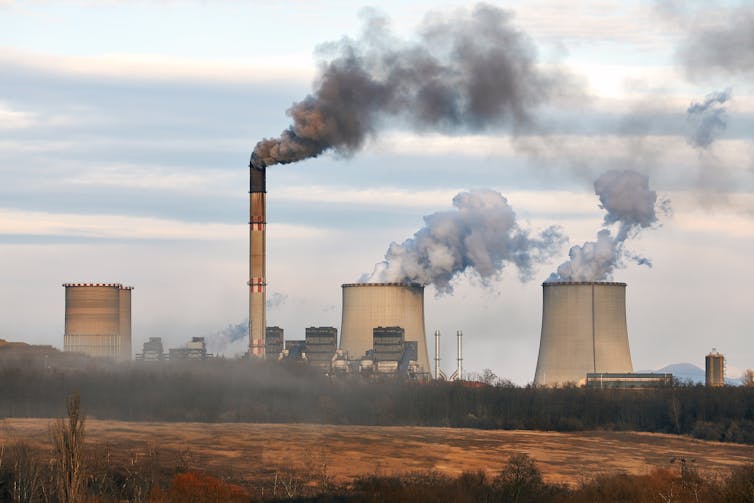
A power plant emitting dark smoke.
Coal, oil and gas are the main culprits of climate change. Peter Gudella/Shutterstock

But global warming doesn’t happen in a smooth progression. Like UK house prices, the general trend is up, but there are ups and downs along the way.

Behind much of the ups and downs is the El Niño phenomenon. An El Niño event is a reorganisation of the water across the vast reaches of the Pacific Ocean. El Niño is so important to the workings of worldwide weather as it increases the temperature of the air on average across all of Earth’s surface, not only over the Pacific. Between El Niño events, conditions may be neutral or in an opposite state called La Niña that tends to cool global temperatures. The oscillation between these extremes is irregular, and El Niño conditions tend to recur after three to seven years.

The warm El Niño phase of this cycle began to kick in a year ago, reached its peak around the end of 2023 and is now trending neutral, which is why the record-breaking streak has ended.

The 2023/2024 El Niño was strong, but it wasn’t super-strong. It doesn’t fully explain the remarkable degree to which the past year broke temperature records. The exact influence of other factors has yet to be fully untangled.

We know there is a small positive contribution from the Sun, which is in a phase of its 11-year sunspot cycle in which it radiates fractionally more energy to the Earth.

Methane (also a byproduct of the fossil fuel industry, alongside cattle and wetlands) is another important greenhouse gas and its concentration in the air has risen more rapidly in the past decade than over the previous decade.

Scientists are also assessing how much measures to clean up air pollution might be adding to warming, since certain particulate air pollutants can reflect sunlight and influence the formation of clouds.

A temperature ratchet

Across the global ocean, 2023 was a devastating summer for coral reefs and surrounding ecosystems in the Caribbean and beyond. This was followed by heavy bleaching across the Great Barrier Reef off Australia during the southern hemisphere summer. While it is El Niño years that tend to see mass mortality events on reefs around the world, it is the underlying climate change trend that is the long-term threat, as corals are struggling to adapt to rising temperature extremes.

A multi-lobed tropical hard coral bleached white.
Corals stressed by hot water eject nourishing algae and can die without swift relief. Damsea/Shutterstock

As the Pacific Ocean is now likely to revert towards La Niña conditions, global temperatures will continue to ease back, but probably not to the levels seen prior to 2023/24.

El Niño acts a bit like a ratchet on global warming. A big El Niño event breaks new records and establishes a new, higher norm for global temperatures. That new normal reflects the underlying global warming trend.

A plausible scenario is that global temperatures will fluctuate near the 1.4°C level for several years, until the next big El Niño event pushes the world above 1.5°C of warming, perhaps in the early 2030s.

The Paris agreement on climate change committed the world to make every effort to limit global warming to 1.5°C, because the impacts of climate change are expected to accelerate beyond that level.

The good news is that the shift away from fossil fuels has started in sectors such as electricity generation, where renewable energy meets a growing share of rising demand. But the transition is not happening fast enough, by a large margin. Meeting climate targets is not compatible with fully exploiting existing fossil-fuel infrastructure, yet new investment in oil rigs and gas fields continues.

Headlines about record breaking global temperatures will probably return. But they need not do so forever. There are many options for accelerating the transition to a decarbonised economy, and it is increasingly urgent that these are pursued.


Imagine weekly climate newsletter

Don’t have time to read about climate change as much as you’d like?
Get our award-winning weekly roundup in your inbox instead. Every Wednesday, The Conversation’s environment editor writes Imagine, a short email that goes a little deeper into just one climate issue. Join the 35,000+ readers who’ve subscribed so far.


Christopher Merchant, Professor of Ocean and Earth Observation, University of Reading

This article is republished from The Conversation under a Creative Commons license. Read the original article.


Continue ReadingEarth has just ended a 13-month streak of record heat – here’s what to expect next

After a streak of record-breaking global temperatures, the climate is on a knife-edge

Spread the love

Jack Marley, The Conversation

For 13 consecutive months, global average air and ocean temperatures were probably the hottest they have been in human history.

This streak of extraordinary heat ended last month, the EU’s Copernicus Climate Change Service reported, as July 2024 was only the second hottest ever recorded – 0.04°C cooler than a record set the previous July.

In its wake are thousands of heat-related deaths, ailing ecosystems and a planet firmly on the precipice of a profoundly altered climate.


Imagine weekly climate newsletter

This roundup of The Conversation’s climate coverage comes from our award-winning weekly climate action newsletter. Every Wednesday, The Conversation’s environment editor writes Imagine, a short email that goes a little deeper into just one climate issue. Join the 35,000+ readers who’ve subscribed.


“Global warming has consistently toppled records for warm global average temperatures in recent decades, but breaking them by as much as a quarter of a degree for several months is not common,” says Christopher Merchant, a professor of ocean and Earth observation at the University of Reading.

Air temperatures peaked in December 2023, when the Earth was 1.78°C hotter than the pre-industrial average for that time of year. Buoy-based sensors confirmed that the ocean was also record-warm at the time.

So what caused this stretch of unusually high temperatures on land and at sea?

“Several factors came together,” Merchant says. “But the biggest and most important is climate change, largely caused by burning fossil fuels.”

Big Oil and the little boy

When scientists refer to Earth’s pre-industrial temperature, they typically mean a global average taken between 1850 and 1900. Factories and power plants still existed in the second half of the 19th century, especially in Europe and North America, but the vast majority of greenhouse gas emissions generated by human activity had yet to be emitted. What’s more, meteorologists have a fairly good temperature record for this period with which to compare modern warming.

What this comparison tells us is that July 2024 was 1.48°C warmer than a typical July before the mass burning of coal, oil and gas, Merchant says. Roughly 1.3°C of that is directly attributable to global heating caused by these fossil emissions and land-use changes (deforestation, livestock farming) over the intervening decades.

The remainder, which caused the sudden temperature spike beginning in June 2023, was largely the result of a natural cycle in the climate known as El Niño.

“An El Niño event is a reorganisation of the water across the vast reaches of the Pacific Ocean. El Niño is so important to the workings of worldwide weather as it increases the temperature of the air on average across all of Earth’s surface, not only over the Pacific,” Merchant explains.

El Niño has ended, and with it, the run of record global average temperatures. Merchant expects temperatures to ease back slightly, but says there is no going back to the pre-2023 norm.

“A plausible scenario is that global temperatures will fluctuate near the 1.4°C level for several years, until the next big El Niño event pushes the world above 1.5°C of warming, perhaps in the early 2030s,” he says.

Over? Shoot!

Since the 2015 Paris agreement, the political consensus on climate change has been to strive to limit warming to 1.5°C. A slew of catastrophic and potentially irreversible changes to the systems that keep Earth habitable are more likely to occur once this long-term average has been crossed.

It’s possible that this process has already started for one system in particular: tropical coral reefs. Earth’s largest, the Great Barrier Reef off Australia, has suffered five mass bleaching events in the past nine summers and recently endured its worst heat in at least 400 years.

The new plan, if one exists among the world’s governments (approving new oil and gas production is still a normal feature of governing), would seem to accept the 1.5°C target being breached at least temporarily.

“The question is, how do we manage this period of ‘overshoot’ and bring temperatures back down?” asks Jonathan Symons, a lecturer in international relations at Macquarie University.

In autumn last year, a commission mainly composed of former government ministers from several countries published a report on the implications of overshooting 1.5°C. The report argued that high-emitters like Australia should now aim for “net-negative emissions” and begin urgently removing carbon from the air – by restoring habitats and deploying carbon capture and storage technology.

Symons summed up their reservations with both:

“The commission worries many carbon removal approaches are phoney, impermanent or have adverse social and environmental impacts.”

A tall metal structure within an industrial scene.
A direct air capture plant in British Columbia, Canada. David Buzzard/Shutterstock

One drastic option the Climate Overshoot Commission ruled out was “solar radiation management”: reflecting some of the Sun’s heat and light back to space by injecting reflective particles into the atmosphere, among other techniques. Academics continue to debate whether this is now an unpleasant necessity or more reckless vandalism of the atmosphere.

In lieu of a radical change of course, present global climate policy could breach the 1.5°C target by a degree Celsius or more according to an analysis published in Nature Climate Change on Monday.

The world seems to be delaying the end of fossil fuels, gambling that nature will hold its breath. Research has so far condemned this wishful thinking: computer models predict “waves of extinctions” and ecological damage spanning centuries from even a brief sojourn at 2°C.

Jack Marley, Environment + Energy Editor, The Conversation

This article is republished from The Conversation under a Creative Commons license. Read the original article.

Continue ReadingAfter a streak of record-breaking global temperatures, the climate is on a knife-edge

The Scotsman newspaper making unfounded claims of copyright infringement

Spread the love

I’ve had a couple of emails initiated from the Scotsman claiming copyright infringement. They’re wrong and look to be produced by a simple automated routine without human supervision or intervention i.e. a stupid bot. My website host has taken a few pages down as a result and there are threats of further restrictions.

Scotsmen poncing about. Sporran, haggis, gear …

I don’t agree with the Scotsman.

One of them is this

Speaking to the Mail on Sunday, Swinney said: “I want the Scottish Government to work closely and carefully with the oil and gas sector to ensure its sustainability.

“We need the oil and gas sector to contribute to the transition to net zero, so it has to be strong enough and robust enough to do that.

“In addition to that, I want to make sure that the sector is able to contribute to the objectives of energy security that we’ve set out in our policy programme.

https://www.heraldscotland.com/news/24360504.swinney-considers-u-turn-new-oil-gas-licences/

That’s it, a very small section clearly attributed to it’s source. That’s acceptable use under copyright laws. Stick that in your sporran Scotsman.

Dear Sir/ Madam,

Notice of Copyright Violation (DMCA Takedown Notice) – Formal Notification Pursuant to Section 512(c)(3)(A) of the Digital Millennium Copyright Act

We are writing on behalf of the attached listed publishers (“Publishers”). We understand that you are the host provider for onaquietday.org (“Infringing Website”). A number of articles which belong our Publishers (“Infringing Material”) are being hosted on the Infringing Website. This email is an official notification, pursuant to Section 512(c)(3)(A) of the Digital Millennium Copyright Act (“DMCA”), in which we seek the immediate removal of the Infringing Material your servers.

The Infringing Material is located at the URLs listed below. If there are other URLs that distribute our Publishers’ content, we ask that you apply this notice to those URLs also.

https://onaquietday.org/2024/06/03/swinney-considers-u-turn-on-new-oil-and-gas-licences/


Details of where the original material was hosted is also set out below. 

https://www.heraldscotland.com/news/24360504.swinney-considers-u-turn-new-oil-gas-licences/

https://www.scotsman.com/news/opinion/columnists/rishi-sunaks-claim-that-boosting-uk-oil-and-gas-production-will-help-fight-climate-change-does-not-stand-up-to-scrutiny-scotsman-comment-4238637

https://www.scotsman.com/news/opinion/why-labours-ban-on-puberty-blockers-shows-party-abandoning-progressive-principles-4709353

https://www.scotsman.com/news/opinion/columnists/climate-change-rishi-sunak-must-reject-rosebank-oil-field-and-join-the-countries-calling-for-fossil-fuels-to-be-urgently-phased-out-cross-party-group-of-politicians-4231467

NLA Media Access Limited (“NLA”) is a licensing body under section 116(2) of the Copyright Designs and Patents Act 1988, and a Collective Management Organisation (“CMO”) under the Collective Management of Copyright (EU Directive) Regulations 2016.NLA “is authorised by law or by way of assignment, licence or any other contractual arrangement to manage copyright or rights related to copyright on behalf of more than one right holder, for the collective benefit of those right holders, as its sole or main purpose” (see Regulation 2 of Collective Management of Copyright (EU Directive) Regulations 2016/221). For more information about who we are, what we do and who we represent,  please visit our website at: https://www.nlamediaaccess.com/. NLA licenses the content of our mandating publishers through copyright licences (which can be found on our website).

We are providing this notice in good faith and with reasonable belief that our Publishers’ rights are being infringed and the hosting of the Content is not authorised by the copyright owner, its agent, or by operation of law. Under the penalty of perjury, we hereby confirm that the information contained in this notification is true and accurate, and that NLA is authorised to act on behalf of the Publishers.

Please be reminded that the law requires you, as a service provider, to “expeditiously remove or disable access to” the Content upon receiving this notice. We would be grateful if you would confirm by return email that you have actioned this takedown request. Alternatively, you may contact us using the contact information set out below.

Our contact information is as follows:

Name: NLA Media Access Limited

Address: M- section omitted -

Contact: - section omitted -, Copyright Infringement Manager

Email address: - section omitted -

Telephone number: - section omitted -


Yours faithfully,

- section omitted -

Copyright Infringement Manager

For and on behalf of NLA Media Access Limited

Copyright Infringement Team

NLA media access | - section omitted -

Registered in England and Wales | Company number 3003569

Switchboard: - section omitted -

www.nlamediaaccess.com
Continue ReadingThe Scotsman newspaper making unfounded claims of copyright infringement

As Gaza Death Toll Tops 40,000, Congress Urged to Block New Weapons to Israel

Spread the love

Original article by BRETT WILKINS republished form Common Dreams under Creative Commons (CC BY-NC-ND 3.0). 

Activists demand an end to U.S. arms transfers to Israel during a May 2, 2024 protest outside the White House in Washington, D.C. (Photo: Amnesty International USA)

“U.S. arms transfers to Israel have fueled unimaginable suffering in Gaza, including staggering levels of civilian harm,” said one embargo advocate.

As the Palestinian death toll from Israel’s 314-day assault on Gaza passed 40,000—a figure experts say is likely a vast undercount—human rights groups this week decried the Biden administration’s approval of $20 billion worth of new weapons for Israel and renewed pleas for Congress to block further arms transfers to the nation on trial for genocide at the World Court.

On Tuesday—just days after Israeli forces used at least one U.S.-supplied bomb in an airstrike on a Gaza City school that killed scores of forcibly displaced Palestinian civilians sheltering there—the Biden administration notified Congress of the pending sale of a new weapons package that includes dozens of F-15 fighter jets, tens of thousands of 120mm mortar shells, over 32,700 tank shells, and 30 Advanced Medium Range Air-to-Air Missiles.

Since October, Congress and the Biden administration have approved more than $14 billion in unconditional military aid to Israel. President Joe Biden has signed off on more than 100 arms transfers to Israel during that period. This, atop the $3.8 billion in annual armed aid the U.S. already gives to the key Middle Eastern ally.

“Israel used U.S.-made weapons in May when it slaughtered Palestinian families sheltering in tent camps in Rafah,” Jewish Voice for Peace (JVP) said Wednesday. “Israel used U.S.-made weapons when it bombed the al-Mutanabbi school in Khan Younis in early July, killing over two dozen displaced Palestinians seeking refuge there. And it used U.S.-made weapons on Saturday to murder over 100 Palestinians while they prayed.”

“Biden continues to send weapons to Israel, and both political parties—Republicans and Democrats—have cheered on the Israeli government’s slaughter and genocide of Palestinians in Gaza,” JVP continued. “This is a U.S.-perpetrated genocide as much as it is an Israeli one.”

“But the Democratic voting base is calling for something different, and we have seen the progressive and increasingly mainstream wing of the party begin to echo this need,” the group said. “We are playing a critical role in driving the Democratic Party to finally catch up to the demands of its own base.”

“Right now, we have an opportunity to re-center Gaza in the national conversation and continue building pressure on the Biden administration, on [Vice President] Kamala Harris, and on Democratic members of Congress to support an immediate arms embargo,” JVP added.

While Harris has expressed sympathy for Palestinians suffering what she called a “humanitarian catastrophe” in Gaza, the vice president and Democratic presidential nominee, like Biden, has proclaimed her “unwavering” support for Israel. One aide said last week that Harris does not support an arms embargo.

“The decision to approve yet another massive sale of arms to Israel is appalling and a blatant violation of U.S. and international law and policy,” Annie Shiel, the U.S. advocacy director at the Center for Civilians in Conflict, said on Thursday.

“U.S. arms transfers to Israel have fueled unimaginable suffering in Gaza, including staggering levels of civilian harm, the destruction of civilian infrastructure, and an ever-growing humanitarian catastrophe,” Shiel continued. “The U.S. is complicit in this devastation.”

“Congress must block these sales, including through the introduction of joint resolutions of disapproval,” she added, “and the Biden-Harris administration must finally end U.S. arms transfers and use its leverage to bring about an immediate cease-fire.”

The international anti-poverty NGO ActionAid said Thursday: “We are outraged and heartbroken by the staggering loss of 40,000 lives in Gaza. It is a number that is incomprehensible—every life lost is an individual tragedy.”

“But this is not an inevitable one, it is an ongoing atrocity, and it could have been prevented,” the group continued. “Most governments across the world have refused to do the bare minimum to protect civilian life and it is to our collective shame. We are losing confidence each day in the concept of justice.”

“We reiterate our calls for an immediate cessation of hostilities and urge all governments to meet their obligations under international law and use all available means to take immediate and decisive action to ensure the safety and security of all civilians,” ActionAid said.

“We call for the imposition of sanctions, including travel bans and asset freezes, on Israeli officials linked to alleged violations of international humanitarian law,” the NGO added. “Every day that you choose to avoid this as a reality, this death toll will keep rising until there is nobody left in Gaza alive.”

In addition to the South Africa-led genocide case against Israel at the International Court of Justice, International Criminal Court (ICC) Prosecutor Karim Khan has applied for warrants to arrest Israeli Prime Minister Benjamin Netanyahu and Defense Minister Yoav Gallant, and for three Hamas leaders, at least one of whom has been assassinated by Israeli forces.

The Biden administration and numerous members of Congress have condemned the courts’ pursuit of justice for Israel and its leaders. In June, 42 Democrats joined nearly every Republican in the House of Representatives in passing a bill that would sanction ICC officials over Khan’s application for arrest warrants for Netanyahu and Gallant.

In addition to rights groups, a coalition of journalists, news outlets, and press freedom organizations on Thursday implored the Biden administration to immediately halt arms transfers to Israel.

As the tight 2024 presidential race between Harris and former President Donald Trump, the Republican nominee, heads toward the home stretch, a survey commissioned by the Institute for Middle Eastern Understanding Policy Project and conducted by YouGov revealed this week that Democratic and Independent voters in the key swing states of Arizona, Georgia, and Pennsylvania would be more willing to vote for Harris if she backed an arms embargo on Israel.

Original article by BRETT WILKINS republished form Common Dreams under Creative Commons (CC BY-NC-ND 3.0). 

Continue ReadingAs Gaza Death Toll Tops 40,000, Congress Urged to Block New Weapons to Israel

40,000 dead in Gaza a ‘milestone the world must be ashamed of’: Irish Premier

Spread the love

Original artticle republished from MIMO under a Creative Commons Attribution-NonCommercial-ShareAlike 4.0 International License.

Ireland’s Prime Minister Simon Harris attends a press conference at Government Buildings in Dublin on April 12, 2024 [PAUL FAITH/AFP via Getty Images]

Ireland’s Prime Minister, on Thursday, said that 40,000 dead in Gaza is a “milestone the world must be ashamed of”, Anadolu Agency reports.

“International diplomacy has failed to protect innocent children, some only days old,” Simon Harris said on X.

He called on Israel to stop the bombings in Gaza and asked Hamas to release the hostages.

In addition to his call for a ceasefire in Gaza, Harris urged the EU to reassess its association agreement with Israel.

Flouting a UN Security Council resolution demanding an immediate ceasefire, Israel has faced international condemnation amid its continued brutal offensive on Gaza since a 7 October, 2023 attack by Hamas.

The Israeli onslaught has since killed over 40,000 people, mostly women and children, and injured over 92,400 others, according to local health authorities.

Over 10 months into the Israeli onslaught, vast tracts of Gaza lie in ruins amid a crippling blockade of food, clean water and medicine.

Israel is accused of genocide at the International Court of Justice, whose latest ruling ordered it to immediately halt its military operation in the southern city of Rafah, where more than 1 million Palestinians had sought refuge from the war before it was invaded on 6 May.

READ: Pope Francis calls for ceasefire in Gaza amid ongoing Israeli onslaught

Original artticle republished from MIMO under a Creative Commons Attribution-NonCommercial-ShareAlike 4.0 International License.

Continue Reading40,000 dead in Gaza a ‘milestone the world must be ashamed of’: Irish Premier