What We Talk About When We Don’t Talk About Genocide

Spread the love

Original article by Belén Fernández republished from FAIR under a Creative Commons Attribution-NonCommercial-NoDerivs 3.0 Unported License.
Amnesty International (12/5/24) found that “Israel has persisted in committing genocidal acts, fully aware of the irreparable harm it was inflicting on Palestinians in Gaza.”

Imagine for a moment that a magnitude 8 earthquake occurred somewhere in the world, and the Western corporate media refused to use the word “earthquake” in reporting it, instead talking ambiguously of a “tectonic incident” that had caused buildings to collapse and people to die.

Obviously, reporters would be called out for deliberate linguistic ineptness and a bizarre obfuscation of truth. And yet just such a verbal sleight of hand has been on display for more than 14 months in the Gaza Strip, where corporate media outlets continue to dance around the word “genocide” while the Israeli military carries out the systematic mass killing of Palestinians.

Since October 2023, nearly 45,000 people have officially been killed in Gaza—although as a letter to the Lancet medical journal (7/20/24) pointed out back in July, the true death toll at that time was likely to exceed 186,000. A new report (BBC11/8/24) from the Office of the United Nations High Commissioner for Human Rights indicates that almost 70% of the over 8,000 Palestinian fatalities verified by the UN over a six-month period were women and children; a survey of medical volunteers in Gaza found that “44 doctors, nurses and paramedics saw multiple cases of preteen children who had been shot in the head or chest in Gaza” (New York Times10/9/24).

Nearly the entire population of Gaza has been displaced, and most of the territory has been reduced to rubble.

‘Committed with intent’
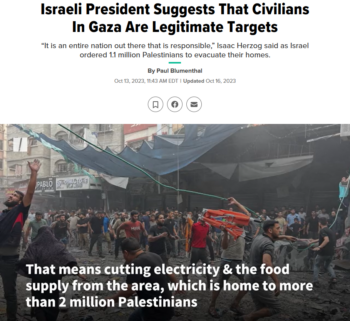
From the beginning of the Israeli assault, officials like President Isaac Herzog (HuffPost10/13/23) made it clear that they saw themselves as being at war with a population.

As per Article II of the Genocide Convention, “genocide means…acts committed with intent to destroy, in whole or in part, a national, ethnical, racial or religious group.” These include “killing members of the group,” “causing serious bodily or mental harm to members of the group,” and “deliberately inflicting on the group conditions of life calculated to bring about its physical destruction in whole or in part.”

Israeli leaders again and again have effectively admitted genocidal intent. Defense Minister Yoav Gallant (Times of Israel10/9/23), at the beginning of Israel’s assault, declared:

I have ordered a complete siege on the Gaza Strip. There will be no electricity, no food, no fuel, everything is closed…. We are fighting human animals and we are acting accordingly.

Israeli President Isaac Herzog (HuffPost10/13/23) likewise insisted, “It is an entire nation out there that is responsible…. It is not true, this rhetoric about civilians not being aware, not involved.”

Prime Minister Benjamin Netanyahu (Mother Jones11/3/23) invoked a biblical justification for genocide: “You must remember what Amalek has done to you, says our Holy Bible. And we do remember.” The Bible (1 Samuel 15:3) says of the Amalekites: “Do not spare them; put to death men and women, children and infants.”

And Deputy Knesset speaker Nissim Vaturi couldn’t have been more clear (X10/7/23), posting the following comment to X at the outset of hostilities in October 2023: “Now we all have one common goal—erasing the Gaza Strip from the face of the Earth.”

In other words, Gaza is a pretty textbook case of genocide. But the term “genocide” is ostracized by the corporate media world because it violates the political line of the United States, the global superpower that is currently enabling Israel’s genocidal behavior—to the tune of tens of billions of dollars in aid and weaponry. And the media’s refusal to call a spade a spade has produced all manner of linguistic gymnastics.

‘Blistering retaliatory offensive’
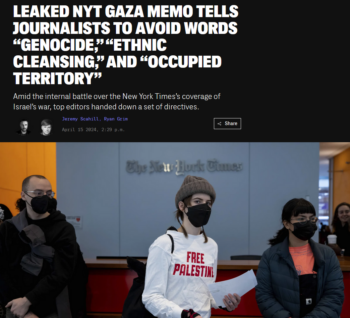
New York Times memo (Intercept4/15/24) said of the word “genocide,” “We should…set a high bar for allowing others to use it as an accusation, whether in quotations or not.” The same memo declared, “It is accurate to use ‘terrorism’ and ‘terrorist’ in describing the attacks of October 7.”

In the eyes of the Associated Press (12/4/24), for example, the genocide in Gaza is merely “Israel’s blistering retaliatory offensive,” while Fox News (11/3/24) detects a “fight against terrorists” and the Washington Post (12/3/24) sees “one of the most deadly and destructive wars in recent memory.”

Or take the New York Times, where a memo (Intercept4/15/24) leaked earlier this year explicitly instructed journalists to avoid using words like “genocide,” “ethnic cleansing,” and “occupied territory” when discussing “Palestine”—another word whose use was highly discouraged. On October 7, the one-year anniversary of Israel’s ongoing assault, the US newspaper of record headlined the affair as “The War That Won’t End,” with the G-word appearing only in a fleeting reference to “accusations of genocide and war crimes.”

This particular Times dispatch begins with Yaniv Hegyi, an Israeli who “fled his home last October 7, after terrorists from Gaza overran his village in southern Israel.” As ever, the selectivity with which US media deploys the T-word safely obliterates the chance that domestic audiences will be confronted with the fact that the state of Israel has literally been terrorizing Palestinians since the moment of its foundation on Palestinian land in 1948—or that Zionist terrorism preceded even that moment.

Only after we’ve been introduced to Hegyi, victim of “terrorists,” do we meet Mohammed Shakib Hassan, a Palestinian who “fled his home on October 12, after the Israeli Air Force responded by striking his city in northern Gaza.” Which brings us to another tactic that has been institutionalized in the US political and media establishment alike: the perennial Israeli monopoly on “responding,” “retaliating” and generally engaging in “self-defense” no matter what it does—including genocide.

Never mind that Israel would have nothing to “retaliate” against if it hadn’t up and invented itself on other people’s land, and then spent the next 76 years (and counting) occupying, forcibly displacing and slaughtering Palestinians en masse. Fortuitously for Israel, the corporate media are ever standing by to set the record askew.

‘Propaganda war never stops’
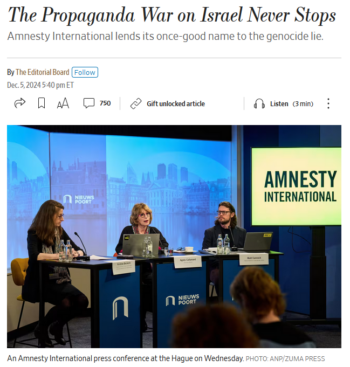
The Wall Street Journal (12/5/24) calls for ethnic cleansing as an alternative to genocide: “Not one of the groups yelling genocide calls on Egypt to let women and children escape to safety by opening its border with Gaza.”

That said, the media have been increasingly unable to abide by a de facto blanket ban on the word “genocide,” given, inter alia, Amnesty International’s recent determination (12/5/24) that Israel is committing just that in the Gaza Strip. In such cases, then, the term inevitably finds its way into news reports—but only as an allegation.

CNN (12/5/24), for instance, reported that Amnesty had “said that it had gathered ‘sufficient evidence to believe’ that Israel’s conduct during the war in Gaza amounts to genocide against the Palestinian people—a charge the Israeli government has vehemently denied.” The rest of the article similarly alternates between Amnesty’s charges and Israel’s vehement rebuttals.

This template was also followed by AP (via ABC12/4/24), NBC News (12/5/24) and the other usual suspects. Significantly, this sort of rebuttal option is never extended to Palestinians; you’d never see Yaniv Hegyi fleeing his home from “conduct by Gazans that the Israeli government says amounts to terrorism—a charge the government of Gaza has vehemently denied.”

The Wall Street Journal editorial board (12/5/24) took it upon themselves to pen a diatribe against the organization that had chosen to “lend…its once-good name to the genocide lie,” and thereby “assure… its good standing in the anti-Israel herd.” Bearing the headline “The Propaganda War on Israel Never Stops,” the rant came accompanied by an entirely irrelevant 23-minute documentary on “the worst antisemitic riot in American history” in Crown Heights, Brooklyn, which took place in 1991.

According to the Journal, Amnesty has committed an “inversion of reality”: It’s actually Hamas that is the “genocidal” actor—and, by the way, there are “terrorist headquarters in hospitals” in Gaza. This is just about the most unabashed apology for war crimes you can ask for. Israel has pulverized the bulk of Gaza’s medical infrastructure, and an October UN press release noted that

Israeli security forces have deliberately killed, detained and tortured medical personnel and targeted medical vehicles, while tightening their siege on Gaza and restricting permits to leave the territory for medical treatment.

By converting Israel into the victim not only of “terrorists” but also of a “propaganda war,” the Journal is engaging in its own criminal “inversion of reality.” But for a corporate media committed to complicity in genocide by linguistic omission, it’s all in a day’s work.

Original article by Belén Fernández republished from FAIR under a Creative Commons Attribution-NonCommercial-NoDerivs 3.0 Unported License.

Continue ReadingWhat We Talk About When We Don’t Talk About Genocide

‘The plan is just to kill’: personal testimonies of Israel’s genocide in Gaza

Spread the love

https://www.middleeastmonitor.com/20241213-the-plan-is-just-to-kill-personal-testimonies-of-israels-genocide-in-gaza

The British Palestinian Committee (BPC) and UK Gaza Community (UKGC) convened a press conference in London on 12 December 2024

by Nasim Ahmed

The British Palestinian Committee (BPC) and UK Gaza Community (UKGC) convened a press conference in London yesterday, bringing together healthcare workers and British-Palestinian voices to expose the scale of Israel’s systematic destruction of Gaza amid an enforced media blackout.

The event, held metres away from BBC Broadcasting House, aimed to break through the information vacuum created by Israel’s targeting of journalists and closure of the besieged Gaza Strip from the world. With 193 journalists killed since 7 October 2023 and systematic restrictions on media access, particularly in northern Gaza, evidence of massacres, mass executions and widespread destruction has largely fallen out of the news cycle.

The attacks in northern Gaza represent the most violent and brutal assaults in the history of Israel’s colonial occupation of Palestine, the organisers pointed out, as speakers prepared to share harrowing testimonies of death and devastation in the Gaza Strip.

Mai Annan, speaking via video link from Gaza where she leads the Reviving Gaza mutual aid project, provided a chilling account of Israeli military tactics. “We started hearing loudspeakers asking the men in the building to come out naked, then they asked the women and children to come out. They lined up the men, and the soldiers began firing at them randomly,” she recounted. “Many were killed, and some were wounded and left to bleed to death. Then they put all the women and children in one room and threw a gas grenade inside. It’s very clear to us that everyone is a target, and the plan is just to kill and kill more.”

They lined up the men, and the soldiers began firing at them randomly. Then they put all the women and children in one room and threw a gas grenade inside.

Dr Mahim Qureshi, a London-based vascular surgeon who recently returned in November after volunteering in Gaza detailed the catastrophic medical situation. “The types of injuries are predominantly blast injuries,” she explained, “but the degree of overcrowding and lack of hygiene, lack of antibiotics and high level of antibiotic resistance means people cannot fight basic infections.” She described how young girls arrived with gunshot wounds to the head, while doctors, lacking basic neurosurgical equipment, were forced to drill through skulls with inadequate tools in desperate attempts to save lives.

Hala Sabbah, the London-based coordinator of the Sameer Project aid group, explained how aid has been weaponised through systematic starvation. “Prior to the genocide 400-500 trucks entered Gaza, starting from October only 50 trucks were permitted,” she explained. “Zionists are collaborating with people on the ground to make sure these trucks are stolen. Not only are the number of trucks limited they are making sure it’s not reaching the victims. Palestinians pay thousands to buy the basic necessities.”

WATCH: Israeli occupation soldier plays sadistic games with toys of Gaza children

Dr Mohamed Ashraf, who worked in northern Gaza during the initial phase of Israel’s assault, shared devastating evidence of the targeting of medical personnel. He displayed photographs of murdered colleagues, speaking of Dr Mosab Sama, abducted from Nasser Hospital with no information about his whereabouts, and Dr Maisara Rais, killed and still buried under rubble with his family. Of his own family’s fate, he explained how he has been contacting hospitals to see if they received the bodies of his wife and daughter – their silence the only indication they might still be alive.

Ahmed Najjar, born in Jabaliya refugee camp, provided testimony of living there for 55 years before this assault. “This wasn’t just another military campaign,” he said, “this was an attempt to erase an entire people. North of Gaza is stripped of its humanity and its home.” His sister was told at gunpoint to abandon her son, while his brother watched helplessly. His father, older than the state of Israel, initially refused to move, saying he was tired of being displaced, before Israel’s relentless bombardment finally forced him to flee to Gaza City.

Dr Loai Nasir reported that 400,000 people remain besieged in northern Gaza, facing severe food insecurity as Israeli authorities consistently deny food deliveries. Ibrahim Assalia testified about the use of unknown chemical agents, describing how his father died after inhaling an Israeli substance. Speaking recently with his family, they told him “they are dying of hunger. People in north Gaza are feeding on grass and trees.”

The conference also unveiled new evidence of British complicity in Israel’s military campaign. A comprehensive report launched by the BPC detailed how British military infrastructure actively supports Israel’s assault on Gaza. Khem Rogaly explained that Britain’s military collaboration “goes far beyond licensing exports.” Britain’s global F35 programmes and export of components are essential for Israel to fly the F35 and bomb Gaza. British parts are central to the regular repairs needed to maintain Israel’s bombing campaign.

The human cost of Britain’s military support was further illustrated through testimony about the devastating medical situation in Gaza. Qureshi described how chronic illnesses are killing Gazans but their numbers are not added to the death toll. She noted that what she witnessed in the south could not compare to the horror unfolding in the north. Healthcare workers shared accounts of performing surgeries without anaesthesia, while Ashraf recounted doctors watching helplessly as patients died from treatable conditions due to lack of basic medical supplies. The toll on medical staff has been both physical and mental, with many forced to work through their own trauma while treating an endless stream of casualties

The systematic targeting of healthcare workers emerged as a recurring theme. According to figures presented at the conference, some 1,800 healthcare workers have been killed since October 2023, with 319 health workers currently detained by Israeli occupation forces. Ashraf spoke of being trained to deal with crises, but never having faced anything like this current situation, with no medical supplies reaching Gaza.

Sabbah detailed how the starvation of Gaza is being systematically engineered. To buy vegetables in northern Gaza now costs hundreds of dollars, she explained. “It’s not a famine,” she emphasised. “It’s manufactured starvation by Israel.”

READ: Smotrich: Without us in the cabinet, the war on Gaza would have ended earlier

“I’m not asking western leaders to see us as humans,” Najjar stated in his closing remarks. “Stop pretending, stop lecturing. We see through your hypocrisy. You think you can erase us – you will not, you will fail.”

The testimonies presented paint a harrowing picture of systematic destruction aimed at making Gaza uninhabitable. Speakers emphasised that while mainstream media attention has shifted elsewhere, the situation in northern Gaza continues to deteriorate, with hundreds of thousands of Palestinians facing what the UN has described as catastrophic hunger.

The evidence presented of British military support for Israel’s campaign comes as legal experts increasingly warn that Israel’s actions constitute genocide. The International Court of Justice (ICJ) is currently investigating genocide charges against Israel following South Africa’s legal action, while the UN’s recent report found Israel’s military actions in Gaza to be consistent with genocidal intent. Amnesty International has joined a growing chorus of human rights organisations in concluding that Israel’s actions in Gaza constitute genocide.

The press conference highlighted how Israel’s media blackout serves to conceal the scale of destruction in Gaza from international scrutiny. Through harrowing firsthand testimonies, damning evidence of British military support and documented accounts of systematic starvation and medical deprivation, the event provided a devastating glimpse of the genocide unfolding in Gaza.

The article above, this work by Middle East Monitor is licensed under a Creative Commons Attribution-NonCommercial-ShareAlike 4.0 International License.

Continue Reading‘The plan is just to kill’: personal testimonies of Israel’s genocide in Gaza

Rising desertification shows we can’t keep farming with fossil fuels

Spread the love
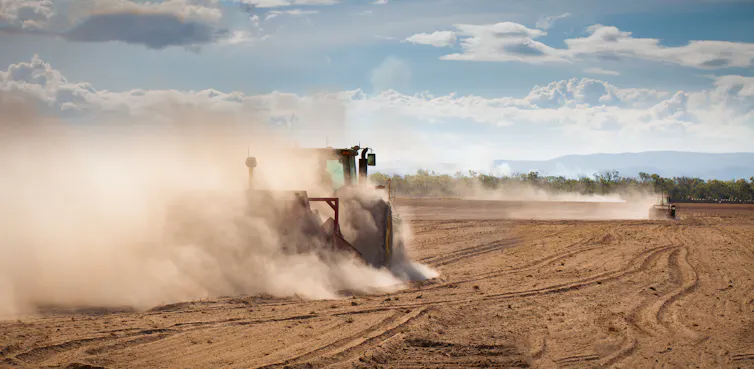
Johan Larson/Shutterstock

Jack Marley, The Conversation

Three-quarters of Earth’s land has become drier since 1990.

Droughts come and go – more often and more extreme with the incessant rise of greenhouse gas emissions over the last three decades – but burning fossil fuels is transforming our blue planet. A new report from scientists convened by the United Nations found that an area as large as India has become arid, and it’s probably permanent.

A transition from humid to dry land is underway that has shrunk the area available to grow food, costing Africa 12% of its GDP and depleting our natural buffer to rising temperatures. We have covered several consequences of humanity’s fossil fuel addiction in this newsletter. Today we turn to the loss of life-giving moisture – what is driving it, and what we are ultimately losing.


Imagine weekly climate newsletter

This roundup of The Conversation’s climate coverage comes from our award-winning weekly climate action newsletter. Every Wednesday, The Conversation’s environment editor writes Imagine, a short email that goes a little deeper into just one climate issue. Join the 40,000+ readers who’ve subscribed.


Why is the land drying out so fast? It’s partly because there is more heat trapped in the atmosphere by greenhouse gases emitted from burning fossil fuels. This excess heat has exacerbated evaporation and is drawing more moisture out of soil.

‘Oil, not soil’

Climate change has also made the weather more volatile. When drought does cede to rain, more of it arrives in bruising downpours that slough the topsoil.

A stable climate would deliver a year’s rain more evenly and gently, nourishing the soil so that it can nurture microbes that hold onto water and release nutrients.

This is the kind of soil that industrial civilisation inherited. It’s disappearing.

“Soil is being lost up to 100 times faster than it is formed, and desertification is growing year on year,” says Anna Krzywoszynska, a sustainable food expert at the University of Sheffield.

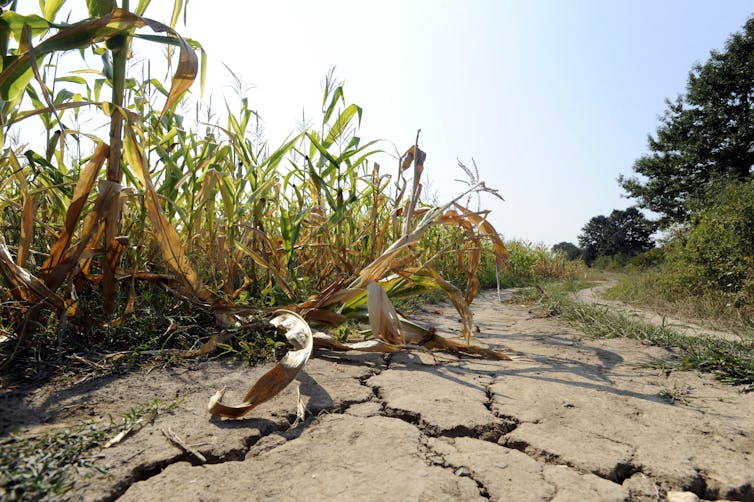
A wilting corn crop in dry, cracked soil.
Humid and fertile farmland is becoming increasingly arid. Nikola Fific/Shutterstock

“The truth is, the modern farming system is based around oil, not soil.”

Fossil fuels have unleashed agriculture from the constraints of local ecology. Once, the nutrients that were taken from the soil in the form of food had to be replaced using organic waste, Krzywoszynska says. Synthetic nitrogen fertilisers, made with fossil energy at great cost to the climate, changed all that.

Next came diesel-powered machinery that brought more wilderness into cultivation. Farm vehicles as heavy as the biggest dinosaurs now churn and compact the soil, making it difficult for earthworms and assorted soil organisms to maintain it.

Tractors and chemicals served humanity for a long time, Krzywoszynska says. But soil is now so degraded that no amount of fossil help can compensate.

“Across the world, soils have been pushed beyond their capacity to recover, and humanity’s ability to feed itself is now in danger.”

Green pumps and white mirrors

The primary way that we have been making up for lost food yield is turning more forests into farms. This is accelerating our journey towards a drier, less liveable world because forests, if allowed to thrive, create their own rain.

“Water sucked up by tree roots is pumped back into the atmosphere where it forms clouds which eventually release the water as rain to be reabsorbed by trees,” say Callum Smith, Dominick Spracklen and Jess Baker, a team of biologists at the University of Leeds who study the Amazon rainforest.

“In the Amazon and Congo river basins, somewhere between a quarter and a half of all rainfall comes from moisture pumped from the forest itself.”

Some experts have argued that the UN report understates Earth’s growing aridity by overlooking the water that is held in snow caps, ice sheets and glaciers. Climate change is melting this frozen reservoir, which also serves as a seasonal source of water.

A blue glacier surrounded by water.
Rising temperatures are depleting stores of freshwater, including glaciers. Kavram/Shutterstock

“And as water in its bright-white solid form is much more effective at reflecting heat from the sun, its rapid loss is also accelerating global heating,” says Mark Brandon, a professor of polar oceanography at The Open University.

How do we adapt our relationship with the land to remoisturise the world? Krzywoszynska argues that there is no easy solution, but the future of food-growing “is localised and diverse”.

“To ensure that we eat well and live well in the future, we’ll need to reverse the trend towards greater homogenisation which drove food systems so far.”

The good news, according to Krzywoszynska, is that farmers are experimenting with methods that restore the soil even as they produce a diverse range of nutritious food. These innovators need rights and secure access to the land, the opportunity to share their experiences and financial and political support.

“Regenerating land is a win-win, for humans and their ecosystems, if we dare to look beyond the immediate short-term horizon,” she says.

Jack Marley, Environment + Energy Editor, The Conversation

This article is republished from The Conversation under a Creative Commons license. Read the original article.

Continue ReadingRising desertification shows we can’t keep farming with fossil fuels

Amnesty Urges War Crimes Probe of ‘Indiscriminate’ Israeli Attacks on Lebanon

Spread the love

Original article by Brett Wilkins republished from Common Dreams under Creative Commons (CC BY-NC-ND 3.0). 

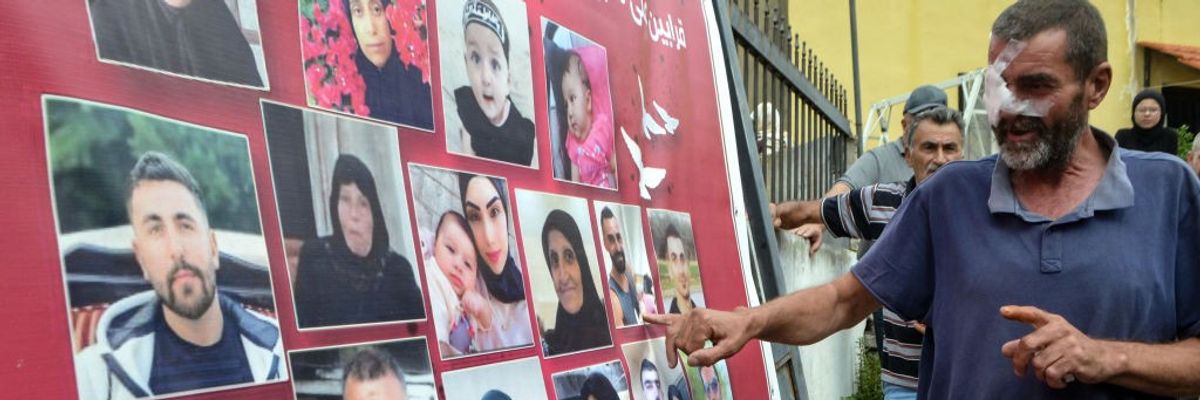
A wounded man points to photos of civilians killed during an October 16, 2024 Israeli airstrike on the village of Aitou, Lebanon. (Photo: Fathi al-Masri/AFP via Getty Images)

“The latest evidence of unlawful airstrikes during Israel’s most recent offensive in Lebanon underscores the urgent need for all states, especially the United States, to suspend arms transfers,” said one campaigner.

Amnesty International on Thursday called for a war crimes investigation into recent Israeli airstrikes in Lebanon that killed dozens of civilians, as well as a suspension of arms transfers to Israel as it attacks Gaza, the West Bank, and Syria.

In a briefing paper titled The Sky Rained Missiles, Amnesty “documented four illustrative cases in which unlawful Israeli strikes killed at least 49 civilians” in Lebanon in September and October amid an Israel Defense Forces (IDF) campaign of invasion and bombardment that Lebanese officials say has killed or wounded more than 20,000 people.

“Amnesty International found that Israeli forces unlawfully struck residential buildings in the village of al-Ain in northern Bekaa on September 29, the village of Aitou in northern Lebanon on October 14, and in Baalbeck city on October 21,” the rights group said. “Israeli forces also unlawfully attacked the municipal headquarters in Nabatieh in southern Lebanon on October 16.”

Erika Guevara Rosas, Amnesty’s senior director for research, advocacy, policy, and campaigns, said in a statement that “these four attacks are emblematic of Israel’s shocking disregard for civilian lives in Lebanon and their willingness to flout international law.”

https://twitter.com/ReinaWehbi/status/1867142527435809200?ref_src=twsrc%5Etfw%7Ctwcamp%5Etweetembed%7Ctwterm%5E1867142527435809200%7Ctwgr%5Ebe8b67de6ddfba791c9b6966c51d43dbeed2529f%7Ctwcon%5Es1_c10&ref_url=https%3A%2F%2Fwww.commondreams.org%2Fnews%2Famnesty-international-lebanon

Sorry, this content could not be embedded.
WordPress / X [Think that this is an X issue that they can’t afford to fix.]

The September 29 attack “destroyed the house of the Syrian al-Shaar family, killing all nine members of the family who were sleeping inside,” the report states.

“This is a civilian house, there is no military target in it whatsoever,” village mukhtar, or leader, Youssef Jaafar told Amnesty. “It is full of kids. This family is well-known in town.”

On October 16, Israel bombed the Nabatieh municipal complex, killing Mayor Ahmad Khalil and 10 other people.

“The airstrike took place without warning, just as the municipality’s crisis unit was meeting to coordinate deliveries of aid, including food, water, and medicine, to residents and internally displaced people who had fled bombardment in other parts of southern Lebanon,” Amnesty said, adding that there was no apparent military target in the immediate area.

In the deadliest single strike detailed in the Amnesty report, IDF bombardment believed to be targeting a suspected Hezbollah member killed 23 civilians forcibly displaced from southern Lebanon in Aitou on October 14.

“The youngest casualty was Aline, a 5-month-old baby who was flung from the house into a pickup truck nearby and was found by rescue workers the day after the strike,” Amnesty said.

Survivor Jinane Hijazi told Amnesty: “I’ve lost everything; my entire family, my parents, my siblings, my daughter. I wish I had died that day too.”

https://twitter.com/MiddleEastEye/status/1846925123871216071?ref_src=twsrc%5Etfw%7Ctwcamp%5Etweetembed%7Ctwterm%5E1846925123871216071%7Ctwgr%5Ebe8b67de6ddfba791c9b6966c51d43dbeed2529f%7Ctwcon%5Es1_c10&ref_url=https%3A%2F%2Fwww.commondreams.org%2Fnews%2Famnesty-international-lebanon

Sorry, this content could not be embedded.
[X can’t afford to fix this]

As the report notes:

A fragment of the munition found at the site of the attack was analyzed by an Amnesty International weapons expert and based upon its size, shape, and the scalloped edges of the heavy metal casing, identified as most likely a MK-80 series aerial bomb, which would mean it was at least a 500-pound bomb. The United States is the primary supplier of these types of munitions to Israel.

“The means and method of this attack on a house full of civilians likely would make this an indiscriminate attack and it also may have been disproportionate given the presence of a large number of civilians at the time of the strike,” Amnesty stressed. “It should be investigated as a war crime.”

The October 21 strike destroyed a building housing 13 members of the Othman family, killing two women and four children and wounding seven others.

“My son woke me up; he was thirsty and wanted to drink. I gave him water and he went back to sleep, hugging his brother,” survivor Fatima Drai—who lost her two sons Hassan, 5, and Hussein, 3, in the attack—told Amnesty.

“When he hugged his brother, I smiled and thought, I’ll tell his father how our son is when he comes back,” she added. “I went to pray, and then everything around me exploded. A gas canister exploded, burning my feet, and within seconds, it consumed my kids’ room.”

Guevara Rosas said: “These attacks must be investigated as war crimes. The Lebanese government must urgently call for a special session at the U.N. Human Rights Council to establish an independent investigative mechanism into the alleged violations and crimes committed by all parties in this conflict. It must also grant the International Criminal Court jurisdiction over Rome Statute crimes committed on Lebanese territory.”

“Israel has an appalling track record of carrying out unlawful airstrikes in Gaza and past wars in Lebanon taking a devastating toll on civilians.”

Last month, the court issued arrest warrants for Israeli Prime Minister Benjamin Netanyahu and former Israeli Defense Minister Yoav Gallant for alleged war crimes and crimes against humanity in connection with Israel’s 433-day Gaza onslaught, which has left more than 162,000 Palestinians dead, maimed, or missing in the embattled enclave.

The tribunal also issued a warrant for the arrest of Hamas leader Mohammed Diab Ibrahim Al-Masri for alleged crimes committed during and after the October 7, 2023 attack on Israel, in which more than 1,100 people were killed and over 240 others were kidnapped.

Meanwhile, the International Court of Justice is weighing a genocide case brought by South Africa against Israel. Last week, Amnesty published a report accusing Israel of genocide in Gaza.

The United States—which provides Israel with tens of billions of dollars in military aid and diplomatic cover—has also been accused of complicity in Israeli war crimes in Palestine and Lebanon.

“Israel has an appalling track record of carrying out unlawful airstrikes in Gaza and past wars in Lebanon taking a devastating toll on civilians,” Guevara Rosas said. “The latest evidence of unlawful air strikes during Israel’s most recent offensive in Lebanon underscores the urgent need for all states, especially the United States, to suspend arms transfers to Israel due to the risk they will be used to commit serious violations of international humanitarian law.”

Original article by Brett Wilkins republished from Common Dreams under Creative Commons (CC BY-NC-ND 3.0). 

Continue ReadingAmnesty Urges War Crimes Probe of ‘Indiscriminate’ Israeli Attacks on Lebanon