US Urged to Condemn Israel’s ‘Summary Execution’ of Two Journalists

Spread the love

Original article by EDWARD CARVER republished from Common Dreams under Creative Commons (CC BY-NC-ND 3.0). 
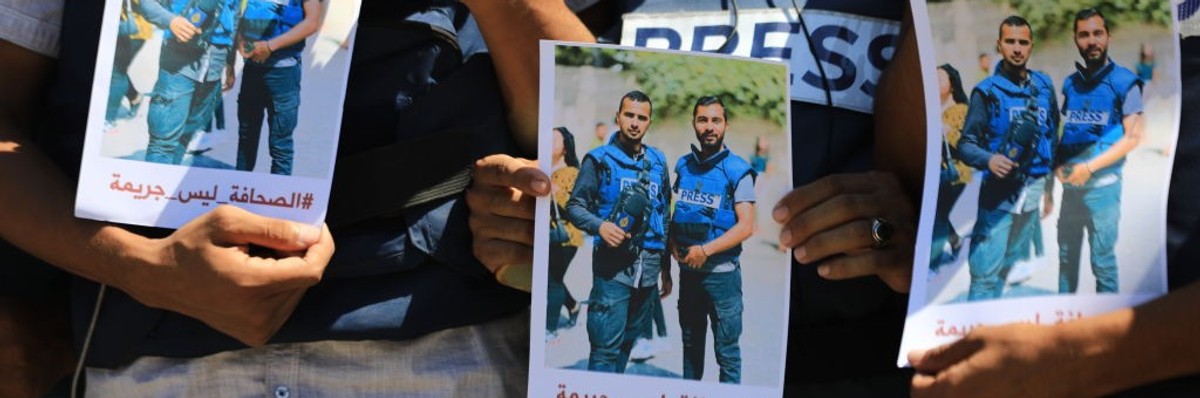
Palestinian Al Jazeera journalist Ismail al-Ghoul and cameraman Rami al-Rifee were killed by Israeli forces on July 31, 2024. (Photo: Dawoud Abo Alkas/Anadolu via Getty Images)

International outcry and a reporter’s pointed questions weren’t enough to get the State Department to denounce the killings of Al Jazeera journalists.

A Palestinian journalist on Thursday pressed a U.S. State Department spokesperson to characterize the killings of two Al Jazeera journalists by Israeli forces as summary execution.

The heated press briefing followed an airstrike on Wednesday that killed Al Jazeera reporter Ismail al-Ghoul and cameraman Rami al-Rifee, and sparked global outrage. Israel’s military acknowledged targeting al-Ghoul, saying he was “eliminated” because he was a Hamas “terrorist,” an allegation the Qatar-based network said was “baseless.”

The death toll of Palestinian journalists and media workers now stands at least 108, including several intentionally targeted by Israel forces, according to the Committee to Protect Journalists (CPJ).

Said Arikat, the Washington bureau chief of Al-Quds, an Arabic-language newspaper based in Jerusalem, called the strike a “premeditated crime to kill a journalist for doing their job” and a “summary execution” in the press briefing, but State Department spokesperson Vedant Patel declined to affirm the characterizations or condemn the airstrike.

Al-Ghoul and al-Rifee were killed in northern Gaza after reporting from near the home of Ismail Haniyeh, the Hamas political leader who was assassinated in Tehran earlier on Wednesday. They wore press vests and had signs on their vehicle identifying them as journalists; they had last contacted their news desk just 15 minutes before the strike, Al Jazeera reported.

The Israel Defense Forces (IDF) presented no evidence in a social media post claiming that al-Ghoul was a terrorist and Hamas operative. In March, al-Ghoul reported being stripped, handcuffed, and blindfolded during the course of a 12-hour detainment by Israeli forces; he had been covering an Israeli attack on al-Shifa hospital in Gaza City. Witnesses said Israeli forces severely beat al-Ghoul at the hospital before arresting him.

Anas al-Sharif, another Al Jazeera reporter in Gaza, was on site at a different hospital on Wednesday when his colleagues’ bodies were brought in, and he spoke about the role al-Ghoul had played in the outlet’s war coverage.

“Ismail was conveying the suffering of the displaced Palestinians and the suffering of the wounded and the massacres committed by the [Israeli] occupation against the innocent people in Gaza,” he told his own news outlet.

“The feeling—no words can describe what happened,” he added.

In protest of the killings, Palestinian journalists gathered to throw off their press vests and vowed to continue showing the suffering of Gazans through their work, despite the dangers they faced.

Condemnation of the killings of the two Al Jazeera journalists came not just from Gaza but all over the world.

CPJ CEO Jodie Ginsberg said in a statement that she was “dismayed” by the killings and that journalists are civilians who should never be targeted.

Defending Rights & Dissent, a U.S.-based civil liberties nonprofit, also condemned the killing of al-Ghoul and said the reasons for it were clear.

“When you ‘eliminate’ journalists, it’s much easier to hide war crimes, it’s easier to spread lies, it’s easier to commit genocide,” Sue Udry, the group’s executive director, said in a statement.

In response to the killing, the International Committee of the Red Cross (ICRC) said that journalists “must be protected, and we decry attacks against them.”

William Schomburg, head of the ICRC’s sub-delegation in Gaza, said in a statement that his team had just met with al-Ghoul the previous week to get an update on the humanitarian situation in Gaza. “Journalists in all wars play a central role in highlighting the plight of civilians and in speaking for the voiceless,” Schomburg said.

Reporters Without Borders (RSF, in French), a Paris-based nonprofit, wrote in unequivocal terms about the need for Israel to stop killing journalists.

“RSF is deeply disturbed to see the Israel Defense Forces using social media to justify their targeted killing of Al Jazeera journalist Ismail al-Ghoul,” the organization wrote on social media. “Journalists are not terrorists. This campaign of violence against media in Gaza must stop now.”

The Freedom of the Press Foundation also responded forcefully to the IDF’s claim about al-Ghoul.

“Documenting a war isn’t terrorism, it’s journalism,” the group wrote on social media. “If the IDF can prove al-Ghoul was working for Hamas’ military, it should do so immediately. If not, this looks like a flimsy excuse for intentionally murdering a journalist from an outlet Israel dislikes.”

Israeli forces have killed at seven journalists or media workers affiliated with Al Jazeera during the war, and Israel shut down the network’s local operations in May, citing a security threat, though critics said it was a case of censorship—an attempt to hide the brutality of the assault on Gaza.

In total, 113 journalists and media workers have died since the war began, including two Israelis and three Lebanese, according to CPJ, which says this has been the deadliest period for journalists anywhere in the world since it began collecting data in 1992.

The international outcry over all of the killings has ramped up pressure on the U.S.—which has backed the Israeli assault with weapons and diplomatic support— to condemn them, and Wednesday’s strike on al-Ghoul and al-Rifee has only increased that pressure. Still, Patel, the spokesperson, wouldn’t issue any such condemnation on Thursday.

Arikat also pressed Patel to call for the release of Palestinian journalists being held in Israeli detention centers without charges, but Patel didn’t do so.

Original article by EDWARD CARVER republished from Common Dreams under Creative Commons (CC BY-NC-ND 3.0). 

Continue ReadingUS Urged to Condemn Israel’s ‘Summary Execution’ of Two Journalists

Allies Vow to Fight Off Big Oil Lawsuit Aimed at Ending ‘Existence’ of Greenpeace

Spread the love

Original article by OLIVIA ROSANE republished from Common Dreams under Creative Commons (CC BY-NC-ND 3.0).

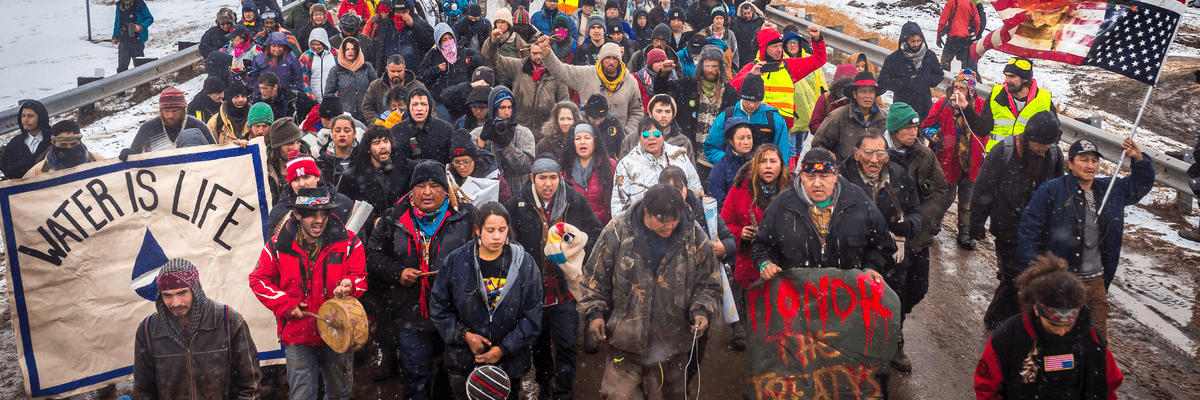
Dakota Access Pipeline protesters rally at Standing Rock Indian Reservation on February 22, 2017. (Photo: Michael Nigro/Pacific Press/LightRocket via Getty Images)

“No matter who you are, no matter what your politics are, this is one of the most important issues in America right now,” one Greenpeace spokesperson said.

Nearly 300 organizations and tens of thousands of individuals have signed an open letter supporting Greenpeace USA against a $300 million lawsuit brought against the environmental group by Energy Transfer—a company with a majority stake in the Dakota Access pipeline.

The corporation is falsely accusing Greenpeace of being the driving force behind Indigenous-led protests against the Dakota Access pipeline (DAPL) in 2016 and 2017.

Greenpeace USA announced its supporters on Thursday as it launched a campaign to raise awareness about the lawsuit—which it said could “functionally bankrupt” the organization, threatening its “existence.” However, Greenpeace said that the dangers posed by strategic lawsuits against public participation (SLAPPs), like the one it faces, extend far beyond one organization.

“No matter who you are, no matter what your politics are, this is one of the most important issues in America right now,” Greenpeace USA spokesperson Rolf Skar said in a statement. “Energy Transfer built the Dakota Access pipeline. But they’re suing anyway in order to send a message: If you dare to oppose us, we will financially ruin you.”

The Dakota Access pipeline drew massive protests from the Standing Rock Sioux Tribe, more than 300 other tribal nations, and non-Indigenous allies. While former U.S. President Donald Trump forced the pipeline through shortly after taking office in early 2017, the protests rattled the fossil fuel industry and their allies in government. After 2016, 18 states passed anti-protest laws that shielded around 60% of U.S. oil and gas production and related infrastructure from peaceful protests. The industry also turned to “judicial harassment.”

Energy Transfer (ET) initially brought suits against Standing Rock Tribal Chairman Dave Archambault and other Water Protectors, as well as a federal suit against Greenpeace in 2017.

At the time, ET CEO Kelcy Warren told a reporter: “Could we get some monetary damages out of this thing, and probably will we? Yeah, sure. Is that my primary objective? Absolutely not. It’s to send a message—you can’t do this, this is unlawful, and it’s not going to be tolerated in the United States.”

“Everyone who says they care about freedom—of whatever political stripe—should join together to support the Greenpeace campaign to protect people’s right to speak out against corporate abuses.”

While the 2017 cases were all dismissed, ET immediately filed a similar case against Greenpeace in North Dakota state court in 2019. The new case, which is scheduled to go to trial in February 2025, makes what Greenpeace called a “deeply racist” case that Greenpeace, and not Indigenous leaders, coordinated the Dakota Access protests.

“The lawsuit against Greenpeace is also an attack on the Indigenous movement in our fight for self-determination to protect Mother Earth, our waters, sacred and cultural sites, and our youth and future generations,” Morgan Brings Plenty of the Standing Rock Youth Council said in a statement. “These colonialist lawsuits are trying to send a warning to anyone who might consider speaking out and to be quiet—any of you could be next.”

ET also makes several claims that would set a dangerous precedent if upheld, including denouncing legitimate speech as defamatory and making anyone who is present at a protest liable for things that occurred at the same protest.

“The whole point of this type of lawsuit is to limit freedom of expression, so even if you don’t care about climate change, or you don’t care about Greenpeace, you should pay attention,” Skar said. “What’s at stake isn’t just Greenpeace or environmentalism, but the fundamental American rights to freedom of peaceful expression and advocacy for all of us.”

Greenpeace has circulated a letter to ET that has so far been signed by more than 290 organizations—including 350.orgPublic Citizen, ACLU North Dakota, SEIU, Indigenous Environmental Network, and Amnesty International USA—and tens of thousands of individuals, including prominent celebrities and activists like Jane Fonda, Susan Sarandon, Billie Eilish, and Adam McKay.

“This is corporate overreach that is part of a disturbing trend of attacks on advocacy and speech around the world,” the letter reads. “We will not allow lawsuits like this one to stop us from advocating for a just, green, and peaceful future. On the contrary, we will ensure they have the opposite effect, increasing the support for organizations like Greenpeace and strengthening the broader movement for justice.”

“This legal attack on Greenpeace is an attack on us all,” the letter continues. “We will not stand idly by. We will not be bullied. We will not be divided and we will not be silenced.”

Organizations also issued individual statements of support.

“Everyone who says they care about freedom—of whatever political stripe—should join together to support the Greenpeace campaign to protect people’s right to speak out against corporate abuses,” said Robert Weissman, co-president of Public Citizen. “As Greenpeace knows from its own experience, too often corporations use their political, economic, and legal power not just to run PR campaigns justifying their wrongdoing, but to threaten public interest advocates with bad-faith lawsuits (SLAPPs) and other intimidation tactics.”

Brian Hauss, a senior staff attorney for the ACLU, said: “Protesters and advocacy groups should never have to fear the weight of groups like ETP as a condition for expressing their First Amendment rights. The court should see this lawsuit for what it is and toss it.”

Progressives are also calling for a national legislative solution to the problem of SLAPP suits. While most states do have laws on the books against them, North Dakota is one of the 18 that do not.

Rep. Jamie Raskin (D-Md.) introduced the Strategic Lawsuits Against Public Participation (SLAPP) Protection Act during Congress’ last session, and plans to reintroduce it in September of this year.

“The case against Greenpeace illustrates how mega-corporations can use lawsuits to silence, intimidate, and ruin their critics,” Raskin said. “America must demand, and Congress must pass, bipartisan legislation to protect First Amendment rights against ruinous litigation practices.”

Original article by OLIVIA ROSANE republished from Common Dreams under Creative Commons (CC BY-NC-ND 3.0).

Continue ReadingAllies Vow to Fight Off Big Oil Lawsuit Aimed at Ending ‘Existence’ of Greenpeace

Starmer exploits far-right to attack our civil freedoms and web access

Spread the love

In so-called ‘opposition’, Starmer enabled the Tories every time they assaulted our civil rights to protest or to be free from spying and surveillance – and when they passed laws to protect undercover police and their agents from legal consequences for their crimes – including rape and murder. He went further, colluding with the Tories to defeat an attempt to overturn anti-protest legislation, to block measures to protect journalists from state persecution and to pass laws to prevent public bodies acting against apartheid.

Starmer’s live facial recognition plan would usher in national ID, campaigners say

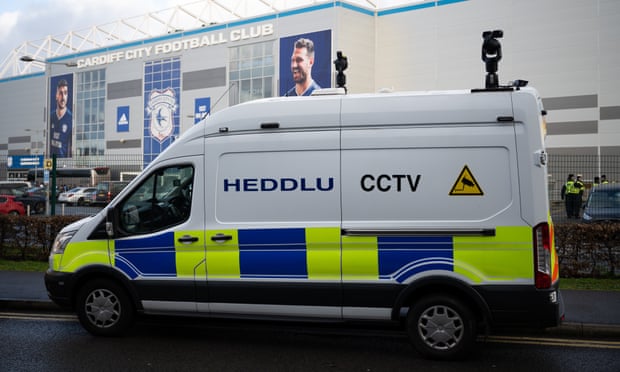
Live facial recognition is already used by the Metropolitan police and South Wales police. Photograph: Matthew Horwood/Getty Images

PM accused of ignoring civil rights and aping autocracies as he proposes new powers after far-right unrest

Civil liberties campaigners have said that a proposal made by Keir Starmer on Thursday to expand the use of live facial recognition technology would amount to the effective introduction of a national ID card system based on people’s faces.

Silkie Carlo, the director of Big Brother Watch, said it was ironic the new prime minister was suggesting a greater use of facial matching on the same day that an EU-wide law largely banning real-time surveillance technology came into force.

“Expanding live facial recognition means millions of innocent Britons being subjected to automated ID checks,” said Carlo. “These are the surveillance tactics of China and Russia and Starmer seems ignorant of the civil liberties implications.”

Promising to create a national police capability to tackle the rioting, the new prime minister said forces needed to work better together, sharing intelligence and engaging in a “wider deployment of facial recognition technology”.

Details were scant but immediately after, Starmer suggested that trouble-makers could be subject to “criminal behaviour orders to restrict their movements before they can even board a train” – implying a wider use of live facial recognition at transport hubs such as railway stations.

Daragh Murray, a senior lecturer at Queen Mary University of London, said: “There is a clear danger that in responding to a tragedy and public unrest we expand and entrench police surveillance without appropriate scrutiny. Given that the police have responded to disorder and riots for decades, why is facial recognition needed now?”

Continue ReadingStarmer exploits far-right to attack our civil freedoms and web access

Barclays’ $2bn coal loans expose ‘enormous loophole’ in its climate policy

Spread the love

Original article by Josephine Moulds republished from The Bureau of Investigative Journalism under a Creative Commons Attribution-NonCommercial-NoDerivs 3.0 Unported License.

Bank accused of ‘trying to have it both ways’ with coal policy that allows financing for huge polluters

Barclays helped raise nearly $2bn for companies running highly polluting coal-fired power plants in the US, exposing an “enormous loophole” in its climate policy.

As part of its strategy to reach net zero, the bank has committed to stop financing companies that make more than half their revenues from coal-fired power.

Last year, however, Barclays helped raise $1.7bn for coal-fired power companies that appear to exceed that threshold, the Bureau of Investigative Journalism and ITV News can reveal.

Among these deals were two $400m loans for Monongahela Power, which generates 95% of its electricity from burning coal at two huge plants in West Virginia. The company only sells electricity that it generates itself, suggesting that the vast majority of its revenues are from coal-fired power.

Barclays, however, said its policy only prohibits financing for companies that make more than 50% of revenues specifically from generating coal-fired power; and that TBIJ’s calculations did not account for these companies’ revenues from transmitting and distributing that power.

Barclays was Europe’s biggest lender to the coal power industry last yearAndrea Domeniconi / Alamy

Seth Feaster, an analyst at the Institute for Energy Economics and Financial Analysis (IEEFA) think tank, said: “The bank is trying to have it both ways: a public-facing coal policy that sounds like it will no longer support coal-heavy companies, but the technicality [regarding transmission and distribution revenue] has rendered that policy largely meaningless.

“The bank has created an enormous loophole that appears to allow it to largely continue doing business as usual with coal-friendly utilities.”

Natasha Landell-Mills, head of stewardship at the asset manager Sarasin & Partners, which holds Barclays debt, said the bank’s position appeared to be “somewhat disingenuous”.

“In the end, what matters is that coal-fired power falls in keeping with ensuring a safe climate. As investors, we would expect all related activities that enable coal-fired power to be captured and, if they are not, would hope to see the board urgently address this loophole.” She said this was not just a question of how Barclays is run and its reputation, but that continuing to fund high emitters was also financially risky for long-term investors.

The news comes amid a storm of protest against the bank, which was revealed in May to be Europe’s biggest funder of fossil fuels.

It is also Europe’s biggest lender to the coal power industry, taking part in $75bn worth of deals for companies active in the sector last year.

Bold pledges

Under pressure from its customers and investors, Barclays has made increasingly bold climate promises. It tightened its coal policy in 2022 and said financing the sector not only poses a threat to the planet but could represent a bad lending decision. Yet a number of companies it funded last year appear to be making most of their money from coal-fired power.

In addition to the Monongahela Power deals, Barclays helped raise $400m for Kentucky Utilities, which in 2022 generated almost three quarters of its electricity from burning coal. This suggests more than half its revenues were from coal-fired power.

Barclays also helped raise a $500m loan for Louisville Gas & Electric, which generated 83% of its power from coal in 2022. It makes some revenues from selling gas but calculations based on company and government data suggest its revenue share from coal was more than 50%.

Mill Creek power plant, a coal-fired stations owned by Louisville Gas and ElectricWilliam Alden / Creative Commons

Neither company appears to be transitioning to renewable power and their owner, PPL Corporation, said it expects they will use coal and natural gas as their predominant fuels “for the foreseeable future”.

Monongahela Power is investing millions to keep its two West Virginia plants running until 2035 and 2040, despite scientists warning that developed countries must end power generation from coal by 2030. The company aims to build 50MW of solar generation, but that represents less than 2% of its current coal-fired power capacity.

Barclays told TBIJ the deals complied with its policy “based on publicly disclosed information and our due diligence”. It said its policy does not have a loophole and that its methodology is robust. “An ambition to be net zero by 2050 does not require an immediate exit from financing coal,” the bank said. “Barclays is financing an energy sector in transition, providing finance to meet current energy needs and also financing the scaling of clean energy”.

PPL, which owns utilities in Kentucky, Rhode Island and Pennsylvania, said it had set a clear goal to achieve net-zero carbon emissions by 2050 and was transitioning to a cleaner energy mix across the group. It added that it had received approval from the authorities to retire 600MW of coal-fired power generation in Kentucky by 2027. This, however, represents less than 15% of its remaining coal capacity.

Monongahela Power did not respond to TBIJ’s request for comment.

Deadly coal plants

Coal-fired power plants are responsible for more than 40% of global CO2 emissions from energy. At Cop28 UN climate talks in Dubai last year, all countries agreed that accelerating the transition from coal to renewables was essential in order to avert catastrophic climate change.

Coal is also a major source of toxic air pollution. In the US alone, more than 3,800 people die from soot released by coal-fired power plants every year, according to a report by Sierra Club, a US NGO. While many European banks have distanced themselves from the industry, Barclays has retained strong links with US coal-fired power companies.

The boom in fracked gas and plunging cost of renewables has changed the landscape for power generation in the US. Seth Feaster at IEEFA said: “[Coal-fired power] companies are going to start struggling because they can’t sell their power in competitive environments.

“Investing in coal is very risky because most of [these coal plants] are losing money. They’re not going to be around for very long and if something breaks, they tend to shut down early because they can be very costly to repair.”

Bob Ward from the Grantham Research Institute on Climate Change said: “The coal industry in the United States is failing, it’s on its way out … there’s no excuse for propping up the American coal industry.” He described the distinction Barclays made between the generation, transmission and distribution of electricity from coal in its policy as “semantics”.

“What consumers and investors will be expecting is that Barclays are complying with the spirit of their declarations, and not just a technicality,” Ward said. “If you are generating most of your income from burning coal and then distributing the electricity results, then that’s the coal. That’s the coal industry. You’re damaging the climate. And that is what Barclays said they would stop.”

Last month, the organisers of the Wimbledon tennis championships faced calls to drop Barclays as a sponsor over its ties to fossil fuels and defence companies supplying Israel. Barclays addressed criticism of its defence funding, saying it trades in shares on behalf of clients. “Whilst we provide financial services to these companies, we are not making investments for Barclays.”

Live Nation also dropped the bank as a sponsor for various music festivals – including Download, Latitude and Isle of Wight – after protests from bands and fans.

Steff Wright, chairman of the Gusto Group, said his construction and manufacturing business is moving away from banking with Barclays. “As a company that’s working towards a green future, we need to look at our supply chain and who else is on that journey with us.

“We’d encourage all businesses to move away from them, to put pressure on them to rethink their strategy.”

Reporters: Josephine Moulds
Environment editor: Robert Soutar
Impact producer: Grace Murray
Deputy editors: Chrissie Giles and Katie Mark
Editor: Franz Wild
Production editor: Alex Hess
Fact checker: Somesh Jha

This reporting is funded by the Sunrise Project. None of our funders have any influence over our editorial decisions or output.

Original article by Josephine Moulds republished from The Bureau of Investigative Journalism under a Creative Commons Attribution-NonCommercial-NoDerivs 3.0 Unported License.

More from this project

Barclays’ billions of ‘sustainable’ finance for fossil fuel industry is greenwash, says investor

HSBC helped oil and gas industry raise $47bn despite net-zero pledge

How will new FCA greenwashing rule tackle banks’ dodgy climate claims?

Continue ReadingBarclays’ $2bn coal loans expose ‘enormous loophole’ in its climate policy