Netanyahu Accused of Sabotaging Cease-Fire Talks With Assassination of Hamas Leader

Spread the love

Original article by JAKE JOHNSON republished from Common Dreams under Creative Commons (CC BY-NC-ND 3.0). 
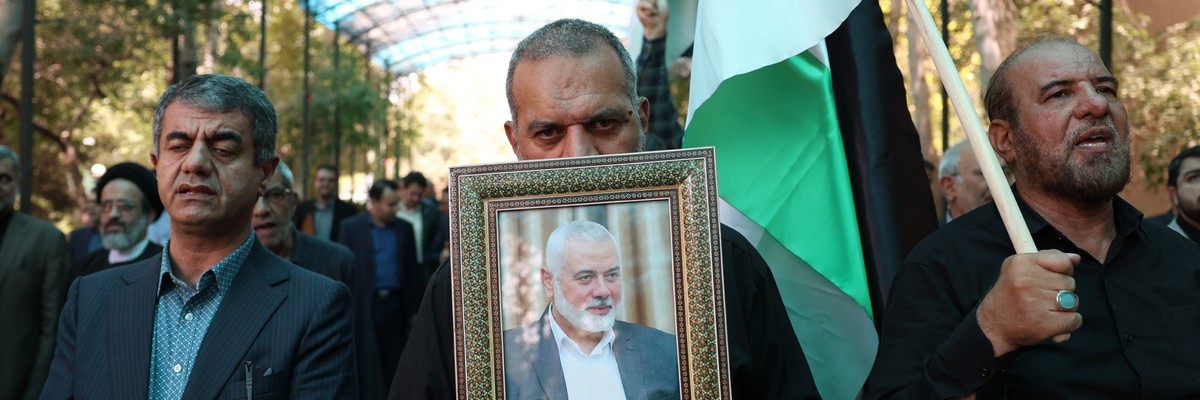
People hold up a portrait of assassinated Hamas political chief Ismail Haniyeh in Tehran, Iran on July 31, 2024. (Photo: AFP via Getty Images)

“Netanyahu isn’t playing chicken, he wants to crash the car,” said one observer.

The political leader of Hamas was assassinated early Wednesday in what the group said was an Israeli attack on his residence in the Iranian capital of Tehran, which he was visiting to attend the inauguration of the country’s newly elected president.

The killing of Ismail Haniyeh, who became the head of Hamas’ political arm in 2017, sparked warnings that Israeli Prime Minister Benjamin Netanyahu is doing all he can to undermine cease-fire talks with the Palestinian group after they showed signs of progress in recent weeks.

“Netanyahu has systematically sabotaged cease-fire talks because ending the war will likely end his political career,” Trita Parsi, executive vice president of the Quincy Institute for Responsible Statecraft, said following the assassination of Haniyeh, a key figure in the negotiations.

“The assassination buys Netanyahu several weeks, if not months, in which there will be no serious expectation of a cease-fire deal,” Parsi argued. “Thus, the war will continue, as will Netanyahu’s reign as prime minister.”

Haniyeh’s killing prompted fury from Iran, whose supreme leader vowed a “harsh response”—heightening the chances of a long-feared all-out war between Israel and Iran. Earlier this year, Israel killed several Iranian commanders in a strike on Tehran’s consulate in Syria’s capital, prompting Iran to retaliate with a drone attack.

Iranian lawmakers are expected to hold an emergency meeting about Haniyeh’s assassination later Wednesday. As of this writing, the Israel Defense Forces (IDF) has yet to comment on the killing.

The International Criminal Court’s (ICC) top prosecutor, Karim Khan, was seeking an arrest warrant against Haniyeh for war crimes committed on October 7. Khan has also applied for an arrest warrant against Netanyahu and Israeli Defense Minister Yoav Gallant.

“How can mediation succeed when one party assassinates the negotiator on the other side?”

The suspected Israeli strike in Tehran on Wednesday was launched just hours after Israel’s military bombed the Lebanese capital of Beirut, killing several people—including two children—in retaliation for a deadly attack on the occupied Golan Heights. Israel claimed its attack on Beirut killed Hezbollah commander Fouad Shukur, but subsequent reporting suggested he may have survived the strike.

News of Haniyeh’s assassination in Tehran came days after top officials from Israel, Egypt, Qatar, and the United States met in Rome over the weekend to continue negotiating a possible deal to end Israel’s assault on the Gaza Strip.

The New York Times reported that “despite progress in recent weeks, the monthslong negotiations remain stalled over several critical issues, particularly the extent to which Israeli forces would remain in Gaza during a truce.”

“Earlier in July, Israel hardened its position on maintaining checkpoints along a strategic highway south of Gaza City, weeks after suggesting that it could compromise,” the Times added. “It was unclear on Sunday if Mr. Netanyahu had allowed negotiators to show greater flexibility on the matter during the talks. Mr. Netanyahu faces pressure from members of his right-wing government to stick to a tougher line. The length of the truce is also a source of dispute: Hamas wants a permanent truce, while Israel wants the option to resume fighting.”

Egypt said Haniyeh’s killing is a signal from Israel that it lacks “political will for deescalation,” according toAl Jazeera.

Qatar’s prime minister, meanwhile, wrote on social media: “Political assassinations and continued targeting of civilians in Gaza while talks continue leads us to ask, how can mediation succeed when one party assassinates the negotiator on the other side?”

Jamal Abdi, president of the National Iranian American Council, warned that with the assassination of Haniyeh, “Netanyahu isn’t playing chicken, he wants to crash the car.”

U.S. Secretary of State Antony Blinken said Wednesday that the United States was “not aware of or involved in” the assassination of Haniyeh.

Belén Fernández, a contributing editor at Jacobin, wrote in an op-ed for Al Jazeera that “Israel made its intention to continue and expand the war clear” by killing Haniyeh.

“By assassinating Haniyeh in Tehran, Israel is literally playing with fire,” Fernández wrote. “In order to derail cease-fire prospects and keep up the killing in Gaza, then, it seems Israel is going to end up with a whole lot more regional blood on its hands.”

This story has been updated to include new comment from U.S. Secretary of State Antony Blinken.

Original article by JAKE JOHNSON republished from Common Dreams under Creative Commons (CC BY-NC-ND 3.0). 
Continue ReadingNetanyahu Accused of Sabotaging Cease-Fire Talks With Assassination of Hamas Leader

UN Probe Finds ‘Appalling Acts’ of Torture Against Palestinians Detained by Israel

Spread the love

Original article by EDWARD CARVER republished from Common Dreams under Creative Commons (CC BY-NC-ND 3.0).
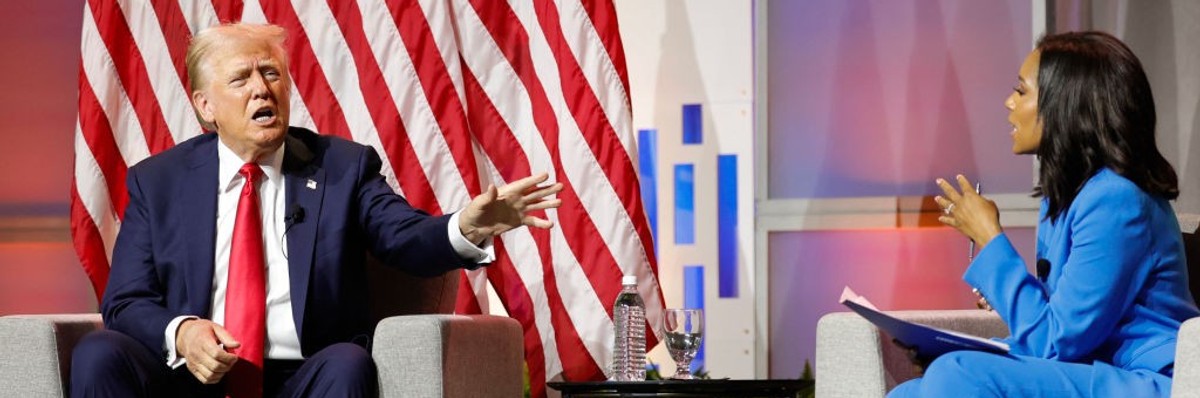
Palestinian Faouzi Abdel Aal, 21, is rushed to Nasser hospital in the southern Gaza Strip to receive treatment for his injuries, after being reportedly released from an Israeli detention center on July 25, 2024. (Photo: Bashar Taleb/AFP via Getty Images)

The U.N. report found evidence of sexual violence, waterboarding, and the use of dogs against detainees, many of whom were deprived of food, water, sleep, and toilet access.

The Office of the United Nations High Commissioner for Human Rights on Wednesday released a report detailing torture and abuse of Palestinians at Israeli detention centers, including sexual violence, waterboarding, and the use of dogs.

Israeli security forces have also used electric shocks, burned detainees with cigarettes, and deprived them of food, water, sleep, and toilet access, according to the 23-page OHCHR report, based largely on interviews with released detainees. Some detainees said they were held with their arms suspended from the ceiling; were forced to be naked for prolonged periods, wearing only diapers; and were blindfolded for extended periods.

Israel security forces have arrested thousands of Palestinians from the West Bank and Gaza since October, many of them arbitrarily; they held more than 9,400 “security detainees” as of the end of June, often in secret and incommunicado, without providing a reason for the detainment, the report says.

“The testimonies gathered by my office and other entities indicate a range of appalling acts, such as waterboarding and the release of dogs on detainees, amongst other acts, in flagrant violation of international human rights law and international humanitarian law,” U.N. Human Rights chief Volker Türk said in a statement accompanying the report.

Most of the detainees have been men and adolescent boys, though some are also women and adolescent girls, and there are many reported instances of sexual and gender-based violence, the report says, including “the forced nudity of both men and women; beatings while naked, including on the genitals; electrocution of the genitals and anus; being forced to undergo repeated humiliating strip searches; widespread sexual slurs and threats of rape; and the inappropriate touching of women by both male and female soldiers.”

OHCHR also said it had video evidence of detainees filmed in “deliberately humiliating positions” while handcuffed and blindfolded, and noted it received “consistent reports” of Israeli security forces “inserting objects into detainees’ anuses.”

Some detainees also reported “cage-like” facilities and overcrowding. The report says that 13 to 20 male detainees were kept in cells designed for five people, forcing many to sleep on the floor. There were “poor living, hygiene, and health conditions, with reports of water running only one hour per day over several weeks” and detainees faced “exposure to cold temperatures due to the confiscation of blankets and removal of windows panes in cold weather.”

At least 53 Palestinian detainees have died in Israeli detention centers since October, according to the report, which suggests that the detention system appears “to constitute a collectively punitive measure against Palestinians,” citing the words of Itamar Ben-Gvir, Israel’s minister of national security, who has said that “terrorists” deserve the most “stringent conditions.” Male detainees reported losing between about 55 and 120 pounds while in custody.

The OHCHR report comes as a highly controversial case involving detention abuse unfolds in Israel. The Israeli military is investigating nine soldiers for alleged “substantial abuse” of a Palestinian detainee who reportedly had to be hospitalized and could not walk after they attacked him. Far-right Israeli groups and political figures have protested the investigation.

Concern about Israeli detentions of Palestinians has been high for many months. In January, a Palestinian watchdog group issued a report condemning the forced disappearance of Gazans, and The New York Times found evidence of detainees being stripped and beaten.

Not all of the alarms about the situation in Israeli detentions centers have come from abroad. In February, Israeli’s public defender’s office issued a report calling for improved prison conditions, including for Palestinians. In April, local human rights groups called for a closure of the Sde Teiman military base detention center, due to its notorious conditions.

The calls were prompted in part by gruesome reports including amputations of detainees’ limbs due to handcuff injuries. The United Nations Relief and Works Agency for Palestine Refugees in the Near East then issued a damning report on detainee treatment, including of its own staff, some of whom had been detained and subjected to harsh interrogation.

Last week, Save the Children called for an end to the Israel’s arbitrary detainment of Palestinian minors, with a regional director saying that “these children are trapped, unable to move or see the sun, forced into crowded cells with appalling, unsanitary conditions, and subject to severe abuse and violence.”

Experts said Wednesday that the OHCHR report served mainly to confirm previous findings on Israeli detention centers. Neil Sammonds, a campaigner at the U.K.-based progressive advocacy group War on Want, said on social media that leaders of the new U.K. government haven’t spoken up about abuses at Israeli detention centers. He also said that the report could be used as evidence by the International Criminal Court, which has sought arrest warrants for both Israeli and Hamas leaders.

The new report also addresses abuses of Israelis held by Hamas and affiliated groups. The Palestinian militants killed roughly 1,200 people in a horrific set of attacks in southern Israel on October 7 and kidnapped about 250 Israelis, more than 100 of whom have since been released. Like Palestinian detainees, the released Israelis reported “appalling” conditions, the report says, including beatings, receiving surgery without anesthetic, and sexual and gender-based violence. The Israeli government has reported that 44 of the remaining hostages in Gaza have died.

Both Israel and Hamas have refused to allow the International Committee of the Red Cross to visit detainees or hostages. The OHCHR called for both sides to allow such independent monitoring.

Original article by EDWARD CARVER republished from Common Dreams under Creative Commons (CC BY-NC-ND 3.0).
Report From Gaza Aid Agencies Shows ‘Catastrophe on an Entirely New Level’

Iranian American Group Says Biden Must Change Course to Avert ‘Bloody Regional War’

Netanyahu Accused of Sabotaging Cease-Fire Talks With Assassination of Hamas Leader

Continue ReadingUN Probe Finds ‘Appalling Acts’ of Torture Against Palestinians Detained by Israel

Racist Donald Trump Says Kamala Harris ‘Happened to Turn Black’

Spread the love

Original article by JESSICA CORBETT republished from Common Dreams under Creative Commons (CC BY-NC-ND 3.0).

Former U.S. President Donald Trump, the 2024 Republican presidential nominee, answers questions from moderator and journalist Rachel Scott during the National Association of Black Journalists convention in Chicago, Illinois, on July 31, 2024. (Photo: Kamil Krzaczynski/AFP via Getty Images)

“This unhinged and shameful person should never be near the presidency again,” said Congressman Robert Garcia. “He’s a disgrace.”

Former U.S. President Donald Trump’s long and well-documented history of racism garnered fresh attention on Wednesday after the Republican nominee’s comments about Vice President Kamala Harris, his presumptive Democratic opponent, at a convention for Black reporters.

During Trump’s appearance at the National Association of Black Journalists (NABJ) event in Chicago, he was asked about racist claims from some Republicans that Harris is a “DEI hire,” a reference to the diversity, equity, and inclusion policies targeted by the GOP.

“She was always of Indian heritage and she was only promoting Indian heritage,” Trump said. “I didn’t know she was Black, until a number of years ago, when she happened to turn Black, and now she wants to be known as Black. So I don’t know, is she Indian or is she Black?”

Harris, whose nomination process is set to begin Thursday, was born to an Indian mother and Jamaican father. As she recalled in a 2019 debate, she was “a little girl in California who was part of the second class to integrate her public schools, and she was bused to school every day.” She went on to graduate from the historically Black Howard University.

Washington Post columnist Karen Attiah, who announced on social media Tuesday that she “decided to step down as co-chair from this year’s #NABJ24 convention,” reported Wednesday that “the crowd has actually been gasping and upset at Trump’s attacks on NABJ, Kamala Harris’ racial identity, etc.”

While some right-wing figures celebrated Trump’s comments about Harris’ identity, there was also significant backlash beyond the convention.

Sharing a video on social media, Nebraska state Sen. Megan Hunt (D-8) said: “Unreal, racist, worth watching, and I have to say it’s a good thing that he’s out on the record in serious spaces talking about how he really feels. Keep it up, here’s your guy, conservatives.”

Congressman Robert Garcia (D-Calif.) declared: “This unhinged and shameful person should never be near the presidency again. He’s a disgrace.”

Harris campaign communications director Michael Tyler said in a statement that “the hostility Donald Trump showed on stage today is the same hostility he has shown throughout his life, throughout his term in office, and throughout his campaign for president as he seeks to regain power and inflict his harmful Project 2025 agenda on the American people.”

“Trump lobbed personal attacks and insults at Black journalists the same way he did throughout his presidency—while he failed Black families and left the entire country digging out of the ditch he left us in,” Tyler continued, echoing the campaign’s comments ahead of the Wednesday event. “Donald Trump has already proven he cannot unite America, so he attempts to divide us.”

“Today’s tirade is simply a taste of the chaos and division that has been a hallmark of Trump’s MAGA rallies this entire campaign. It’s also exactly what the American people will see from across the debate stage as Vice President Harris offers a vision of opportunity and freedom for all Americans,” he added. “All Donald Trump needs to do is stop playing games and actually show up to the debate on September 10.”

Harris supporters and anti-racism advocates have anticipated such comments from Trump and his allies and expect them to continue. Sung Yeon Choimorrow, executive director of the National Asian Pacific American Women’s Forum, wrote Monday in a Common Dreams opinion piece, “As a society, we cannot simply brush off verbal attacks and racist misogyny as acceptable speech.”

“Working towards real systemic change in a world that recognizes and addresses the real harm caused by anti-Asian and racialized misogyny,” she argued, “will take all of us speaking up against these kinds of attacks that have been allowed to go on for far too long.”

Original article by JESSICA CORBETT republished from Common Dreams under Creative Commons (CC BY-NC-ND 3.0).
Continue ReadingRacist Donald Trump Says Kamala Harris ‘Happened to Turn Black’

7 Green Groups That Didn’t Back Biden Just Endorsed Harris as ‘Our Only Choice’

Spread the love

Original article by JESSICA CORBETT republished from Common Dreams under Creative Commons (CC BY-NC-ND 3.0). 
Vice President Kamala Harris speaks at the American Federation of Teachers’ 88th National Convention on July 25, 2024 in Houston, Texas. (Photo: Montinique Monroe/Getty Images)

“With a President Harris, we will have a chance to build the political power to move the bold climate initiatives we need.”

Progressive climate and environmental advocacy groups on Wednesday stressed the threat posed by the Republican presidential ticket and endorsed Vice President Kamala Harris, the presumptive Democratic nominee for the November election.

One coalition of six groups—350 Action, Center for Biological Diversity Action Fund, Clean Water Action, Climate Hawks Vote, Food and Water Action, and 350 Action, Center for Biological Diversity Action Fund, Clean Water Action, Climate Hawks Vote, Food and Water Action,350 Action, Center for Biological Diversity Action Fund, Clean Water Action, Climate Hawks Vote, Food and Water Action, and Friends of the Earth Action—cited Harris’ record as vice president and a U.S. senator from California.

Despite his months as the presumptive Democratic nominee, none of the organizations had endorsed President Joe Biden before he dropped out of the race and backed Harris earlier this month.

“Vice President Harris is a visible leader in the Biden-Harris administration’s successful work to address environmental injustice, tackle the climate crisis, hold polluters accountable, reduce water pollution, and ensure clean drinking water for all,” said Clean Water Action president and CEO Jeff Carter, emphasizing that her actions “have made a real difference in people’s lives.”

Jeff Ordower of 350 Action highlighted that in addition to being “part of the administration that invested in renewable energy through the historic Inflation Reduction Act,” Harris “has a history of taking on Big Oil and advocating for environmental justice.”

“As a global climate movement, we know Harris represents not just the ability to make progress in the U.S., but globally as well,” he added. “For those… who care about democracy, climate, and decreased corporate capture of our government, Kamala Harris is our only choice.”

“For those… who care about democracy, climate, and decreased corporate capture of our government, Kamala Harris is our only choice.”

Kierán Suckling, president of the Center for Biological Diversity Action Fund, similarly urged “everyone who cares about our planet, environmental justice, women’s rights, civil rights, and our democracy to get out and vote for Kamala Harris to be our next president.”

Suckling also took aim at former President Donald Trump, the Republican nominee, declaring that “Harris will lead us toward a brighter future for our children and grandchildren, and put the nightmare of Trump behind us.”

Trump—who earlier this month announced Big Oil-backed Sen. JD Vance (R-Ohio) as his running mate—has vowed to “drill, baby, drill” and roll back the Biden-Harris administration climate policies if fossil fuel executives pour money into his campaign.

Although the U.S. is among five wealthy countries that have led a global surge in oil and gas development this year, Harris’ campaign has warned that “oil barons are salivating” over Trump’s potential return to the White House.

A March study found that Trump’s plans for a second term would lead to 4 billion more tons of carbon dioxide being released into the atmosphere by 2030 when compared with the policies of Biden—who has passed the torch to Harris, whose online nomination process is set to start on Thursday.

“Kamala Harris’ record provides a stark contrast with Donald Trump and the far-right, pro-polluter Project 2025,” said Wenonah Hauter, founder and executive director of Food and Water Action. “Of course, much more needs to be done, and Harris’ positions do not yet go far enough to tackle the existential threats to our food, water, and climate.”

“But with a President Harris, we will have a chance to build the political power to move the bold climate initiatives we need,” Hauter emphasized. “Four more years of Trump and Project 2025 will further accelerate an already escalating climate crisis and eviscerate important protections for our food and water.”

The six groups that backed Harris but not Biden were among the campaigners and scientists angered by the president supporting the Willow project and Mountain Valley Pipeline, continuing fossil fuel lease sales, skipping last year’s United Nations summit, and declining to declare a national climate emergency.

As HEATED, which scooped the endorsement news, reported late Tuesday:

Harris has already received endorsements from the so-called “Big Green” groups—the political arms of the League of Conservation Voters, the Natural Resources Defense Council, the Sierra Club, and Clean Energy for America. But those weren’t much of a surprise, as each group had already backed Biden’s reelection bid, and are traditionally loyal to Democratic Party politicians.

The groups endorsing Harris on Wednesday, however, had so far held off on throwing their support behind Biden while he was running for reelection—in part because of the sitting president’s mixed record on climate policy.

“It was very much a debate” on whether to endorse Biden, said one of the group’s staffers, who spoke on background because the Harris announcement is not yet public. But with Harris, the calculus has changed.

“Because of her work in California and when she was a senator—a lot of us worked with her on creating the Environmental Justice for All Act—it gives us hope,” the staffer said. “She’s just a different person [than Biden], and has a stronger track record.”

“Friends of the Earth Action is excited to endorse Kamala Harris for president of the United States,” the group’s president, Erich Pica said Wednesday. “We are not going back to an era dominated by fossil fuel interests, corporate greed, and disenfranchisement. Instead, we’re looking forward to building a healthy and just future with Vice President Harris.”

For Climate Hawks Vote, this is the organization’s first presidential endorsement since its founding over a decade ago.

“We’re breaking our usual rule of not endorsing in presidential elections, given our strong history with Kamala Harris (we endorsed her in her 2016 Senate race), her track record in taking on Big Oil and holding polluters accountable, and the extraordinary moment of this election,” explained RL Miller, the group’s president. “We are climate hawks who vote, and we’ll be flocking together for Kamala Harris.”

The Green New Deal Network—which also never endorsed Biden—separately threw its support behind Harris on Wednesday.

“What the Green New Deal really is, is understanding that everything’s connected,” the network’s national director, Kaniela Ing, toldInside Climate News. “Making sure our tax dollars aren’t just going to kill children abroad, but to build schools and hospitals here at home… Local control of resources, self-determination of our communities. That’s the vision Kamala Harris, given her background—being bused to schools, really being a product of a lot of our social programs—really understands.”

One group that has not yet endorsed Harris but has certainly been attentive to both major party tickets is the youth-led Sunrise Movement. The organization warned earlier this month that the Republicans would cause “catastrophic and irreversible damage” to the climate if elected, and some members were arrested for a Monday protest Vance’s Senate office on Capitol Hill.

That same day, Sunrise rallied outside of the Democratic National Committee headquarters in Washington, D.C. to urge Harris “to put forward a comprehensive plan on the economy and climate.”

Sunrise is also part of a youth-led coalition—which includes Gen-Z for Change, March for Our Lives, and United We Dream Action—that wrote to Harris last week, “This is your chance to energize young people and our communities to vote, mount one of the greatest political comebacks in decades, and deliver a resounding defeat to the far-right agenda of Trump and Vance.”

Original article by JESSICA CORBETT republished from Common Dreams under Creative Commons (CC BY-NC-ND 3.0). 

Continue Reading7 Green Groups That Didn’t Back Biden Just Endorsed Harris as ‘Our Only Choice’

The climate is changing so fast that we haven’t seen how bad extreme weather could get

Spread the love
Andreas Thaller/Alamy Stock Photo

Simon H. Lee, University of St Andrews; Hayley J. Fowler, Newcastle University, and Paul Davies, Newcastle University

Extreme weather is by definition rare on our planet. Ferocious storms, searing heatwaves and biting cold snaps illustrate what the climate is capable of at its worst. However, since Earth’s climate is rapidly warming, predominantly due to fossil fuel burning, the range of possible weather conditions, including extremes, is changing.

Scientists define “climate” as the distribution of possible weather events observed over a length of time, such as the range of temperatures, rainfall totals or hours of sunshine. From this they construct statistical measures, such as the average (or normal) temperature. Weather varies on several timescales – from seconds to decades – so the longer the period over which the climate is analysed, the more accurately these analyses capture the infinite range of possible configurations of the atmosphere.

Typically, meteorologists and climate scientists use a 30-year period to represent the climate, which is updated every ten years. The most recent climate period is 1991-2020. The difference between each successive 30-year climate period serves as a very literal record of climate change.

This way of thinking about the climate falls short when the climate itself is rapidly changing. Global average temperatures have increased at around 0.2°C per decade over the past 30 years, meaning that the global climate of 1991 was around 0.6°C cooler than that in 2020 (when accounting for other year-to-year fluctuations), and even more so than the present day.

A moving target for climate modellers

If the climate is a range of possible weather events, then this rapid change has two implications. First, it means that part of the distribution of weather events comprising a 30-year climate period occurred in a very different background global climate: for example, northerly winds in the 1990s were much colder than those in the 2020s in north-west Europe, thanks to the Arctic warming nearly four times faster than the global average. Statistics from three decades ago no longer represent what is possible in the present day.

Second, the rapidly changing climate means we have not necessarily experienced the extremes that modern-day atmospheric and oceanic warmth can produce. In a stable climate, scientists would have multiple decades for the atmosphere to get into its various configurations and drive extreme events, such as heatwaves, floods or droughts. We could then use these observations to build up an understanding of what the climate is capable of. But in our rapidly changing climate, we effectively have only a few years – not enough to experience everything the climate has to offer.

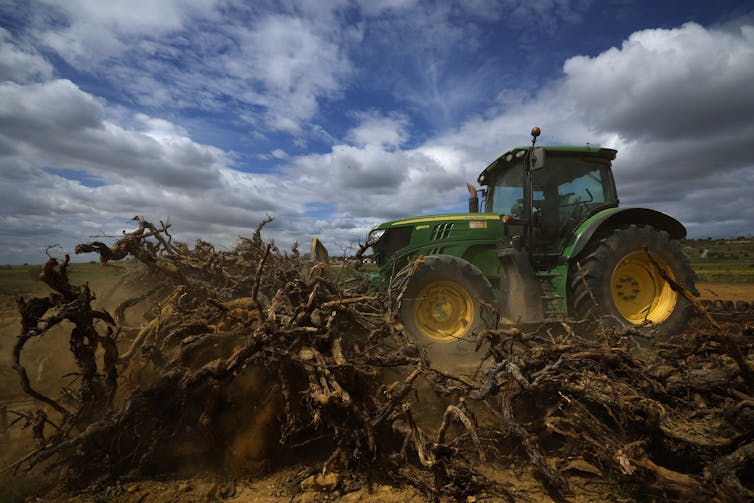
Extreme weather, such as drought, is a particular problem for farmers. EPA-EFE/Guillaume Horcajuelo

Extreme weather events require what meteorologists might call a “perfect storm”. For example, extreme heat in the UK typically requires the northward movement of an air mass from Africa combined with clear skies, dry soils and a stable atmosphere to prevent thunderstorms forming which tend to dissipate heat.

Such “perfect” conditions are intrinsically unlikely, and many years can pass without them occurring – all while the climate continues to change in the background. Based on an understanding of observations alone, this can leave us woefully underprepared for what the climate can now do, should the right weather conditions all come together at once.

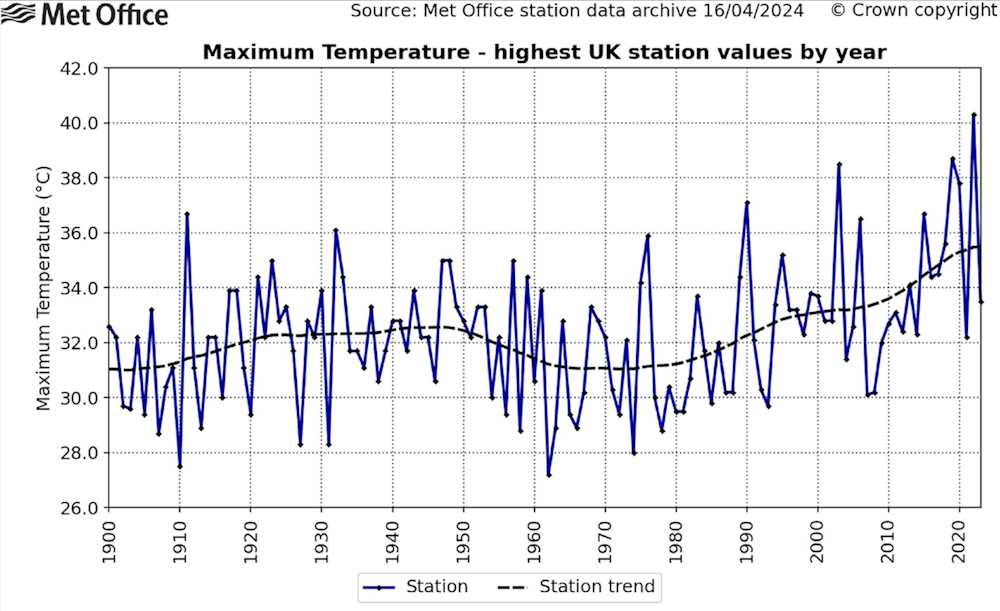
Startling recent examples include the extreme heatwave in the Pacific north-west of North America in 2021, in which temperatures exceeded the previous Canadian record maximum by 4.6°C. Another is the occurrence of 40°C in the UK in summer 2022, which exceeded the previous UK record maximum set only three years earlier by 1.6°C. This is part of the reason why the true impact of a fixed amount of global warming is only evident after several decades, but of course – since the climate is changing rapidly – we cannot use this method anymore.

Playing with fire

To better understand these extremes, scientists can use ensembles: many runs of the same weather or climate model that each slightly differ to show a range of plausible outcomes. Ensembles are routinely used in weather prediction, but can also be used to assess extreme events which could happen even if they do not actually happen at the time.

When 40°C first appeared in ensemble forecasts for the UK before the July 2022 heatwave, it revealed the kind of extreme weather that is possible in the current climate. Even if it had not come to fruition, its mere appearance in the models showed that the previously unthinkable was now possible. In the event, several naturally occurring atmospheric factors combined with background climate warming to generate the record-shattering heat on July 19 that year.

The highest observed temperature each year in the UK, from 1900 to 2023

A graph showing the highest observed temperature in the UK between 1900 and 2023.
The hottest days are getting hotter in the UK. Met Office/Kendon et al. 2024

Later in summer 2022, after the first occurrence of 40°C, some ensemble weather forecasts for the UK showed a situation in which 40°C could be reached on multiple consecutive days. This would have posed an unprecedented threat to public health and infrastructure in the UK. Unlike the previous month, this event did not come to pass, and was quickly forgotten – but it shouldn’t have been.

It is not certain whether these model simulations correctly represent the processes involved in producing extreme heat. Even so, we must heed the warning signs.

Despite a record-warm planet, summer 2024 in the UK has been relatively cool so far. The past two years have seen global temperatures far above anything previously observed, and so potential extremes have probably shifted even further from what we have so far experienced.

Just as was the case in August 2022, we’ve got away with it for now – but we might not be so lucky next time.


Imagine weekly climate newsletter

Don’t have time to read about climate change as much as you’d like?
Get our award-winning weekly roundup in your inbox instead. Every Wednesday, The Conversation’s environment editor writes Imagine, a short email that goes a little deeper into just one climate issue. Join the 35,000+ readers who’ve subscribed so far.


Simon H. Lee, Lecturer in Atmospheric Science, University of St Andrews; Hayley J. Fowler, Professor of Climate Change Impacts, Newcastle University, and Paul Davies, Chief Meteorologist, Met Office and Visiting Professor, Newcastle University

This article is republished from The Conversation under a Creative Commons license. Read the original article.

Continue ReadingThe climate is changing so fast that we haven’t seen how bad extreme weather could get