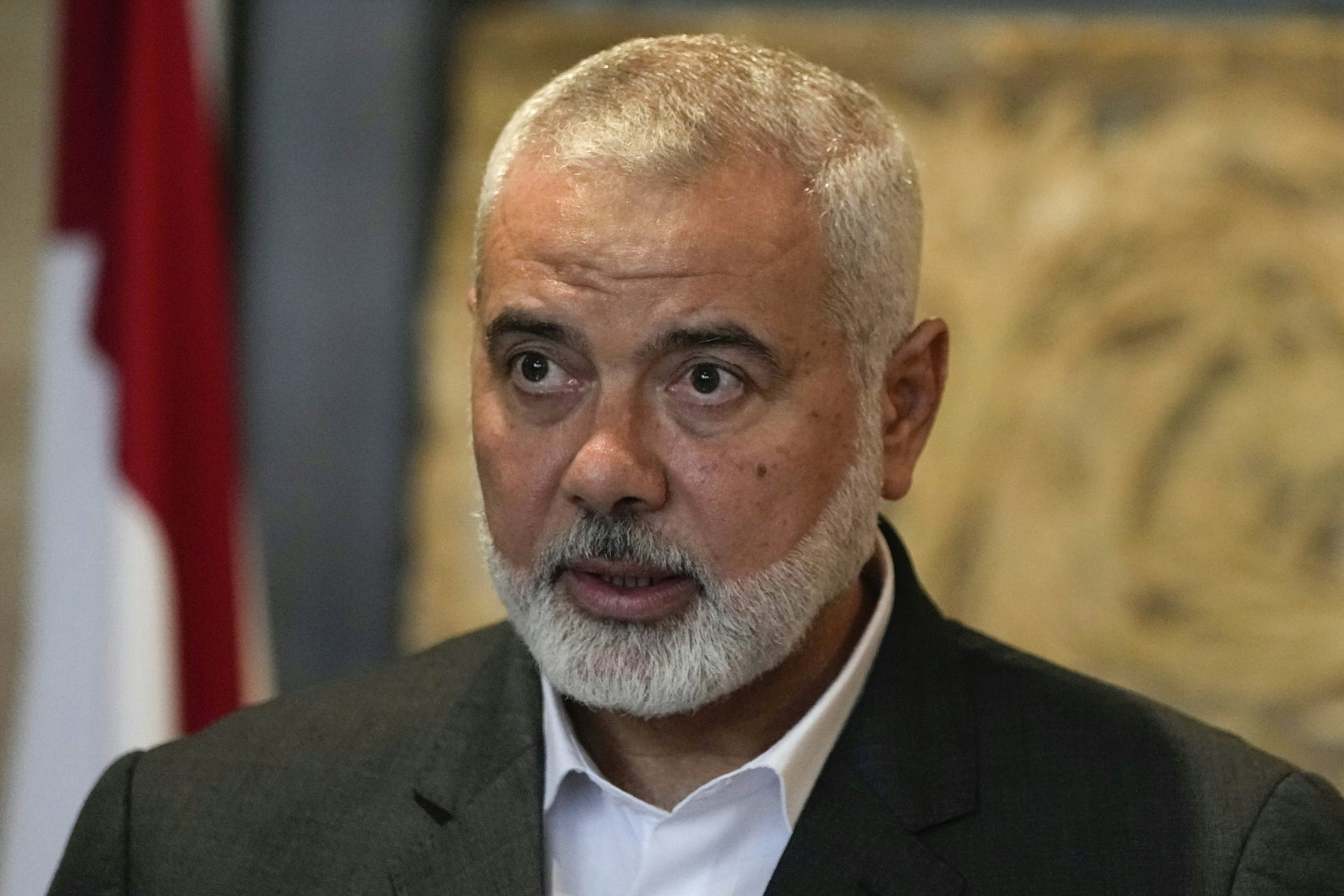
Palestinian militant group Hamas says its top political leader, Ismail Haniyeh, has been killed in his home in Tehran. It blames Israel for the attack, saying it was “a Zionist airstrike on his residence in Tehran after he participated in the inauguration of Iran’s new president”.
Palestinian group Hamas has released a statement regarding the assassination of its political leader Ismael Haniyeh in Iran.
Iran has not yet given any details on how Haniyeh was killed, but says it is under investigation.
With the war in Gaza showing no sign of abating and the whole Middle East on a knife’s edge, the killing raises questions about whether it may spark a wider regional war.
Who is Ismail Haniyeh?
Haniyeh is the most senior political leader of Hamas, based in Doha, Qatar. He was essentially the Hamas leader for the ceasefire negotiations with Israel in the Gaza War, brokered by the United States, Egypt and Qatar. These negotiations will obviously now be on hold.
While Israel has not yet claimed responsibility for his death – and this is unlikely, given it does not typically claim responsibility for covert actions – Haniyeh has long been on its list of targets.
What is surprising, though, is where and how it was done. Haniyeh was in Tehran to attend the swearing-in ceremony of Iran’s new president, Masoud Pezeshkian. Details of exactly what happened are still sketchy, but it appears Haniyeh was killed along with one of his bodyguards by an explosion in his building. We do not yet know if the explosion was from a remotely controlled bomb or a missile attack.
Iran’s Islamic Revolutionary Guard Corps (IRGC) is investigating the killing.
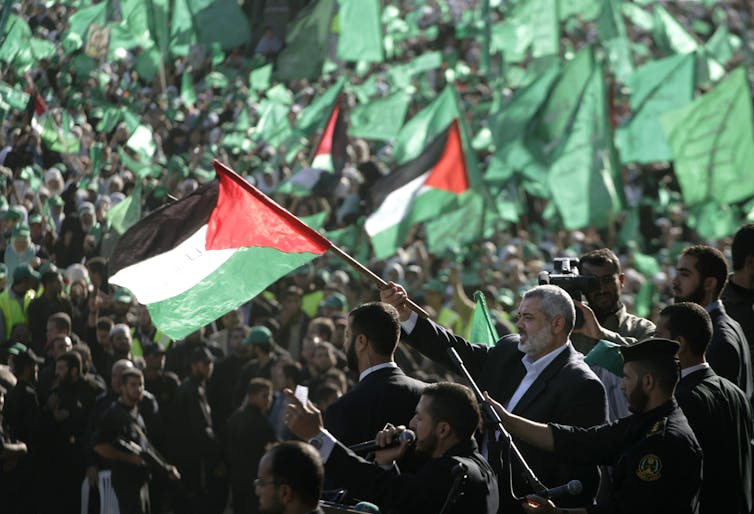
Haniyeh at a rally in 2007, when he was Palestine’s Prime Minister. EMILIO MORENATTI/AP
What does this mean for a wider regional war?
There are two important issues that will be under close scrutiny in the coming hours and days.
The first is that, assuming it was Israel that was responsible for Haniyeh’s killing, it raises the question of whether Iran will retaliate because Haniyeh was under the country’s protection when he was killed. His death is likely to cause enormous anger in Iran, and may in turn prompt retaliation against Israel on top of that from Hamas.
Tensions between Iran and Israel have been long been high. In April, Iran launched more than 300 missiles and drones at Israel in retaliation for an attack on the Iranian consulate in Damascus. The attack killed several senior IRGC leaders.
The attack on Haniyeh is indicative of a remarkable degree of intelligence and operational access that Israel seems to have in Iran at the moment. In recent years there has been a steady stream of Iranian scientists working on the nuclear program who have been killed. This includes the program’s “father”, Mohsen Fakhrizadeh, who was killed by a sophisticated remote-controlled machine gun in 2020.
However, there remain Hamas leaders on Israel’s list who, as far as can be discerned, are still alive. Gaza political leader Yahya Sinwar is apparently still directing the operations of militants there. In July, Israel carried out a strike that was believed to have killed the elusive military leader Mohammed Deif. However, Hamas has not acknowledged this, and Deif has survived several previous assassination attempts.
The second major question is whether Lebanon-based Hezbollah will launch an attack on Israel, at Iran’s behest.
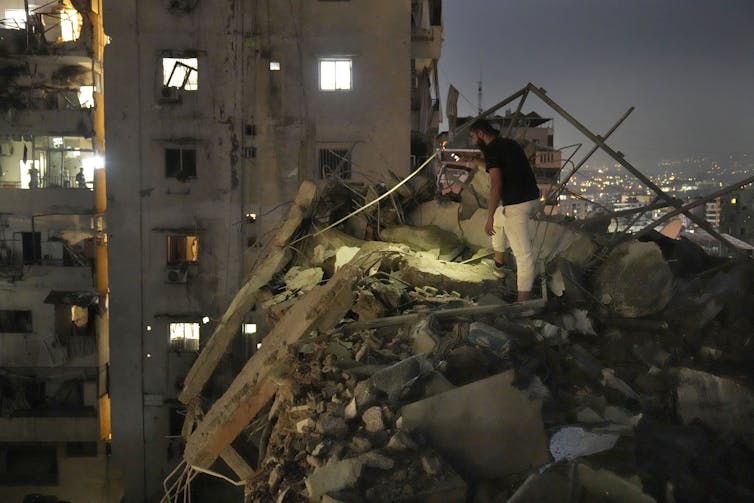
The Haniyeh killing comes within hours of an Israeli airstrike in southern Beirut, in which Israeli officials believe they have killed senior Hezbollah commander Fuad Shukr.
An Israeli airstrike on Southern Beirut, Lebanon threatens to further increase tensions in the region. Hussein Malla/AP
If Iran were to retaliate, it might be through Hezbollah from Lebanon. A major missile barrage from Hezbollah could potentially overwhelm Israel’s Iron Dome missile defence system.
Iran also has other allies on which it can call, including Shia militant groups in Syria and Iraq, as well as the Houthis in Yemen who have already launched a drone strike on Tel Aviv last week. Israel quickly retaliated.
What happens now is difficult to say until there is more information. But what is certain is that the killing of Haniyeh is likely to cause a significant escalation in the Gaza War, and possibly in the wider Middle East.
Cutting emissions from buildings and transport across the UK could yield billions of pounds in economic “co-benefits”, leaving people healthier and better off, a new study finds.
The research calculates that meeting sectoral climate targets out to 2037 could result in at least £164bn worth of benefits in six UK urban centres, from Belfast to Manchester.
The UK-wide figure is likely to be far higher, say the authors, because this analysis only covers a handful of regions and does not account for all the co-benefits, including the impact cutting emissions would have on climate change.
Some right-leaning politicians and media outlets like to claim that the UK’s net-zero policies should be abandoned due to “excessive” costs. This has led to many inaccurate claims about the “cost of net-zero”.
Yet officialanalysis for the UK government has repeatedly concluded that the lower costs of running clean technologies and cutting reliance on fossil fuels will likely save money, offsetting much of the upfront investment costs.
The new study, published in the Journal of Environmental Studies and Sciences, argues that while such running cost savings are significant, they are dwarfed by the “social benefits” of net-zero. These include the economic benefits of improved air quality, less congested roads and warmer homes.
The researchers calculate that around four-fifths of the economic gains from cutting building and transport emissions over the next decade will be social benefits. This is mostly due to fewer people driving cars, with far-reaching consequences for everyone’s health.
‘Cost’ of net-zero
Climate sceptics and some right-leaning politicians have seized on the “cost of net-zero” as an argument to weaken climate policies or abandon the target altogether.
This rhetoric cut through when the previous Conservative government rolled back core climate targets, citing the burden on “hard-pressed British families”.
The recent election saw both the Conservatives and Reform UK spreading misleading messages about the cost of net-zero. Typically, they chose to ignore the cost of business-as-usual, plus cited costs but not benefits or omitted the costs of failing to tackle climate change.
Achieving the UK target of net-zero emissions by 2050 will require significant investment in low-carbon infrastructure. Government advisors at the Climate Change Committee (CCC) place the figure at £50bn a year by 2030 – mostly delivered by the private sector.
Yet the CCC and others have also stressed that these numbers do not account for the financial benefits of net-zero. Ultimately, the lower costs of driving electric cars, heating well-insulated homes and cutting reliance on gas are expected to save people money, offsetting most of the cost of net-zero investments.
But even this is only part of the story. Moving to a low-carbon economy is also set to bring all sorts of other benefits, including cleaner air, less traffic and improved health.
These “co-benefits” of climate action have been “side-lined in many economic analyses”, according to the new study. This is partly because it is hard to place a value on things that lack data, are difficult to quantify or vary depending on location and context.
Amid pushback against net-zero, the paper argues that it is essential to quantify these co-benefits. Study co-author Ruaidhrí Higgins-Lavery, a senior carbon analyst at the Edinburgh Climate Change Institute, tells Carbon Brief:
“At the end of the day, we need to decarbonise – we have a legal commitment – and the way we do that will have massive implications across economic and social barriers…If you incorporate co-benefits into the decision-making process, we can have a more balanced deployment of measures.”
Among Higgins-Lavery’s six co-authors, two have affiliations at the consultancy PwC and two at the consultancy Your Climate Strategy. The latter describes its focus as “designing and delivering ambitious climate strategies” for local authorities, businesses and other organisations.
Case for action
The study focuses on six major urban regions – three in England, one in Scotland, one in Wales and one in Northern Ireland – which are home to 13% of the UK population. They are Belfast, Cambridgeshire and Peterborough, Glasgow, Greater Manchester and Liverpool.
It assesses policies that would allow the UK to meet “sixth carbon budget” targets for transport and buildings in these areas, out to 2037. (The CCC says nearly half of the emissions reductions required over this period will need to come from these two sectors.)
The analysis covers around 750 measures that would collectively help curb emissions by the sixth carbon budget target of 78% by 2035, compared to 1990 levels.
In total, the researchers find that this programme of action for achieving the sixth carbon budget would generate £179bn in total benefits in these regions. Accounting for investment costs, this amounts to £164bn in net benefits.
These benefits are made up of three components. First, the researchers use “best-practice UK government methods” – including the Treasury’s own “green book” – to assess the financial costs and benefits of investing in low-carbon homes and transport.
Their assessment finds that the investment required to electrify transport, build charging stations and replace gas boilers with heat pumps is significantly offset by the energy savings and lower costs of running these technologies.
Overall, the analysis concludes that these regions would need to invest £14.5bn, but would save £23.2bn – meaning a saving of £8.7bn over this period.
Second, the researchers assess the “carbon case for action” by converting the emissions savings from policy interventions into monetary values.
They use the UK’s own “carbon value” calculations, which are the costs the government says are associated with cutting a tonne of carbon dioxide (CO2), and are used to gauge the impact of climate policies. This results in savings of £13.6bn.
However, while the financial and carbon benefits are substantial, the study concludes that £142bn – or 79% of the total benefits – are “social”.
In order to arrive at this figure, the team uses a range of well-established methods to convert everything from warmer homes to reduced traffic accidents into monetary values.
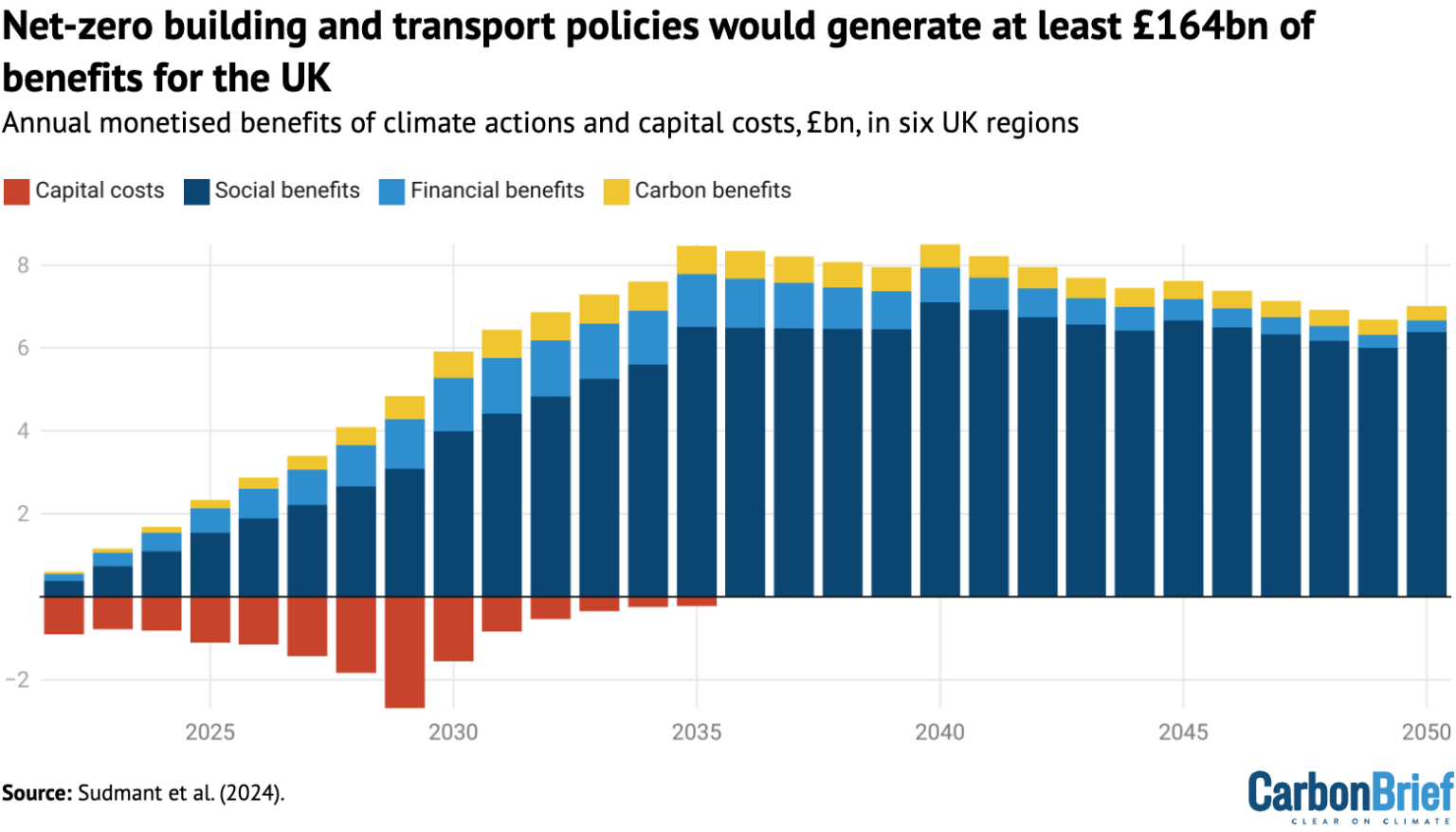
The chart below shows how the social benefits of the transport and building policies set out in the new study far exceed the investment needs over the sixth carbon budget period. It also shows that social benefits are significantly larger than financial and carbon benefits.
Annual monetised financial, carbon and social benefits of climate actions by benefit type, and capital costs, £bn, in the transport and building sectors across six UK regions. Source: Sudmant et al. (2024). Chart by Carbon Brief.
Higgins-Lavery notes that while they attempted to be as comprehensive as possible, the team’s calculation of total benefits is likely an underestimate. This is because many major benefits that could arise from cutting emissions, including avoided harm to food supplies and lower heat stress, were “beyond the scope” of their analysis.
Cutting cars
The study concludes that by far the biggest co-benefits come from reducing the number of cars on the roads. Instead, people would depend more on public transport, walking and cycling.
The resulting dip in congestion and increase in physical activity accounts for 86% of the social benefits identified. Among other things, cities would see lower healthcare costs due to fewer car accidents, less air pollution and fitter populations.
The researchers note that their estimate of per-capita health improvements resulting from transport sector policies is between four and 13 times higher than previous studies.
This is largely due to their optimistic estimates of how much people will choose to walk or cycle. The authors defend this assumption on the basis that it is still lower than the active transport rates seen in the Netherlands and Denmark, and similar to those seen in Paris.
Higgins-Lavery tells Carbon Brief that all of this highlights the importance of different policy decisions made on the path to net-zero:
“If we don’t prioritise things like active travel – if we instead prioritise switching to electric vehicles – we could miss out on a lot of social benefits.”
As it stands, the UK’s highest-profile net-zero transport policies have focused on electric cars. The government has a target to deliver a “world-class cycling and walking network in England by 2040”, but this has been hampered by years of underinvestment.
Citing this as a key example, Higgins-Lavery and his colleagues write that co-benefits are “significantly affected by value-based decisions” made during the policymaking process.
With this in mind, they call for organisations such as the CCC to be clearer about the assumptions that inform their advice to the government.
(The research group’s work will inform the CCC”s upcoming seventh carbon budget, which will include an assessment of “non-monetary benefits and costs”.)
‘Lopsided picture’
Overall, the authors argue that accounting for co-benefits can help to make the economic case for net-zero and “overcome ideological barriers” to climate action.
Prof Sam Fankhauser, a climate change economist at the University of Oxford who was not involved in the new study, welcomes the new paper. He tells Carbon Brief:
“Most net-zero cost studies acknowledge [co-benefits], but don’t actually quantify them. This produces a lopsided picture since the qualitatively assessed benefits get forgotten and the focus is on the hard cost numbers.”
He notes that focusing on transport and buildings alone means the authors “chose sectors where the indirect benefits of action are particularly pronounced”, compared to other sectors such as power and industry.
However, Fankhauser says this is “swings and roundabouts”, considering that, for example, the direct costs of decarbonising buildings are higher than for the power sector.
Dom Boyle, study co-author and director of net-zero policy and economics at the consultancy PwC, notes that the public is “not particularly aware” of the co-benefits of net-zero. He tells Carbon Brief:
“There has been a reticence from previous governments to communicate these benefits to the public, which has not been matched by the relish the right-wing press show in communicating the dis-benefits.”
This is despite the CCC estimate that nearly two-thirds of the emissions cuts required to meet the UK’s net-zero target will depend on individual choices and behaviours.
“It is far more accurate to talk about the multiple benefits of smart policies that address the great environmental crises, and these should be central to any cost-benefit analysis.”
Phoebe Plummer and Jane Touil at Heathrow Airport, July 30, 2024Photo: Just Stop Oil
TWO Just Stop Oil supporters sprayed several departure boards at Heathrow Airport with orange paint today. [30 July 2024]
The protest was part of the Oil Kills uprising, a series of actions co-ordinated by climate groups across 12 countries.
The activists are demanding that governments establish a fossil fuel treaty to end the extraction and burning of oil, gas and coal by 2030. Actions have taken place at 18 airports so far.
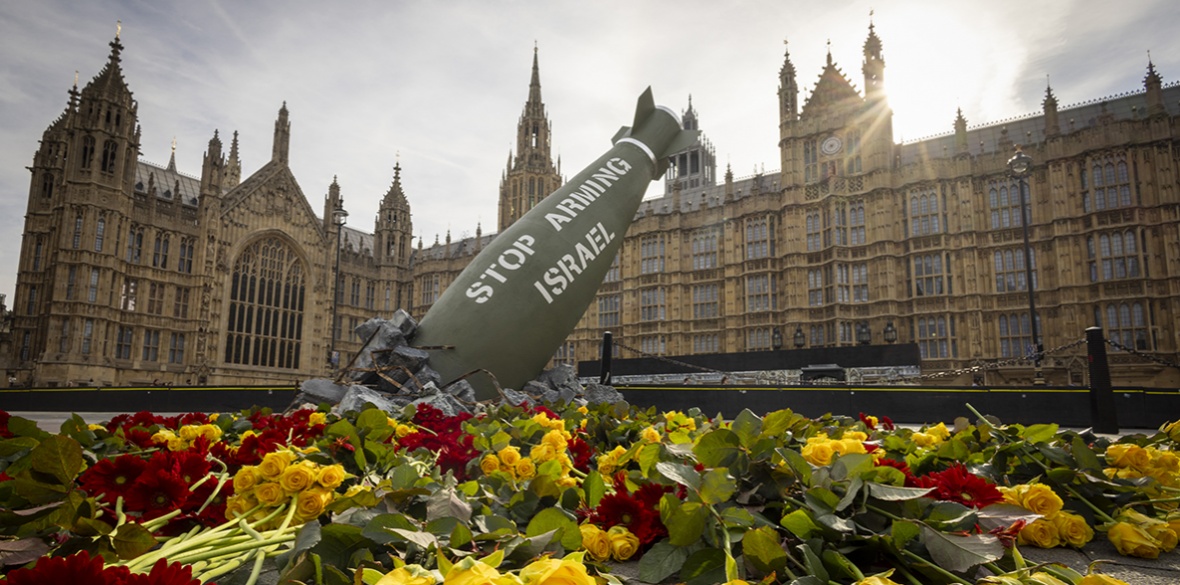
Oxfam placed a replica Mark 84 2,000-pound bomb, used by the Israeli military in Gaza to devastating effect, opposite Parliament, July 30, 2024Photo: Andy Aitchison / Oxfam
Oxfam warns that 7,000 people are estimated to be killed or injured in Gaza by Israeli military during Parliament recess
AS BRITAIN remains complicit in Israel’s war crimes by refusing an arms embargo, a replica of a 2,000-pound bomb was placed outside of Parliament today, serving as a stark reminder of the innocent lives that will be claimed while the government breaks up for summer.
The 16-foot replica was placed by Oxfam after it released a new analysis estimating that around 7,000 people in Gaza will be killed or injured over the next 33 days.
A carpet of flowers around the bomb symbolised those who are likely to be killed by the Israeli military, as well as the Israeli hostages still in captivity.
Using UN cumulative impact reports, Oxfam estimated that Israel will likely murder more than 1,800 people — a third of them children — if its military offensive continues at its current level.
The analysis comes as Britain refuses to commit to an arms embargo, despite warnings that exports are likely being used to commit war crimes.
This includes components for F-35 Israeli fighter jets, which carry out devastating strikes.
According to Action on Armed Violence, air-strikes were responsible for more than 45 per cent of recent fatalities.
Oxfam GB chief executive Halima Begum said: “By selling F-35 components to Israel, the UK government is effectively facilitating many of the Israeli air strikes and the decimation of Gaza.
“The government is fully aware of the risk that arms exported from the UK are likely being used to commit war crimes in Gaza.
“It is critical that the UK government immediately suspend both existing and new licences for all arms sales, whether direct to Israel or via third parties.”
Britain is legally obliged to halt arms exports if there is a clear risk they might be used to commit or facilitate a serious violation of international humanitarian law.
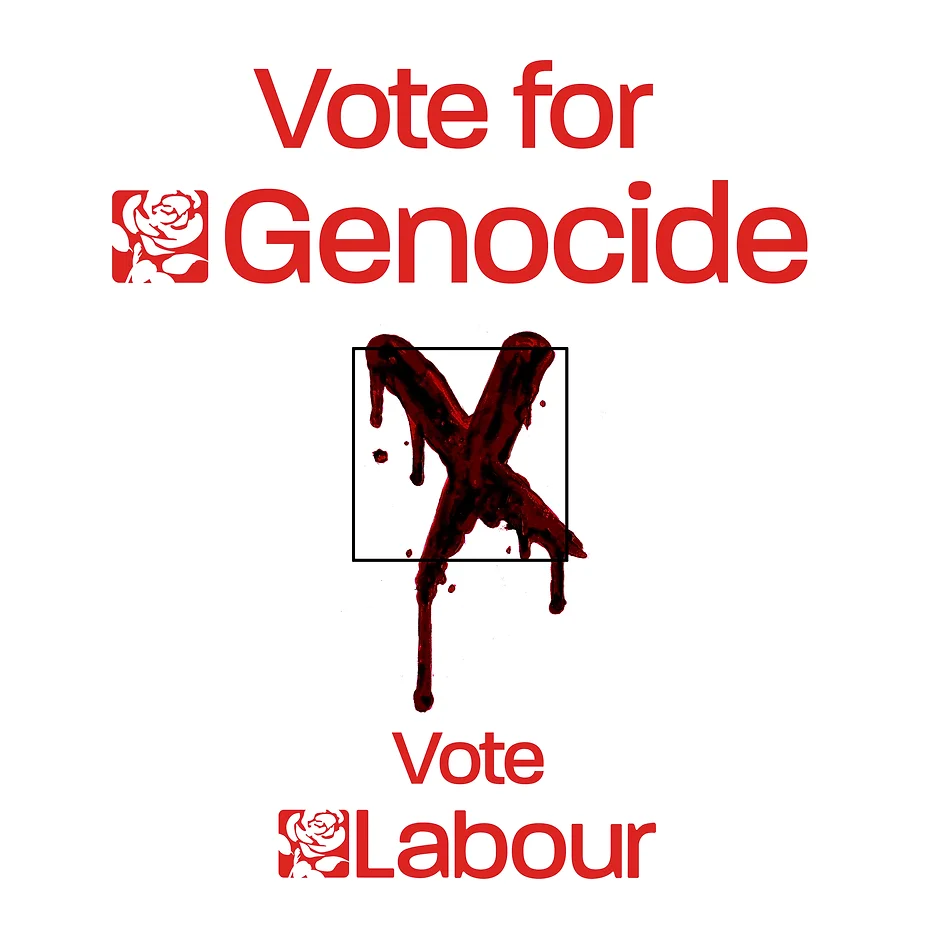
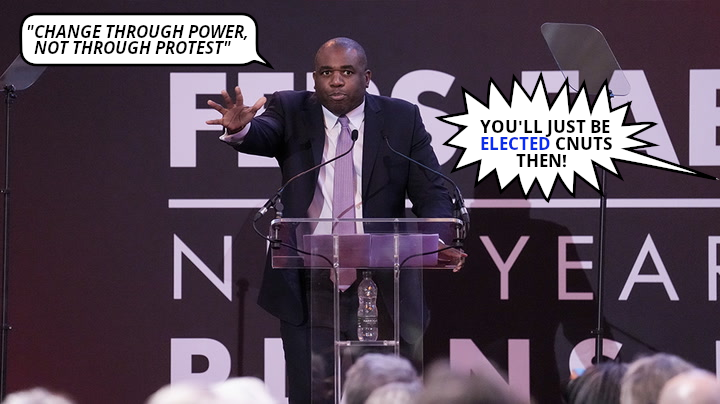
Zionist Keir Starmer is quoted “I support Zionism without qualification.” He’s asked whether that means that he supports Zionism under all circumstances, whatever Zionists do.Vote For Genocide Vote Labour.UK Labour Party Shadow Foreign Secretary repeatedly heckled at a speech to the Fabian Society over his and the Labour Party’s support for and complicity in Israel’s genocide of Gaza.
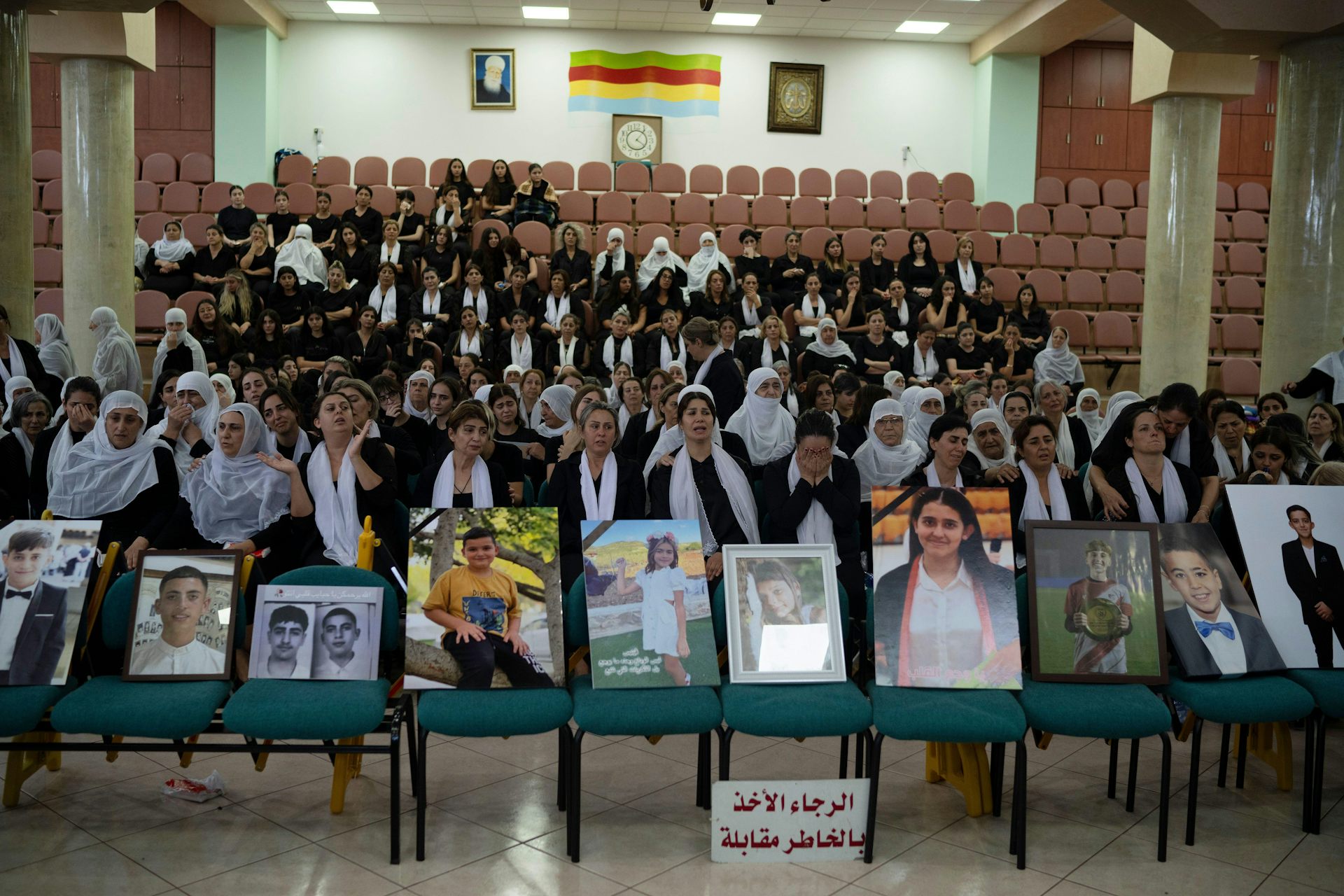
Israel’s prime minister, Benjamin Netanyahu, has threatened a harsh response to a rocket attack that on July 27 struck the Israeli-occupied Syrian Golan Heights, killing 12 children and injuring about 30 more.
Visiting the small town of Majdal Shams, where the children had been playing football when the strike occurred, Netanyahu blamed Hezbollah for the attack and said it would pay a “hefty price”. He said: “Our response will come, and it will be harsh.”
While Israel is claiming the attack targeted their citizens, all the victims of the strike were members of the Druze religious minority group located across Israel, Lebanon and Syria. Hezbollah has denied responsibility for the attack, but without an independent investigation, it remains unclear who fired the rocket.
The Golan Heights, a rocky 1,000 square kilometre region south-west of Damascus, was occupied by Israel after the 1967 Arab-Israeli war in a move that, half a century on, is often referred to as the “forgotten occupation”.
After defeating Egypt, Jordan, and Syria in the short conflict, Israel occupied the West Bank, Gaza and East Jerusalem as well as the Sinai desert and two-thirds of the Syrian Golan. Around 127,000 indigenous Syrians (95% of the population) – including Christians, Muslims and Druze – fled or were forcibly displaced. Depopulated villages were razed to the ground.
Later in 1981, Israel illegally annexed the territory, passing the Golan Heights Law. The UN security council immediately condemned this as illegal and passed resolution 497 (1981) calling on Israel to rescind its action, which would have “serious consequences for peace and security in the Middle East”.
Israel’s annexation of the Golan Heights was not recognised internationally until 2019 when the then US president Donald Trump released a “Proclamation on Recognizing the Golan Heights as Part of the State of Israel”.
Israel views its control over the Golan Heights as crucial to its security, as the region shares a border with Israel, Jordan and Lebanon. There is a buffer zone between the Israeli-occupied area of the Golan Heights and Syria, which is administered by the United Nations Disengagement Observer Force (Undof). The Golan gives whoever controls the land a vantage point overlooking Syria, which has never given up on its claim over the land.
Forgotten people
But what of the indigenous people of the Golan? Roughly 20,000 Druze people now remain, members of an Arab sect which is an offshoot of Islam that allows no intermarriage or joining from outside the religion. There are about 150,000 Druze in Israel and about 1 million across the Middle East. Druze men with Israeli citizenship are subject to military service.
Historically, Golanis have resisted the occupation via non-violent means, drawing on Druze religious beliefs, secular political ideas and the continuing assertion of their Syrian identity. The main industry in the region is agriculture and the area is known for its production of apples, cherries and olive oil.
Golanis in Majdal Shams participating in peaceful demonstration in solidarity with Palestinians. Al-Marsad
Resistance
In the years before annexation of the Golan, Israel attempted to introduce Israeli identity cards for the population. But this was rejected by Syrian communities in the Golan, who issued a wathiqa wataniya (Syrian national document), which asserted their Syrian-Arab national identity and connection to the land and opposed the annexation of the Golan.
The annexation also triggered what became known as the aldrab alkabir (great strike) that began in the February of 1982 and lasted almost six months. All segments of Golani society took part in demonstrations, discarded their Israeli ID cards and refused to pay taxes or participate in Israeli land surveys. The aim was to resist the imposition of Israeli citizenship and assert their Syrian identity.
Israel responded by placing curfews on the Druze villages, setting up blockades and restricting goods from entering, including milk and baby food. Some residents were arrested, including women who played a central role in the strike.
The Golani community responded to these restrictions by sharing resources and offering free services to one another. Palestinians also mobilised in support of Golanis by taking part in demonstrations and solidarity visits to the Golan.
This non-violent action was successful in achieving its primary aim and to this day around 80% of Golani Druze have rejected citizenship. They identify as Syrian and, unlike the Druze living in Israel, do not serve in the Israeli military.
This does mean that they are “stateless” (though not landless like many stateless people) and instead of passports they hold “laissez passer” travel documents that state their nationality is “undefined”. Without Israeli citizenship they are not allowed to vote, though they can attend Israeli educational institutions.
Meanwhile there are also an estimated 25,000 Jewish-Israelis living in the Golan Heights, across more than 30 settlements, considered illegal under international law. They are supported by the Israeli military and now together control 95% of the Golan, including much of its agriculture and industries.
Fear of escalation
There are now fears in the region that an Israeli retaliation against Hezbollah could significantly escalate the conflict. I’ve been working with local partners in the Golan Heights on a research project about Golani youth and human rights.
I spoke with a colleague in Majdal Shams this week. She told me that the people of the Golan “don’t want any other mother to scream and cry”. She said: “The Golani people are and have always been a peaceful people. Our message would be, ‘Stop the killing.’”
The 12 children were killed while playing football. Let that sink in. Then remember that it should not take their deaths to bring this forgotten occupation and these people who are forced to live under a foreign power to the world’s attention.