Trump vs. Harris: what each presidency would mean for the green transition

Spread the love

https://www.energymonitor.ai/features/trump-vs-harris-what-each-presidency-would-mean-for-the-green-transition/

Trump and Harris’s environmental policies chart starkly different climate futures for the US and the world. Credit (from left): Stephen Maturen/Getty Images and Allison Joyce/AFP via Getty Images

The presidential candidates for the world’s largest fossil fuel producer have starkly different climate policies.

All eyes are on the US elections in November this year, with the decision of the 160+ million voters in the country to play a major role in determining the world’s trajectory towards a net-zero future.

According to the United Nations Environment Programme (UNEP), even with current pledges for emissions reduction, the planet is hurtling towards a rise of up to 2.9°C above pre-industrial levels by the end of the century. This would be catastrophic, and, one report indicates that the crisis could cost $178trn in global economic loss by 2070.

Projected 2030 emissions must fall by an additional 28-42% to limit warming to 2°C, per UNEP estimates. This means that global decisions on decarbonisation in this decade will have ramifications for this century of humanity.

Trump dismisses ‘green new scam’

Under a Trump administration, net-zero goals are expected to be in severe jeopardy.

During his former presidency, Trump not only reversed more than 100 Obama-era environmental protections but also pulled the US out of the landmark 2016 Paris Agreement, through which countries are working together to keep global emissions below the threshold of a 2°C rise.

During his campaign for re-election, Trump has dismissed rising environmental regulations as a “green new scam” and made no secret of his intentions to support the fossil fuel industry yet again.

Speaking to a Fox News journalist at a town hall event in Iowa, he shared plans to expand oil drilling on “day one” and also promised to “drill, baby, drill” in his presidential nomination speech on 18 July.

Moreover, at an April dinner at Trump’s Mar-a-Lago resort, he was reported to have asked oil industry executives to donate $1bn to aid his presidential campaign, citing benefits for them on avoided taxation and regulation as he plans to reverse environmental rules.

The projections are dire. According to analysis by Carbon Brief, a climate policy and science website, Trump’s likely policies would add four billion tonnes of greenhouse gas emissions to the atmosphere, which would cause global climate damages worth more than $900bn, as per the latest US government evaluations.

Harris hailed a ‘climate champion’

Harris, on the other hand, has a long history of enforcing climate action and is widely expected to carry on the legacy of the IRA.  

She was an early co-sponsor for the Green New Deal, a comprehensive proposal for systemic decarbonisation in the US, including creating a 100% renewable energy grid and millions of green jobs.

Most notably, ahead of her brief presidential election campaign back in 2019, Harris unveiled a $10trn plan to reduce US greenhouse gas emissions to zero by 2045, including policies such as working to eliminate fossil fuel subsidies.

She also pledged to tax polluting industries and said she would establish an independent Office of Climate and Environmental Justice Accountability that would represent and support frontline communities, and monitor government compliance.

“Success in the presidential election in November would likely lead to Harris continuing to build on this existing climate legislation and defend against Republican criticism,” says Gregory.

https://www.energymonitor.ai/features/trump-vs-harris-what-each-presidency-would-mean-for-the-green-transition/

Continue ReadingTrump vs. Harris: what each presidency would mean for the green transition

Do we accept Capitalist cnuts destroying the planet?

Spread the love

DO we let them get away with it?

We can go for them. It’s documented.

ed: We can know who are responsible. Their names are on it.

ed: So they have decided to profit from destroying other peoples lives.

ed: It’s almost as if Are we willing to accept this shit any more?

Continue ReadingDo we accept Capitalist cnuts destroying the planet?

It’s good to talk

Spread the love

There is a huge global issue that needs but is not getting immediate attention. It’s the climate crisis, that fossil fuels industries knew that they were killing our planet for profit.

We need to understand what’s happening. Let’s start:

Fossil fuel companies knew from 1960s that they were destroying the planet for their profits, to make themselves rich they knowingly destroyed the World. They must have had the attitude we don’t give a fuck for anyone else, we’re going to get rich. They fucking knew. They fucking knew because they had reports telling them that they were desroying the planet for their profits.

These fossil fuel companies knew in the 60s, 80 years ago and they decided to destroy the planet so that they would get rich. That’s Capitalism.

ed: There’s more of course.

80+ years after the oil companies were advised by their own research that they were destroying the planet, they’re still doing it.

dizzy: You’re going to have to object to it soon or it will be too late, you will have missed it. We need an immediate transition from fossil fuels.

dizzy: The world needs an immediate transition from fossil fuels to renewables. The immediacy cannot be overstated …

Continue ReadingIt’s good to talk

Shell Slammed for ‘Planet-Wrecking’ Profits as Temperatures Soar to New Heights

Spread the love

Original article by OLIVIA ROSANE republished from Common Dreams under Creative Commons (CC BY-NC-ND 3.0). 

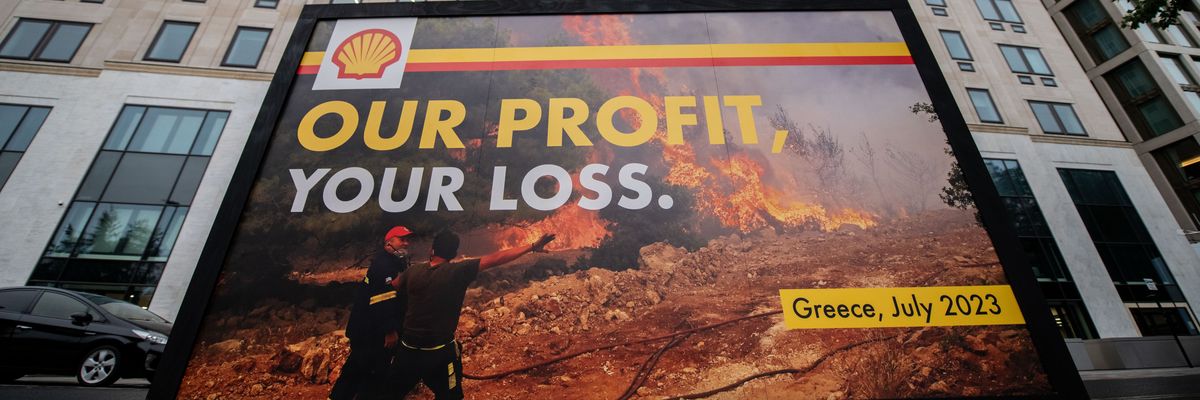
Geenpeace activists set up a billboard during a protest outside Shell headquarters amid the company’s profits announcement on July 27, 2023 in London, England. (Photo: Handout/Chris J Ratcliffe for Greenpeace via Getty Images)

“We cannot let countries and communities that have done the least to cause climate change pay the price for Shell’s greed,” one green group said.

A little more than a week after Earth endured its four hottest days on record, fossil fuel giant Shell announced higher second-quarter profits than expected at $6.3 billion.

The company also announced a new share buyback program worth $3.5 billion through September, CNBC reported.

“It is shameful that Shell, as one of the world’s largest and most profitable fossil fuel companies, continues to reap billions in profits off the back of its planet-wrecking oil and gas operations,” Chiara Liguori, the senior climate justice policy adviser at Oxfam Great Britain, said in response to the news. “At a time when the company should be taking strong action to cut emissions it is instead weakening its climate targets and continues to invest in new oil and gas projects, in favor of short-term shareholder returns.”

“That the profits of two companies alone can outweigh the GDP of six countries already being battered by the climate crisis lays bare the shameful inequity at the heart of the fossil fuel economy.”

Shell’s announcement covers the months of April through June 2024. While the company made 19% less than it did during the first three months of the year, it made $400 million more than London Stock Exchange Group predicted for the quarter, according to CNBC.

A Global Witness analysis concluded that Shell paid $23 billion to shareholders since June 2023. Every month in that same 13-month period saw temperatures averaging 1.5°C or more above preindustrial levels—the more ambitious temperature goal enshrined in the Paris agreement. Each month in that stretch was also the hottest of its kind on record.

“Wildfires raging across the Arctic Circle and temperature records breaking by the day should be a wake-up call,” Greenpeace U.K. said on social media. “But Shell continues to bank billions from digging up climate-wrecking fossil fuels.”

Shell’s announcement caps a month in which high global temperatures fueled a number of extreme weather events. July began with Hurricane Beryl forming as the earliest ever Category 4 and Category 5 Atlantic hurricane on record, before it devastated several Caribbean islands. Last week, a fast-moving wildfire forced more than 20,000 people to flee historic Jasper in the Canadian Rockies before it destroyed nearly a third of the town. The same week, Typhoon Gaemi dumped more than 1,000 millimeters of rain on Taiwan in less than 24 hours.

“As people flee wildfires in Canada, floods in Taiwan, and rebuild in the wake of Storm Beryl, Shell is doubling down on fossil fuels, U-turning on renewables, and profiting to the tune of billions from an intensifying climate crisis,” Alice Harrison, head of Fossil Fuel Campaigns at Global Witness, said in a statement.

Shell’s announcement also comes days after BP posted $2.8 billion in second-quarter profits.

Global Witness calculated that BP and Shell’s second-quarter profits combined would be enough to pay one-tenth of the $100 billion in climate-related loss and damage money that developing nations have requested by 2030.

At the same time, the two oil giants’ profits over the past year—£31.2 billion ($39.8 billion)—exceed the £27.7 ($35.3) billion combined gross domestic products of the six nations most impacted by Beryl: Barbados, the Cayman Islands, Dominica, Jamaica, St. Vincent and the Grenadines, and Grenada, according to Global Justice Now.

“That the profits of two companies alone can outweigh the GDP of six countries already being battered by the climate crisis lays bare the shameful inequity at the heart of the fossil fuel economy,” Izzie McIntosh, climate campaigner at Global Justice Now, said in a statement. “People in the Caribbean devastated by the impacts of Hurricane Beryl are left to pick up the pieces, while rich shareholders and fossil fuel CEOs get to rake in the profits, removed from the chaos they’ve played a leading role in creating.”

The climate justice organizations called for governments to take action to stop fossil fuel companies before they can further destabilize Earth’s climate.

“We need accountability and a government that isn’t afraid to stand up to them—it can start by introducing measures to make these polluting megacorporations pay up for the climate damage they’ve caused in the Global South, as well as a fossil fuel phaseout,” McIntosh continued.

Harrison agreed: “We can’t keep letting polluters off the hook. Governments should be holding fossil fuel majors to account for the crisis they created and forcing them to pay for the damage they are inflicting on millions of families around the world.”

Oxfam G.B. and Greenpeace U.K. recommended policies for the United Kingdom—where Shell and BP are headquartered—specifically.

“As global temperatures and the huge costs of tackling the climate crisis continue to rise, the U.K. government has a chance to ensure those most responsible for contributing to global greenhouse gas emissions, like Shell, are held to account by taxing them more,” Liguori said. “This could help raise the vital funds needed to ensure a fair switch to clean, renewable energy in the U.K. as well as fulfilling our international commitments to support communities worst-hit by climate change to adapt and recover.”

Greenpeace concluded: “We cannot let countries and communities that have done the least to cause climate change pay the price for Shell’s greed. The new Labour government must prove it is different to its predecessor by reining in the fossil fuel giants and imposing bold new taxes on polluters to force them to pay their climate debts at home and abroad.”

Original article by OLIVIA ROSANE republished from Common Dreams under Creative Commons (CC BY-NC-ND 3.0). 

Continue ReadingShell Slammed for ‘Planet-Wrecking’ Profits as Temperatures Soar to New Heights

‘Extraordinary’ Antarctic Heatwave Puts Temps 50°F Above Normal

Spread the love

Original article by EDWARD CARVER republished from Common Dreams under Creative Commons (CC BY-NC-ND 3.0). 

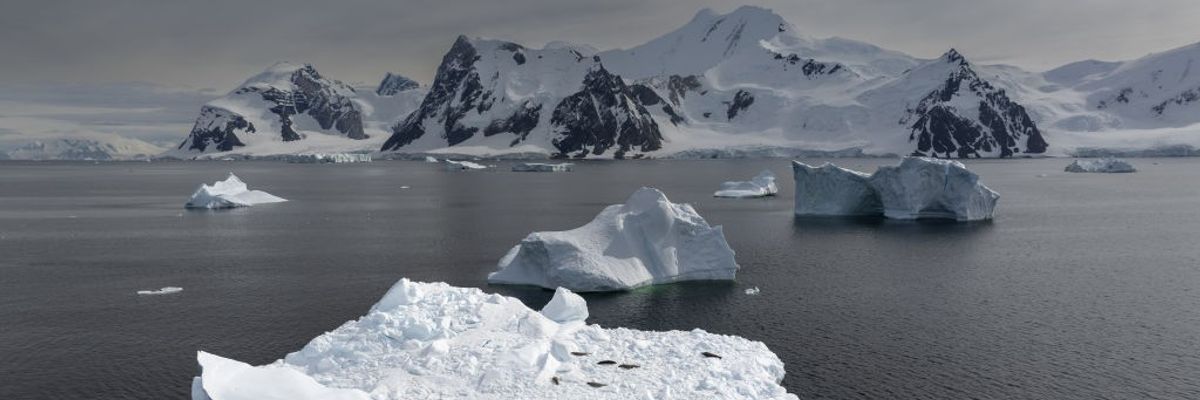
Seals rest on an ice mass in Antarctica in April 2024. (Photo: Sebnem Coskun/Anadolu via Getty Images)

The long-lasting heatwave is an “eye-opening sign that climate change is starting to really transform the planet,” a climate scientist said.

Antarctica is experiencing its second extreme heatwave in the last three years, with temperatures more than 50°F higher than normal, The Washington Post reported Wednesday.

The heatwave is notable not just for its intensity but also its timing and duration: It’s hit during Antartica’s winter and is expected to last. Temperatures of 36°F to 50°F above average are expected to persist up to 10 days, and July temperatures were already well above average before it began. The spiking temperatures were also spread across a large area, covering much of the continent, scientists said.

The world has faced exceptionally high temperatures in the last year, with 13 straight monthly heat records and counting, and the poles are warming at roughly twice the rate of the global average. Scientists say the changing conditions around Antarctica have increased the likelihood of higher winter temperatures on the continent.

“It is likely that having less sea ice and a warmer Southern Ocean around the Antarctic continent ‘loads the dice’ for warmer winter weather over Antarctica,” Edward Blanchard, an atmospheric scientist at the University of Washington, told the Post.

Scientists warned that this heatwave was a sign of what’s to come as the planet heats up thanks primarily to fossil fuel emissions.

“This historic warm spell in East Antarctica is an ominous example of the temperature spikes this polar climate could experience more of in a warming world,” the Post reported.

Jonathan Overpeck, a climate scientist at the University of Michigan, said on social media that the heatwave is an “eye-opening sign that climate change is starting to really transform the planet.”

In March 2022, Antarctica experienced the most intense heatwave in the planet’s recorded history, with temperatures up to 72°F above normal. On-site scientists at the time wore shorts and removed their shirts to bask in the sun. The heatwave was the subject of intense scientific research in the two years that followed, with a 54-person team trying to decipher the causes, which they described as “head-hurting” in their complexity.

The 2022 heatwave contributed to reduced sea ice levels. Antarctica experienced the lowest summer and winter levels of sea ice ever recorded last year.

High temperatures in Antarctica are relative—this week’s heatwave still had temperatures hovering at about minus-4°F. But sustained periods at such temperatures are highly unusual.

“The heatwave on the Antarctic Plateau is extraordinary more for its duration than for its intensity, although some values are notable,” Stefano Di Battista, an expert on Antarctic temperatures, told the Post.

The heatwave is likely the result of changes in the stratosphere roughly 20 miles above ground, scientists said. At the South Pole, the stratosphere contains a polar vortex that is normally stable with cold temperatures and low pressure during the Antarctic winter, but a sudden stratospheric warming event occurred due to atmospheric wave activity, Amy Butler, an atmospheric scientist at the National Oceanic and Atmospheric Administration, told the Post.

Original article by EDWARD CARVER republished from Common Dreams under Creative Commons (CC BY-NC-ND 3.0). 

Continue Reading‘Extraordinary’ Antarctic Heatwave Puts Temps 50°F Above Normal