No Kings protests in US
There are many “No Kings” protests and rallies throughout the United States. They are opposing Donald Trump and his administration’s policies and actions.
Civilians in El Fasher, Sudan face “slow, deliberate death under the RSF siege”
Original article by Pavan Kulkarni republished from peoples dispatch under Creative Commons Attribution-ShareAlike 4.0 (CC BY-SA) license.
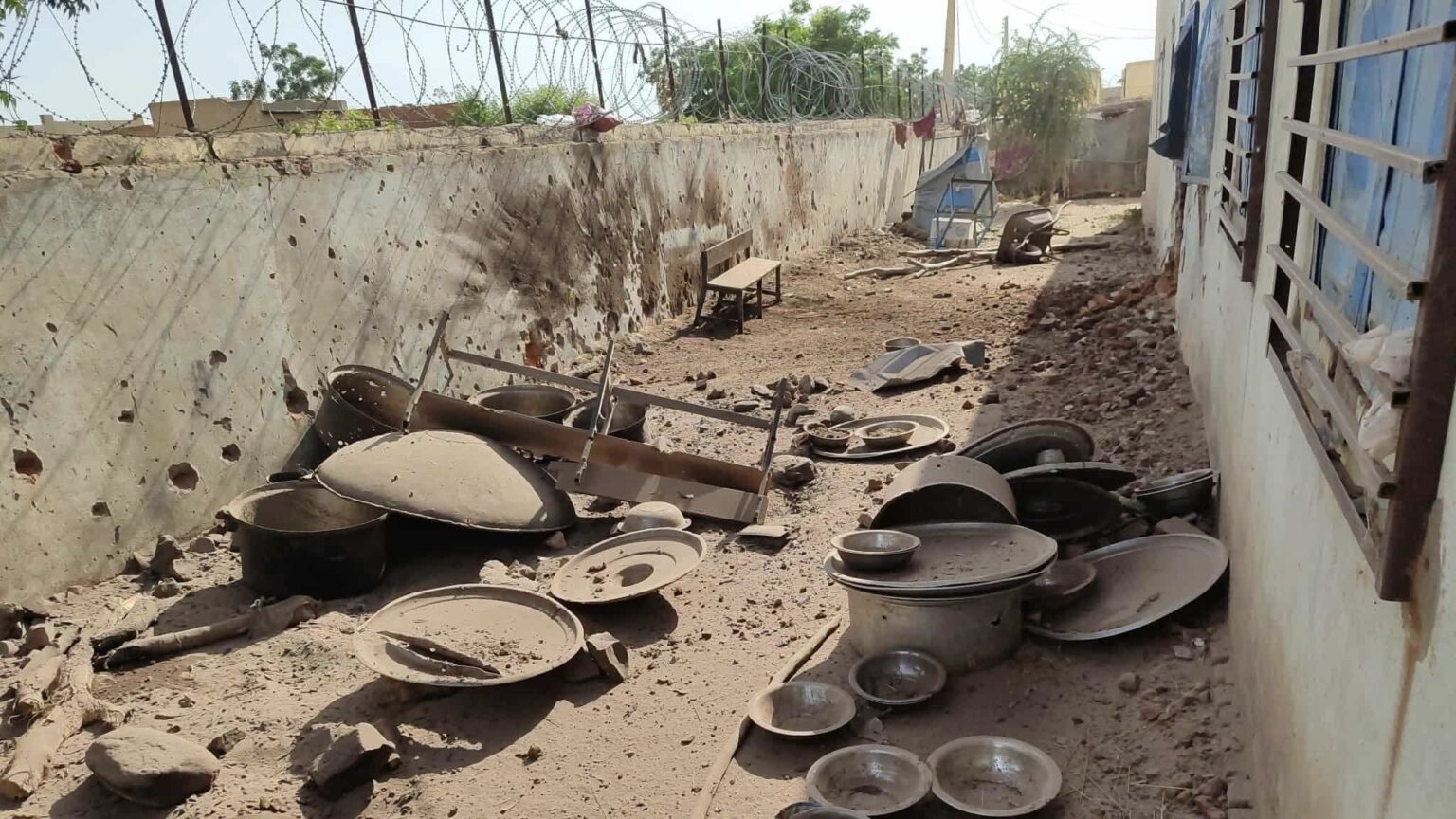
After running out of animal fodder, people are now consuming cow skin as a last resort against starvation in North Darfur state’s besieged capital, cut off from all food supply by a 57-km wall the paramilitary has built around the city.
Walled in by war-torn Sudan’s paramilitary, the Rapid Support Forces (RSF), over two hundred thousand civilians in North Darfur state’s besieged capital El Fasher “have nothing left but resistance and a collective death,” warned the city’s Resistance Committees (RC)*.
Traders report having completely run out of food supplies as famine closes in on the malnourished population, cut off from food aid since the RSF laid siege on the city in April 2024 to oust the Sudanese Armed Forces (SAF) from its last foothold in the Darfur region.
There were “only some secret points to enter and exit the city”, through which small quantities of food supplies were being smuggled through the siege, reportedly with the collaboration of some RSF troops, said Saleh Osman, President of the Darfur Bar Association.
However, severe shortages and hoarding meant that grains were sold at prices multiple times higher than before the war started in April 2023. Unable to afford, most people were surviving on small portions of porridge made from kora ambaz – a type of animal fodder left behind after extracting oil from peanuts.
Unsafe for long-term human consumption, it had nevertheless become a staple of last resort for the survival of El Fasher’s residents. Now, however, the “ambaz is gone too”, the RC said in a statement on October 14.
Total siege
The earthen wall that the RSF started building around the city this May to totalize its siege is reportedly complete, 57 km long, leaving little or no opening for food or any other essentials to be smuggled in.
“El Fasher is now effectively under siege from all directions,” Stéphane Dujarric, Spokesperson for the UN Secretary-General, said in a briefing on Wednesday, October 15. With the “earthen barriers around the city… preventing movement of both people and supplies”, the city’s markets, which have been repeatedly bombed by the RSF, “are largely empty”.
The little amount of grain left in the city is priced beyond reach. “A kilo of rice costs 450,000 Sudanese pounds” – over USD 748 – said Adam Rojal, spokesperson of the General Coordination of Darfur Displaced People and Refugees. Early this month, even the cost of a 50-kilo sack of ambaz had reached 2 million Sudanese pounds, over USD 3,300.
The last of the community kitchens, which Dujarric described as the “last line of support”, closed down on October 11. “People are now eating cow skin to survive”, the RC said, posting a video of a resident roasting the animal hide over an open fire. “This is not just hunger. It’s a slow, deliberate death under the RSF siege.”
Famine – which first broke out in August 2024 in displaced people’s camps on the outskirts of El Fasher – is fast closing in on the city where about 260,000 residents, including 130,000 children, remain trapped, awaiting death by starvation, if they are not killed by the RSF first.
The smell of death now fills the streets
Composed of the Janjaweed militias organized by the SAF to commit mass atrocities during the civil war in Darfur in the 2000s, the RSF has ethnically cleansed several areas in the other four states of Darfur that it has taken over.
In over 250 attacks on El Fasher, the RSF has already killed hundreds in shelling. “The shells pour down like rain, not distinguishing between a sleeping child or a mother pleading to the heavens to protect her children,” the RC said after the intense bombardment of the city on October 3.
“The smell of death now fills the streets, blood washes over the pavements, homes are destroyed on top of their inhabitants, markets have been reduced to ashes, and bodies are being pulled from beneath the rubble – without names, without faces, only numbers in a long record of massacres.” Hundreds of bodies remain in the rubble of residential neighborhoods struck by drones.
Chemical weapons used?
The following day, on October 4, RSF drones dropped projectiles emitting a “strange and strong” smelling gas, after inhaling which several were rushed to hospitals, vomiting, convulsing, and hallucinating. “All signs point to the use of internationally banned gases or chemical agents,” the RC said.
Later on the night of October 7, RSF shelled the hospital multiple times, killing at least 13 and wounding sixteen others, including medics. The shelling destroyed several wards in one of the last remaining hospitals in El Fasher.
“No aid planes, no humanitarian bridge, no genuine international action”
“After over 500 days of unremitting siege by the RSF and incessant fighting, El Fasher is on the precipice of an even greater catastrophe if urgent measures are not taken to loosen the armed vice upon the city and to protect civilians,” UN High Commissioner for Human Rights Volker Türk warned earlier this month.
“The international community – led by the United Nations – continues to speak in the language of proposals without action. The UN proposal to deliver humanitarian aid by air to Al-Fasher has been awaited far too long, at a time when waiting is no longer an option – because people are dying of hunger now,” the RC complained.
“No aid planes, no humanitarian bridge, no genuine international action, no ground movement to lift the siege,” it lamented. “We cry for help and no one answers… We see our city being erased and we die resisting, because we have nothing left but resistance and a collective death in the silence of the world.”
*Organized in localities across Sudan’s cities, the Resistance Committees comprise a decentralized network of youth activists. It spearheaded the mass pro-democracy protests against the military junta before its components – the SAF and the RSF – turned on each other, hurling Sudan into a civil war in April 2023. Since the war, the Committees have been at the forefront of coordinating and organizing relief, rescue and defense of stranded civilians.
Original article by Pavan Kulkarni republished from peoples dispatch under Creative Commons Attribution-ShareAlike 4.0 (CC BY-SA) license.
Ecuadorian government increases repression of Indigenous-led national strike
Original article by Peoples Dispatch republished from peoples dispatch under Creative Commons Attribution-ShareAlike 4.0 (CC BY-SA) license.
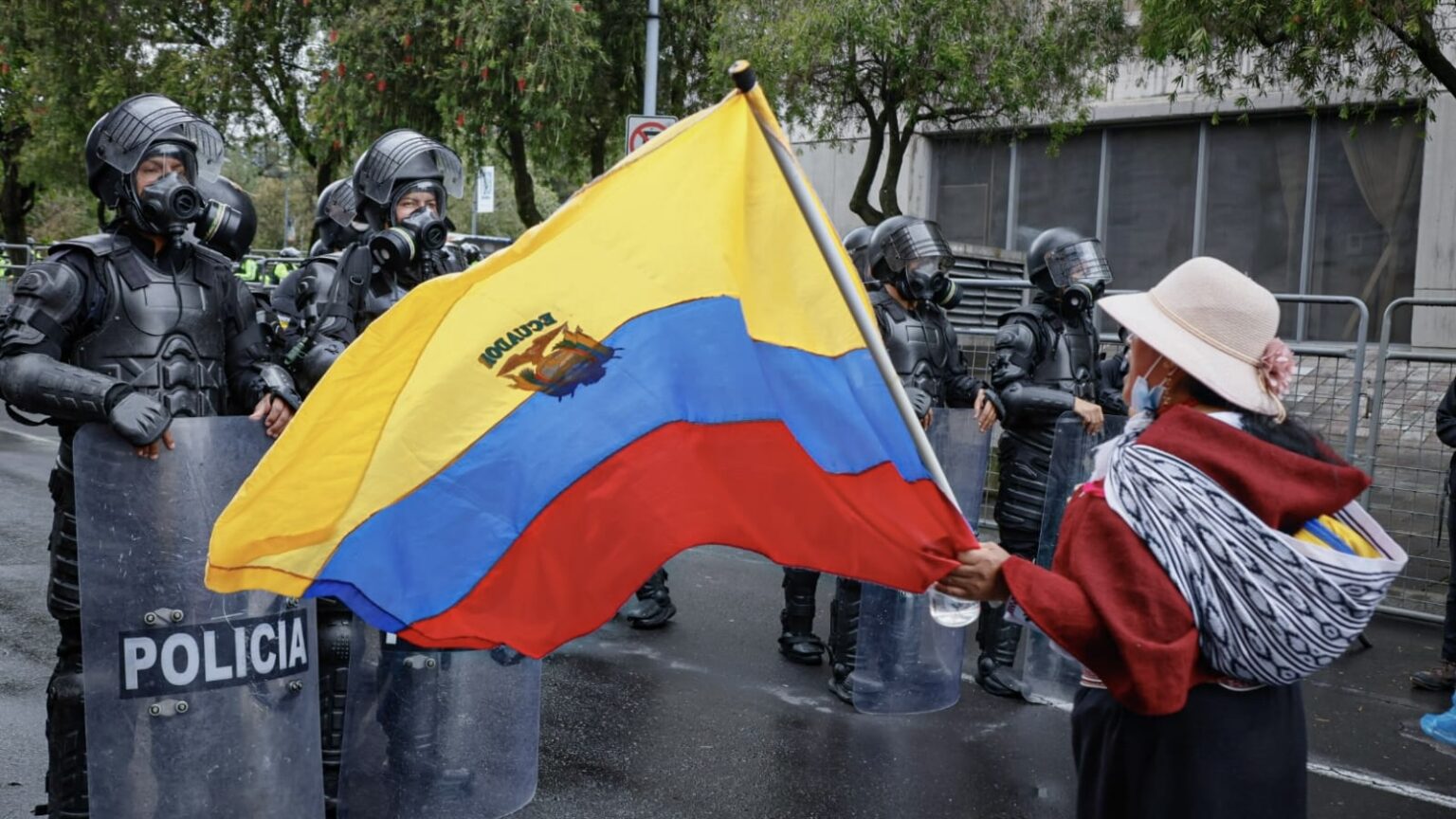
CONAIE reports that at least two people have been killed so far and more than a hundred have been injured. The government defends the actions of the security forces and promises to end the national strike in a few days.
The government of Daniel Noboa has opted to reinforce the security forces to definitively suppress the national strike called by the Confederation of Indigenous Nationalities of Ecuador (CONAIE), which has now been going on for 26 days. The protests, which have been concentrated in the province of Imbabura (although they have also taken place in dozens of other locations), demand the repeal of a presidential decree that eliminates the subsidy on diesel fuel, which is used especially by transporters, farmers, and rural workers. However, little by little, the demonstrations have taken on an anti-government tone that is evident in the mobilizations.
On October 12, various protests were organized across the country in support of the demonstrations. In the capital, Quito, the police and army cracked down hard on demonstrators, who were unable to gather in one place as they were dispersed with tear gas. Subsequently, several media outlets reported on the repression of several demonstrators who were beaten, shot with rubber bullets, and tear-gassed and pepper-sprayed.
Humanitarian convoy or vanguard of repression?
A few hours later, the Executive announced that it would send a second humanitarian convoy to Imbabura to, as it claimed, assist families affected by the protests. However, the so-called humanitarian convoy quickly became an advance group that attempted, using force and tear gas, to open the roads closed by Indigenous groups.
In this regard, Interior Minister John Reimberg announced on October 13 that the national strike “is ending now.” “We are going to use the police to completely open the roads, because this is ending now… We are going to arrive, we are going to dialogue, and if there is no dialogue and they want to become violent, the police are there to act,” said the minister.
In effect, the government ordered law enforcement to act more harshly against protesters who refused to end their protest measures. Several media outlets showed how the police and army acted forcefully against protesters, which has been denounced by various human rights organizations and opposition politicians. Videos depicted how soldiers and police officers beat detained protesters in groups, or how soldiers attempted to enter people’s homes to arrest protesters.
Alleged raids on hospitals and an increase in deaths
However, what has caused the most controversy has been the allegations made by several civil society groups, such as the Regional Foundation for Human Rights Advisory Services (Inredh), which warned of alleged raids by the military on hospitals to arrest injured protesters. Inredh has also reported that several doctors have been asked not to assist the wounded.
The clashes between police and protesters have left more than just the wounded. Several days ago, a video showed the death of Efraín Fuérez. However, following the latest incursions by the military and police, CONAIE has reported that another Indigenous man, José Guamán, died because of was hit by projectiles.
“We sadly report the death of our brother José Guamán, shot in the chest by the armed forces in the massacre ordered by the National Government in Otavalo… CONAIE expresses its deep solidarity and condolences to the family and community of Chachimbiro for this cruel murder. We join in the grief of his loved ones and demand truth and justice for José and for all the social activists who have been detained and killed in defense of the rights of our people,” CONAIE wrote in a statement.
In addition, it was reported that a woman died from suffocation caused by tear gas, bringing the death toll to three. According to the Alliance of Human Rights Organizations, there have been 310 alleged human rights violations, 144 injuries, and 103 arrests.
While road closures and law enforcement actions continue, talks to reach an agreement between various Indigenous leaders and government representatives are still going on in Otavalo, Imbabura, said the city’s mayor, Anabel Hermosa.
A long struggle against neoliberalism
According to sociologist Soledad Stoessel, the strike is part of a prolonged state crisis that began when Lenin Moreno (2017-2021), followed by Guillermo Lasso (2021-2023), and now Daniel Noboa (2023-present) initiated a transformation of the state to benefit the economic elites through a neoliberal economic program: “The current Ecuadorian state crisis has its roots in a process of institutional dismantling that began during the government of Lenín Moreno (2017-2021). Under the discourse and with the aim of ‘de-Correa-izing’ the state, Moreno reversed the social gains of the progressive cycle and restored the power of the economic elites. The 2018 referendum and the Productive Development Law paved the way for the cancellation of corporate debts, the subordination of the state to local economic elites and international financial capital, and the political proscription of Correísmo as a political force.”
The strike has revived memories of the recent waves of national and cross-sectoral mobilization against the neoliberal governments of Lenín Moreno (2019) and Guillermo Lasso (2022). Those mobilizations were waged against similar policies to the ones Noboa seeks to implement by force today, yet importantly had great adhesion from across the left movements and political parties.
For now, the government is under pressure to put an end to the protests, which have shown extraordinary resistance to the enormous deployment of police and military forces. In less than a month, there will be a referendum that will decide, among other things, whether to draft a new constitution that will almost certainly structure the neoliberal transformation of the state.
On the other hand, CONAIE has once again proven to be the only social and political organization in Ecuador capable of standing up to the neoliberal project promoted by the economic elites and sponsored by international powers such as the IMF and the United States, one of the most important allies of the Noboa government, who, incidentally, belongs to the richest family in the country.
Original article by Peoples Dispatch republished from peoples dispatch under Creative Commons Attribution-ShareAlike 4.0 (CC BY-SA) license.
Peru’s latest president José Jerí faces mounting pressure after killing of protester
Original article by Pablo Meriguet republished from peoples dispatch under Creative Commons Attribution-ShareAlike 4.0 (CC BY-SA) license.
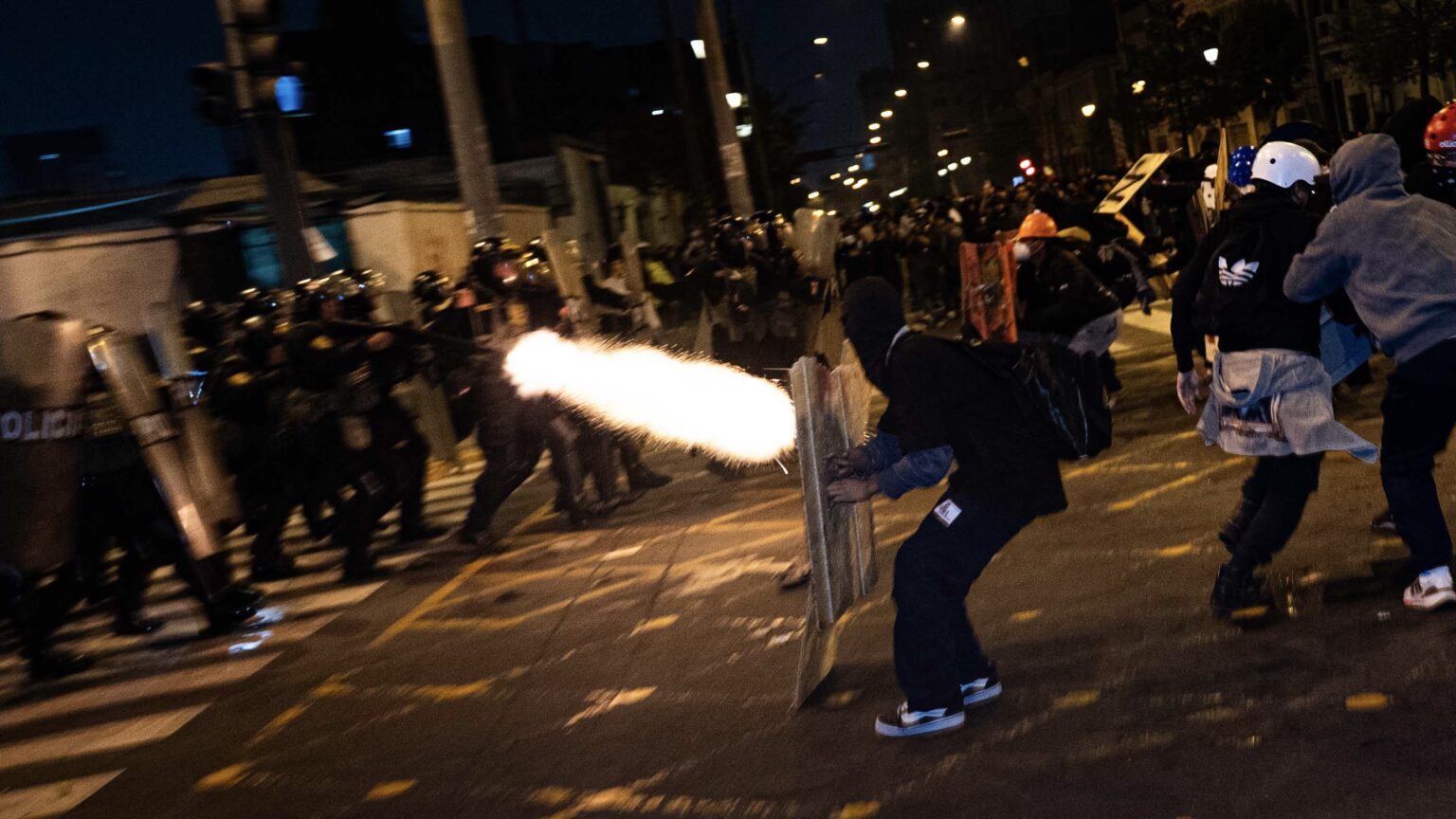
Protests have not subsided despite Boluarte’s removal from office. Now, Jerí’s newly formed government faces an attempt at censure just days after he accepted the position.
Peru’s right-wing Congress gambled that their removal of highly unpopular Dina Boluarte and the subsequent swearing in of José Jerí as President of Peru would perhaps bring down the intensity of the protests in the country and ultimately lead to their dissipation.
However, in Lima (the capital) and other cities such as Arequipa, Cusco, and Puno, protests have continued and even grown in strength. The state repression of the protests also appears to be a constant, as this too has persisted and intensified. According to human rights organizations and local media outlets, the latest protests have been met with heavy repression by Peruvian security forces resulting in the death of 32-year-old hip hop artist Mauricio Ruiz on October 15. Dozens have also been injured.
The National Human Rights Coordinator (CNDDHH) denounced the violent repression and return of killings of protestors by police: “The field monitoring team of the National Human Rights Coordinator has confirmed the death of young Mauricio Ruiz Sanz during the day of protest … We express our deep outrage and solidarity with his family, and we demand an immediate, thorough, and independent investigation to clarify the facts and determine who is responsible.”
According to the CNDDHH, the perpetrator of the murder was an undercover police officer who, upon being discovered by protesters, attempted to flee and shot Ruiz, who died a few minutes later at Loayza Hospital in downtown Lima, very close to the epicenter of the demonstrations (around the National Congress).
In the aftermath of Ruiz’s death, artists collectives, student organizations, and progressive movements have organized vigils and recommitted themselves to the struggle against the repressive and corrupt Peruvian state.
Peru faces a deep structural crisis
The continuation of protests following Boluarte’s removal from office confirms that the crisis facing the country goes beyond one leader. Before Boluarte’s removal, protesters were demonstrating not only against her government (the most unpopular in Peru’s recent history), but also against a political structure and system that does not meet the needs of the Peruvian people.
Read More: Peru after the soft coup
The serious security crisis and increasing social inequalities, in addition to the radicalization of the neoliberal program that shows no signs of reversing, are factors that have led thousands of Peruvians, especially young people, to demand a complete overhaul of Peruvian politics, which seems unable to break out of its current cycle of instability.
The recent Peruvian government is faltering
As the protests show no signs of letting up and outrage has intensified following the violent repression, the administration of controversial right-wing President Jerí is already on unstable ground. Amid the outcry over the killing of the young artist, President Jerí wrote on X: “I mourn the death of 32-year-old citizen Eduardo Ruiz Sanz. My thoughts are with his family at this time. May the investigations determine the facts and responsibilities objectively.” Notably, most of Jerí’s other posts in the last several days are focused on condemning protesters and highlighting the toll the protests have taken on law enforcement.
And yet, just a few days after accepting the position, Jerí is facing a motion of censure by the very Congress that elected him president a few days ago. According to several legislators, the alleged killing of protester Ruiz by security forces is a sufficient reason to demand Jerí’s censure, which requires 66 votes to be carried out.
Read More: José Jerí: Peru’s eighth president in a decade
If Jerí is removed from office, congressman and former army general Roberto Chiabra would assume the presidency. Chiabra was a significant military figure during the internal armed conflict of the 1990s and the war with Ecuador in Cenepa in 1995. He later served as commander-in-chief of the army during the administration of Alejandro Toledo (2001-2006) and subsequently as defense minister in that administration.
At the moment, there is maximum tension in Peru, where news of the rapid succession of presidents seems to be repeating itself due to the inability of the political forces to sustain a government. In addition, demonstrations seem to be increasing in intensity and the number of participants, so the coming weeks are not expected to be easy in the South American country.
Original article by Pablo Meriguet republished from peoples dispatch under Creative Commons Attribution-ShareAlike 4.0 (CC BY-SA) license.