President Donald Trump delivers remarks during a working breakfast with governors in the State Dining Room at the White House on February 20, 2026 in Washington, DC. (Photo by Kevin Dietsch/Getty Images)
One analyst predicted Iran would close the Strait of Hormuz and attack oil installations “in the hope of driving oil prices to record levels” should the US strike.
US President Donald Trump on Friday confirmed that he’s considering launching an unprovoked military strike against Iran.
According to the New York Times, Trump was asked by reporters on Friday if he was considering attacking Iran, and he replied, “I guess I can say I am considering that.”
The US has for weeks been sending fleets of warships, including the world’s largest aircraft carrier, to the Middle East in apparent preparation for a massive military operation against Iran.
According to a Friday report from Al Jazeera, the buildup is the largest by the US Air Force in the region since the 2003 Iraq War, and it includes deployments of E-3 Sentry Airborne Warning and Control System (AWACS) aircraft, F-35 stealth strike fighters and F-22 air superiority jets, and F-15 and F-16 fighter jets.
Trump has not given any justification for launching such an attack, nor has he asked the US Congress to approve it, even though the Constitution gives the legislative branch the power to declare war.
Reps. Ro Khanna (D-Calif.) and Thomas Massie (R-Ky.) have been pushing for a vote in the US House of Representatives on a war powers resolution that would require Congress to debate and approve any act of war with Iran.
It is also not clear what goals the president would hope to achieve with the attack. A Thursday CNN report indicated that Trump is now weighing several options ranging from “more targeted strikes to sustained operations that could potentially last for weeks,” including “plans to take out Tehran’s leaders.”
Trita Parsi, co-founder and executive vice president of the Quincy Institute for Responsible Statecraft, wrote in a Friday analysis of Trump’s reported attack plans that there is little chance that the president will be able to achieve a quick victory over Iran simply because the offers he has made to its government are nonstarters.
“Since the US strategy… is to escalate until Tehran caves, and since capitulation is a non-option for Iran, the Iranians are incentivized to strike back right away at the US,” explained Parsi. “The only exit Tehran sees is to fight back, inflict as much pain as possible on the US, and hope that this causes Trump to back off or accept a more equitable deal.”
Parsi acknowledged that there is no way Iran can defeat the US militarily, but could “get close to destroying Trump’s presidency before it loses the war” through a number of maneuvers intended to spike the price of oil, including “closing the Strait of Hormuz” and attacking “oil installations in the region in the hope of driving oil prices to record levels and by that inflation in the US.”
“This is an extremely risky option for Iran,” Parsi conceded, “but one that Tehran sees as less risky than the capitulation ‘deal’ Trump is seeking to force on Iran.”
Orcas discuss Donald Trump and the killer apes’ concept of democracy. Front Orca warns that Trump is crashing his country’s economy and that everything he does he does for the fantastically wealthy.Donald Fuhrump says that Amerikkka doesn’t bother with crimes or charges anymore, not being 100% Amerikkkan and opposing his real estate intentions is enough.Elon Musk urges you to be a Fascist like him, says that you can ignore facts and reality then.
People participate in a “Hands Off” protest against the Trump administration in Detroit, Michigan, on April 5, 2025. (Photo by Jim West/UCG/Universal Images Group via Getty Images)
“We urge federal officials to focus on real threats to student well-being like gun violence, funding cuts, and staffing shortages rather than singling out districts that work to support all children,” said one advocacy leader.
Denouncing the Trump administration’s probes to determine whether three public school districts “have included sexual orientation and gender ideology” content in courses as “part of a broader attack on our rights as Michiganders,” the head of one progressive group pledged Friday to keep fighting to ensure that “all of our kids can thrive at school free from bullying, harassment, and other unfair treatment.”
The US Department of Justiceannounced Wednesday that its Civil Rights Division is investigating Detroit Public Schools Community District, Godfrey-Lee Public Schools, and the Lansing School District. The DOJ is examining content for pre-K through 12th grade courses, opt-out policies, and whether the districts “limit access to single-sex intimate spaces, such as bathrooms and locker rooms, based on biological sex.”
In a Friday statement, Justin Mendoza, executive director of Progress Michigan, emphasized that his state’s “civil rights laws explicitly protect LGBTQ+ students, and our state must enforce them to the fullest extent.”
Mendoza condemned not only the Trump administration’s efforts to harm “the most vulnerable and historically marginalized among us,” but also Republicans at the state and federal level who “are trying to limit honest conversations about our nation’s history, while fighting each and every attempt to create safe, inclusive schools for our children.”
“Attorney General Pam Bondi is setting a terrible example for younger generations—considering the way she behaved at a recent congressional hearing where she name-called members of Congress—and now she’s going a step further by throwing nondiscrimination policies into the dumpster,” he said. “People of all genders, races, and backgrounds benefit from strong nondiscrimination policies.”
“From Marquette to Monroe, teachers, students, and their families are committed to having an educational system that reflects the diversity of the world they live in,” Mendoza continued. “Classrooms deserve to have age-appropriate conversations about health, identity, and respect, and if parents choose to opt their children out of participating in these conversations, they are already allowed to by Michigan law.”
“The Trump Department of Justice is truly looking to invent problems instead of actually fighting crime and violence towards youth,” he concluded, “and Michiganders won’t take this intrusion into our education system.”
“The Trump Department of Justice is truly looking to invent problems instead of actually fighting crime and violence towards youth, and Michiganders won’t take this intrusion into our education system.”
Other state and nationwide groups have also spoken out against the administration’s probes and targeting of LGBTQ+ youth this week. Brian Dittmeier, director of LGBTQI+ equality at the National Women’s Law Center, blasted the investigations as a “blatant attempt to discourage inclusive education.”
Jay Kaplan, a staff attorney for the ACLU of Michigan, toldChalkbeat that “this is an attempt to harass and bully districts into discriminating against trans kids and into erasing the existence of LGBTQ people.”
Equality Michigan executive director Erin Knott said that “LGBTQ+ youth are among the most vulnerable young people in our state. They face higher rates of bullying, harassment, and mental health challenges. Inclusive education policies are not ‘ideology,’ they are evidence-based efforts to ensure that every student feels safe, respected, and seen in their own school community.”
“All kids deserve an education that reflects the diversity of the world they live in,” she stressed. “Age-appropriate discussions about health, identity, and respect help create safer classrooms for all students. We urge federal officials to focus on real threats to student well-being like gun violence, funding cuts, and staffing shortages rather than singling out districts that work to support all children.”
State Superintendent Glenn Maleyko was similarly critical of the federal administration in his response, saying Thursday that “the Michigan Department of Education strongly supports all students and supports the school districts that have been targeted by the US Department of Justice.”
Maleyko continued:
If we want to put Students First and make sure children can learn, we need all students to be healthy and safe and feel included. The much-needed updates to health education guidelines—which the Department of Justice falsely said are state requirements—help local districts make decisions on how they can support student health.
As required by state law, MCL 380.1507, local school boards set health curriculum with input from local sex education advisory boards. Local control remains in place. Parents retain the right to decide whether their children should participate in sex education instruction.
The Michigan Department of Education strongly supports and will work closely with the three districts’ efforts to select a curriculum that best supports the needs of their students, consistent with state standards and guidelines. We remain committed to protecting the rights of all students and to upholding Michigan’s constitutional guarantee of access to a free public education for every child.
“The breadth and scope of the federal requests, premised on a mischaracterization of the Michigan Health Education Standards Guidelines adopted by the State Board of Education, place a significant administrative burden on local districts and risk diverting time and resources away from the core mission of educating students,” Maleyko added.
As for the targeted districts, a spokesperson for the Detroit schools declined to comment, while Guillermo Lopez, the Lansing school board president, told the Detroit Free Press that parents in his district are informed that “they can opt out of certain classes.”
Arnetta Thompson, superintendent of Godfrey-Lee schools, told Chalkbeat that her district will provide information requested by the DOJ and “is not facing any charges or findings of wrongdoing. We remain committed to complying with all applicable federal, state, and local laws and have consistently operated in accordance with those laws.”
Donald Trump decrees forbidden terms denying sexual diversityElon Musk urges you to be a Fascist like him, says that you can ignore facts and reality then.Orcas discuss Donald Trump and the killer apes’ concept of democracy. Front Orca warns that Trump is crashing his country’s economy and that everything he does he does for the fantastically wealthy.
US President Donald Trump speaks during a press conference at the White House, Washington, D.C., US on February 20, 2026. (Photo by Kyle Mazza/Anadolu via Getty Images)
“Donald Trump illegally stole your money,” said Sen. Elizabeth Warren. “He should give it back to you.”
President Donald Trump defiantly vowed to continue slapping tariffs on imported goods on Friday after the US Supreme Courtoverturned the so-called “Liberation Day” tariffs he implemented last year.
In a press conference held hours after the Supreme Court ruled against the president’s tariff regime, Trump said that he had other tools at his disposal that allowed him to hit foreign products with taxes.
Among other things, Trump said he was going to issue a 10% global tariff using his authority under Section 122 of the Trade Act of 1974 that allows the president to levy tariffs to address “large and serious” balance-of-payments deficits with foreign nations.
However, as a Friday analysis by the libertarian Cato Institute explains, any tariffs enacted through Section 122 expire after 150 days without authorization from Congress, which in theory could put vulnerable congressional Republicans on the spot to vote for or against the president’s signature policy this summer right before the 2026 midterm elections.
The president’s decision to plow ahead with his politically unpopular tariffs drew immediate criticism from Sen. Amy Klobuchar (D-Minn.), who said during an interview with MS NOW that Trump was creating even more economic uncertainty.
“What he’s done is just doubled down and tried to make it worse,” Klobuchar explained, “which, of course, is going to create more cost and chaos for the American people.”
Klobuchar: "The scariest part from his press conference, in addition to the continued assault on the rule of law and the Constitution, is that he plans to continue doing this … [but] I think you're starting to see bipartisan opposition to the president's tariffs, which would… pic.twitter.com/pqniYagtyW
Nobel Prize-winning economist Paul Krugman also predicted more chaos in the months to come from Trump’s trade policies, particularly when it comes to businesses that will now lobby to get back the money illegally seized from them by the president’s unconstitutional tariff regime.
Writing on his Substack, Krugman argued that Trump finding alternative means to levy tariffs would not “obviate the need to refund the tariffs already collected,” because “if you seized money without constitutional authority, finding other revenue sources going forward doesn’t make the original seizure legal.”
David Frum, staff writer at The Atlantic, predicted that the coming lawsuits aimed at getting refunds for the illegal tariffs would be a massive mess.
“The post-tariff litigation is going to be nightmarish,” he wrote on social media. “Wrongfully taxed plaintiffs will now sue for return of their illegally taken money. Can their customers then sue for a portion of the higher prices caused by the wrongful taxes? More Trump chaos.”
However, US Treasury Secretary Scott Bessent downplayed the possibility of American businesses and consumers getting refunded for the tariffs.
While speaking at the Economic Club of Dallas on Friday, Bessent was asked if he expected a “food fight” for the $175 billion in tariff revenues that government has illegally collected since April.
“I’ve got a feeling the American people won’t see it,” Bessent said of the tariff money.
Bessent: I got a feeling the American people won't see the $175 billion in tariff revenue we collected pic.twitter.com/rj0Bmm0Exg
However, some Democrats indicated that they were not simply going to let the administration getting away with money they unlawfully confiscated from US businesses and consumers.
“Donald Trump illegally stole your money,” wrote Sen. Elizabeth Warren (D-Mass.). “He should give it back to you. Instead Trump is scheming up new ways to force Americans to pay even more.”
Democrats on the US House Ways and Means Committee wrote that “Trump does not want to refund the money he illegally stole from you,” vowing the party “won’t stop fighting to get your money back.”
Democratic Illinois Gov. JB Pritzker wrote Trump a letter after the Supreme Court ruling demanding that the president provide every family in his state a $1,700 refund for the tariffs, which he said “wreaked havoc on farmers, enraged our allies, and sent grocery prices through the roof.”
Donald Fuhrump says that Amerikkka doesn’t bother with crimes or charges anymore, not being 100% Amerikkkan and opposing his real estate intentions is enough.Elon Musk urges you to be a Fascist like him, says that you can ignore facts and reality then.Orcas discuss rotting brain. Front Orca says “Wish someone would lock him up”.
Keeping global warming to less than 2C above pre-industrial temperatures is “crucial” for limiting damage to the Antarctic Peninsula’s unique ecosystems, according to a new study.
The paper, published in Frontiers in Environmental Science, reviews the latest literature on the impacts of warming on Antarctica’s most biodiverse region.
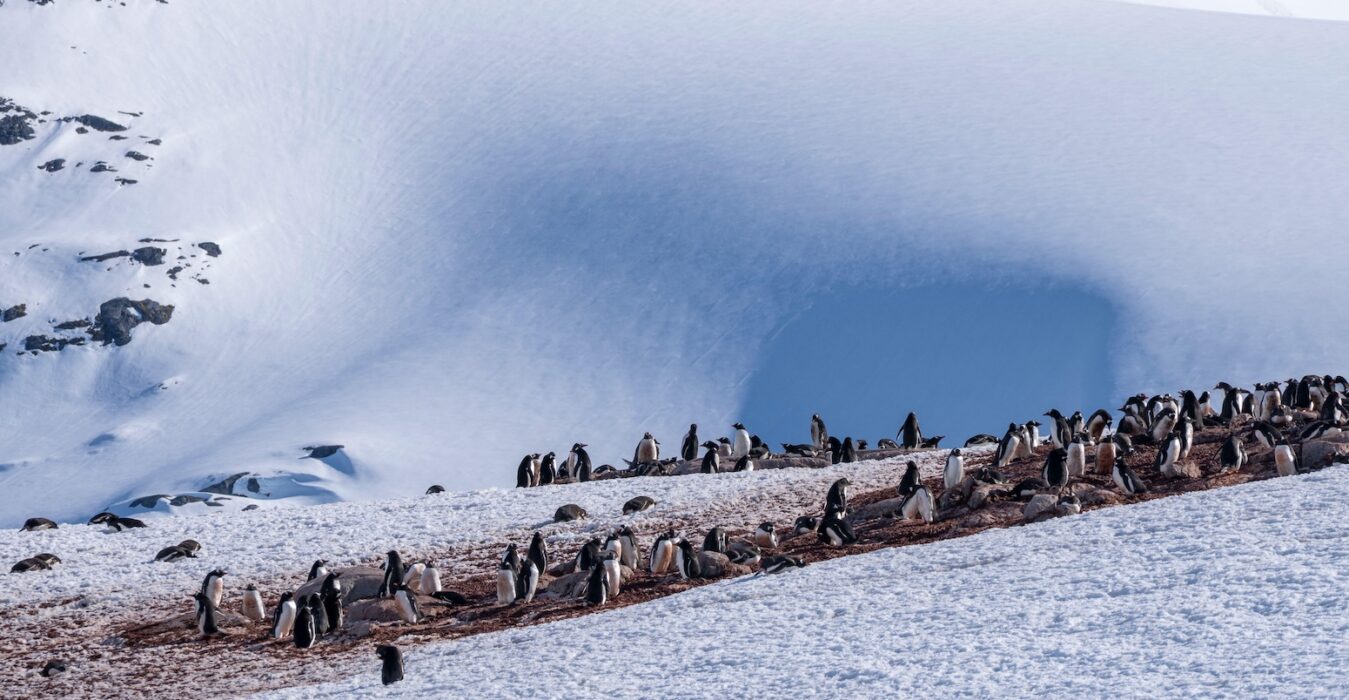
The Antarctic Peninsula is home to many types of penguins, whales and seals, as well as the continent’s only two flowering plant species.
The study also analyses previously published data and model output to create a fuller picture of the potential futures facing the peninsula under different levels of global warming.
Under a low-emissions scenario that keeps global temperature rise to less than 2C, the Antarctic Peninsula will still face 2.28C of warming by the end of the century, the study says, while higher-emissions futures could push the region’s warming above 5C.
Limiting warming to 2C would avoid the more dramatic impacts associated with higher emissions, such as ice-shelf collapse, increasingly frequent extreme weather events and extinction of some of the peninsula’s native species, according to the paper.
However, warming of 4C would result in “dramatic and irreversible” damages, it adds.
Importantly, the paper shows that the outlook for the peninsula is “dependent on the choices we make now and in the near future”, a researcher not involved in the study tells Carbon Brief.
‘Alternative futures’
The Antarctic Peninsula juts northwards from West Antarctica, stretching towards the tip of South America.
The region is made up of the main peninsula, which spans around 232,000 square kilometres (km2) and a series of islands and archipelagos that cover another 80,000km2. The mainland peninsula is nearly entirely covered in ice, while its islands – many of which are further north – are around 92% covered.
Taken as a whole, the Antarctic Peninsula is the most biodiverse region of the icy continent, and a “beautiful, pristine environment”, says Prof Bethan Davies, a glaciologist at Newcastle University, who led the new work.
It hosts many species of penguins and whales, as well as apex predators, such as orcas and leopard seals. Each spring, more than 100m birds nest there to rear their young. It is also home to hundreds of species of moss and lichens, along with the only two flowering plant species on the continent.
In 2019, a group of researchers published a study on the fate of the Antarctic Peninsula at 1.5C of global warming above pre-industrial temperatures. However, it has since “become apparent” that keeping warming below this limit is no longer in reach, Davies says.
SSP1-2.6 represents the “new goal” of keeping warming less than 2C, Davies says.
SSP3-7.0 and SSP5-8.5 represent “alternative futures” – with the former being one that “felt quite relevant” to the current state of the world and the latter being “useful to consider as a high end”, she adds.
For each potential future, the researchers conducted a literature review to assess the changes to different parts of the peninsula’s physical and biological systems. To fill gaps in the published literature, the team also reanalysed existing datasets and results from the Coupled Model Intercomparison Project 6 (CMIP6) group of models developed for the IPCC’s latest assessment cycle.
“By choosing three different emissions scenarios, they’ve shown just how much variability there is in the possible future of the Antarctica Peninsula that is dependent on the choices we make now and in the near future.”
Buzzard, who was not involved in the new study, adds that it “highlights the consequences of this [change] for the glaciers, sea ice and unique wildlife habitats in this region”.
Physical changes
The Antarctic Peninsula is already experiencing climate change, with one record showing sustained warming over nearly a century. The peninsula is also warming more rapidly than the global average.
For the new study, Davies and her team assess the changes in temperature for the decade 2090-99 across 19 CMIP6 models.
They find that under the low-emissions scenario, the Antarctic Peninsula is projected to warm by 2.28C compared to pre-industrial temperatures, or about 0.55C above its current level of warming. Under the high- and very-high-emissions scenarios, the peninsula will reach temperatures of 5.22C and 6.10C above pre-industrial levels, respectively.
They also analyse output from 12 sea ice models.
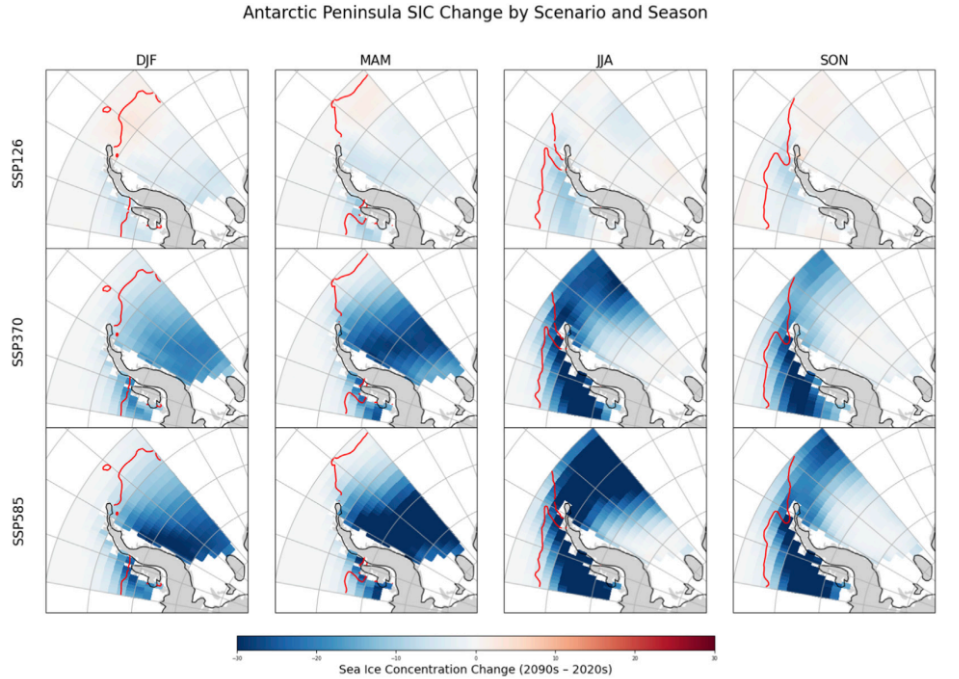
In each scenario, they find that the western side of the Antarctic Peninsula experiences the largest declines in sea ice concentration during the winter months of June, July and August. For the southern hemisphere’s summertime, it is the eastern side of the peninsula that shows the largest decreases.
The maps below show the projected change in sea-ice concentration around the Antarctic Peninsula for each season (left to right) under low (top), high (middle) and very high (bottom) emissions. Decreasing concentrations are shown in blue and increasing concentrations are shown in red.
Changes in the concentration of sea ice around the Antarctic Peninsula in the 2090s, as compared to the 2020s. Decreases (increases) in sea ice concentration are shown in blue (red). The rows show the different future pathways (top to bottom): SSP1-2.6, SSP3-7.0 and SSP5-8.5. The columns show three-month chunks of the year (left to right): December, January and February; March, April and May; June, July and August; and September, October and November. Source: Davies et al. (2026)
The paper gives a “great overview of the current literature on the Antarctic Peninsula, examining multiple aspects of the region holistically”, Dr Tri Datta, a climate scientist at the Delft University of Technology, tells Carbon Brief.
However, Datta – who was not involved in the study – notes that the coarse resolution of CMIP6 models means that the “most vulnerable regions are too poorly represented to capture important feedbacks”, such as the forming of meltwater ponds on the tops of glaciers, which warm much more than the icy surface around them.
Ecosystem impacts
The study also looks at potential futures for the Antarctic Peninsula’s marine and terrestrial ecosystems – albeit, much more briefly than it examines the physical changes.
This is because modelling ecosystem change is very difficult, Davies explains:
“If you’re going to model an ecosystem, you have to model the climate and the ocean and the ice and how that changes. Exactly how that ecosystem responds to those changes is still beyond most of our Earth system models.”
Still, by looking at trends in the Antarctic over the past several decades, as well as changes that have occurred in other high-latitude regions, the researchers piece together some of the potential impacts of warming.
They conclude that under SSP1, the changes experienced by ecosystems are “uncertain”, but will “likely” be similar to present day – with some terrestrial species, such as its flowering plants, even benefitting from increased habitat area and water availability.
Flowering plants on rock crevices in Antarctica. Credit: Colin Harris / era-images / Alamy Stock Photo
However, under higher-emissions scenarios, species will become “increasingly likely” to experience warmer temperatures than they are suited for.
Other changes that may occur in the very-high-emissions scenario are closely linked to the projected reductions in sea ice. These include the increased spread of invasive alien species, reduced ranges for krill and the displacement of animals unable to tolerate the warmer temperatures by those more able to adapt.
Prof Scott Doney, an oceanographer and biogeochemist at the University of Virginia, notes that some of these changes are already happening. Doney, who was not involved in the study, is part of an ongoing research programme on the Antarctic Peninsula known as the Palmer Long-Term Ecological Research project.
He tells Carbon Brief that Adélie penguins, which are a polar species, have “seen a massive drop in their breeding population” at their research sites. Meanwhile, gentoo penguins – whose range extends into the subpolar regions – “have been quite opportunistic” in colonising those breeding sites.
‘Changes here first’
Antarctica is home to 50 year-round research stations and dozens of summer-only ones, operated by more than 30 countries.
Around a dozen year-round stations are found on the peninsula and its islands, including the oldest permanent settlement in Antarctica – Argentina’s Base Orcadas, established in 1903 by the Scottish national Antarctic expedition.
The continent is home to commercially important fisheries – particularly krill, which also play a critical role in the Antarctic marine food chain.
Increasingly, the Antarctic Peninsula is also a tourist destination.
Climate change poses a threat to all of these activities, Davies says.
For example, much of the research infrastructure on the Antarctic Peninsula was “built to assume dry, snowy conditions”, she says. Rain can “cause quite a lot of difficulty”, she adds.
(In an article published last year, Carbon Brief looked at the causes of rain in sub-zero temperatures in West Antarctica.)
Decreased sea ice cover can impact krill populations. It can also lead to increased ship traffic, as more of the continent becomes accessible throughout more of the year.
Furthermore, Davies says, the changes occurring on the peninsula will reverberate across Antarctica and around the world. She tells Carbon Brief:
“We’ll see changes here first and those changes will continue to be felt in West Antarctica and continent-wide…What happens in Antarctica doesn’t stay in Antarctica.”
Davies, B. J. et al. (2026). The Antarctic Peninsula under present day climate and future low, medium-high and very high emissions scenarios, Frontiers in Environmental Science, doi:10.3389/fenvs.2025.1730203.
Donald Trump urges you to be a Climate Science denier like him. He says that he makes millions and millions for destroying the planet, Burn, Baby, Burn and Flood, Baby, Flood.Nigel Farage urges you to ignore facts and reality and be a climate science denier like him and his Deputy Richard Tice. He says that Reform UK has received £Millions and £Millions from the fossil fuel industry to promote climate denial and destroy the planet.Elon Musk urges you to be a Fascist like him, says that you can ignore facts and reality then.
dizzy: The article discusses of global rises of 4C while humans won’t exist to witness that. It’s also unrealistic to expect limiting warming to 2C, that is so unlikely.
A technician works at an Amazon Web Services artificial intelligence data center in New Carlisle, Indiana on October 2, 2025. (Photo by Noah Berger/Getty Images via Amazon Web Services)
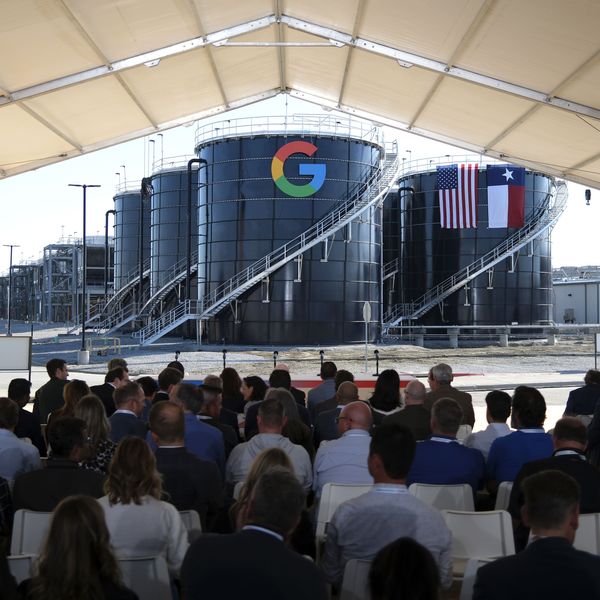
The New Brunswick, New Jersey City Council voted Wednesday to cancel plans to construct an artificial intelligence data center and instead build a new public park where the 27,000-square foot facility would have gone.
Artificial intelligence data centers—which house the servers and other infrastructure needed to train and power AI models—have major environmental and climate impacts, as they consume massive amounts of electricity and water, as well as rare earth metals and other resources.
According toNew Brunswick Patch, hundreds of people packed into Wednesday evening’s city hall meeting to voice concerns that the proposed data center would send their electricity and water bills skyrocketing, and that the facility would harm the environment.
“Many people did not want this in their neighborhood,” New Brunswick NAACP president Bruce Morgan said during the council meeting. “We don’t want these kinds of centers that’s going to take resources from the community.”
The site of the nixed data center, 100 Jersey Avenue, is already slated for development including 600 new apartments—10% of which will be affordable housing units—and warehouses for startups and other small businesses. Now, thanks to Wednesday’s vote, a park is on the agenda too.
“This is great news, no data center,” New Brunswick resident Anne Norris told Patch.
“My kids went through the public school system; we didn’t pay for lunch because we have so many families under the poverty line,” Norris said before taking aim at what she said was the dearth of affordable housing approved for the site.
“Given the economic status of the people who live in New Brunswick, I don’t think 10% is really sufficient,” she contended.
A data center in New Brunswick was canceled tonight when hundreds of residents showed up. When fight big tech and private equity we win. pic.twitter.com/doZ63Pdwue
Following the council meeting, jubilant residents celebrated the data center’s cancellation, chanting slogans including, “The people united will never be defeated!”
“We say a big ‘fuck you’ to Big Tech!” local organizer Ben Dziobek shouted to the crowd. “We say a big ‘fuck you’ to private equity! And it’s time to build communities, not data centers.”
dizzy: There’s a UK expression about getting your knickers in a twist – it’s about getting confused and making a mess of things … ed: might have a different meaning about getting frustrated by events which doesn’t really apply.
Orcas discuss Donald Trump and the killer apes’ concept of democracy. Front Orca warns that Trump is crashing his country’s economy and that everything he does he does for the fantastically wealthy.Elon Musk urges you to be a Fascist like him, says that you can ignore facts and reality then.