According to the Times report, Farage has found himself linked with five whole houses since 2020 – the year we officially left the EU:
His main residence – a £1.42m five-bedroom gaff in Surrey (Grade II listed).
His £885,000 Clacton residency – officially owned by his partner Laure Ferrari.
A Kent residency he lived in with his ex-wife (currently occupied by his daughter Isabelle Farage and an unidentified man).
Two beachfront properties owned through his production company, Thorn in the Side Ltd.
As reported:
The Times understands the Tandridge property is the Surrey woodland lodge, and the Folkestone and Hythe property is one of the Kent beachfront homes owned via his company. This means the Kent village property, the second beachfront home and the Essex address are not on the register.
Farage does not have to declare the Essex home because legally it is owned entirely by his partner. However, the case with the other two properties is less clear.
The Times spoke to a number of experts who mostly agreed that Farage should have erred on the side of caution and declared the properties. Does this mean he’ll get in trouble? It’s hard to say given what politicians usually get away with, but it’s certainly another case in which he’s given the impression that he’s on the blag.
…
dizzy: I’d say that Farage is far from open and honest about his affairs …
Nigel Farage reminds you that he’s the man that brought you Brexit and asks what could possibly go wrong.Nigel Farage urges you to ignore facts and reality and be a climate science denier like him and his Deputy Richard Tice. He says that Reform UK has received £Millions and £Millions from the fossil fuel industry to promote climate denial and destroy the planet.Elon Musk urges you to be a Fascist like him, says that you can ignore facts and reality then.
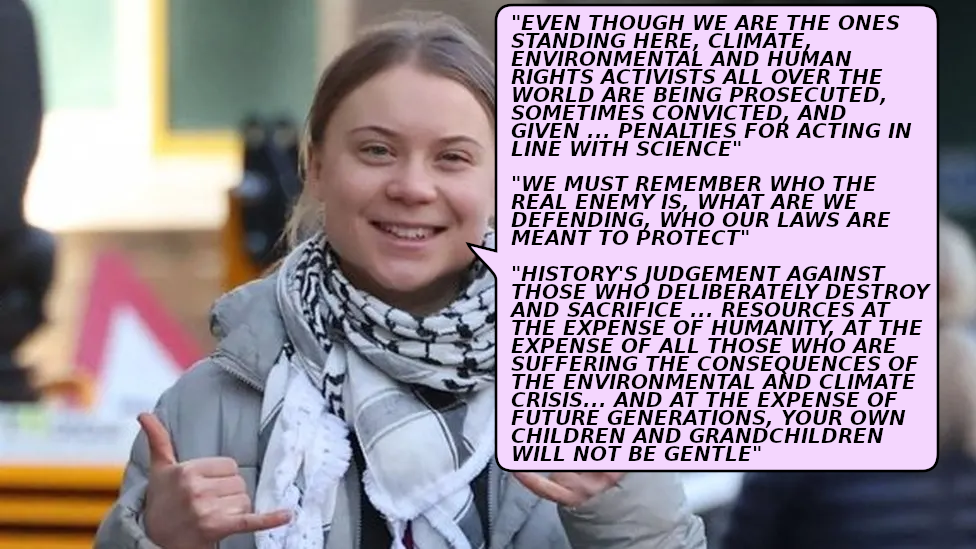
Outside court in London, Greta Thunberg says “We must remember who the real enemy is … who our laws are meant to protect.” Quoted from https://www.bbc.com/news/uk-england-london-68166341
We need change urgently. To try to bring that change, let’s think of where we want to be in 5 years time or sooner if possible. You’re all welcome to get on board, think and publish where you want to be in 5 years or less.
Some yet to be thought through ideas
Climate action is needed urgently. The rich are properly recognised as responsible for being the most damaging to climate. Tax the rich out of existence. Convert super-yachts to housing, do away with private jets.
CounterSpin interview with Seth Stern on criminalizing dissent
Janine Jackson interviewed Freedom of the Press Foundation’s Seth Stern about the criminalization of dissent for the July 26, 2026, episode of CounterSpin. This is a lightly edited transcript.
Janine Jackson: The official government press release is headlined “Leader of Antifa Cell Members in North Texas Sentenced to 100 Years in Prison for Terrorist Attack on ICE Facility.” That statement from the Office of Public Affairs states that
eight North Texas Antifa cell operatives were sentenced for their roles in rioting, using weapons and explosives, providing material support to terrorists, obstruction and the attempted murder of an Alvarado police officer at the Prairieland Detention Center on July 4, 2025.
If you aren’t questioning the Trump White House version of reality, in which vandals snuck into the Reflecting Pool with “very sharp knives and razors” because they hate freedom, you probably don’t care about the Prairieland case. But for all of the rest of us, this is a nightmare: historically, legally, morally.
What is happening here, and how do people who think a country with aspirations for democracy, with the understanding that that critically involves protest and multiple voices, how do we respond to what has just happened in the case of activists who participated in a protest at Prairieland ICE Detention Center—or didn’t—and are now facing lives in prison?
There was never a time to not pay attention, to not understand that an official enemy campaign was always going to come for anyone designated undesirable—laws, practices, long-held understandings be damned. But if ever there were a time of comfortable ignorance, it’s over.
Here to help us see what’s happening in this case, and how to move forward, is Seth Stern. He’s the chief of advocacy at the Freedom of the Press Foundation, and he joins us now by phone. Welcome to CounterSpin, Seth Stern.
JJ: We can start with material facts about Prairieland. A group of people gathered outside an ICE detention center to protest the policy, the actions, of masked agents sweeping Black and brown people off the street and into camps, and then out of the country without due process, and to show audible support for those inside. And a man did shoot and wound a police officer.
But we know this case is not ultimately about a noise protest, or even the wounding of a police officer, because if it were that, the sentences would look different, and we wouldn’t be hearing things like “assault on democracy,” or “conspiracy to conceal documents.” Can you just set us up a little with why you are so concerned about this? Because injustice is old, but this feels new.
SS: It really does. What we’re seeing here is an attempt to criticize, not only an ideology, but a very loosely defined ideology. The administration’s theory is that because they attended the same protest as the shooter, and because they read some of the same literature as the shooter, might have shared political views with the shooter, you can from those facts alone infer a conspiracy, infer an organized—as the administration would call it—“terrorist attack.”
In reality, none of these people—including the shooter, in all likelihood—came to the protest with any intention of a police officer being shot. Certainly the other six defendants who were at the protest besides the shooter had no idea that was going to occur. There was no evidence, and no allegation, even, that anyone had planned a shooting.
When these people left their homes to go to a protest, they figured they would sleep in their own beds that night. At most, they might have contemplated the possibility of getting picked up for trespassing, or a noise disturbance, or the typical minor misdemeanors that people risk when they engage in protest activity. But there was no reason anyone would contemplate that they might be held criminally liable, their lives ruined, sentenced to decades behind bars, for merely attending a protest where someone else shot somebody.
The prosecutors and judge made very clear that their purpose was to send a message to people sharing a similar ideology. The prosecutor said, “This is not any normal ideology. This is an ideology that endorses political violence,” presumably referring to anarchism, or whatever shared belief system these people supposedly had.
But almost everyone, in some circumstance or another, would endorse some form of political violence. Like, I’m the grandson of Holocaust survivors. I don’t really take issue with violence against Nazis. Does that mean that if I go to an anti-Nazi protest, and I have some anti-Nazi books, let’s say, on my bookshelf, that if someone else at the protest, who I’ve never met, commits an act of violence against a Nazi, that I’m then implicated in a conspiracy, and go to prison for decades based on what that person does? It sounds absurd, but it’s no more absurd than what happened at Prairieland.
And I shouldn’t neglect to mention, one of the individuals who was convicted, and sentenced to 30 years, wasn’t even at the protest. He’s somebody who allegedly transported a box of pamphlets, because his wife was at the protest, and he believed, according to prosecutors, that the box of pamphlets might implicate his wife, might be used against her, so he was “concealing evidence.”
Evidence of what? This wasn’t a how-to manual. Yeah, obviously, if his wife had been the one to shoot the police officer—which she wasn’t; nobody alleges she was—and he had a how-to manual on where to get a gun, how to get into this protest and how to shoot a cop, that would be a whole different case. We wouldn’t be having this conversation.
But that’s not what was in the box. They were ‘zines. They said nothing about this protest, about the Prairieland Detention Facility, about shooting this police officer. They were written years ago; they’re political theory that’s available at bookstores nationwide.
So when they say that he concealed evidence by moving these ‘zines, evidence of what? It’s evidence of an ideology. It’s evidence of somebody’s reading habits. There should be no universe where that can be considered concealment of evidence, because it’s not probative of anything. You can’t introduce somebody’s reading habits, or their library, their bookshelf, as evidence of a specific crime in court.
And if you can, we’ve got a big problem, because people have hundreds of books; books can be interpreted any which way. I have plenty of books on my bookshelf that I’m sure someone could characterize as endorsing some form of violence or another. That doesn’t mean I agree with the books. I might; it depends. But that’s really a preposterous way to conduct criminal proceedings, is to thought-police people to this degree.
JJ: And yet here we are, because I think, for a lot of folks, it sounds just as weird as you’ve just laid out. First of all, it sounds like these rulings are not saying you can’t protest. They’re saying, “You can protest, just not against the administration. Just not with these particular ideas.” We all saw January 6, but if you don’t like it, then it’s going to be labeled terrorism.
And I guess I’d want to pull you out on that, because we can say what folks did was not illegal, but if you keep changing the law to make things illegal, then the ground is shifting under our feet. And so what’s happening there, from a legal perspective? Are we just creating new categories, and now you can say yesterday you weren’t violating the law, but today you are, and so now you go under the jail?
SS: Theoretically you can’t do that, because we’ve got a Constitution that trumps any executive order, or even statute. In this case, we’re talking about NSPM-7, and the Trump administration’s new counter-terrorism memorandum, which don’t change the law. They’re simply an expression of prosecutorial priorities, and they instruct prosecutors to go after Antifa, to go after far-left groups, people who they view as “anti-American,” whatever that means.
People with “extreme gender ideologies”; no idea what that one means. I’ve never heard of any sort of trans “supremacy” movement that wants to lock up cisgender people. So presumably they’re just talking about people who believe that trans people should have rights, and now they’re on the same plane as terrorists, as ISIS, according to this administration.
It’s all pretty absurd, but at the end of the day, we have a Constitution that prohibits people from being locked up for what they think, write or read, as long as they are not inciting imminent violence.
So hopefully the appellate courts will reverse these convictions, but the law is only as good as the people who enforce it. So if the judiciary isn’t up to the task, if the judiciary is compromised, and lawmakers are unwilling to step in—and, of course, at the end of the day, the president has pardon and clemency power, but we know who’s president, so that’s not something you can rely on—then the law is not as good as the paper it’s written on. So that’s the situation we’re in. And if the appellate courts don’t correct this egregious error that the trial courts have committed, we’ll be in a really scary place.
Remember, in Georgia, they tried something very similar with the Stop Cop City protesters, very similar situation. They indicted 61 people who were part of the Stop Cop City movement, because a few of those individuals had allegedly committed criminal acts: arson, vandalizing police cars, whatnot. There was no indication that all 61 of those people had anything to do with those isolated criminal acts, but they were looped into a RICO conspiracy, solely because they, again, read the same ‘zines, shared the same ideologies, were part of the same movement, had the same alleged belief system.
That case fell apart, as it should have, after putting all 60 of those people through a whole lot of headache and expense, but still, it ultimately fell apart. And it was easy to dismiss at the time as though, this is just some local prosecutor who had an awful idea and made a fool of himself. Now it’s the federal government doing it.
And you mentioned January 6. These sentences here were far more severe than any sentences against anyone involved in January 6. That issue was raised with the judge, who said, “Well, this case was charged differently. This case was charged as terrorism.” So essentially incentivizing prosecutors, going forward, if they want to get headline-grabbing sentences and make themselves look effective, to overcharge, to continue charging defendants as terrorism, despite the lack of any evidence of them being terrorists, being affiliated with a terrorist group or having any terrorist intentions. So we should expect to see more of this. Hopefully other trial judges will do their jobs, and not leave it up to the appellate courts to clean up the mess.
JJ: I think language is playing a role here. I have said repeatedly that when news media took “war on terror” out of quotes, we lost something. A brain wrinkle got smoothed, so now we can just say “terrorism.” “I don’t know actually what it is, but I know it’s the very worst thing in the world and I don’t need to ask any further questions.” And we’re now at that situation with Antifa; what the actual heck? Now Antifa is being legally identified as an organized thing? What is meaningful? What changes when you allow folks to say, “Hey, we made up a name for everybody who thinks a certain way, and now you’re a group and you’re conspiring terrorism?”
SS: I certainly agree, even before the Trump administration, the idea of terrorism had kind of lost its meaning, but I think one assumption that everybody, for the most part, had was that to be labeled a terrorist, you have to have engaged in or collaborated with others who engaged in violence, and that you had to have some foreknowledge of that violence. And to get to a point where people are being convicted of terrorism for merely going to a protest, where the prosecution didn’t even bother trying to prove that they had any intention to commit an act of violence, that they had any foreknowledge that one of them might pick up a gun and shoot at a cop, is really quite alarming, because terrorism becomes less of an action and more of an ideology that people like Donald Trump can define as synonymous with dissent. Anyone whose beliefs are inconvenient to him, or that interferes with his agenda, becomes a terrorist. “Anti-Trump” and “anti-American” become interchangeable in the views of the administration and judges, apparently, who are sympathetic to them.
So it’s quite scary to have this kind of power to abuse the word “terrorism,” particularly in a domestic context. In the international context, we’ve long had the problem of prosecutors and judges and politicians characterizing things as national security threats with no basis to do so, going back to the Pentagon Papers, where the truth about the Vietnam War was almost censored because the administration at the time called it a national security threat for the American people to know the truth. Fortunately, the judiciary back then rejected that.
Reporters are threatened with prosecution under, for example, the Espionage Act, because their reporting supposedly poses a national security threat when, in fact, it merely is inconvenient to those in power. We see that, for example, in the case involving Hannah Natanson, the Washington Post reporter whose home newsroom was raided. That’s long been an issue in the context of national security in matters of war, international issues.
But now you’ve got any local dissident, any activist, any person in any of the 50 states who opposes the president’s agenda, being treated the same way, being treated as a national security threat. The line between First Amendment–protected dissent and terrorism is just entirely blurred by this administration. And, again, the judges have the power to set it straight. Whether they will or not is to be determined.
JJ: I will say I spoke with Mara Verheyden-Hilliard in 2017 about arrests after the first Trump inauguration, where police were saying, if you were somewhere near an act of property damage—I think it was a car being set on fire—if you were near it, it’s the same as you committing it. If you were wearing black, well, forget about it; you are obviously part of it.
At the time, a Washington Post poll was saying that one out of every three DC residents were saying they’d taken part in a protest against Trump since his first inauguration. And that was half of the district’s white residents, half of people making more than $100,000 a year and a fifth of respondents over the age of 65.
So what I want to say, and what I think you’re wanting to say also, is you’re not safe from this. The idea that you’re not going to do anything wrong is not going to protect you in this case. We’re seeing the straight-up criminalizing of resistance per se. And so I guess I’d ask you, what can we do? What can we be doing in the face of this?
SS: That is important to remember, because it is easy for people to look at this and say: “Well, I am not an anarchist. I don’t read these zines. I don’t go to these kinds of protests. My protests are permitted. I’m not at risk.”
But I’ve mentioned Des Sanchez, who was convicted solely for transporting a box of zines. Think about the Don Lemon and Georgia Fort cases. They were arrested, of course, while covering a protest at a church in Minneapolis, against immigration enforcement there.
I don’t think anyone would characterize Don Lemon as a far-left anarchist type. You can like him or not like him, but that’s not something that he is. But the Trump administration sought a warrant that would have allowed it to gather from YouTube a list of subscribers to both Lemon and Fort’s YouTube channels.
Now, that warrant was fortunately rejected by a judge, but think about it. What possible evidence could a subscriber to Lemon and Fort’s YouTube channels have that would assist the Trump administration in prosecuting its frivolous case against those journalists? All they saw was what was publicly broadcast. The prosecution already has that. This is clearly an attempt by the Trump administration to gather information about who is in possession, who is accessing news, that it does not like.
So just as Des Sanchez was prosecuted for his box of zines, those who watch Don Lemon and Georgia Fort’s show may have faced danger or risk down the road. Why else would prosecutors want their information? It has nothing to do with their case.
So it’s certainly a mistake to believe that this is a problem that is limited to “Antifa,” or people on the political fringes. Stephen Miller has said the entire Democratic Party is a terrorist organization. Donald Trump has called the press “enemies of the people,” has called his critics “the enemy within.” He is not only talking about anarchists when he says that.
Seth Stern: “When there’s enough resistance, the administration will back down, or shift its priorities. People do have the power to do that.”
As far as what we can do, I would encourage people to make their voices heard. Of course, we’re not in a position where Congress is likely to act, and we don’t have control, directly, over what any judge does.
But we have platforms. We have local newspapers, we have social media, we have the ability to write letters to the editor, op-eds, posts, videos, create noise, create a chorus of dissent.
We’ve seen repeatedly, for example, with ICE in Minneapolis, that when there’s enough resistance, the administration will back down, or shift its priorities. People do have the power to do that. This isn’t a situation where there is some corporation that can be boycotted, where there is a direct lever to pull to stop the administration from criminalizing dissent. But if there is enough uproar, and if we make that uproar to some extent bipartisan, there can be sufficient pressure to, if not stop them, cause them to be a bit more cautious, and to dial it down.
We need to continue making noise about this, continue talking about it on radio shows, continue talking about it on social media and on newspaper pages. And we need to communicate clearly to people with different political ideologies that, hey, one day the shoe is going to be on the other foot. And once you give the government, once you give prosecutors the power to criminalize dissent in these ways, it’s a matter of time before the political tides turn, and that same power is used against you.
Whereas earlier in the Trump administration, I think there was this feeling of exuberance on the right, the feeling that this party is never going to end. We’re going to be in power forever. We’re not really worried about these sorts of hypotheticals, where it comes back to bite us one day.
Now I think there might be a little bit of recognition that this MAGA thing is not going to last forever, that the political tides might be turning, and people are a bit more concerned about how the abuses that they’re enabling, the powers that they’re granting the president, could one day be used against them. So I think it’s time to lean into that and send that message.
JJ: Absolutely. Let me just ask you, in case you have any final thoughts about what journalists or reporters—you know, it’s mixed. Independentreporters are bringing us the story. Elite reporters are doing something slightly different. Any thoughts about journalism, and the role it plays right now?
SS: Yeah. Well, it’s an old story where independent journalists—who are not necessarily abiding by this myth that good journalism has to be in this passive, neutral voice, that is so objective it doesn’t acknowledge reality—are calling it like it is.
Whereas some corporate outlets, although they have covered the convictions, they’re covering these convictions the way that they covered, say, the Iraq War: One side says that these people were terrorists, and the defense attorney says that they weren’t. The prosecutor says they are. Here’s a quote from both sides. Done.
It’s good they’re covering it, but in a way, they’re sanewashing it by reporting it that way, by not giving any sense of how unusual this is, how unprecedented and how absurd. And I’m not saying that they should editorialize, if that is not the style of journalism they do. There’s room for all different styles of journalism. But you don’t lose neutrality by providing some historical context.
So if you’re not going to come out and say in your own voice that this is alarming and preposterous, you can provide historical context. You can talk about how dissent has been treated in the past, how unusual these charges are. Compare it to, as I saw one, as you said, independent outlet do, compare it to the Haymarket cases, compare it to past abuses, McCarthyism, so on. Give readers that context. Don’t just get a quote from both sides and call it a day. This is a bigger story than that.
JJ: All right. Well, we have lots more to talk about, but we’ll end it now for now. We’ve been speaking with Seth Stern from the Freedom of the Press Foundation. Thank you so much, Seth Stern, for joining us this week on CounterSpin.
SS: Anytime.
FAIR’s work is sustained by our generous contributors, who allow us to remain independent. Donate today to be a part of this important mission.
Donald Fuhrump says that Amerikkka doesn’t bother with crimes or charges anymore, not being 100% Amerikkkan and opposing his real estate intentions is enough.Elon Musk urges you to be a Fascist like him, says that you can ignore facts and reality then.
20 days of protest over Kushner development plan on 19 June 2026. Vlasov Sulaj/NurPhoto via Getty
Campaign against luxury developments in protected wetlands has become national revolt over land, corruption and power
On 30 May, residents and activists gathered beside Albania’s Narta Lagoon to protest against the fencing off of Pishë Poro beach, part of the protected Vjosa-Narta landscape.
The confrontation that followed transformed a long-running environmental campaign. Activists say private security guards dragged away a local resident, threw stones and used pepper spray while nearby police failed to intervene. Footage spread rapidly online, drawing young people, members of Albania’s diaspora and many first-time protesters onto the streets.
Flamingos, among the wetlands’ most recognisable inhabitants, appeared across placards and banners. The emerging ‘Flamingo Revolution’ was no longer only about wildlife: it had become a protest against corruption, political capture and a development model campaigners say transfers public land and natural wealth to powerful investors.
At the centre of the dispute are luxury tourism developments associated with US president Donald Trump’s daughter, Ivanka Trump, and her husband, Jared Kushner, planned for Sazan Island and the nearby Zvërnec peninsula, beside the Vjosa-Narta Protected Landscape.
Albanian prime minister Edi Rama has presented the projects as an opportunity to attract investment and turn the country into a high-end tourism destination. Campaigners instead see a system in which environmentally sensitive land is placed at the disposal of wealthy investors, with little meaningful public involvement.
A recent investigation by the Balkan Investigative Reporting Network found that the company developing the Zvërnec resort is registered through a network of Dutch companies and trusts, while its ultimate beneficial owners remain undisclosed. Campaigners say this opacity reinforces concerns about who stands to benefit from the development.
openDemocracy spoke to ornithologist Ledi Selgjekaj about what is already being lost in Vjosa-Narta, and to Lëvizja Bashkë activist Bora Mema, a member of the left-wing Lëvizja Bashkë party, about how the campaign became a wider political movement. The following interviews have been edited for length and clarity.
‘Connected changes that gradually weaken the whole ecosystem’
Ledi Selgjekaj is a biologist and bird expert at PPNEA, the Protection and Preservation of Natural Environment in Albania, the country’s BirdLife partner. She is completing a PhD focused on the behaviour and reproductive success of shorebirds in the Vjosa-Narta Protected Landscape.
You have spent five years monitoring birds in Vjosa-Narta. What changes have you witnessed yourself?
The main disturbance began with the construction of Vlora airport. It fragmented habitats, reduced ecological continuity and affected how species use the wider landscape.
It also limited the space available for wildlife movement, increasing pressure on ground-nesting birds. At the same time, the constant disturbance has affected sensitive species such as flamingos, which have been present for years but have struggled to breed successfully.
Recent works in the area have also led to the destruction of dune habitats, which are crucial for many species.
From a field perspective, these are not isolated impacts. They are connected changes that gradually weaken the whole ecosystem. With the planned resort and further infrastructure, there is a real concern that these pressures will intensify, pushing an already fragile wetland system closer to a point where it can no longer function as it does today.
Flamingos have become the movement’s defining symbol. Has that helped people understand what is at stake, or could the wider ecological damage be overlooked?
Flamingos are striking, familiar and present in large numbers in the Vjosa-Narta wetlands. They are closely tied to the identity of the place and are often seen as part of the landscape itself.
Many people recognise them from photographs and media coverage, making them an immediate and powerful way to connect the public with the wetlands.
In the context of the Albanian protests against recent development projects, the flamingo has come to represent a wider sense of shared natural heritage and concern for the whole ecosystem.
What action is now needed from the Albanian government and European institutions – and what would victory look like?
The European Parliament has already spoken clearly, calling for stronger protection of the Vjosa-Narta wetlands, including the repeal of the 2024 amendments to the Law on Protected Areas and a moratorium on new development in sensitive ecosystems until full compliance with EU nature standards is ensured.
Albania should halt current construction, repeal the recent amendments to the Law on Protected Areas and restore strong legal protection for this network.
Large-scale infrastructure and urban expansion that are incompatible with the ecosystem should be stopped, and decision-making must fully respect biodiversity protection and public participation.
That would represent a victory for the wetlands and the wider movement: a shift away from destructive development towards real protection, where Vjosa–Narta is safeguarded as a functioning natural landscape and conservation, biodiversity and sustainable local livelihoods are prioritised together.
‘People connected the dots’
Bora Mema is an activist with Lëvizja Bashkë, a left-wing Albanian political party that grew out of worker, student and social justice organising.
How did a campaign to protect Albania’s coastline and wetlands grow into a much broader revolt against corruption and political capture?
The campaign grew because the issue at its core is what David Harvey [distinguished professor in anthropology, earth and environmental sciences at the City University of New York] calls “accumulation through dispossession”, the blatant theft of public and private land to hand it over to oligarchs and drug traffickers.
What started as an environmental protest to save the ecosystems and wetlands of Zvërnec and Pishë Poro-Nartë, or the private lands of communities in the village, quickly exposed the deeper corruption of the state. People connected the dots: their protected natural areas were being fenced off and privatised for a $4.5bn luxury resort under the guise of “foreign investment”. Because the movement targets this entire system of looting public wealth, it naturally turned from a local environmental fight into a direct rebellion against three decades of corrupt political capture.
What was the turning point that brought so many young people, members of the diaspora and first-time protesters onto the streets?
The definitive turning point was 30 May 2026. During a peaceful protest against the luxury resort, private security forces violently dragged away and put a gun to the head of a citizen, threw stones and pepper-sprayed, while the state police just stood there and watched.
Activists from Lëvizja Bashkë caught this violence on camera while they supported the community, and the footage spread like wildfire on social media. Seeing state-supported corporate thugs attack peaceful citizens completely shattered public apathy. It pushed Gen Z, members of the diaspora, and thousands of first-time protesters to overcome their fear and take to the streets, turning the flamingo into a radical symbol of resistance.
What have activists achieved so far, and which responses from the government, prosecutors or European institutions came as a result of public pressure?
Public pressure has broken the traditional political narrative and forced the establishment onto the defensive.
First, the government is visibly panicking. Prime minister Edi Rama has tried to downplay the movement by minimising crowd sizes, claiming the project didn’t even exist, and even wearing flamingo-printed T-shirts to try and hijack the symbol.
What happens next? What would victory look like, and how can the movement maintain its momentum beyond this particular development fight?
Victory looks like a complete rejection of the old political duopoly and a total systemic overhaul. It means permanently ending the process of accumulation through dispossession, revoking the “strategic investor” statuses used by oligarchs and money launderers, and ensuring public assets stay in the hands of the citizens. It also means seeing the corrupt ruling class held accountable, which is why people are chanting, “Rama in jail, Berisha in jail!”. [The latter refers to the former prime minister and current opposition leader, Sali Berisha, who has long been accused of links to organised crime and corruption, which he denies.]
To maintain momentum, the movement must stay completely independent from the traditional political establishment. It cannot let itself be co-opted by the mainstream opposition, who are just the other side of the same corrupt coin and initially failed to even oppose the luxury project. They should organise and understand that the power relies on them.
Donald Fuhrump says that Amerikkka doesn’t bother with crimes or charges anymore, not being 100% Amerikkkan and opposing his real estate intentions is enough.
A view of the Chamber of the House of Lords ahead of the State Opening of Parliament at the Palace of Westminster in London, May 13, 2026
PEERS have seen their shares in oil and gas firms soar by tens of thousands since the start of the US war on Iran as the energy price cap jumped today, the Morning Star can reveal.
At least seven lords and one baroness have seen their stock holdings in companies such as Equinor, Chevron and Shell, increase since the war-driven energy shock.
New research from the End Fuel Poverty Coalition (EFPC) shared exclusively with the Star revealed the estimated gains made by peers as households “dread” the next energy bill.
EFPC co-ordinator Simon Francis slammed the lords who “may be leaping at the prospect of increased dividends and share prices” on the backs of “suffering households.”
Among the lords who saw the highest rise in their holdings was former Treasury and Cabinet Office minister Lord Agnew of Oulton.
A Tory peer and board member on GB News’ holding company, Lord Agnew saw his shares in Britain’s largest gas supplier Equinor grow by around £28,000 since the February 28 US-Israeli strikes on Iran which kicked off the war.
Former Tory Treasury minister Lord Sassoon saw shares in Chevron, ConocoPhillips, Occidental Petroleum and Shell grow by a combined value of just under £28,000.
EFPC highlighted other sitting peers holding shares in Shell, including former Hong Kong governor Lord Patten, former Tory home secretary and chancellor Lord Clarke and crossbencher Lord Rees.
Orcas discuss Donald Trump and the killer apes’ concept of democracy. Front Orca warns that Trump is crashing his country’s economy and that everything he does he does for the fantastically wealthy.Greenpeace activists display a billboard during a protest outside Shell headquarters on July 27, 2023 in London. (Photo: Handout/Chris J. Ratcliffe for Greenpeace via Getty Images)Experienced climbers scale a rock face near the historic Dumbarton castle in Glasgow, releasing a banner that reads “Climate on a Cliff Edge.” One activist, dressed as a globe, symbolically looms near the edge, while another plays the bagpipes on the shores below. | Photo courtesy of Extinction Rebellion and Mark Richards