Israeli army detains at least 70 Palestinians across West Bank, 8 injured in attack by occupiers

Spread the love

This work by Middle East Monitor is licensed under a Creative Commons Attribution-NonCommercial-ShareAlike 4.0 International License.

Israeli soldiers block the road leading to Nablus Hospital, after raiding the hospital and detaining a wounded Palestinian, and his sibling in Nablus, West Bank, Palestine on July 24, 2026. [Nedal Eshtayah – Anadolu Agency]

Israeli forces detained at least 70 Palestinians in raids across the occupied West Bank on Saturday, while eight others were injured in a separate attack by occupiers, according to Palestinian media and the Palestinian Red Crescent Society, Anadolu reports.

The official Voice of Palestine radio said Israeli forces arrested more than 40 young Palestinian men in an ongoing raid on the town of Tell, west of Nablus in the northern part of the occupied territory.

Israeli troops seized a house in the town and converted it into a field interrogation center, the broadcaster said.

It added that Israeli forces were carrying out extensive raids on homes across the town while surrounding it from all directions.

On Friday, Israeli Premier Benjamin Netanyahu and Defense Minister Israel Katz ordered a “wide-scale military operation” in Palestinian villages across the West Bank following an attack near the illegal Havat Gilad settlement that killed two Israeli soldiers and wounded three others.

According to sources and witnesses, Israeli occupiers later attacked several Palestinian communities in the Nablus governorate, setting fire to Palestinian homes and other property.

Four Palestinians were killed on Friday in an attack by Israeli occupiers and Israeli forces on the town of Tell, according to the Palestinian Health Ministry.

READ: Netanyahu orders ‘wide-scale’ military offensive in occupied West Bank villages

Meanwhile, the official Palestinian news agency Wafa reported that Israeli forces launched widespread raids before dawn in the city of Jenin and several towns and villages across the governorate.

Troops also searched a number of homes and detained five Palestinians, while military operations continued in several parts of the governorate, according to local sources cited by the agency. Separately, Israeli forces detained three Palestinians in the Bethlehem governorate.

In another incident, the Palestinian Red Crescent Society said eight Palestinians were injured, including six who were shot with live fire, in an attack by Israeli occupiers on the village of Farata, east of Qalqilya in northwestern West Bank. The organization did not immediately provide further details on the attack or the condition of the injured.

In northern West Bank, the Israeli army detained at least six Palestinians during extensive raids across neighborhoods and towns in Jenin, amid a heavy military deployment and continued troop movements.

The Israeli army also raided the city of Tubas and the Al-Far’a refugee camp in northern West Bank, launching a large-scale campaign of raids on Palestinian homes.

In the central West Bank, the army detained 13 Palestinians from various areas across the Ramallah and Al-Bireh governorate.

In the southern West Bank, Israeli forces raided Hebron and detained eight Palestinians.

This work by Middle East Monitor is licensed under a Creative Commons Attribution-NonCommercial-ShareAlike 4.0 International License.

Donald Trump sings and dances, says that it's fun to kill everyone ... unless he gets distracted or falls asleep.
Donald Trump sings and dances, says that it’s fun to kill everyone … unless he gets distracted or falls asleep.
Orcas discuss rotting brain, front Orca says he wishes someone would lock him up, small Orca speaks bluntly.
Keir Starmer objects to criticism of the IDF. He asks how could anyone object to them starving people to death, forced marches like the Nazis did, bombing Gaza's hospitals and universities, mass-murdering journalists, healthworkers and starving people queuing for food, killing and raping prisoners and murdering children. He calls for people to stop obstructing his genocide for Israel.
Keir Starmer objects to criticism of the IDF. He asks how could anyone object to them starving people to death, forced marches like the Nazis did, bombing Gaza’s hospitals and universities, mass-murdering journalists, healthworkers and starving people queuing for food, killing and raping prisoners and murdering children. He calls for people to stop obstructing his genocide for Israel.

Continue ReadingIsraeli army detains at least 70 Palestinians across West Bank, 8 injured in attack by occupiers

Lebanese president says time has come to end war permanently after ‘fruitful’ Trump meeting

Spread the love

This work by Middle East Monitor is licensed under a Creative Commons Attribution-NonCommercial-ShareAlike 4.0 International License.

President Donald Trump (L) greets Lebanese President Joseph Aoun (R) upon his arrival at the White House in Washington, D.C., United States, on July 21, 2026. [Mehmet Eser – Anadolu Agency]

Lebanese President Joseph Aoun said Friday that his meeting with US President Donald Trump was “fruitful,” adding that the time had come to end the war permanently, according to the Lebanese Presidency, Anadolu reports.

In a statement, the presidency said Aoun made the remarks while receiving EU Ambassador Sandra De Waele, along with a delegation of ambassadors and chargés d’affaires.

Lebanon remains committed to the path of reforms and will continue working to achieve its goals despite the war, Aoun said.

“The continued presence of the UN Interim Force in Lebanon (UNIFIL) remains the best option for the coming phase,” he said, adding that if this was not possible, an alternative force should be created to replace it.

READ: 2 paramedics among 3 injured by Israeli fire in Lebanon despite framework agreement

Aoun called on the EU to support the implementation of the “framework formula,” saying Lebanon’s stability would reflect positively on the stability of countries across the region.

For her part, De Waele said Lebanon stood at a crossroads and was at the beginning of a new chapter, adding that the EU supported its path toward security, stability and reforms.

Since March 2, 2026, Israel’s offensive on Lebanon has killed 4,329 people and injured 12,233 others, according to Lebanon’s Health Ministry, while Israel continues to occupy areas in the south despite the agreement.

Israel occupies areas in southern Lebanon, some for decades and others since the 2023-2024 confrontations, and advanced more than 10 kilometers (6.2 miles) into Lebanese territory during the current offensive.

READ: Lebanese parliament speaker says success of Aoun-Trump meeting depends on results on the ground

This work by Middle East Monitor is licensed under a Creative Commons Attribution-NonCommercial-ShareAlike 4.0 International License.

Donald Trump sings and dances, says that it's fun to kill everyone ... unless he gets distracted or falls asleep.
Donald Trump sings and dances, says that it’s fun to kill everyone … unless he gets distracted or falls asleep.
Orcas discuss rotting brain, front Orca says he wishes someone would lock him up, small Orca speaks bluntly.
Keir Starmer objects to criticism of the IDF. He asks how could anyone object to them starving people to death, forced marches like the Nazis did, bombing Gaza's hospitals and universities, mass-murdering journalists, healthworkers and starving people queuing for food, killing and raping prisoners and murdering children. He calls for people to stop obstructing his genocide for Israel.
Keir Starmer objects to criticism of the IDF. He asks how could anyone object to them starving people to death, forced marches like the Nazis did, bombing Gaza’s hospitals and universities, mass-murdering journalists, healthworkers and starving people queuing for food, killing and raping prisoners and murdering children. He calls for people to stop obstructing his genocide for Israel.

Continue ReadingLebanese president says time has come to end war permanently after ‘fruitful’ Trump meeting

The US–Saudi nuclear deal: An energy partnership caught in a diplomatic ultimatum

Spread the love

This work by Middle East Monitor is licensed under a Creative Commons Attribution-NonCommercial-ShareAlike 4.0 International License.

US President Donald Trump (2nd L) is welcomed by Saudi Crown Prince Mohammed bin Salman Al Saud (R) as he arrives at Malik Khalid Airport, for the first leg of his three-country Middle East tour in Riyadh, Saudi Arabia on May 13, 2025. [Bandar Al-Jaloud/Saudi Royal Court – Anadolu Agency]

by Dr Umud Shokri ushukrik

The United States and Saudi Arabia took a step toward nuclear cooperation on 22nd July 22 2026, when U.S. Energy Secretary Chris Wright and Saudi Energy Minister Prince Abdulaziz bin Salman signed a Section 123 Agreement. It creates the legal basis for civilian nuclear trade and comes with a bilateral safeguards agreement. Washington presented it as the foundation of a decades-long, multibillion-dollar partnership favouring American companies. 

One day later, however, President Donald Trump introduced a condition that was absent from the original announcement: Saudi Arabia must normalize relations with Israel through the Abraham Accords or “the deal is off.”

The ultimatum turns what had looked like a completed nuclear framework into a politically conditional bargain, creating uncertainty for Riyadh, Congress, and prospective U.S. suppliers. 

Scope, legal and commercial framework, timeline, and significance

Section 123 of the Atomic Energy Act requires nine nonproliferation criteria, including peaceful-use guarantees, safeguards, physical-security requirements, and U.S. consent rights over enrichment, reprocessing, and retransfers of American-origin material. The agreement does not authorize a reactor by itself; it enables licensing, exports, fuel services, training, and technical cooperation. For Saudi Arabia, the agreement opens the door to American reactors, fuel services, training, and regulatory support. For Washington, it promises exports, jobs, and lasting influence. Cooperation could extend to research and peaceful applications beyond electricity generation. 

The difficult question is uranium enrichment. Unlike the US–UAE “gold standard,” under which Abu Dhabi renounced enrichment and reprocessing, the Saudi agreement may leave that door open. Washington and Riyadh could study enrichment inside the kingdom, perhaps using tightly controlled American technology or a sealed “black box” system. That might reduce the risk, but enrichment on Saudi soil would still carry serious proliferation implications. 

READ: Trump says Saudi nuclear deal will be subject to Riyadh joining Abraham Accords

The agreement is expected to last roughly 30 years. Saudi Arabia must choose technology, sites, financing, and suppliers while expanding regulatory capacity. Large reactors require years of licensing and construction, while most small modular designs remain commercially immature. The agreement is an enabling framework, not a construction schedule. Trump’s new condition now makes even that framework uncertain. 

Commercially, the agreement strengthens companies such as Westinghouse and emerging small-reactor suppliers. Success will depend on financing, project costs, and whether American vendors can match state-backed competitors. 

Benefits for Saudi Arabia and US opportunities

Saudi electricity demand is climbing as its population, industries, cooling needs, desalination plants, and Vision 2030 projects grow. Nuclear plants could provide steady low-carbon power while reducing the oil and gas burned at home, leaving more hydrocarbons for export or higher-value uses.

Desalination strengthens the case. As the world’s largest producer of desalinated water, Saudi Arabia could use nuclear facilities for electricity and process heat with lower direct emissions. Nuclear power could also complement solar after sunset and during peak demand. The Saudi National Atomic Energy Project includes reactors, fuel-cycle capabilities, and applications in industry, medicine, research, and water. A domestic program could create specialized jobs and support engineering and manufacturing, but it should complement cheaper renewable and efficiency options. 

Saudi Arabia must still decide where nuclear power belongs within its expanding solar and gas systems. Reactors offer steady output but require large upfront commitments and management of construction risk. A phased program beginning with strong regulation, workforce development, and one carefully selected project would be more practical than announcing a large fleet before local institutions are ready.For the United States, benefits extend to fuel, maintenance, safety systems, and training. Continued involvement provides leverage over standards and safeguards, while Saudi investment could support the American nuclear supply chain. 

Principal challenges and risks

Nonproliferation remains the central concern. Saudi Arabia has a comprehensive safeguards agreement with the IAEA but has not adopted the Additional Protocol, which gives inspectors wider access to search for undeclared activity. Riyadh should accept it before receiving sensitive technology or material. 

The concern is simple: technology used to produce reactor fuel can also make weapons-grade material. Crown Prince Mohammed bin Salman has said Saudi Arabia would pursue a bomb if Iran acquired one. Even tightly controlled enrichment could give Riyadh a latent capability and weaken the precedent established by the UAE. 

The bilateral safeguards agreement, IAEA monitoring, U.S. consent rights, and export licensing can reduce risk, but only with access, transparency, and enforcement. Arrangements must also address spent fuel, reprocessing, waste, cybersecurity, physical protection, and dual-use knowledge. 

Cost is another challenge. Large nuclear projects often face delays and overruns, especially in newcomer countries. Saudi Arabia needs an independent regulator with adequate staff, authority, and expertise, alongside credible plans for emergencies, waste, decommissioning, liability, and oversight. 

Congress will review the agreement for 90 days of continuous session. Lawmakers will focus on enrichment and safeguards. Supporters will emphasize jobs and influence; critics will reject weaker standards. Israel’s concern is equally direct. It fears Saudi enrichment could encourage an arms race and will likely demand firm limits, tougher inspections, and a clear link between nuclear cooperation and normalization. 

Comparison with alternatives and US competitiveness

Without an attractive American offer, Saudi Arabia could select Russia’s Rosatom, China’s CNNC, South Korea’s KEPCO, or French suppliers. Russia and China can offer state financing, integrated fuel services, and fewer political conditions, but choosing them would expand their strategic influence and weaken U.S. visibility into the Saudi program. South Korea and France offer credible commercial and safety records, although some projects may still depend on U.S.-origin technology and approvals.

Washington therefore faces a difficult balance. Terms that are too restrictive could push Riyadh toward suppliers demanding less transparency, while too much flexibility could weaken global nonproliferation standards. A U.S.-operated or technically sealed enrichment facility might offer a compromise, but only with the Additional Protocol, continuous monitoring, clear termination rules, and the removal of sensitive material during a crisis. 

READ: Israel warns Saudi-US nuclear deal raises stakes as Iran expands nuclear programme

Regional context: Iran, Abraham Accords, and stability

The agreement comes amid renewed conflict with Iran and uncertainty over Tehran’s nuclear program. For Riyadh, nuclear cooperation strengthens ties with Washington, reduces dependence on Russian or Chinese technology, and signals continued American investment in the kingdom’s security. Trump’s July 23 ultimatum goes beyond using nuclear cooperation as an incentive. By declaring that “the deal is off” without normalization, he has made the Abraham Accords a condition for implementation. That may give Washington leverage for a wider regional bargain, but it also leaves Riyadh with less room to maneuver. Saudi leaders continue to demand credible progress toward Palestinian statehood and face strong regional opposition to normalization, particularly during the Iran war. A public ultimatum may therefore harden positions instead of bringing an agreement closer. 

With strong safeguards, the agreement could show that civilian nuclear energy and regional security can advance together. But if enrichment rules look permissive, Iran may cite the deal to defend its own program, while Egypt, Turkey, and others could demand similar rights. Depending on implementation, the agreement could either reinforce deterrence or accelerate regional nuclear hedging. 

Conclusion: Opportunities vs. risks

The agreement offers real benefits: diversified Saudi electricity generation, support for desalination and industry, commercial opportunities for US companies, and stronger bilateral ties. American participation is preferable to withdrawing and leaving the market to suppliers offering less transparency. 

But engagement alone will not be enough, and normalization cannot replace nuclear safeguards. Success requires Saudi adoption of the Additional Protocol, enforceable limits on enrichment and reprocessing, congressional oversight, credible waste and security plans, and sustained regional diplomacy. Trump’s ultimatum could produce a broader strategic bargain, but it could also stall an energy agreement Washington had already presented as complete.

Ultimately, the deal’s value will depend on whether the United States can combine nuclear commerce, nonproliferation discipline, and realistic diplomacy without allowing one objective to undermine the others.

OPINION: Beyond the Strait of Hormuz: Refining capacity and product-market vulnerability

The views expressed in this article belong to the author and do not necessarily reflect the editorial policy of Middle East Monitor.

This work by Middle East Monitor is licensed under a Creative Commons Attribution-NonCommercial-ShareAlike 4.0 International License.

Donald Trump sings and dances, says that it's fun to kill everyone ... unless he gets distracted or falls asleep.
Donald Trump sings and dances, says that it’s fun to kill everyone … unless he gets distracted or falls asleep.
Orcas discuss rotting brain, front Orca says he wishes someone would lock him up, small Orca speaks bluntly.
Keir Starmer objects to criticism of the IDF. He asks how could anyone object to them starving people to death, forced marches like the Nazis did, bombing Gaza's hospitals and universities, mass-murdering journalists, healthworkers and starving people queuing for food, killing and raping prisoners and murdering children. He calls for people to stop obstructing his genocide for Israel.
Keir Starmer objects to criticism of the IDF. He asks how could anyone object to them starving people to death, forced marches like the Nazis did, bombing Gaza’s hospitals and universities, mass-murdering journalists, healthworkers and starving people queuing for food, killing and raping prisoners and murdering children. He calls for people to stop obstructing his genocide for Israel.

Continue ReadingThe US–Saudi nuclear deal: An energy partnership caught in a diplomatic ultimatum

France records more than 5,700 excess deaths during June heatwave

Spread the love

https://www.theguardian.com/world/2026/jul/22/france-recorded-more-than-5700-excess-deaths-during-june-heatwave

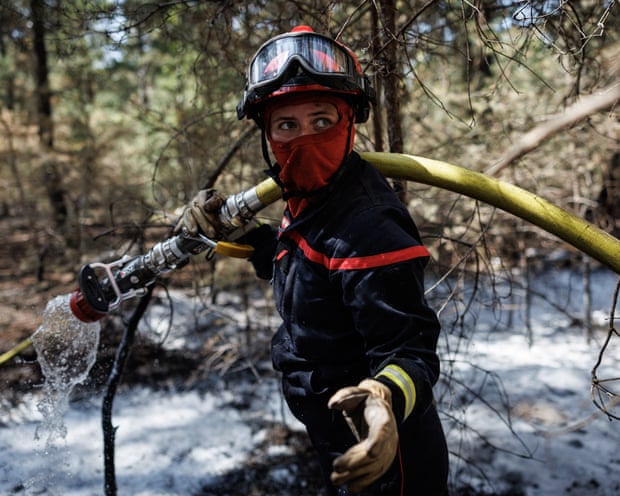
A French firefighter responds to a flare-up to prevent the fire from reigniting in the Fontainebleau Forest, in Noisy-sur-Ecole, France. Photograph: Simon Wohlfahrt/AFP/Getty Images

Figures come as large parts of southern Europe endure another record-breaking period of extreme temperatures

France recorded more than 5,700 excess deaths during its June heatwave, authorities have said, as swathes of southern Europe continue to endure another record-breaking period of extreme temperatures.

The French national health agency said on Wednesday that it had recorded 5,764 excess deaths ⁠between ​17 June and 2 July, an excess mortality rate of 36%.

More than half of the “unprecedented” total were recorded between 25 and 27 June, with deaths of people aged ⁠75 and older accounting for about two-thirds ​of ​the excess mortality, the agency said.

The announcement came as firefighters in Spain battled one of the country’s largest ever wildfires, which has burned about 32,000 hectares (79,000 acres) in the Guadalajara region north of Madrid, forcing the evacuation of 1,200 people from 34 villages in the sparsely populated area and confinement orders in 14 others.

Authorities said on Wednesday that the fire was beginning to stabilise, and residents of five villages were allowed to return home. The prime minister, Pedro Sánchez, said on a visit to the area that Spain had already suffered 22 major wildfires so far this year, four times more than in the same period last year.

See the original article at https://www.theguardian.com/world/2026/jul/22/france-recorded-more-than-5700-excess-deaths-during-june-heatwave

Neo-Fascist Climate Science Denier Donald Trump says Burn, Baby, Burn.
Nigel Farage urges you to ignore facts and reality and be a climate science denier like him and his Deputy Richard Tice. He says that Reform UK has received £Millions and £Millions from the fossil fuel industry to promote climate denial and destroy the planet.
Donald Trump urges you to be a Climate Science denier like him. He says that he makes millions and millions for destroying the planet, Burn, Baby, Burn and Flood, Baby, Flood.

Continue ReadingFrance records more than 5,700 excess deaths during June heatwave

Climate crisis-driven heat ‘sucking soils dry’ as extreme drought hits Europe

Spread the love

https://www.theguardian.com/environment/2026/jul/23/climate-crisis-heat-sucking-soils-dry-extreme-drought-europe-analysis

Barren, salt-damaged soil in a sunflower field in Scardovari, north-east Italy. Low water levels and prolonged hot, dry conditions in the Po delta are threatening irrigation supplies and crops. Photograph: Piero Cruciatti/Anadolu/Getty Images

Analysis shows how heatwaves are making atmosphere thirstier, damaging water supplies, food production and power generation

Extreme heat supercharged by the climate crisis is sucking Europe dry in summer and intensifying the drought hitting the continent, a scientific analysis has found.

Record-breaking heatwaves meant the hot atmosphere strongly evaporated water from rivers, lakes, soils and plants – conditions made 80 times more likely by global heating in western Europe and 40 times more likely in eastern Europe, the study showed. The level of soil dryness in the west was made five times more likely by the pollution from fossil fuels in the west, and 11 times more likely in the east.

Droughts have usually been linked to low rainfall, but western Europe’s most recent winter was a wet one. The scientists said the climate crisis was redefining drought in Europe, with high temperatures the key factor this summer. Today’s drought in western Europe is classified as “extreme” but would have been “moderate” in the world before the climate crisis, according to the analysis.

Deadly wildfires have raged through Spain and France and farmers have been hit hard, facing some of the driest soils on record. About 9m tonnes of grain are expected to be lost across Europe, with the worst maize harvest in 50 years expected in France, and Romanian farmers losing over a million hectares of crops.

Rivers are running low across Europe, cutting the generation of clean hydropower and restricting cargo ships. The Rhine at Lobith in the Netherlands is now lower than the minimum level seen in the hot summer of 1976. The scientists warned that this disruption could push up the price of food and energy, hitting low-income households hardest.

https://www.theguardian.com/environment/2026/jul/23/climate-crisis-heat-sucking-soils-dry-extreme-drought-europe-analysis

Neo-Fascist Climate Science Denier Donald Trump says Burn, Baby, Burn.
Nigel Farage urges you to ignore facts and reality and be a climate science denier like him and his Deputy Richard Tice. He says that Reform UK has received £Millions and £Millions from the fossil fuel industry to promote climate denial and destroy the planet.
Donald Trump urges you to be a Climate Science denier like him. He says that he makes millions and millions for destroying the planet, Burn, Baby, Burn and Flood, Baby, Flood.
Continue ReadingClimate crisis-driven heat ‘sucking soils dry’ as extreme drought hits Europe