President Donald Trump speaks during a bilateral meeting with the Emir of Qatar, Sheikh Tamim bin Hamad Al Thani on the sidelines of the G7 summit, on June 16, 2026 in Evian-les-Bains, France. (Photo by Anna Moneymaker/Getty Images)
Despite the strait’s closure, Trump insisted it was “open as far as we’re concerned.”
US President Donald Trump on Sunday twice told journalists to stop asking him about the status of the Strait of Hormuz, which Iran once again closed after the president declared an end to the ceasefire deal between the two countries.
The first instance came during an interview with NBC News’ Kristen Welker, who pointed to conflicting statements from the Iranian government and US Central Command about the status of the strait, which is an essential shipping lane for global petroleum supplies.
Trump replied that “it’s open, and I don’t want to talk about it because I want to honor the life” of the late Sen. Lindsey Graham (R-SC), who died on Saturday from what his office described as “a brief and sudden illness.”
“So I don’t want to talk about it,” Trump continued. “I told you that before the call.”
WELKER: Iran says the Strait of Hormuz is closed. CENTCOM says it's open. Which is it?
TRUMP: It's open, and I don't want to talk about because I want to honor the life of Lindsey Graham, so I don't want to talk about it. I told you that before the call. pic.twitter.com/3ed7dN1bhK
Iran shut down shipping traffic in the strait after Trump launched an illegal war against the country in late February. The strait’s closure resulted in spiking oil and gasoline prices, which coincided with further erosion in Trump’s approval ratings.
Although traffic through the strait initially picked up in the wake of a June memorandum of understanding signed by the US and Iran, it has since slumped as the ceasefire between the two nations has fallen apart.
Ana Marie Cox, contributing editor at The New Republic, bashed both Welker and Tapper for heeding the president’s requests and not pushing him to answer questions about the war he unlawfully started.
“Frankly astonished that supposed news sources agreed to terms to interview Trump and appeared to be deferential to them,” Cox wrote in a social media post, “enough that they were apologetic in brining up other topics.”
Cox’s sentiment was echoed by Kai Ryssdal, host of NPR’s Marketplace, who remarked that “the guy being interviewed doesn’t get to pick the questions.”
Journalist Helen Kennedy challenged Trump’s assertion that asking about the status of the Iran war was irrelevant when talking about Lindsey Graham.
“Making war with Iran was Lindsey Graham’s favorite thing,” Kennedy observed. “It’s not like it’s unrelated.”
Elon Musk urges you to be a Fascist like him, says that you can ignore facts and reality then.Donald Trump calls for help from NATO allies in securing the Strait of Hormuz despite saying on 7 March 2026 that they don’t need people to join wars after they’ve already won. He’s challenged with the claim that he lies as much as the IDF.Orcas discuss how Trump was re-elected and him being an obviously insane, xenophobic Fascist.
A Border Patrol Tactical Unit agent sprays pepper spray into the face of a protester attempting to block an immigration officer vehicle from leaving the scene where a woman was shot and killed by a federal agent earlier, in Minneapolis, Minnesota on Wednesday, January 7, 2026. (Photo by Alex Kormann/The Minnesota Star Tribune via Getty Images)
The unaccountable killings, the show trials, the informant bounties, the door knocks over emails, the leader’s praetorian guard, the captured press, the rewritten history, and now the reach for the ballots themselves: Every component is now built, tested, and humming.
Tuesday morning in Houston, Lorenzo Salgado Araujo did what he’d done nearly every morning for 35 years. He woke at 5:00 am, kissed his wife goodbye, loaded his van, and drove off to pick up his construction crew in Magnolia Park, the neighborhood that’s anchored Houston’s Mexican American community for a century.
He’d raised three sons in that city; they became a teacher and two engineers. He had no criminal record, and he was partway through the legal process of getting a work permit, biometrics and fingerprints already done.
By 7:00 am he was lying face down on Canal Street with a bullet in his abdomen, crying out for help in Spanish while a federal agent knelt over him talking on the phone. He died at Ben Taub Hospital, the same hospital where two of his sons were born. The Harris County medical examiner has ruled the manner of his death a “homicide.”
Immigration and Customs Enforcement (ICE) says he rammed their vehicle and “weaponized” his van to run down an officer, who fired in self-defense. His family says he almost certainly thought the unmarked cars tailing him were thieves after his work tools, because the men following him wore no insignia identifying them as law enforcement.
What we still have, and what the DDR and the Third Reich did not, is one more election in which the machine’s operators can be stripped of their power by the people they’re trying to frighten.
The League of United Latin American Citizens says photographs of the vehicles show little visible damage, which is a strange thing for a van that supposedly rammed a law enforcement vehicle hard enough to justify lethal force. David Bier of the libertarian Cato Institute reviewed newly surfaced footage and concluded it appears to show ICE initiating contact with Salgado Araujo’s vehicle, not the other way around; Norm Ornstein looked at the same evidence and called it “cold-blooded murder.”
The federal government has released no body camera footage, no dash camera video, and no photos of the damage it claims exists. The three eyewitnesses who were in the van, including Salgado Araujo’s own brother, are in ICE custody and can’t speak out. The Harris County District Attorney is trying to investigate, but her office says access to key evidence “remains under federal control.”
The president of Mexico announced this week that her government will pursue legal action against the United States over the killing. The historical inversion packed into that sentence is complete: Mexico is now appealing to international bodies to protect its citizens from American police violence.
Which brings us to the question people keep asking me on my radio show and on social media: “Are we in a police state yet?” And the question underneath it, the one that really matters: “How would we know?”
I lived in Germany for years, working with Salem International, some of that time in the little village of Höchheim hard up against the East German border, where the guard towers and the death strip were part of the landscape you saw on your way to buy bread.
I crossed through Checkpoint Charlie into East Berlin in 1986 and felt what a mature police state does to ordinary people: the lowered voices indoors, the glance over the shoulder before anybody said anything real. (If you’ve never experienced that world, watch the brilliant film The Lives of Others; it captures the East German surveillance state better than anything else on film.)
My spiritual mentor and employer in Germany, Gottfried Müller, had been an intelligence officer in Adolf Hitler’s army who renounced Nazism, was captured by the British in Iran, and spent most of the war in prison; he devoted the rest of his life to peace work.
And my dear old friend Armin Lehmann, who was the teenage Hitler Youth courier in the Führerbunker who delivered the news to Hitler that the war was lost (I still have a picture of him with Hitler, that’s on the cover of his book), spent his last decades in America as a peace activist.
Both men told me essentially the same story about how it began. It started getting scary, they noted, when the regime began to explicitly come after verbotener Gedanke, “forbidden thought.” For example, the radio stations, they said, used to encourage ordinary Germans to call in—to the shows and to the police—and “out” their neighbors who weren’t sufficiently loyal to the regime. Informing became one of the highest expressions of patriotism.
The Germans even have a word for the process by which their entire society was brought into line during 1933 and 1934: as Timothy Snyder notes, it’s Gleichschaltung, a coordination, a synchronization.
Germany didn’t become a police state in a day, and there was never an announcement.
There was just a series of Fridays, each one slightly worse than the last, until one day the question, “Are we in a police state?” had become dangerous to ask out loud.
So instead of waiting for an announcement that’s never coming, let’s do what Herr Müller would have done and run through the inventory necessary to create a fascist police state:
1. A police state is a nation where the police answer to the leader rather than to the law, and where nobody outside the leader’s circle is permitted to hold them accountable. It’s a nation where they can arrest, beat, torture, imprison, and even kill with both anonymity and impunity.
In January, ICE officer Jonathan Ross reportedly shot Renee Good, a 37-year-old mother of three, through the window of her car in Minneapolis, and Border Patrol agents killed Alex Pretti, an ICU nurse, on a public street days later. Within hours, then-Homeland Security Secretary Kristi Noem was calling both dead Americans “domestic terrorists,” a slander she refused six times under oath to retract.
Murder is a state crime, and in America state investigators have always worked police shootings alongside the feds. Not this time. The FBI agreed to a joint investigation with Minnesota’s Bureau of Criminal Apprehension the morning Good was killed, then reversed itself the same day after President Donald Trump declared Minnesota officials “crooked.”
Hennepin County Attorney Mary Moriarty called the categorical withholding of all evidence “unprecedented in American history.” Now the same machinery has closed around the killing of Lorenzo Salgado Araujo in Houston. It won’t be the last time.
2. A police state imprisons its dissidents, and it makes the sentences spectacular so everyone else gets the message.
On June 23, federal judges in Fort Worth sentenced eight members of a local book club who held a July 4, 2025 protest outside the Prairieland ICE detention center to a combined 450 years in prison, a figure the Justice Department bragged about in its own press release. Benjamin Song, who fired at an officer after the officer drew his weapon on the crowd, got 100 years.
Maricela Rueda, a doula and mother who was acquitted by the jury of every violent count against her, got 70 years in prison. Five others who were likewise acquitted of the attempted murder and firearms charges got 50 years apiece, because prosecutors persuaded the jury that wearing black and using the Signal messaging app constituted “material support for terrorism.”
And Daniel Sanchez Estrada, a Denton teacher and poet who wasn’t even at the protest, got 30 years for moving a box of anti-fascist political zines at his wife’s request, literature the prosecutors admitted was protected by the First Amendment.
For comparison, Proud Boy leader Enrique Tarrio was sentenced to 22 years for orchestrating the seditious conspiracy of January 6, and Trump pardoned him anyway. In this America, leading an armed attempt to overthrow the government earns you a pardon, while a book club that protests ICE earns its members what amounts to life without parole.
3. A police state criminalizes thought itself, as well as any expression of or action on that thought, no matter how “otherwise legal” it may be.
Last September, Trump signed NSPM-7, a national security directive that names “anti-Americanism, anti-capitalism, and anti-Christianity” as “indicators of domestic terrorism” and calls anti-fascism the “organizing rallying cry” of domestic terrorists. Consider how many of the roughly 75 million Americans who voted against Trump it could plausibly cover.
In December, then-AG Pam Bondi ordered every federal law enforcement agency to mine five years of data for anything “Antifa-related” by average Americans and hand it to the FBI, and directed the bureau to publicize its domestic terrorism call-in tip line and establish a cash reward system for informants.
When Herr Müller and Armin told me about German radio hosts urging listeners to inform on their neighbors, I thought I was hearing history, but it turns out I was hearing a forecast, and the American version pays cash.
4. A police state knocks on your door in reaction to your opinions, should you dare to express them out loud or in print.
In January, a Rochester software professional named David Streever sent a three-paragraph email to then-ICE Director Todd Lyons after watching the videos of ICE killings in Minneapolis.
“You are a monstrous human being and will go down in history as America’s Reinhard Heydrich, the butcher,” he wrote. “You will torment yourself until your last day on Earth.”
The email contains no threat of any kind, just a prophecy about a man’s conscience, the kind of furious letter Americans have been writing to powerful officials since before there was a Constitution to protect the practice.
Five months later, two federal agents rang his doorbell while he was in Finland with his 7-year-old daughter and handed his wife a document headed “WARNING NOTICE” and “YOU MAY BE IN VIOLATION OF FEDERAL LAW.” When he flew home, an agent showed up at his New York City hotel, a hotel whose location his wife had never disclosed, meaning Homeland Security found him anyway.
He’s now suing with the help of FIRE, the Foundation for Individual Rights and Expression, which could, like the Southern Poverty Law Center and multiple DC law firms, cause the Trump regime to put FIRE in their crosshairs next.
That same week, federal agents confronted Paigelynne Gonyea while she was working the polls during New York’s primaries, over an Instagram post about the already-publicly-identified officer who killed Renee Good. Federal agents questioned this poll worker, at her polling place, during an election, about her opinion of a federal agent who killed an American citizen on live video for the world to see.
5. A police state builds a security force loyal to the leader and his oligarch cronies rather than the nation.
Pentagon documents reviewed by The Washington Post describe a new National Guard “quick reaction force” of roughly 23,500 troops across all 50 states, trained for domestic riot control, with the first units ordered ready by last January 1 and the rest by April, timed neatly to the midterms.
Trump has claimed “unfettered authority” to deploy troops into American cities, boasting, “I could send the Army, Navy, Air Force, Marines, I can send anybody I wanted,” while governors are cut out of the chain of command and Pete Hegseth has barred military personnel from even talking to Congress without approval.
Vladimir Putin built exactly this in 2016; he called it Rosgvardiya, and its job was never national defense but regime preservation. Hitler built his version too, and it started small, as a “protection detail,” which in German is Schutsstaffel. History remembers it as the SS.
6. A police state needs a compliant press, and you don’t have to nationalize the networks when you can simply arrange for a friendly morbidly rich oligarch to buy them.
7. A police state rewrites the past, because people who remember accurate history make poor subjects.As George Orwell wrote of fascism, “Who controls the past controls the future: who controls the present controls the past.”
In March of last year Trump signed an executive order called “Restoring Truth and Sanity to American History,” and the sanitizing began: The National Park Service was ordered to strip signs and exhibits about slavery from national parks, including “The Scourged Back,” the famous photograph of the whip-scarred back of a man named Peter who escaped enslavement in Louisiana, and materials about John Brown’s raid at Harpers Ferry.
Trump himself complained that the Smithsonian was “OUT OF CONTROL” because its museums discussed “how bad Slavery was,” and this past weekend, on the Fourth of July no less, the White House released a report declaring that the National Museum of American History “cannot be trusted” to tell America’s story, faulting its director for, among other sins, wanting to move the museum away from an “America First mentality.”
Herr Müller and Armin lived through the original version of this, too: Within months of taking power the Nazis had burned the books, purged the universities and museums of “un-German” scholarship, and rewritten the textbooks so that German children would grow up inside a glorious past that never existed. Control what people remember and you control what they’ll accept.
8. And finally, a police state controls the vote.
In January, FBI agents raided Fulton County’s election warehouse and seized more than 650 boxes of 2020 ballots and voter rolls on an affidavit that omitted the state findings debunking its own claims, with then-Director of National Intelligence Tulsi Gabbard on scene and Trump personally on the phone with the agents.
On Tuesday, the same day Lorenzo Salgado Araujo was killed, the Justice Department sent letters to the election chiefs of all 50 states threatening each of them individually with criminal prosecution if noncitizens are found on their rolls, giving them five days to respond, this after the department lost 11 straight court cases trying to seize those very rolls.
On Thursday, citing last week’s Supreme Court decision giving him essentially unlimited firing power, Trump removed from officeall of the members of the Federal Election Assistance Commission, an independent, bipartisan agency that, along with the now-paralyzed Federal Election Commission, have the power to call out election fraud; illegal campaign tactics and spending; and vote-rigging when it’s committed by candidates, parties, or state or local officials. Both are now effectively shut down.
And when senators asked, under oath, whether ICE agents would be kept away from polling places this November, both Kristi Noem and her successor and former plumber Markwayne Mullin refused to rule it out, while the White House press secretary said she “can’t guarantee” it and Steve Bannon openly muses that ICE at the airports was a “test run” for ICE at the polls.
So, are we in a police state yet?
Armin and Herr Müller taught me that we’re asking the wrong question—or at least at the wrong moment—because nobody ever wakes up one morning and notices, “Gee, I guess I’m inside a police state…”
Instead, a police state gets assembled around you, one component at a time, while officials assure you that each component is perfectly normal and even necessary to “maintain order” or, more insidiously, to “preserve freedom.”
Milton Mayer, in his 1955 book They Thought They Were Free, described how good, decent Germans came to accept fascism. He was a Chicago reporter who, following World War II, went to Germany to interview 10 “average Germans” to try to learn how such a terrible thing could have happened and, hopefully, thus prevent it from ever happening here.
The stories he heard are so familiar to me, as I heard the same things over and over when living in Germany in the 1980s while talking with people who’d kept their heads down through the 1930s and early 1940s just to survive day-to-day:
“What happened here was the gradual habituation of the people,” a German college professor told Mayer, “little by little, to being governed by surprise; to receiving decisions deliberated in secret; to believing that the situation was so complicated that the government had to act on information which the people could not understand, or so dangerous that, even if the people could understand it, it could not be released because of national security….”
As Mayer’s professor friend noted, and Mayer recorded in his book:
This separation of government from people, this widening of the gap, took place so gradually and so insensibly, each step disguised (perhaps not even intentionally) as a temporary emergency measure or associated with true patriotic allegiance or with real social purposes. And all the crises and reforms (real reforms, too) so occupied the people that they did not see the slow motion underneath, of the whole process of government growing remoter and remoter…
To live in this process is absolutely not to be able to notice it—please try to believe me—unless one has a much greater degree of political awareness, acuity, than most of us had ever had occasion to develop… [O]ne no more saw it developing from day to day than a farmer in his field sees the corn growing. One day it is over his head.
In this conversation, Mayer’s friend suggests that he wasn’t making an excuse for not resisting the rise of the fascists but was simply pointing out what happens when you keep your head down and just assume that ultimately the good guys will win:
“You see,” Mayer’s friend continued, “One doesn’t see exactly where or how to move. Believe me, this is true. Each act, each occasion, is worse than the last, but only a little worse. You wait for the next and the next…”
“But of course this isn’t the way it happens. In between come all the hundreds of little steps, some of them imperceptible, each of them preparing you not to be shocked by the next. Step C is not so much worse than Step B, and, if you did not make a stand at Step B, why should you at Step C? And so on to Step D.”
“And one day, too late, your principles, if you were ever sensible of them, all rush in upon you. The burden of self-deception has grown too heavy, and some minor incident, in my case my little boy, hardly more than a baby, saying ‘Jew swine,’ collapses it all at once, and you see that everything, everything, has changed and changed completely under your nose.”
In a police state, everything seems the same, Mayer’s friend told him. You still go to work, cash your paycheck, have friends over, go to the movies, enjoy a meal out. The regime even backs down from time to time, making things seem ever more normal. Little victories, you tell yourself.
Except, as the German professor told Mayer, they’re not. One day, he said, you inevitably realize that:
The world you live in—your nation, your people—is not the world you were in at all. The forms are all there, all untouched, all reassuring, the houses, the shops, the jobs, the mealtimes, the visits, the concerts, the cinema, the holidays.
But the spirit, which you never noticed because you made the lifelong mistake of identifying it with the forms, is changed. Now you live in a world of hate and fear, and the people who hate and fear do not even know it themselves; when everyone is transformed, no one is transformed. Now you live in a system which rules without responsibility even to God.
So, here we are. The unaccountable killings, the show trials, the informant bounties, the door knocks over emails, the leader’s praetorian guard, the captured press, the rewritten history, and now the reach for the ballots themselves: Every component is now built, tested, and humming.
But what we still have, and what the DDR and the Third Reich did not, is one more election in which the machine’s operators can be stripped of their power by the people they’re trying to frighten.
That’s precisely why they’re working so hard on the machinery of that election, and precisely why the single most subversive act available to a free American this year is to vote, and to help everyone you know do the same.
So call the Capitol switchboard at 202-224-3121 and tell your senators and representative to defend state authority over elections; demand independent investigations of the killings of Renee Good, Alex Pretti, and Lorenzo Salgado Araujo; and put a statutory ban on federal agents at the polls.
Check your registration right now at vote.org, because voter roll purges are already happening in red states.
Sign up to be a poll worker in your county; they want poll workers intimidated, and the answer to that is more of us, not fewer.
Program the Election Protection hotline into your phone, 866-OUR-VOTE, and share it.
Support the people fighting this in court, from FIRE to the Blue state attorneys general.
And if this piece helped you see the machinery used to construct a police state more clearly, please share it and support independent media like my Hartmann Report, because a free press that can’t be bought by billionaires is one component of democracy they haven’t figured out how to seize.
Donald Trump sings and dances, says that it’s fun to kill everyone … unless he gets distracted or falls asleep.Orcas discuss how Trump was re-elected and him being an obviously insane, xenophobic Fascist.
Several different factors likely explain this trend, including reductions in planet-cooling aerosols as nations have cleaned up their air pollution, as well as changes in atmospheric circulation patterns, which models struggle to represent.
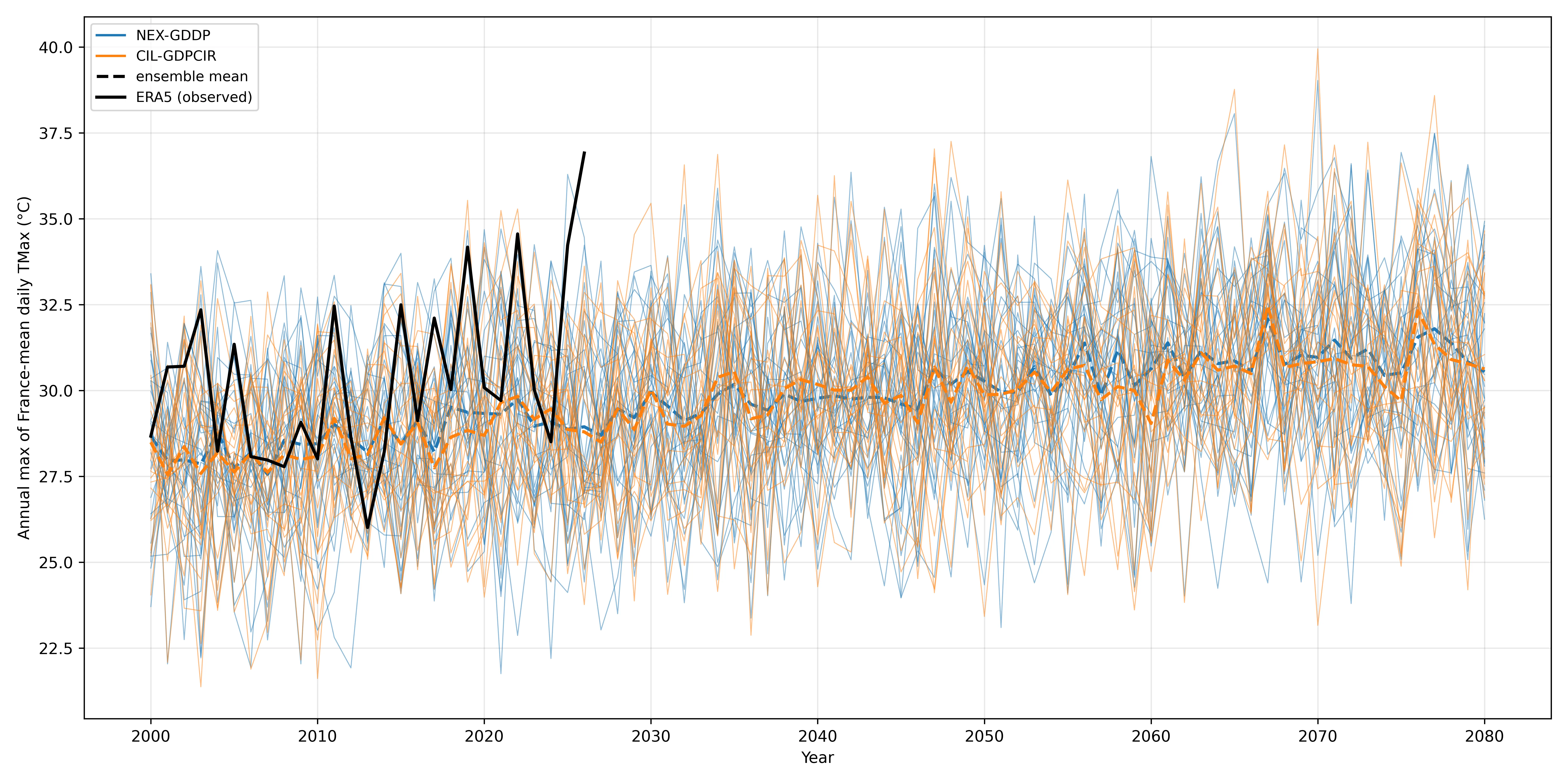
In June 2026, daily high temperatures averaged across France reached 36.9C, shattering the previous June record set in 2022 by 2.4C.
[For more on the impacts and coverage of Europe’s June heatwave, see Carbon Brief’s explainer.]
The rise in observed temperatures in France has outpaced projections made by climate models, with June maximum temperatures more in line with what was expected for the 2070s.
This is illustrated in the figure below, which shows how France’s average maximum daily high temperature for June recorded in 2026 (black line) compares to climate model projections (blue and orange lines).
Comparison of observed (ERA5, black) and modelled (blue and orange) temperatures across France from 2000 to 2080. Plot shows the maximum daily high temperature recorded in June for each year, after averaging temperatures across France. The model ensembles are bias-corrected CMIP6 model ensembles from the NEX-GDDP (blue) and CIL-GDPCIR (orange) projects. The dashed blue and orange lines are the ensemble averages. Credit: Prof Andrew Dessler.
Counting the death toll of climate change
The downstream impacts of these extreme temperatures are lethal.
Scientists are able to estimate the death toll of high temperatures in many locations, depending on the availability of mortality and climate data.
One option is to examine death certificates to see which deaths have been directly recorded by physicians as related to heat. However, there is strong evidence that this method significantly undercounts heat-related deaths, as most death certificates do not consider environmental factors such as heat when diagnosing the cause of death.
Alternatively, it is possible to calculate the rate of total (“all-cause”) mortality in a given time period relative to previous time periods – for example, by comparing the total number of deaths in June 2026 compared to the average of previous Junes. This “excess deaths” figure can be used as an estimate of the deaths from a heat wave.
Using this approach, Public Health France attributed around 2,000 deaths in France to the extreme heat in the week of 22-28 June.
Finally, scientists can use long-term data on overall mortality and correlate changes in mortality with changes in temperature to understand the statistical relationship between the two.
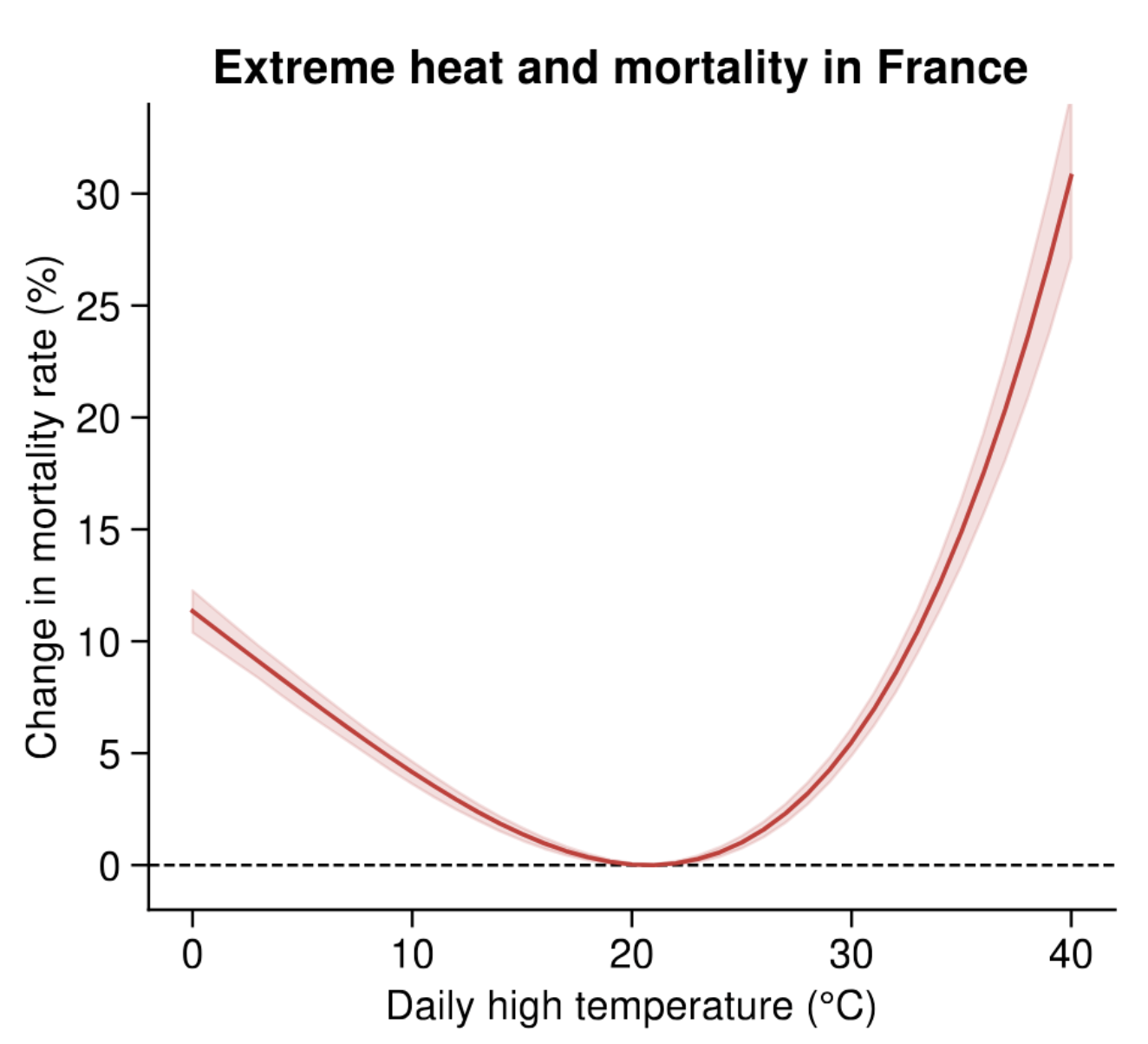
Research published in Proceedings of the National Academy of Sciences in 2025 that used this third approach found that mortality rates in France increase rapidly in cold or hot conditions as daily maximum temperatures depart further from approximately 20C.
This pattern of a U-shaped response of mortality to temperature – shown in the figure below – is veryconsistent across time periods and regions around the world.
Relationship between daily high temperature and all-cause mortality rates in France, estimated using data over 2004-19. Credit: Dr Christopher Callahan, based on data and methods in Callahan et al. (2025)
To calculate the death toll of the June 2026 heatwave in France, we compared observed temperatures over 12-29 June to their baseline average over 1980-2025.
The difference between these two temperatures helps us understand how many more people died than they would have in the absence of such extreme conditions.
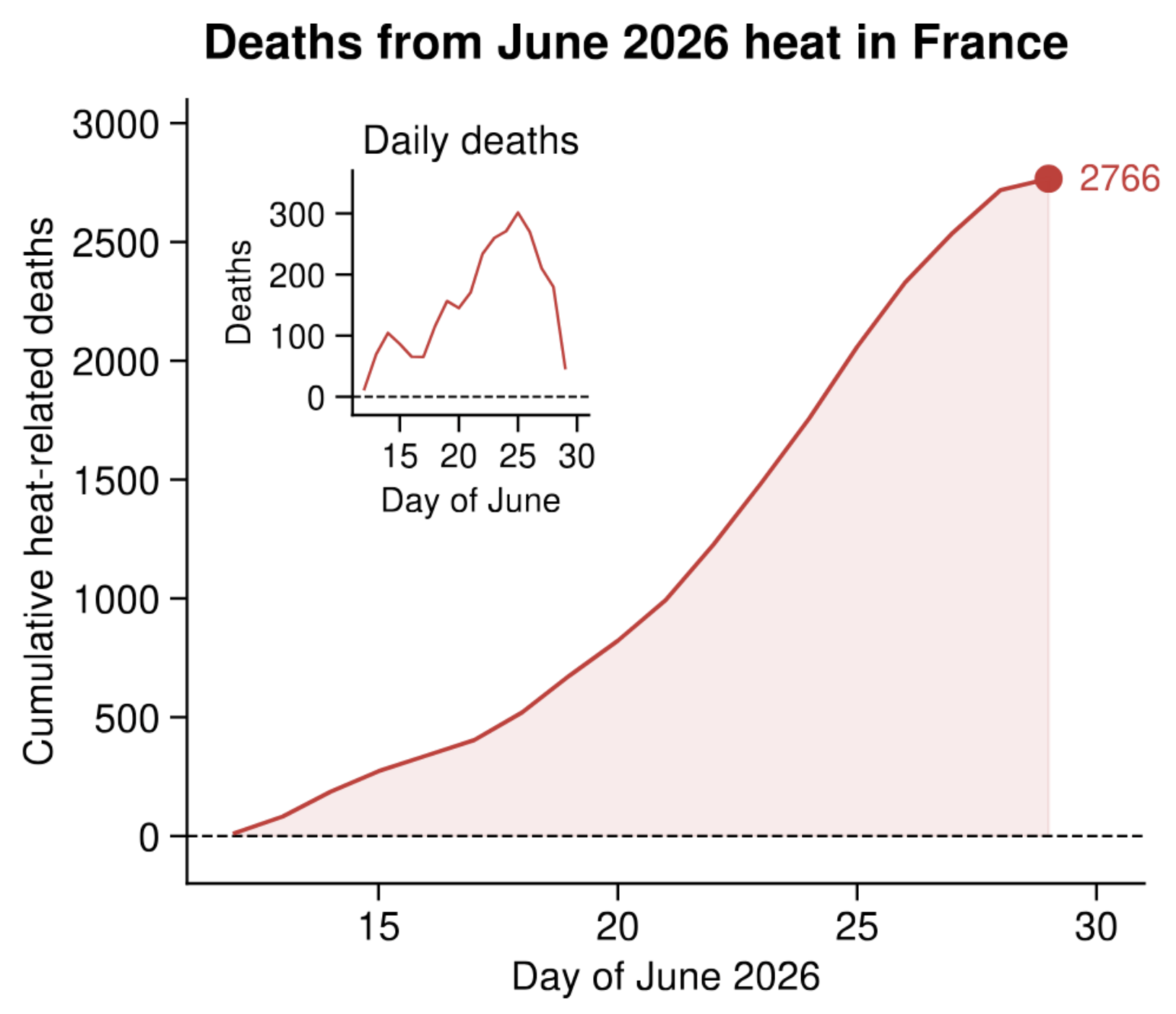
Over 12-29 June, we found that France has experienced around 2,700 heat-related deaths above the average baseline. Day-to-day heat-related mortality rates rose from less than 100 to almost 300 on the hottest days of 24 and 25 June.
This is shown in the graph below, which illustrates the cumulative total heat-related deaths seen in France over the two-and-a-half week period. The inset shows how heat-related deaths fluctuated on a day-to-day basis during this time.
Estimated heat-related mortality over 12-29 June, based on a U-shaped response of mortality to temperature. The main plot shows cumulative total deaths and the inset shows daily deaths. Credit: Dr Christopher Callahan, based on data and methods in Callahan et al. (2025)
Recent analysis by World Weather Attribution has already shown that human-caused climate change increased the frequency and intensity of the June heat wave across Europe.
Meanwhile, previousresearch has shown there is substantial evidence that heat-related mortality in Europe has already been elevated by greenhouse gas emissions.
As a result, we can be confident that at least some of the more than 2,700 deaths already seen in France are directly due to the burning of fossil fuels.
Calculating climate risk
In April, the UN-led body responsible for coordinating the work of climate modelling centres – the Coupled Modelling Intercomparison Project (CMIP) – unveiled a set of seven new emissions scenarios.
These are designed to replace the previous scenarios that have been used by scientists to understand how the climate might change in the future. They will feed into the upcoming seventh assessment report (AR7) of the Intergovernmental Panel on Climate Change (IPCC).
The range of future emissions in the new CMIP scenarios is smaller, with scenarios of very high or very low emissions no longer on the table.
The retirement of the very-high emissions scenario – known as “RCP8.5” – led to certain commentators in the media and in politics, including US president Donald Trump, arguing that the risks of climate change had been “overstated”.
[For more on false and misleading claims around the new emissions scenarios, see Carbon Brief’s factcheck.]
Our analysis of June’s heat-related deaths in France suggests that, even if the most severe emissions pathways are no longer needed, climate impacts are taking a heavy toll on society.
Moreover, the temperatures seen in France show that climate models continue to underpredict the magnitude of heatwaves for a particular level of global warming.
This is because greenhouse gas emissions are only a first step in estimating the impacts of climate change.
The second step is converting emissions to changes in the climate at both the global and local levels – or hazards. This includes heatwaves, flash floods and droughts.
The third step is to determine how changes in the hazards will affect local populations. This can be determined by calculating people’s exposure and vulnerability to hazards.
Substantial uncertainty persists at every stage of this sequence.
For example, scientists do not know exactly how the global climate will react to ever-rising greenhouse gas emissions – nor the extent to which global temperature increases will drive local climate hazards. We also do not know how climate change at a local level impacts human health outcomes.
Adaptation options, such as air conditioning, heat action plans and social support for isolated people, will be crucial as the climate moves away from the typical conditions that people are used to.
Neo-Fascist Climate Science Denier Donald Trump says Burn, Baby, Burn.Nigel Farage urges you to ignore facts and reality and be a climate science denier like him. He says that Reform UK has received millions and millions from the fossil fuel industry to promote climate denial and destroy the planet.Donald Trump urges you to be a Climate Science denier like him. He says that he makes millions and millions for destroying the planet, Burn, Baby, Burn and Flood, Baby, Flood.
As successive heatwaves hit Europe, air-conditioning (AC) has emerged as a new front in the international “culture war” over climate action.
France, Germany and the UK have experienced record-breaking heat and thousands of heat-related deaths this summer, with June temperatures in many regions passing 40C.
This has drawn attention to the relatively low rates of AC use in these countries – and in Europe as a whole – especially when compared to its widespread adoption in the US.
Right-wing politicians, including National Rally in France and the UK Conservatives, have styled themselves as champions of AC, while opposing efforts to tackle climate change.
Missing from most of these interventions is the fact that human-caused climate change has made once-rare heat far more common, in what is the world’s fastest warming continent.
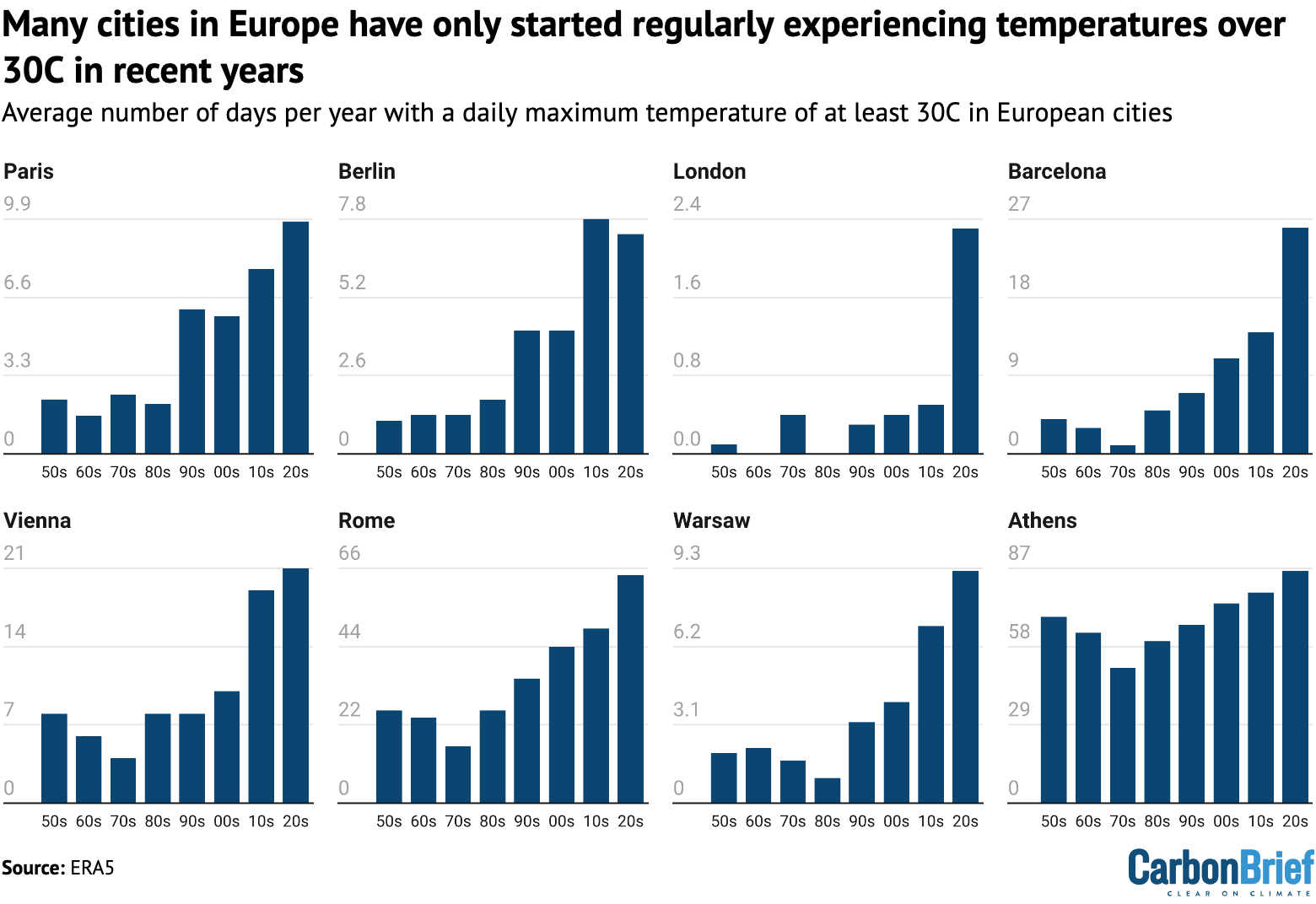
Carbon Brief analysis for this article shows that, until the 2020s, it was rare for many European cities to see days above 30C, making AC an unnecessary expense.
Here, Carbon Brief explains – via eight facts – why AC rates in some parts of Europe are relatively low, as well as clarifies and contextualises some of the misleading claims circulating about the technology.
AC installation rates in northern parts of Europe are very low. The best available estimates suggest that 6% of households in Germany and just 4% in England use AC.
However, these rates are largely explained by the historical climates in these nations.
Unlike the US, much of the housing stock and infrastructure in Europe was built at a time when AC did not exist and was not necessary.
Moreover, nations such as France, Germany and the UK have only started to regularly experience extreme heat in recent decades.
The chart below shows the average number of days per year, in each decade since the 1950s, when maximum temperatures have exceeded 30C in major European cities. Capitals such as London and Paris have seen a significant jump since around 2000.
Average number of days per year with a daily maximum temperature of at least 30C in a selection of major European cities, for each decade since the 1950s. Source: Copernicus ERA5, Carbon Brief analysis by Dr Zeke Hausfather.
“For most of the 20th century, northern Europe simply didn’t need cooling. Homes in Britain and Germany were built to keep heat in, not out, because winters were cold and summers rarely hot.”
However, Rosenow says people’s views on AC in these countries likely stem from their historically colder climates. He adds:
“Attitudes formed around those facts, not the other way round…There is a cultural element, but it is the product of climate, not of some green ideological project.”
In the past, many in Europe relied on traditional methods to keep buildings cool. Richard Black, head of communications at Climate Analytics, made this point in a post on LinkedIn:
“Once, residents of cities such as Paris could cope with summer heatwaves by opening shutters and windows during the night, and closing them again in the morning to trap the cool air inside…We’ve reached a limit to this sort of adaptation.”
Now, with Europe around 2.5C warmer than pre-industrial levels, climate change is routinely driving record-breaking heatwaves, even in the north of the continent.
This is forcing a reappraisal of societies that were “built for a climate that no longer exists”, as the UK’s Climate Change Committee (CCC) put it in a recent report.
Experts broadlyagree that much of Europe will indeed need more AC, particularly in spaces housing the most vulnerable populations, such as care homes, schools and hospitals.
AC is already widely used in hotter parts of Europe
During periods of extreme heat, articles criticising “European hostility” towards the technology frequently note that “only about 20%” of households in Europe have AC.
Often, this is contrasted with the US, where more than 90% of households have AC installed. (In fact, the US is something of a global outlier, matched only by Japan.)
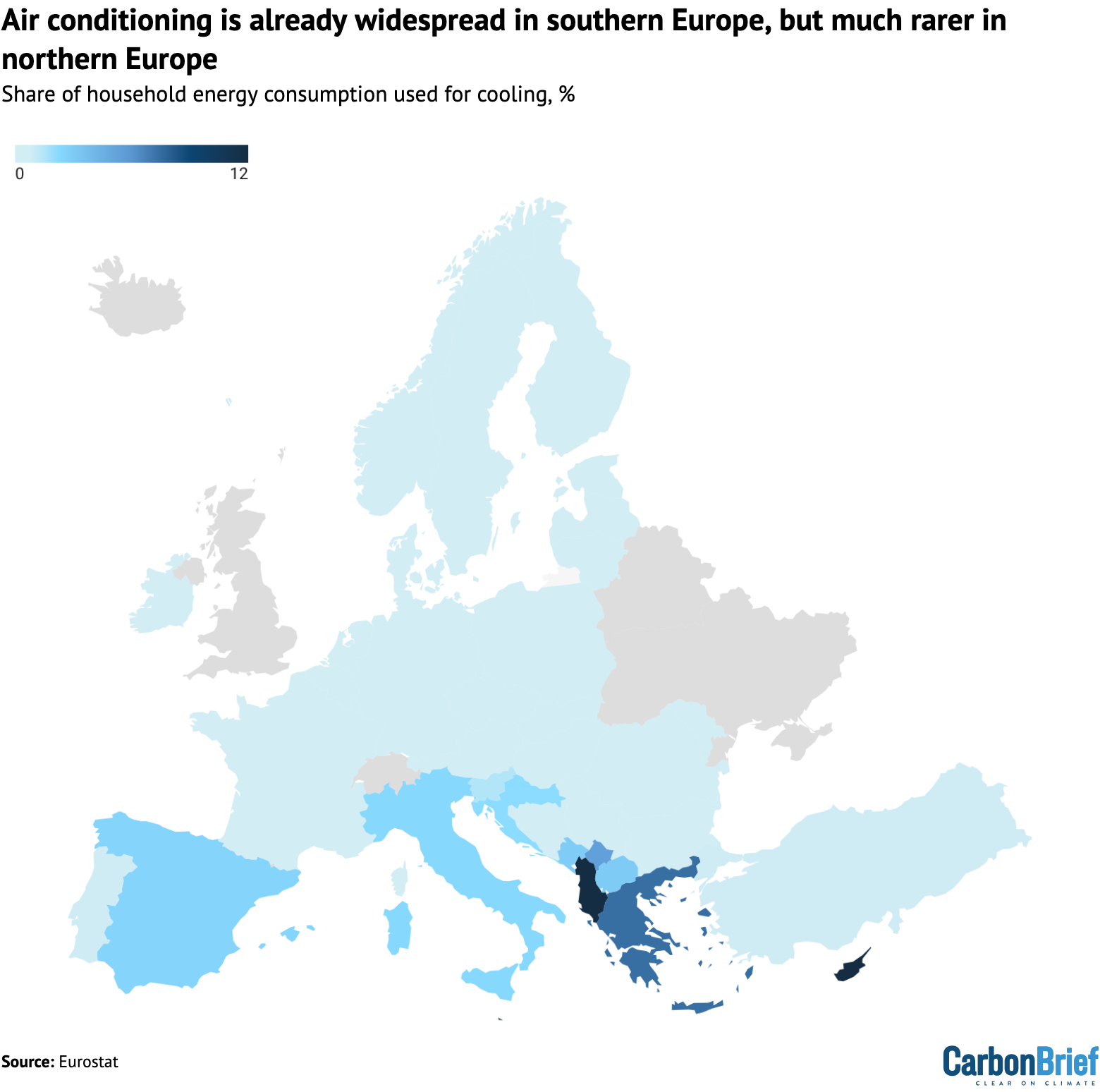
However, the continent-wide figure for Europe obscures the reality. In southern Europe – where temperatures are and have always been higher – AC is relatively common.
The map below, based on official EU data, shows that southern European nations use far more household energy for “space cooling” than those in the north.
Percentage share of household energy consumption used for “space cooling”, including AC, in EU member states and the Balkans. Source: Eurostat.
Government figures show that nearly 60% of Italian households have AC. Household-level data in many countries is patchy, but various analyses have placed that figure at 70-80% in Greece and 41% in Spain – with higher penetration in the hotter, southern part of the country.
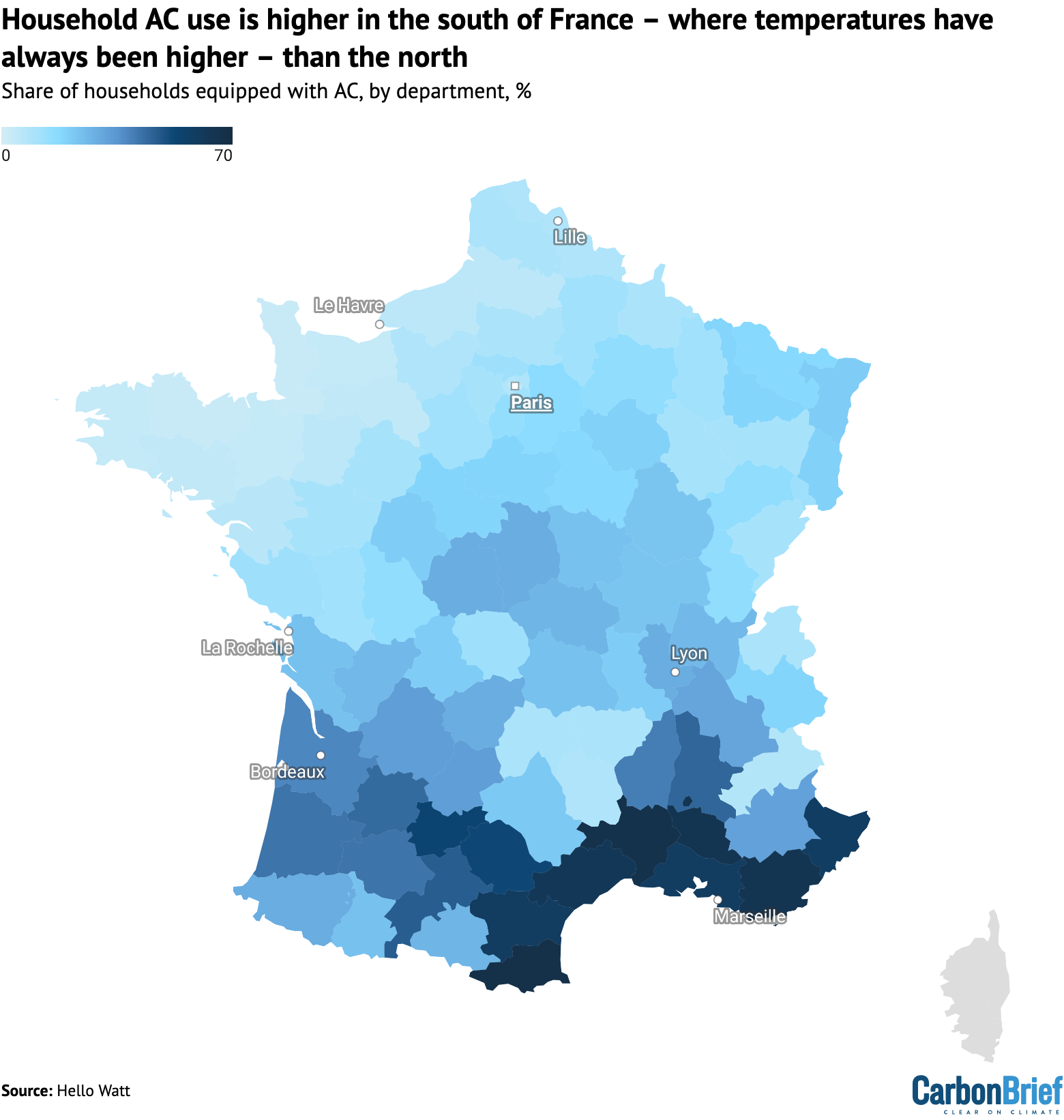
The same pattern can be seen within France. International coverage has stressed the country’s “cultural resistance to AC”, citing a nationwide figure from 2020 that suggests “only” 25% of French households have AC.
However, polling data from customers of the Hello Watt energy app suggests that there is a distinct north-south divide in French uptake. At least 60% of households in Mediterranean regions of France are equipped with AC, according to these figures.
This can be seen in the map below, with households across northern regions, including Paris, reporting far lower AC installation rates, often below 5%.
Percentage share of households equipped with AC in departments of mainland France, according to polling data. Source: Hello Watt.
Finally, when making such comparisons to Europe, it is worth noting that high rates of AC use reported for the entire US also obscure significant differences between – and within – US states. This, too, aligns with differences in regional climate.
Hotter states in the US south have near-universal AC access. But in Washington, a north-western state with a climate more comparable to that of western Europe, 66% of people have AC in their homes.
Some European nations have ‘resisted’ AC – but its popularity is growing
International commentators have written extensively about Europe’s “longstanding resistance to cooling technology”, especially when compared to the US.
Often, European attitudes are attributed to “guilt” about AC’s energy demand, “cultural conservatism” or “overbearing governments”. One commentator ascribed divergent attitudes in Europe and the US to “different ideas about physical suffering and sacrifice”.
Meanwhile, right-leaning commentators and climate-sceptic groups have blamed “climate policies, which view AC as an unnecessary luxury”.
In general, these critiques often fail to consider the most obvious explanation, which is that AC adoption is low in northern Europe because the historical climate made AC unnecessary.
Critical articles have instead drawn attention to restrictions on AC use in some European countries, as well as the lack of support for AC in official heatwave guidance.
For France, in particular, polling has indeed highlighted widespreaddisapproval of AC, both on environmental grounds and due to alleged health impacts. Such messages have also been voiced regularly in French media and by left-leaning and green politicians.
However, across Europe there are plenty of signs that such attitudes are shifting, following successive spells of extreme heat.
Amid the June heatwave, there were reports from Germany, France and the UK of “skyrocketing” AC sales. This surge was even acknowledged by the foreign ministry in China, due to the nation’s role in supplying many of these products.
The shift is taking place in politics as well. Marine Tondelier, leader of the French Green party – which has traditionally opposed AC – recently stated that “there are places where we just can’t do without AC anymore”.
Overall, AC has been on the rise across Europe, with France, Spain and the Netherlands all using more than twice as much energy for AC and other “space cooling” technologies in 2024 as they did in 2015.
AC production in Germany has also risen by at least 75% in recent years and a growing share of German homes are being built with it installed.
Notably, there is little evidence that “climate policies” are blocking Europeans from installing AC. Polling in Germany shows that, while people are concerned about environmental impacts, the high costs of installing and running it are perceived as greater barriers.
Finally, there is an important distinction between individual AC units in people’s homes and installing them in public spaces, such as hospitals, care homes and schools.
While neither is widespread in France, support for the latter can increasingly be found across the political spectrum, from Greens to the far-right National Rally (RN).
AC emissions are growing, but its climate impact could be limited
Somepeople have noted that a wider rollout of AC in Europe could drive up emissions.
As noted in the Financial Times by columnist and chief data reporter John Burn-Murdoch, there is a logic to this argument, “at least superficially”. He writes:
“AC uses a lot of energy; if the proposed defence against emissions-driven global warming means emitting more, then we have an obvious problem.”
The emissions impact of AC depends heavily on the generation mix of a country’s power sector.
As such, it was responsible for 1bn tonnes of carbon dioxide (CO2) from electricity use globally. This equates to around 2.7% of total CO2 emissions globally from fossil fuels and industry.
(As well as indirect emissions through power use, AC units can also directly release greenhouse gases – used as AC refrigerants – when they leak or are improperly disposed of. Following the 2016 Kigali Amendment, countries are progressively trying to phase down the use of potent greenhouse gases in AC units.)
“There is a lot of alarmist messaging about how much electricity AC uses. However, on an annual basis, the demand is not that substantial. Currently, AC uses about 1% of electricity in the EU and catching up to adoption rates in the US would double this.”
According to the IEA estimates from 2018, “if left unchecked, energy demand from AC will more than triple by 2050”, reaching 6,200TWh of power.
By mid-century, households would contribute the most to the increase (70%), with at least two-thirds of the world’s households potentially having AC, according to the Paris-based agency.
Decarbonising electricity grids and energy-efficiency improvements can reduce AC emissions and their impact on climate.
For instance, in countries with a low-carbon electricity mix – such as France, where nuclear energy accounts for 67% of its electricity generation – expanding AC would have a more limited climate impact than in other countries.
In countries such as India, there could be a more significant increase in emissions as AC is adopted, due to the role coal plays in the country’s energy mix, especially during the night. Demand is growing fast – following low access historically – and many AC units are inefficient, with high electricity use.
According to a new working paper from the India Energy and Climate Center (IECC) at the University of California, Berkeley, “room AC” – portable plug-in units, as opposed to those permanently installed in buildings – already accounts for nearly one-quarter of India’s peak electricity demand (60-70GW) – and this is before the majority of Indian households have bought their first AC unit.
Dr Nikit Abhyankar, co-faculty director of the IECC, tells Carbon Brief that, as AC use is expanded across the world, it should be paired with solar and battery storage, where the “economics have completely shifted” in the last few years. This will help to cut both energy bills and emissions.
According to the IEA, accelerating energy efficiency improvements could deliver more than one-third of all CO2 emission reductions between now and 2030.
The global energy demand needed to run ACs alone in 2050 could be reduced by 1,300GW – the equivalent of all of China and India’s coal plants – through energy efficiency measures, it estimates.
Aditya Valiathan Pillai, a climate adaptation researcher at King’s College London, tells Carbon Brief that, as the use of AC expands, there is a conversation to be had about where and “what type of technology [is used] and who gets access” to it.
A final point is that many AC units are air-to-air heat pumps, which can efficiently heat homes, as well as keeping them cool. As such, wider AC adoption could boost the adoption of electrified heat, helping to cut emissions from gas boilers.
But AC also has a localised impact. It works by removing heat from indoor air and pushing it outdoors, raising temperatures on the street and exacerbating the “urban heat island” effect.
Left-leaning French politicians are among those citing this as an argument against AC, particularly in cities. Indeed, Emmanuel Grégoire, the Socialist mayor of Paris, appeared to be making this point in an interview with Le Monde, during the June heatwave:
“[AC] can be useful for cooling collective spaces and protecting the most vulnerable populations, but individual AC is a scourge – it makes the problem worse by heating the city even more.”
One study concludes that, in a city such as Phoenix, Arizona, where the technology is widespread, AC use during a heatwave can raise night-time temperatures by 1-1.5C.
Another models a nine-day heatwave in Paris – in a future with “massive” AC use – and finds an increase in external temperature of more than 2C, due to heat emitted by the units.
Given this, some scientists argue that AC can be a form of climate “maladaptation” – referring to actions that backfire and make people more vulnerable to global warming.
“AC may constitute a maladaptation because of its high demands on energy and associated heat emissions, especially in high-density cities.”
Compared to the US, more people in Europe live in dense, urban areas. According to Dr Vincent Viguié, a climate change economist at École des Ponts ParisTech, this could leave Europeans more exposed to heat from AC units. He tells Carbon Brief:
“If you live in a neighbourhood that is not dense, like in a suburban neighbourhood or in the countryside, you don’t care about this…So, once again, there is a key difference between US and European cities.”
Viguié is among the experts arguing that other climate-adaptation measures should be considered alongside AC, to keep entire cities cool – not just individual homes. He says:
“It’s not to say that the heat released by AC by itself is a reason to forbid AC…It’s just that not taking that into account may lead to bad decisions.”
The heatwave in June 2026 is estimated to have killed more than 20,000 people in Europe. In France – which has seen some of the hottest temperatures – the heatwave caused more than 2,700 heat-related deaths, according to analysis published by Carbon Brief.
AC does help to protect people from the effects of extreme heat. A 2021 study found that globally, AC averted an estimated 190,000 heat-related deaths annually during 2019-21.
With its much higher penetration of AC, the US has fewer deaths due to extreme heat than Europe.
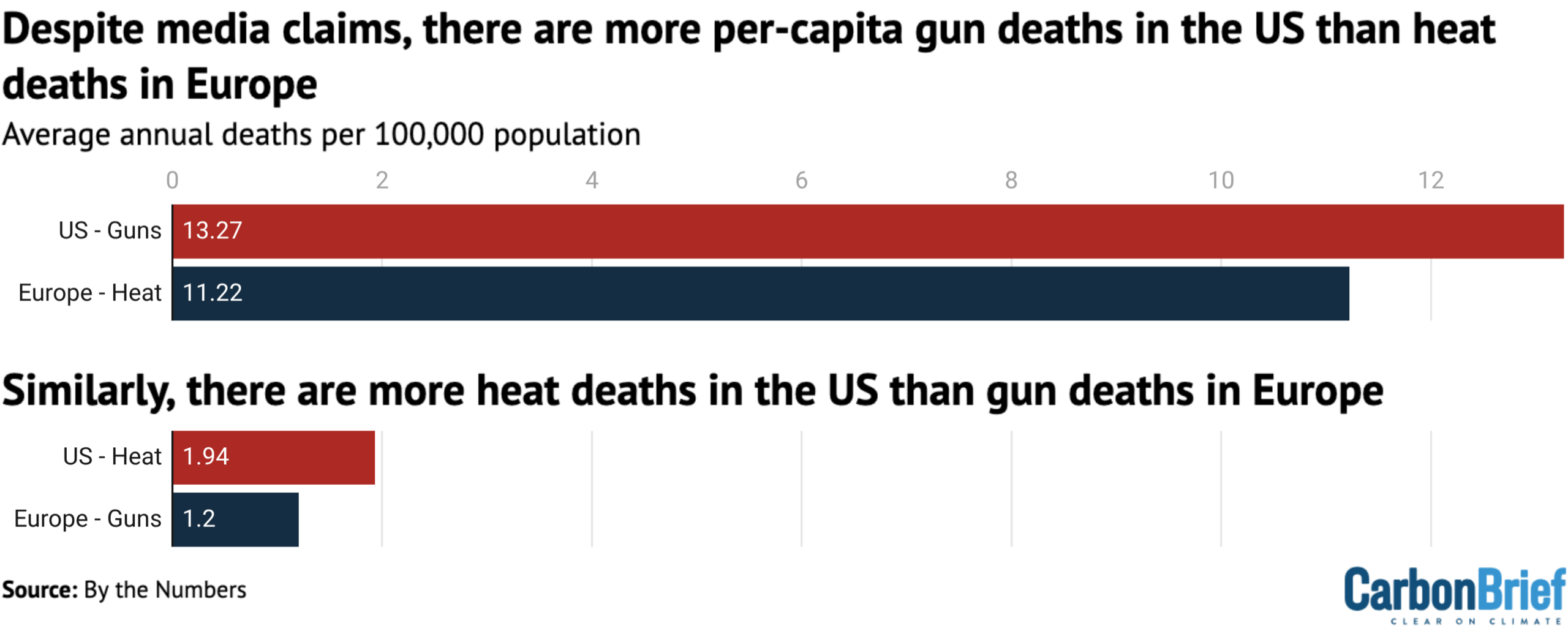
Heat kills around 11 people out of every 100,000 in Europe, compared to around two people in the US, according to analysis by data scientist Dr Hannah Ritchie from Our World in Data.
Several publications have pointed out that “Europe’s heatwaves are deadlier than American gun violence”. While this is technically accurate in absolute terms, Ritchie says the comparison is “a bit silly” for a number of reasons, not least because on a per-capita basis, US gun deaths are higher.
Average annual deaths per 100,000 for heat and gun deaths in the US (red) and Europe (blue) to as close to the end of 2024 as possible. Heat deaths are based on excess death methodology, not death certificates. Source: By the Numbers.
However, experts suggest that AC is only one part of a wider effort to protect people from extreme heat.
A 2020 study looking at heat-related mortality in Canada, Japan, Spain and the US, found that excess deaths due to heat decreased between 1972 and 2009.
For example, the proportion of deaths due to extreme heat fell from 1.7% to 0.5% over the period in the US and 3.5% to 2.8% in Spain.
However, an increase in AC only explained 16.7% of the drop in the US and 14.3% in Spain.
The research concludes that “other factors have played an equal or more important role in increasing the resilience of populations”. This is supported by research that shows changes to cities, such as planting more trees, as well as behavioural shifts and public-health measures, can all protect people from dangerous heat.
Additionally, across Europe there is already a range of policies and measures in place to protect the most vulnerable from heatwaves. Many of these were brought in following the unprecedented summer of 2003, when 70,000 died from extreme heat.
These policies were highlighted by French environment minister Agnès Pannier-Runacher, in response to the far-right National Rally (RN) party’s AC proposals:
“The incompetent RN has just found out that nursing homes need air-conditioned rooms. Thank you, but it’s actually been mandatory since 2004.”
Another study found that measures that have already been rolled out in France would cut the projected death toll of a 2003-like heatwave by more than 75%. This is in part due to the expansion of AC in places such as nursing homes, but also other approaches, such as heat action plans.
For example, France has a multi-tiered action plan, which includes local governments ensuring access to cooled spaces and water, keeping a list of vulnerable individuals for targeted interventions, as well as national information campaigns.
‘Net-zero rules’ are not blocking AC installation in the UK
In the UK, Conservative politicians and right-leaning media have tried to pit the adoption of AC against net-zero policy.
Writing in the climate-sceptic Daily Telegraph, columnist Matthew Lynn claimed falsely:
“Strict net-zero rules now mean that aircon is effectively banned in the UK.”
(Further down the article, he concedes: “AC is not strictly speaking banned in new-build homes in the UK. But tough environmental rules mean that it is very hard, and expensive, to install in practice.”)
The same narrative has been used in articles by GB News, the Sun and others. A separate article in the Daily Telegraph’s “money” section goes further, claiming that AC had been “torn from homes under net-zero clampdown”.
A blog post from the Ministry of Housing, Communities and Local Government rebuts these claims, stating:
“There has been media coverage this week suggesting that AC is banned in homes. This is incorrect.”
For the UK, while it is true that fewer than 5% of homes currently have AC, this is largely due to the fact that it was not hot enough in the past to warrant the expense. Historically, the focus has therefore been on keeping buildings warm, rather than cool.
Current regulations do not ban the installation of AC outright. However – as the government’s blog post notes – there is no blanket rule, meaning there are some localised differences.
Certain areas – or certain kinds of properties – may be subject to additional complications for installing AC.
In a 2025 video on Instagram, shadow secretary of state for energy security and net-zero Claire Coutinho referenced the London plan, for example, which is a framework for development in the capital launched in 2021. She said:
“[London mayor] Sadiq Khan says no. The London plan says we shouldn’t have air con because it uses too much energy. But this is mad! This is a poverty mindset that we need to get away from.”
The London Plan does not stop homes from having AC. It simply says that, for new buildings, passive design measures should be prioritised, such as the orientation of the building, the window design and incorporation of measures such as external shading and trees.
A recent response from the mayor added further measures, such as the need to “minimise the necessity for the operation of mechanical measures including AC, which would further add to the heat island effect within urban areas and add operational cost to residents”.
Elsewhere, new-build homes across England must meet the requirements of “part O” of the 2022 building regulation updates. This includes addressing overheating in buildings through energy-efficient design and prioritising passive cooling, with AC as a last resort.
For existing buildings, most AC units fall under “permitted development rights”, meaning no planning application is required to install them.
Additionally, regulations were relaxed in 2025 to make it easier to install an air-to-air heat pump – which can both heat and cool air – without planning permission.
This means that, far from blocking the expansion of AC, net-zero policy has made it easier to install specific cooling systems.
Speaking to Carbon Brief, Andrew Sissons, director of sustainable future at Nesta, says the government must now implement its announced £2,500 subsidy for air-to-air heat pumps “as quickly as possible”, to further ensure that the technology can be rolled out efficiently. He adds:
“[The government] should also continue to expand permitted development rights for air-to-air heat pumps, with a particular focus on flats and homes in denser areas. As long as heat pumps meet the MCS [Microgeneration Certification Scheme] noise test, there are few reasons to limit their use via the planning system.”
Some properties, such as large homes, listed buildings or those in conservation areas, may still require planning permission to install an air-to-air heat pump or other AC. Sissons notes that this can add cost and delay to installation.
While it cannot be said that AC has been blocked or banned due to net-zero, neither has it been prioritised.
This may shift as temperatures continue to rise. UK government advisors at the Climate Change Committee (CCC) suggest that 22% of the UK’s housing stock will likely need active cooling, such as AC, to cope with 2C of global warming.
The CCC’s recent adaptation report also calls for all new homes to be built using low-cost, passive cooling measures, alongside more AC.
Active cooling such as AC is more likely to be needed for retrofitting existing homes, the report adds.
AC has become increasingly politicised in Europe, as demonstrated by France’s RN party announcing its “grand plan for AC” in all public buildings.
As noted by Dutch MEP Gerben-Jan Gerbrandy, this “far-right” embrace of AC is coming from the same people who for years have “delayed emissions reductions”.
In response, left-leaning policymakers in Europe have frequently downplayed the role of AC, prioritising programmes of urban greening and retrofitting older buildings.
Such approaches for dealing with extreme heat have already proved successful. Therefore, many experts argue that these methods, alongside AC, will be essential to prepare for a hotter world.
According to the IPCC’s sixth assessment report, adaptive infrastructure, such as urban forests and green roofs, can reduce energy use because of cooling, with co-benefits for climate, air quality, physical and mental health.
While retrofitting older buildings for heat as well as insulating them from the cold might prove challenging, urban greening and an active shade policy – one that determines how much of every street is exposed to direct sunlight – are simple measures cities can adopt.
Some experts have also warned about the high cost of running AC, expressing concerns that excessive reliance on the technology could increase energy poverty.
In a Carbon Brief guest post published in 2025, researchers at the Basque Centre for Climate Change found that framing AC as the “default solution” can miss the opportunity to design “more inclusive, human-centred responses” to rising temperatures.
William Lewis, a PhD candidate and one of the guest post’s authors, tells Carbon Brief it is not a case of “one or the other”, when considering AC and other options:
“We have this opportunity in European countries to choose a slightly different path [from the US], which isn’t AC in every single home.”
King’s College London’s Pillai says that, by centring the debate on AC, the far-right response to the heatwaves in Europe has “completely neglected the science of how you cool human beings”.
There are many solutions, he adds, that are already widely used across hot developing countries, such as ceiling fans, windows that open and cross-ventilation, as well as strategies to reduce cumulative hours of heat exposure.
Pillai tells Carbon Brief that, while places reaching 42C and higher “definitely need to think about AC very seriously”, places in the “low to mid 30Cs” could rely on these alternatives.
Behavioural change, he adds, is the “least glamorous part” of heat policy, but “pulls most of the weight” of protecting people. These include a wide range of actions and responses – from reducing heat exposure, to wearing lighter clothing and drinking more water and fluids.
There are also workplace protections. Pillai tells Carbon Brief that these could include legislation on mandatory work breaks, cooling and shade requirements at workplaces, as well as health insurance that covers heat stress days that have been lost by heat-exposed workers.
Report predicts severe food shortages, but government won’t publish it in full.
Britain faces a national security crisis within just a few years due to the impending collapse of global ecosystems, spy chiefs have warned, but the government is refusing to publish their report in full.
A redacted 14-page document warns of severe food shortages, which could begin within five years, along with price rises, political destabilisation and the possible outbreak of war as countries compete for dwindling resources.
Crop failures, disease outbreaks and intensifying natural disasters could cause “geopolitical instability, economic insecurity, conflict, migration and increased inter-state competition for resources”, it said.
The joint intelligence committee, which oversees M15 and MI6, was responsible for the report, the Guardian reported. Members of parliament are demanding it be published in full.
At at a hearing for the environmental audit committee on Wednesday, Mary Creagh, an environment minister, told MPs the redacted report should provide enough information. The redacted contents were obtained through repeated freedom of information requests in January.
Nigel Farage urges you to ignore facts and reality and be a climate science denier like him and his Deputy Richard Tice. He says that Reform UK has received £Millions and £Millions from the fossil fuel industry to promote climate denial and destroy the planet.Orcas comment on killer apes destroying the planet by continuing to burn fossil fuels.