Prime Minister Sir Keir Starmer (right) and then British ambassador to the US Peter Mandelson during a welcome reception at the ambassador’s residence in Washington, DC, February 27, 2025
LABOUR MP Ian Byrne got to the heart of the Mandelson crisis in the Commons on Wednesday. Namely, he made the point that it is in fact a Mandelson-McSweeney-Labour Together scandal and the measures taken by the government in the wake of the New Labour grandee’s disgrace only scratch the surface of what is needed.
Byrne told MPs that the row over Mandelson’s appointment as ambassador to Washington in December 2024 “was not just a catastrophic error of judgment that has caused profound damage to this government’s reputation.
“It was the result of a clique at the top of the party, as we have seen with the Morgan McSweeney and Labour Together scandal, which I and colleagues … have called on the Prime Minister and the general secretary of the Labour Party to launch an independent investigation into.”
Socialist Campaign Group secretary Richard Burgon underlined the point, asking how Mandelson was even considered for the Washington job.
“It is because it suited the interests of a tiny faction in the Labour Party, funded by big business, which wanted Mandelson at the heart of things in order to shift a Labour government away from the agenda that a real Labour government should have.
“That is why Mandelson was popular with these people … and that is why, despite his despicable character, despite his greed and his avarice, he was put in that position.”
Palestinians imprisoned at Sde Teiman are shackled and blindfolded 24 hours a day and are forced to sit still and silent in painful positions for hours on end. (Photo by whistleblower via Quds News Network)
“Israel’s military attorney general just gave his soldiers license to rape—so long as the victim is Palestinian,” said one Israeli rights group.
The Israel Defense Forces on Thursday dismissed the indictments of five soldiers accused of raping a Palestinian prisoner at the notorious Sde Teiman prison in July 2024—an attack that sparked worldwide outrage.
The IDF spokesperson’s office said the decision to drop the indictments of five reserve members of Force 100—a special unit of the military police responsible for guarding and controlling high-risk detainees—“was made following an examination of all the considerations, evidence, and relevant circumstances.”
“Among the factors taken into account were the complexity of the evidentiary basis in the case and the implications of the release of the security detainee to the Gaza Strip, which created significant consequences for the evidentiary aspect of the case,” the office added. “These developments created exceptional circumstances that affect the ability to continue the criminal proceedings while preserving the right of the defendants to a fair trial.”
Israel is the only state where rape is state policy
Israel’s Military Advocate General Itai Ofir has dropped charges against five Israeli soldiers accused of sexually abusing a Palestinian detainee at the Sde Teiman detention facility in 2024.pic.twitter.com/ee7tbEHObY
The dismissal of the indictments, according to The Jerusalem Post, does not mean the soldiers have been exonerated.
The five soldiers were caught on video assaulting a Palestinian prisoner at Sde Teiman on July 5, 2024. Although they used riot shields in a bid to conceal the nearly 15-minute attack, medical reports cited in the case show the victim suffered serious rectal injuries requiring surgery, a ruptured bowel, punctured lung, and fractured ribs. An Israeli medical staffer said that the victim arrived at the hospital in critical condition.
Israeli Prime Minister Benjamin Netanyahu—who is wanted by the International Criminal Court in The Hague for alleged war crimes and crimes against humanity in Gaza—welcomed the dismissal of the indictments, which he said had “damaged Israel’s reputation in the world in an unprecedented manner.”
Israeli President Israel Katz raised eyebrows by asserting that “the role of the IDF’s legal system is to protect and safeguard IDF soldiers who engage heroically in war against cruel monsters, and not the rights of the terrorists of Hamas.”
Netanyahu and Katz both called the prosecution of the Sde Teiman reservists a “blood libel.”
The Defense Minister of Israel says it was "blood libel" to go after Israeli soldiers caught on camera raping a Palestinian.
Israeli Finance Minister Bezalel Smotrich similarly welcomed the dismissals, declaring that “now all that’s left is to ensure that the ousted military advocate general stands trial.”
Smotrich was referring to Yifat Tomer-Yerushalmi, who admitted last year to authorizing the leak of the Sde Teiman assault video in order to “confront the false propaganda against the law enforcement officials in the military” by those who denied the allegations against the soldiers.
Human rights groups and others condemned the decision to kill the case, with the Public Committee Against Torture in Israel (PCATI) posting on social media that “Israel’s military attorney general granted his soldiers a rape license—as long as the victim was Palestinian.”
PCATI said that dismissing the indictments “adds to a long series of decisions and actions taken by the army… which cover up the violent violations that have occurred in Israeli prisons and detention facilities Increasingly since October 7, 2023.”
Contrasting the failure to hold the reservists accountable with the draconian prison sentences given to Palestinians who resist Israel’s illegal occupation, US Congresswoman Ilhan Omar (D-Minn.) said on Bluesky: “Just so that we are clear, Israel drops criminal charges on five Israeli soldiers who were caught on camera sexually assaulting a Palestinian detainee. But Israel will keep kids in prison for decades because they were throwing rocks? Make it make sense.”
Canadian journalist Justin Ling said that “the abuse inflicted on Palestinian detainees at Sde Teiman prison—including the murder of a Palestinian doctor—was inhumane.”
“This one case, brought because the abuse was *caught on camera*, was a small sign that rule of law in Israel still worked,” he added. “The Israeli government has dropped the case.”
Israeli-American academic Shaiel Ben-Ephraim also noted the strength of the case, including the video footage of the assault.
“They had witness testimony,” he added. “It was a slam-dunk case. Guards I talked to in Sde Teiman said this case was just the tip of the iceberg. And now they are dropping the charges. Of course.”
Former Palestinian prisoners, IDF soldiers, and Israeli medical professionals have all said they witnessed torture and other abuse of detainees at Sde Teiman and other facilities. Victims ranged in age from children to the elderly.
According to an analysis by Israeli journalist Yuval Abraham, at least 98 Palestinians have died in Israeli prisons and military detention centers during the war. Many bodies of former Palestinian prisoners returned by Israel have shown signs of torture, execution, and mutilation.
The IDF has announced investigations into the deaths of dozens of Palestinian prisoners in its custody during the genocidal war on Gaza launched after the Hamas-led attack of October 7, 2023.
Nine Israeli soldiers were initially arrested in connection with the recorded Sde Teiman assault. Five of them were indicted in February 2025.
While many Israelis condemned the alleged rape of the Sde Teiman prisoner, others rallied around the accused soldiers—especially on the far right. National Security Minister Itamar Ben-Gvir hailed the reservists as “our best heroes.” Smotrich called them “heroic warriors.”
Smotrich and others demanded an investigation into the video showing the attack—not in order to seek justice for the victim, but rather to find out who leaked the damning footage.
The soldiers’ arrests outraged many on the Israeli right. At least one Cabinet member and several members of the Knesset, Israel’s legislative body, joined a mob that in August 2024 stormed two military bases where they believed the arrested suspects were being held.
Other Israelis, including journaist Yehuda Schlesinger, called for legalizing the torture of Palestinian prisoners, because “they deserve it,” and “it’s great revenge.”
Last year, Israel blocked a request from United Nations sex crimes experts to probe alleged sexual violence perpetrated by Hamas fighters during the October 7, 2023 attack, reportedly to avoid attendant scrutiny of rapes and other abuses allegedly committed by Israeli forces against imprisoned Palestinians.
Keir Starmer objects to criticism of the IDF. He asks how could anyone object to them starving people to death, forced marches like the Nazis did, bombing Gaza’s hospitals and universities, mass-murdering journalists, healthworkers and starving people queuing for food, killing and raping prisoners and murdering children. He calls for people to stop obstructing his genocide for Israel.Donald Trump explains why he established his Bored of PeaceOrcas discuss Genocide-supporting and complicit Zionists. Donald Trump, Keith Starmer, David Lammy, Rachel Reeves, Angela Rayner and Wes Streeting are acknowledged as evil genocide-complicit and supporting cnuts.
Children stand next to damaged cars at the site of an Israeli airstrike that hit the Imad Tower in the Aicha Bakkar neighborhood of Beirut, Lebanon early on March 11, 2026. (Photo by Jonathan Labusch/Middle East Images/AFP via Getty Images)
The agency demanded that all parties protect civilians and reiterated the secretary-general’s call “to end the fighting and engage in diplomatic negotiations.”
Since the United States and Israel launched an unprovoked war on Iran at the end of February, more than 1,100 youth have been killed or injured in related violence across the Middle East, the United Nations Children’s Fund said Wednesday, calling for a swift diplomatic resolution.
“The situation is becoming catastrophic for millions of children across the region,” UNICEF said in a statement, noting that at least 200 children are reportedly dead in Iran, 91 in Lebanon, four in Israel, and one in Kuwait. “These numbers will likely climb as the violence intensifies and spreads.”
Most of the kids killed in Iran died in what mounting evidence suggests was a US attack on the Shajareh Tayyebeh girls’ school in Minab on February 28. That attack killed an estimated 175 people, mostly students ages 7-12, part of an overall death toll that the Iranian government has said exceeds 1,300.
Responding to the school bombing, Gordon Brown, a former UK prime minister who’s now the UN special envoy for global education, argued in a Guardian opinion piece Thursday that “the world will now need stronger mechanisms to ensure accountability,” such as a body complementing the International Criminal Court but specifically for children, “focusing its attention on the bombing of schools, abductions of pupils, and militias that enslave boys and girls.”
With the widening conflict in the Middle East, UNICEF noted Wednesday, “widespread disruption to education has left millions of children out of school across the region, while hundreds of thousands of children have been displaced by unrelenting bombardment.”
In Lebanon, where Israeli attacks are allegedly targeting the Lebanese political and paramilitary group Hezbollah despite a November 2024 ceasefire deal, nearly 800,000 people, including around 200,000 children, have been forced from their homes, according to Mercy Corps. The Lebanese government has said at least 570 people have been killed and 1,444 injured.
“Civilian infrastructure, including hospitals, schools, and water and sanitation systems—upon which children depend to survive—have been attacked, damaged, or destroyed by parties to the conflict,” UNICEF said. “Nothing justifies the killing and maiming of children, or the destruction and disruption of essential services that children depend on.”
“Grave violations against children in armed conflict can constitute violations of international law, including international humanitarian law, and international human rights law,” the UN agency continued.
Across Iran, several United Nations Educational, Scientific, and Cultural Organization (UNESCO) World Heritage sites have also been damaged by the US-Israeli war, which experts worldwide argue violates both the US Constitution and UN Charter.
According to UNICEF and latest reports, over 270 children across #MENA have been killed since 28 February, with most children killed in #Iran and #Lebanon. These figures are staggering and escalating. They are a stark testament to the toll that conflict is taking on children.… pic.twitter.com/WYBXZRQZgR
The UN Security Council, which is currently led by President Donald Trump’s administration, on Wednesday adopted a resolution condemning Iran’s retaliatory attacks on Bahrain, Kuwait, Oman, Qatar, Saudi Arabia, the United Arab Emirates, and Jordan—nations that host US military bases—without even mentioning the US-Israeli bombing campaign.
UN Secretary-General António Guterres last Friday demanded a return to negotiations. Trump, who abandoned a previous Iranian nuclear deal during his first term, ditched recent talks with Iran in favor of bombing the country with Israeli Prime Minister Benjamin Netanyahu—who has used war on Iran to again close crossings into the Gaza Strip, or as critics have put it, reinstate a “starvation policy” in the Palestinian territory devastated by Israel’s 29-month genocidal assault.
In addition to reiterating “the secretary-general’s call on parties to the conflict to end the fighting and engage in diplomatic negotiations,” UNICEF on Wednesday urged everyone involved “to take all necessary precautions in the choice of means and methods of warfare to minimize harm to civilians, including by avoiding the use of explosive weapons that disproportionally affect children.”
“The region’s children—all 200 million of them—are counting on the world to act quickly,” the agency concluded.
A Wednesday letter signed by every member of the US Senate Democratic Caucus but Sen. John Fetterman (D-Pa.)—who previously helpedRepublicans block a war powers resolution intended to halt Trump’s assault on Iran—called for a probe of the Minab school attack and sounded the alarm about Defense Secretary Pete Hegseth’s rhetoric that “only serves to endanger civilians.”
Specifically, Hegseth has said that the US assault on Iran, which they’re calling Operation Epic Fury, would have “no stupid rules of engagement,” and there will be “death and destruction from the sky all day long.”
Keir Starmer explains that UK is participating defensively in Trump and Israel’s criminal war for Israel’s genocidal expansion in Iran and states that he supports Zionism “without qualification”. Starmer said it here: https://www.jewishnews.co.uk/keir-starmer-interview-i-will-work-to-eradicate-antisemitism-from-day-one/Donald Trump explains why he established his Bored of PeaceOrcas discuss how Trump was re-elected and him being an obviously insane, xenophobic Fascist.
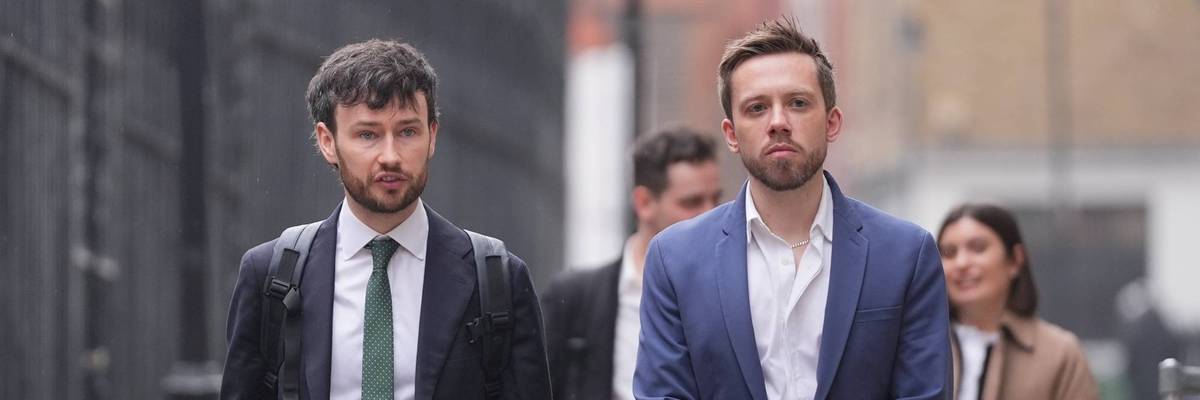
Journalist Owen Jones (right) is seen leaving the Royal Courts of Justice in London, where he was being sued by Raffi Berg for libel, on March 6, 2026. (Photo by Yui Mok/PA Images via Getty Images)
The BBC has long been accused of centering Israel and dismissing the humanity of Palestinians in its coverage of Gaza.
British journalist Owen Jones on Thursday celebrated a UK High Court judge’s ruling in his favor in a libel lawsuit that a BBC editor brought against him—and said that should the editor choose to move forward with his case despite the decision, he was looking forward “to defending my article in court.”
The High Court ruled that Jones was expressing an opinion when he wrote an article for Drop Site News in December 2024 titled “The BBC’s Civil War Over Gaza,” in which he spoke to BBC staffers about Middle East online editor Raffi Berg’s influence over the news outlet’s coverage of Israel and Palestine.
Jones’ article described staffers’ allegations that “internal complaints about how the BBC covers Gaza have been repeatedly brushed aside” as Berg “sets the tone” for the outlet’s online coverage of Israel’s onslaught in the exclave, where more than 75,000 Palestinians have been killed since October 2023 in what’s been called a genocide by top Holocaust scholars and human rights groups.
It noted that the BBC failed to report on Amnesty International’s finding that Israel was committing genocide in Gaza and displayed an on-screen chyron reading, “Israel rejects ‘fabricated’ claims of genocide.’”
“Journalists expressed concerns over bias in the shaping of the Middle East index of the BBC news website,” wrote Jones. “Several allege that Berg ‘micromanages’ this section, ensuring that it fails to uphold impartiality.”
The BBC has long been criticized for centering Israel and “dehumanizing” Palestinians, as more than 1,000 artists said in a letter last year when they condemned the network for refusing to air a documentary about the impact of Israel’s attacks on children in Gaza, on the grounds that it featured the child of the exclave’s deputy minister of agriculture—suggesting “that Palestinians holding administrative roles are inherently complicit in violence.”
The article also pointed to Berg’s own history of pro-Israel coverage, including a 2002 story “that presented young [Israel Defense Forces] soldiers as courageous defenders of their country while failing to mention the occupation and settlement of Palestinian land or the widespread allegations of crimes” documented by human rights groups and the US government.
Berg also presented Israeli settlers in the West Bank as “victims seeking ‘a better quality of life’ and did not mention the fact that the settlements have been repeatedly deemed illegal,” and wrote about the Mossad “in glowing terms” in a book he wrote with extensive cooperation from the Israeli intelligence agency.
He also posted a photo on social media showing Prime Minister Benjamin Netanyahu with a copy of Berg’s book on his bookshelf, Jones reported.
Berg’s lawyer said last year that Jones’ reporting attacked Berg’s “professional reputation as a journalist and editor,” and led to death threats.
In order for his case against Jones to proceed, Berg would now need to prove in court that “Jones did not genuinely hold the opinion he expressed in his reporting, or demonstrate that the opinion is not one an honest person could hold on the basis of any fact that existed at the time of its publication,” Middle East Eye reported.
“I am proud to stand by my journalism,” said Jones Thursday.
Keir Starmer objects to criticism of the IDF. He asks how could anyone object to them starving people to death, forced marches like the Nazis did, bombing Gaza’s hospitals and universities, mass-murdering journalists, healthworkers and starving people queuing for food, killing and raping prisoners and murdering children. He calls for people to stop obstructing his genocide for Israel.Donald Trump explains why he established his Bored of PeaceOrcas discuss Genocide-supporting and complicit Zionists. Donald Trump, Keith Starmer, David Lammy, Rachel Reeves, Angela Rayner and Wes Streeting are acknowledged as evil genocide-complicit and supporting cnuts.

 Prime Minister Sir Keir Starmer (right) and then British ambassador to the US Peter Mandelson during a welcome reception at the ambassador’s residence in Washington, DC, February 27, 2025