A few recent news articles concerning the UK’s Conservative and Liberal-Democrat coalition government – the ConDem’s – brutal attack on the National Health Service.
Research involving 1,645 BMA members polled about the government’s health and social care bill has found that 89% think increased competition will lead to fragmentation of services, while 66% believe that the move for all NHS acute providers to reside within foundation trusts will damage NHS values.
The poll, conducted online in January by Ipsos Mori, also shows that nearly 60% of those surveyed think health secretary Andrew Lansley’s plans will have a negative impact on their personal role within the NHS, with 31% saying it will be a major one and 27% saying it will be minor. A specific concern, feared by a majority of those polled, is that the reforms will mean they spend less time with patients – something opposed by almost all those questioned.
Dr Hamish Meldrum, chairman of council at the BMA, said that the results show that the government “can no longer claim widespread support among doctors”.
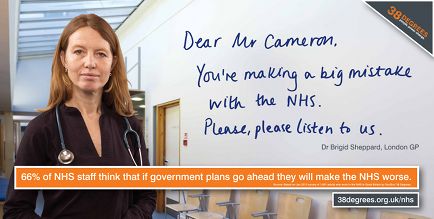
In just six days, the petition to tell the government to Save The NHS has been signed by an incredible 175,000 members. We’ve only just finished voting on which campaigns to work on together over the next few weeks, and now we’ve already managed to build 38 Degrees’ fastest-ever growing petition!
While the petition is growing fast, 52,000 of us have shared it on Facebook, thousands more spread the petition on Twitter, hundreds of members organised local meetings and have spoken to their local MP, and the petition has only just been launched!
The media have noticed too. On Monday the Independent said, ”The campaign group 38 Degrees – which was instrumental in forcing the Government to drop its plans to sell off parts of Britain’s forests – collected more than 80,000 signatures against the plans over the weekend.”
If you haven’t already, please sign the petition and share with your friends and family.
The “creeping privatisation” of the NHS will affect patient care, top doctors have warned, saying the government’s planned shakeup risks hospitals losing key services, critical research being jeopardised and public goodwill for blood donations disappearing as private firms are seen to profit from public funds.
Medical leaders fear the controversial switch to allow “any willing provider” – voluntary, public or private – to supply care services in the NHS will fragment the system. Driven by the need to save £20bn from NHS budgets, the health secretary, Andrew Lansley, plans to increase commercialisation and competition across the health service – with no part off limits.
Already, large elements of the health service are falling into private hands. Last September, Serco, the multinational services company with an empire stretching from railways to maintaining ballistic missiles, became the UK’s largest provider of pathology services, a market worth £2.5bn, with the takeover of King’s hospital laboratories in London.
The government’s plans to outsource more NHS services have left many in the public sector with a bitter taste in their mouth and the private sector positively drooling. In the coming years, an array of health services is likely to be outsourced despite little evidence that it would improve efficiency and make savings. This will see a push to further privatise clinical services such as radiology and pathology – the latter worth £2.5bn per year. The government has recently been in talks about privatising part of the NHS blood service to make it more “commercially effective”.
Even NHS Direct is in the firing line with Capita – a company reported to the Office of Fair Trading two years ago for allegedly overcharging schools by £75m for IT contracts – lined up to manage the contract, according to reports. Major off-shoring is also on the agenda. John Neilson, head of NHS Shared Business Services, said recently that the NHS should outsource the administration of procurement to call centres in India to save £20bn over the next four years. For private companies eyeing a slice of the NHS pie, it gets better: NHS Trusts may ultimately come under private ownership with many of the services they manage also outsourced.
Areas such as estates management, worth about £7bn per year, and back-office functions such as HR and IT are also prime targets to be transferred to private owners.
West Cornwall MP Andrew George is calling for cross-party support in an effort to block the Government’s Health and Social Care Bill.
Speaking during an initial debate on the bill in Parliament, Mr George said that the future of the NHS is more important than party political point scoring. He called for MPs to come together and to see if the Health Secretary and his fellow Ministers were really “listening” to concerns as they had claimed they were.
After the debate, Mr George said that he would be seeking a meeting of MPs and other stakeholders (including the BMA, Kings Fund, Royal Colleges, etc) before the Bill comes back to the main chamber of the House of Commons for its report stage after the Easter recess.
Simon Burns, the ebullient health minister and understudy to Andrew Lansley, has been sporting a new haircut this week in preparation for being made a privy counsellor. But his promotion as a confidant of the Queen hardly compensates for the terrible pounding he and Lansley, not to mention the Liberal Democrat health minister Paul Burstow, have been taking over the NHS proposals. One suspects the Queen might be quietly asking him what he thinks he is doing meddling with the health service.
Ministers certainly feel they are being hit from every side after they formally lost the support of the Lib Dems on Saturday, the British Medical Association on Tuesday and the former Blairite health secretary Alan Milburn on Wednesday.
For David Cameron it is now double or quits. He has a limited amount of political capital. Should he expend it on defending the plans as they stand or signal some big rethink? Half-measures are pointless. He has shown himself willing to compromise on school sport, forests and some welfare changes. But to delay the health shakeup, or change it at its core, would be a retreat of an entirely different order.
Monitor, the taxpayer-funded body that regulates the health service, will have to spend millions more to keep the Health Secretary’s free-for-all in check.
The Government quango could see its budget jump from £20million a year to £130million to cope with the changes, it has emerged.
It makes a mockery of David Cameron’s claim that the Coalition plans, which hand 80% of the NHS budget for doctors to spend how they want, will “abolish” bureaucracy in the health service.
Ed Miliband, leader of the UK Labour Party performs well yesterday against Prime Minister David Cameron at Prime Minister’s Question Time on the destruction of the NHS issue.
David Cameron accuses Ed Miliband of publishing (reading actually) a union press release. There’s a strange ring about that. The BMA is hardly a union – more of a professional body.
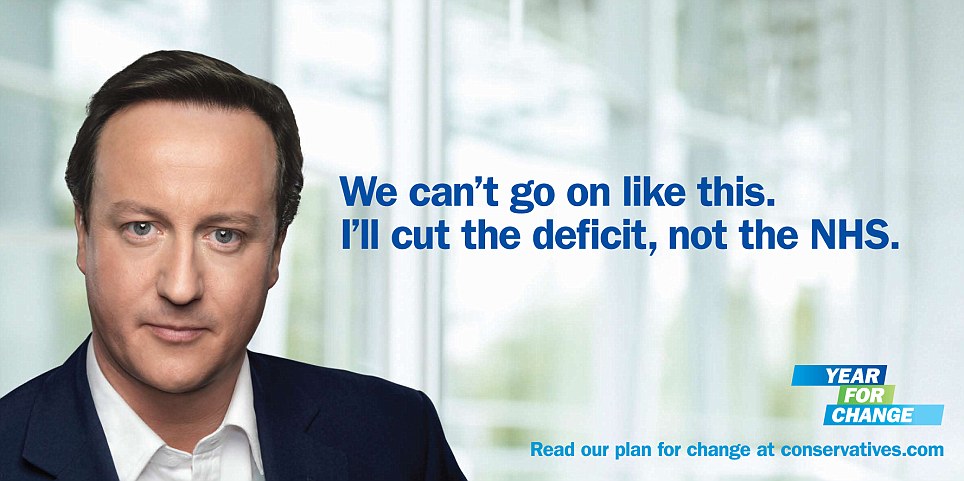
Conservative election poster 2010
A few recent news articles concerning the UK’s Conservative and Liberal-Democrat coalition government – the ConDem’s – brutal attack on the National Health Service.
UPDATED Missed many news links in the original posting
Just as yesterday the British Medical Society urged Andrew Lansley to scrap ‘top-down reforms’ of the NHS, today we see the government’s champions hit the airwaves.
Radio 2’s Jeremy Vine show this lunchtime featured two such champions, one introduced as a GP, the other a ‘health expert’. The former, Dr Paul Charlson, is indeed a GP in favour of Lansley’s reforms. He also runs a private centre which specialises in cosmetic anti aging treatments (Botox), not typical of most GPs.
Charlson is also spokesperson for a lobby group called Doctors for Reform, which is supported by the free-market think tank, Reform. Funding for Reform has come from the UK’s largest private hospital group, General Healthcare Group and other private health companies set to benefit from Lansley’s reforms.
Vine’s ‘health expert’ was Dr Helen Evans, director of Nurses for Reform. Its funding is more opaque, but it does have ties to many free-market think tanks that favour privatisation. These include the Adam Smith Institute and the Centre for Policy Studies, a think tank that promotes “the opening up [of] state monopolies” in health.
Evans has labelled the NHS “a Stalinist, nationalised abhorrence”.
As the criticism of the NHS reforms gets louder, expect to hear more from these two.
‘privatisation’ bill hangs in the balance, as opposition continues to mount, Unite, the largest union in the country, said today (Wednesday 16 March).
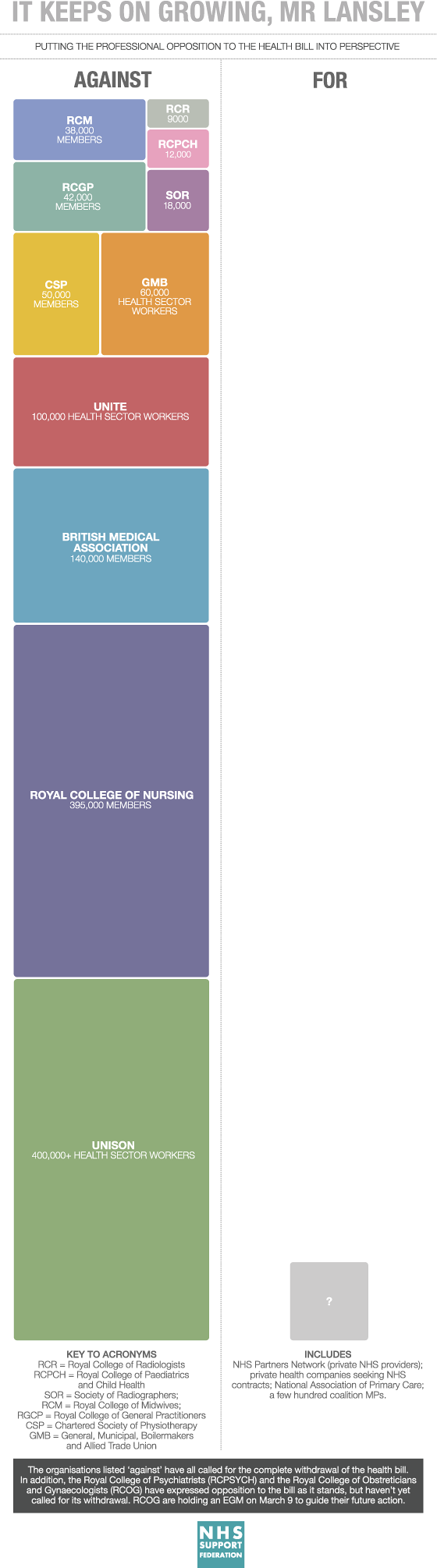
Unite, which has 100,000 members in the health sector, said that the country faced the biggest battle to save the NHS in its present form since its inception in 1948.
Unite said that health secretary Andrew Lansley and his ministers needed to radically rethink the bill to guarantee that the NHS is the preferred provider of choice – not private healthcare firms, some of which have bankrolled the Conservative party.
Unite general secretary Len McCluskey said: ”The government is on the back foot over its Health and Social Care bill, following the opposition voiced by the British Medical Association yesterday and the Liberal Democrats at last weekend’s spring conference.
GPs could more than double their income to £300,000 a year under health secretary Andrew Lansley’s plans for the NHS, according to an analysis for the Guardian – sparking calls from top doctors for the government to reverse controversial policies that would appear to reward physicians who ration care.
The revelation comes after the British Medical Association voted to scrap the “dangerous” health bill and demanded that Lansley rethink his radical pro-market changes to the NHS.
GPs are central to the government’s programme, and by 2013 will have to band together into consortiums before being handed £80bn of NHS funds to commission care for their patients.
It is a serious matter that the British Medical Association has called an emergency meeting – the first of its kind for nearly 20 years – to warn the Government to think again about the pace and scale of its reforms to the National Health Service. The aims of those reforms might be laudable. The Health Secretary, Andrew Lansley, says he wants to set the NHS free from political interference and make it more responsive to patients. And he is right to say that with an ageing population making increasing demands on services, and the cost of drugs and new treatments rising, change is needed.
But he has set in train the biggest reorganisation in the 62-year history of the NHS – at a time when it is being asked to save £20bn from its £100bn budget. And he has done so despite a Tory pledge before the election that there would be no major overhaul of the health service. Doctors’ leaders have rightly complained that the detail on the massive changes were not available at all until the Bill was published two months ago. Mr Lansley’s reforms have been premised on ideological conviction rather than pragmatism; pilot projects should have been trialled first rather than in parallel with the passage of a Bill which is already well on its way through Parliament. No wonder Liberal Democrat delegates rejected the plans at the party’s spring conference last weekend.
Why is the government planning a big shakeup of the NHS in England?
The health secretary, Andrew Lansley, says that while the NHS is world-class in some respects, and employs leading medical figures, it is still not good enough in some key areas of care. “For example, rates of mortality amenable to healthcare, rates of mortality for some respiratory diseases and some cancers, and some measures of stroke, have been among the worst in the developed world. International evidence also shows the NHS has much further to go on managing care more effectively,” says the Department of Health. Doctors have cast doubt on the evidence underpinning some of Lansley’s claims about the quality of NHS care, and critics argue that his “modernisation” changes will usher in widespread privatisation of NHS services.
What is the government proposing?
Arguably the most radical restructuring of the NHS since it was created in 1948. England’s 150 or so primary care trusts will be wound up in 2013 and their work, commissioning healthcare, will pass to groups of GPs called general practice commissioning consortiums (GPCCs). Each GPCC, perhaps including scores of existing practices, will have its own budget. The consortiums will have £80bn of NHS funds in all, and agree contracts with hospitals and others. Almost 200 GPCCs have already been set up.
At Prime Minister’s Questions today, David Cameron complained of “roadblocks” to reform of the NHS, but at first did not refer directly to the British Medical Association; the doctors’ representative body, who called yesterday for the NHS bill to be dumped.
Then, in his answer to Ed Miliband’s final question, he said:
“He should remember the fact that the BMA opposed foundation hospitals, they opposed GP fundholding, they opposed longer opening hours for GPs’ surgeries.
“Isn’t it typical, just as he has to back every other trade union, just as he has no ideas of his own, he comes here and just reads a BMA press release.”
Rarely has David Cameron appeared as rattled as he did at today’s PMQs. Ed Miliband’s decision to lead on the coalition’s troubled NHS reforms proved fortuitous as the Prime Minister struggled to offer a coherent defence of his Health Bill.
Asked if he was planning any further amendments, Cameron prattled on about “cutting bureaucracy” and disingenuously claimed that the coalition would prevent “cherry-picking” by the private sector. As is frequently the case, his disregard for detail let him down. Asked if it was true that the NHS would be subject to EU competition law for the first time in its history, the PM appeared either unwilling or unable to answer Miliband’s question.
Instead, for the third time in recent months, he selectively quoted from a speech by John Healey in which the shadow health secretary declared that “no one in the House of Commons knows more about the NHS than Andrew Lansley . . . these plans are consistent, coherent and comprehensive. I would expect nothing less from Andrew Lansley.”
What Cameron failed to acknowledge is that Healey went on to argue:
They [the Conservatives] believe that competition drives innovation, that price competition brings better value, that profit motivates performance, and that the private sector is better than the public sector. I acknowledge the ambition but I condemn this as the core philosophy being forced into the heart of the NHS. It’s wrong for patients. It’s wrong for our NHS. It’s wrong for Britain.
Labour has accused the government of “arrogance” for pushing ahead with NHS reforms despite recent criticism from the British Medical Association (BMA) and the Liberal Democrat spring conference.
At prime minister’s questions on 16 March 2011, opposition leader Ed Miliband asked whether the PM would amend the plans in response to the demands of Lib Dem delegates calling for a halt to the “damaging and unjustified” shake-up of GP services in England.
Meanwhile the BMA described measures that would increase competition in the NHS as “dangerous and risky”.
Mr Miliband accused Prime Minister David Cameron of “ignoring people who know something about the health service” and creating “a free-market free-for-all”.
Hospitals will shut, others will lose their accident and emergency or maternity units, and some will be downgraded to glorified health centres because of the government’s NHS shakeup, the head of England’s leading hospitals has warned.
Sue Slipman, chief executive of the Foundation Trust Network, told the Guardian that handing GPs control of £80bn of NHS funds, letting private healthcare firms provide treatment and giving patients more choice about where they are treated – key policies promoted by the health secretary, Andrew Lansley – would increase existing pressures on hospitals so much that some will not survive.
“There will be some ‘shut’ signs; I suspect there will be some closures. There will be fewer A&E departments and in urban centres there may well be fewer maternity units,” said Slipman, who predicted unprecedented changes to hospitals over the next few years.
Hospitals will shut, others will lose their accident and emergency or maternity units, and some will be downgraded to glorified health centres because of the government’s NHS shakeup, the head of England’s leading hospitals has warned.
Sue Slipman, chief executive of the Foundation Trust Network, told the Guardian that handing GPs control of £80bn of NHS funds, letting private healthcare firms provide treatment and giving patients more choice about where they are treated – key policies promoted by the health secretary, Andrew Lansley – would increase existing pressures on hospitals so much that some will not survive.
“There will be some ‘shut’ signs; I suspect there will be some closures. There will be fewer A&E departments and in urban centres there may well be fewer maternity units,” said Slipman, who predicted unprecedented changes to hospitals over the next few years.
The general election battle was in full swing last April in the marginal seat of Bury North when shadow health secretary Andrew Lansley paid a visit to help the Conservative candidate, David Nuttall. Understandably he offered his opinions on a huge local issue: the plan to close the children’s department, including a maternity unit and special care baby unit for ill newborns, at Fairfield general hospital, the town’s much-loved hospital.
As Nuttall’s blog entry for that day records: “Andrew Lansley has reviewed the latest figures for the number of births across Greater Manchester and today said: ‘If I am secretary of state for health after the election, maternity and children’s services will be maintained at Fairfield and I will ensure this happens. In the long term there will be no change without the consent of GPs … who will in our reforms be responsible for commissioning local services’.”
Under the headline “Conservatives will maintain children’s services at Fairfield”, Nuttall added: “The choice for voters in Bury North is clear: vote Labour and these services will be axed from Fairfield. Vote Conservative and if there is a Conservative government the maternity department will be kept open.”
Social care is facing a funding gap of more than £1bn by 2014 in England – a situation which would have consequences for the NHS, a leading think-tank says.
The King’s Fund analysis predicted councils would struggle to protect home help and care home places as they come to terms with funding cuts.
The report said if this happened there could be more admissions to hospital and longer delays in discharging.
But the government said it did not believe there would be a funding gap.
Too many hospitals in the wrong places. As towns become cities and population shifts and ages, ministers must reconfigure hospitals and consider closing wards and departments; Labour began doing so.
Why is all this now a problem for Andrew Lansley?
Once Tory leader, David Cameron promised a “bare-knuckle fight” over ward closures. In the election, both sides made extraordinary promises. In a tour of northern constituencies, Lansley pledged to reopen closed hospital wards and A&E departments.
What happened once Lansley took office?
Lansley announced in May 2010 an end to “top-down forced closures”. Instead, health trusts would have to pass several tests to make a closure: support from GP commissioners, better public and patient engagement, and clear clinical evidence to justify the change. But of three dozen closure proposals, only one, Chase Farm in north London, has seen him intervene, merely to delay the decision a month. Lansley has not reopened any services closed under Labour.
I consider this posting to comply with copyright laws since
a. Only a small portion of the original article has been quoted satisfying the fair use criteria, and / or
b. This posting satisfies the requirements of a derivative work.
Please be assured that this blog is a non-commercial blog (weblog) which does not feature advertising and has not ever produced any income.
Yesterday’s vote by the BMA to call on Health Secretary Andrew Lansley to withdraw the abolition of the NHS bill.
Andrew Lansley’s response needs to be fact-checked e.g. that the BMA previously supported parts of the bill.
The Labour Party has belatedly joined the campaign to oppose the abolition of the NHS. Belatedly because they appear to have joined the campaign once it was assured widespread support – after both the Liberal Democrats and the BMA have declared that they oppose the decimation of the NHS.
The Labour Party response – a petition – is pathetically inadequate.
It is interesting that Liberal Democrat MPs are mandated to vote with Labour MPs to oppose the bill.
Conservative election poster 2010
A few recent news articles concerning the UK’s Conservative and Liberal-Democrat coalition government – the ConDem’s – brutal attack on the National Health Service.
At a committee stage meeting on the reforms on Tuesday, the shadow health team was set to demand the removal of the whole middle third of the Bill, which opens up commissioning to ‘any willing provider’.
This section will grant the regulator Monitor powers to fine commissioning groups up to 10% of their turnover for anti-competitive practice, Labour claims. The powers would be in line with those currently exercised by the Office of Fair Trading.
Speaking at a press briefing before the committee meeting, Shadow health minister John Healey said the Health and Social Care Bill will expose the NHS to full force of competition law.
Doctors have voted to call on the government to scrap its plans for overhauling the NHS.
The health secretary, Andrew Lansley, is coming under increasing pressure over his reforms, which involve the abolition of more than 150 organisations and moving 80% of the NHS budget into the hands of GPs.
Some doctors support the content of the health and social care bill, currently going through parliament, but many have been voicing opposition to parts of it, including increasing the role of private companies in delivering healthcare.
Today the British Medical Association (BMA) held an emergency meeting attended by almost 400 doctors to debate the plans.
Doctors voted in favour of calling on Lansley to withdraw the bill entirely and for a “halt to the proposed top-down reorganisation of the NHS”.
The Government is coming under increasing pressure over its NHS reforms after doctors voted for the plans to be dropped.
Delegates at an emergency meeting said Health Secretary Andrew Lansley should withdraw the Health and Social Care Bill, and “halt the proposed top-down reorganisation of the NHS”.
Some doctors support the Bill, currently going through parliament, which would see more than 150 organisations abolished and 80% of the NHS budget pass into the hands of GPs.
But many have been voicing their opposition, including to increasing the role of private companies in delivering healthcare.
The emergency meeting of the British Medical Association (BMA) comes as Labour tabled amendments to the Bill, saying there was a need to protect the NHS against the introduction of a full-blown competitive market.
More than 220,000 jobs are under threat in councils, the NHS, education and other parts of the public sector because of the Government’s spending cuts, according to a new study.
The GMB union, which has been tracking job loss announcements in councils for months, said that when other parts of the public sector were included, the toll of job cuts was “shocking”.
Over 170,000 posts were under threat at 318 local authorities in England, Wales and Scotland, but when planned cuts in the NHS, universities and Government departments were included, the total was 226,000, said the union.
Doctors overwhelmingly followed disaffected Liberal Democrats on Wednesday in condemning government plans to break apart the NHS.
Health Secretary Andrew Lansley is forging enemies left, right and centre over his flagship “reform” plan, as the British Medical Association became the latest to vote against it at an emergency meeting attended by almost 400 doctors.
The deeply unpopular Health and Social Care Bill, currently at the committee stage in Parliament, was also voted against by Lib Dems at their party’s spring conference in Sheffield on the weekend.
The Government’s reforms of the NHS are coming under attack from health campaigners and unions.
Q: What will the shake-up do?
A: Health Secretary Andrew Lansley has unveiled plans to change the way the NHS works in England, saying they will improve patient care.
Under proposals in the Health and Social Care Bill, GPs will take control of 80% of the NHS budget – some £80 billion a year – and hospitals will be given more freedom from central Government.
The aim is for groups of GPs to be ready to commission services from April 2013.
It is unclear exactly how many of these GP consortia plan to do the work themselves and how many will buy-in outside expertise.
An NHS Commissioning Board will oversee the way services are bought, and primary care trusts and strategic health authorities, which currently hold the purse strings, will be scrapped.
The move is a major overhaul and will lead to more than 150 organisations being abolished and thousands of job losses.
Since the General Election, the British public has seen David Cameron break promise after promise on the NHS despite promising that it was a top priority.
Labour’s petition to protect frontline services, launched today, calls on David Cameron to keep his promises to:
* Protect frontline NHS services;
* Stop precious NHS money being wasted on a big top-down reorganisation, which is putting the NHS at risk;
* Provide the real increase he promised in NHS funding.
Among the 50 GPs feted by the prime minister in January at a champagne reception in Downing Street were the leading lights of the National Association of Primary Care, a group of family doctors who many see as the brains behind health secretary Andrew Lansley’s plans.
The physicians sipping bubbly at No 10 were part of the first wave of GP shadow consortiums – doctors tasked with reshaping hospital services in the runup to finally being handed the NHS purse strings. Treading the corridors of power that chilly winter evening was Charles Alessi, an executive member of the NAPC, who two weeks earlier had penned a tabloid comment piece backing the radical pro-market plans of the government.
While the association is careful to say it is not aligned to any party, it did come up with the central plank of the health secretary’s policy: dissolve England’s primary care trusts, which currently commission hospital care on behalf of patients, and instead allow GP practices, essentially private businesses run by doctors, to form consortiums to buy treatments using £80bn of Treasury money. The loss of the primary care trusts will see 24,000 jobs go.
For the first time all England’s 38,000 general practitioners will, under the government’s plans, be directly responsible for access to expensive hospital treatments through referrals. Those family doctors who manage to stay within budget – and perhaps even save the taxpayer money – will get cash bonuses.
No 10 responded to the British Medical Association vote on NHS reforms by describing the general meeting as unrepresentative of the BMA membership, adding it was disappointed it had decided to oppose reforms it had previously supported.
Andrew Lansley, the health secretary, has insisted he will only be making minor changes to the language of the health and social care bill in response to the Liberal Democrat decision to oppose it. A discussion is now under way inside the coalition on how to respond, with some influential cabinet figures arguing Lansley has to recast a bill that is losing support daily.
Labour is to stage a debate on health on Wednesday with a motion broadly designed to mirror the Liberal Democrats’ objections to the bill, which were passed in a weekend motion at its conference in Sheffield. Liberal Democrat MPs met on Tuesday to decide how to vote in the Commons debate, but are not expected to vote with Labour.
GPs could more than double their income to £300,000 a year under health secretary Andrew Lansley’s plans for the NHS, according to an analysis for the Guardian – sparking calls from top doctors for the government to reverse controversial policies that would appear to reward physicians who ration care.
The revelation comes after the British Medical Association voted to scrap the “dangerous” health bill and demanded that Lansley rethink his radical pro-market changes to the NHS.
GPs are central to the government’s programme, and by 2013 will have to band together into consortiums before being handed £80bn of NHS funds to commission care for their patients.
At the heart of many doctors’ concerns lies the possibility that, under the reforms, GPs’ pay will be linked to rationing patient care; in essence, being rewarded for saving the taxpayer money. Doctors’ leaders warned that the public would view as “unethical” any move towards a GP’s assessment of a person’s medical need being coloured by a profit motive.
It is a serious matter that the British Medical Association has called an emergency meeting – the first of its kind for nearly 20 years – to warn the Government to think again about the pace and scale of its reforms to the National Health Service. The aims of those reforms might be laudable. The Health Secretary, Andrew Lansley, says he wants to set the NHS free from political interference and make it more responsive to patients. And he is right to say that with an ageing population making increasing demands on services, and the cost of drugs and new treatments rising, change is needed.
But he has set in train the biggest reorganisation in the 62-year history of the NHS – at a time when it is being asked to save £20bn from its £100bn budget. And he has done so despite a Tory pledge before the election that there would be no major overhaul of the health service. Doctors’ leaders have rightly complained that the detail on the massive changes were not available at all until the Bill was published two months ago. Mr Lansley’s reforms have been premised on ideological conviction rather than pragmatism; pilot projects should have been trialled first rather than in parallel with the passage of a Bill which is already well on its way through Parliament. No wonder Liberal Democrat delegates rejected the plans at the party’s spring conference last weekend.
Doctors’ leaders yesterday stopped short of a vote of no confidence in Health Secretary Andrew Lansley but demanded that he halt his plans to reform the NHS and condemned his failure to act on their concerns.
In what is turning out to be a torrid week for the Health Secretary, the British Medical Association (BMA) called on him to withdraw the Health and Social Care Bill, now going through Parliament, and warned that it would lead to the “fragmentation” and “privatisation” of the NHS.
However, the BMA failed to back a vote of no confidence and stopped short of condemning its leadership for pursuing a policy of “critical engagement” with the Government rather than outright opposition to the Bill, after an appeal from the chairman, Hamish Meldrum, not to “tie our hands”.
The Government’s NHS reforms face their biggest challenge yet, after Liberal Democrats at their party’s spring conference voted to oppose key parts of the health bill.
In a motion passed in Sheffield on Saturday, the party committed to demand new safeguards are written into the bill to limit the role of private firms and effectively return to the previous Government’s policy of the NHS as the ‘preferred provider’.
The motion was an embarrassment to Liberal Democrat health minister Paul Burstow, whose original motion overwhelmingly supported the reforms, and leaves health secretary Andrew Lansley now facing having to re-negotiate the terms of the bill, or see Liberal Democrats vote against them.
Why is the government planning a big shakeup of the NHS in England?
The health secretary, Andrew Lansley, says that while the NHS is world-class in some respects, and employs leading medical figures, it is still not good enough in some key areas of care. “For example, rates of mortality amenable to healthcare, rates of mortality for some respiratory diseases and some cancers, and some measures of stroke, have been among the worst in the developed world. International evidence also shows the NHS has much further to go on managing care more effectively,” says the Department of Health. Doctors have cast doubt on the evidence underpinning some of Lansley’s claims about the quality of NHS care, and critics argue that his “modernisation” changes will usher in widespread privatisation of NHS services.
What is the government proposing?
Arguably the most radical restructuring of the NHS since it was created in 1948. England’s 150 or so primary care trusts will be wound up in 2013 and their work, commissioning healthcare, will pass to groups of GPs called general practice commissioning consortiums (GPCCs). Each GPCC, perhaps including scores of existing practices, will have its own budget. The consortiums will have £80bn of NHS funds in all, and agree contracts with hospitals and others. Almost 200 GPCCs have already been set up.
The British Medical Association said health secretary Andrew Lansley should dump his bill and adopt an ‘evolution not revolution’ approach.
While agreeing with some central points, such as clinicians having more of a say in decision making and better information for patients, doctors argued the proposals went too far, too fast.
BMA chairman Dr Hamish Meldrum addressed almost 400 doctors at the meeting in central London, saying reforms could have ‘irreversible consequences’.
He said: ‘But, as on so many occasions, it’s the reality not the rhetoric that counts and it’s the reality that is causing all the problems.
‘Because what we have seen is an often contradictory set of proposals, driven by ideology rather than evidence, enshrined in ill-thought-through legislation and implemented in a rush during a major economic downturn.’
Health Secretary Andrew Lansley’s plans to reform the NHS have been heavily criticised by doctors, but they stopped short of rejecting the Health and Social Care Bill outright.
Approximately 400 doctors attended an emergency meeting called by the British Medical Association (BMA) in London to debate and vote on the government’s reforms, with 43% in favour of rejecting the Bill completely, with 54% against, and 3% abstaining.
They called on Mr Lansley to “adopt an approach of evolution not revolution regarding any changes to the NHS in England” and that the government must respond to criticisms regarding the Bill and accept ministers had “no electoral mandate” for the plans.
I consider this posting to comply with copyright laws since
a. Only a small portion of the original article has been quoted satisfying the fair use criteria, and / or
b. This posting satisfies the requirements of a derivative work.
Please be assured that this blog is a non-commercial blog (weblog) which does not feature advertising and has not ever produced any income.
The notable NHS news in the past hour os so is that the Bristish Medical Association (BMA) has called on the Health Secretary Andrew Lansley to withdraw the bill that destroys the NHS.
Doctors have voted in favour of calling on the Government to scrap its plans for overhauling the NHS.
Health Secretary Andrew Lansley is coming under increasing pressure over his reforms, which would see more than 150 organisations abolished and 80% of the NHS budget pass into the hands of GPs.
Some doctors support the content of the Health and Social Care Bill, currently going through Parliament, but many have been voicing opposition to parts of it, including increasing the role of private companies in delivering healthcare.
The British Medical Association (BMA) held an emergency meeting on Tuesday attended by almost 400 doctors to debate the plans.
Doctors voted in favour of calling on Mr Lansley to withdraw the Bill entirely and for a “halt to the proposed top-down reorganisation of the NHS”. They said the Government should accept there was “no electoral mandate” for the plans which were not part of the election manifesto of either the Conservatives or the Liberal Democrats.
Conservative election poster 2010
A few recent news articles concerning the UK’s Conservative and Liberal-Democrat coalition government – the ConDem’s – brutal attack on the National Health Service.
YORK lives will be put at risk if children’s heart surgery services are moved from Leeds, a top paediatric doctor has warned.
Dr Robin Ball, of York Hospital, said NHS proposals to move the heart surgery to Newcastle would be a “major problem” for the children of York and said it would put stress on hospital transport services.
He said York currently sends about ten extreme emergency cases a year to Leeds General Infirmary (LGI) for surgery as well as referring a “significant number” of the estimated 250 child heart cases which are seen in York each year.
DOCTORS in Buckinghamshire are set to deliver a stinging attack on the health secretary Andrew Lansley – saying he has reneged on a pre-election promise and is ‘unfit’ to run the NHS.
The Bucks division of the British Medical Association, the doctors’ trade union, is expected to join other regions in calling for Lansley to resign at a meeting today.
A motion from Bucks doctors set to be debated says Lansley has “reneged on his pre-election promise not to reorganise the NHS management structures”, while “demonstrating his desire to destroy the public’s trust in their GPs”.
The government will not back down on its plans to introduce large-scale reforms to the NHS, Downing Street has maintained.
Members of the Liberal Democrats used the opportunity of their party’s spring conference to express their concerns with the plans laid out by David Cameron, voting against what they believe to be a potentially damaging programme of reforms.
However, despite this emergent split within the ruling coalition, Number 10 has insisted that, while proposals such as axing primary care trusts may ultimately be amended when they are placed before parliament, the government will not be performing a u-turn anytime soon.
A short statement released by Mr Cameron’s official spokesman on the back of the weekend conference said: “There are not about to be significant changes to the policy.”
Health Secretary Andrew Lansley is facing the biggest revolt yet from doctors over his plans to shake up the NHS.
The British Medical Association (BMA) will vote on three separate motions of no confidence in Mr Lansley later.
Doctors are meeting in central London at the BMA’s first special representative meeting in 19 years.
The hastily-arranged summit is a sign of how much anger the Government’s plans to give more power to GPs and introduce more private competition into the NHS have provoked.
Opening the BMA special representative meeting in London today, Dr Hamish Meldrum said representatives must use the ‘opportunity wisely’.
He warned that most commentators say it is ‘unlikely’ the government will ‘buckle and withdraw the Bill’.
He said: ‘What we have to decide today is how to move on from here, how we are most likely to achieve change, how we support our colleagues – and yes, how we best defend our NHS.
‘Whatever we do today we must remember that, above all, we are medical professionals. We must search for the best outcomes for our patients as well as the profession, even in the most difficult situations.’
Mr Lansley was facing a potentially embarrassing day as the British Medical Association (BMA) debates a series of motions that are highly critical of the Government’s health reforms.
It is the first special representative meeting in 19 years – a measure of how angry many doctors are over plans to give more power to GPs and introduce more private competition into the NHS.
The Health and Social Care Bill, currently going through Parliament, would also see more than 150 organisations scrapped.
The BMA delegates voted in favour of calling on Mr Lansley to put a “halt to the proposed top-down reorganisation of the NHS”.
The BMA is to call on health secretary Andrew Lansley to withdraw the Health and Social Care Bill, after representatives ignored warnings by their leader that it would be impractical.
In the first significant policy move at today’s Special Representative Meeting, a motion was passed calling on the Government to ‘call a halt to the proposed top down reoganisation of the NHS’.
Representives voted overhwelmingly for the legislation to be withdrawn and called on the Government to ‘consider and act on the criticisms and advice from the medical profession.’
The vote, which causede a split between council members and grassroots representatives, showed how divided the BMA is over how it should respond to the health bill, with BMA chair Dr Hamish Meldrum having earlier warned representatives not to ‘tie the hands’ of negotiators.
Welcome to this SRM – your opportunity, together, to help shape the difficult decisions that the BMA needs to make in the face of potentially the biggest reorganisation the NHS in England has faced in its 63 years.
The decisions you make today will have a profound effect on your profession, your patients and the future shape of our NHS.
The Government’s proposed reforms have far-reaching and potentially irreversible consequences for how the NHS is run and the way we deliver care to our patients.
This is your opportunity to scrutinise the proposals, to consider their impact, and ultimately to decide how best to influence the direction of health policy in England.