Climate change is relentless: Seemingly small shifts have big consequences

Spread the love

July 2021 was Earth’s hottest month on record and was marked by disasters, including extreme storms, floods and wildfires.
Thomas Lohnes via Getty Images

Kevin Trenberth, National Center for Atmospheric Research

Climate change has been accumulating slowly but relentlessly for decades. The changes might sound small when you hear about them – another tenth of a degree warmer, another centimeter of sea level rise – but seemingly small changes can have big effects on the world around us, especially regionally.

The problem is that while effects are small at any time, they accumulate. Those effects have now accumulated to the point where their influence is contributing to damaging heat waves, drought and rainfall extremes that can’t be ignored.

The most recent report from the United Nations’ Intergovernmental Panel on Climate Change is more emphatic than ever: Climate change, caused by human activities like burning fossil fuels, is having damaging effects on the climate as we know it, and those effects are rapidly getting worse.

Earth’s energy imbalance

An excellent example of how climate change accumulates is Earth’s energy imbalance. I am a climate scientist and have a new book on this about to be published by Cambridge University Press.

The Sun bombards Earth with a constant stream of about 173,600 terawatts (that is 12 zeros) of energy in the form of solar radiation. About 30% of that energy is reflected back into space by clouds and reflective surfaces, like ice and snow, leaving 122,100 terawatts to drive all the weather and climate systems around us, including the water cycle. Almost all of that energy cycles back to space – except for about 460 TW.

That remaining 460 TW is the problem we’re facing. That excess energy, trapped by greenhouse gases in the atmosphere, is heating up the planet. That is the Earth’s energy imbalance, or in other words, global warming.
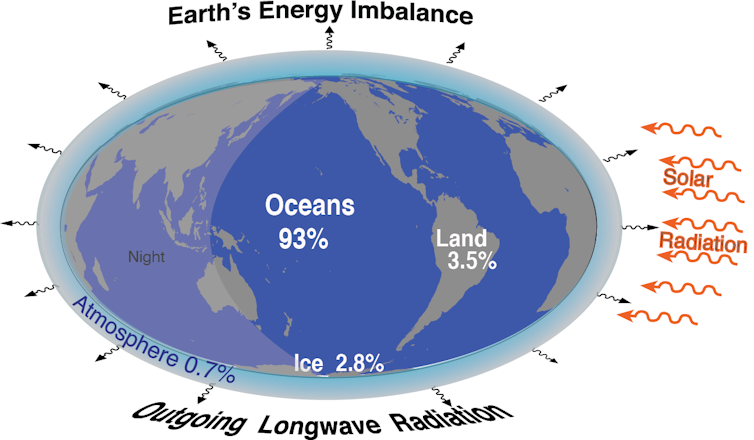
Globe illustration showing energy in and out and the remainder, trapped by greenhouse gases, going primarily into the oceans
Outgoing radiation is decreasing, owing to increasing greenhouse gases in the atmosphere, and leading to Earth’s energy imbalance of 460 terawatts. The percentage going into each domain is indicated.
Kevin Trenberth, CC BY-ND

In comparison with the natural flow of energy through the climate system, 460 TW seems small – it’s only a fraction of 1 percent. Consequently, we cannot go outside and feel the extra energy. But the heat accumulates, and it is now having consequences.

To put that in perspective, the total amount of electricity generated worldwide in 2018 was about 2.6 TW. If you look at all energy used around the world, including for heat, industry and vehicles, it’s about 19.5 TW. Earth’s energy imbalance is huge in comparison.

Interfering with the natural flow of energy through the climate system is where humans make their mark. By burning fossil fuels, cutting down forests and releasing greenhouse gases in other ways, humans are sending gases like carbon dioxide and methane into the atmosphere that trap more of that incoming energy rather than letting it radiate back out.

Before the first industries began burning large amounts of fossil fuels in the 1800s, the amount of carbon dioxide in the atmosphere was estimated at around 280 parts per million of volume. In 1958, when Dave Keeling began measuring atmospheric concentrations at Mauna Loa in Hawaii, that level was 310 parts per million. Today, those values have climbed to about 415 parts per million, a 48% increase.

Carbon dioxide is a greenhouse gas, and increased amounts cause heating. In this case, the human increment is not small.

Where does the extra energy go?

Measurements over time show that over 90% of this extra energy is going into the oceans, where it causes the water to expand and sea level to rise.

The upper layer of the oceans started warming around the 1970s. By the early 1990s, heat was reaching 500 to 1,000 meters (1,640 to 3,280 feet) deep. By 2005, it was heating the ocean below 1,500 meters (nearly 5,000 feet).
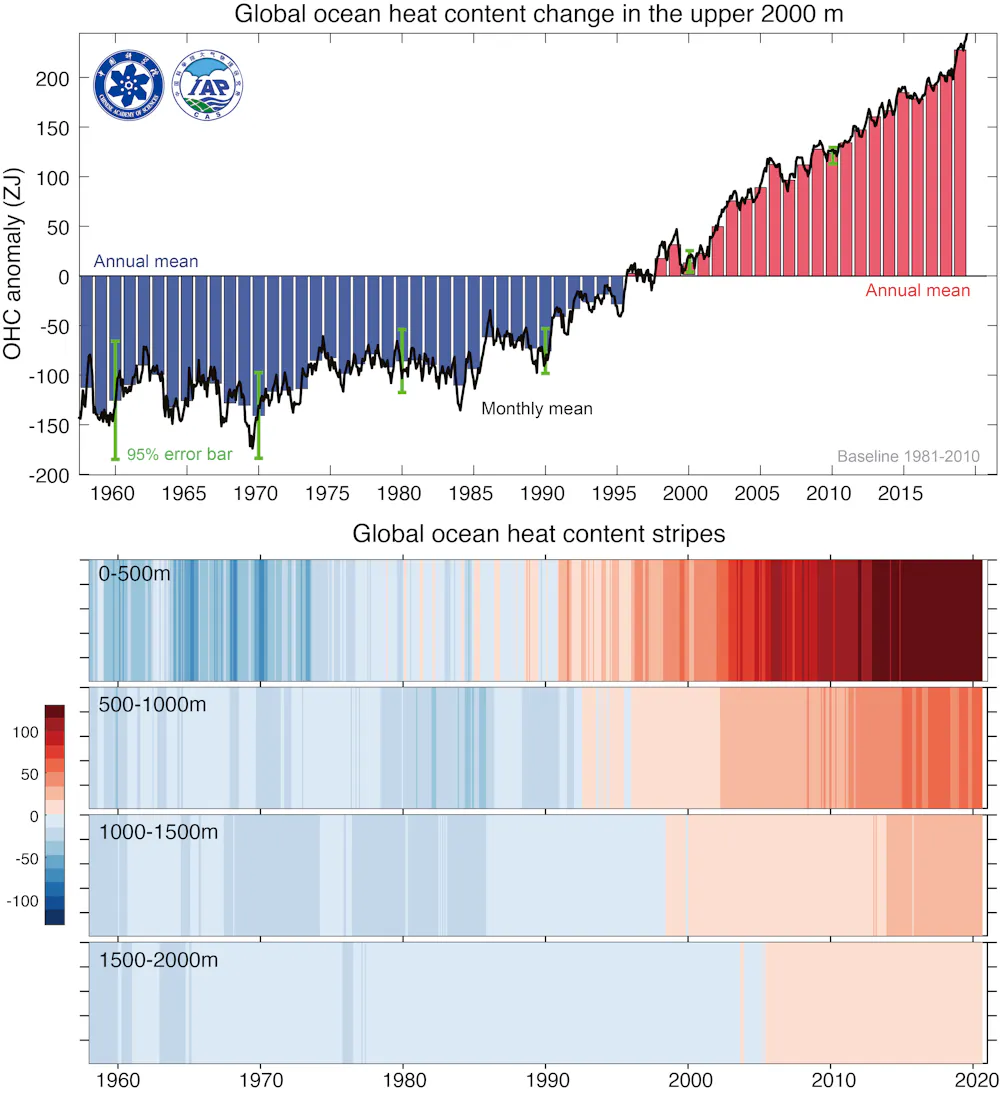
Two charts, one showing the annual increase in temperature in the top 2000 meters of ocean. The other is colored stripes showing heat increasing at several levels.
The average global temperature change at different ocean depths, in zetajoules, from 1958 to 2020. The top chart shows the upper 2,000 meters (6,561 feet) compared with the 1981-2010 average. The bottom shows the increase at different depths. Reds are warmer than average, blues are cooler.
Cheng et al, 2021, CC BY-ND

Global sea level, measured by flights and satellites, was rising at a rate of about 3 millimeters per year from 1992 to 2012. Since then, it been increasing at about 4 millimeters a year. In 29 years, it has risen over 90 millimeters (3.5 inches).

If 3.5 inches doesn’t sound like much, talk to the coastal communities that exist a few feet above sea level. In some regions, these effects have led to chronic sunny day flooding during high tides, like Miami, San Francisco and Venice, Italy. Coastal storm surges are higher and much more destructive, especially from hurricanes. It’s an existential threat to some low-lying island nations and a growing expense for U.S. coastal cities.

Some of that extra energy, about 13 terawatts, goes into melting ice. Arctic sea ice in summer has decreased by over 40% since 1979. Some excess energy melts land ice, such as glaciers and permafrost on Greenland, Antarctica, which puts more water into the ocean and contributes to sea level rise.

Some energy penetrates into land, about 14 TW. But as long as land is wet, a lot of energy cycles into evapotranspiration – evaporation and transpiration in plants – which moistens the atmosphere and fuels weather systems. It is when there is a drought or during the dry season that effects accumulate on land, through drying and wilting of plants, raising temperatures and greatly increasing risk of heat waves and wildfire.

Consequences of more heat

Over oceans, the extra heat provides a tremendous resource of moisture for the atmosphere. That becomes latent heat in storms that supersizes hurricanes and rainstorms, leading to flooding, as people in many parts of the world have experienced in recent months.

Air can contain about 4% more moisture for every 1 degree Fahrenheit (0.55 Celsius) increase in temperature, and air above the oceans is some 5% to 15% moister than it was prior to 1970. Hence, about a 10% increase in heavy rain results as storms gather the excess moisture.

Again, this may not sound like much, but that increase enlivens the updrafts and the storms, and then the storm lasts longer, so suddenly there is a 30% increase in the rainfall, as has been documented in several cases of major flooding.
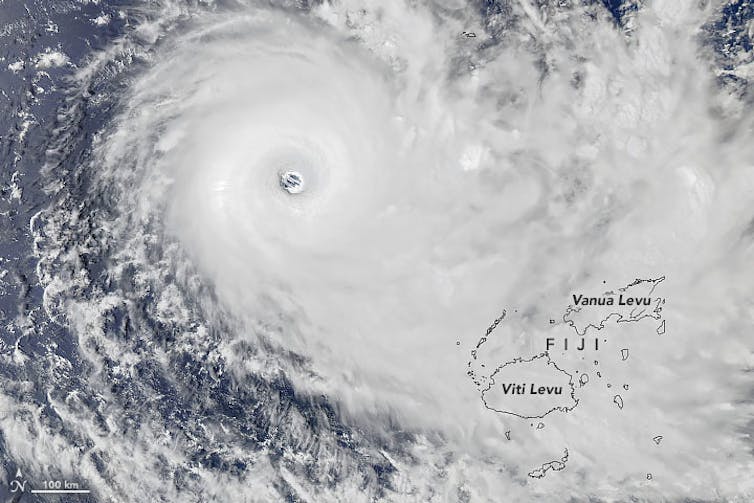
Satellite view of a hurricane with outlines of the islands in its path
Cyclone Yasa heads for Fiji in December 2020. It was the fourth most-intense tropical cyclone on record in the South Pacific.
NASA Earth Observatory

In Mediterranean climates, characterized by long, dry summers, such as in California, eastern Australia and around the Mediterranean, the wildfire risk grows, and fires can be readily triggered by natural sources, like dry lightning, or human causes.

Extreme events in weather have always occurred, but human influences are now pushing them outside their previous limits.

The straw that breaks the camel’s back syndrome

So, while all weather events are driven by natural influences, the impacts are greatly magnified by human-induced climate change. Hurricanes cross thresholds, levees break and floods run amok. Elsewhere, fires burn out of control, things break and people die.

I call it “The straw that breaks the camel’s back syndrome.” This is extreme nonlinearity, meaning the risks aren’t rising in a straight line – they’re rising much faster, and it confounds economists who have greatly underestimated the costs of human-induced climate change.

The result has been far too little action both in slowing and stopping the problems, and in planning for impacts and building resilience – despite years of warnings from scientists. The lack of adequate planning means we all suffer the consequences.

[The Conversation’s science, health and technology editors pick their favorite stories. Weekly on Wednesdays.]The Conversation

Kevin Trenberth, Distinguished Scholar, National Center for Atmospheric Research

This article is republished from The Conversation under a Creative Commons license. Read the original article.

Continue ReadingClimate change is relentless: Seemingly small shifts have big consequences

Just Stop Oil: Pair guilty of damaging Van Gogh painting’s frame

Spread the love
Image: sailko at https://commons.wikimedia.org, licensed under the Creative Commons Attribution-Share Alike 3.0 Unported

https://www.bbc.com/news/uk-england-london-63717863

Two Just Stop Oil protesters have been found guilty of causing criminal damage to a Vincent Van Gogh painting’s frame after gluing themselves to it.

Louis McKechnie, 22, and Emily Brocklebank, 23, caused about £2,000 of damage to the frame of Peach Trees In Blossom at London’s Courtauld Gallery.

McKechnie was jailed for three weeks while Brocklebank received a suspended sentence.

She had said: “I didn’t think I would cause much damage. Glue comes off.”

Continue ReadingJust Stop Oil: Pair guilty of damaging Van Gogh painting’s frame

Extinction Rebellion actions at fossil fuel enablers across London

Spread the love

From 11am on Monday November 21st, Extinction Rebellion and other aligned groups took nonviolent action at thirteen sites across central London, targeting the offices of companies and organisations which have links to the fossil fuel industry. The groups sent a universal message that it’s time to ‘cut the ties’ with fossil fuels.  

Actions took place at BP, Hill+Knowlton Strategies, BAE Systems, Church House, Ineos, Eversheds Sutherland, Schlumberger, the International Maritime Organisation, the Institute of Economic Affairs, JP Morgan, Arch Insurance, the Ontario Teachers Pension Plan and the Department for Business, Energy and Industrial Strategy. 

The actions follow the conclusion of COP27 in Egypt, which was widely criticised for the heavy presence of representatives of oil and gas companies. Hill+Knowlton Strategies, one of the companies targeted today, has worked for fossil fuel companies ExxonMobil, Shell, Chevron and Saudi Aramco and recently managed communications for Egypt’s presidency of the UN climate conference at Sharm El Sheikh.

Extinction Rebellion spokesperson, Sarah Hart, said: “Behind incomprehensible government decisions to double down on fossil fuel development, sign off new oil exploration licenses and allow the big energy companies to rake in record profits, lies a network of companies and organisations that are profiting from this destructive path. 

“While the rest of us worry about the cost of turning the heating on our government is prioritising the profits of the very companies that are jeopardising our climate and environment. But everyday people are way ahead of politicians. They want to be able to heat their homes and they want a future for their children. 

“So today, Extinction Rebellion are sending the message that it’s time to cut the ties with fossil fuels or lose the social license to operate in the UK.”

DETAILS OF THE ACTIONS: 

XR Cymru at Hill+Knowlton Strategies offices, Clerkenwell Green
XR Cymru splattered fake oil over the offices of public relations consultancy Hill+Knowlton Strategies. Hill+Knowlton has worked for fossil fuel companies ExxonMobil, Shell, Chevron and Saudi Aramco and recently managed communications for Egypt’s presidency of the UN climate conference at Sharm El Sheikh.

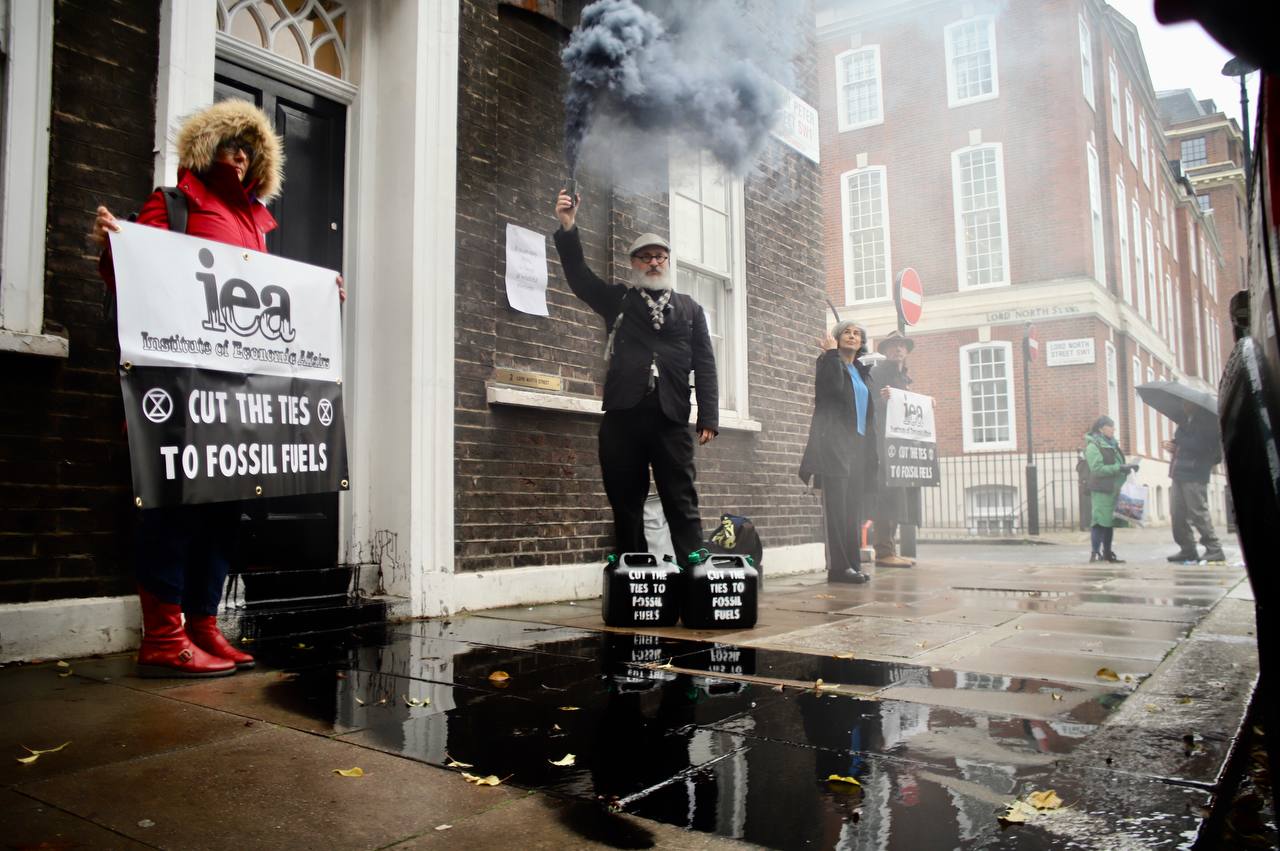
IEA Writers Rebel. Photo: Extinction Rebellion.

Writers Rebel at the Institute of Economic Affairs, Lord North Street
Writers Rebel poured fake oil on the front steps of free market think tank the Institute of Economic Affairs. The institute, located just meters from the Houses of Parliament, has received money from fossil fuel companies, regularly publishes materials questioning the consensus on climate science and has huge influence on politicians.

21st Nov 2022. J P Morgan offices, 60 Victoria Embankment, London, UK. Three Doctors for XR arrested after pasting posters and gluing themselves to the outside windows.Photo: Extinction Rebellion.

Doctors for XR at JP Morgan, Victoria Embankment 
Doctors for XR glued themselves to the windows at the London HQ of JP Morgan and pasted images to the front facade of the building depicting scenes of climate breakdown both here in the UK and overseas. JP Morgan are the world’s biggest fossil fuel financiers.

Christian Climate Action at BAE Systems offices, Carlton Gardens
Christian Climate Action left handprints of fake blood and oil on the offices of Britain’s leading arms manufacturer BAE Systems. BAE Systems supply weaponry to conflicts which increase the vulnerability of people living on the front lines of climate change. The arms giant also provides military and technical support to Saudia Arabia, enabling the regime’s oil production.

Christian Climate Action. Photo: Extinction Rebellion Holly

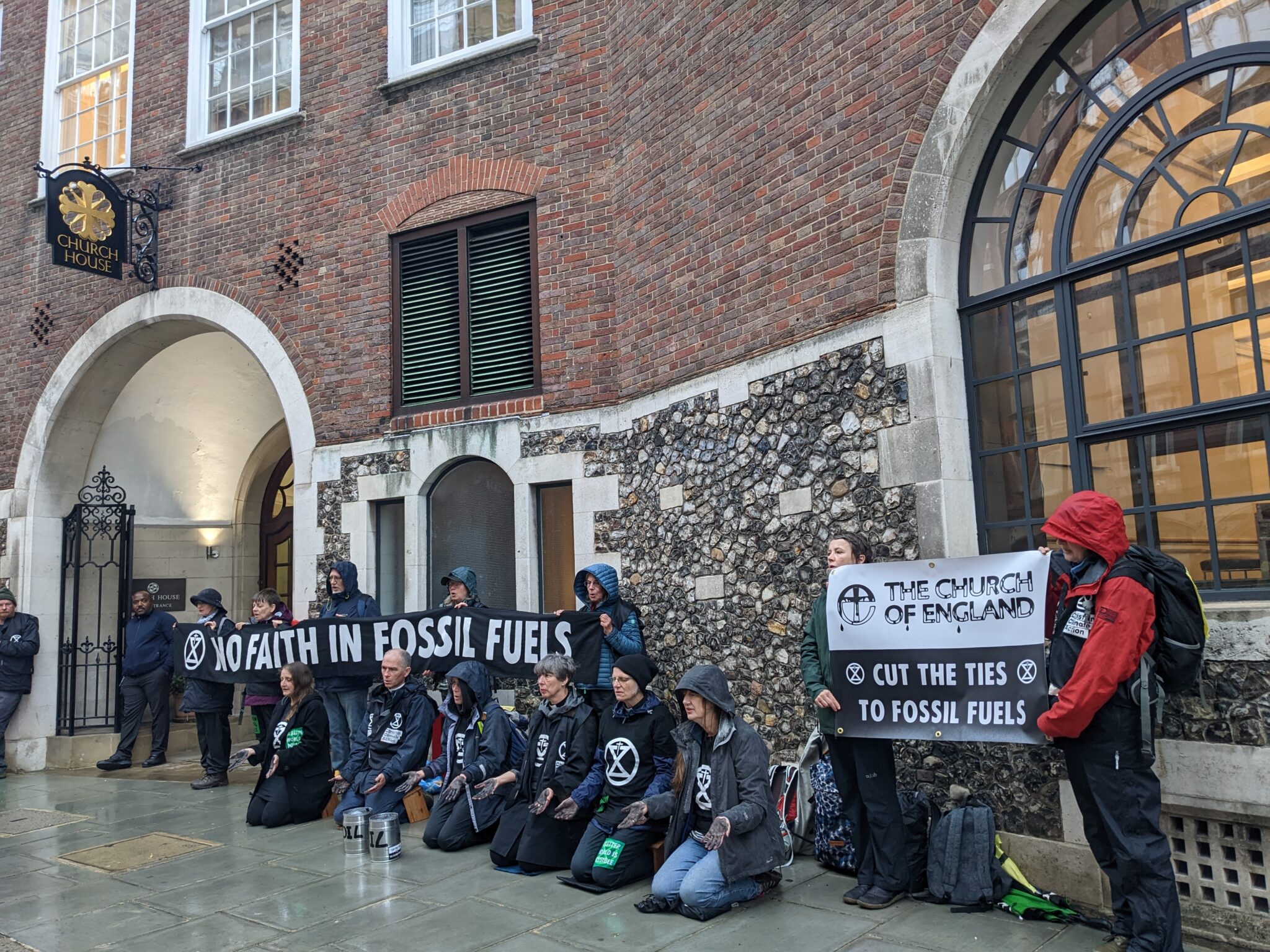
Christian Climate Action at Church House, Great Smith Street
Christian Climate Action also took action outside Church House in Westminster to highlight the Church of England’s failing strategy to stay invested in fossil fuels and influence the industry as shareholders.

A spokesperson for Christian Climate Action, said: “The Church should be showing moral leadership in rejecting profiting from investments in companies that continue to fuel climate suffering.”

Plastics Rebellion at Ineos offices, Hans Crescent
Plastics Rebellion sprayed fake oil outside the offices of Ineos, one of the world’s largest petrochemical producers and a significant player in the oil and gas market. Many of the plastics produced in the UK start their life at the INEOS Grangemouth refinery.

HS2 Rebellion at Eversheds Sutherland, Wood Street
HS2 Rebellion sprayed the offices of multinational law firm Eversheds Sutherland with fake oil. As solicitors for HS2 and Esso, Eversheds Sutherland have been forerunners in criminalising nonviolent environmental protest through the use of injunctions.

XR East of England and XR Youth at Schlumberger offices in London, Buckingham Gate
XR East of England and XR Youth poured fake oil over a globe at the offices of the world’s largest oilfields services provider Schlumberger to expose their complicity in ecocide. As the world’s largest oilfield services provider, Schlumberger enable fossil fuel extraction, operating in 120 countries around the world, with over 36,000 patents dedicated to extracting every last drop of oil and gas from the ground.

Ocean Rebellion at the International Maritime Organisation, Albert Embankment 
Ocean Rebellion held protests outside the offices of the International Maritime Organisation where performances illustrated the UN shipping body’s refusal to regulate shipping emissions. A heavy plume of smog filled the air and an oil slick appeared on the ground with dead birds caught in it.

Money Rebellion at Arch Insurance, Great Tower Street
Money Rebellion poured fake oil at the offices of Arch Insurance. Arch Insurance are understood to be in negotiations with fossil fuel giant Total regarding the insurance of the East Africa Crude Oil Pipeline (EACOP), a project that will jeopardise important ecosystems, fuel climate change and pose significant risks to millions of people. Money Rebellion is there to say ‘Arch must rule out EACOP’.

Sky Rebellion at Ontario Teacher’s Pension Plan, Portman Square
Sky Rebellion poured fake oil in front of the London offices of Ontario Teacher’s Pension Plan. The Canadian based pension fund invests in infrastructure projects including the controversial expansion of Bristol Airport which it owns.

XR South East at BP. Photo: Extinction Rebellion

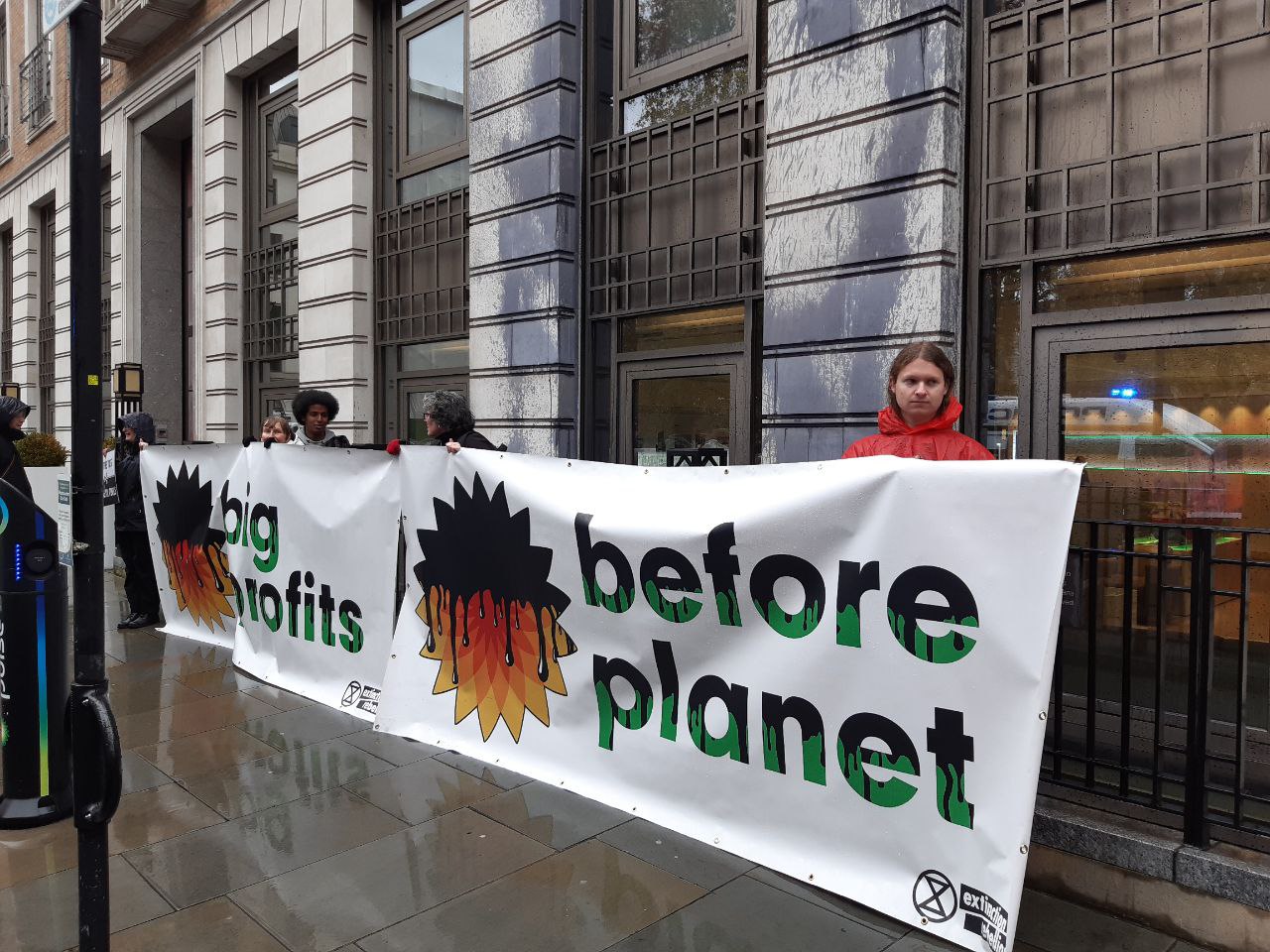
XR South East at BP HQ, St James’ Square
XR South East used fire extinguishers to spray fake on oil BP headquarters in central London. 

A spokesperson for XR South East, said: “The addiction to fossil fuels must end. The huge fossil fuel corporations like BP and those who aid and abet them KNOW what we face. BP hides the dirty secrets that lie behind its latest big profit of £7,100,000,000. Enough is enough. Today we are exposing the ties between the collaborators and we will piece together the web of lies with our actions.”

XR South West at the Department for Business, Energy and Industrial Strategy, Victoria Street
XR South West sprayed fake oil on the Department for Business, Energy and Industrial Strategy to protest against its plans to issue more than 100 new licences for exploration and extraction of oil and gas in the North Sea – meaning renewed and accelerating extraction way beyond 2030 and way beyond the UK’s Paris Agreement commitments.

XR Rhythms (marching between the locations listed above)
In June, London endorsed the Fossil Fuel Non-Proliferation Treaty, so XR Rhythms is marching through London to highlight the web of fossil fuel enablers still working in our city. We want to drum out fossil fuel investments and celebrate the future transition to a more sustainable economy!

[from an Extinction Rebellion press release.]

Continue ReadingExtinction Rebellion actions at fossil fuel enablers across London

The Superyacht Forum engage with Extinction Rebellion

Spread the love

https://www.superyachtnews.com/business/extinction-rebellion-invited-on-stage-at-tsf

The Extinction Rebellion Group offered food for thought at this year’s The Superyacht Forum event after turning up on the final day to protest against the existence of the industry. The group arrived at roughly 9:30am on Wednesday morning with a megaphone and banners to peacefully protest against the complicit behaviour of stakeholders in yachting – they also made it clear they would not be using superglue or tins of tomato soup. We invited the group on stage to speak candidly to the nucleus of the industry about their reasoning and motivations.

Full unedited transcript [follows]

Continue ReadingThe Superyacht Forum engage with Extinction Rebellion

‘Another Terrible Failure’: COP27 Ends With No Action to Cut Off Climate-Wrecking Fossil Fuels

Spread the love

Republished from Common Dreams under Creative Commons (CC BY-NC-ND 3.0). Feel free to republish and share widely.

“If all fossil fuels are not rapidly phased out, no amount of money will be able to cover the cost of the resulting loss and damage,” said one climate justice advocate.

KENNY STANCILNovember 21, 2022

Despite mountains of iron-clad evidence that extracting and burning more coal, oil, and gas will exacerbate deadly planetary heating, negotiators at the United Nations COP27 climate conference failed yet again to directly confront the fossil fuel industry whose insatiable quest for profits is putting the future of humanity in jeopardy.

“More fossil fuels equals more loss and damage.”

“In a critical year, this COP made no progress towards the just and equitable phase-out of fossil fuels needed to avoid the worst impacts of climate change,” Oil Change International executive director Elizabeth Bast said Sunday in a statement. “Despite important progress on the establishment of a loss and damage fund, the final outcome reiterated unambitious language on fossil fuels that will lead to catastrophic consequences.”

In what climate justice advocates called a major breakthrough, the United States on Saturday dropped its opposition to the establishment of a loss and damage fund that aims to compensate low-income nations for the devastating effects of global warming. Through no fault of their own, the world’s poorest people are most vulnerable to the deadly impacts of increasingly frequent and intense extreme weather caused primarily by wealthy polluters. A committee of 24 countries has one year to hammer out details, including which governments will contribute to the fund and which will benefit from it.

However, “COP27’s key steps toward a loss and damage fund are deeply marred by the lack of progress on fossil fuels,” said Collin Rees, U.S. campaign manager for Oil Change International. “Despite unprecedented discussion of equitably phasing out oil, gas, and coal, the end result was yet another COP without formal recognition that Big Oil is driving the climate crisis and harming communities.”

“The failure of leaders at COP27 to commit to an unqualified phase-out of oil, gas, and coal not only pushes 1.5ºC further out of reach, it also undermines progress on loss and damage,” Nikki Reisch, director of climate and energy at the Center for International Environmental Law, wrote on social media. “The plain truth is that more fossil fuels equals more loss and damage. Remedy requires cessation of the harm.”

“In settling for a copy-paste of the Glasgow Pact’s incomplete and loophole-ridden language on a ‘phasedown of unabated coal power’ and ‘phase-out of inefficient fossil fuel subsidies,'” Reisch continued, “governments at COP27 took a giant step backward.”

This critical assessment was shared by many observers.

“If all fossil fuels are not rapidly phased out, no amount of money will be able to cover the cost of the resulting loss and damage,” said Yeb Saño, executive director of Greenpeace Southeast Asia. “When your bathtub is overflowing you turn off the taps, you don’t wait awhile and then go out and buy a bigger mop.”

Republished from Common Dreams under Creative Commons (CC BY-NC-ND 3.0). Feel free to republish and share widely.

Ahead of the COP27 summit, the U.N. found that Earth is on currently track to be up to 2.9°C hotter than the preindustrial average by century’s end. Existing emissions reductions targets and policies are so weak, the body warned, that there is “no credible path to 1.5°C in place,” and only “urgent system-wide transformation” can prevent the world from crossing dangerous tipping points that will lead to the most cataclysmic outcomes.

Temperature rise of roughly 1.2°C to date has already unleashed chaos around the world, including calamitous flooding in Nigeria and Pakistan, along with several other disasters in various places this year.

Despite the worsening nature of the fossil fuel-driven climate emergency, hundreds of corporations are planning to expand dirty energy production in the coming years, including several proposed drilling projects and pipelines in Africa. To make matters worse, delegates at COP27—where more than 630 fossil fuel industry representatives made their presence felt—refused to endorse a complete phase-out of coal, oil, and gas.

“We are at risk of a major surge of new oil and gas production.”

“I don’t in any way want to diss the great success by poorer nations in achieving a loss and damage agreement,” environmental journalist George Monbiot tweeted Sunday, though he predicted that “rich nations will break their promises to pay,” as they have when it comes to providing $100 billion each year to fund climate action in the Global South. “There was no progress on stopping climate breakdown. COP27 is another terrible failure.”

“Whenever an agreement is reached at one of these meetings, people celebrate, largely with relief at having got to the end,” Monbiot added. “It’s only afterwards that we begin to ask, ‘What exactly has been achieved?’ If it’s is anything other than decisive action, the answer is not much.”

David Tong, global industry campaign manager at Oil Change International, said that “some people turned up to negotiate for their futures, but oil and gas lobbyists turned up to negotiate for their wallets.”

“The reality is that the only way to safely limit warming to 1.5ºC is to equitably phase out oil, gas, and coal,” said Tong. “Instead, we are at risk of a major surge of new oil and gas production.”

Tong noted that “new fields and shale wells approved from 2022-2025 could result in 70 gigatonnes of additional climate pollution—and every single tonne of that would take us further beyond 1.5ºC because burning just the oil and gas in already existing fields would exhaust our carbon budget for a 50% chance at 1.5ºC.”

“Although this COP failed to call for an equitable phase-out of oil, gas, and coal,” Tong continued, “momentum is growing. A remarkable group of countries across numerous negotiating blocs spoke up together, urging the phase-out of fossil fuels.”

Notwithstanding the anti-extraction struggles being waged by communities and climate justice campaigners the world over, Seve Paeniu, minister of finance for the Pacific island nation of Tuvalu, denounced his fellow policymakers for omitting language that explicitly demands a fossil fuel phase-out. Tuvalu called for a Fossil Fuel Non-Proliferation Treaty at COP27, becoming the second country to do so, after Vanuatu at the U.N. General Assembly in September.

“We have finally responded to the call of hundreds of millions of people across the world to help them address loss and damage. So this is a defining COP in that respect,” said Paeniu. “However, it is regrettable that we haven’t achieved an equal success in our attempt to achieve the 1.5ºC target. It is regrettable that we haven’t got strong language included in the cover decision before us on phasing out fossil fuel.”

“It is regrettable that we haven’t got text on peaking emissions before 2025,” Paeniu continued. “It is regrettable that we haven’t managed to get stronger mention of methane reduction.”

“In Glasgow, we saw a phase-down of coal,” Zeina Khalil Hajj, head of global campaigning and organizing at 350.org, said in a statement. “At COP27 in Sharm El-Sheikh, we needed to see an equitable and just phase-out of all fossil fuels.”

“A text that does not stop fossil fuel expansion, that does not provide progress from the already weak Glasgow Pact makes a mockery of the millions of people living with the impacts of climate change,” Hajj continued. “The agreement on loss and damage is a major breakthrough, but without action to phase out the expansion of the fossil fuels that will cause further loss and damage, COP27 has failed to make the progress needed. And we are building a fund for our own destruction.”

Bast, for her part, said that “even with this disappointing outcome, we’re seeing growing momentum from individual governments making meaningful commitments to phase out fossil fuels through initiatives like the Beyond Oil and Gas Alliance and the Statement on International Public Support for the Clean Energy Transition.”

“Most importantly, COP27 has showcased the growing power of the climate justice movement,” said Bast. “Throughout these two weeks, civil society voices have demanded a phase-out of fossil fuels and called for rich countries to pay up for climate debt.”

“Every day, we are seeing the power of communities resisting harmful oil, gas, and coal projects,” she added. “We are seeing massive growth in the breadth and depth of the movement. With this people power, we will force an equitable end to fossil fuels and a just transition to clean energy.”

Republished from Common Dreams under Creative Commons (CC BY-NC-ND 3.0). Feel free to republish and share widely.

Continue Reading‘Another Terrible Failure’: COP27 Ends With No Action to Cut Off Climate-Wrecking Fossil Fuels