‘Abdication of Responsibility’: Fury as COP27 Draft Omits Oil and Gas Phase-Out

Spread the love

Republished from Common Dreams under Creative Commons (CC BY-NC-ND 3.0). Feel free to republish and share widely.

“At a COP shaped by more than 600 fossil-fuel lobbyists roaming the halls, parties fighting for progress must push back against weak language that allows the fossil fuel industry to continue its deadly expansion,” said one campaigner.

Julia Conley November 17, 2022

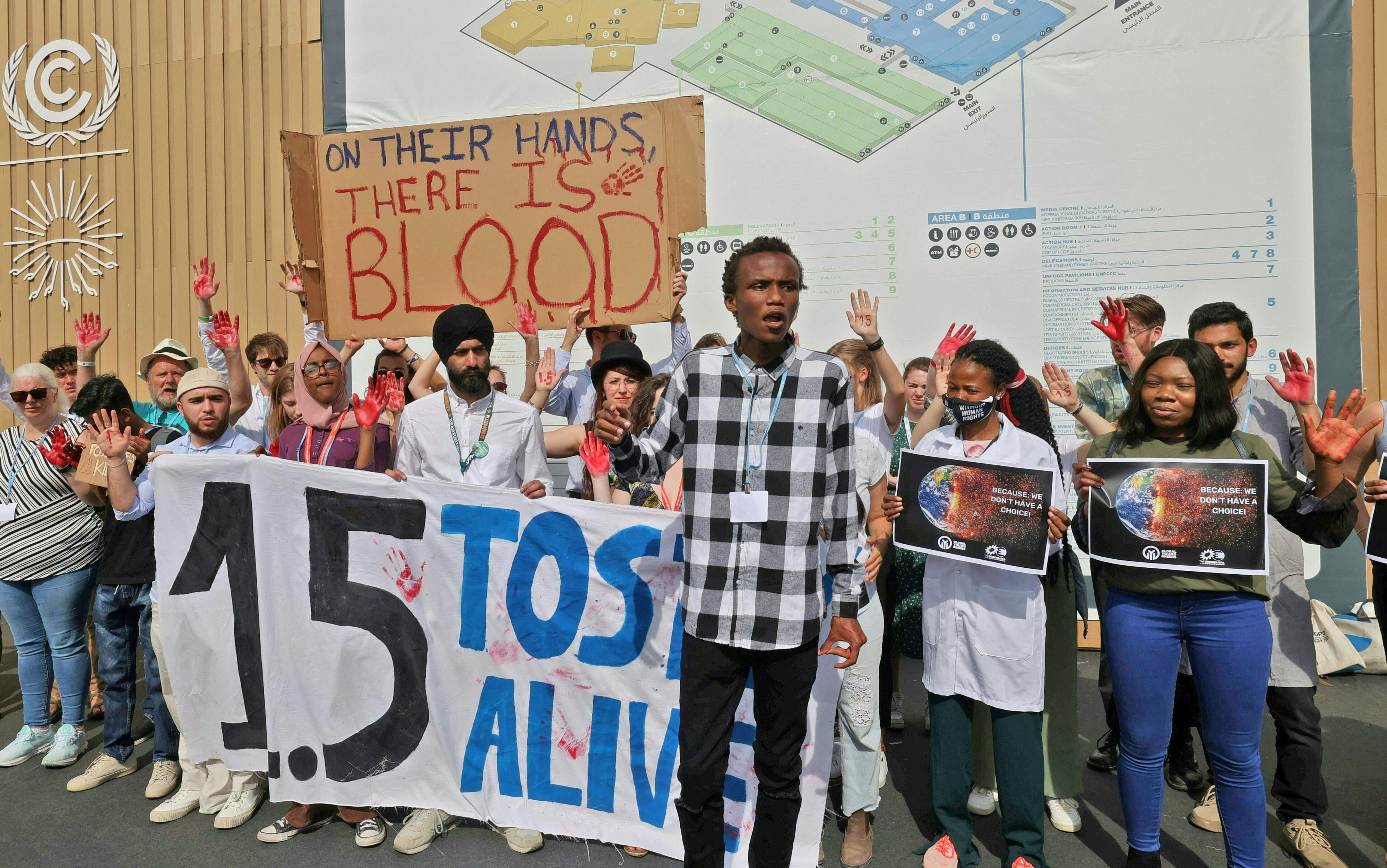
Climate action groups were outraged Thursday as global policymakers released a draft agreement making clear that dire warnings from energy experts and scientists regarding fossil fuel extraction have not gotten through to them, with the document failing to endorse a phase-out of oil and gas use.

The draft agreement was published as the 2022 United Nations Climate Change Conference (COP27) comes to a close in Sharm el-Sheikh, Egypt, and is expected to be heavily revised in the coming days.

“As climate impacts and injustice accelerate, lives, livelihoods, cultures, and even whole countries are lost, the latest draft cover note from the COP27 presidency pushes the pedal to the metal on the highway to climate hell.”

The absence of crucial language regarding oil and gas left campaigners concerned that the conference, where hundreds of fossil fuel lobbyists were present, will ultimately fail to produce an agreement that treats the climate crisis with the urgency needed.

“We came to Sharm el-Sheikh to demand real action on meeting and exceeding climate finance and adaptation commitments, a phase-out of all fossil fuels and for rich countries to pay for the loss and damage done to the most vulnerable communities within developing countries by agreeing a Loss and Damage Finance Fund,” said Yeb Saño, Greenpeace International’s head of delegation at the summit. “None of that is on offer in this draft. Climate justice will not be served if this sets the bar for a COP27 outcome.”

The draft agreement “encourages the continued efforts to accelerate measures towards the phase-down of unabated coal power and phase out and rationalize inefficient fossil fuel subsidies.”

It also echoes the call in last year’s document out of COP26 to emphasize “the importance of exerting all efforts at all levels to achieve the Paris agreement temperature goal of holding the increase in the global average temperature to well below 2°C above pre-industrial levels and pursuing efforts to limit the temperature increase to 1.5°C above pre-industrial levels.”

But the omission of a phase-out of all fossil fuel extraction, which delegates from India have lobbied for at COP27 and which the U.S., U.K., and European Union expressed conditional support for in recent days, denotes a draft document that “ignores the science of 1.5°C” even as it pledges to limit the temperature increase, said Tzeporah Berman, chair of the Fossil Fuel Non-Proliferation Treaty Initiative.

“Acknowledging only the need to phase down coal while ignoring oil and gas is hugely problematic. This predatory delay is out of line with the science and with 1.5 degrees,” Collin Rees, campaign manager at Oil Change International, told Bloomberg. “At a COP shaped by more than 600 fossil-fuel lobbyists roaming the halls, parties fighting for progress must push back against weak language that allows the fossil fuel industry to continue its deadly expansion.”

The draft is the first agreement out of an annual U.N. climate conference to address “loss and damage”—the harms already suffered by countries in the Global South due to the climate crisis and the need for wealthy governments to help finance their recovery.

The document does not provide details about how a loss and damage fund would operate, saying only that it “welcomes” the inclusion of the issue in the final agreement.

“More than 40 million people in the Horn of Africa are currently experiencing climate-induced hunger crisis,” said Nafkote Dabi, climate change policy lead for Oxfam, on Wednesday. “Pakistan is faced with $30 billion worth of loss and damage from the recent mass floods that left a third of the country under water. It is crucial that developing countries can access a formal fund to pay for the damages and losses they are already suffering today.”

Rich countries must meet their $100 billion annual goal for climate finance in addition to establishing a new Loss and Damage fund that is fit for purpose, accessible and gender responsive,” Dabi added. “Rich countries must heed the urgent call and deliver a loss and damage fund at COP27.”

Related Content
COP27 protest

As COP27 Failure Looms, Climate Movement Demands: ‘Phase Out All Fossil Fuels’

Brett Wilkins

The document includes some areas of improvement over the agreement written at COP26 last year, such as a call for multilateral development banks to scale up climate finance “without exacerbating debt burdens” for countries in the Global South, but leaves out details on how wealthy countries must strengthen their emissions-slashing targets.

“There should be a clear road map by those who are emitting a lot to start reducing their emissions,” Collins Nzovu, Zambia’s environment minister, told Bloomberg. “We are headed completely in the wrong direction—driving very, very fast into a ditch.”

Saño condemned the draft as “an abdication of responsibility to capture the urgency expressed by many countries to see all oil and gas added to coal for at least a phase-down.”

“As climate impacts and injustice accelerate, lives, livelihoods, cultures, and even whole countries are lost,” he added, “the latest draft cover note from the COP27 presidency pushes the pedal to the metal on the highway to climate hell.”

Republished from Common Dreams under Creative Commons (CC BY-NC-ND 3.0). Feel free to republish and share widely.

Continue Reading‘Abdication of Responsibility’: Fury as COP27 Draft Omits Oil and Gas Phase-Out

Is COP27 Already Too Lost and Too Damaged?

Spread the love

Republished from Common Dreams under Creative Commons Attribution-Noncommercial-No Derivative Works 3.0 United States License.

To date, the world’s wealthy countries have so far refused to pay for “loss and damage,” that is, to admit that they’ve massively polluted the atmosphere with carbon dioxide, methane and other greenhouse gasses.

Amy GoodmanDenis Moynihan November 17, 2022 by Democracy Now!

The United Nations Climate Change Conference has convened here in Sharm el-Sheikh, Egypt. It’s called COP27, the 27th Conference of Parties to the UN’s Framework Convention on Climate Change (UNFCCC), the ever-evolving, never-quite-fully-negotiated treaty that, it is hoped, will someday ensure all countries rapidly reduce greenhouse gas emissions to forestall catastrophic climate change. An estimated 30,000 people from around the world have descended on this Red Sea resort on the southern tip of the Sinai Peninsula. The summit is hosted by Egypt, a dictatorship propped up by billions of dollars annually in military aid from the United States. This has been dubbed “The Africa COP,” to highlight the continent’s plight as one of the world’s poorest regions, already suffering dire impacts of the climate crisis.

The phrase “Loss and Damage” denotes the devastating climate impacts millions are already experiencing in poor frontline nations—those that have contributed the least to global warming.

“This is not an African COP. Africa is not here,” Nnimmo Bassey, renowned Nigerian environmentalist, said on the Democracy Now! news hour. “The poor people who are suffering floods, droughts and all kinds of adverse situations, they are not here. They can’t afford to get here. They wouldn’t get accreditation. They can’t afford the accommodation in this city that is mostly for tourists…The other COPs were exclusive, but this is super exclusive. We are all cordoned into a peninsula, cut off from even the country in which we are supposed to be.” Bassey concluded, calling the UN climate process itself “lost and damaged.”

While Bassey has been coming to COPs for many years, members of the growing youth climate movement joined more recently. Vanessa Nakate founded the first climate strike in Uganda. “Fridays for Future” grew out of a solo protest by teenager Greta Thunberg in front of the Swedish parliament in August 2018 and blossomed into a global movement involving more than 14 million young people. Students take a school day off to strike, typically on Friday, demanding that the older people in charge take urgent action on the climate emergency.

In December, 2019, at COP25 in Madrid, Vanessa Nakate described her early days as a climate striker in Kampala, Uganda: “People found it very weird that I was on the streets. Some of them threw some negative comments, like I was wasting my time, and the government will not listen to anything that I have to say. But I just kept going.”

One month later, at the World Economic Forum in Davos, Switzerland, Vanessa was photographed with Greta and other youth activists. The Associated Press published an edited version of the photo, cropping Vanessa out of a group of five. The four remaining in the photo were white. The AP apologized and restored the image.

“Being cropped out of that photo changed me. I became bolder and more direct in how I talk about the climate crisis and racism,” Vanessa later wrote in her book, A Bigger Picture: My Fight to Bring a New African Voice to the Climate Crisis.

Here at COP27, Vanessa said on Democracy Now!, “We have more than 600 fossil fuel lobbyists at this COP, and yet so many communities and activists from the frontlines of the climate crisis weren’t able to make it here…The climate crisis is pushing so many communities beyond adaptation. You cannot adapt to starvation. You can’t adapt to extinction.”

She continued, “What will make it an African COP is ensuring that there is an establishment of a Loss and Damage Finance Facility…supporting a just transition to renewable energy while addressing the energy poverty on the African continent.”

The phrase “Loss and Damage” denotes the devastating climate impacts millions are already experiencing in poor frontline nations—those that have contributed the least to global warming. These developing countries are demanding that rich, historically high-polluting countries meet their pledges made at COP21 in Paris, in 2015, to contribute $100 billion per year to a fund “for mitigation and adaptation.” “Mitigation” refers to investments that lower emissions, like building renewable energy installations. and “adaptation” to building infrastructure and capacity to deal with the impacts of climate change—for example, building seawalls to cope with rising sea levels.

To date, the world’s wealthy countries have so far refused to pay for “loss and damage,” that is, to admit that they’ve massively polluted the atmosphere with carbon dioxide, methane and other greenhouse gasses—in the case of the United States and most of Europe, since the beginning of the Industrial Revolution—and thus must pay climate reparations for the impacts of their pollution.

But those who have been fighting for a just climate transition aren’t giving up hope. Hundreds packed into a People’s Plenary here as COP27 neared it close. Asad Rehman, lead spokesperson for the Climate Justice Coalition, offered his assessment of the entrenched fossil fuel interests as he rallied those gathered for the struggles ahead:

“The word they fear the most: solidarity.”

Republished from Common Dreams under Creative Commons Attribution-Noncommercial-No Derivative Works 3.0 United States License.

Continue ReadingIs COP27 Already Too Lost and Too Damaged?

Court finds Doctors for XR not guilty for Lambeth Bridge blockade

Spread the love

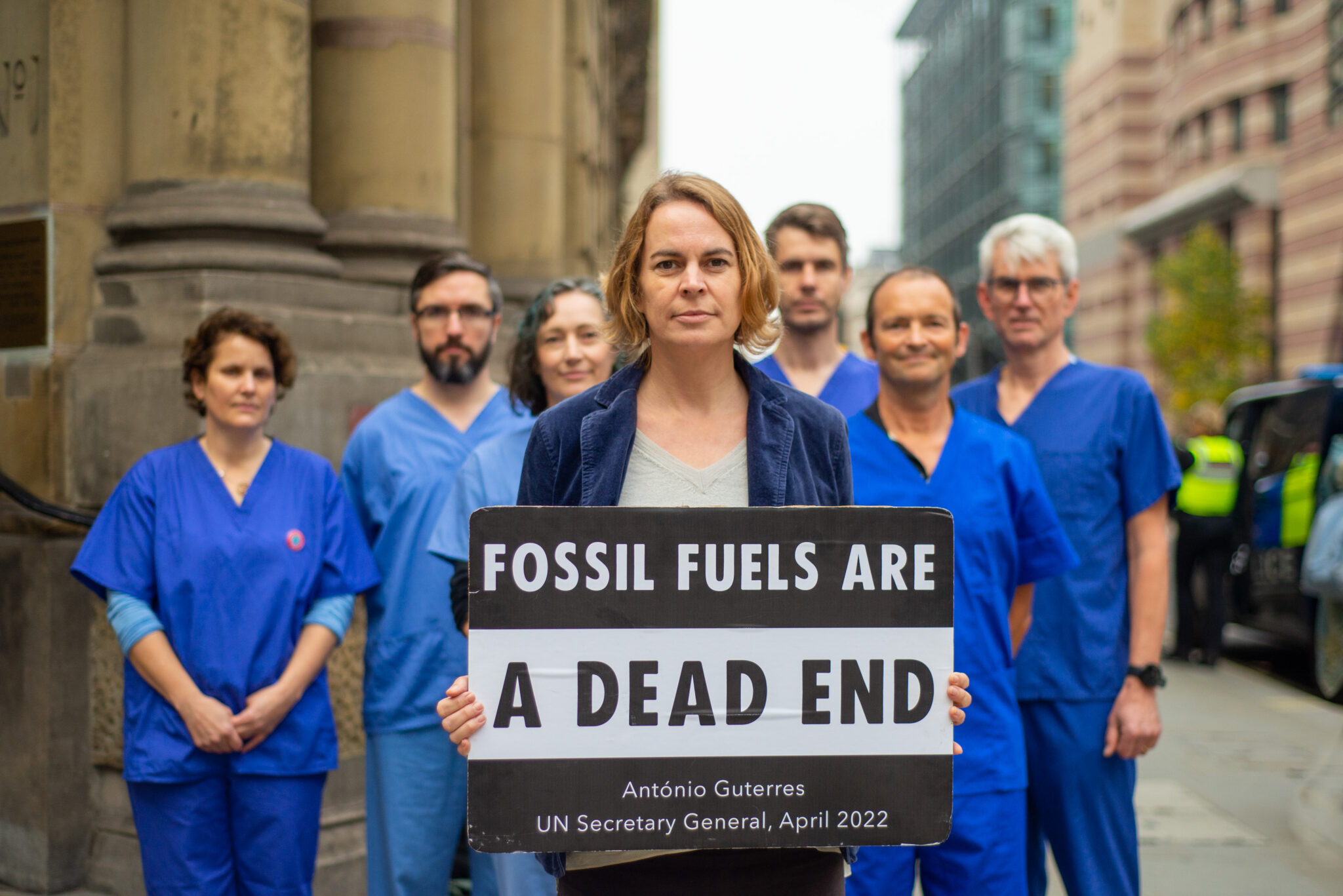
Seven health professionals have been acquitted at City of London magistrates’ court today. Dr David McKelvey, Dr Chris Newman, Dr Mark Russell and Dr Patrick Hart – all GPs, Dr Alice Clack – a hospital consultant obstetrician, Rosie Jones – a clinical psychologist and Anna Bunten – a specialist nurse, faced a charge of ‘breach of section 14’ of the public order act.

Judge Robinson remarked on acquittal, “I was impressed by the integrity and rationality of their beliefs” and “their evidence was highly moving.”

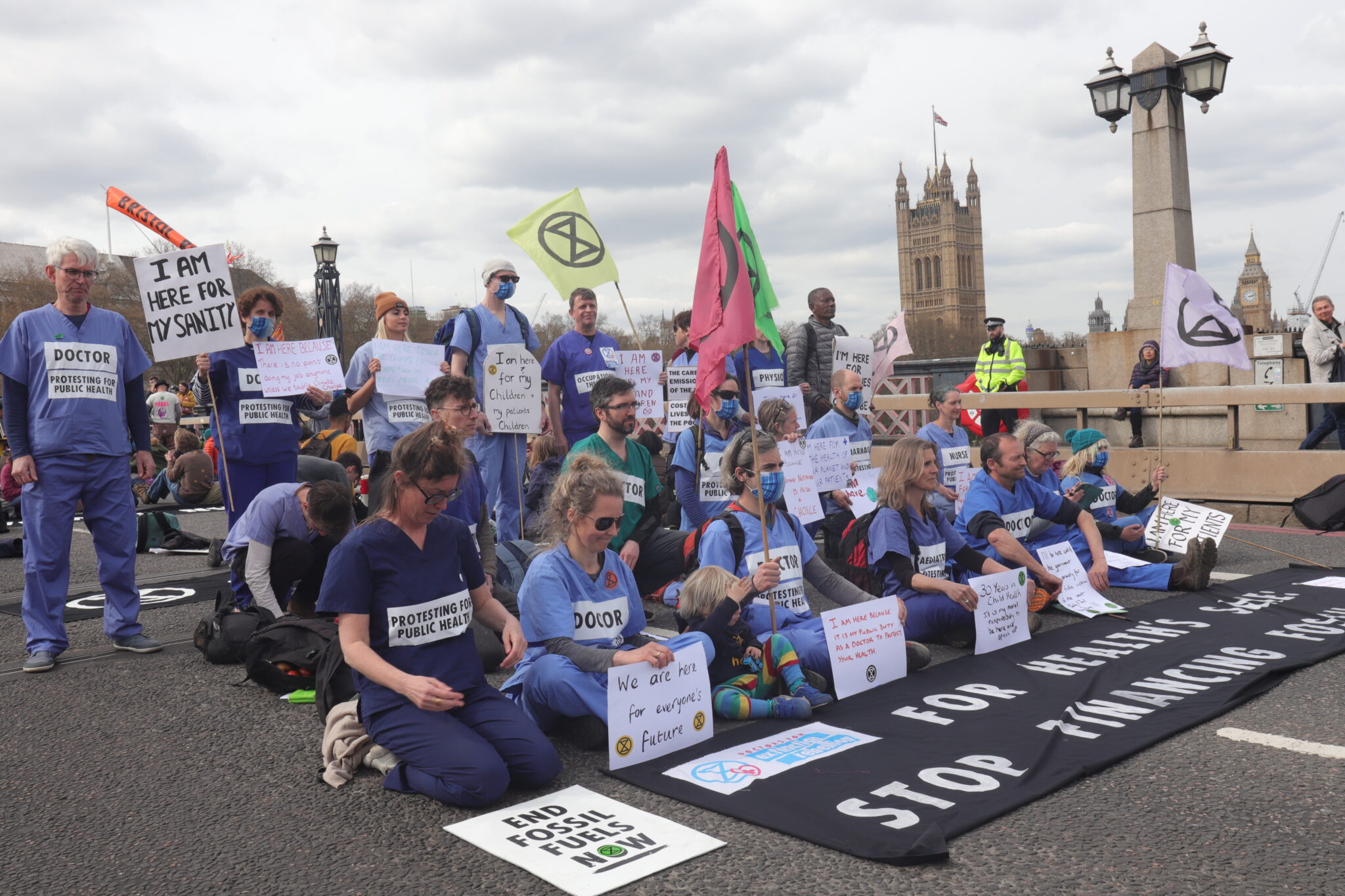
Doctors for XR block Lambeth Bridge 10th April 2022. Photo: Extinction Rebellion

They are part of a group of approximately thirty health professionals who blocked Lambeth bridge in the late afternoon of Sunday 10th April, including former Editor in Chief of the British Medical Journal, Dr Fiona Godlee. They displayed a banner saying ‘For Health’s Sake. Stop Financing Fossil Fuels’, to highlight the estimated £10 billion in annual  financial support the government gives to the fossil fuel industry, according to the OECD.

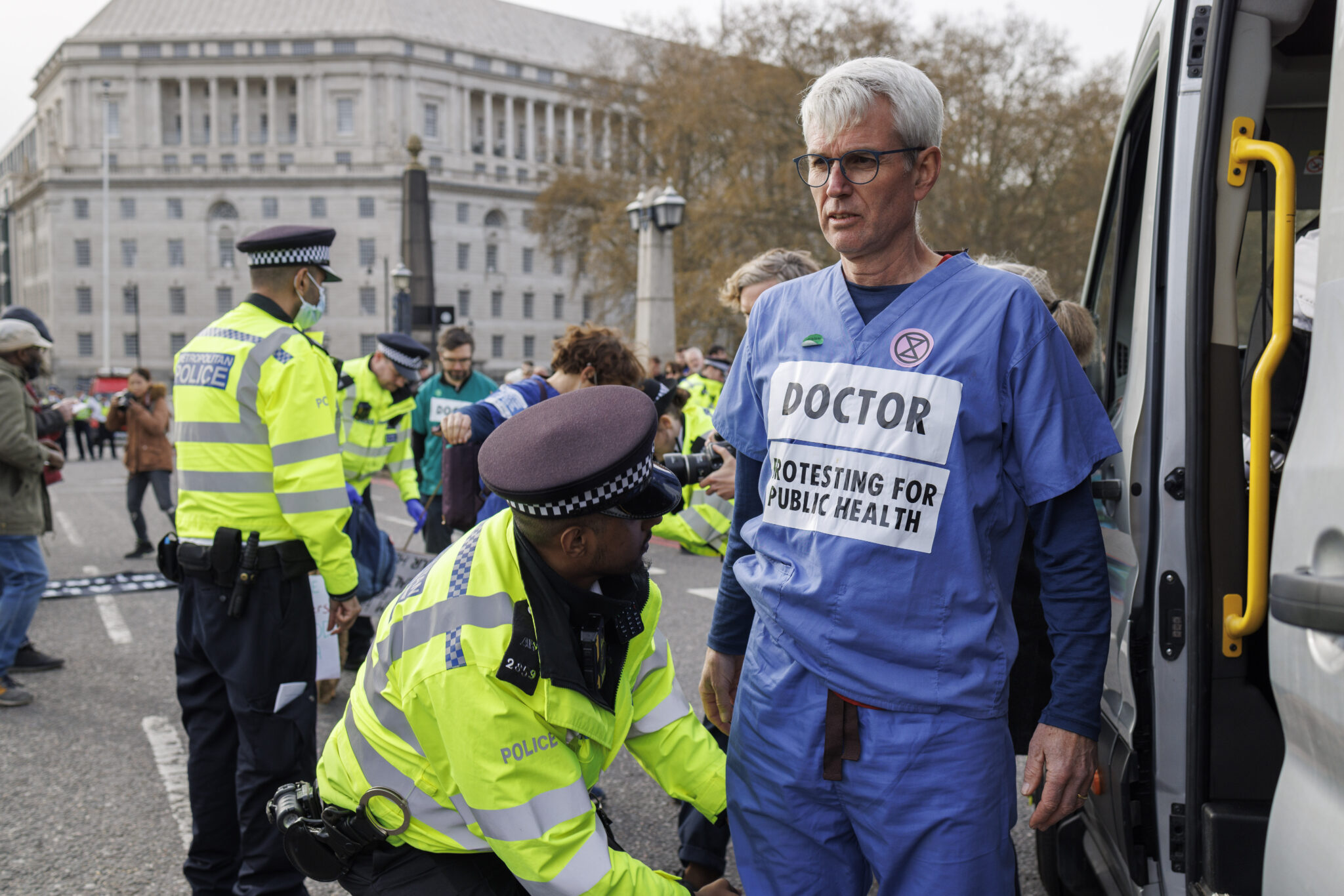
The group were present at an earlier blockade by Extinction Rebellion, which had taken place from 2pm to 4:30pm. Most protesters left by 4.30pm but the health professionals elected to block the bridge to make their own protest. Thirty minutes later, shortly after 5pm, they were arrested.

This followed an earlier protest on World Health Day, the 7th April, when the group blocked the road outside HM Treasury, while delivering a letter requesting ‘the removal of UK financial support for fossil fuels’. The Treasury made no immediate response but replied to the letter in May.

Doctors for XR block Lambeth Bridge 10th April 2022. Photo: Extinction Rebellion

Jenny Winter, a solicitor acting on behalf of Dr David McKelvey, said:“The right to peaceful protest is a cornerstone of any properly functioning democracy so that a government found wanting in protecting public interest or health is called to account. These health professionals have been exonerated of wrongdoing after raising the alarm about urgent, major, public health issues.”

Dr Fiona Godlee, Ambassador of the UK Health Alliance on Climate Change and former Editor in Chief of the British Medical Journal, said: “I was a part of the protest on Lambeth Bridge and these doctors and health professionals have my full support. They have acted at all times with enormous professionalism, courage and integrity. Their protest is in a long tradition of non-violent civil disobedience for causes that seek to improve social justice and, in the case of climate protest, to secure a liveable future for all. 

“By acting as they have done, they are fulfilling their duty of care to their patients and the public, alerting us all to the real and present dangers of the climate crisis and calling on our political leaders to act now to avoid climate catastrophe.”

Defendant Dr Chris Newman, a GP, said: “Medical institutions have been printing ever more concerned articles about the risks of climate change to health in the past couple of years, but it has not been enough. Protest, like this one, is like attempting to shock a failing heart, in the hope it will change its rhythm.  The Lancet said recently “There is some evidence that disruptive or radical non-violent actions…are successful at garnering public attention for a cause. Thankfully today, the court recognised that right to protest “

14.11.22_XR Docs_City of London Mags_Helena Smith_7224

Dr Patrick Hart, a GP, said: “I’m trying to make a point. It’s not about our morning coffee being too milky, it’s about the deaths of millions, the loss of everything we care about, in particular the loss of law and order. The level of disruption we caused was proportionate to the problems we face. I don’t want to be arrested, but I accept it as a consequence. I’m heavily invested in the rule of law, and I do this to protect the rule of law, 18 King’s Counsellors have said that we face the collapse of the rule of law.”

Anna Bunten, an Advanced Nurse Practitioner, said: “The Lancet, a top medical journal, said just this year ‘A persistent fossil fuel addiction is amplifying the health impacts of climate change, and compounding the concurrent energy, cost-of-living, food, and COVID-19 crises we face.’ We believe that this protest will help to wake us all up to this inconvenient truth and the need for society-wide change to get us off fossil fuels – our future health depends on it.”

DefendantDr Alice Clack, a Consultant Obstetrician, said: “As an Obstetrician it’s becoming ever more clear that climate change will impact the life of every child I deliver. UN Secretary General Antonio Guterres recently said ‘We have a rapidly closing window of opportunity to create a livable future’, and yet our government continues to invest in new fossil fuels we cannot safely burn.  As a health practitioner, an aunt, and a member of society, I have a responsibility to speak out and demand both an end to this destructive policy, and an appropriate commitment to the urgent action we need to protect our children.” 

Continue ReadingCourt finds Doctors for XR not guilty for Lambeth Bridge blockade

Impose climate tax on fossil fuel giants, media groups urge

Spread the love

https://www.theguardian.com/environment/2022/nov/15/impose-climate-tax-on-fossil-fuel-giants-media-groups-urge

Dozens of media organisations from around the world have published a joint editorial article calling for a windfall tax on the biggest fossil fuel companies.

The funds raised should be redistributed to poorer, vulnerable countries, the editorial says, as they are suffering the worst impacts of the climate crisis despite having done the least to cause it.

“Humanity has to end its addiction to fossil fuels,” the joint editorial, which was coordinated by the Guardian, says. “Rich countries account for just one in eight people in the world today but are responsible for half of greenhouse gases. These nations have a clear moral responsibility to help.”

The UN secretary general recently called for a windfall tax on fossil fuel companies, whose profits have soared as Russia’s war in Ukraine drives up energy prices. Oil and gas companies made $100bn (£85bn) in the first three months of 2022 alone. Any success at the UN’s Cop27 summit, taking place in Egypt, is widely seen as dependent on rapidly increasing the flow of climate funding to developing countries.

“Climate change is a global problem that requires cooperation between all nations,” the editorial says. However, without adequate funding, there is no trust between the global north and south, according to Cop27 observers. “This is no time for apathy or complacency; the urgency of the moment is upon us,” the article states.

Continue ReadingImpose climate tax on fossil fuel giants, media groups urge

Extinction Rebellion target Barclays in biggest ever day of climate protests

Spread the love

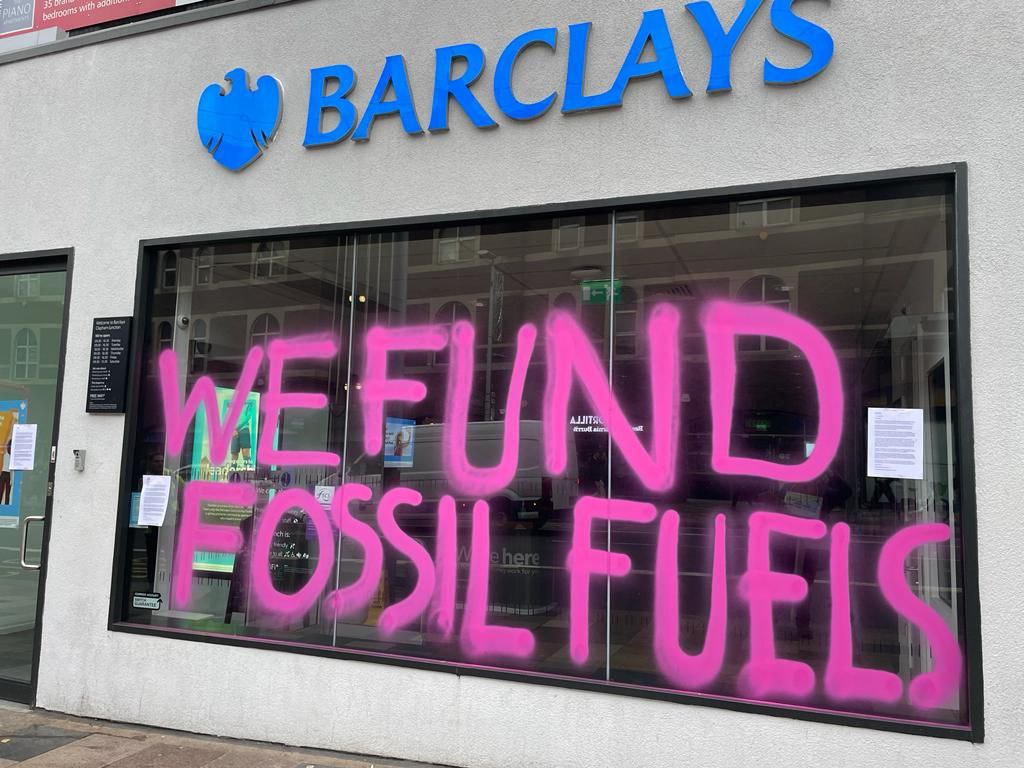
Barclays Clapham Junction

On Monday November 14 Barclays faced the biggest ever day of climate protests as  hundreds of people took action at over 100 Barclays branches across the UK to protest against the high street bank’s investment in fossil fuels.

Protesters from Extinction Rebellion groups in Scotland, Wales, Northern Ireland and England occupied and flyposted branches, painted buildings with red paint and fake oil and held die-ins and street theatre performances, with actions set to continue throughout the day. 

Barclays is the UK’s and Europe’s largest financier of fossil fuels. Since 2021, when the International Energy Agency concluded there could be no new oil, gas or coal development if the world was to reach net zero by 2050, Barclays has invested $19.583B in fossil fuels. Since the Paris Climate Agreement in 2016 their total investment in fossil fuels is  $144.897B. 

In the early hours of Monday morning, Extinction Rebellion London flyposted 45 Barclays branches across the capital with posters bearing the Barclays logo and reading ‘this is an intervention’ and ‘banking on climate chaos’. In Birmingham protesters threw washable fake oil over the High Street branch of Barclays and spray painted ‘Europe’s biggest fossil fuel funder’ on the facade of the building. At 8am in Glasgow two people carefully cracked the windows of the Barclays branch in their new offices at Clyde Place Quay, following the action they remained in front of the bank to be held accountable for their actions, holding banners reading ‘this is an intervention’ and ‘stop funding Rosebank’.

Barclays…Europe’s Biggest Financier of Climate Breakdown!

Extinction Rebellion co-founder Gail Bradbrook, said: “Today hundreds of people staged an intervention on Barclays, sending a message to the high street bank that with protests taking place at over 100 of their branches they are rapidly losing the social licence to do business in towns and cities of the UK. 

“It’s high time that Barclays recognised the destructive role they are playing as Europe’s largest financier of fossil fuels and changed course.” 

“We want Barclays to stop funding nature destroying projects and more than that we want them to show leadership. We ask them to publicly denounce an economic system that is geared towards the destruction of the planet, we want them to admit in public what bankers tell us in private – that they aren’t changing fast enough because the current system incentivises harmful behaviour.”

Just this week the UN Secretary General, António Guterres, warned, “We are on a highway to climate hell with our foot still on the accelerator.” This summer the UK recorded its hottest ever temperature, and there were three times the usual number of wildfires. Drought conditions across the nation are set to continue into 2023. In a departure from the traditionally more neutral stance adopted by the UN, in April Guterres indicated for the first time those he considers responsible for the worsening climate saying, “some government and business leaders are saying one thing – but doing another. Simply put, they are lying.”

Extinction Rebellion, along with other groups, are calling for Barclays to end all investment in fossil fuel expansion. In March 2020 Greenpeace activists shut down nearly 100 Barclays branches in protest against the bank’s continued multi-billion dollar support for fossil fuels.

Alongside the protest actions, people from Extinction Rebellion local groups were out on the streets raising awareness about Barclays and encouraging people who use the bank to consider switching – other high street banks produce six times less emissions per pound in a current account than Barclays.

The day of protests follows Barclays’ announcement of much higher than expected pre-tax profits for the quarter of nearly £2bn. Higher interest rates have helped increase Barclays profits, whilst the cost of living has soared.

Sourced from an Extinction Rebellion press release

Continue ReadingExtinction Rebellion target Barclays in biggest ever day of climate protests