Amnesty International’s 296-page report – ‘You Feel Like You Are Subhuman’: Israel’s Genocide Against Palestinians in Gaza – documents how, during its military offensive launched in the wake of the deadly Hamas-led attacks in southern Israel on 7 October 2023, Israel has unleashed hell and destruction on Palestinians in Gaza brazenly, continuously and with total impunity.
Over the past two months the crisis has grown particularly acute in the North Gaza governorate, where a besieged population is facing starvation, displacement and annihilation amid relentless bombardment and suffocating restrictions on life-saving humanitarian aid.
Amnesty’s report examines in detail Israel’s violations in Gaza over the nine months between 7 October 2023 and early July 2024, with Amnesty interviewing 212 people – including Palestinian victims and witnesses, local authorities in Gaza and healthcare workers – while conducting fieldwork and analysing an extensive range of visual and digital evidence, including satellite imagery. Amnesty also analysed statements by senior Israeli government and military officials, and official Israeli bodies. On multiple occasions, Amnesty shared its findings with the Israeli authorities but has received no substantive response.
Agnès Callamard, Amnesty International’s Secretary General, said:
“Amnesty International’s report demonstrates that Israel has carried out acts prohibited under the Genocide Convention, with the specific intent to destroy Palestinians in Gaza.
“These acts include killings, causing serious bodily or mental harm and deliberately inflicting on Palestinians in Gaza conditions of life calculated to bring about their physical destruction.
“Month after month, Israel has treated Palestinians in Gaza as a subhuman group unworthy of human rights and dignity, demonstrating its intent to physically destroy them.
“Our damning findings must serve as a wake-up call to the international community: this is genocide. It must stop now.
“States that continue to transfer arms to Israel at this time must know they are violating their obligation to prevent genocide and are at risk of becoming complicit in genocide.
“All states with influence over Israel, particularly key arms suppliers like the USA and Germany, but also other EU member states – the UK and others – must act now to bring Israel’s atrocities against Palestinians in Gaza to an immediate end.
“The International Criminal Court’s arrest warrants for Prime Minister Benjamin Netanyahu and former Defence Minister Yoav Gallant for war crimes and crimes against humanity issued last month offer real hope of long-overdue justice for victims.
“States must demonstrate their respect for the court’s decision and for universal international law principles by arresting and handing over those wanted by the ICC.”
Sacha Deshmukh, Amnesty International UK’s Chief Executive, said:
“As a state party to the Genocide Convention, the UK has a legal obligation to use all reasonable means to help prevent genocide.
“The UK must take urgent steps to make clear to Israel that this country does not support genocidal acts against Palestinians in Gaza, and those acts must end immediately.
“The UK government must, as an urgent first step, work with other countries by all diplomatic and legal means to press Israel into fully implementing the provisional measures ordered by the International Court of Justice.
“To avoid the risk of itself being complicit in genocide, the UK must immediately end all arms transfers to Israel.
“The UK should also press for multilateral targeted sanctions at the UN Security Council against Israeli and Hamas officials most implicated in crimes under international law.
“The UK must act to ensure justice and accountability, supporting the ongoing International Criminal Court investigation into Palestine and executing any ICC arrest warrants.”
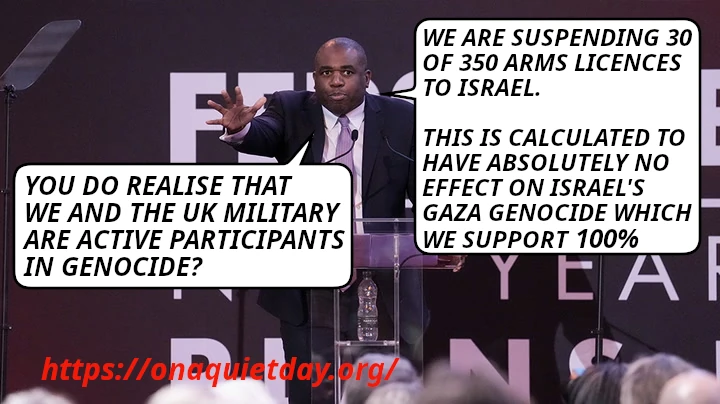
Genocide denying UK Foreign Secretary David Lammy says that UK is suspending 30 of 350 arms licences to Israel. He also confirms the UK government’s support for Israel’s Gaza genocide and the UK government and military’s active participation in genocide.
Stephen Feinberg is pictured at the U.S. Capitol on December 11, 2008. (Photo: Jahi Chikwendiu/The The Washington Post via Getty Images)
Stephen Feinberg is co-CEO of Cerberus Capital Management, which owns a company that provided training to members of the hit squad that murdered Saudi journalist Jamal Khashoggi.
President-elect Donald Trump has reportedly offered the number-two Pentagon job to a secretive billionaire investor with close ties to the military-industrial complex, potentially introducing additional conflicts of interest to an incoming administration that is set to be rife with corporate executives and lobbyists.
Stephen Feinberg is co-founder and co-CEO of the private equity behemoth Cerberus Capital Management, which owns a firm that provided paramilitary training to members of the elite team that murdered Saudi journalist and U.S. resident Jamal Khashoggi in 2018.
Trump drew global outrage for publicly defending the Saudi regime in the wake of the assassination, even after U.S. intelligence agencies established that Saudi Crown Prince Mohammed bin Salman authorized Khashoggi’s murder.
The New York Times reported in 2021 that four Saudis who took part in the 2018 Khashoggi assassination “received paramilitary training in the United States the previous year under a contract approved by the State Department.” Tier 1 Group, an Arkansas-based company financed by Cerberus, provided the training.
“The instruction occurred as the secret unit responsible for Mr. Khashoggi’s killing was beginning an extensive campaign of kidnapping, detention, and torture of Saudi citizens ordered by Crown Prince Mohammed bin Salman, Saudi Arabia’s de facto ruler, to crush dissent inside the kingdom,” the Times noted.
“Having this revolving door of people who sit on boards of major defense contractors and then cycle in and out of the Pentagon is a problem that did not begin with Trump, but is a problem nonetheless.”
It’s not yet clear whether Feinberg intends to accept Trump’s offer to serve as deputy defense secretary, but news of the choice prompted speculation that Feinberg could be elevated to the top Pentagon spot as Fox News host Pete Hegseth—the president-elect’s nominee for the role—faces skepticism from senators amid new details of the sexual assault allegations against him. (Update: The Times reported Wednesday morning that Trump’s support for Hegseth is “wobbling” and he is “openly discussing other people for the job, including Gov. Ron DeSantis of Florida.”)
Citing an unnamed person familiar with his thinking, Politicoreported that Feinberg is expected to accept the job offer for deputy defense secretary. Feinberg would also have to be confirmed by the Senate.
The Washington Post, which first reported Trump’s offer on Tuesday, noted that the private equity billionaire is a major donor to the president-elect and has “investments in defense companies that maintain lucrative Pentagon contracts.” The Post observed that Cerberus “has invested in hypersonic missiles” and “previously owned the private military contractor DynCorp.”
Matt Duss, executive vice president at the Center for International Policy and a former foreign policy adviser to Sen. Bernie Sanders (I-Vt.), told the Post that “having this revolving door of people who sit on boards of major defense contractors and then cycle in and out of the Pentagon is a problem that did not begin with Trump, but is a problem nonetheless.”
“Is he going to be listening to a whole range of constituencies or primarily business constituencies?” Duss asked of Feinberg.
Jeff Hauser, executive director of the Revolving Door Project, characterized Trump’s Cabinet picks so far as “chaotic evil” and warned that their conflicts of interest could bring horrible consequences for the American public.
“Corruption is not only bad in and of itself,” Hauser told the Institute for Public Accuracy on Tuesday. “It’s also a bad thing that makes other terrible things more likely to happen. If you corrupt the enforcement of environmental protection laws, people will be poisoned by the water they drink and air they breathe. If you corrupt the Department of Labor, workplace safety will collapse over time and wage protections will disappear.”
“That’s what happened under the last Trump administration. This is going to be worse,” Hauser warned. “Food safety issues, automobile safety with driverless cars, rail safety—these are all risks that the Trump team will be taking with the lives of ordinary people.”
Palestinian residents, carrying their belongings, are on their way to migrate for safer areas following the Israeli army’s orders evacuation of the Bani Suheila town in Khan Yunis, Gaza on October 07, 2024 [Ashraf Amra – Anadolu Agency]
The UN, on Tuesday, reported that Israel’s recurring evacuation orders affecting approximately 80 per cent of the Gaza Strip have exposed civilians to risk, Anadolu Agency reports.
“Israel’s repeated evacuation orders, which are now in effect for about 80 per cent of the Gaza Strip, leaves civilians exposed to the danger of hostilities and deprived of access to essential services,” spokesman, Stephane Dujarric, said at a news conference.
Saying that northern Gaza has been under a tightening siege for nearly two months, Dujarric said around 65,000 to 500,000 people are unable to access regular food, water, electricity or reliable health care.
Dujarric stated that “the entire population of Gaza needs humanitarian assistance,” and stressed the plight of more than 58,000 people with disabilities who are facing additional challenges in accessing food.
In the southern areas of Gaza, he said that “some people are skipping meals and searching through trash to find food.”
Citing the Office for the Coordination of Humanitarian Affairs (OCHA), Dujarric warned that humanitarian access continues to be obstructed.
“In November, out of 578 planned aid movements across Gaza that require coordination with Israeli authorities, only 41 per cent were facilitated. More than a third were denied outright, and the rest were either impeded or cancelled due to security and logistical challenges,” he said.
Dujarric reported that aid missions to northern Gaza have been especially disrupted, with efforts to reach besieged areas such as Jabalia, Beit Lahiya and Beit Hanoun encountering severe obstacles.
A view of destruction near Kamal Adwan Hospital after Israeli forces’ withdrawal, northern Gaza Strip on October 26, 2024. [Karam Hassan – Anadolu Agency]
Three staff members of the Kamal Adwan Hospital in northern Gaza were wounded, one critically, when the Israeli occupation army bombed the facility’s courtyard again on Tuesday, the Palestinian Information Centre has reported. This was the fifth attack by the Israeli occupation army on the medical facility in recent weeks.
A medical source said that at least one Israeli quadcopter was used in the attack. One of the wounded employees is now in the intensive care unit.
The hospital’s director, Dr Hussam Abu Safiya, said that drones were dropping bombs, scattering shrapnel at the site.
Meanwhile, media sources reported a surge in Israeli air strikes on Gaza City where Al-Ahli Hospital has been struggling to deal with mass casualties.
A demonstrator is seen wearing a placard that calls for the arrest of Israeli prime minister Benjamin Netanyahu during the rally. Pro-Palestine demonstrators joined the 21st demonstration organised by the Palestine Solidarity Campaign (PSC) since October 2023. (Photo by David Tramontan/SOPA Images/LightRocket via Getty Images)
The live-documented ethnic cleansing in Gaza, much like in 1948, alongside the expansion of Jewish-only colonies in the West Bank, underscores the true undeclared objectives in Israel’s ostensible “total victory.”
Israeli Prime Minister Benjamin Netanyahu has declared that Israel’s war on Gaza will continue until achieving what he terms “total victory.” Instead of critically examining Netanyahu’s vague and open-ended objectives, much of the Western media and many governments frame the onslaught as self-defense, and some even normalize the genocide as a “humane” attempt to “free” Israeli captives.
At the same time, the same pundits decontextualized the Palestinian right to self-defense by ignoring that the October 7 revolt was a direct response to over two decades of Israel’s imposed “starvation diet” blockade on Gaza. Exactly, as the West turns a blind eye, and continues to enable Israel’s theft of Palestinian-occupied land in the West Bank to benefit Jewish-only colonies.
Meanwhile, these media outlets downplay or dismiss Israel’s treacherous undeclared war objectives, even to the detriment of Israeli captives and the immense civilian suffering in Gaza.
For over a year, Netanyahu has prioritized an agenda to reoccupy and to ethnically cleanse northern Gaza rather than engage in negotiations for prisoner’s swap. Especially since the release of Israeli captives would undermine one of Netanyahu’s primary pretexts for pursuing his sinister objectives.
This is only possible in the wake of Western leaders embracing Netanyahu’s racist perspective, focusing only on the well-being of Israeli captives, while ignoring the over 10,000 Palestinian hostages held in Israeli jails, and the welfare of the 2.3 million Palestinians in Gaza. For instance, Joe Biden has expressed recently his concern over Netanyahu potentially delaying action to secure the release of Israeli captives until January 20, 2025, while expressing no sympathy for the suffering of Palestinians in 2024 and beyond.
With the conspicuous silence or impotence of world bodies, the Israeli captives became a convenient fig leaf under which Netanyahu saw as an opportunity to reoccupy Gaza. It is worth recalling that in 2005, Netanyahu resigned from the Israeli government in protest against Prime Minister Ariel Sharon’s decision to “disengage” and remove the Jewish-only colonies from the Gaza strip.
Immediately following October 7, Netanyahu launched a genocidal war, disregarding the Palestinian Resistance’s proposal for prisoner’s exchange. His decision to pursue war instead of negotiations was motivated by several factors:
a) Deflect responsibility for the intelligence failure under his watch. b) Evade scrutiny of his role in facilitating external funding to Hamas. c) Execute a campaign of genocide and ethnic cleansing to reoccupy Gaza.
The strategy to ethnically cleanse Gaza was openly advocated by Israel’s racist Finance Minister Bezalel Smotrich, who three months following October 7 called for Palestinians to leave Gaza. The scion of an Ukrainian immigrant repeated the century-old European Zionist myth of blooming the desert⎯a narrative that not only ignores historical and geographical realities but also contradicts his own Old Testament that once described Canaan, the land of the Filastin (Palestine), as the “land of milk and honey,” before the ancient Hebrews migrated from their original homes to Palestine.
Further, and on January 1, 2024, Smotrich’s fellow racist National Security Minister Itamar Ben Gvir declared in a Knesset speech that Israel should never withdraw from any territory it occupies and explained that the establishment of new Jewish-only colonies in Gaza as “an important thing.” The following day, on January 2, Ben Gvir doubled down, stating that displacing “hundreds of thousands” of Palestinians from Gaza would help pave the way for the creation of the new Jewish-only colonies.
More recently, on Monday, November 25, Smotrich declared to the Yesha Council, an umbrella group representing the Jewish-only colonies in the occupied West Bank, “We can and must conquer the Gaza Strip.” He claimed there is “a unique opportunity” with Donald Trump’s election to halve Gaza’s population—a veiled euphemism for ethnic cleansing. Last Thursday, Israeli National Security Minister Itamar Ben Gvir echoed similar calls to “reoccupy the Gaza Strip.”
On the ground inside Gaza, the tools of occupation were more explicit in defining the meaning of Netanyahu’s ostensible mantra: “total victory.” Israeli soldiers posed before an orange banner that read, “Only (Jewish-only) settlement (in Gaza) would be considered victory!” Notably, the orange color harkens back to the banners used by the settler movement in 2005 to protest Sharon’s decision to evacuate the Jewish-only colonies from Gaza.
On November 29, Ajith Sunghay, head of the U.N. Human Rights Office for the Occupied Palestinian Territories, stated after visiting Gaza that the “U.N. had been unable to deliver any aid to northern Gaza” due to “repeated impediments or outright rejections of humanitarian convoys by the Israeli authorities.”
Regarding the genocide by terror, U.N. Human Rights Chief Volker Türk reported that residents of northern Gaza are subjected to “non-stop” bombing. Simultaneously, hundreds of thousands have been ordered to evacuate, likely to make way for new Jewish-only settlements.
As part of the forced depopulation of Gaza’s northern region—the most fertile land in the strip—Israel is constructing a topographic barrier to isolate this area from the rest of Gaza. Beginning in early October, Israel carried out extensive controlled explosions, demolishing multi-story buildings to clear a path for a 5.6-mile road cutting across the strip. This road divides Gaza City from the northern towns of Jabalia, Beit Hanoun, and Beit Lahia. Human Rights Watch (HRW) has characterized this widespread forced displacement as part of an official government policy amounting to “crimes against humanity.”
On November 30, former Defense Minister and IDF Chief of Staff Moshe Ya’alon confirmed HRW findings, stating that Netanyahu and “far-right” (racist) elements are waging a war of “occupation, annexation, and ethnic cleansing.” He added, “There is no Beit Lahia, there is no Beit Hanoun.”
The live-documented ethnic cleansing in Gaza, much like in 1948, alongside the expansion of Jewish-only colonies in the West Bank, underscores the true undeclared objectives in Israel’s ostensible “total victory.” In this contest, Netanyahu’s deliberate undermining of U.S.-led negotiations for prisoner’s swap exemplifies his quintessential diabolical persona: exploiting the predicament of his own Israeli captives to further his cynical undeclared agenda of slaughtering the “Amalek,” and ethnically cleansing Gaza to pave the way for new Jewish-only colonies.
Genocide denier and Current UK Prime Minister Keir Starmer is quoted that he supports Zionism without qualification. He also confirms that UK air force support has been essential in Israel’s mass-murdering genocide. Includes URLs https://www.declassifieduk.org/keir-starmers-100-spy-flights-over-gaza-in-support-of-israel/ and https://youtu.be/O74hZCKKdpAGenocide denying UK Foreign Secretary David Lammy says that UK is suspending 30 of 350 arms licences to Israel. He also confirms the UK government’s support for Israel’s Gaza genocide and the UK government and military’s active participation in genocide.