Deputy Labour Party Leader Angela Rayner calls for police to kill and harass innocent people.
There are news reports that Jeremy Corbyn and Diane Abbott have been urged to apologise for backing gangster Chris Kaba after criticising police following his death. [ed: uncertain that he should be called a gangster.]
He was unarmed and police didn’t know who he was when he was killed. There were claims following his inquest that he had shot somebody 6 days previous to him getting killed by police. He was never tried of this alleged crime of course because he was dead. You can’t retrospectively justify his killing when an unarmed, unknown man was killed by armed police.
PEACE: Former Labour Party leader and now independent MP Jeremy Corbyn speaks at a London rally for Palestine, September 11 2024
Speaking at the Podemos congress over the weekend, JEREMY CORBYN MP outlines three crucial areas for building a powerful leftist movement across Europe: opposing austerity, promoting peace and combating the far right
AS we look to build a united left across Europe, there are three key issues that can form the basis of a strong, powerful movement: anti-austerity, peace and opposition to the far right.
Europe is heading toward a renewed era of austerity. We have witnessed attacks on wages and conditions all over Europe. Working-class living standards have fallen. Wages have stagnated. Meanwhile, there are more billionaires than ever before.
Inequality is not inevitable. It is the result of decisions that governments take to take money from the many and give it to the few. Last week, the British government celebrated its 100-day anniversary.
In that time, it has made two supposedly “tough” choices. One is to keep children in poverty by retaining the two-child benefits cap, refusing to lift 250,000 children out of poverty. The second decision was to cut the winter fuel allowance for 10 million pensioners.
We are told that these have been “tough choices.” Every day, my constituents make tough choices. Tough choices like deciding whether to heat their homes or put food on the table. Tough choices like taking out a loan to pay for this month’s rent. Tough choices like selling their home to pay for their family’s social care.
The government knows that there is a range of choices available to them. They could introduce wealth taxes to raise upwards of £10 billion. They could stop wasting public money on private contracts. They could launch a fundamental redistribution of power by bringing water and energy into full public ownership.
Instead, they have opted to take resources away from people who were promised things would change. There is plenty of money, it’s just in the wrong hands — and we will not be fooled by ministers’ attempts to feign regret over cruel decisions they know they don’t have to take.
Austerity is not a tough choice. It is the wrong choice. The British government tells us there is no money. At the very same time, they are committing to raising defence expenditure to 2.5 per cent of GDP.
March for Palestine | Mark Kerrison/In Pictures via Getty Images
A new generation across the UK is demanding political representation. But this unstoppable force is meeting an immovable object, the Labour Party
A new generation across the UK is demanding political representation. Yet, this unstoppable force is now meeting an immovable object, the Labour Party.
On one hand, despite its failure to leave behind much grassroots organisation, Jeremy Corbyn’s leadership galvanised millions. This generation now knows what it’s like to have a voice in the political mainstream. It won’t tolerate being shut out of the political process indefinitely. The success of Green and independent candidates at this year’s general election was in part driven by this fact.
Meanwhile, the realities of climate breakdown, renewed austerity and a genocide in Gaza continue to alienate many. The British public backs the renationalisation of energy by a margin of four to one, the introduction of a wealth tax by a margin of eight to one, and a ban on arms exports to Israel by about three to one.
On the other hand, the Labour Party is a fortress. Many advisors and politicians of the Labour right regarded the party’s defeat under Corbyn in 2019 as a lucky escape, and remain terrorised by the prospect of losing their careers to an insurgent political force. Starmerism is a relentless campaign on behalf of this professional political class, which is determined to shut the left out. Their hubris is an existential threat not just to Labour’s role as a political home for the left, but to the party itself.
Both wings of the Labour Party are being blindsided by this process. The Labour right, and the commentariat that lives in its orbit, likes to think in terms of historical cycles and playbooks. The crushing of the post-Corbynite left was a repeat of Kinnock’s expulsion of the Militant Tendency. 2024 was just 1997 with TikTok.
Starmer’s first act in government – blaming the outgoing administration for an economic mess and indicating a shift towards austerity – was both a conscious mimicry of Tory George Osborne and an homage to New Labour’s fiscal hawkishness.
The Labour left’s attachment to the past is more nostalgic. Its leaders – Aneurin Bevan, Tony Benn, Corbyn – are stripped of their failings and revered. Its heroic defeats – the 1981 Deputy Leadership campaign, the Greater London Council’s fight for survival, Corbyn’s general elections – are endowed with their own folklore.
Life on the outside is unthinkable and futile, as illustrated by every past attempt (the Socialist Labour Party, the Socialist Alliance, Respect, the Trade Union and Socialist Coalition, Left Unity) to build an alternative. “It is the Labour Party or it is nothing”, as Bevan once wrote, chiding members of the Independent Labour Party when they split in 1932.
Both wings of Labour are good at producing a sense of collective memory that reinforces the party’s standing as immutable, and which relates new events to past ones. Neither are good at understanding when reality diverges from the historical script.
In 2015, the left challenged for power, and in doing so broke the old system. Tony Blair did not bother to get rid of Tony Benn. Yet Starmer almost immediately expelled Corbyn and changed Labour’s rule to ensure that no one like him could lead the party again. He has already suspended seven MPs for voting to abolish the two-child benefit cap. It is only a matter of time until more feel forced to rebel.
A politics from below
The real politics happens outside parliament. We’ve already witnessed huge protests take shape against the massacre in Gaza, and the coming years could see mass movements and industrial unrest over cuts and living standards. Having lived through the Corbyn years, the participants of these movements are unlikely to be satiated by the prospect of a soft left Labour leader some time in the 2030s.
Labour’s initial plans will provide some relief. The Employment Rights Bill is likely to be the most significant improvement in workers’ rights in decades. The renationalisation of the railways will also prove popular. But what happens once these progressive measures have been exhausted?
The Green Party came second behind Labour in 39 seats. Pro-Palestinian Independent candidates have made inroads into safe Labour areas. For this to have happened while Labour was in opposition is unprecedented. Unless the new government rapidly shifts its approach on public spending, redistribution and green investment, it will face an earthquake.
“Unless the new government shifts its approach on public spending, redistribution and green investment, it will face an earthquake”
To have any success, the post-Corbynite left will have to ditch its obsession with icons and celebrities. Despite its roots in social movements, Corbynism became a tightly centralised project, in which activists were given little, if any, role in determining policy and strategy. Even now, discussion of the left’s future beyond Labour seems to centre on the intentions of Corbyn, his former advisors, prominent commentators, or MPs.
Building a serious political project is about representing a solid base in society. This task flows from organising, and having roots in social and industrial struggle, not how many Twitter followers you have.
The green surge
Much of the left will also have to get over its age-old sectarianism towards the Greens, who have emerged as by far the most serious organised force to Labour’s left.
If you listen to many old Labour left activists, or read many socialist newspapers, you will be presented with a critique of the Greens that is at least two decades old. They are portrayed as ‘Tories on bikes’ and alternative medicine enthusiasts. Their ability to win seats in North Herefordshire and Waveney is said to be the product of triangulation towards right-wing rural voters. The compromises of Green parties in France and Germany are held up as the inevitable destiny of the UK Greens.
On the contrary, the Greens have become a major force precisely by occupying a space to the left of their sister parties in continental Europe. Since the turn of the millennium, their membership has risen twelve-fold to around 60,000. Waves of new members – from the ‘green surge’ of 2014 to today’s recruits – comprise its activist base.
Many joined on a radical environmental basis, but just as many did so to oppose austerity, champion freedom of movement, or fight for Palestinian rights. There might be a case that their time would be better spent in Labour, or that party affiliation often operates more like a consumer identity than a political strategy. But the existence of a genuinely left-wing, and increasingly successful, Green Party in Britain is simply a fact. Any attempt to rebuild the left as an electoral force – from within Labour or outside – must take account of this.
The landscape of the British left following the fall of Corbynism is still emerging. The only people who are definitely wrong are those who claim to know exactly what will happen. Perhaps Starmer will move back to the centre-left. Perhaps the social and industrial movements won’t materialise. There are many socialists – including me – who remain in Labour and will keep chipping away.
One thing we can be certain of is that things will never go back to the way they were before the Corbyn moment. The late 2010s unleashed forces that are only beginning to shape our politics. The left must adapt if it is to survive.
A man documents the damaged buildings at the site of an Israeli airstrike in Beirut’s southern suburb, Lebanon, October 1, 2024
ISRAEL’S invasion of Lebanon looked close to having ignited all-out war in the Middle East last night as Iran launched multiple missiles at Israeli targets in response.
It was unclear how Israel or the US, which has stationed huge forces in the region to back Israel up as it continues its Gaza genocide, would react as the Morning Star went to press.
The Israeli military followed up its violation of Lebanese territory by warning residents of nearly two dozen border communities to evacuate, hours after announcing the start of “limited” ground operations against the Hezbollah resistance movement.
…
British peace activists condemned Israel’s invasion and its attempts to portray it as a “limited” operation.
Independent MP Jeremy Corbyn told the Morning Star: “Israel’s decision to send troops into Lebanon, a sovereign nation, is no ‘limited ground operation,’ it is an invasion.”
Mr Corbyn also blasted British policy in the Middle East, saying: “Our government’s hypocrisy is on full display. Its failure to defend international law and stand up to Israel is a moral disgrace.”
Pro-Palestinian protesters take part in a Palestine Solidarity Campaign demonstration as they march to the Labour Party conference venue on September 21, 2024 in Liverpool, England. [Ian Forsyth/Getty Images]
It’s difficult to comprehend the horrors of what’s happening in Gaza, Lebanon and beyond in the Middle East. The heartbreaking scenes of dirt-encrusted toddlers screaming as they’re pulled from the rubble of what was once their homes; the small children carrying plastic bags containing the remains of their slain siblings; the white-bandaged bodies of whole families laid out next to hospitals in their hundreds; the shaking youngsters trying to hide as Israeli soldiers fire indiscriminately at anything that moves. Surely, feeling a deep, painful empathy for the victims of such savagery, especially the children, is part of what gives us our humanity.
This isn’t the same for everyone, of course. Not for the perpetrators, who use their cutting-edge western-manufactured machines of death to extinguish these innocent lives. Nor, in most cases, for politicians here in Britain. For Prime Minister Keir Starmer, these scenes are even the set up for a joke.
During the new prime minister’s triumphant speech at this week’s Labour Party conference, a heckler dared to challenge the Dear Leader on his lack of empathy for Israel’s victims. After Starmer said that, “Every child, every person, deserves to be respected for the contribution they make,” Labour member Daniel Riley, 18, shouted in response: “Does that include the children of Gaza?”
“This guy’s obviously got a pass from the 2019 conference,” quipped the smug Starmer, in a reference to years when Labour was led by pro-Palestinian Jeremy Corbyn. The more sycophantic element of Starmer’s congregation, stronger than ever thanks to Sir Keir’s purges of the left, lapped up the jibe.
It’s become a cliché to respond to such things with variations of “imagine the response if Corbyn had said something like that about Israeli children,” but sometimes you can’t help but be stunned at the double standards. Corbyn would never have said such a thing, but if he had it would have been frontpage news; irrefutable proof of his alleged anti-Semitism.
But they weren’t Israeli children. They were Arabs. And in mainstream western discourse, they don’t count. They don’t suffer. They don’t have dreams. They’re abstract numbers, if that.
They’re just Arabs, unworthy of our empathy.
To really hammer home the hypocrisy, the words “genocide” and “apartheid” had already been banned from the Labour conference. The Palestine Solidarity Campaign was forced to remove both words from the title of its fringe meeting. Some activists responded by painting the words “genocide conference” on the windows of the venue.
In many ways, the Labour government, elected in July after 14 years in the wilderness, is an improvement on their Conservative predecessors regarding Palestine. But that’s a pretty low bar. Starmer may have banned his MPs from attending the huge protests against the war on Gaza, which often numbered hundreds of thousands of people, but he didn’t go as far as former home secretary Suella Braverman, who branded them “hate marches”.
Pro-Palestinian protesters campaign near Downing Street in London, UK, on Wednesday, July 24, 2024. [Betty Laura Zapata/Bloomberg via Getty Images]
And despite Labour’s top team repeating the mantra that “Israel has the right to defend itself” like a broken record whenever the issue comes up, it has at least (and belatedly) called for a ceasefire and the establishment of a Palestinian state (however problematic that demand in itself is).
The Labour government has also drawn the ire of Israel for dropping its opposition to the International Criminal Court’s bid for an arrest warrant against Benjamin Netanyahu. A further schism was seen when the UK resumed its £21 million funding to the Palestinian refugee agency, UNRWA. Again, it was a low bar.
Much has also been made of the new government’s decision to block arms sales to Israel (although this is limited to a pitiful eight per cent of exports). Unsurprisingly, the Palestine solidarity movement says it’s not enough. And so do the British public: in May, 55 per cent of the British public wanted arms sales to Israel to be suspended until the war against the Palestinians in Gaza ends.
Even less surprisingly, it was met with fury from Israel. Benjamin Netanyahu said that it was “sending a horrible message” to Hamas. Starmer responded to Netanyahu’s comment during an interview on LBC Radio over the conference period. “No, he’s not right about that,” he tried to reassure the audience. “We had to comply with international law and our domestic law in relation to that. I’ve always been clear, I support Israel’s right to self-defence, I’ve been robust about that… I’ve taken blows in relation to that – there’s no doubting that support – but it’s got to be done in accordance with international law.”
In other words, “I’m really sorry, and I’m not saying you’re committing war crimes, it’s just that it would be a bad look for a former lawyer to end up in The Hague.”
Foreign Secretary David Lammy was also questioned on LBC during the conference about why the other 92 per cent of arms sales to Israel had not been banned, including the export of parts for F-35 fighter jets, which Israel has used, among other things, to bomb heavily-populated refugee camps in Gaza. Lammy said that a full embargo would limit Israel’s ability to fight the Houthis in Yemen “and other proxies”.
“I think that would be a mistake,” he added. “It would lead to a wider war and an escalation that we here in the UK are committed to stopping, so I’m afraid I disagree with that position.”
In Lammy’s eyes, war is peace.
By coincidence, two of the arms companies currently selling their merchandise to Israel for use in Gaza were also at the conference. According to Private Eye magazine, BAE Systems, which makes parts for the F-35, hosted a high-profile meeting with defence secretary John Healey. A separate event, featuring armed forces minister Luke Pollard, was sponsored by US arms firm Northrop Grumman. Northrop Grumman makes parts for the F-35, the F-16 and the Apache helicopter. All are being used to massacre civilians in Israel’s war in Gaza and the wider region.
To ensure compliance with the Zionist narrative, Israeli politicians came to the conference themselves. Among them was opposition leader Yair Golan, who has said that Palestinians should “starve to death” until the hostages are released. He was granted audiences with several ministers, including Lammy, and attended a meeting hosted by Labour Friends of Israel.
Nevertheless, the conference did at least spark some hope for the Palestine cause, albeit inadvertently. During its opening weekend, 15,000 protesters gathered in Liverpool to send a message to Labour over its appalling support for the occupation state.
And that’s where the hope is. The Labour government won’t stand up to Israel’s devastating behaviour without pressure. If what we’ve seen already isn’t enough to make them change this attitude, I’m not sure what would. If Israel invaded London, Keir Starmer would probably still be trying to sell them the weapons to do it with.
Labour has pretty much always backed wars that align with the needs of the British and now US empires, from the First World War to Vietnam. It wants to preserve the British state, its crown and its interests, albeit in a way that slightly improves life for its working-class base. It’s currently in the interests of the British ruling class to cling to the coattails of the United States. The US, in turn, needs Israel as its outpost in the Middle East. This is all hardwired into Establishment politics.
Politicians who deviate from such norms, such as Corbyn, are vilified. That’s not how we do grown-up politics in this country, don’t you know?
Starmer is no radical. He’s not really much at all.
His main use was to seize back control of the Labour party from the left and return it to the hands of the Establishment. He did this by standing on a left-wing manifesto during his leadership election only to abandon it, ally himself with the right of the party and purge the left once he assumed the leadership.
His domestic agenda is hampered severely by his unwillingness to tax the rich to repair the devastation left by the Conservatives. Instead, he is removing winter fuel allowances from pensioners and maintaining benefit restrictions on anyone with more than two children. These, he keeps saying, are “tough choices”, even though they are the easiest choices for him, as he is so scared of upsetting the rich and powerful.
He’s desperate to be seen as an effective manager for the British state, which means maintaining the easy ride enjoyed by the wealthy and aligning himself with US-led geopolitical interests. Moreover, the British Establishment that Starmer works for is fully behind the US and its Middle Eastern proxy, Israel.
Just as a middle manager at a fast food company would enthusiastically and unquestioningly promote its unhealthy products, despite their harmful effects on consumers, Starmer is hardwired to enthusiastically and unquestioningly execute the will of the people with real power over Britain. That’s not the electorate.
Tales of children suffering in Gaza are as irrelevant to him as children suffering under his benefit restrictions in Britain. Elderly people freezing in makeshift shelters in Lebanon are as irrelevant to him as elderly people freezing in Britain because they can’t afford to pay their energy bills.
And all the while, Starmer enjoys the patronage of the powerful. His bewilderment at a recent outcry over major donations of cash, designer clothes and tickets to football matches and concerts to him and his top team reveals his belief that he should be reaping the rewards of his subservience as much as any effective manager.
The Labour party conference showed us a government that will continue to stand firmly behind Israel, no matter what the state does or the wider horrors it looks set to unleash. Mild reprimands aside, Labour under Starmer will not abandon the apartheid state without huge pressure.
That’s why real opposition to Israel’s crimes remains in the hands of those outside parliament who take to the streets, occupy their universities and speak up loudly in defence of Palestinians. The Labour leadership’s limited concessions to Palestinian rights would not have been made without that pressure from below. It’s only when actions like these begin to challenge Starmer’s tentative grip on power that he will be forced to offer any sort of meaningful opposition to Israel’s barbarism.
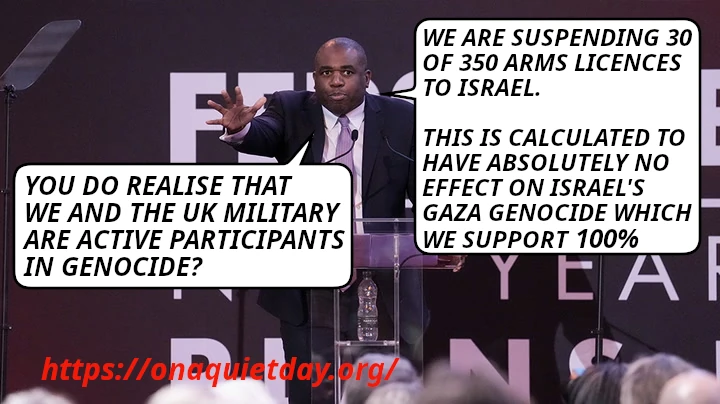
Zionist Keir Starmer is quoted “I support Zionism without qualification.” He’s asked whether that means that he supports Zionism under all circumstances, whatever Zionists do.Vote For Genocide Vote Labour.UK Foreign Secretary David Lammy says that UK is suspeding 30 of 350 arms licences to Israel. He also confirms the UK government’s support for Israel’s Gaza genocide.