Hundreds of Thousands Join London March to Demand ‘Cease-Fire Now’ in Gaza

Spread the love

Original article by JAKE JOHNSON republished from Common Dreams under Creative Commons (CC BY-NC-ND 3.0). 
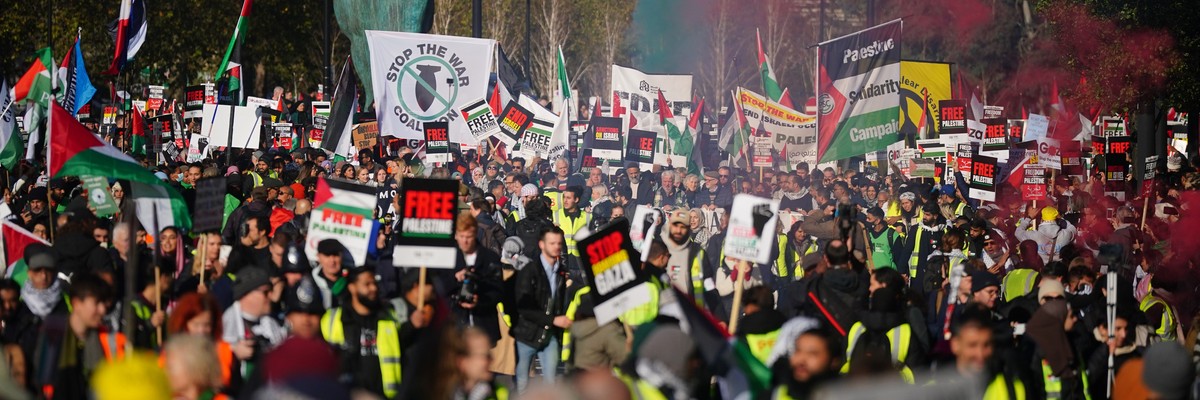
People take part in the National March for Palestine in London on Saturday November 11, 2023.  (Photo: Victoria Jones/PA Images via Getty Images)

“In our thousands, in our millions, we are all Palestinians,” demonstrators chanted at Saturday’s march, described as one of the largest political protests in U.K. history.

Hundreds of thousands of people took to the streets of London on Saturday to demand an immediate cease-fire in Gaza as Israeli forces ramped up their aerial and ground assault on the Palestinian enclave’s hospitals and other civilian infrastructure, intensifying the territory’s humanitarian crisis.

Described as one of the largest political demonstrations in U.K. history, the march moved ahead despite criticism from British Home Secretary Suella Braverman and Tory Prime Minister Rishi Sunak, who suggested earlier in the week that the protest should have been banned by London police given that it coincided with Armistice Day. Braverman accused the police of giving favorable treatment to “pro-Palestinian mobs.”

“I am horrified by the tone, language, and incitement our own government is using to whip up hatred against its own citizens—citizens who are standing up in solidarity with the besieged and bombed citizens of Gaza,” British Army veteran and march participant Nadia Mitchell wrote for OpenDemocracy. “Personally, I cannot think of a more appropriate day to demand a cease-fire than on the day we remember the mother of all cease-fires, to remember and honor those who sacrificed their lives in pursuit of peace and an end to war.”

Some U.K. lawmakers, including former Labour leader Jeremy Corbyn and Labour MP John McDonnell, joined Saturday’s march alongside hundreds of thousands of peace activists, union members, and people of all faiths.

“In our thousands, in our millions, we are all Palestinians,” demonstrators chanted.

(Photo: Henry Nicholls/AFP via Getty Images)

Reuters reported that “police said far-right groups opposing the march were present in central London in ‘significant numbers,’ leading to skirmishes with officers near the Cenotaph war memorial, close to the Houses of Parliament and in Westminster.”

“Officers in riot gear sought to contain the far-right protesters, some of whom threw bottles at them, and police vehicles sped around the city to respond to reports of tensions in the streets,” the outlet added.

Participants in the mass demonstration, meanwhile, marched from London’s Hyde Park to the U.S. Embassy to protest the Biden administration’s unwavering military and political support for the Israeli government as the death toll in Gaza continues to climb.

The head of the World Health Organization told the United Nations Security Council on Friday that Israel’s bombing and siege are killing one child on average every 10 minutes in Gaza.

“Nowhere and no one is safe,” said WHO Director-General Tedros Adhanom Ghebreyesus.

Mohammed Abu Mughaisib, deputy medical coordinator for Doctors Without Borders in Gaza, toldThe Washington Post on Saturday that hospitals in northern Gaza have become “a graveyard” due to mounting Israeli attacks.

Medical workers at al-Nasr pediatric hospital were forced to leave babies in incubators behind as they evacuated south, Abu Mughaisib said.

“The medical staff evacuated because of the shelling on the pediatric hospital, and they couldn’t save the babies to take them out, so they left five babies alone in the intensive care on the machines and the ventilators,” he told the newspaper. “That’s the situation: leaving babies now alone on the ventilators.”

(Photo: Victoria Jones/PA Images via Getty Images)

Saturday’s march was organized by the Palestine Solidarity Campaign (PSC), Stop the War Coalition, Campaign for Nuclear Disarmament, and other advocacy groups.

“We march to call for an end to the indiscriminate bombing of civilians and a #CeasefireNOW,” PSC director Ben Jamal wrote on social media. “We march in respect of the rights of all to live in freedom and with dignity.”

The demonstration is part of a growing international movement supporting a cease-fire in the Gaza Strip as Western leaders, including Sunak and U.S. President Joe Biden, refuse to demand an end to Israel’s siege and relentless bombing campaign.

Earlier this week, as Israeli forces encircled northern Gaza, Biden told reporters that there is “no possibility” of a cease-fire. Israeli Prime Minister Benjamin Netanyahu reportedly rejected a proposed five-day cease-fire in exchange for the release of some of the hostages held by Hamas.
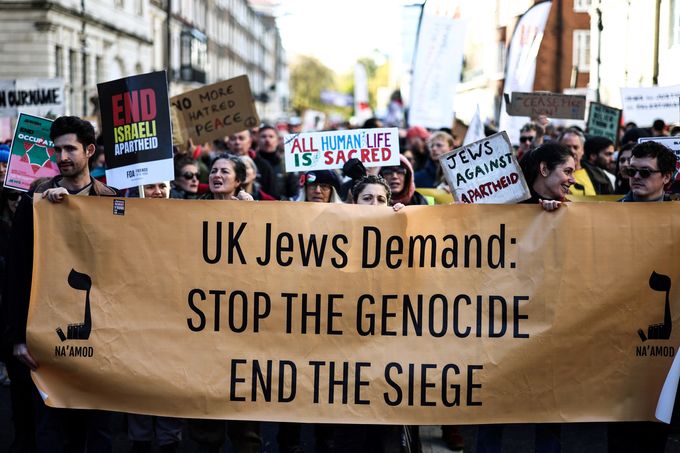
(Photo: Henry Nicholls/AFP via Getty Images)

Video footage of Saturday’s march shows the streets of central London packed with demonstrators expressing solidarity with the people of Gaza and demanding an end to Israel’s assault, which began after a deadly Hamas-led attack in southern Israel last month.

An estimated 300,000 people took part in Saturday’s march, according to London authorities.

“This footage shows the true will of the British people,” wrote Ahmed Alnaouq, a London-based Palestinian journalist and co-founder of the nonprofit We Are Not Numbers. “Hundreds of thousands are protesting peacefully despite rounds of vicious smear campaigns and intimidation. “All say in one word: CEASE-FIRE NOW!”

Original article by JAKE JOHNSON republished from Common Dreams under Creative Commons (CC BY-NC-ND 3.0). 

Continue ReadingHundreds of Thousands Join London March to Demand ‘Cease-Fire Now’ in Gaza

Breaking: new Labour Files episode sees Forde respond to Labour racism

Spread the love

Republished from the Skwawkbox for non-Commercial use.

The Al Jazeera ‘Labour Files’ documentary series exposed afresh the rampant racism and war on democracy of the Labour right, both to sabotage the leadership of Jeremy Corbyn and to purge the left from the party under Keir Starmer.

Now a new episode sees Martin Forde – the barrister Starmer reluctantly commissioned to investigate the report’s allegations and whose findings have been ignored by the Labour right and their media allies ever since – respond to the programme’s evidence and conclusions:

Watch and share widely.

The Labour Files – The Forde Response I Al Jazeera Investigations

Republished from the Skwawkbox for non-Commercial use.

Continue ReadingBreaking: new Labour Files episode sees Forde respond to Labour racism

The solution is resistance

Spread the love

Now is the time to be joining demonstrations, occupations and the picket lines writes JOHN MCDONNELL MP

(Socialist) Labour MP John McDonnell Image: John McDonnell, Shadow Chancellor 21-25 September 2019
Brighton by Socialist Appeal at Wikimedia  Creative Commons Attribution 2.0 Generic license

https://morningstaronline.co.uk/article/f/blackrock-power-behind-throne

We need to be out there in the streets, taking every opportunity we can to hold this government to account and linking up all the forms of resistance taking place.

As well as the large numbers of people taking industrial action to try and secure decent wages, there are renters campaigning against eviction, people with disabilities campaigning to ensure their benefits are not cut, climate justice campaigners and a whole range of social movements saying no to the Tories’ agenda.

So, what way forward for our movement? The solution is deepening this resistance at all levels, and that means joining demonstrations, occupations and the picket lines — and it also means discussing the alternatives we need around a socialist policy programme.

This programme must be based on redistributive taxation that will fund our public services and address the poverty and inequality that scar our society. And it must include securing stable, long-term investment in our infrastructure and in our people — including through extending public ownership — so we can mobilise our whole economy to tackle the challenges ahead and the rising challenge of climate change.

Follow John on Twitter @johnmcdonnellmp.

Continue ReadingThe solution is resistance

What nationalising energy companies would cost – and how to do it

Spread the love

UK could bring National Grid and retailers in-house and build public renewable energy, says ex-Labour policy chief

Andrew Fisher

17 August 2022, 12.01am

Image of banknotes and a prepayment meter key by Lydia, https://creativecommons.org/licenses/by/2.0/

Republished from OpenDemocracy under Creative Commons Attribution-NonCommercial 4.0 International licence.

When 62% of Conservative voters want energy run in the public sector, it’s fair to say the left has won the argument (75% of Labour voters agree, 68% of Lib Dems).

Yet public ownership is opposed passionately by the Conservative government, while the leader of the opposition has said he is “not in favour” of it – despite his election on a platform that committed to “bring rail, mail, water and energy into public ownership to end the great privatisation rip-off and save you money on your fares and bills”.

Public ownership is on the media’s radar, too. When Labour leader Keir Starmer announced his policy to freeze bills this week, he was asked why he wouldn’t also nationalise energy, replying that: “In a national emergency where people are struggling to pay their bills … the right choice is for every single penny to go to reducing those bills.”

But so long as energy remains privatised, every single penny won’t. Billions of pennies will keep going to shareholders instead.

The energy market was fractured under the mass privatisations of the Thatcher governments in the 1980s. It contains three sectors: producers or suppliers (those that produce energy), retailers (those that sell you energy), and distribution or transmission (the infrastructure that transports energy to your home).

It is important to bear this in mind when we’re talking about taking energy into public ownership. We need to be clear about what we want in public ownership and why.

By 2019, Labour had a detailed plan on how to do this – worked up by the teams around then shadow business and energy secretary Rebecca Long Bailey and then shadow chancellor John McDonnell. The plan is not the only way, but it illustrates what exists and how one could go about re-establishing a public energy ecosystem, run for people not profit.

The recent TUC report shows the cost of nationalising the ‘Big 5’ energy retailers – British Gas, E.ON, EDF, Scottish Power and Ovo – to be £2.8bn, which would go on buying all the companies’ shares. That’s a lot of money, equivalent to more than the annual budget of the Sure Start programme in 2009/10 (its peak year). But it’s a one-off cost, not an annual one.

And it’s not like the current privatised system doesn’t have its costs: since June 2021, the UK government has spent £2.7bn bailing out 28 energy companies that collapsed because they put short-term profits ahead of long-term stability – companies like Bulb Energy. We have spent billions of pounds already to get nothing in return. So £2.8bn is not a large amount of money to pay to gain these assets, rather than just bailing them out.

The big energy retail companies made £23bn in dividends between 2010 and 2020 according to Common Wealth, and £43bn if you include share buy-backs. What you choose to do with that surplus in public ownership is another matter: you could use it to invest in new clean energy or to lower bills or fund staff pay rises, rather than subject your workers to fire-and-rehire practices as British Gas did last year.

Labour’s previous plan also involved taking the distribution networks – the National Grid – into public ownership. This would end the profiteering at this level, too – with £13bn paid out in dividends over the five years prior to 2019. As Long Bailey said at the time, we need “public driven and coordinated action, without which we simply will not be able to tackle climate change”. Like previous nationalisations, the purchase of the grid and distribution networks could be achieved by swapping shares for government bonds. By international accounting standards, the cost is fiscally neutral as the state gains a revenue-generating asset, which more than pays for the bond yield.

The final part of the plan – and the most complicated – is production and supply. It would be impossible to nationalise the oilfields of Saudi Arabia or Qatar – and for good reasons we should want to leave fossil fuels in the ground, anyway, rather than contest their ownership.

And so what Labour proposed in 2019 was a mass investment in new renewable energy generation projects, with the public sector taking a stake and returning profits to the public. For example, under the ‘People’s Power Plan’, we proposed 37 new offshore wind farms with a 51% public stake, delivering 52GW alone by 2030, equivalent to 38 coal power stations. There were additional proposals for onshore wind, solar, and tidal schemes, as part of a 10-year £250bn Green Transformation Fund, which included other schemes like the Warm Homes insulation initiative.

Labour’s new shadow chancellor Rachel Reeves has promised a similar level of investment – a £28bn a year climate investment pledge.

Any surplus energy would then be sold on international markets, with a People’s Power Fund – a sort of sovereign wealth fund – to deliver public investment in local communities’ social infrastructure: a genuine levelling-up fund, perhaps.

Many people will say this can’t be done, but of course it has been before. The 1945 Attlee government nationalised energy and successive Conservative governments – including those of Churchill, MacMillan and Heath – were happy to have a nationalised asset. Harold MacMillan famously accused Margaret Thatcher of “selling off the family silver” when she privatised state industries.

When I was born in 1979, the National Coal Board, British Gas and British Petroleum were all publicly-owned or majority publicly-owned companies. Between them, they were the major suppliers of our energy. Our gas bills came from British Gas and our electricity bills from our regional electricity board (in my case Seeboard, the South Eastern Electricity Board), and coal and oil fuelled our power stations.

The regional electricity boards had been brought into being by the Attlee government’s Electricity Act 1947, when electricity companies were forcibly merged into regional area boards and nationalised. The Coal Industry Nationalisation Act 1946 and the Gas Act 1948 had together brought energy into public ownership.

Seeboard was privatised in 1990, and later became part of EDF Energy – ironically, the nationalised French energy company, whose profits from the UK’s stupidity are used to subsidise French consumers.

The French government has now fully nationalised EDF (previously it was 84% publicly owned), and household energy bills rose by just 4% this year – compared to over 50% in the UK and a forecast 200% by January 2023.

If Starmer doesn’t want to listen to me (or his own commitments from 2020), perhaps emulating the centrist Emmanuel Macron in this instance would be palatable?

From the depletion of fish stocks to the burning of the Amazon, profit has proved a failed regulator for use of our natural resources

In his later years, Robin Cook argued: “The market is incapable of respecting a common resource such as the environment, which provides no price signal to express the cost of its erosion nor to warn of the long-term dangers of its destruction.”

From the depletion of fish stocks to the burning of the Amazon, profit has proved a failed regulator for use of our natural resources. The market has also failed to decarbonise at pace, or to end the scourge of fuel poverty.

On the media this week, shadow energy secretary Ed Miliband said Labour is “continuing to look at what the right long-term solution is for our energy system”. It is up to all of us to campaign for that solution to be public ownership – whether that’s from within the Labour Party (like me) or from the outside.

Republished from OpenDemocracy under Creative Commons Attribution-NonCommercial 4.0 International licence.

Related at OpenDemocracy

Revealed: UK household energy debt hit record high even before price hikes

Revealed: Energy crisis has made 30 House of Lords members wealthier

On energy strategy, the government is leaving women in the cold

Continue ReadingWhat nationalising energy companies would cost – and how to do it