The choice in the new IPCC report is stark: what we do in the next few years will determine our fate for millennia
After a 10,000-year journey, human civilisation has reached a climate crossroads: what we do in the next few years will determine our fate for millennia.
That choice is laid bare in the landmark report published on Monday by the Intergovernmental Panel on Climate Change (IPCC), assembled by the world’s foremost climate experts and approved by all the world’s governments. The next update will be around 2030 – by that time the most critical choices will have been made.
The report is clear what is at stake – everything: “There is a rapidly closing window of opportunity to secure a liveable and sustainable future for all.”
…
“Continued emissions will further affect all major climate system components, and many changes will be irreversible on centennial to millennial time scales,” it says. To follow the path of least suffering – limiting global temperature rise to 1.5C – greenhouse gas emissions must peak “at the latest before 2025”, the report says, followed by “deep global reductions”. Yet in 2022, global emissions rose again to set a new record.
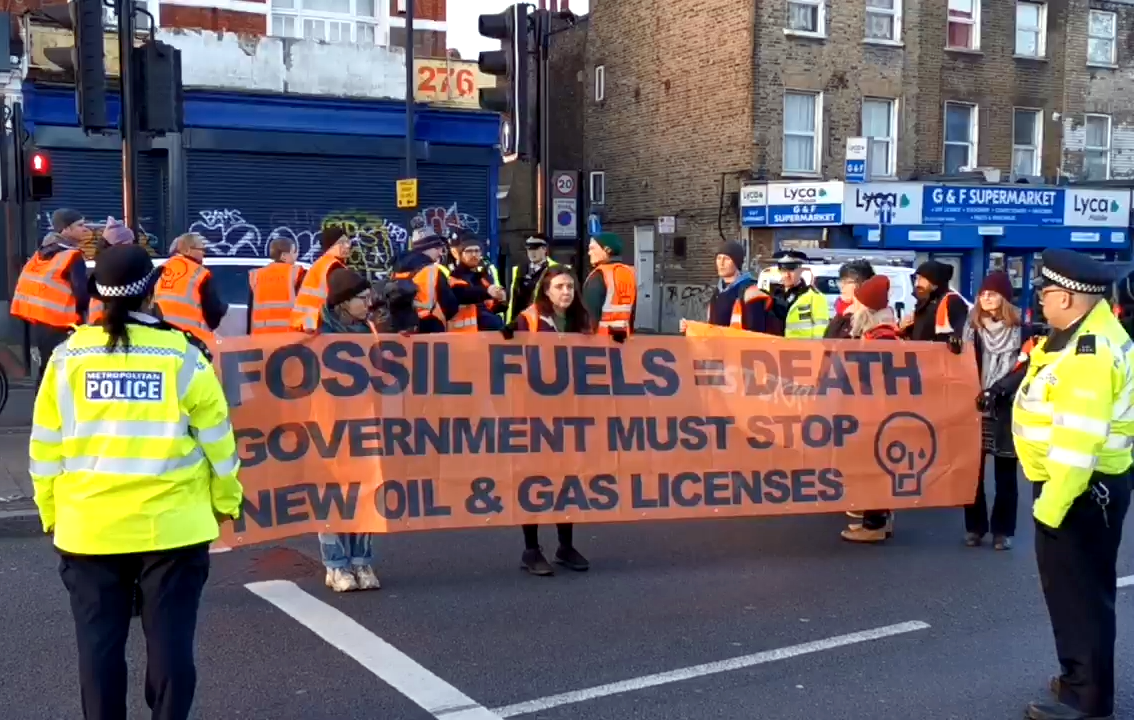
AJUDGE told Just Stop Oil activists today during their trial for disrupting an Esso oil terminal in Birmingham last year that they “should feel guilty for nothing.”
Seven of the protesters were found guilty and two were acquitted over the action last April, which pressed the demand that the government ends fossil fuel licences.
Harley Brewer, Paul Barnes, Oliver Clegg, Jon Deery, Paul Fawkesley, Naomi Goddard, Diana Hekt, Sylvie More and Alan Woods appeared before District Judge Graham Wilkinson at Wolverhampton magistrates’ court on charges of aggravated trespass.
…
“I say this, and I mean this sadly, I have to convict you. Good people doing the wrong thing cannot make the wrong thing right.
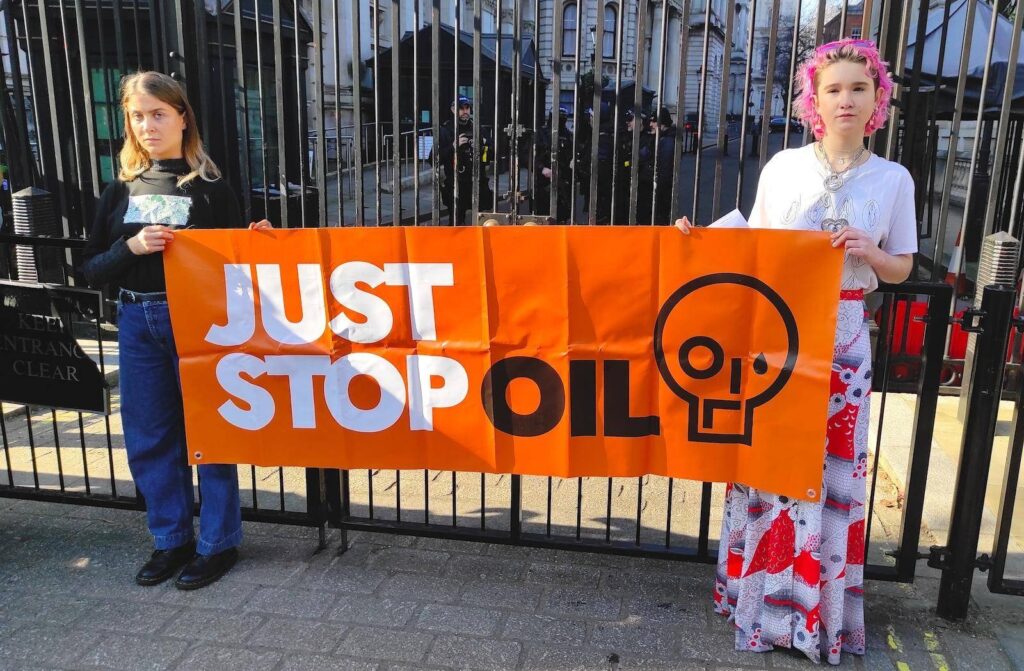
Two young supporters of Just Stop Oil, a one year old campaign demanding that the government stops granting licences for new fossil fuel projects, delivered an ultimatum letter to 10 Downing Street this morning.
Just Stop Oil youth campaigners deliver ultimatum to Rishi Sunak 14 February 2023. Image: Just Stop Oil
Hannah Hunt, 23, from Brighton announcing the delivery of the letter, made a brief speech to assembled reporters. She said:
“A year on from delivering Just Stop Oil’s Saint Valentine’s Day letter, along with hundreds of others, I face multiple trials and the loss of my freedom because we refused to stand by while our government planned the destruction of everything we love.
“We may not succeed, and we may yet bequeath a poisoned bleak inheritance – but I make this promise to those I love: for the government to win, it will have to defeat the youth of this country for we will put our bodies on the line.
“Now I am asking you to pick a side, to join me, to stand with those future generations and with all the ordinary people willing to sacrifice their freedom to protect our future. We must stop the harm that is new oil and gas.”
Phoebe Plummer, 21, from London read out the contents of the letter to the Prime Minister. It points out that according to the International Energy Agency in order to have an even chance of limiting the global temperature rise to 1.5°C in line with the Paris Agreement, there can be no new investments in fossil fuel supply projects. [3] She said:
“One year ago our letter stressed that the government, of which you were a part, knew that breaching 1.5˚C could be the death sentence for our children and for whole countries and regions of the world.
“Since then, we have been warned by the United Nations that not only will we hurtle over 1.5˚C but also that there is “no credible pathway to 1.5˚C in place”.
“Accelerating the granting of North Sea oil and gas licences … is to knowingly plan for the death of countless millions, for the loss of entire nation states. It is an act of genocide, for which you will be held accountable.”
She went on to deliver the following ultimatum:
“Just Stop Oil is demanding that: The UK government makes a statement that it will immediately halt all future licensing and consents for the exploration, development and production of fossil fuels in the UK.
“If you do not provide such assurance by 10th April 2023, we will be forced to escalate our campaign – to prevent the ultimate crime against our country, humanity and life on earth..”
“The shift to a low-carbon economy is not just inevitable, it’s already happening. Yet the board is persisting with a transition strategy that is fundamentally flawed.”
A group of activist investors sued Shell’s board of directors on Wednesday for failing to “deliver the reduction in emissions that is needed to keep global climate goals within reach.”
ClientEarth, an environmental law charity and institutional investor in Shell, described the case as the first time a company board is facing a shareholder lawsuit for inadequately preparing to transition away from fossil fuels.
“Shell may be making record profits now due to the turmoil of the global energy market, but the writing is on the wall for fossil fuels long term,” Paul Benson, a senior lawyer at ClientEarth, said in a statement. “The shift to a low-carbon economy is not just inevitable, it’s already happening. Yet the board is persisting with a transition strategy that is fundamentally flawed, leaving the company seriously exposed to the risks that climate change poses to Shell’s future success—despite the board’s legal duty to manage those risks.”
The lawsuit, which is backed by large institutional investors that collectively hold 12 million shares of Shell, alleges that the oil giant’s 11 directors are violating the Companies Act, a U.K. law that requires corporate boards to “promote the success” of the business.
By failing to sufficiently manage climate risks and implement “an energy transition strategy that aligns with the Paris Agreement,” Shell is flouting its legal obligations, the lawsuit contends.
“Shell’s Board on the other hand maintains that its ‘Energy Transition Strategy’—including its plan to be a net-zero emissions business by 2050—is consistent with the 1.5°C temperature goal of the Paris Agreement,” ClientEarth notes. “It also claims that its plan to halve emissions from its global operations by 2030 is ‘industry-leading,’ however this covers less than 10% of its overall emissions.”
“It is in the best interests of the company, its employees, and its shareholders—as well as the planet—for Shell to reduce its emissions harder and faster than the board is currently planning.”
ClientEarth and its backers are asking the High Court of Justice in London to force Shell’s board to “adopt a strategy to manage climate risk in line with its duties under the Companies Act” and in compliance with a 2021 Dutch court ruling ordering the oil giant to cut its total carbon emissions by 45% by 2030.
“Long term, it is in the best interests of the company, its employees, and its shareholders—as well as the planet—for Shell to reduce its emissions harder and faster than the board is currently planning,” Benson said.
Jacqueline Amy Jackson, the head of responsible investment at London CIV—one of the institutional backers of ClientEarth’s lawsuit—said that “we do not believe the board has adopted a reasonable or effective strategy to manage the risks associated with climate change affecting Shell.”
“In our view,” Jackson added, “a board of directors of a high-emitting company has a fiduciary duty to manage climate risk, and in so doing, consider the impacts of its decisions on climate change, and to reduce its contribution to it.”
Shell said in response that ClientEarth’s suit “has no merit.”
ClientEarth filed its complaint a week after Shell announced that its profits doubled in 2022, surging to a record $40 billion as households across Europe and around the world struggled with high energy costs. The company said it returned $26 billion to shareholders last year through dividends and stock buybacks.
Earlier this month, the advocacy group Global Witness filed a complaint with the U.S. Securities and Exchange Commission accusing Shell of “lumping together some of its gas-related investments with its spending on renewables to inflate its overall investment in renewable sources of energy,” misleading investors and authorities.
“Shell’s so-called renewable and energy solutions category is pure fiction,” said Zorka Milin, a senior adviser at Global Witness. “The company is living in fantasy land if it thinks fossil gas has any place in the much-needed energy transition. Shell’s business model has always been, and continues to be, overwhelmingly based on climate-polluting fossil fuels.”
Shell is also facing lawsuits from nearly 14,000 Nigerians whose communities have been devastated by the company’s pollution and oil spills.
Shell initially said it did not expect to pay any windfall tax for 2022, as its North Sea investments meant was not considered to have made any UK profits.
But on 2 February it announced that it would pay $134m (£108m) for 2022, and expected to pay more than $500m (£400m) for 2023.
BP said it would pay $700m (£583m) in windfall tax for 2022.
…
BP and Shell both received more money back from the UK government than they paid every year from 2015 to 2020 (except 2017, when Shell paid more than it received).
Shell also paid a negative amount of tax in 2021, taking its 2015 to 2021 total to -£685m of tax in the UK.