What Hannah Spencer’s historic win means for the Green party’s future
Louise Thompson, University of Manchester
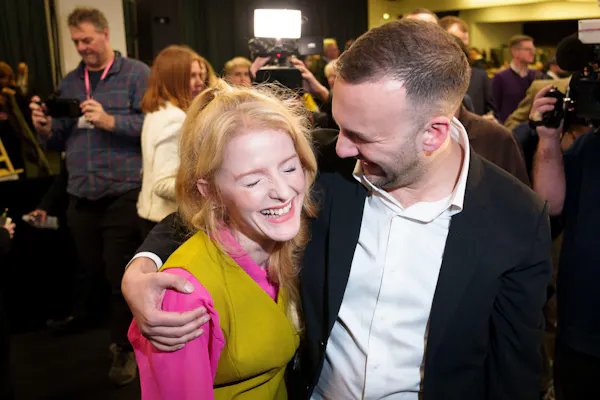
The byelection in Gorton and Denton this week has been huge for the Green party of England and Wales, with Hannah Spencer pushing Reform’s Matt Goodwin into second place, and Labour into third. Having one extra MP in parliament may not seem like a big milestone, but this byelection win is record-breaking for the Greens. I believe it shows their potential to be a credible alternative to Labour.
The Greens had never won a byelection before. They polled less than 7% of the vote (coming in fourth place) in the Runcorn and Helsby byelection in May 2025. And, unlike Reform UK in that byelection, the Greens didn’t just edge this victory – they took nearly 41% of the vote. That’s a whopping 28-point increase on their performance in the same constituency at the 2024 general election.
The victory has given party leader Zack Polanski the confidence that voters now see the Greens as a viable alternative to Labour, even in former Labour strongholds. He announced to supporters, “this is what replacing Labour looks like”.
Over the past few years the Greens have really professionalised their party. We saw the impact of this in the 2024 general election, when they quadrupled their number of MPs and finished second in 40 constituencies.
Under Polanski’s leadership, they’ve developed a more populist edge, focusing on issues such as the cost of living and moving away from being “just” a climate party. They’ve also had a more visible media presence and started to take their communication strategy more seriously.
Spencer’s win increases the size of the Green parliamentary group to five MPs. In the context of a 650-member House of Commons, this doesn’t seem like much.
The Greens certainly aren’t large enough to swing any votes, or cause the government many problems. And although they now have more MPs than ever before, they are still only the sixth-largest party group in the Commons. There are still over twice as many independent MPs as there are Greens.
The win will, however, give the Greens some breathing space. It’s a tough job being a small party in the Commons, and the existing group of four Green MPs have shared a heavy burden of responsibilities in the chamber since their arrival in 2024. As Spencer finds her feet, she will be able to take on some of these policy portfolio responsibilities.
Having a bigger parliamentary team doesn’t just alleviate some of the pressure to be in the chamber all the time. It also allows the party to be more strategic, and to insert Green voices into more conversations than before.
This could be through places on committees scrutinising legislation, trying to catch the speaker’s eye during high-profile government statements and question times, or holding backbench debates on more local issues. There is no place for passengers in any small party, so we can expect to see Spencer playing a very visible role for the rest of the parliament.
The battle ahead
When the next general election draws closer, the Greens may be grateful of this bigger team. They will want to capitalise on their success in Manchester and continue to professionalise their operations as a national party.
They are also likely to face more hostility at Westminster. Labour is now fighting a war on two fronts. The party’s embarrassing third-place result in Gorton and Denton – which Keir Starmer called “very disappointing” – will have hammered this home. We can expect to see more attacks on the Greens, including in the Commons chamber.
Until now, the prime minister has focused much more consistent attention on discrediting Reform. Now, he needs to worry much more about Polanski and the Greens, and will be directing some focus to winning back Labour voters who see the Greens as the stronger party of the left.
We had a glimpse of this in January, when North Herefordshire’s Ellie Chowns used her occasional opportunity to question the prime minister to ask about water pollution. Starmer turned it into a partisan attack on the unrelated topic of Polanski’s comments about Nato.
While the Reform UK leader, Nigel Farage, regularly berates Starmer in the Commons, the Greens rarely take such an overtly partisan approach. Reform MPs tend to participate more frequently in high-profile parliamentary occasions, where they can question the government. The Greens tend to have a more balanced, policy-focused approach, regularly popping up on committees to scrutinise legislation.
This is helped by Polanski’s position as a leader who sits outside the Commons (a member of the London Assembly). He can delegate the scrutiny of government policy to Chowns and her colleagues, while he takes broader comments about the government’s performance directly to the press.
This balance will be important as the Greens think about the upcoming local elections. Spencer told the press today that the party can now “win anywhere”, and Polanski predicted a “tidal wave” of Green MPs at the next election.
To do this, they need to maintain the momentum they’ve created this week. This means keeping a tight hold of the former Labour voters who chose them instead in Gorton and Denton.
It will be difficult for the party to carry out the same intensive campaign strategy on a more national level, but this sort of intensity is key to ensuring that the left vote goes to the Greens rather than to the other alternatives. Having more party members than ever before will help with this, but they will need to rely on their on-the-ground campaigners to feel secure.
Louise Thompson, Senior Lecturer in Politics, University of Manchester
This article is republished from The Conversation under a Creative Commons license. Read the original article.


dizzy: I won hundreds of pounds by gambling on this election. I have a bet on the Green party at general election at 66/1.
Owen Jones: I saw how the Greens channelled voters’ anger – and fused it with hope. That’s why they won in Gorton and Denton
…
Labour did not simply lose; it disgraced itself. It has been accused of sending leaflets appearing to come from a tactical voting organisation that did not exist, which “recommended” voting Labour based on “a new prediction”. Labour attacked the Greens for their principled opposition to a failed “war on drugs” that leaves a multibillion-pound trade in the hands of criminal gangs and condemns many addicts to early graves.
…
Labour feared a Green victory would be existential. It is. Gorton and Denton ranked 127th on the Greens’ target list. If Polanski’s party can capture one of Labour’s safest seats, then no Labour MP can feel secure. And it is worse than it looks. Canvassers repeatedly told me they met voters – Muslim and non-Muslim alike – who were frightened into backing Labour to stop Reform. They would have voted Green had they believed victory possible. Next time, those people will.
The Starmer project rested on crushing the left. As a mere frontman for the most reactionary and personally toxic elements in his party, he secured power by assuring members he would preserve the radicalism they had voted for – and then buried it. They assumed they could get away with it, confident much of the media would applaud the destruction of socialists as sober statecraft.
But deceit is all Starmerism had – and events in Gorton and Denton show the vacuity of that. There was no animating vision, no reckoning with a broken economic order. What Starmer’s Labour did not anticipate was the re-emergence of the left beyond Labour’s institutional walls. It was comfortable competing with the Conservatives and Reform, aping their anti-migrant rhetoric. It did not regard the left as a legitimate political force: being devoured by the radical left was never in the script. In the end, its war on the left has consumed it.
Labour now faces a reckoning between a Blairite faction urging further defiance of an estranged electorate and others demanding a frantic pivot to win back disillusioned voters. Even if the leadership desired the latter, the parliamentary party is crowded with too many cynical careerists to make it credible. In my view, Labour cannot be saved: it must be replaced. Gorton and Denton suggests that is possible.
…
See the original article at https://www.theguardian.com/commentisfree/2026/feb/27/gorton-and-denton-byelection-keir-starmer-labour
Greens win Gorton and Denton by-election for the left
Hannah Spencer has won a huge victory for the Green party over Reform UK and the Labour party in Gorton and Denton. The left united in their support behind Spencer and the Green party to defeat the evil promoted by Farage and Starmer’s parties. Both nasty right-wing parties were properly rejected.
Congratulation to Hannah and the Green Party, champions of the left, defeaters of evil.


Israel Responsible for Two-Thirds of Journalist Deaths in 2025: Press Freedom Group
Original article by Brad Reed republished from Common Dreams under Creative Commons (CC BY-NC-ND 3.0).

The number of journalists killed by Israel is remarkably high even when compared to the number of journalists killed in other conflict zones.
A new report from a major press freedom group has found that a record 129 journalists were killed in 2025, and that Israel was responsible for two-thirds of the worldwide total.
The Tuesday report from the Committee to Protect Journalists says that the Israeli military has cumulatively killed more journalists than any other government since CPJ started tracking reporter deaths in 1992, with the vast majority being Palestinian media workers in Gaza.
RECOMMENDED…

‘Where Is the Ceasefire?’: Israel’s Bombing of Gaza Kills 23, Mostly Women and Children

Investigation Details IDF’s ‘Execution-Style’ Massacre of Gaza Medics
The report also finds an increase in the use of drones to attack journalists, with Israel accounting for more than 70% of the 39 documented instances of reporters killed by drone strikes.
The number of journalists killed by Israel is remarkably high even when compared to the number of journalists killed in other conflict zones.
Only nine journalists were killed in Sudan, for example, while just four journalists were killed in Ukraine, despite both countries being in the midst of brutal conflicts that have collectively killed hundreds of thousands of people.
A report issued in December by Reporters Without Borders similarly found that Israel was responsible for the most journalists deaths in 2025, the third consecutive year that the country had held that distinction.
The CPJ report also points the finger at governments for not taking their responsibilities to protect journalists seriously.
“The rising number of journalist deaths globally is fueled by a persistent culture of impunity,” the report states. “Very few transparent investigations have been conducted into the 47 cases of targeted killings (classified as ‘murder’ in CPJ’s longstanding methodology) documented by CPJ in 2025—the highest number of journalists deliberately killed for their work in the past decade—and no one has been held accountable in any of the cases.”
CPJ CEO Jodie Ginsberg said that attacks on the media are “a leading indicator of attacks on other freedoms, and much more needs to be done to prevent these killings and punish the perpetrators,” adding that “we are all at risk when journalists are killed for reporting the news.”
Original article by Brad Reed republished from Common Dreams under Creative Commons (CC BY-NC-ND 3.0).