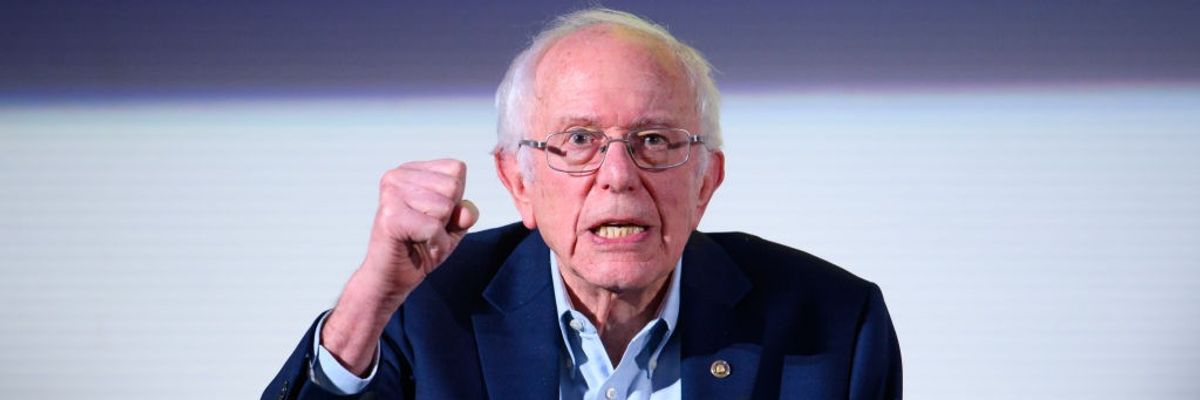
Bernie Sanders attends during “Bernie Sanders: It’s OK To Be Angry About Capitalism” at Royal Geographical Society on February 22, 2024 in London, England. (Photo by Joe Maher/Getty Images For Fane)
“My friends, you don’t have to be a PhD in political science to understand that this is not democracy. This is not one person, one vote. This is not all of us coming together to decide our future. This is oligarchy.”
Sen. Bernie Sanders of Vermont is escalating his fight against the U.S. oligarchy with a new campaign directed at the nation’s wealthiest individuals—including Elon Musk, Jeff Bezos, and Mark Zuckerberg—who he says are key culprits in a global race to the bottom that is stripping people worldwide of political agency while impoverishing billions so that the rich can amass increasingly obscene levels of wealth.
Announcing a new series that will detail how “billionaire oligarchs” in the U.S. “manipulate the global economy, purchase our elections, avoid paying taxes, and increasingly control our government,” Sanders said in a Friday night video address that it makes him laugh when mainstream pundits talk openly about the nefarious oligarchic structures in other places, but refuse to acknowledge the issue in domestic terms.
“Strangely enough, the term ‘oligarchy’ is very rarely used to describe what’s happening in the United States or in fact, what’s happening around the world,” said Sanders. “But guess what? Oligarchy is a global phenomenon, and it is headquartered right here in the United States.”
While rarely discussed in the corporate press or by most elected officials, argues Sanders, the reality is that a “small number of incredibly wealthy billionaires own and control much of the global economy. Period. End of discussion. And increasingly they own and control our government through a corrupt campaign finance system.”
Since the the victory of President-elect Donald Trump in November, Sanders has been increasingly outspoken about his frustrations over the failure of the Democratic Party to adequately confront the contradictions presented by a party that purports to represent the interests of the working class yet remains so beholden to corporate interests and the wealthy that lavish it with campaign contributions.
In a missive to supporters last month, Sanders bemoaned how “just 150 billionaire families spent nearly $2 billion to get their candidates elected” in this year’s elections, which included giving to both major political parties. Such a reality, he said, must be challenged.
As part of his new effort announced Friday, Sanders’ office said the two-time Democratic presidential candidate would be hosting a series of discussions with the leading experts on various topics related to the form and function of U.S. oligarchy and expose the incoming Trump administration’s “ties to the billionaire class,” including their efforts to further erode democracy, gut regulations, enrich themselves, and undermine the common good.
“In my view,” said Sanders, “this issue of oligarchy is the most important issue facing our country and world because it touches on everything else.” He said the climate crisis, healthcare, worker protections, and the fight against poverty are all adversely effected by the power of the wealthy elites who control the economy and the political sphere.
“My friends, you don’t have to be a PhD in political science to understand that this is not democracy,” he said. “This is not one person, one vote. This is not all of us coming together to decide our future. This is oligarchy.”
Slain health CEO Brian Thompson’s tenure was marked by skyrocketing prior authorization denials, leading to increased profits
Brian Thompson, slain CEO of UnitedHealthcare, was responsible for skyrocketing prior authorization denials (Photo: UnitedHealthcare)
The assassination of UnitedHealthcare CEO Brian Thompson on December 4 has sparked a reaction that few may have suspected. The perpetrator has received an outpouring of popular support, and a profound debate on the brutality of the US for-profit healthcare system has been sparked, with many accusing healthcare corporations of reaping their profits directly from human misery.
Thompson was shot and killed while heading to an investors meeting in Midtown Manhattan on December 4. Police have arrested 26-year-old Luigi Mangione in connection with the crime, who quickly has become a working class hero in the eyes of many in the US public, especially after his alleged manifesto revealed that he was motivated by outrage towards healthcare corporations. “A reminder: the US has the #1 most expensive healthcare system in the world, yet we rank roughly #42 in life expectancy,” reads the alleged manifesto, which law enforcement claim to have found in his backpack. “It is not an issue of awareness at this point, but clearly power games at play. Evidently I am the first to face it with such brutal honesty.”
The reactions to Thompson’s death show that this outrage is echoed by the US public. UnitedHealthcare had to remove a Facebook post mourning Thompson after it received over 42,000 laughing reactions. Comments on social media regarding Thompson’s death made insurance-related quips including “unfortunately my condolences are out-of-network,” and “thoughts and deductibles to the family.”
Health beyond the for-profit system
People in the US are increasingly demanding alternatives to the present for-profit healthcare system. A Gallup poll taken shortly before Thompson’s assassination shows that the highest percentage of US adults in over a decade believe it is the government’s responsibility to ensure that people have healthcare coverage—62%, as opposed to 36% who insist it is not the government’s responsibility. Gallup data also indicates that most in the US have a negative view of the healthcare industry.
Data for Progress polling indicates that people across the political spectrum support policies that make healthcare more equitable, with 75% of both Democrat, Republican, and independent voters opposing allowing insurers to deny coverage or charge more based on pre-existing conditions. Also across party lines, 70% of voters oppose stopping Medicare (US public insurance) from being able to negotiate lower costs for drug prices.
The unpopularity of the healthcare insurance industry becomes obvious when one examines how exactly insurance companies wield their power over the healthcare system to extract profits from working people.
Cost cutting through denial of service
Shortly before Thompson’s killing, another insurance corporation, Anthem Blue Cross Blue Shield, announced that it would not pay for the complete duration of anesthesia for surgical procedures. This move was denounced by the American Society of Anesthesiologists (ASA). “This is just the latest in a long line of appalling behavior by commercial health insurers looking to drive their profits up at the expense of patients and physicians providing essential care,” said Dr. Donald E. Arnold of ASA. “It’s a cynical money grab by Anthem, designed to take advantage of the commitment anesthesiologists make thousands of times each day to provide their patients with expert, complete and safe anesthesia care. This egregious policy breaks the trust between Anthem and its policyholders who expect their health insurer to pay physicians for the entirety of the care they need.”
Following Thompson’s assassination and the subsequent outrage over the state of the healthcare industry, Anthem walked back this decision, with a company spokesperson stating that “there has been significant widespread misinformation about an update to our anesthesia policy. As a result, we have decided to not proceed with this policy change.”
Regardless of Anthem’s flip-flopping, the corporation was willing to cut anesthesia for patients mid-surgery simply to cut costs. This is only one example of how health insurance companies are able to reap their enormous profits from policies which maximize human misery.
Under the current privatized healthcare system in the US, working people and their employers pay hundreds of billions of dollars to private insurance companies in the hopes of receiving adequate coverage when most needed. Insurance companies, which under a capitalist system exist only to make a profit, not to actually provide coverage, do whatever they can do to deny coverage to patients in their hour of need—enabling them to pocket the billions they receive from people in the US and increase their revenue.
Companies such as UHC, which is the nation’s largest health insurer with over 15% of the market share, cut costs by denying coverage to patients, including through a process called prior authorization, a process which insurance companies utilize to determine if they will cover a prescribed procedure, service, or medication. Prior to Thompson’s tenure as UHC CEO, which began in 2021, the rate of prior authorization denials was 8%. By 2022, the rate of denial had skyrocketed to 22.7%. According to personal finance platform ValuePenguin, UHC denies Medicare and non-Medicare insurance claims at a rate that is double the rate of the national average.
UHC’s prior authorization denials increased so sharply that they prompted an investigation by media outlet ProPublica as well as the US Senate. ProPublica found that UHC had culled therapy expenses by using an algorithm to restrict mental healthcare coverage. A report by the Senate Permanent Subcommittee on Investigations found that UHC used artificial intelligence to deny claims at an increasing rate. In November of 2023, UHC was hit by a class action lawsuit filed by the families of two former UHC beneficiaries, which alleged that the company had illegally denied “elderly patients care owed to them under Medicare Advantage Plans” by utilizing an AI algorithm with a 90% error rate.
“The elderly are prematurely kicked out of care facilities nationwide or forced to deplete family savings to continue receiving necessary medical care, all because [UHC’s] AI model ‘disagrees’ with their real live doctors’ determinations,” said the complaint.
These sharp increases in claim denials served a particular purpose: under Thompson’s leadership, UHC profits increased from USD 12 billion in 2021 to USD 16 billion in 2023. UnitedHealthcare Group, of which UHC is a part, is now the largest health insurance company is the US, with an annual revenue of over USD 189 billion.
Hey @UHC. Completed a hysterectomy yesterday afternoon, discharged her home in the evening (saving @UHC and everyone some money). Discharge medications included 12 Vicodin. (retail cost $30). Vicodin DENIED pending prior authorization. Patient in pain all night. Way to go.
As health insurance companies extract their enormous profits from those left without coverage, some are seeking to propose and organize alternatives to the for-profit healthcare system. Progressive demands for Medicare for All, a single-payer healthcare program in which the costs of essential healthcare for all US residents are covered under a public health plan that would replace almost all other existing public and private health plans, have reignited following Thompson’s assassination. Organizations such as Physicians for a National Health Program have advocated for such a policy. As PNHP outlines, under a single-payer program, “over $500 billion in administrative savings would be realized by replacing today’s inefficient, profit-oriented, multiple insurance payers with a single streamlined, nonprofit, public payer.”
“There is no justification for violence,” said California Representative Ro Khanna, who supports the policy. “But the outpouring afterwards has not surprised me.
Uniqlo is among the retailers using gig economy apps such as Temper and YoungOnes to draft in shop assistants for the busy Christmas run-up. Photograph: Iain Masterton/Alamy
Lush and Gymshark among chains using apps promoted by TikTok influencers to take on gig economy assistants lacking basic protections, say unions
Unions have accused high-street retailers of drafting in young gig economy store assistants without basic employment rights in the run-up to Christmas.
The Observer has found large brands, including Urban Outfitters, Lush, Gymshark and Uniqlo, are recruiting “freelance” shop assistants through gig apps to staff their stores during the busy festive period.
The apps are being promoted by youth influencers with hundreds of thousands of TikTok followers.
“This is a worrying new development,” said Tim Sharp, senior policy officer for employment rights at the Trades Union Congress (TUC).
“It would seem absurd to most people that someone can do a job like working in a shop and not be entitled to basic legal protections. There is a big question mark over the employment status of these supposed freelancers.”
The president-elect’s advisers are reportedly discussing plans to shrink or eliminate key bank watchdogs, including the Federal Deposit Insurance Corporation.
President-elect Donald Trump and his advisers are reportedly considering plans to weaken—or abolish altogether—top bank regulators, including the Federal Deposit Insurance Corporation and Office of the Comptroller of the Currency.
The Wall Street Journal reported Thursday that members of Trump’s transition team and the new Elon Musk-led Department of Government Efficiency have asked nominees under consideration to head the FDIC and OCC if the bank watchdogs could be eliminated and have their functions absorbed by the Treasury Department, which is set to be run by a billionaire hedge fund manager and crypto enthusiast.
“Bank executives are optimistic President-elect Donald Trump will ease a host of regulations on capital cushions and consumer protections, as well as scrutiny of consolidation in the industry,” the Journal reported. “But FDIC deposit insurance is considered near sacred. Any move that threatened to undermine even the perception of deposit insurance could quickly ripple through banks and in a crisis might compound customer fears.”
The Trump team’s internal and fluid discussions about the fate of the key bank regulators broadly aligns with Project 2025’s proposal to “merge the Office of the Comptroller of the Currency, the Federal Deposit Insurance Corporation, the National Credit Union Administration, and the Federal Reserve’s non-monetary supervisory and regulatory functions.”
The FDIC, which is primarily funded by bank insurance premiums, was established during the Great Depression to restore public trust in the nation’s banking system, and the agency played a central role in navigating the 2023 bank failures that threatened a systemic crisis.
Observers warned that gutting the FDIC and OCC could catalyze another economic meltdown.
“The next recession starts here,” tech journalist Jacob Silverman warned in response to the Journal‘s reporting.
Eric Rauchway, a historian of the New Deal, wrote that “even Milton Friedman appreciated the FDIC,” underscoring the extreme nature of the incoming Trump administration’s deregulatory ambitions.
Musk, the world’s wealthiest man, is also pushing for the elimination of the Consumer Financial Protection Bureau, an agency established in the wake of the 2008 financial crisis.
The Journal noted Thursday that “Rep. Andy Barr, a Republican from Kentucky and Trump ally on the House Financial Services Committee, has backed the plan to eliminate or drastically alter the CFPB and said he wants to get rid of what he calls ‘one-size-fits-all’ regulation for banks.”
Barr has received millions of dollars in campaign donations from the financial sector and “introduced many pieces of pro-industry legislation, including significant rollbacks of protections stemming from the 2008 financial crisis,” according to the watchdog group Accountable.US.
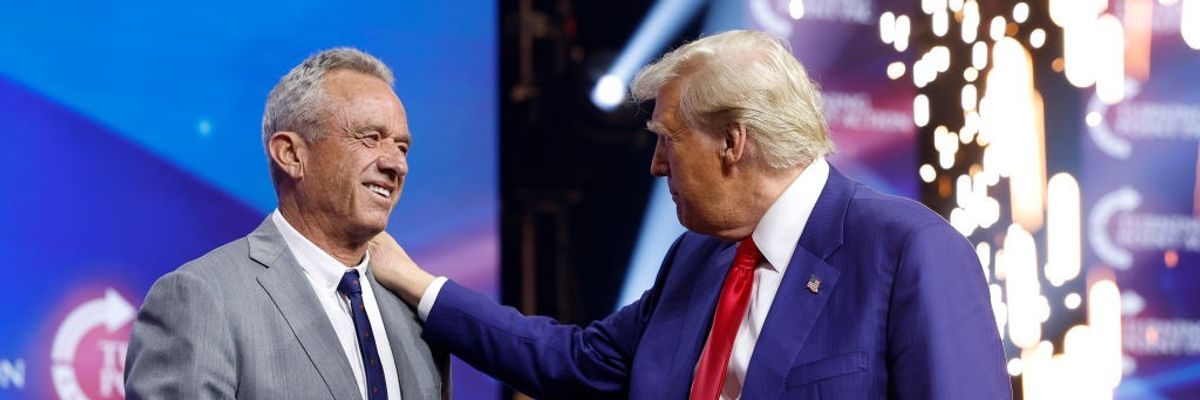
Former U.S. President Donald Trump welcomes Robert F. Kennedy Jr. to the stage at a campaign rally at the Gas South Arena on October 23, 2024 in Duluth, Georgia. (Photo: Anna Moneymaker/Getty Images)
“So if you’re wondering if Donald Trump is trying to kill your kids, yes, yes he is,” said one critic.
Public health advocates, federal lawmakers, and other critics responded with alarm to The New York Times reporting on Friday that an attorney helping Robert F. Kennedy Jr. select officials for the next Trump administration tried to get the U.S. regulators to revoke approval of the polio vaccine in 2022.
“The United States has been a leader in the global fight to eradicate polio, which is poised to become only the second disease in history to be eliminated from the face of the earth after smallpox,” said Liza Barrie, Public Citizen’s campaign director for global vaccines access. “Undermining polio vaccination efforts now risks reversing decades of progress and unraveling one of the greatest public health achievements of all time.”
Public Citizen is among various organizations that have criticized President-elect Donald Trump’s choice of Kennedy to lead the Department of Health and Human Services, with the watchdog’s co-president, Robert Weissman, saying that “he shouldn’t be allowed in the building… let alone be placed in charge of the nation’s public health agency.”
Although Kennedy’s nomination requires Senate confirmation, he is already speaking with candidates for top health positions, with help from Aaron Siri, an attorney who represented RFK Jr. during his own presidential campaign, the Times reported. Siri also represents the Informed Consent Action Network (ICAN) in petitions asking the Food and Drug Administration (FDA) “to withdraw or suspend approval of vaccines not only for polio, but also for hepatitis B.”
According to the newspaper:
Mr. Siri is also representing ICAN in petitioning the FDA to “pause distribution” of 13 other vaccines, including combination products that cover tetanus, diphtheria, polio, and hepatitis A, until their makers disclose details about aluminum, an ingredient researchers have associated with a small increase in asthma cases.
Mr. Siri declined to be interviewed, but said all of his petitions were filed on behalf of clients. Katie Miller, a spokeswoman for Mr. Kennedy, said Mr. Siri has been advising Mr. Kennedy but has not discussed his petitions with any of the health nominees. She added, “Mr. Kennedy has long said that he wants transparency in vaccines and to give people choice.”
After the article was published, Siri called it a “typical NYT hit piece plainly written by those lacking basic reading and thinking skills,” and posted a series of responses on social media. He wrote in part that “ICAN’s petition to the FDA seeks to revoke a particular polio vaccine, IPOL, and only for infants and children and only until a proper trial is conducted, because IPOL was licensed in 1990 by Sanofi based on pediatric trials that, according to FDA, reviewed safety for only three days after injection.”
The Times pointed out that experts consider placebo-controlled trials that would deny some children polio shots unethical, because “you’re substituting a theoretical risk for a real risk,” as Dr. Paul A. Offit, a vaccine expert at the Children’s Hospital of Philadelphia, explained. “The real risks are the diseases.”
Ayman Chit, head of vaccines for North America at Sanofi, told the newspaper that development of the vaccine began in 1977, over 280 million people worldwide have received it, and there have been more than 300 studies, some with up to six months of follow-up.
Trump, who is less than six weeks out from returning to office, has sent mixed messages on vaccines in recent interviews.
Asked about RFK Jr.’s anti-vaccine record during a Time “Person of the Year” interview published Thursday, the president-elect said that “we’re going to be able to do very serious testing” and certain vaccines could be made unavailable “if I think it’s dangerous.”
Trump told NBC News last weekend: “Hey, look, I’m not against vaccines. The polio vaccine is the greatest thing. If somebody told me to get rid of the polio vaccine, they’re going to have to work real hard to convince me. I think vaccines are—certain vaccines—are incredible. But maybe some aren’t. And if they aren’t, we have to find out.”
Both comments generated concern—like the Friday reporting in the Times, which University of Alabama law professor and MSNBC columnist Joyce White Vance called “absolutely terrifying.”
She was far from alone. HuffPost senior front page editor Philip Lewis said that “this is just so dangerous and ridiculous” while Zeteo founder Mehdi Hasan declared, “We are so—and I use this word advisedly—fucked.”
Ryan Cooper, managing editor at The American Prospect, warned that “they want your kids dead.”
Author and musician Mikel Jollett similarly said, “So if you’re wondering if Donald Trump is trying to kill your kids, yes, yes he is.”
Multiple critics altered Trump’s campaign slogan to “Make Polio Great Again.”
U.S. Sen. Elizabeth Warren (D-Mass.) responded with a video on social media:
Without naming anyone, Senate Minority Leader Mitch McConnell (R-Ky.), a polio survivor, put out a lengthy statement on Friday.
“The polio vaccine has saved millions of lives and held out the promise of eradicating a terrible disease. Efforts to undermine public confidence in proven cures are not just uninformed—they’re dangerous,” he said in part. “Anyone seeking the Senate’s consent to serve in the incoming administration would do well to steer clear of even the appearance of association with such efforts.”