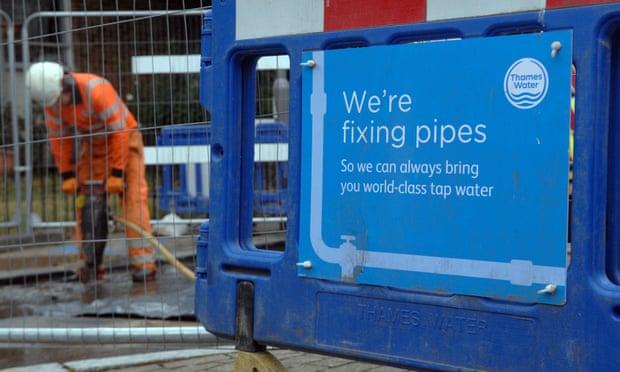
Thames Water, the UK’s largest such firm, is fighting for its survival after years of poor performance, fines and hefty dividend payouts Photograph: Gill Allen/REX/Shutterstock
Guardian Exclusive: UK’s biggest water company assessed risks before cutting back on cost of environmental work, investigation shows
Thames Water intentionally diverted millions of pounds pledged for environmental clean-ups towards other costs including bonuses and dividends, the Guardian can reveal.
The company, which serves more than 16 million customers, cut the funds after senior managers assessed the potential risks of such a move.
Discussions – held in secret – considered the risk of a public and regulatory backlash if it emerged that cash set aside for work such as cutting river pollution had been spent elsewhere.
This could be seen as abreach of the company’s licence commitments and leave it vulnerable to accusations it had broken the law, according to sources and material seen by the Guardian.
Thames Water continued to pay staff bonuses worth hundreds of thousands of pounds, and also paid tens of millions in dividends as recently as March this year, while cutting back on its spending promises. The company did so despite public claims from its leaders that improvements to its environmental performance, including on pollution, were a priority.
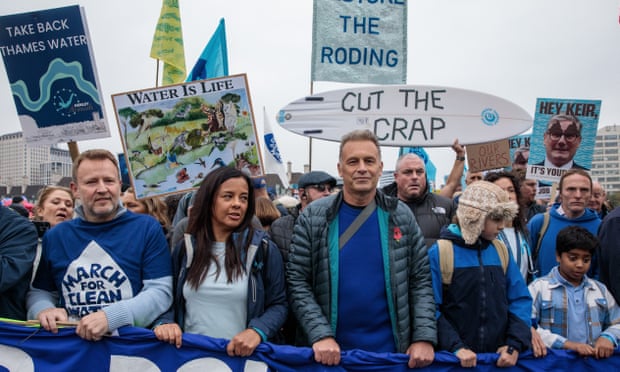
Wildlife presenter Liz Bonnin and naturalist and TV presenter Chris Packham join thousands of environmental campaigners from more than 130 organisations in a March for Clean Water on 3 November 2024 in London. Photograph: Mark Kerrison/In Pictures/Getty Images
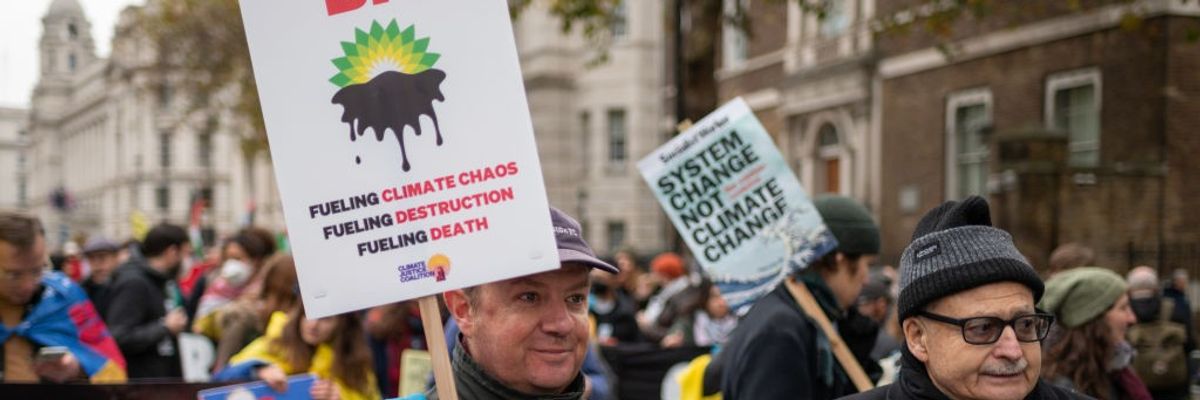
A demonstrator is seen marching while holding a placard criticizing BP in London on November 16, 2024. (Photo: David Tramontan/SOPA Images/LightRocket via Getty Images)
“By facilitating the transport of oil that fuels military operations in Gaza, BP has contributed to the humanitarian catastrophe unfolding in the region,” said the director of the organization backing the claimants.
A group of Palestinians whose family members have been killed in Israeli attacks on the Gaza Strip over the past 14 months have initiated legal action in the United Kingdom against the British fossil fuel giant BP, arguing the company is aiding the assault on the enclave via its ownership of a pipeline that provides Israel with crude oil.
In a 36-page letter before claim, the group contends that BP’s role in supplying oil to Israel violates the company’s stated commitments to human rights, including its expressed support for the United Nations Guiding Principles on Business and Human Rights.
“Israel relies heavily on crude oil and refined petroleum imports to run its large fleet of fighter jets, tanks, and other military vehicles and operations, as well as the bulldozers implicated in clearing Palestinian homes and olive groves to make way for unlawful Israeli settlements,” the letter notes. “Some fuel from refineries goes directly to the armed forces, while much of the rest appears to go to ordinary gas stations where military personnel can refuel their vehicles under a government contract.”
The group demands from BP an “immediate cessation of oil supply to Israel and facilitation through” the Baku-Tbilisi-Ceyhan pipeline as well as an “admission liability and a commitment to mediation for assessing damages.”
“Our clients seek justice for the profound suffering and loss they have endured and call on BP to act responsibly by immediately halting its involvement.”
Tayab Ali, head of international law at Bindmans LLP and director of the International Centre of Justice for Palestinians (ICJP)—which is supporting the group of claimants—said in a statement Monday that “this legal action marks a new phase in accountability for those that are complicit in alleged war crimes and crimes against humanity.”
“The evidence against BP demonstrates a clear failure to adhere to its own human rights policies and international law,” said Ali. “By facilitating the transport of oil that fuels military operations in Gaza, BP has contributed to the humanitarian catastrophe unfolding in the region. Our clients seek justice for the profound suffering and loss they have endured and call on BP to act responsibly by immediately halting its involvement.”
According to ICJP, the claimants include “a British citizen of Palestinian origin who lost 16 family members to Israeli airstrikes,” “a second British Palestinian claimant whose relatives in Gaza have suffered fatalities and displacement,” and “additional claimants who have endured catastrophic physical and psychological harm including amputations and loss of family members.”
The group sent its legal letter just over a month after a coalition of environmental groups published a report identifying BP as one of the “top corporate suppliers of oil to Israel.”
“The major international oil companies, including BP, Chevron, Eni, ExxonMobil, Shell, and TotalEnergies, may be linked to 35% of the crude oil supplied to Israel since October [2023],” the report states. “These companies, as well as state-owned entities and other private and publicly traded oil producers, profit from supplying oil to Israel’s refineries, where a proportion is likely refined into fuels for Israel’s war machine.”
Last week, the Centre for Research on Multinational Corporations argued that “foreign governments have an obligation” under international law “to end the supply of fuel to Israel unless they can guarantee it will only be used for nonmilitary purposes.”
“This includes both a ban on the export of crude oil, military jet fuel, and other fuels, as well as a prohibition on the transport of these commodities through their territory,” the group said.
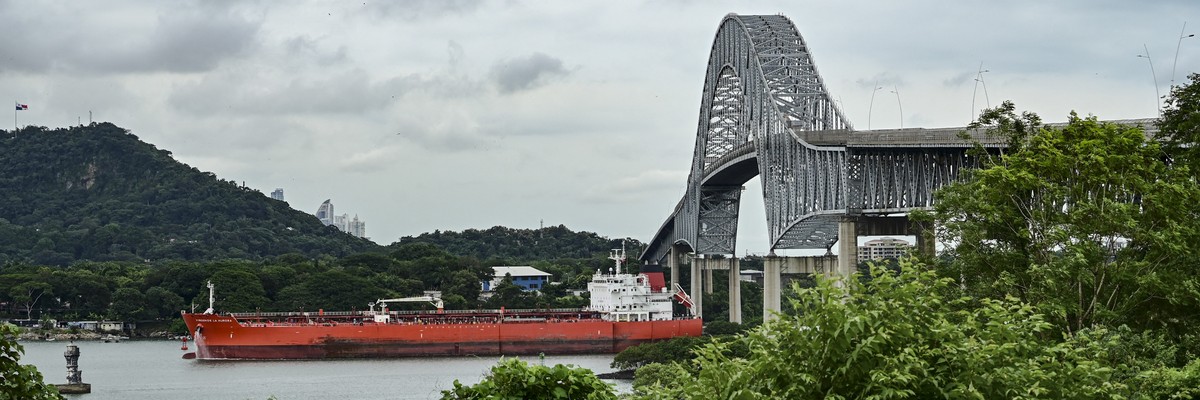
A tanker ship enters the Panama Canal from the Pacific side on October 25, 2024. (Photo: Martin Bernetti/AFP via Getty Images)
The U.S. president-elect’s remarks came a day after the 35th anniversary of the country’s invasion of Panama, which grassroots groups say killed thousands of civilians and displaced tens of thousands.
President-elect Donald Trump threatened over the weekend that the U.S. would retake control of the Panama Canal if Panama did not lower the fees it charges U.S. ships to access the waterway that connects the Atlantic and Pacific oceans.
Trump first issued the threat in two posts on Truth Social Saturday night. He then mentioned the canal again on Sunday while speaking at the conservative group Turning Point’s annual AmericaFest in Arizona, implying that Panama had allowed China to take control of the waterway.
“We will never, ever let it fall into the wrong hands,” Trump said.
“Trump is a tyrant threatening the sovereignty of Panama a day after the 35 year commemoration of a deadly and disproportionate U.S. invasion in which thousands of Panamanian civilians were killed.”
In response, Rep. Ritchie Torres (D-N.Y.), posted on Bluesky, “Donald Trump is openly advocating for imperialism against Panama and the seizure of the Panama Canal by the United States. He doesn’t seem to know that Panama is a sovereign country or doesn’t seem to care.”
The U.S. struck an agreement with Panama in 1904 to build the canal and take possession of the land on each side of it. However, former U.S. President Jimmy Carter negotiated a treaty with Panama in the late 1970s to return the canal to Panama by 1999.
In his initial Truth Social post, Trump wrote that “it was solely for Panama to manage, not China, or anyone else. It was likewise not given for Panama to charge the United States, its Navy, and corporations, doing business within our country, exorbitant prices and rates of passage.”
In the second post, Trump concluded that the canal “was not given for the benefit of others, but merely as a token of cooperation with us and Panama. If the principles, both moral and legal, of this magnanimous gesture of giving are not followed, then we will demand that the Panama Canal be returned to us, in full, and without question. To the officials of Panama, please be guided accordingly!”
Trump repeated many of the same arguments in his speech at AmericaFest.
When he first mentioned the canal, an audience member called out, “Take it back!”
Trump responded, “That’s a good idea.”
In reporting on Trump’s remarks, Reuters noted that China does not control any part of the canal. However, a subsidiary of Hong Kong-based CK Hutchison Holdings has managed two ports on either side for years. The outlet called Trump’s remarks “an exceedingly rare example of a U.S. leader saying he could push a sovereign country to hand over territory.”
“The government has the duty to defend our autonomy as an independent country,” Panamanian opposition deputy Grace Hernandez wrote on social media in response to Trump’s remarks. “Diplomacy demands steadfastness in the face of regrettable statements.”
The current leader of Panama, President José Raúl Mulino, is a pro-U.S. conservative, according to The Associated Press. The rising prices that Trump laments have less to do with any targeting of the U.S. and more to do with environmental conditions impacting all of the canal’s users, though the U.S. does use it more than any other nation. As AP explained:
The canal depends on reservoirs to operate its locks. It was heavily affected by droughts in Central America in 2023 that forced it to substantially reduce the number of daily slots for crossing ships. With fewer ships using the canal each day, administrators also increased the fees that are charged all shippers for reserving a slot.
With weather returning to normal in the later months of this year, transit on the canal has normalized. But price increases are still expected for next year.
Trump’s initial remarks came a day after the 35th anniversary of the U.S. invasion of Panama to oust President Manuel Noriega, which grassroots groups say killed thousands of civilians in Panama and displaced tens of thousands.
“Trump is a tyrant threatening the sovereignty of Panama a day after the 35 year commemoration of a deadly and disproportionate U.S. invasion in which thousands of Panamanian civilians were killed,” Panamanian architectural designer Luis Alfaro wrote on social media. “The canal is on Panamanian land, and will always be Panamanian.”
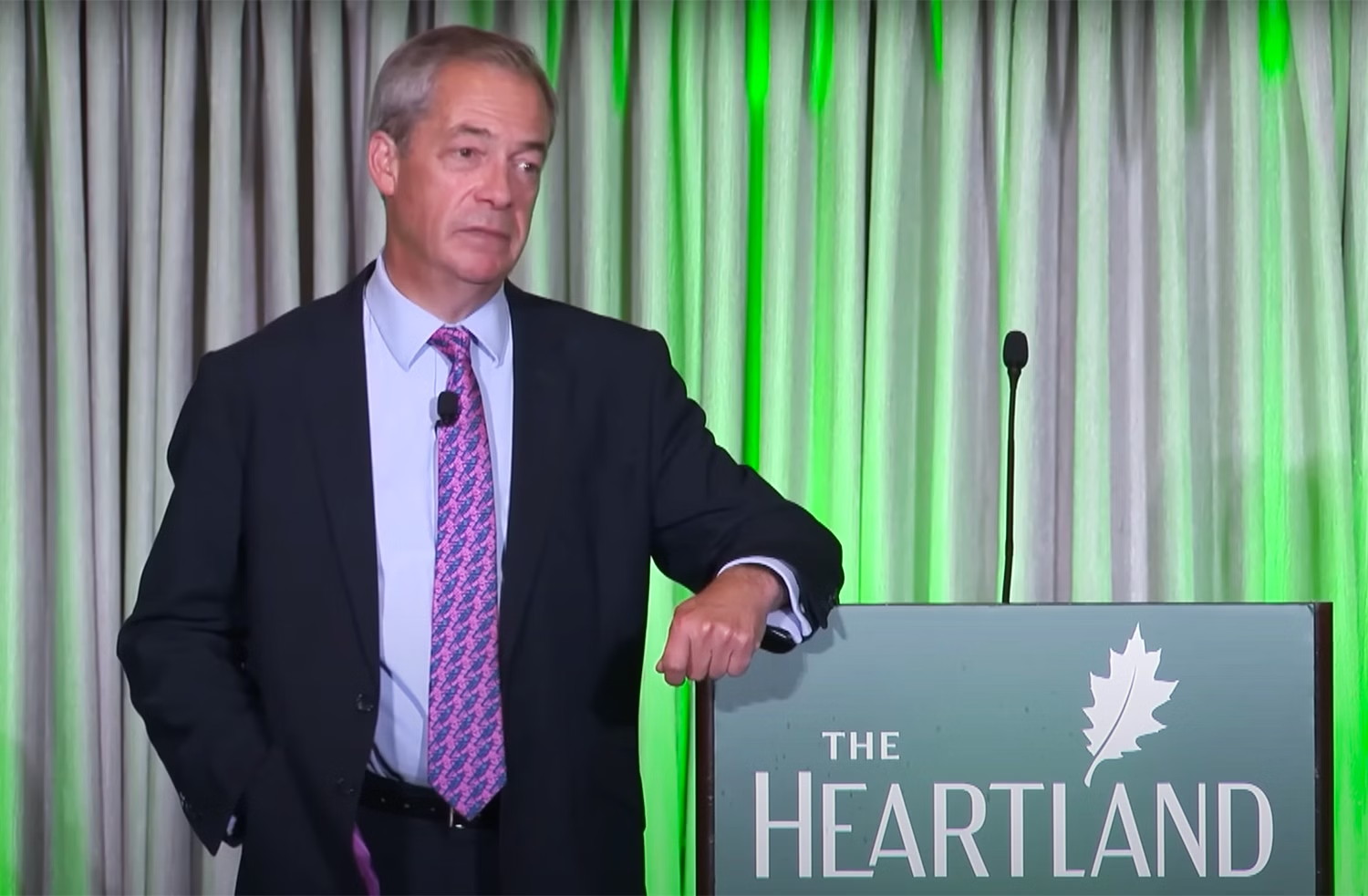
Reform UK leader Nigel Farage speaking at the Heartland Institute’s 40th anniversary fundraiser in September 2024. Credit: Heartland Institute / YouTube
The Heartland Institute, which questions human-made climate change, has established a new branch in London.
The Heartland Institute – one of the organisations involved in the radical Project 2025 agenda for a second Donald Trump term – has been at the forefront of denying the scientific evidence for man-made climate change, and received at least $676,000 between 1998 and 2007 from U.S. oil major ExxonMobil.
Heartland is known “for its persistent questioning of climate science”, according to Merchants of Doubt by Naomi Oreskes and Erik M. Conway, and it has received tens of thousands in donations from foundations linked to the owners of Koch Industries – a fossil fuel behemoth and a leading sponsor of climate science denial.
A Union of Concerned Scientists report in 2007 alleged that nearly 40 percent of the total funds received by Heartland Institute from ExxonMobil since 1998 were designated for climate change projects.
In a press release announcing its new UK-EU branch, based in London, Heartland boasted that it is “the world’s most prominent think tank supporting skepticism about man-made climate change”.
Heartland Institute president James Taylor added that, “During recent years, a growing number of policymakers in the UK and continental Europe have requested Heartland establish a satellite office to provide resources to conservative policymakers throughout Europe”.
This has included Farage, who spoke at the Heartland Institute’s 40th anniversary fundraising event in September and called for the group to open an offshoot in Europe. “Give us your wisdom, give us your guidance, give us your discipline. I’d love to see Heartland on the other side of the pond,” he said.
Reform UK has called for the UK’s 2050 net zero emissions target to be scrapped, and Farage’s Heartland speech urged the U.S. to re-elect Trump and “drill baby drill” for more oil and gas.
DeSmog revealed in June that – between the 2019 election and the beginning of the 2024 campaign – Reform UK received 92 percent of its funding (£2.3 million) from oil and gas interests, highly polluting industries, and climate science deniers.
Heartland’s European branch will be run by Lois Perry, a climate science denier who has said it’s her “personal belief” that climate change “is happening” but “is not man made”. Perry followed in Farage’s footsteps earlier this year by becoming the leader of the UK Independence Party (UKIP), though stood down after just 34 days.
Perry formerly ran the anti-net zero pressure group CAR26, which has claimed that carbon dioxide is “essential to all life” and that its “welcome growth has greened our planet saving countless human and other lives”.
She told DeSmog that Heartland is “advocating for a balanced, evidence-based approach to climate policy, not the one-size-fits-all alarmism that seems to make headlines.”
Perry added: “As for my past with UKIP and CAR26, I wear those roles with pride. I’ve always been upfront about my views: climate change happens, but the hysteria around human causation is, frankly, a bit of a stretch. CO2 is indeed vital for life, turning our planet into a blooming, green paradise rather than a barren wasteland.”
In reality, authors working for the world’s foremost climate science body, the UN’s Intergovernmental Panel on Climate Change (IPCC), have said that “it is a statement of fact, we cannot be any more certain; it is unequivocal and indisputable that humans are warming the planet”.
The IPCC has also stated that carbon dioxide “is responsible for most of global warming” since the late 19th century, which has increased the “severity and frequency of weather and climate extremes, like heat waves, heavy rains, and drought” – all of which “will put a disproportionate burden on low-income households and thus increase poverty levels.”
Farage and Project 2025
Farage’s views on climate change appear to reflect those of Perry and the Heartland Institute.
Although two thirds of his constituents are concerned about climate change, Farage stated in an interview with climate science denier Jordan Peterson in July that: “I do find it extraordinary that people call carbon dioxide a pollutant, because as I understand it, plants don’t grow without carbon dioxide.”
In his speech to the Heartland Institute in September, Farage also claimed that the UK’s efforts to reduce carbon dioxide emissions doesn’t “make any bloody difference at all”, due to the emissions produced by larger countries like China.
He also repeated the misleading claim that “man-made carbon dioxide is only about 3 percent of global, annual production of carbon dioxide”. In fact, human activity has raised the atmosphere’s carbon dioxide content by 50 percent in less than 200 years, according to NASA.
Farage has been attempting to cultivate ties between Reform UK and senior figures associated with Donald Trump, who has called climate change a “hoax” and is expected to once again pull the U.S. out of the flagship 2015 Paris Agreement.
Farage this week met with key Trump ally and donor Elon Musk, who invested at least $277 million in the Republican’s re-election campaign, and said that he would seek to “negotiate” a donation from Musk to Reform UK.
“The threat of U.S. interference in our democracy isn’t just contained to Elon Musk’s touted $100 million donation to Reform,” said Hannah Greer, Good Law Project campaigns manager. “Farage has now helped a fossil-fuel-funded American climate science denial think tank to set up shop in the UK.
During the recent presidential campaign, Democrats highlighted that Trump’s second term agenda was being drafted by another radical right-wing think tank, the Heritage Foundation, under the banner Project 2025.
The document proposes a range of radical anti-climate policies, including slashing restrictions on fossil fuel extraction, scrapping investment in renewable energy, and gutting the Environmental Protection Agency.
Project 2025 – heavily funded by just six family fortunes – has been accused of being “extreme” and “authoritarian” for setting out a plan to rapidly “reform” the U.S. government by shuttering bureaus and offices, overturning regulations, and replacing thousands of public sector employees with hand-picked political allies of Trump. The agenda also proposes radical tax cuts, and a crackdown on reproductive rights.
Farage has been heavily criticised for venturing regularly to the U.S. since his election in July, rather than spending time in his constituency of Clacton. The Reform UK leader has made six trips to the U.S. as an MP, often meeting with avowed climate deniers, despite his coastal constituency being at risk of flooding due to global warming.
Reform UK and the Heartland Institute were approached for comment.