STARMERISM is an attempt to turn the clock back. It isn’t working, cannot work and tolerating it risks disaster for the working-class movement.
It has always been an attempt to turn the clock back. The entire Starmer project was, from his election as Labour leader on a false prospectus, an attempt to undo Corbyn: to drag the unruly Labour Party back to a supposed “middle ground” of support for neoliberal economics and imperialist war.
It has been a project pursued with total ruthlessness: Labour members were, and are, broadly supportive of Corbyn’s manifesto commitments to greater public ownership and redistribution of wealth through progressive taxation, and certainly weren’t happy with the former leader being portrayed as the devil incarnate and cast out of the party, so Starmer had to smash Labour democracy.
His regime has banned debate in constituency parties, suspended those in their entirety when they wouldn’t play ball, and expelled anyone who dared to object. Since coming to power, MPs have found themselves excluded from the parliamentary party for backbench rebellion against child poverty — an authoritarian intolerance for dissent far harsher than anything Tony Blair ever expressed.
The paranoia reflects an underlying reality: Starmer and his acolytes know the majority are against them and must coerce because they cannot persuade. In this sense, the project is about much more than exorcising Corbyn.
It is part of a wider ruling-class effort to reboot the British system so we are back where we were in 2015 or even 2007 — pre-Corbyn, pre-Brexit, pre-bankers’ crash: when the world was one the liberal elite understood and had mastery over.
It is an impossible task. In foreign policy, the “unipolar moment” is gone: the West is no longer economically strong enough to dictate to the world, and its attempts to do so merely alienate.
In domestic policy, the consensus for privatisation and unfettered corporate domination of the economy can only continue to deliver what it delivers already: worsening services and falling living standards.
The two come together because Establishment liberalism is collapsing in the cockpit of imperialism, the United States. It is already defeated there by hard-right nationalism of the Farage type, but the nature of the US-led “free world” forces the ostensibly liberal leaders of Europe to fawn on the demagogic leader of the counter-revolution, Donald Trump.
Labour members fooled into voting for Starmer on the grounds he might be a polished, media-savvy version of Corbyn misunderstood Establishment hatred of the Corbyn project: it was about content, not form, and any leader threatening real reform would have met the same vitriol.
Similarly, the angst now expressed by liberal commentators from the Guardian to Channel 4 about Starmer not having what it takes to see off Farage is off-piste. Starmer is bad at politics, but that is not the root of a problem that engulfs Emmanuel Macron, Olaf Scholz and Joe Biden too. Liberalism has nothing to offer and populations across the West can no longer be duped.
The labour movement needs to wake up to this. Without a radical change of direction from Labour, Britain will soon be ruled by nasties of the Donald Trump sort, whose hostility to trade unions (see Elon Musk) equals their viciousness towards immigrants.
The Jonathan Freedlands and Robert Pestons wonder if Starmer needs to be replaced. He does, but not because he is incompetent: because his zombie-Blair politics are anachronistic. The political consensus of the 1990s is not coming back.
It’s over a century since Rosa Luxemburg defined the choice facing humanity as socialism or barbarism. It is the choice now, for sure. We can break with Starmer-Labour or we can resign ourselves to Reform UK: there is no middle ground.
Keir Starmer explains that he feels no shame or guilt benefitting personally from gifts from the rich and powerful while insisting on policies of severe austerity causing suffering and death.
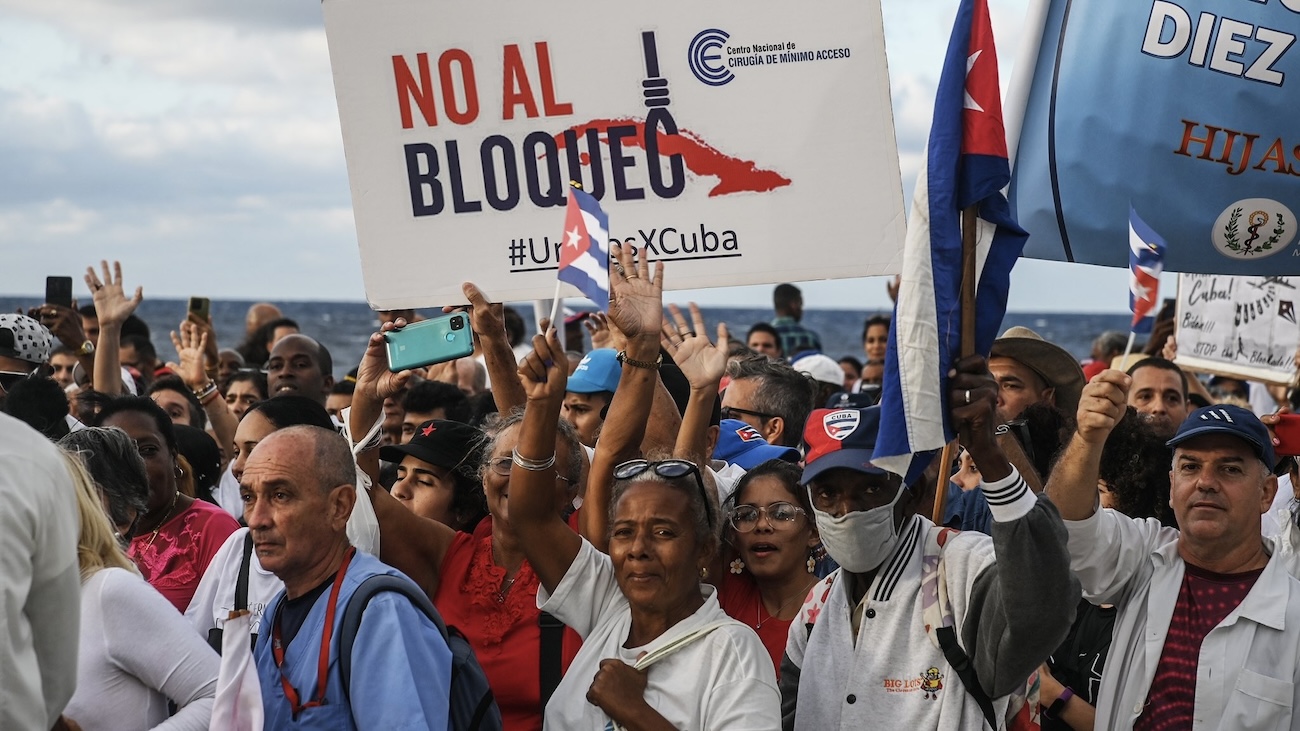
Over half a million Cubans filled the Malecón on Friday December 20 in a massive march against the US blockade. Photo: Presidencia Cuba
Hundreds of thousands of Cuban people participated in the mass demonstration against the six-decade US blockade of Cuba and the inclusion of Cuba on the US state sponsors of terrorism list.
“President Biden, take Cuba off the infamous list!” exclaimed the over half a million Cubans who marched on Havana’s malecón to the US Embassy. The mass march was called for by Cuban President Miguel Díaz-Canel earlier this week to demonstrate the absolute and total rejection of the Cuban people to the six-decade US-imposed blockade on the island as well as the inclusion of Cuba to the US State Sponsors of Terrorism list (SSoT) which together have wreaked havoc on the island’s economy.
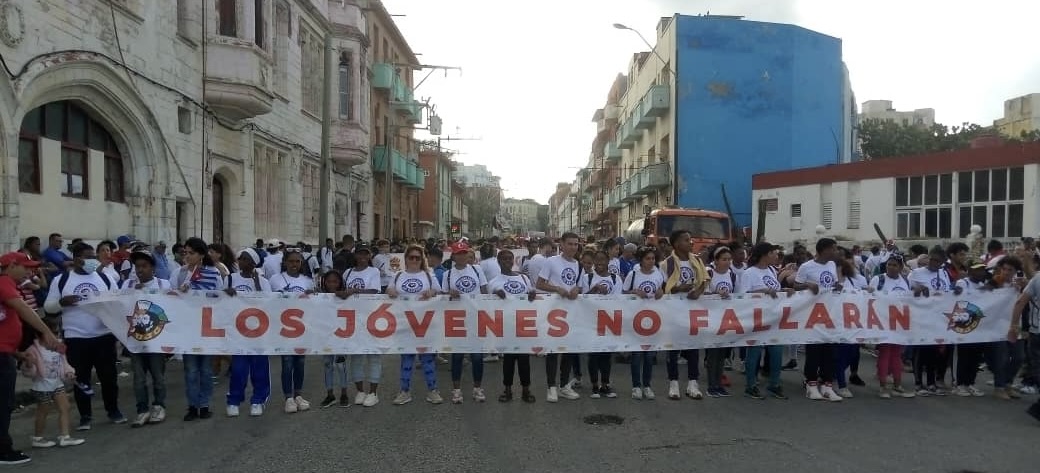
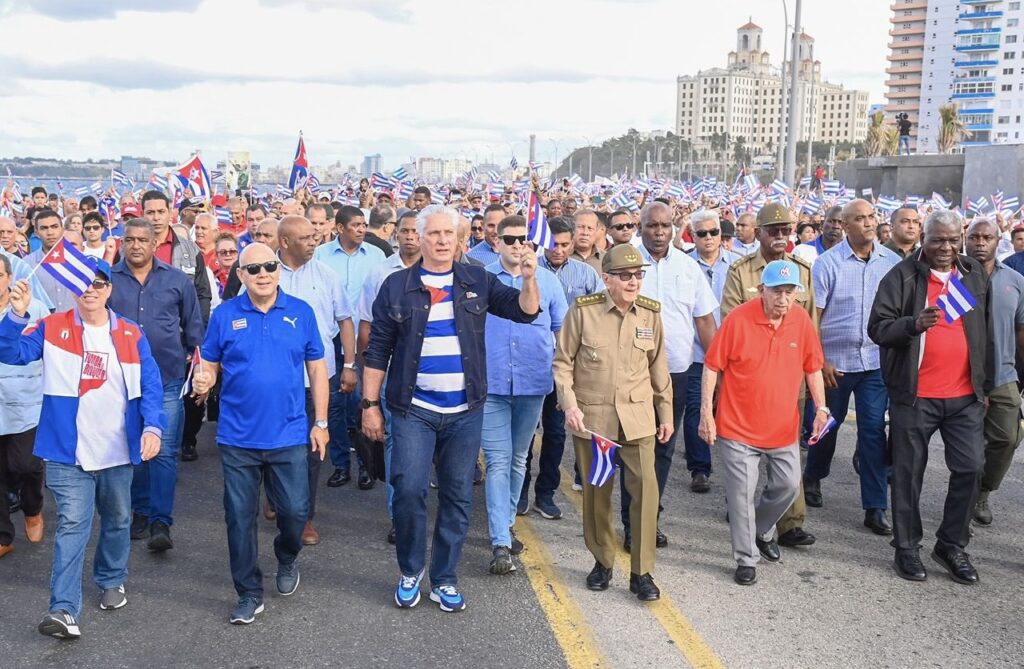
The march was led by Cuban President Miguel Díaz-Canel and General Raúl Castro who were flanked by over half a million Cubans from all sectors of life including students, doctors, construction workers, artists, and more. Cuban youth and students who participated in the massive mobilization carried banners reading “the youth will not fail!” and “this is the revolution!”
“The youth will not fail!” Photo: UJC
The mass mobilization began at the Anti-Imperialist Tribunal José Martí on the malecón, which is located directly in front of the US Embassy. There, the Cuban president delivered an address wherein he condemned the inaction of Joe Biden in reversing the policies of his predecessor Donald Trump which have tightened the economic and financial stranglehold on Cuba. Biden, he said, “has done nothing to move away from the line of reinforced blockade and economic asphyxiation of Cuba left as a legacy by the Republican administration that returns to the Oval Office in January.”
He also highlighted that people from across the US and the world have in the recent period called attention to the inhumane US policy that goes against international law, “In recent weeks and days there have been numerous pronouncements from US leaders and from other parts of the world demanding that Biden make use of his authority to at least remove the name of a nation that should never have been on this spurious list.”
He emphasized that, “When our international trade is persecuted and financial transactions are impeded, the people of Cuba are being denied food, medicine, fuel, goods, supplies and merchandise essential for their survival.”
In addition to condemning the illegal blockade, Díaz-Canel also alerted the Cuban people that there are currently paramilitary groups training in the south of Florida with the intention of carrying out terrorist attacks against Cuba. “They are based in South Florida and do not hide to train. They do it publicly, in plain sight and with the protection of local authorities, even violating their own laws and international treaties.”
The president’s announcement was both a warning and an attempt to expose the deep hypocrisy of calling Cuba a sponsor of terrorism, whilst in plain view of US authorities, these groups, “organize, promote and finance terrorist actions against social and economic structures in Cuba.” This phenomenon is not new and he reminded the people of how the US sheltered “self-confessed terrorists” and CIA agent Luis Posada Carriles and Orlando Bosch who were the architects of numerous criminal attacks against the Cuban people, the worst one being the 1976 bombing of a Cuban aircraft which resulted in the death of 73 people. “Knowing such antecedents,” Díaz-Canel stated, “no US ruler can classify Cuba as a terrorist state.”
Cuban President Miguel Díaz-Canel and General Raúl Castro marching on the malecón. Photo: Presidencia Cuba
The demand to end the over 60-year US blockade on Cuba and remove the country from the SSoT list has become even more urgent in light of the energy crisis on the island. In recent months, Cuba has suffered a series of blackouts due to its major challenge in accessing fuel to keep its power plants operating.
The election of far-right leader Donald Trump as president has also awoken fears that he may intensify existing unilateral coercive measures against Cuba.
However, as manifested in the mass mobilization, the Cuban people have vowed to remain firm in the face of any threat lodged at them by the US government and maintain that they are open to dialogue with any US administration based on mutual respect and equality.
In concluding his address, Cuban President Miguel Díaz-Canel declared, “If the United States persists in its determination to undermine our sovereignty, our independence, our socialism, it will only find rebellion and intransigence! Every administration that has tried has been outlived by the Cuban Revolution, and it will continue to be so. This is a march, yes, a very anti-imperialist march! Against US imperialism and its pretension to impose itself in Cuba by force or seduction, we will march now and always!”
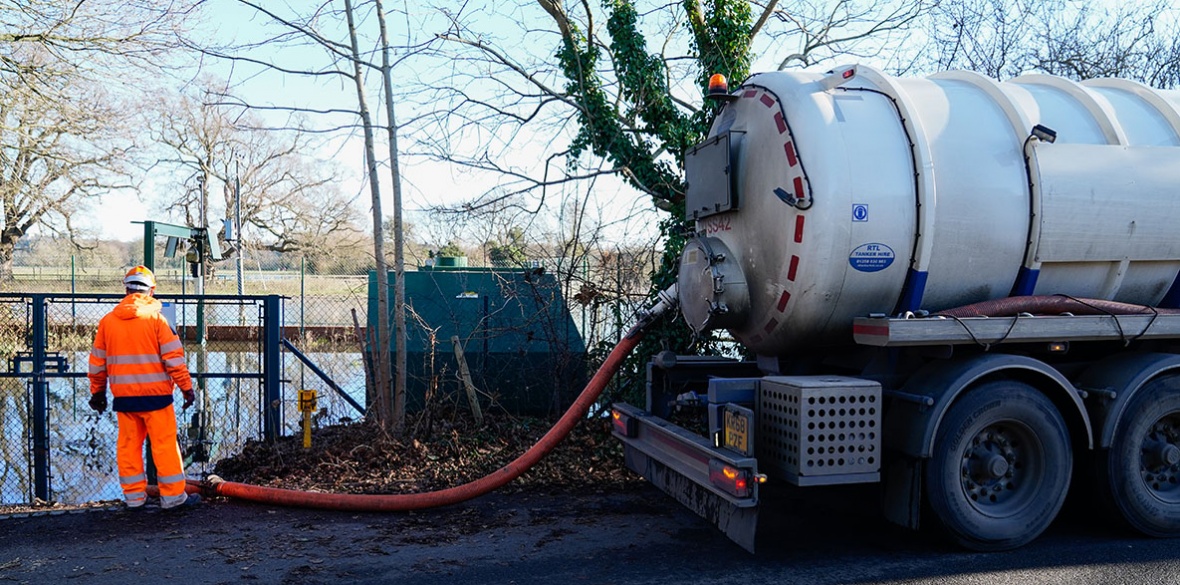
A tanker pumping out excess sewage from the Lightlands Lane sewage pumping station in Cookham, Berskhire which flooded after heavy rainfall, January 10, 2024
WATER COMPANY fat cats are being rewarded for decades of criminal behaviour, a Labour MP said today after the industry regulator announced an average £86 bill hike from April.
Clive Lewis said billpayers are paying for crooks as he called for water firms to be nationalised and Ofwat abolished.
The MP for Norwich South said: “Ofwat is making us pay for decades of criminal behaviour by water companies.
“The regulator turned a blind eye to years of these companies’ widespread illegal sewage dumping.
“Privatisation is a failed experiment. We deserve a public ownership model prioritising people and the environment over profit.”
Ofwat said that the steep rise is part of bill increases in England and Wales over the next five years that will pay for supply upgrades and to reduce sewage discharges.
This is despite water companies doubling their profits since 2019.
In the immediate wake of the Syrian government’s abrupt collapse, much remains uncertain about the country’s future – including whether it can survive as a unitary state or will splinter into smaller states as did Yugoslavia in the early 1990s, a move that ultimately led to a bloody NATO intervention. Moreover, who or what may take power in Damascus remains an open question. For the time being at least, members of ultra-extremist Hayat Tahrir al-Sham (HTS) appear highly likely to take key positions in whatever administrative structure sprouts from Bashar Assad’s ouster after a decade-and-a-half of grinding Western-sponsored regime change efforts.
As Reuters reported on December 12, HTS is already “stamping its authority on Syria’s state with the same lightning speed that it seized the country, deploying police, installing an interim government and meeting foreign envoys.” Meanwhile, its bureaucrats – “who until last week were running an Islamist administration in a remote corner of Syria’s northwest” – have moved en masse “into government headquarters in Damascus.” Mohammed Bashir, head of HTS’ “regional government” in extremist-occupied Idlib, has been appointed the country’s “caretaker prime minister.”
However, despite the chaos and precariousness of post-Assad Syria, one thing seems assured – the country will be broken open to Western economic exploitation, at long last.
Multiple reports show that HTS has informed local and international business leaders that when in office, it will “adopt a free-market model and integrate the country into the global economy, in a major shift from decades of corrupt state control.”
As Alexander McKay of the Marx Engels Lenin Institute tells MintPress News, state-controlled parts of Syria’s economy may have been under Assad, but corrupt it wasn’t. He believes a striking feature of the ongoing attacks on Syrian infrastructure from forces within and without the country is that economic and industrial sites are a recurrent target. Moreover, the would-be HTS-dominated government has done nothing to counter these broadsides when “securing key economic assets will be vital to societal reconstruction, and therefore a matter of priority”:
We can see clearly what kind of country these ‘moderate rebels’ plan to build. Forces like HTS are allied with U.S. imperialism, and their economic approach will reflect this. Prior to the proxy war, the government pursued an economic approach that mixed public ownership and market elements. State intervention enabled a degree of political independence [that] other nations in the region lack. Assad’s administration understood without an industrial base, being sovereign is impossible. The new ‘free market’ approach will see all of that utterly decimated.”
‘Reconstruction Project’
Syria’s economic independence and strength under Assad’s rule and the benefits reaped by average citizens, as a result, were never acknowledged in the mainstream before or during the decade-long proxy war. Yet, countless reports from major international institutions underline this reality – which has now been brutally vanquished, never to return. For example, an April 2015 World Health Organization document noted how Damascus “had one of the best-developed healthcare systems in the Arab world.”
Per a 2018 U.N. investigation, “universal, free healthcare” was extended to all Syrian citizens, who “enjoyed some of the highest levels of care in the region.” Education was likewise free, and before the conflict, “an estimated 97% of primary school-aged Syrian children were attending class, and Syria’s literacy rates were thought to be at over 90% for both men and women [emphasis added].” By 2016, millions were out of school.
A U.N. Human Rights Council report two years later noted pre-war Syria “was the only country in the Middle East region to be self-sufficient in food production,” its “thriving agricultural sector” contributing “about 21%” to GDP 2006 – 2011. Civilians’ daily caloric intake “was on par with many Western countries,” with prices kept affordable via state subsidy. Meanwhile, the country’s economy was “one of the best performing in the region, with a growth rate averaging 4.6%” annually.
At the time that report was written, Damascus had been reduced to heavy reliance on imports by Western sanctions in many sectors and, even then, was barely able to buy or sell much in the way of anything, as the measures amounted to an effective embargo. Simultaneously, the U.S. military occupation of a resource-rich third of Syria cut off the government’s access to its own oil reserves and wheat. The situation would only worsen with the Caesar Syria Civilian Protection Act’s passing in June 2020.
Under its auspices, a vast volume of goods and services in every conceivable field were and today remain banned from being sold to or traded with any Syrian citizen or entity. The legislation’s terms explicitly state preventing attempts to rebuild Syria was its chief objective. One passage openly outlines “a strategy to deter foreign persons from entering into contracts related to reconstruction.”
Immediately after coming into effect, the Syrian pound’s value collapsed further, sending living costs skyrocketing. In a blink, almost the entire country’s population was left barely able to afford even the bare essentials. Even mainstream sources typically approving of belligerence towards Damascus cautioned of an inevitably impending humanitarian crisis. However, Washington was neither concerned nor deterred by such warnings. James Jeffrey, State Department chief of Syria policy, actively cheered these developments.
Simultaneously, as Jeffrey subsequently admitted to PBS, the U.S. was engaged in frequent, secret communication with HTS and actively assisting the group – albeit “indirectly” due to the faction’s designation as a terrorist entity by the State Department. This followed direct approaches to Washington by its leaders, including Abu Mohammed Jolani, former leader of Al Qaeda affiliate al-Nusra. “We want to be your friend. We’re not terrorists. We’re just fighting Assad,” HTS reportedly said.
Given this contact, it may be no coincidence that in July 2022, Jolani issued a series of communications about HTS’ plans for future Syria, containing multiple passages in which finance and industry loomed large. Directly foreshadowing the group’s recent pledge to “adopt a free-market model,” the extremist mass murderer discussed his desire to “open up local markets to the global economy.” Many passages read as if they were authored by representatives of the International Monetary Fund.
Coincidentally, Syria, since 1984, has refused IMF loans, a key tool by which the U.S. Empire maintains the global capitalist system and dominates the Global South, ensuring ‘poor’ countries remain under its heel. The World Trade Organization, of which Damascus isn’t a member either, plays a similar role. Accession to both would go some way to cementing the “free-market model” advocated by HTS. After over a decade of deliberate, systematic economic ruin, geopolitical risk analyst Firas Modad tells MintPress News:
They have no choice. They need Turkish and Qatari backing, so [they] will need to liberalize. They have no capital whatsoever. The country is in ruins and they desperately need investment. Plus, they hope liberalizing may attract some Saudi, Emirati or Egyptian interest. It’s impossible for Syria to rebuild using its own resources. The civil war might resume. They are acting out of necessity.”
‘Shock Therapy’
In Syria’s protracted political and economic dismantling, there are eerie echoes of the U.S. Empire’s destruction of Yugoslavia throughout the 1990s. During that decade, the multiethnic socialist federation’s breakup produced bitter wars of independence in Bosnia, Croatia and Slovenia – encouraged, financed, armed, and prolonged every step by Western powers. Belgrade’s perceived centrality to these brutal conflicts and purported complicity in and sponsorship of horrendous war crimes led the U.N. Security Council to impose sanctions against what remained of the country in May 1992.
The measures were the harshest ever levied in U.N. history. At one point, producing inflation of 5.578 quintillion percent, drug abuse, alcoholism, preventable deaths and suicides skyrocketed, while shortages of goods – including water – were perpetual. Yugoslavia’s once thriving independent industry was crippled, its ability to manufacture even everyday medicines virtually non-existent. By February 1993, the CIA assessed that the average citizen had “become accustomed to periodical shortages, long lines in stores, cold homes in the winter and restrictions on electricity.”
Surveying the wreckage years later, Foreign Affairs noted that sanctions against Yugoslavia demonstrated how “in a matter of months or years whole economies can be devastated,” and such measures can serve as uniquely lethal “weapons of mass destruction” against civilian populations of target countries. Yet, despite such desolation and misery, throughout this period, Belgrade remained resistant to privatization and foreign ownership of its industry or to the pillaging of its vast resources. The overwhelming majority of Yugoslavia’s economy was state- or worker-owned.
Yugoslavia was not a member of the IMF, World Bank, or WTO, which went some way to insulate the country from economic predation. In 1998, though, authorities began waging a heavy-handed counterinsurgency against the Kosovo Liberation Army, a CIA and MI6-funded and armed al-Qaeda-linked extremist militia. This provided the U.S. Empire with a pretext to, at last, finish the job of neutralizing what remained of the country’s socialist system. As a Clinton administration official later admitted:
It was Yugoslavia’s resistance to the broader trends of political and economic reform [in Eastern Europe] – not the plight of Kosovar Albanians – that best explains NATO’s war.”
From March – June 1999, the military alliance bombed Yugoslavia for 78 straight days. Yet, Belgrade’s army was barely in the firing line at any stage. In all, officially, just 14 Yugoslav tanks were destroyed by NATO, but 372 separate industrial facilities got smashed to smithereens, leaving hundreds of thousands jobless. Markedly, the alliance took guidance from U.S. corporations on which sites to target, and not a single foreign- or privately-owned factory was hit.
NATO’s bombing laid the foundations for Yugoslav leader Slobodan Milosevic’s removal via a C.I.A.- and National Endowment for Democracy-sponsored color revolution in October of the following year. In his place, a doggedly pro-Western government advised by a collective of U.S.-sponsored economists took power. Their explicit mission was to “make an economic environment favorable for private and other investments” in Belgrade. Ravaging “shock therapy” measures were deployed the moment they assumed office, to the further detriment of an already immiserated and impoverished population.
In the decades since successive Western-backed governments across the former Yugoslavia have enforced an endless array of neoliberal “reforms” to ensure an “investor-friendly” environment locally for wealthy Western oligarchs and corporations. In lockstep, low wages and a lack of employment opportunities stubbornly endure or worsen while living costs rise, producing mass depopulation, among other destructive effects. All along, U.S. officials intimately implicated in the country’s breakup have brazenly sought to enrich themselves from the privatization of former state industries.
‘Internal Repression’
Does such a fate await Damascus? For Pawel Wargan, founder of the Green New Deal for Europe, the answer is a resounding “yes.” He believes the country’s story is familiar “to those who study the mechanisms of imperialist expansion.” Once its defenses are fully neutralized, he foresees the country’s industries being “bought-up at bargain sale prices as part of market ‘reforms,’ which transfer yet another chunk of humanity’s wealth to Western corporations”:
We’ve witnessed the well-rehearsed choreography of imperialist regime change: a ‘tyrant’ is overthrown; backers of national sovereignty are systematically and viciously repressed; with tremendous, but hidden, violence, the country’s assets are chopped and diced and sold to the lowest bidder; labor protections are discarded; human lives are cut short. The most predatory forms of capitalism take root in every crevice and pore that emerges in the collapse of the state. This is the agenda of structural adjustment policies enforced by the World Bank and IMF.”
Alexander McKay echoes Wargan’s analysis. Now “free,” Syria will be forcedly made “dependent upon imports from the West” evermore. This not only fattens the Empire’s bottom line but “also severely restricts the freedom of any Syrian government to act with any degree of independence.” He notes similar efforts have been undertaken throughout the post-1989 era of U.S. unipolarity. It was well underway in Russia during the 1990s “until the slow turn around in policy started in the early 2000s under Putin”:
The aim is to reduce Syria to the same status as Lebanon, with an economy controlled by imperial forces, an army used primarily for internal repression, and an economy no longer able to produce anything but merely serve as a market for commodities produced elsewhere, and site of resource extraction. The U.S. and its allies do not want independent development of any nation’s economy. We must hope the Syrian people can resist this latest act of neo-colonialism.”
Kit Klarenberg is an investigative journalist and MintPress News contributor exploring the role of intelligence services in shaping politics and perceptions. His work has previously appeared in The Cradle, Declassified UK, and Grayzone. Follow him on Twitter @KitKlarenberg.
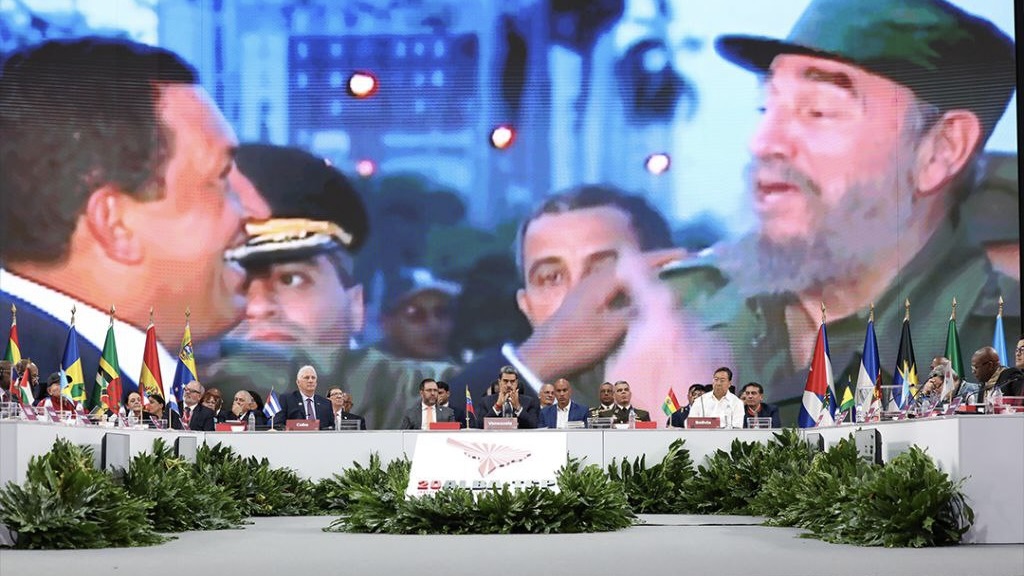
Heads of State Summit of ALBA-TCP in Caracas, Venezuela. Photo: ALBA-TCP
ALBA-TCP was founded in 2004 in an attempt to counter the US proposal of creating a “free trade zone of the Americas
December 14 marked the 20th anniversary of the creation of the Bolivarian Alliance for the Peoples of Our America-People’s-Trade Agreement (ALBA-TCP). ALBA-TCP was created in 2004 as a geopolitical alternative to the devastating advance of neoliberalism in the region.
The project was founded on December 14, 2004, in Havana by Cuban President Fidel Castro and Venezuelan President Hugo Chávez. Currently, the organization has 10 member countries and four countries considered “special guests.” In 2006, Bolivia signed its membership; in 2007, Nicaragua; in 2008, Dominica; in 2009, Antigua and Barbuda and St. Vincent and the Grenadines; in 2014, St. Kitts and Nevis and Grenada; and in 2021, St. Lucia. The special invited countries are Syria, Haiti, Suriname, and now Palestine.
To commemorate the 20 years, social movements, political parties, and heads of state gathered in Caracas, Venezuela for the 24th Heads of State Summit as well as parallel meetings. The event was attended by the host, Venezuelan President Nicolás Maduro; Bolivian President Luis Arce; Cuban President Miguel Díaz-Canel; Nicaraguan President Daniel Ortega; Prime Minister of St. Vincent and the Grenadines, Ralph Gonsalves; Prime Minister of Dominica, Roosevelt Skerrit; and the Prime Minister of Antigua and Barbuda, Gaston Browne.
Independence and solidarity among countries
In their addresses during the Summit on December 14, the heads of state and invited countries stressed the importance of solidarity among countries seeking alternative ways of development and the need for unrestricted solidarity among people struggling against imperialist attacks. They also demonstrated their support for Nicolás Maduro and his victory in the last presidential elections.
Miguel Díaz-Canel said “We reiterate the strongest support for the Bolivarian revolution, led by President Nicolás Maduro…We also call for the elimination of the blockade against Cuba …We cry out for a free Puerto Rico and declare our solidarity with Haiti, our Cuban doctors are there…We reiterate our demand for a ceasefire in Gaza and condemn the attacks perpetrated by Israel against Lebanon, Syria, and Iran.”
The Bolivian President, Luis Arce, highlighted the historical importance of ALBA in its fight against economic projects promoted by the United States such as the FTAA (Free Trade Area of the Americas): “The embrace of Hugo Chávez and Fidel Castro not only marked history but also manifested the defeat of the hegemonic project of the FTAA. ALBA was born, ALBA placed the human being at the center, promoting that a better world is possible. Bolivia reaffirms, once again, its commitment to ALBA-TCP, because it is a resistance that raises its voice against the unjust and criminal blockade against Cuba…ALBA is also a firm voice against the arbitrary and unilateral measures imposed against Venezuela and Nicaragua, which affect the welfare of our peoples.”
Nicolás Maduro said, “We must win the battle of life and truth in the streets, networks, media, and walls, as well as in the conscience and spirituality of the people.” He also added the importance of the struggle of the people to be masters of their destiny without imperial impositions or impositions of any kind. In the same line of discourse, Nicaraguan President Daniel Ortega said “From Nicaragua we reaffirm our commitment to ALBA. We will continue to fight the battle.”
The Prime Minister of Dominica, Roosevelt Skerrit stated “We congratulate the electoral triumph of President Nicolas Maduro on July 28. We wish him all the best…We also want to reaffirm our solidarity with the people of Cuba, a brave people for whom we have our greatest respect and love; we will never cease to lend our voice against the United States to eliminate the blockade against Cuba.”
Ralph Gonsalves, Prime Minister of St. Vincent and the Grenadines, harshly criticized US interference in the development of the past Venezuelan elections “Perhaps [the US government] thinks it is superior,” he said in this regard. He also stressed that the creation of ALBA-TCP was a fundamental invention for the emancipation of the American people, “ALBA is the product of the geniuses of our peoples.”
Inclusion of Palestine to ALBA-TCP
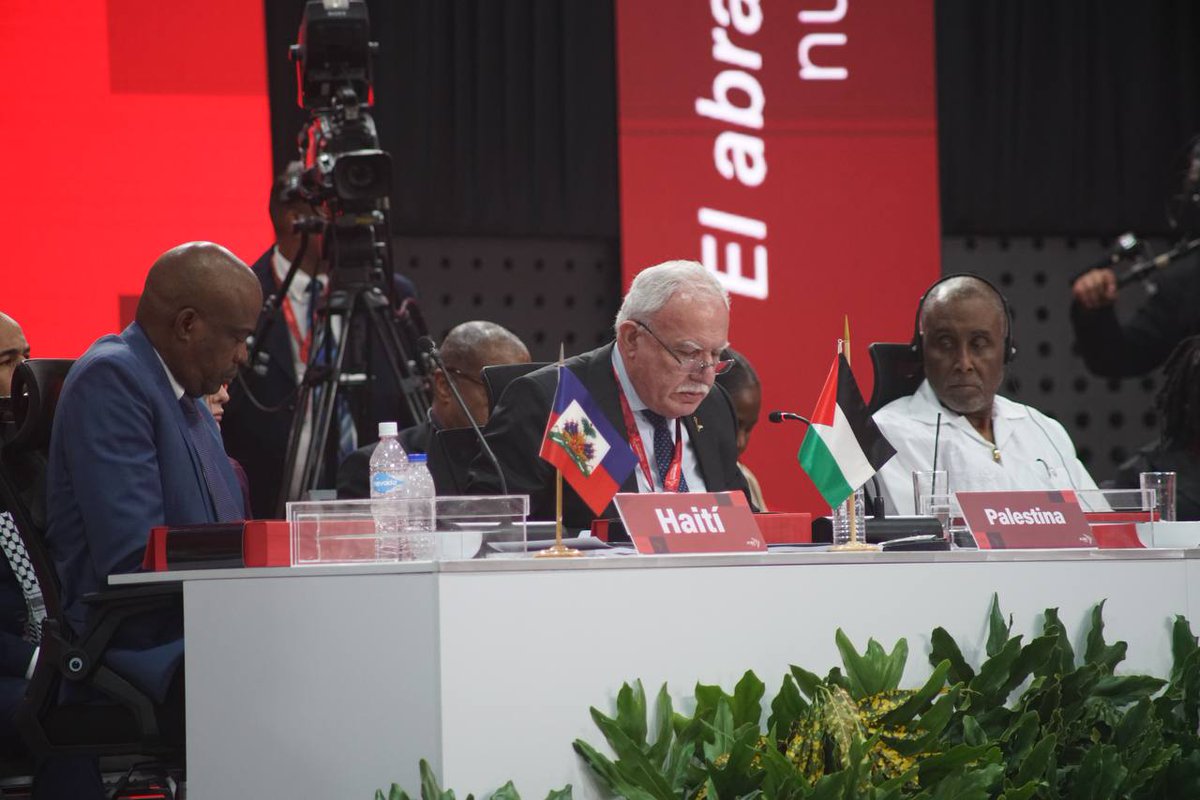
At the current summit, it was announced that Palestine had been included as a “brotherly country” and was included as a “permanent guest”. According to the resolution of the Heads of State, ALBA-TCP condemns the attacks against the Palestinian population and the “illegally occupied territories” and rejects “the merciless and inhuman genocide committed by the State of Israel, the occupying power, as well as its plan of spoliation, invasion, and domination.” Likewise, they denounced the support of several governments currently collaborating with the actions of the Israeli army and called for an “immediate ceasefire…From the heart of the peoples and governments of this alliance, we declare Palestine a brother country of the ALBA-TCP, and reaffirm our commitment to the defense of the Palestinian cause, which is the defense of humanity,” reads the resolution.
In this regard, Riyad al-Malki, advisor to the President of State for International Affairs of Palestine said “History will remember those who stood on the side of justice, ALBA’s lasting solidarity with Palestine is a testimony of freedom and collective resistance.” Furthermore, Malki added “This Alliance is a living testimony of collective integration to challenge imperialism and ensure a just world. These values resonate with the Palestinian struggle, an end to the illegal occupation.”
A call for counter-hegemonic struggle
The joint document signed by all the countries highlights the historical importance of ALBA-TCP in the struggle for a more equitable world: “Twenty years after this giant step, we pay homage to the founding leaders, Hugo Chávez Frías and Fidel Castro Ruz, who adopted that December 14, 2004, in Havana, Cuba, the vision of the future embodied in the founding documents of ALBA, which have allowed us to walk united until the present, animated by the ancestral force that led our peoples to be free and that encourages us to continue integrated in this Alliance for Life.”
Similarly, it was stressed that the existence of this multilateral organization operates as a possibility to create a region that resists the impositions of the most developed countries: “Today, we want to ratify before our peoples, the counter-hegemonic, democratic, anti-imperialist and anti-fascist nature of our Alliance and renew our commitment to help and protect each other, to continue building together a future of shared goals under the founding principles of complementarity, cooperation, social justice, defense of our sovereignty and solidarity.”
In this sense, Luis Arce stressed that “In the face of the challenges of a world threatened by fascism and neo-fascism, ALBA is not an option, ALBA is a necessity that must continue with firm steps, reaffirming the founding principles of solidarity, justice, and cooperation…ALBA is not only an alliance, it is a promise for the future, a living resistance, an instrument for the most dispossessed, and a reminder that together, as peoples, we are invincible.”
Objectives and principles of ALBA-TCP
According to ALBA’s official website, the fundamental objective of the project is “to achieve integral development, ensure social equality and contribute to guaranteeing the quality of life, good living, independence, self-determination and identity of the peoples.” For this very reason, the principles of ALBA-TCP propose that political decisions be made horizontally and take into account the economic differences of its members without meaning that the importance of each of the members is underestimated.
The principles shared by the countries are “trade and investment should not be ends in themselves, but instruments to achieve sustainable development; special and differentiated treatment, according to the level of development of the various countries; economic complementarity and cooperation; cooperation and solidarity; the creation of the Social Emergency Fund; the integrative development of communications and transportation; the sustainability of development; energy integration; the promotion of investments of Latin American capital in the region; the defense of Latin American and Caribbean identity and culture; respect for intellectual property; and the agreement of multilateral positions and in negotiations with countries and blocs in other regions.”