The government can’t cure the lethal consequences of deprivation by increasing deprivation. Eligibility for the payment will be linked to pension credit, but experts say that this will see 1.6 million pensioners who are below the poverty line lose vital financial support during the coldest months. With a majority of 167, the government will comfortably win Tuesday’s vote on the issue. However, it has lost the argument, largely because ministers seem incapable of making a coherent case for their policy.
The risible claim that there would be a “run on the pound” if there were not spending cuts was dismissed in the City. Ministers then said that they want to increase pension credit uptake – currently 880,000 eligible people do not claim it – but many are put off by the 243 questions that need to be answered in the application form. Sir Keir argues that the losses would be offset by rises in the state pension. But that won’t wash with many pensioners who know such increases were coming anyway and have been less than impressed by Labour discarding its social care commitments.
Until recently, Elon Musk was just a wildly successful electric car tycoon and space pioneer. Sure, he was erratic and outspoken, but his global influence was contained and seemingly under control.
But add the ownership of just one media platform, in the form of Twitter – now X – and the maverick has become a mogul, and the baton of the world’s biggest media bully has passed to a new player.
What we can gauge from watching Musk’s stewardship of X is that he’s unlike former media moguls, making him potentially even more dangerous. He operates under his own rules, often beyond the reach of regulators. He has demonstrated he has no regard for those who try to rein him in.
Under the old regime, press barons, from William Randolph Hearst to Rupert Murdoch, at least pretended they were committed to truth-telling journalism. Never mind that they were simultaneously deploying intimidation and bullying to achieve their commercial and political ends.
Musk has no need, or desire, for such pretence because he’s not required to cloak anything he says in even a wafer-thin veil of journalism. Instead, his driving rationale is free speech, which is often code for don’t dare get in my way.
This means we are in new territory, but it doesn’t mean what went before it is irrelevant.
A big bucket of the proverbial
If you want a comprehensive, up-to-date primer on the behaviour of media moguls over the past century-plus, Eric Beecher has just provided it in his book The Men Who Killed the News.
Alongside accounts of people like Hearst in the United States and Lord Northcliffe in the United Kingdom, Beecher quotes the notorious example of what happened to John Major, the UK prime minister between 1990 and 1997, who baulked at following Murdoch’s resistance to strengthening ties with the European Union.
In a conversation between Major and Kelvin MacKenzie, editor of Murdoch’s best-selling English tabloid newspaper, The Sun, the prime minister was bluntly told: “Well John, let me put it this way. I’ve got a large bucket of shit lying on my desk and tomorrow morning I’m going to pour it all over your head.”
MacKenzie might have thought he was speaking truth to power, but in reality he was doing Murdoch’s bidding, and actually using his master’s voice, as Beecher confirms by recounting an anecdote from early in Murdoch’s career in Australia.
In the 1960s, when Murdoch owned The Sunday Times in Perth, he met Lang Hancock (father of Gina Rinehart) to discuss potentially buying some mineral prospects together in Western Australia. The state government was opposed to the planned deal.
Beecher cites Hancock’s biographer, Robert Duffield, who claimed Murdoch asked the mining magnate, “If I can get a certain politician to negotiate, will you sell me a piece of the cake?” Hancock said yes. Later that night, Murdoch called again to say the deal had been done. How, asked an incredulous Hancock. Murdoch replied: “Simple […] I told him: look you can have a headline a day or a bucket of shit every day. What’s it to be?”
Between Murdoch in the 1960s and MacKenzie in the 1990s came Mario Puzo’s The Godfather with Don Corleone, aided by Luca Brasi holding a gun to a rival’s head, saying “either his brains or his signature would be on the contract”.
Former British Prime Minister John Major fell foul of Rupert Murdoch – and paid the price. Lynne Sladky/AP/AAP
Changing the rules of the game
Media moguls use metaphorical bullets. Those relatively few people who do resist them, like Major, get the proverbial poured over their government. Headlines in The Sun following the Conservatives’ win in the 1992 election included: “Pigmy PM”, “Not up to the job” and “1,001 reasons why you are such a plonker John”.
If media moguls since Hearst and Northcliffe have tap-danced between producing journalism and pursuing their commercial and political aims, they have at least done the former, and some of it has been very good.
The leaders of the social media behemoths, by contrast, don’t claim any fourth estate role. If anything, they seem to hold journalism with tongs as far from their face as possible.
They do possess enormous wealth though. Apple, Microsoft, Google and Meta, formerly known as Facebook, are in the top ten companies globally by market capitalisation. By comparison, News Corporation’s market capitalisation now ranks at 1,173 in the world.
Regulating the online environment may be difficult, as Australia discovered this year when it tried, and failed, to stop X hosting footage of the Wakeley Church stabbing attacks. But limiting transnational media platforms can be done, according to Robert Reich, a former Secretary of Labor in Bill Clinton’s government.
Despite some early wins through Australia’s News Media Bargaining Code, big tech companies habitually resist regulation. They have used their substantial influence to stymie it wherever and whenever nation-states have sought to introduce it.
Meta’s founder and chief executive, Mark Zuckerberg, has been known to go rogue, as he demonstrated in February 2021 when he protested against the bargaining code by unilaterally closing Facebook sites that carried news. Generally, though, his strategy has been to deploy standard public relations and lobbying methods.
But his rival Musk uses his social media platform, X, like a wrecking ball.
Musk is just about the first thing the average X user sees in their feed, whether they want to or not. He gives everyone the benefit of his thoughts, not to mention his thought bubbles. He proclaims himself a free-speech absolutist, but most of his pronouncements lean hard to the right, providing little space for alternative views.
Kamala wants to destroy your right to free speech under The Constitution https://t.co/oJN5T8nPLn
Some of his tweets have been inflammatory, such as him linking to an article promoting a conspiracy theory about the savage attack on Paul Pelosi, husband of the former US Speaker, Nancy Pelosi, or his tweet that “Civil war is inevitable” following riots that erupted recently in the UK.
As the BBC reported, the riots occurred after the fatal stabbing of three girls in Southport. “The subsequent unrest in towns and cities across England and in parts of Northern Ireland has been fuelled by misinformation online, the far-right and anti-immigration sentiment.”
Nor does Musk bother with niceties when people disagree with him. Late last year, advertisers considered boycotting X because they believed some of Musk’s posts were anti-Semitic. He told them during a live interview to “Go fuck yourself”.
He has welcomed Donald Trump, the Republican Party’s presidential nominee, back onto X after Trump’s account was frozen over his comments surrounding the January 6 2021 attack on the capitol. Since then both men have floated the idea of governing together if Trump wins a second term.
Is the world better off with tech bros like Musk who demand unlimited freedom and assert their influence brazenly, or old-style media moguls who spin fine-sounding rhetoric about freedom of the press and exert influence under the cover of journalism?
That’s a question for our times that we should probably begin grappling with.
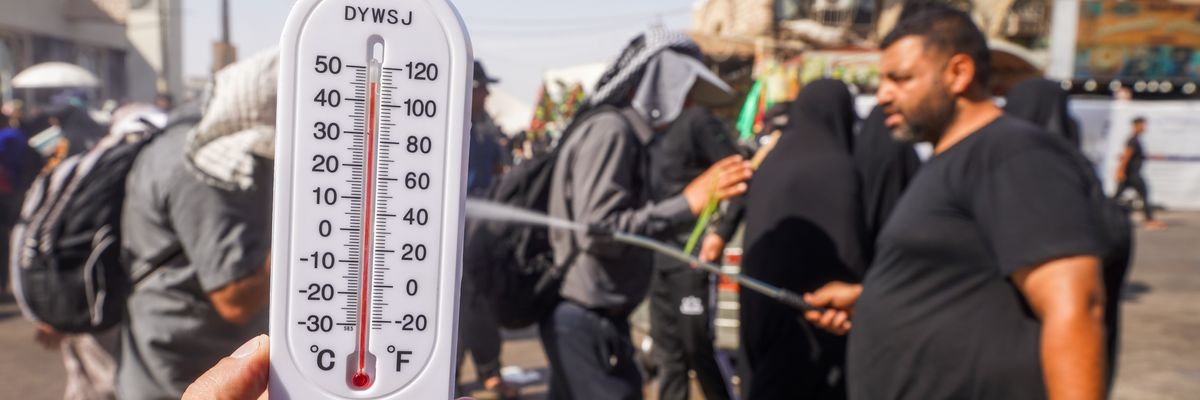
People try to protect themselves from the sun and cool off in Najaf, Iraq on August 20, 2024. (Photo: Karar Essa/Anadolu via Getty Images)
“If you keep doing the same thing, you cannot expect to get any different result,” said the director of the Copernicus Climate Change Service. “Unless we limit greenhouse gases, we will only see an exacerbation of these temperatures.”
Scientists with the European Union’s climate service said Friday that Earth experienced its hottest summer on record for the second consecutive year in 2024 as unprecedented and deadly heatwaves scorched large swaths of the planet, intensifying the urgency of large-scale policy changes to phase out the fossil fuels that are driving temperatures to alarming new heights.
The Copernicus Climate Change Service (C3S) said the three-month period between June and August saw global-average temperatures that were 0.69°C, or 33.24°F, higher than the average summer temperatures seen from 1991 to 2020.
“During the past three months of 2024, the globe has experienced the hottest June and August, the hottest day on record, and the hottest boreal summer on record,” said C3S deputy director Samantha Burgess. “This string of record temperatures is increasing the likelihood of 2024 being the hottest year on record.”
“The temperature-related extreme events witnessed this summer will only become more intense, with more devastating consequences for people and the planet, unless we take urgent action to reduce greenhouse gas emissions,” Burgess added.
Summer 2024 just set a new benchmark – the hottest on record. With global temperatures now regularly exceeding the 1.5°C threshold, we’re in dangerous territory. Time for urgent action is right now – not tomorrow, not next year.https://t.co/sF1WxgNyrMpic.twitter.com/w2lhhEEST1
Temperatures in Europe were 1.54°C, or 34.77°F, above the 1991-2020 average, a record temperature surge that had deadly consequences in Greece, Italy, and other nations.
But The Washington Post‘s Sarah Kaplan noted that the consequences of the record-shattering summer heat “were felt by people on every continent, from world-class athletes competing in the Paris Olympics to refugees fleeing from wars.”
She continued:
Wildfires fueled by heat and drought raged through the Brazilian Pantanal, a vital wetland known to store vast amounts of carbon. A turbocharged monsoon triggered landslides that killed hundreds of people in India’s Kerala state. The Atlantic Ocean saw its earliest Category 5 hurricane on record, while deadly floods have wreaked havoc from Italy to Pakistan to Nigeria to China.”
It was a summer of unrelenting humidity and heat too extreme for the human body to withstand. In June, at least 1,300 pilgrims visiting the Muslim holy city of Mecca died amid temperatures of 50 degrees Celsius (122 degrees Fahrenheit). Another 125 people were reported dead in Mexico during a July streak of exceedingly hot nights that researchers say was made 200 times as likely because of climate change. And in the Arctic archipelago of Svalbard, one of the world’s northernmost inhabited areas, August temperatures soared more than 2.5 degrees Celsius (4.5 degrees Fahrenheit) above the previous record.
Carlo Buontempo, the director of C3S, told the Post that “if you keep doing the same thing, you cannot expect to get any different result.”
“Unless we limit greenhouse gases,” Buontempo added, “we will only see an exacerbation of these temperatures.”
LINDA PENTZ GUNTER condemns Starmer’s willingness to let children go hungry and the elderly shiver while pouring billions into doomed nuclear projects that won’t address the climate crisis
THE Keir Starmer Labour government won’t scrap the two-child benefit cap because, it claims, the country can’t afford it. Doing away with this punitive measure would lift close to half a million children out of poverty at an estimated cost of £3.6 billion a year.
On the other hand, the Starmer government is perfectly happy to scrap the winter fuel allowance for pensioners, because doing so saves money — an estimated £1.4bn this financial year. That potentially life-saving support will now be stripped from as many as 10 million eligible pensioners.
That’s £5bn saved, on the backs of children and the elderly, two of the most vulnerable segments of our society.
Instead, the Labour government has now announced it will assign almost this identical sum — as much as £5.5bn in life support — to the planned 3,200 megawatt (MW) two-reactor Sizewell C nuclear power plant project on the Suffolk coast.
Apparently, it’s perfectly fine to let children go hungry while pensioners shiver in the dark in exchange for an entirely futile energy project that will keep no-one warm anytime soon, if at all.
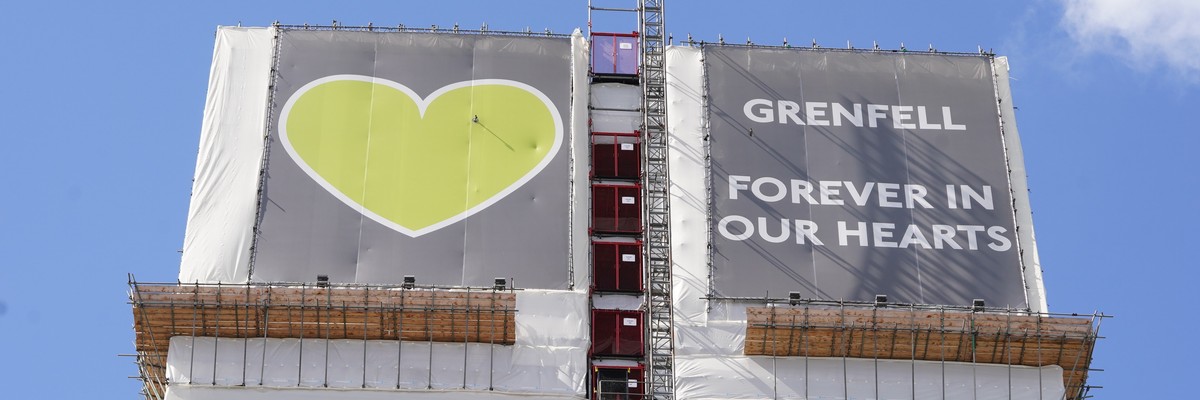
Grenfell Tower is shown in west London on September 3, 2024.. (Photo: Lucy North/PA Images via Getty Images)
“The Grenfell Report gives us official confirmation: 72 people needlessly died because of corporate deceit, deregulation, privatization, ignorance, and contempt for working-class communities,” wrote Jeremy Corbyn.
Seven years after the U.K.’s worst residential fire since World War II, the second half of a report on the causes of the Grenfell Tower disaster partly attributed the deadly blaze to corporate greed.
The Phase 2 report, released Wednesday, blamed both private malfeasance and government deregulation for the fire on June 14, 2017, which claimed the lives of 72 people, including 18 children, when the cheap, flammable cladding surrounding the building ignited.
“The simple truth is that the deaths that occurred were all avoidable and that those who lived in the tower were badly failed over a number of years and in a number of different ways by those who were responsible for ensuring the safety of the building and its occupants,” inquiry chair Sir Martin Moore-Bick said in a statement.
“The system isn’t broken, it was built this way.”
The inquiry, which was launched the day after the fire by then-Prime Minister Theresa May, reviewed more than 300,000 documents and 1,500 witness statements. The first half, released October 30, 2019, focused on how the fire ignited and spread. The second, which took longer than expected, examined the “underlying causes.”
Those include the “systematic dishonesty” of the companies that sold the flammable cladding and insulation used to refurbish the tower in 2015, namely Arconic Architectural Products, Celotex, and Kingspan.
“They engaged in deliberate and sustained strategies to manipulate the testing processes, misrepresent test data, and mislead the market,” the report authors wrote.
For example, Arconic had known since 2005 that its Reynobond 55 PE, used on Grenfell as rainscreen panels, “reacted to fire in a very dangerous way” when sold in cassette form and since 2011 that the cassette form performed worse under fire than its riveted form.
“Nonetheless, it was determined to exploit what it saw as weak regulatory regimes in certain countries (including the U.K.) to sell Reynobond 55 PE in cassette form, including for use on residential buildings,” the report authors noted.
The report authors also blamed quality control bodies such as the British Board of Agrément, Local Authority Building Control, and the U.K. Accreditation Body for failing to do their due diligence. The Building Research Establishment, a former government agency that had been privatized in 1997, was actually “complicit” with Celotex in misleading consumers about the insulation RS5000 by devising a strategy to rig tests to ensure the material passed.
At the same time, the companies took advantage of a period of deregulation in the U.K. during the 2010s, specifically in the Department for Communities and Local Government. The report authors concluded:
The government’s deregulatory agenda, enthusiastically supported by some junior ministers and the secretary of state, dominated the department’s thinking to such an extent that even matters affecting the safety of life were ignored, delayed, or disregarded.
During that period the government determinedly resisted calls from across the fire sector to regulate fire risk assessors and to amend the Fire Safety Order to make it clear that it applied to the exterior walls of buildings containing more than one set of domestic premises.
In addition, the report authors found fault with the Tenant Management Organization for not taking tenant concerns, including about fire safety, seriously enough; the Royal Borough of Kensington and Chelsea, where the tower is located; Studio E, the architect behind the refurbishment; contractor Rydon Maintenance Ltd and some of its subcontractors; and the London Fire Brigade, which was not prepared to respond to a high-rise fire.
“The inquiry report reveals that whenever there’s a clash between corporate interest and public safety, governments have done everything they can to avoid their responsibilities to keep people safe,” Grenfell United, a group of fire survivors and bereaved family members, said in a statement. “The system isn’t broken, it was built this way.”
The group added that the reports’ conclusions spoke to a “lack of competence, understanding, and a fundamental failure to perform the most basic duties of care.”
They continued: “When voids were created as the government outsourced their duties, Kingspan, Celotex, and Arconic filled the gaps with substandard and combustible materials. They were allowed to manipulate the testing regimes, fraudulently and knowingly marketing their products as safe.”
They added that their lawyers had told the inquiry that the three companies were “little better than crooks and killers,” a statement the report reveals to be “entirely true.”
“We were failed in most cases by incompetence and in many causes by calculated dishonesty and greed,” they wrote.
The Grenfell fire, when it first ignited seven years ago, called attention to rising inequality in London, as it was a public housing building in one of the city’s wealthiest boroughs.
In 2019, Member of Parliament Jeremy Corbyn said that “Grenfell Tower would not have happened to wealthy Londoners. It happened to poor and mainly migrant Londoners.”
Upon the report’s publication, he wrote on social media: “The Grenfell Report gives us official confirmation: 72 people needlessly died because of corporate deceit, deregulation, privatization, ignorance, and contempt for working-class communities. We will never, ever forget.”
The Grenfell Report gives us official confirmation: 72 people needlessly died because of corporate deceit, deregulation, privatisation, ignorance, and contempt for working-class communities.
The Peace & Justice Project, meanwhile, wrote that the report showed: “The legislative actions of the Conservative-Liberal Democrat coalition government on 2010-15 are largely to blame for the fire and resulting death toll. Their disgraceful and habitual deregulation has been found to have led to safety matters being ‘ignored, delayed, or disregarded’ by building materials manufacturers and council officials.”
To avoid another similar fire, the report authors made several recommendations, including:
Making one government department responsible for fire safety issues;
Creating a construction regulator;
Mandating fire safety strategies for high-risk buildings;
Developing a special license for contractors who work on higher-risk buildings; and
Establishing a system for accrediting fire-risk assessors.
Grenfell United called the recommendations “basic safety principles that should already exist.”
In addition to following the report’s advice, the survivors and family members also called for the government to ban Arconic, Kingspan, Celotex, and Rydon from working with both central and local governments.
They also urged the Metropolitan Police and the Crown Prosecution Service, who are now reviewing the report to decide on charges, to hold those responsible accountable. Any cases are not expected to go to trial until 2027.
“To prevent a future Grenfell, the government needs to create something that doesn’t exist,” the group wrote, “A government with the power and ability to separate itself from the construction industry and corporate lobbying, putting people before profit.”
The Peace & Justice Project also called for accountability, saying: “Today’s report paints a clear picture of how the Grenfell Tower disaster was allowed to happen. We are hopeful that this stage of the inquiry brings those responsible to justice in the form of prosecutions and criminal proceedings, as well as an immediate end to the callous privatization that has been allowed to shatter communities like Grenfell.”
It noted that there remain 4,630 residential buildings in the U.K. with unsafe cladding as of July 2024.
“With only 29% of the necessary remedial work undertaken under the Conservative governments of May, Johnson, Truss, and Sunak, we call on the new Prime Minister Keir Starmer to accelerate the removal of dangerous cladding from residential buildings to ensure the safety of all residents and the avoidance of another preventable tragedy like the Grenfell Tower fire,” the group wrote.

;)