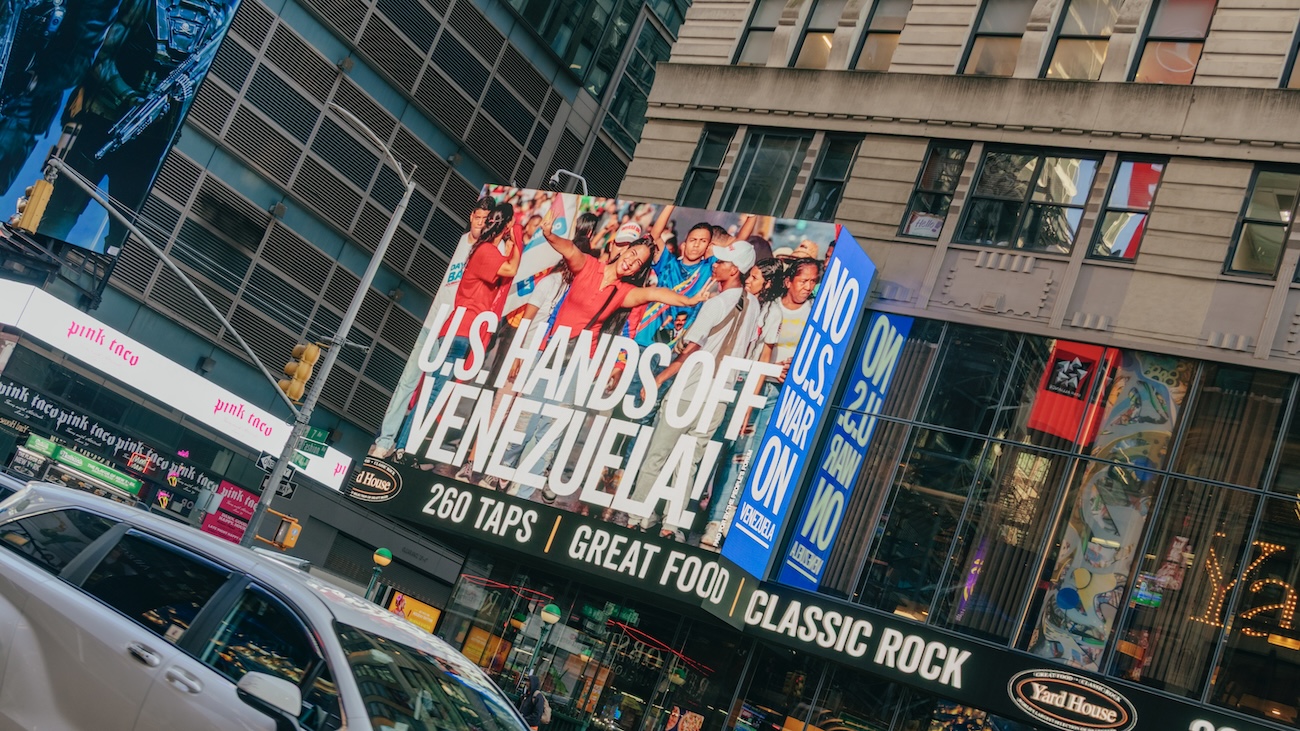
Billboard up in New York City against the US threats against Venezuela. Photo: The People’s Forum
As Trump continues to lodge threats against the Bolivarian Republic, US Congress and grassroots movements mobilize to stop a new war.
The US government has continued to accelerate its drive to war with Venezuela. While rumors circulate about phone calls and possible talks between US President Donald Trump and Venezuelan President Nicolás Maduro, in tandem, the US head of state has continued to launch bizarre and illegal threats and accusations against the South American nation. On Saturday, November 29, Trump unilaterally declared that Venezuelan airspace was closed, despite international law stipulating that only Venezuela has authority over the airspace above its territory and that air traffic above Venezuela has since continued.
While Trump, his Secretary of State Marco Rubio, and the Secretary of War Pete Hegseth have claimed land strikes and “action” against Venezuela could begin imminently and that the country should be on alert, as of now, only the aerial attacks on vessels in the Caribbean have continued. To date, the US missile strikes on boats in the Caribbean have killed at least 83 people. Washington claims they were trafficking drugs, without providing evidence.
Despite Trump’s brazen appetite for war, it appears that public opinion in the United States is against Trump’s escalation against Venezuela. A recent poll conducted by CBS News/YouGOV found that 70% of people in the US would oppose the US taking military action in Venezuela. At the same time, some, albeit limited, bipartisan initiatives have been taken in Congress to attempt to use congressional authority to block Trump from taking military action. From the legislature down to the grassroots movements, opposition to a US war on the Caribbean nation is growing.
Pressure mounts in Congress against Trump’s threats of war
As the Trump cabinet prepares for fresh international law violations, they are already feeling the backlash of ones already committed. Committees in US Congress have reportedly launched investigations into US Secretary of Defense Pete Hegseth for crimes related to missile strikes on boats in the Caribbean, in which the order was reportedly to “kill everybody”.
“These are serious charges, and that’s the reason we’re going to have special oversight,” said Sen. Roger Wicker of Mississippi, the Republican chair of the Senate Armed Services Committee, as reported by PBS.
The mounting scrutiny follows a Washington Post report that details Hegseth’s direction to strike a bombed boat a second time, called a “double tap” strike, even as survivors clung to the edge of the burning vessel. In addition to the investigation, several congressional democrats are calling for Hegseth’s resignation.
When questioned about the targeting of boat strike survivors in an interview with The Hill on December 2, Trump distanced himself from the order and Hegseth blamed Admiral Mitch Bradley for the second strike.
“I moved on to my next meeting. A couple hours later I learned that that commander had made the … correct decision to ultimately sink the boat and eliminate the threat,” said Hegseth.
Adding to the pressure on Hegseth in particular, the Pentagon’s inspector general released a report on Thursday, December 4, concluding that the defense secretary violated department rules and put US forces at risk when he used a signal chat to share details of airstrikes on Yemen back in April.
The renewed scrutiny comes after a bipartisan coalition in both the Senate and the House attempted to check the US president’s ability to carry out deadly strikes in the Caribbean through the War Powers Act.
As opposition continues to build in the legislature, grassroots movements are also mobilizing against the US war drive on Venezuela.
As threat of war grows, so does the people’s resistance
In the same CBS/YouGov poll, 75% of people in the US said that the government needs to show evidence that the boats it is bombing are carrying drugs. Only 13% of Americans believe that Venezuela is a “major threat” to US national security.
“The Trump administration is wildly out of step with public opinion as he threatens to initiate a new forever war with the aim of looting Venezuela’s vast oil resources,” said Brian Becker, National Director of the ANSWER coalition.
After Trump declared Venezuelan airspace to be “closed”, claiming that land strikes would begin “very soon”, a coalition of organizations, including the ANSWER coalition, The Peoples Forum, the Palestinian Youth Movement, the Party for Socialism and Liberation, and others, announced a national day of action on December 6. According to a press release by the coalition, over 50 cities will host protest actions under the slogan “No war on Venezuela – Stop the war before it starts”.
“The Trump Administration’s repeated strikes in the Caribbean have shocked the world as brazen violations of international law,” the coalition asserts.
“Now, Trump is openly threatening to escalate his aggression to land strikes on Venezuelan territory – an unmistakable act of war. This could easily spiral into a ‘boots on the ground’ invasion, and lead to catastrophic death and destruction.”
Organizers expect the day of action to be a “powerful display of the mass opposition” to the US war drive against the Bolivarian nation.
In the wake of decades-long US wars in Iraq and Afghanistan, the growing resistance in Congress and the streets shows that the people of the United States refuse to be dragged into yet another imperialist disaster.
Donald Fuhrump says that Amerikkka doesn’t bother with crimes or charges anymore, not being 100% Amerikkkan and opposing his real estate intentions is enough.
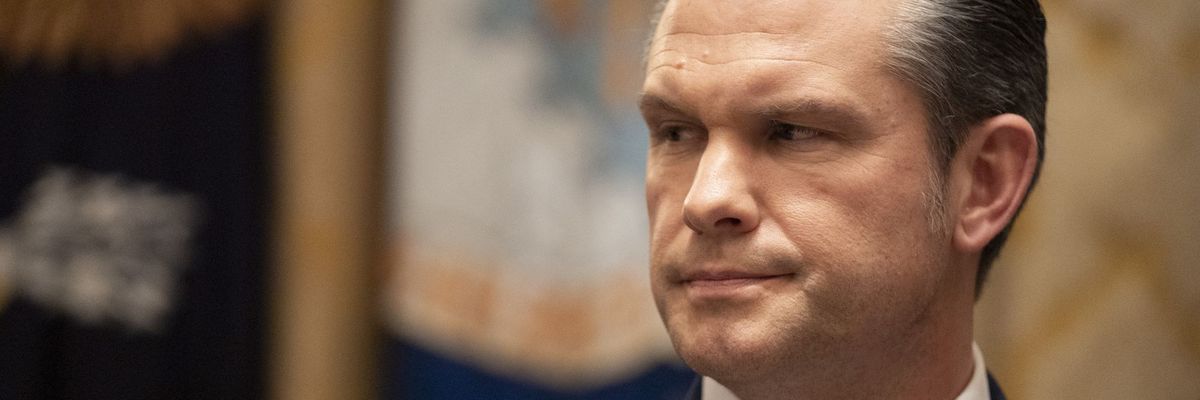
Defense Secretary Pete Hegseth attends a cabinet meeting with President Donald Trump at the White House in Washington, DC on December 2, 2025. (Photo by Carolyn Van Houten/The Washington Post via Getty Images)
According to the official filing, Trump’s Defense Secretary “has admitted that he gave such orders despite the fact that he did not know the identity of those being targeted for these bombings and extra-judicial killings.”
The family of Colombian fisherman Alejandro Carranza Medina, believed killed by the US military in a boat bombing in the Caribbean Sea on Sept. 15, has filed a formal complaint with the Inter-American Commission on Human Rights accusing US Secretary of Defense Pete Hegseth of murder over the unlawful attack.
“From numerous news reports, we know that [Hegseth] was responsible for ordering the bombing of boats like those of Alejandro Carranza and the murder of all those on such boats,” reads the petition, filed Tuesday on behalf of Carranza’s family by Dan Kovalik, a human rights attorney based in Pittsburgh.
“Secretary Hegseth,” the petition continues, “has admitted that he gave such orders despite the fact that he did not know the identity of those being targeted for these bombings and extra-judicial killings.”
The complaint also notes that President Donald Trump, the commander in chief of the US military, “ratified the conduct of Secretary Hegseth described herein.”
First reported on by The Guardian, the filing of the petition with the IACHR—an autonomous body under the charter of Organization of American States (OAS) designed to uphold human rights in the Western Hemisphere—could result in the initiation of an investigation and the release of findings about the bombing that took the life of Carranza and two other individuals believed to be aboard the vessel.
The petition, the outlet noted, “marks the first formal complaint over the airstrikes by the Trump administration against suspected drug boats, attacks that the White House says are justified under a novel interpretation of law.” Experts in international human rights law have stated from the outset that the administration’s justifications lack legal basis and that the attacks constitute unlawful criminal acts.
According to The Guardian:
Carranza, 42, appears to have been killed in the second strike of the Trump administration’s bombing campaign, on 15 September. The administration has publicly disclosed 21 strikes on alleged drug boats. Carranza’s family says he was a fisher who would often set out in search of marlin and tuna.
On the day of the strike, Trump announced on his Truth Social platform that “This morning, on my Orders, US Military Forces conducted a SECOND Kinetic Strike against positively identified, extraordinarily violent drug trafficking cartels and narcoterrorists in the SOUTHCOM area of responsibility”. Trump attached video marked “unclassified” of a small boat floating in the water before it was struck.
Both Hegseth, the highest-ranked civilian at the Pentagon, and Trump have been under growing scrutiny for the series of boat bombings that have resulted in the extrajudicial killing of over 80 people since September. Experts have said the killings should be seen as “murder, plain and simple.”
New revelations about a strike on Sept. 2, in which two survivors of an initial bombing were later killed as they clung to the exploded boat on which they were traveling, has evelated that concern in Washington, DC this week with lawmakers seeking answers about the attack which, even if one accepted the legality of the initial strike under the construct the Trump administration has tried to claim, would constitute a clear human rights violation amounting to a war crime.
In an interview with Agence France-Presse in October, Katerine Hernandez, Carranza’s wife in Colombia, said her husband was “a good man” devoted to fishing and providing for his family. “Why did they just take his life like that?” she asked.
Hernandez denies that Carranza was involved in drug trafficking, as Trump and Hegseth have alleged without providing evidence, but also suggested that even if drug trafficking was taking place, it would not justify his murder. “The fishermen have the right to live,” she said. “Why didn’t they just detain them?”
In a Tuesday statement, the IACHR urged the US government to “ensure respect for human rights” during any and all extraterritorial military operations in the region, noting the deaths of a high number of persons both in the Caribbean and in the Pacific, where other strikes have taken place.
“While acknowledging the seriousness of organized crime and its impact on the enjoyment of human rights, the Commission recalls that States are obliged to respect and ensure the right to life of all persons under their jurisdiction,” the statement reads.
“According to the Inter-American jurisprudence, this duty extends to situations when State agents exercise authority or effective control, including extraterritorial actions at sea,” it continues. “When lethal force is used by security or military personnel outside national territory, States have the obligation to demonstrate that such actions were strictly lawful, necessary, and proportionate, and to investigate, ex officio, any resulting loss of life. These obligations persist irrespective of where the operations occur, or the status attributed to the individuals affected. Likewise, persons under State control must always enjoy full respect for due process and humane treatment.”
The commission called on the US to “refrain from employing lethal military force in the context of public security operations, ensuring that any counter-crime or security operation fully complies with international human rights standards; conduct prompt, impartial, and independent investigations into all deaths and detentions resulting from these actions; and adopt effective measures to prevent recurrence.”
Orcas discuss how Trump was re-elected and him being an obviously insane, xenophobic Fascist.Donald Fuhrump says that Amerikkka doesn’t bother with crimes or charges anymore, not being 100% Amerikkkan and opposing his real estate intentions is enough.
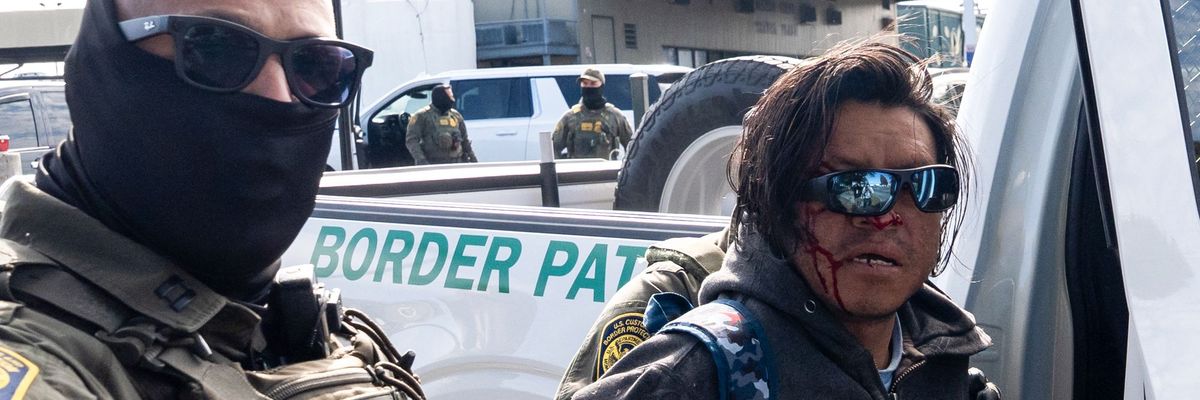
A [man] with a bloody face and sunglasses askew suggests a violent arrest by masked US Customs and Border Patrol agents in New Orleans on December 3, 2025. (Photo by Adam Gray/AFP via Getty Images)
“Our city is not a stage for political theater,” said the Democratic congressman representing New Orleans. “Our people are not props.”
The Trump administration on Wednesday launched a major operation against what it said are “criminal illegal aliens” in New Orleans but that critics contend is political theater targeting what the Louisiana city’s mayor-elect called people “just trying to survive and do the right thing.”
The Department of Homeland Security (DHS) said in a statement that it launched Operation Catahoula Crunch—which some Trump administration officials are also calling “Swamp Sweep”—because New Orleans is a sanctuary city that refuses to cooperate with the anti-immigrant crackdown ordered by President Donald Trump.
The blitz—which began on the same day as a similar operation in Minneapolis and follows federal invasions of cities including Charlotte; Chicago; Los Angeles; Memphis; Portland, Oregon; and Washington, DC—is expected to involve at least hundreds of federal agents and National Guard troops and reportedly aims for 5,000 arrests in Louisiana and Mississippi.
“Sanctuary policies endanger American communities by releasing illegal criminal aliens and forcing DHS law enforcement to risk their lives to remove criminal illegal aliens that should have never been put back on the streets,” Assistant Homeland Security Secretary Tricia McLaughlin said Wednesday.
While McClaughlin claimed the targets of the operation will be “monsters” that “include violent criminals who were released after arrest for home invasion, armed robbery, grand theft auto, and rape,” examination of detention statistics of similar operations in other communities has shown that a large percentage of those swept up have no criminal record.
Academic studies and analyses by both left– and right-wing groups and have repeatedly affirmed that undocumented immigrants commit crime at a dramatically lower rate than native-born US citizens. The libertarian Cato Institute last week published data showing that nearly three-quarters of the 44,882 people booked into Immigration and Customs Enforcement (ICE) custody since October had no criminal conviction and just 5% had been convicted of violent crimes.
Detention data published last month by the Department of Justicerevealed that just 16 out of 614 people arrested in the Chicago area during DHS’s Operation Midway Blitz had criminal histories that present a “high public safety risk.”
Elected officials representing New Orleans called the DHS operation an unnecessary and unwelcome stunt.
“It’s one thing if you would have a real strategic approach on going after people… who have criminal felonies or are being accused of some very serious and violent crimes. But that’s not what the public is seeing,” Democratic New Orleans Mayor-elect Helena Morena told the Washington Post on Wednesday.
“They’re seeing people who are just trying to survive and do the right thing—and many of them now have American children who are not causing problems in our community—treated like they are violent, violent criminals,” she added.
Moreno’s website published a “know your rights” resource page with tips from the National Immigrant Justice Center—a move that could possibly run afoul of a state law cited by Republican Louisiana Attorney General Liz Murrill to threaten felony prosecution of people who nonviolently resist Trump’s crackdown. On Wednesday, the American Civil Liberties Union filed a federal lawsuit arguing that the law is a violation of the right to free speech.
Congressman Troy Carter (D-La.) said in a statement Tuesday that “if the administration truly wants to support public safety in New Orleans, they can help us recruit and retain well-trained local officers, invest in modern policing tools, and build transparent partnerships with city and parish leaders.”
New Orleans welcomes partnership. We do not welcome occupation.What we are seeing unfold in our community is not public safety; it is a political stunt wrapped in badges, armored vehicles, and military uniforms.
“Dropping armed federal agents and National Guard troops into our communities without coordination is not cooperation—it is chaos,” Carter continued. “As Congressman for New Orleans, I want to be clear: We will always stand for the rule of law. We will always stand for safe communities. And we will always stand against tactics that terrorize families and undermine public trust.”
“Our city is not a stage for political theater,” he added. “Our people are not props. If the administration wants to be a partner, then act like one; share the plan, respect local law, and work with us, not around us.”
Hundreds of New Orleans residents took to the streets Monday night despite cold, heavy rain to protest the impending DHS operation. Demonstrators shared umbrellas and held signs showing support for immigrants. They chanted messages, including “No ICE! No fear! Immigrants are welcome here!” and “Chinga la Migra”—roughly translated as “Fuck the Border Patrol.”
“We have to fight for the rights of everyone. I’m out here to support the immigrant community because it’s an integral part of New Orleans. New Orleans was built by immigrants,” protester Jamie Segura toldGambit.
Addressing the crowd at Monday’s rally, resident Mitch Gonzalez said: “This is my home. My trans sister was kidnapped and taken from me. Now she has to fight from Mexico, not even her home country, because they’re snatching people.”
https://twitter.com/i/status/1995859350053601339
As New Orleans residents anticipated the impending operation, mutual aid groups kicked into action in defense of immigrant communities, citing effective rapid response efforts in Chicago.
“What we’ve learned is that even a street witness who is not recording makes these interactions less traumatic and less violent,” Beth Davis, press liaison officer at Indivisible NOLA, told the Washington Post on Wednesday. “So we need to get eyes on these people.”
The New Orleans branch of Democratic Socialists of America—which is hosting training sessions—said ahead of the federal blitz: “We call upon all of New Orleans to get organized and resist this fascist occupation. Protect your neighbors and make these troops and federal agents feel unwelcome in every part of our city.”
Other Orleanians prepared by closing or displaying signs telling the federal invaders that they are not welcome.
“We’re going to make sure that any hotel that they stay at, any neighborhood that they try to terrorize, we’re going to bring as many people there to stop them in their tracks, whether it’s in New Orleans, Los Angeles, Chicago—anywhere in this country,” Antonia Mar of Freedom Road Socialist Organization toldVerite News during Monday’s protest.
Suggesting that the crackdown could backfire, Mar added that “if there’s one thing Trump does well, he gets people organized against him.”
Deputy Prime Minister and Justice Secretary David Lammy leaves following a Cabinet meeting in Downing Street, London, December 2, 2025
DITCH plans to axe jury trials, Labour MPs told David Lammy today as the Justice Secretary presented his plans to attack ancient liberties.
And the dangers of judge-only trials were highlighted as 17 Labour MPs wrote to him over the unexplained decision to switch the judge hearing the Palestine Action case, the Star can report.
Mr Lammy announced that cases where a sentence is likely to be three years’ imprisonment or less will be heard by a judge.
And he ended the right defendants have in certain cases to opt for the sort of trial they would prefer. Magistrates will be given powers to impose longer sentences of up to 18 months, possibly rising to two years.
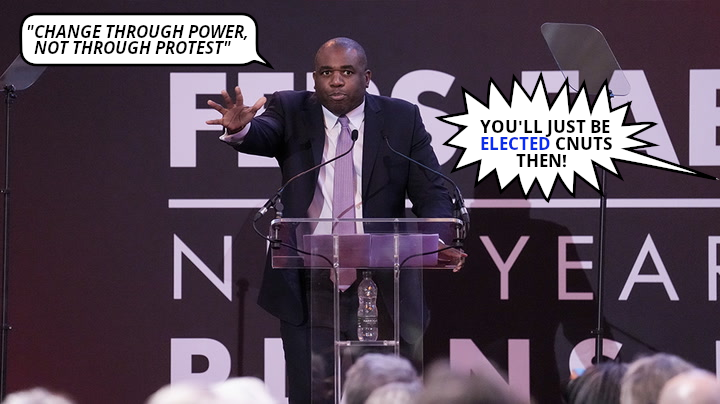
UK Labour Party Foreign Secretary David Lammy repeatedly heckled at a speech to the Fabian Society over his and the Labour Party’s support for and complicity in Israel’s genocide of Gaza.
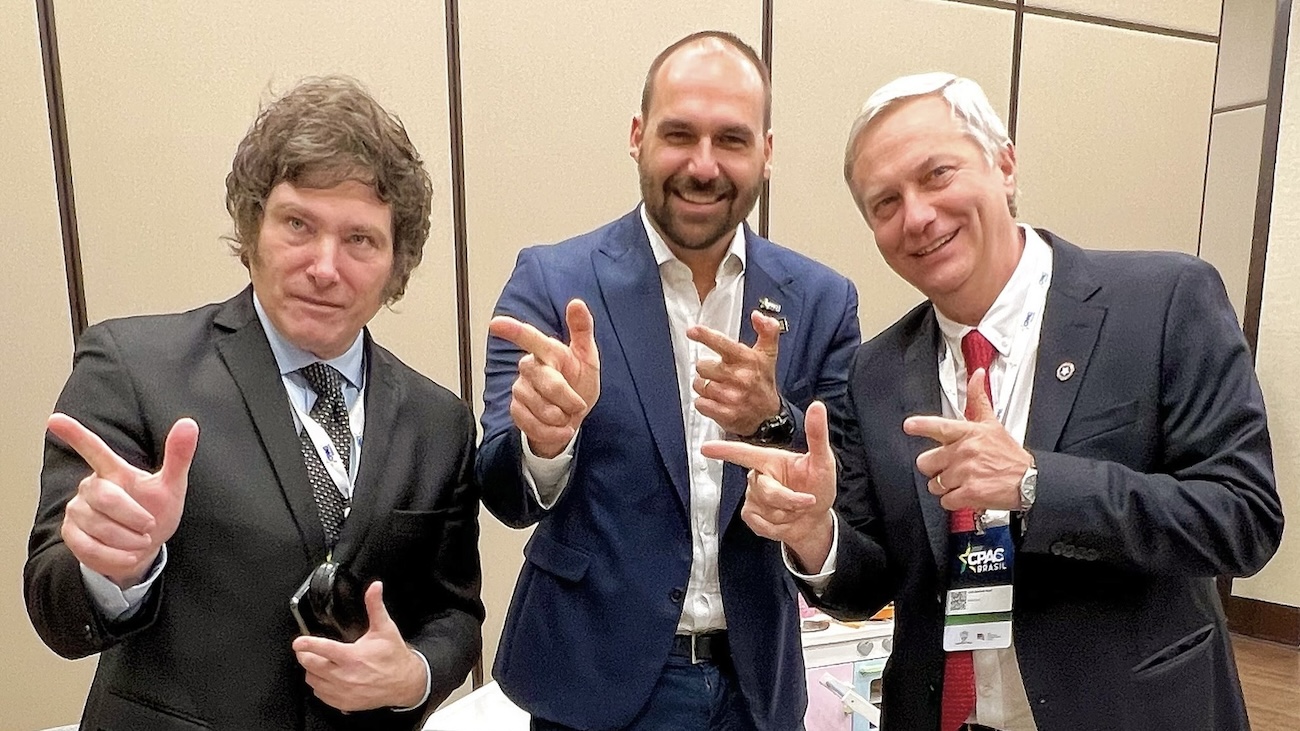
Argentine President Javier Milei, Brazilian legislator Eduardo Bolsonaro, and Chilean far-right presidential candidate José Antonio Kast at CPAC Conference in 2022. Photo: Eduardo Bolsonaro / X
The far right in Latin America is angry. Brazil’s Jair Bolsonaro and Argentina’s Javier Milei always look furious, and they always speak loudly and aggressively. Testosterone leaks from their pores, a toxic sweat that has spread across the region. It would be easy to say that this is the impact of Donald Trump’s own brand of neo-fascism, but this is not true. The far right has much deeper pedigrees, linked to the defense of the oligarchical families that have roots in the colonial era across the virreinatos (viceroyalties) from New Spain to Rio de la Plata. Certainly, these far right men and women are inspired by Trump’s aggressiveness and by the entry of Marco Rubio, a furious defender of the far right in Latin America, to the position of US Secretary of State. This inspiration and support are important but not the reason for the return of the far right, an angry tide that has been growing across Latin America.
On the surface, it looks as if the far right has suffered some defeats. Jair Bolsonaro is in prison for a very long time because of his role in the failed coup d’état on January 8, 2023 (inspired by Trump’s own failed coup attempt on January 6, 2021). In the first round of the presidential election in Chile, the candidate of the Communist Party, Jeannette Jara won the most votes and will lead the center-left bloc into the second round (December 14). Despite every attempt to overthrow the government of Venezuela, President Nicolás Maduro remains in charge and has mobilized large sections of the population to defend the Bolivarian Revolution against any threats. And, in late October 2025, most of the world’s countries voted for a UN General Assembly resolution that demands an end to the blockade on Cuba. These indicators – from Bolsonaro’s imprisonment to the vote on Cuba – suggest that the far right has not been able to move its agenda in every place and through every channel.
However, beneath the surface, there are indications that Latin America is not seeing the resurgence of what had been called the Pink Tide (after the election of Hugo Chávez in Venezuela in 1998) but is experiencing the emergence of an angry tide that slowly has begun to sweep the region from Central America down to the Southern Cone.
Elections in South America
The first round of the Chilean presidential election produced a worrying result. While Jara of the Communist Party won 26.85% of an 85.26% turnout, the far right’s José Antonio Kast came in second with 23.92%. Evelyn Matthei of the traditional Right won 12.5%, while the extreme right candidate who was once with Kast and now to his right, Johannes Kaiser, won 14%. It is likely that Jara will pick up some of the votes of the center, but not enough to overcome the advantage of the far right which looks to have at least more than 50% of the voters on its side. The so-called social liberal, Franco Parisi, who came in third, endorsed Kast in 2021 and will likely endorse him again. That means that in Chile, the presidency will be in the hands of a man of the far right whose ancestry is rooted in German Nazism (Kast’s father was a member of the Nazi Party who escaped justice through the intercession of the Vatican) and who believes that the dictatorship in Chile from 1973 to 1990 was on balance a good idea.
North of Chile, in Bolivia, the new president Rodrigo Paz Pereria, son of a former president, beat the far right’s Jorge Tuto Quiroga (a former president) in the second round of the election. This round had no candidate of the left, after the Movement for Socialism governed Bolivia continuously from 2006 to 2025. Paz’s own party has a minority position in the legislature and he will therefore have to align himself with the Quiroga’s Libre coalition and he will likely adopt a pro-US foreign policy and a libertarian economic policy. Peru will have its own election in April, where the former mayor of Lima – Rafael López Aliaga – is expected to win. He rejects the label far right but adopts all the generic policies of the far right (ultra-conservative Catholic, advocate for harsh security measures, and favors a libertarian economic agenda). Iván Cepeda of Colombia is the left’s likely candidate in their presidential election in May 2026, since Colombia does not permit second terms (so President Gustavo Petro cannot run again). Cepeda will face strong opposition from Colombia’s oligarchy which will want to return the country to their rule. It is too early to say who Cepeda will face, but it might be journalist Vicky Dávila, whose far right opposition to Petro is finding traction in unexpected parts of Colombian society. It is likely that by the middle of 2026, most of the states along the western edge of South America (from Chile to Colombia) will be governed by the far right.
Even as Bolsonaro is in prison, his party, the PL (or Liberal Party), is the largest bloc in Brazil’s National Congress. It is likely that Lula will be re-elected to the presidency next year due to his immense personal connection with the electorate. The far right’s candidate – who could be possibly Tarcísio de Freitas, the governor of São Paulo state, or one of the Bolsonaro’s (wife Michelle or son Flavio) – will struggle against him. But the PL will make inroads into the Senate. Their control over the legislature has already tightened the reins on the government (at COP30, Lula’s representative made no proposals to confront the climate catastrophe), and a Senate win will further their control over the country.
Common agenda of the angry tide
The Angry Tide politicians who are making waves have many things in common. Most of them are now in their fifties – Kast (born 1966), Paz (born 1967), Venezuelan politician María Corina Machado (born 1967), and Milei (born 1970). They came of age in the post-dictatorship period in Latin America (the last dictatorship to end was in Chile in 1990). The decade of the 1990s continued the economic stagnation that characterized the 1980s: the Lost Decade (La Década Perdida) that convulsed these countries with low growth rates and with poorly developed comparative advantages forced into globalization. It was in this context that these politicians of the Angry Tide developed their common agenda:
Anti-Communism. The far right in Latin America is shaped by an anti-left agenda that it inherits from the Cold War, which means that its political formations typically endorse the era of US-backed military dictatorships. The ideas of the left, whether from the Cuban Revolution (1959) or from the era of the Pink Tide (after 1998), are anathema to these political forces; these ideas include agrarian reform, state-led finance for industrialization, state sovereignty, and the importance of trade unions for all workers and peasants. The anti-communism of this Angry Tide is rudimentary, mother’s milk to the politicians and used cleverly to turn sections of society against others.
Libertarian Economic policies. The economic ideas of the Angry Tide are shaped by the Chilean “Chicago Boys” (including Kast’s brother Miguel who was the head of General Augusto Pinochet’s Planning Commission, his Minister of Labor, and his head of the Central Bank). They directly take their tradition from the libertarian Austrian School (Friedrich Hayek, Ludwig von Mises, and Murray Rothbard as well as Milton Friedman). The ideas were cultivated in well-funded think tanks, such as the Centro de Estudios Macroeconómicos de Argentina (founded in 1978) and the Chilean Centro de Estudios Públicos (founded in 1980). They believe the State should be a force to discipline the workers and citizens, and that the economy must be in the hands of private interests. Milei’s famous antics with a chainsaw illuminate this politics not only of cutting social welfare (the work of neoliberalism) but of destroying the capacity of the State itself.
Culture Wars. Drawing on the wave of anti-gender ideology and anti-migration rhetoric, the Angry Tide has been able to appeal to conservative evangelical Christians and to large sections of the working class that has been disoriented by changes seen to come from above. The far right argues that the violence in working class neighborhoods created by the drug industry is fostered by “liberalism” and that only tough violence (as demonstrated by El Salvador’s president Nayib Bukele) can be the solution; for this reason, they want to strengthen the military and police and set aside constitutional limitations on use of force (on October 28, the government of Bolsonaro ally Cláudio Castro in Rio de Janeiro sent in the police who killed at least 121 people in Operation Containment). It helps the far right that it adopted various conspiracy theories about how the “elites” have spread “globalized” ideas to damage and destroy the “culture” of their nations. This is a ludicrous idea coming from far right and traditional right political forces that champion full-scale entry of US corporations into their society and culture, and that have no respect for the histories of struggle of the working class and peasantry to build their own national and regional cultural worlds. But the Angry Tide has been able to construct the idea that they are cultural warriors out to defend their heritage against the malignancies of “globalization”. Part of this culture war is the promotion of the individual entrepreneur as the subject of history and the denigration of the necessity of social reproduction.
It is these three elements (anti-communism, libertarian economic policies, and the culture wars) that brings together the far right across Latin America. It provides them with a robust ideological framework to galvanize sections of the population to believe that they are the saviours of the hemisphere. This Latin American far right is backed by Trump and the international network of the Spanish far right (the Foro Madrid, created in 2020 by Fundación Disenso, the think tank of the far right Vox party). It is heavily funded by the old elite social classes, who have slowly abandoned the traditional Right for these new, aggressive far right parties.
Crisis of the Left
The Left is yet to develop a proper assessment of the emergence of these parties and has not been able to drive an agenda that sparkles with vitality. A deep ideological crisis grips the Left, which cannot properly decide whether to build a united front with the traditional right and with liberals to contest elections or to build a popular front across the working class and peasantry to build social power as a prelude to a proper electoral push. The example of the former strategy (the electoral alliance) comes from Chile, where first the Concertación de Partidos por la Democracia (Concertación) formed in 1988 to keep out the parties of the dictatorship from power and second the Apruebo Dignidad formed in 2021 that brought Gabriel Boric of the centrist Broad Front to the presidency. But outside Chile, there is little evidence that this strategy works. The latter has become harder as unionization rates have collapsed, and as uberization individualizes the working class to erode working class culture.
It is telling that Bolivia’s former socialist Vice President Álvaro García Linera looked northwards to New York City for inspiration. When Zohran Mamdani won the mayor’s race, García Linera said, “Mamdani’s victory shows that the left must commit to boldness and a new future.” It is hard to disagree with this statement; although, Mamdani’s own proposed agenda is mostly to salvage a worn-out New York infrastructure rather than to advance the city to socialism. García Linera did not mention his own time in Bolivia, when he tried with former president Evo Morales to build a socialist alternative. The left will have to be bold, and it will have to articulate a new future, but it will have to be one that emerges from its own histories of building struggles and building socialism.
Donald Fuhrump says that Amerikkka doesn’t bother with crimes or charges anymore, not being 100% Amerikkkan and opposing his real estate intentions is enough.



 Deputy Prime Minister and Justice Secretary David Lammy leaves following a Cabinet meeting in Downing Street, London, December 2, 2025