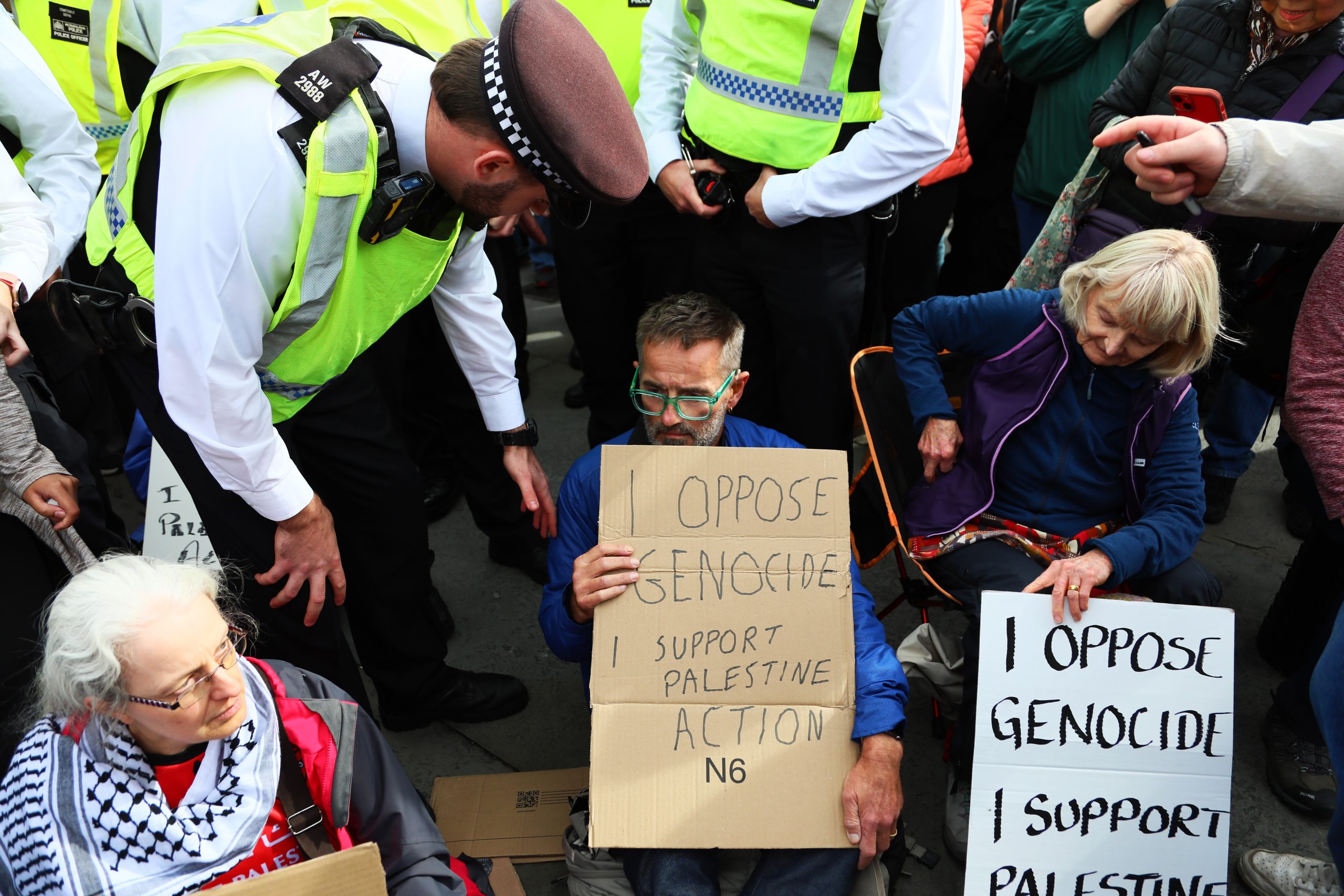
Demonstrators hold up placards in Trafalgar Square during a protest in support of Palestine Action on October 4, 2025 in London, England. (Credit: Alishia Abodunde via Getty Images.)
Labour’s plan to criminalise recurring protests strikes at the heart of democratic life, transforming political freedom into a privilege granted by the state.
On Sunday, Home Secretary Shabana Mahmood announced plans for sweeping new powers to allow the banning and restriction of protests. Her move came after the refusal of the Defend Our Juries campaign group to cancel Saturday’s demonstrations against the proscription of Palestine Action, which are increasingly becoming a mainstay on Parliament Square.
The prime minister and home secretary had both urged organisers to cancel their planned actions in light of the Manchester synagogue attack. Though they paid lip service to the right to protest, they claimed that exercising it at this moment would be ‘un-British’, with Mahmood darkly adding that just because you have freedom, ‘you don’t have to use it at every moment of every day.’ Having seen their appeals ignored, the government now intends to remove those rights.
Mahmood said the new powers would target ‘cumulative disruption’ and the ‘frequency of particular protests in particular places.’ In practice, this means giving police the authority to simply shut down demonstrations from happening. Defying police orders may result in six months in prison, an unlimited fine, or both. The home secretary described the inability to outlaw recurring protests as a technical oversight, a ‘gap in the law’ in need of closing. But far from a technical fix, the proposal amounts to the most serious assault on the freedom of assembly in a generation.
Recurring demonstrations are necessary for the very reason that the injustices they confront are recurring. In the case of pro-Palestine protests, the government continues to arm and directly support Israel’s military operations in defiance of public opinion — and even after the UN formally concluded that Israel is committing genocide. The same is true of protests against the proscription of Palestine Action, under which thousands of peaceful demonstrators have been arrested on terror charges merely for holding signs. The classification of the group as a terrorist organisation — a ‘disturbing’ misuse of anti-terror legislation, according to the UN — remains in force.
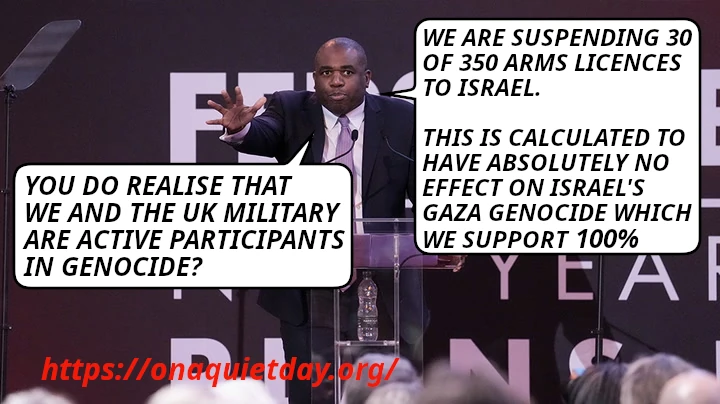
Genocide denying UK Foreign Secretary David Lammy says that UK is suspending 30 of 350 arms licences to Israel. He also confirms the UK government’s support for Israel’s Gaza genocide and the UK government and military’s active participation in genocide.Genocide denier and Current UK Prime Minister Keir Starmer is quoted that he supports Zionism without qualification. He also confirms that UK air force support has been essential in Israel’s mass-murdering genocide. Includes URLs https://www.declassifieduk.org/keir-starmers-100-spy-flights-over-gaza-in-support-of-israel/ and https://youtu.be/O74hZCKKdpAKeir Starmer objects to criticism of the IDF. He asks how could anyone object to them starving people to death, forced marches like the Nazis did, bombing Gaza’s hospitals and universities, mass-murdering journalists, healthworkers and starving people queuing for food, killing and raping prisoners and murdering children. He calls for people to stop obstructing his genocide for Israel.
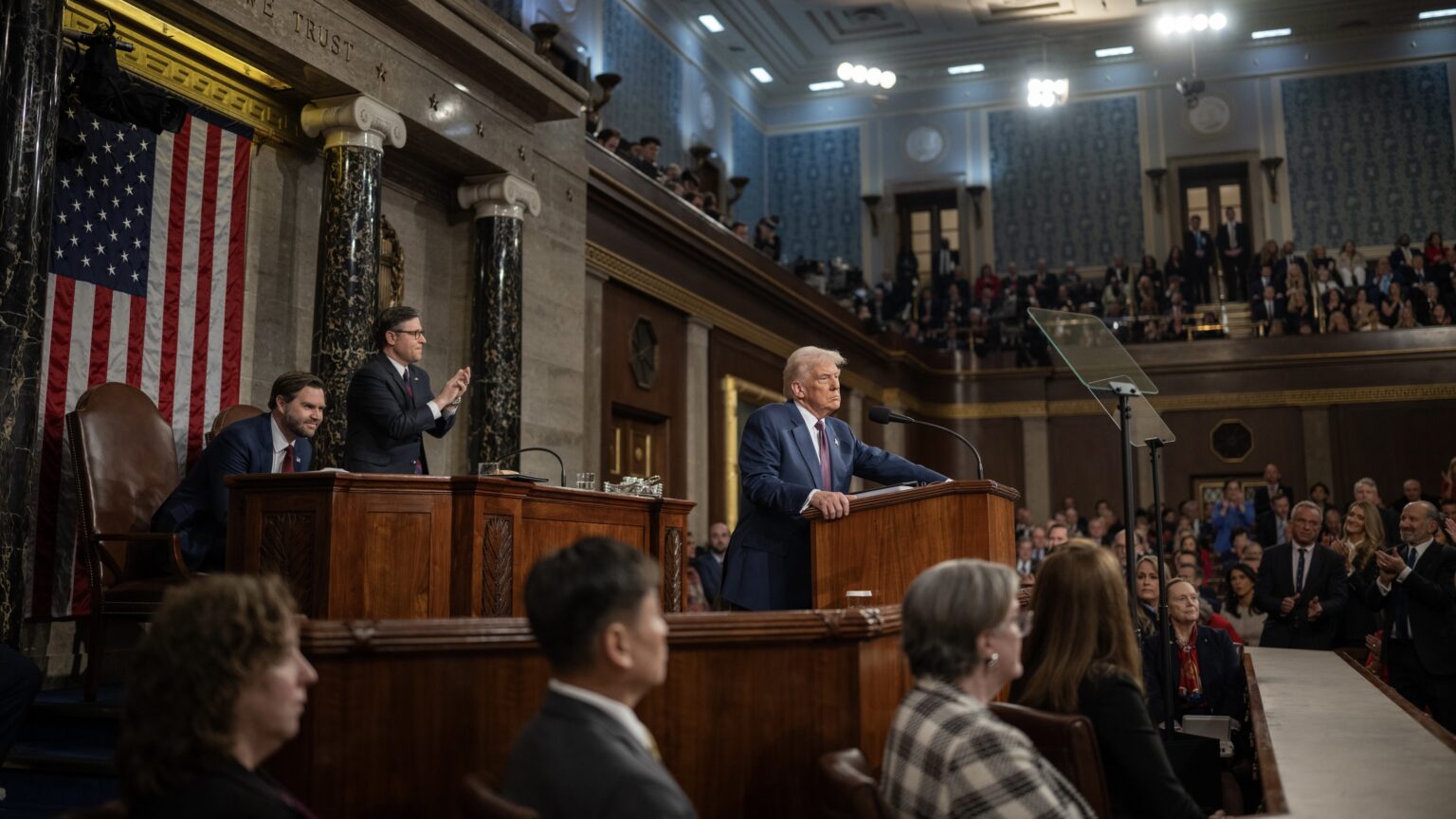
US President Donald Trump speaking at the State of the Union in March 2025. Photo: POTUS / X
After killing 21 people in a series of airstrikes on boats off the coast of Venezuela, the US closes all diplomatic channels and prepares for further military aggression in the region.
On October 6, US President Donald Trump ordered the termination of diplomacy with Venezuela. Richard Grenell, special presidential envoy, was directed by Trump to halt all diplomatic outreach and talks with Venezuelan President Nicolás Maduro.
The move follows multiple US missile strikes on boats in the Caribbean Sea. Washington claims the operations target drug traffickers, but regional leaders and legal experts say they are escalating into an undeclared war against Venezuela.
Caracas calls for diplomacy, US abandons it for war
Grenell had previously been the primary negotiator between the two governments and was involved in US-Venezuela policy decisions in general.
Back in September, President Maduro sent a letter directly to Trump, calling for diplomacy and refuting the drug-trafficking accusations the White House has levied. He pointed out how crucial Grenell’s work had been in overcoming false reports and misunderstandings that had emerged around deportation flights from the US.
“This issue was swiftly resolved and clarified during discussions with Mr. Richard Grenell. This channel has functioned flawlessly to date,” the letter stated.
Maduro cited UN data demonstrating the country’s “impeccable record in the fight against international drug trafficking”.
“This and other matters will always be open for direct and frank discussion with your special envoy Grenell, so that we can overcome media noise and fake news.”
Weeks later, Grenell’s communication with Caracas was ceased completely by President Trump.
Washington’s total diplomatic disengagement suggests that hardliners like Secretary of State Marco Rubio, who have openly called for regime change in Venezuela, are now freely leading a more aggressive, militaristic approach toward the most oil-rich nation on earth.
The US military has now carried out airstrikes on at least four small boats in the Caribbean, raising the reported death toll of Washington’s current military aggression in the region to 21. Officials say the campaign aims to combat alleged drug trafficking but have provided no evidence for the claim.
Airstrikes began on September 2, when 11 people – later identified as fishermen – were killed in a missile strike on the first targeted ship off the coast of Venezuela.
Colombian President Gustavo Petro recently announced that the fourth bombed boat was a Colombian vessel, accusing Trump of opening a “war scenario” in the region.
“This is no war against smuggling,” Petro said. “It is a war against oil and it must be stopped by the world.”
The Trump administration has denied Petro’s allegation that the vessel was Colombian, however, an anonymous US official confirmed to the New York Times that Colombian citizens were on board.
The uncharged, untried, and largely unidentified victims of the last month of US aggression are accused of being narcotraffickers by the Trump administration.
The US has deployed at least eight warships, a nuclear-powered attack submarine, several P-8 surveillance planes, and 4,000 military personnel to the waters of the Caribbean, as well as F-35 fighter jets to Puerto Rico.
The scale and level of aggression, combined with the lack of evidence for drug trafficking accusations, has raised questions about Washington’s true intentions with Venezuela. Sources inside the Trump administration told NBC News in September, “The goal is to force Maduro to make rash decisions that could ultimately lead to his ouster – without American boots on the ground.”
US is waging an “armed conflict” against “unlawful combatants”, declares Trump
Legal experts, US lawmakers, and anti-war groups have asserted that military force in international waters is illegal, violating both international and US law, bypassing due process and law enforcement norms, and lacking any clear justification.
In an apparent attempt to provide some legal basis for the hostilities, President Trump sent a report to Congress last week declaring that the US military is engaged in a “non-international armed conflict” with drug cartels and has killed “unlawful combatants” in the Caribbean.
The president has “designated [cartels] as terrorist organizations, and determined that their actions constitute an armed attack against the United States,” Earl Matthews, the Pentagon’s general counsel told lawmakers, as reported by CNN.
The report sent to Congress is required by law (Section 1543a United States Code) whenever US military forces are engaged in hostilities, but it doesn’t automatically grant or expand the legal basis for a military campaign.
However, Secretary of War Pete Hegseth already cited the recent “legal justification” by President Trump when pressed on Sunday about the most recent airstrike at sea. “We have every authorization needed,” Hegseth told Fox News. “These [cartels] are designated as foreign terrorist organizations.”
Although some senators have questioned “the legal rationale, the mission itself, and the intel surrounding the strikes”, a war powers bill that would have limited Trump’s power, halting further airstrikes on boats without authorization from Congress, was voted down on Thursday, October 9.
The White House insists that its “armed conflict” is legal and constitutional. Yet experts and critics say Trump is waging a secret war against undefined enemies, without fully informing Congress or the people of the US – who overwhelmingly reject US intervention in Venezuela. Polls show that only 16% of Americans would support a US invasion of the country.
Threats of land strikes
Despite widespread opposition, President Trump has openly threatened a direct US attack on Venezuela. During an event on October 5 at Naval Station Norfolk in Virginia, he praised the Navy for how successful the missile strikes on alleged drug boats have been.
“We’ll have to start looking about the land because they’ll be forced to go by land,” he said.
The threat came days after NBC News reported that US military officials had in fact already drawn up plans for drone strikes within Venezuelan territory.
Venezuela belongs to Venezuelans, declares Maduro
Caracas has attempted to open dialogue with special envoy Richard Grenell, President Trump himself, and now the UN Security Council. Amid its diplomatic efforts, the country has also made massive efforts to increase its security and defense capabilities.
On October 6, Maduro announced that Venezuelan security forces had foiled a “false flag” plot by local extremists to bomb the US embassy in Caracas, in an apparent attempt to justify US military provocation. Maduro assured that his administration would reinforce security measures to protect the embassy “despite all the differences we have had with the governments of the United States.”
As soon as the US military deployment was announced by Marco Rubio in August, Venezuela mobilized its 4.5 million members of the Bolivarian National Militia. However, after enlistment campaigns calling on the Venezuelan people to defend the country’s sovereignty against US aggression, 8 million people signed up to join the militia, raising the total size of the force to over 12 million civilian combatants, according to the government. The country has conducted advanced training across the entire territory and the Caribbean Sea to consolidate its defense forces and prepare for any US attack.
“What they want is war in the Caribbean and South America. For a regime change to impose a puppet government and steal the oil, gas, and gold,” the president of the Bolivarian Republic proclaimed during the inauguration of a massive hospital in Caracas.
“But we have news for the North American empire,” he continued. “That oil, that gas, that gold, this land, and this people will continue to belong to Venezuelans. And we will never allow our homeland to be violated or touched. Never!”
Donald Fuhrump says that Amerikkka doesn’t bother with crimes or charges anymore, not being 100% Amerikkkan and opposing his real estate intentions is enough.Orcas discuss how Trump was re-elected and him being an obviously insane, xenophobic Fascist.
In 2002, former US President George W. Bush meets María Corina Machado, then director of Súmate, an “independent democratic civil society group” funded by the US government to “oversee the electoral process in Venezuela”. Source: White House/Eric Draper
Venezuelan opposition figure María Corina Machado was awarded the Nobel Peace Prize, but there’s nothing peaceful about her politics
When I saw the headline María Corina Machado wins the Peace Prize, I almost laughed at the absurdity. But I didn’t, because there’s nothing funny about rewarding someone whose politics have brought so much suffering. Anyone who knows what she stands for knows there’s nothing remotely peaceful about her politics.
If this is what counts as “peace” in 2025, then the prize itself has lost every ounce of credibility. I’m Venezuelan-American, and I know exactly what Machado represents. She’s the smiling face of Washington’s regime-change machine, the polished spokesperson for sanctions, privatization, and foreign intervention dressed up as democracy.
Machado’s politics are steeped in violence. She has called for foreign intervention, even appealing directly to Benjamin Netanyahu, the architect of Gaza’s annihilation, to help “liberate” Venezuela with bombs under the banner of “freedom,” She has demanded sanctions, that silent form of warfare whose effects – as studies in The Lancet and other journals have shown – have killed more people than war, cutting off medicine, food, and energy to entire populations.
Machado has spent her entire political life promoting division, eroding Venezuela’s sovereignty, and denying its people the right to live with dignity.
This is who María Corina Machado really is:
She helped lead the 2002 coup that briefly overthrew a democratically elected president, and signed the Carmona Decree that erased the Constitution and dissolved every public institution overnight.
She worked hand in hand with Washington to justify regime change, using her platform to demand foreign military intervention to “liberate” Venezuela through force.
She cheered on Donald Trump’s threats of invasion and his naval deployments in the Caribbean, a show of force that risks igniting regional war under the pretext of “combating narcotrafficking.” While Trump sent warships and froze assets, Machado stood ready to serve as his local proxy, promising to deliver Venezuela’s sovereignty on a silver platter.
She pushed for the US sanctions that strangled the economy, knowing exactly who would pay the price: the poor, the sick, the working class.
She helped construct the so-called “interim government,” a Washington-backed puppet show run by a self-appointed “president” who looted Venezuela’s resources abroad while children at home went hungry.
She vows to reopen Venezuela’s embassy in Jerusalem, aligning herself openly with the same apartheid state that bombs hospitals and calls it self-defense.
Now she wants to hand over the country’s oil, water, and infrastructure to private corporations. This is the same recipe that made Latin America the laboratory of neoliberal misery in the 1990s.
Machado was also one of the political architects of “La Salida,” the 2014 opposition campaign that called for escalated protests, including guarimba tactics. Those weren’t “peaceful protests” as the foreign press claimed; they were organized barricades meant to paralyze the country and force the government’s fall. Streets were blocked with burning trash and barbed wire, buses carrying workers were torched, and people suspected of being Chavista were beaten or killed. Even ambulances and doctors were attacked. Some Cuban medical brigades were nearly burned alive. Public buildings, food trucks, and schools were destroyed. Entire neighborhoods were held hostage by fear while opposition leaders like Machado cheered from the sidelines and called it “resistance.”
She praises Trump’s “decisive action” against what she calls a “criminal enterprise,” aligning herself with the same man who cages migrant children and tears families apart under ICE’s watch, while Venezuelan mothers search for their children disappeared by US migration policies.
Machado isn’t a symbol of peace or progress. She is part of a global alliance between fascism, Zionism, and neoliberalism, an axis that justifies domination in the language of democracy and peace. In Venezuela, that alliance has meant coups, sanctions, and privatization. In Gaza, it means genocide and the erasure of a people. The ideology is the same: a belief that some lives are disposable, that sovereignty is negotiable, and that violence can be sold as order.
If Henry Kissinger could win a Peace Prize, why not María Corina Machado? Maybe next year they’ll give one to the Gaza Humanitarian Foundation for “compassion under occupation.”
Every time this award is handed to an architect of violence disguised as diplomacy, it spits in the face of those who actually fight for peace: the Palestinian medics digging bodies from rubble, the journalists risking their lives in Gaza to document the truth and the humanitarian workers of the Flotilla sailing to break the siege and deliver aid to starving children in Gaza, with nothing but courage and conviction.
But real peace is not negotiated in boardrooms or awarded on stages. Real peace is built by women organizing food networks during blockades, by Indigenous communities defending rivers from extraction, by workers who refuse to be starved into obedience, by Venezuelan mothers mobilizing to demand the return of children seized under US ICE and migration policies and by nations that choose sovereignty over servitude. That’s the peace Venezuela, Cuba, Palestine, and every nation of the Global South deserves.
Michelle Ellner is a Latin America campaign coordinator of CODEPINK.
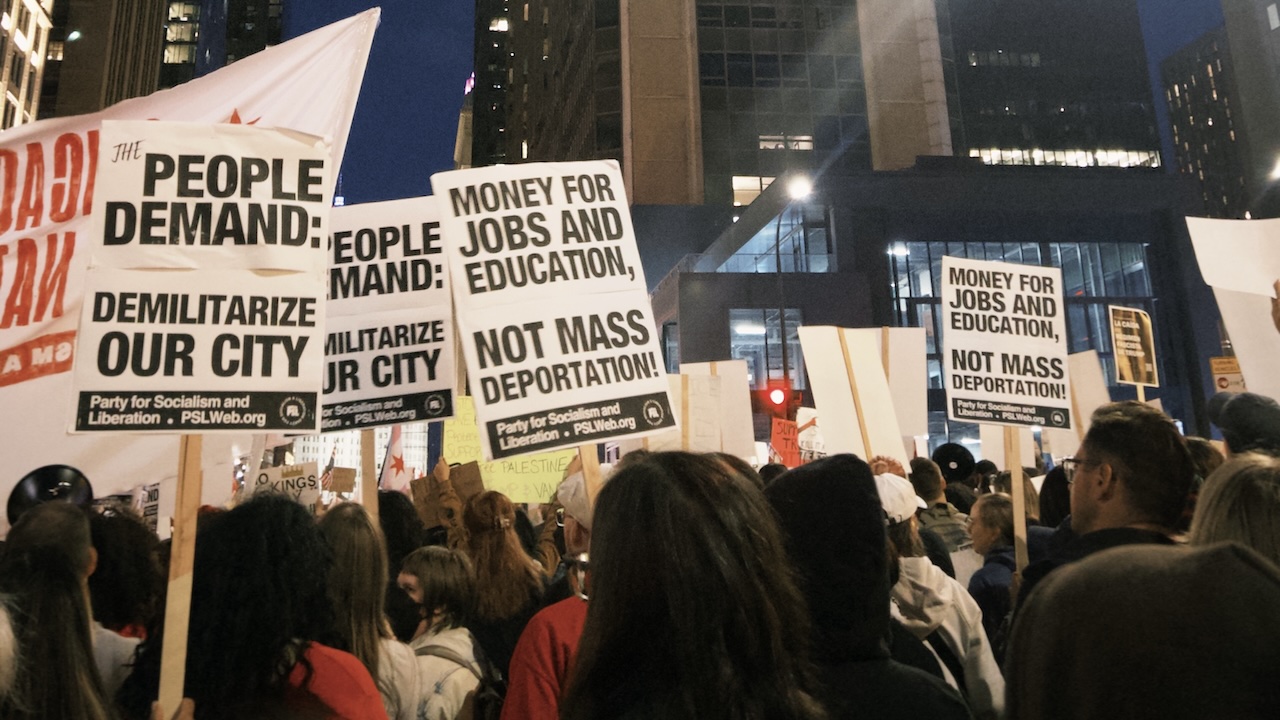
Demonstrators in Chicago on October 8 (Photo: Saja Bilasan)
“The oath we took as soldiers absolutely comes with an asterisk, and this is it,”: Veteran activists in Portland urge National Guard Troops to defy Trump’s orders
A US federal judge issued a temporary restraining order on October 9, blocking the Trump administration’s deployment of hundreds of National Guard troops to Chicago. Hundreds were already stationed in the midwestern city at the time of this ruling. This comes days after a separate judge blocked the deployment of the National Guard to Portland, Oregon.
Currently, there are around 500 National Guard troops in the greater Chicago area, 2,400 in Washington, DC, and 100 still in Los Angeles down from a peak of 4,700 in June.
With the support of the Governor of Tennessee, the state’s National Guard troops are set to begin patrolling the city of Memphis. Unlike Chicago, Los Angeles, and Portland, Tennessee’s Republican governor Bill Lee is supportive of Trump’s federal takeover efforts and therefore is sending troops from his own state to Memphis – thus eliminating the legal obstacles Trump has faced in other states.
Chicago’s Mayor Brandon Johnson called the judge’s order a “win for the people of Chicago and the rule of law.” The previous day, Trump called for the jailing of both Johnson and Illinois Governor JB Pritzker for “failing to protect Ice Officers”. But Johnson asserted that, as protests against violent ICE raids continue in Chicago, that there is “no rebellion,” there are “just good people standing up for what is right.”
Federal troops blocked in Portland
Trump announced the deployment of federal troops to Portland on September 27, characterizing the West Coast city as “war ravaged” and claiming that ICE facilities were under attack by “Antifa, and other domestic terrorists.”
According to federal judge Karin Immergut, who was appointed by Trump during his first term, there is “substantial evidence that the protests at the Portland ICE facility were not significantly violent or disruptive in the days – or even weeks – leading up to the President’s directive ordering the deployment of troops to Oregon.”
Top Trump adviser Stephen Miller described Immergut’s ruling as a “legal insurrection.”
On September 22, Trump announced that he was declaring “Antifa” a domestic terrorist organization, despite the fact that Antifa is a decentralized movement with no central organization attached.
Amid attempts by the Trump administration to militarize the city, Portland residents have continued to protest. Demonstrations continued against ICE, including a march to the ICE facility in Portland in the early afternoon of Saturday, October 4 – which was attacked by federal agents deploying tear gas, smoke canisters, and pepper balls at protesters. Protesters outside the ICE facility also experienced similar brutal crowd control tactics by federal agents once again that evening – including tear gas, flash-bang grenades, and pepper balls – despite no clear provocation by demonstrators.
Portland veterans urge National Guard members to disobey
On October 6, dozens of veterans, some with anti-war veteran group About Face, held a press conference, with some speakers and signage urging National Guard members to disobey Trump’s orders. Several signs read “Trump is the real enemy within,” referencing the President’s previous statements claiming that he is sending troops to so-called “Democrat-run” cities to protect from “invasion from within”. Other signs read: “Veterans say: Duty to disobey”, “No war in Portland”, and “Guard, go home.”
“Trump is signaling in very clear terms he wants to go to war in American cities,” said Portland City Councilor Mitch Green, an Army veteran who served in the US invasion of Afghanistan, at the press conference. “He said he wants to use Portland as a training ground and that soldiers should do ‘whatever they want’ to protesters. While it’s unclear what the role of the National Guard will be, these threats are as serious as anything in American history. The oath we took as soldiers absolutely comes with an asterisk, and this is it.”
Donald Fuhrump says that Amerikkka doesn’t bother with crimes or charges anymore, not being 100% Amerikkkan and opposing his real estate intentions is enough.Orcas discuss how Trump was re-elected and him being an obviously insane, xenophobic Fascist.
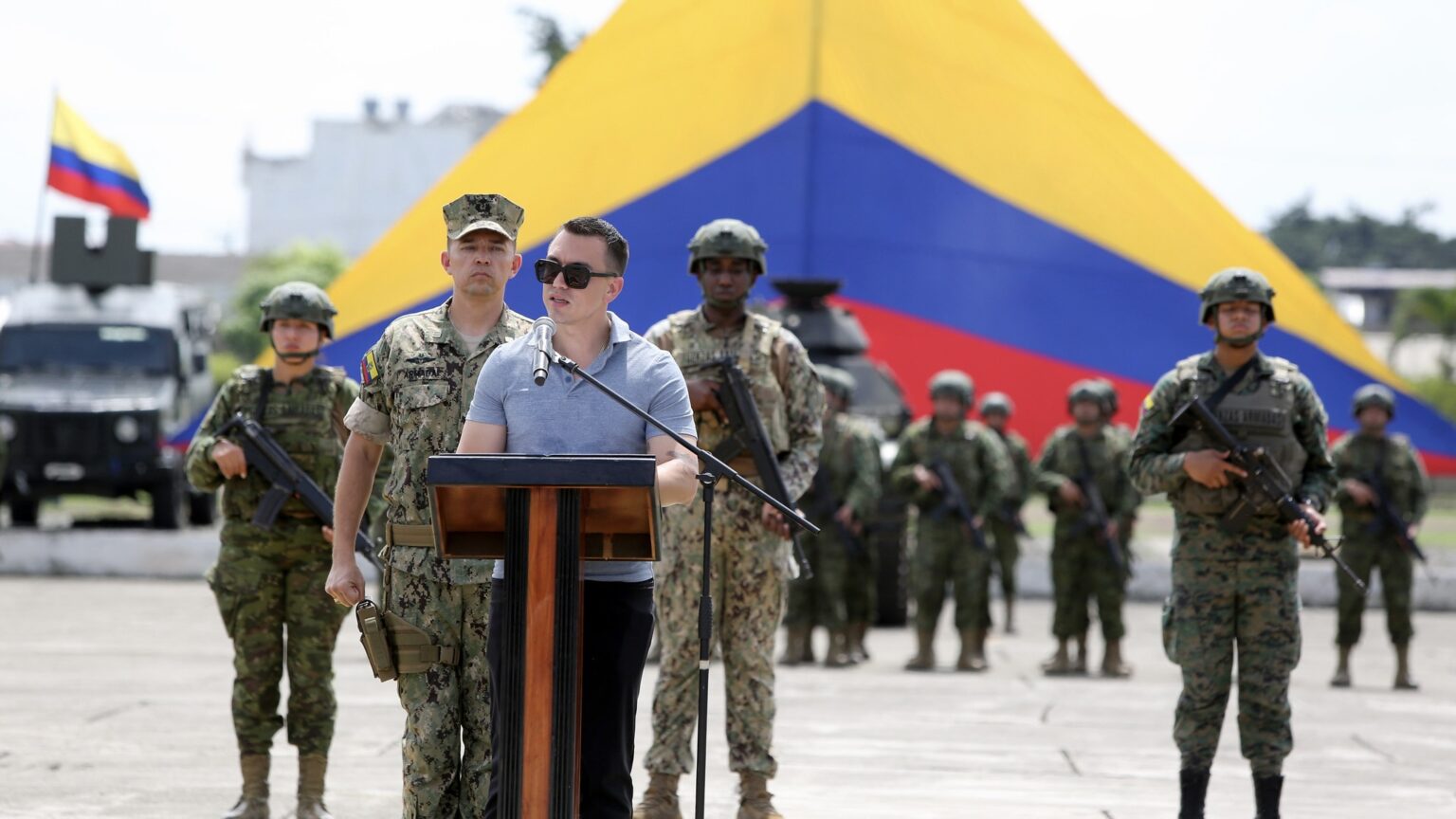
Ecuadorian President Daniel Noboa in January 2025. Photo: Presidencia Ecuador
Ecuadorian President Daniel Noboa has not only deepened the crisis in the country, but is also attempting to change the country’s institutions and laws through loopholes and force.
Daniel Noboa’s government in Ecuador is characterized by the implementation of neoliberal austerity policies dictated by the IMF, the violent repression of social protests, and a series of legal reforms aimed at increasing state authoritarianism, and aligning the country with US foreign policy. All this is taking place amid an unprecedented security crisis.
The security crisis
During the first half of 2025, Ecuador recorded 4,619 homicides, setting a new historical record and representing a 47% increase over the same period in 2024. This figure makes the country the most violent on the continent. No one knows what the Phoenix Plan, implemented by the Noboa government since 2024, consists of, and it has not produced positive results. On the contrary, citizen insecurity has worsened. The constant states of emergency that have militarized the country have also failed to reverse the situation.
Austerity policies
Re-elected in April 2025, Daniel Noboa has implemented a far-right program aligned with the demands of the IMF. In June, he dismissed 5,000 civil servants and merged four ministries. In the most serious case, environmental responsibilities were transferred to the Ministry of Natural Resources and Hydrocarbons, highlighting the government’s extractivist orientation. These measures represent the path toward the minimal state advocated by neoliberalism and respond to the conditions of the latest IMF loan.
On September 12, Noboa withdrew the subsidy on diesel, whose price rose from USD 1.80 to USD 2.80 per gallon until December. Subsequently, the price would depend on a band system tied to international market prices. This measure triggered a national transport strike on September 13, with transport workers quickly reaching an agreement with the government in exchange for subsidies, and subsequently the national strike called by the Confederation of Indigenous Nationalities of Ecuador (CONAIE) on September 18, demanding the repeal of the measure, a reduction in the VAT from 15% to 12%, no mining, respect for prior consultation, and more investment in education and health. It should be noted that public hospitals are in precarious conditions, without medicines or supplies. The media reports that patients who required dialysis treatment died because they did not receive it.
Submission to the United States and constitutional reforms
On June 3, the National Assembly, where the government has a majority, approved an amendment to Article 5 of the Constitution allowing foreign military bases. This amendment required the approval of the Constitutional Court and subsequently a referendum. On September 5, the Constitutional Court rejected four of the eight questions that Noboa had sent for popular consultation and referendum, including this issue.
Authoritarian laws and the Constitutional Court as the last bastion
In June 2025, the government managed to pass three new laws that were sent as economically urgent without actually being so: on Intelligence, National Solidarity, and Public Integrity. The progressive camp filed 23 constitutional challenges with the Constitutional Court because they violate rights related to children and adolescents, freedom of expression, intimacy, and privacy, among others. The Court provisionally suspended 16 articles of these laws, prompting a smear campaign organized by the government, which accused the Court of leaving the country defenseless against crime.
The National Solidarity Law sought to institutionalize the concept of “internal armed conflict” that Noboa used in a decree in January 2024. This implied: free use of the military in police operations; prior pardon for security personnel for potential crimes and human rights violations; criminalization of opposition organizations by classifying them as armed groups; and treatment of areas, movable and immovable property presumed to belong to criminal groups as military targets.
The Intelligence Law sought to intercept any communication without a court order, require information within two days without a court order, access personal data without a court order, reinstate confidential expenses (non-transparent discretionary funds), and incinerate documents rather than keep them on file.
On September 27, the Constitutional Court definitively rejected two of the laws, the National Security Law and the Public Integrity Law, as flagrantly unconstitutional.
The Constitutional Court is the only state body that the Noboa government does not control. The National Court of Justice and the Attorney General’s Office have supported the government by implementing lawfare against the opposition, especially Rafael Correa’s Citizen Revolution party, while failing to investigate any of the signs of corruption in the current government. These include million-dollar contracts with companies owned by Noboa’s relatives, new mining concessions that also lead to his relatives, 48 generators purchased to provide electricity, of which 30 are not compatible with the Ecuadorian system, and the scandal of the contract with Progen for the electrical system, for which USD 149 million was paid without results, leaving open the possibility that last year’s 14-hour daily blackouts will be repeated.
On September 16, in Cuenca, the country’s third largest city with 800,000 inhabitants, the largest environmental march in the country’s history took place: 100,000 people marched against the Loma Larga mining project in the Quimsacocha area, which would put water sources for agricultural and human use at risk. The project had been suspended by a local court for failing to comply with prior consultation and environmental requirements.
On September 19, Noboa ordered the National Electoral Council, by decree, to organize a National Constituent Assembly without seeking the opinion of the Constitutional Court, which constitutes a violation of the Constitution and was interpreted as an attempted coup d’état. The Court admitted five constitutional challenges and the execution of the decree was blocked, although the CNE quickly launched the call for elections for the Constituent Assembly.
At the time of publication of this article, the national strike called by CONAIE continued after 20 days, with support in several cities, especially from students. Roadblocks, protests, and shutdowns are spreading throughout the country, but are strongest in the Sierra, where the Indigenous movement is the main actor in the popular camp.
Tanks and military vehicles repressed the protests in the province of Imbabura, even firing on unarmed Indigenous communities. The Minister of Government, Zaida Rovira, said that it was a humanitarian convoy “ambushed by terrorist structures”. The convoy arrived without prior warning while all internet communication was interrupted, and there is no terrorist group linked to the incident. Efraín Fuérez was killed by the military in a nearby area. A Spanish journalist reporting from the area, Lautaro Bernat, was deported.
At least 100 people have been detained and 10 are missing. On September 26, twelve detainees were sent to one of the maximum security prisons where a prison massacre had taken place the day before, killing 17 people. These massacres have been repeated even with prisons under military control since 2024. These people were falsely accused of terrorism and of having criminal records. The government has frozen the bank accounts of popular leaders and organizations without a court order, claiming without evidence that the strike is being financed by the Venezuelan drug trafficking organization, “Tren de Aragua”.
The former president of CONAIE, Leonidas Iza, leader of the 2019 and 2022 uprisings, suffered an attempt on his life by agents of the National Intelligence Directorate on August 18, 2025. Four children from a suburb of Guayaquil were tortured and extrajudicially executed by the military in December 2024. The level of authoritarianism is such that the US State Department itself denounces it in a report that points to serious human rights violations in Ecuador between 2024 and 2025. International reports show that since 2024 there has been an increase in crimes of abuse of power in the execution of official duties, torture, forced disappearances, and extrajudicial executions.
Noboa’s response to the Constitutional Court’s rejection of the two laws was, on September 30, to send a new urgent economic law to facilitate donations to the National Police and the Armed Forces.
There are no negotiations with the actors on strike. Faced with demands for more democracy and state investment, the government responds with austerity, increased repression, and a communication strategy that seeks to establish the false narrative that all protesters are criminals and/or terrorists. In line with this, on October 8, the presidential guard, after attacking an Indigenous demonstration in the province of Cañar, broke the windows of the presidential motorcade’s vehicles and then claimed that it was an attempt to assassinate the president. This would be the first time that an attempt has been made to assassinate a president by throwing stones at the presidential motorcade, which is protected by the military, police, and private security, who had been warned about the protest by the mayor days earlier.
Pilar Troya Fernández is an Ecuadorian anthropologist with a master’s degree in gender studies and a researcher at the Tricontinental Institute for Social Research. She was an advisor to the National Secretariat of Planning, an advisor to the National Secretariat of Higher Education, Science, Technology, and Innovation, and Deputy Secretary General of Higher Education in Ecuador. She currently resides in Brazil.