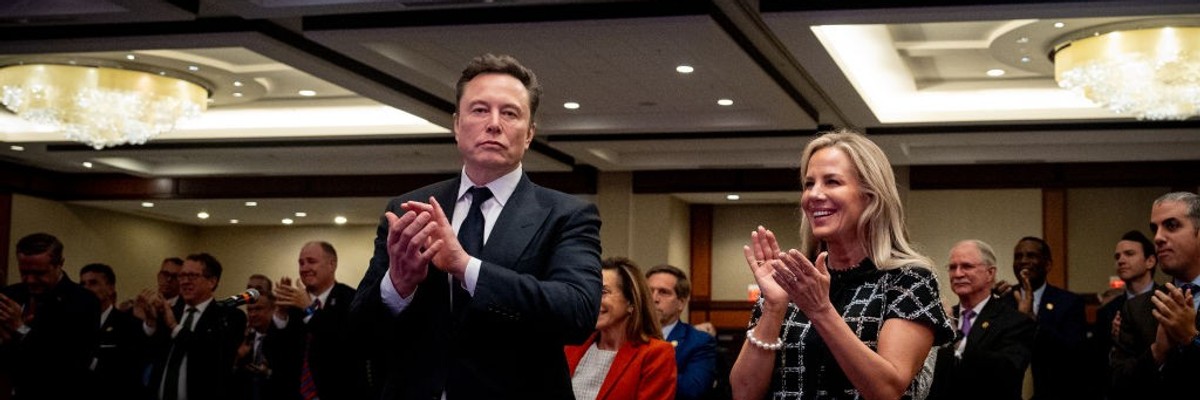
Elon Musk and the wife of House Speaker Mike Johnson (R-La.) applaud during a House Republican Conference meeting on November 13, 2024 in Washington, D.C. (Photo: Andrew Harnik/Getty Images)
“If there was ever a moment when progressives needed to communicate our vision to the people of our country, this is that time,” wrote Sen. Bernie Sanders. “Despair is not an option.”
A Bloomberg analysis of billionaire wealth published Tuesday found that the combined fortunes of the 500 richest people on the planet surpassed $10 trillion this year, a finding that came shortly after U.S. Sen. Bernie Sandersissued an urgent call to action to prevent the emergence of “an oligarchic and authoritarian society.”
The new analysis notes that the world’s top 500 billionaires “got vastly richer” this year with the help of “an indomitable rally in U.S. technology stocks.”
Just eight billionaires—Elon Musk, Mark Zuckerberg, Jensen Huang, Larry Ellison, Jeff Bezos, Michael Dell, Larry Page, and Sergey Brin—added more than $600 billion to their collective wealth in 2024 and accounted for 43% of the $1.5 trillion increase in net worth among the world’s 500 richest people, according to Bloomberg.
“But it was Musk—the so-called ‘first buddy’ of President-elect Donald Trump after unprecedented support for his reelection campaign—who dominated the world’s wealthiest in 2024,” Bloomberg observed, adding that Trump himself also saw his fortune surge to a record high this year, “boosted by the performance of his majority stake in Trump Media & Technology Group Corp.”
Musk’s use of his enormous fortune to influence the U.S. political system—including via his purchase of one of the world’s largest social media platforms and donations to Trump’s 2024 campaign—amplified existing concerns about the corrosive impact of massive wealth concentration on democracy.
“They do not believe in democracy—the right of ordinary people to control their own futures. They firmly believe that the rich and powerful should determine the future.”
In an email to supporters on Monday, Sanders (I-Vt.) called the rapid shift toward oligarchy in the U.S. “the defining issue of our time,” warning that billionaires have come to increasingly dominate not only “our economic life, but the information we consume and our politics as well.”
“A manifestation of the current moment is the rise of Elon Musk, and all that he stands for,” Sanders wrote, pointing to Musk’s outsize influence on the 2024 election and his key role in shaping Trump’s billionaire-dominated Cabinet.
“But it’s not just Musk. Billionaire owners of two major newspapers overrode their editorial boards’ decisions to endorse Kamala Harris, while many others are kissing Trump’s ring by making large donations to his inauguration committee slush fund,” the senator continued. “They do not believe in democracy—the right of ordinary people to control their own futures. They firmly believe that the rich and powerful should determine the future.”
Progressives, Sanders wrote, have a “radically different vision,” one that prioritizes “an economic system based on the principles of justice,” “a vibrant democracy based on one person, one vote,” and making “healthcare a human right.”
“Even though we are not going to succeed in achieving that vision in the immediate future with Trump as president and Republicans controlling Congress, it is important that vision be maintained and we continue to fight for it,” wrote Sanders.
Since Trump’s victory in the 2024 election, Sanders has focused heavily on the need to organize the working class to combat the threat posed by Musk and other far-right billionaires who have amassed obscene wealth and political power.
In his email on Monday, the senator said he intends to “travel, organize, hold events, and create content that reaches people where they are” in the coming weeks as part of the “struggle to determine where we go from here.”
“Will this effort be easy?” asked Sanders. “No, of course it will not. Can it be done? We have no choice. If there was ever a moment when progressives needed to communicate our vision to the people of our country, this is that time. Despair is not an option. We are fighting not only for ourselves. We are fighting for our kids and future generations, and for the well-being of the planet.”
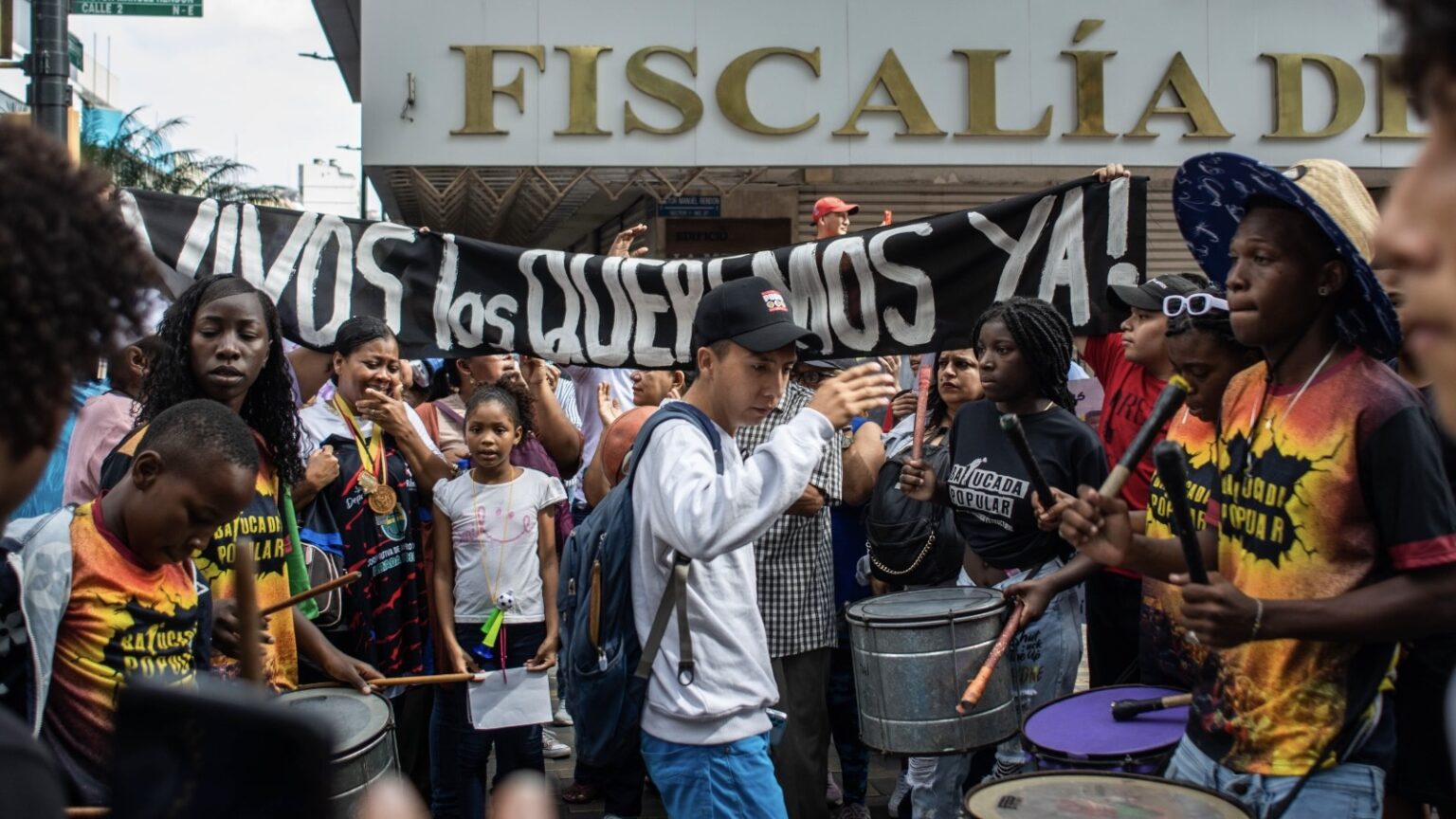
Rally outside prosecutors office in Guayaquil demanding the immediate return of the four disappeared children. Photo: CDH Guayaquil.
The case has revived an existing social trauma about the disappearance of children, especially poor and Black ones, at the hands of the State. There is a general feeling of pain and uncertainty among the population.
Four children in Guayaquil, Ecuador were disappeared after they were arrested by state forces on December 8. The news of their parents desperately searching for their underage children has dominated the news in Ecuador for the last several weeks even amid the festive season. On December 8, Ismael and Josué Arroyo (15 and 14 years old), Saúl Arboleda (15 years old), and Steven Medina (11 years old) were detained by a military contingent patrolling the area where the boys were playing football. The four young Afro-Ecuadorian boys have not been seen since then.
What is known about the disappearance of the children?
According to the relatives of the victims, the children went to play a football game in the neighborhood of Las Malvinas, south of Guayaquil. At some point after the game, soldiers came and arrested the four of them. A now widely circulated video,clearly shows how the military captured and beat the child detainees, and then took them away in a white van. While Ecuador also has a police force to carry out arrests and general internal public safety tasks, in the last Popular Consultation carried out in the country, people voted to grant the army special powers to carry out internal security controls. The military’s powers have vastly increased since President Daniel Noboa declared a state of emergency in the country in January 2024.
One of the children’s parents, Luis Arroyo, reported that shortly after their detention, he received a call from his son asking for help and to be rescued. That call was the last time he heard his son’s voice. A key witness, who reportedly lent his cell phone to the boy to call his father, reported that the child had been beaten by the military and was naked.
After several days without answers, it was reported that four charred corpses were found in Taura, near a military base. The parents have already been summoned to the city morgue to confirm if they are their children. However, the state of decomposition and calcination of the bodies is so advanced that it is not possible to know with the naked eye if the remains correspond to the four missing children. Currently, forensic analyses are being carried out to determine the correspondence between the missing children and the remains that were found. Several experts have stated that, if such correspondence is confirmed, the crime could be defined as an “extrajudicial execution”.
Metropolitan Police officers form a cordon at Parliament Square to prevent protesters reaching Westminster Bridge during a Free Palestine Coalition demonstration in central London, January 6, 2024
A NEW film is warning that “police state tactics” are being used to silence pro-Palestine activists.
Producer Norman Thomas said that the film, Censoring Palestine, shows examples of counter terrorism laws being “stretched and perverted” to try to crush protest in Britain.
He said: “We are seeing dawn raids on journalists, academics being arrested for making speeches, protesters being jailed without bail for long periods — and all using false accusations of terrorism.
“This is all too reminiscent of a police state — and unless someone calls a halt, may lead to one.”
The film features interviews with victims of the use of counter-terrorism laws and their lawyers and legal advisers.
Mr Thomas said: “What we are hearing from them all is that laws supposedly meant to protect people from terror attacks are in fact being stretched and perverted in unprecedented ways to crush protest and free speech.”
He said that mainstream media had imposed a blackout on reporting the use of anti-terrorism laws against protesters.
later: Just remembered that this one is appropriate, one of my favourites ;) XXX
Keir Starmer confirms that his government is cnutier than Suella Braverman on killing the right to protest.Genocide denier and Current UK Prime Minister Keir Starmer is quoted that he supports Zionism without qualification. He also confirms that UK air force support has been essential in Israel’s mass-murdering genocide. Includes URLs https://www.declassifieduk.org/keir-starmers-100-spy-flights-over-gaza-in-support-of-israel/ and https://youtu.be/O74hZCKKdpAUK Foreign Minister David Lammy confirms that UK government and military are active participants in Israel’s genocides and that the F-35 parts that they suspended from supplying to Israel are instead simply diverted via the United States. He says see https://youtu.be/QILgUHrdWRE
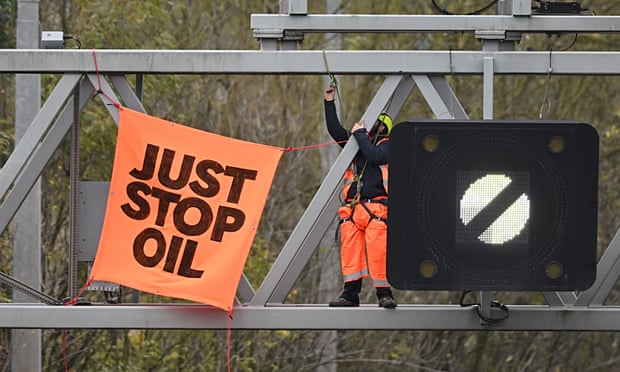
A Just Stop Oil protester on the M25 in 2022. Photograph: Leon Neal/Getty Images
Forty people, aged 22 to 58, incarcerated for direct actions on climate and Gaza actions amid crackdown on dissent
A record number of people who have taken part in protests will be in prison in the UK this Christmas, raising concern about the ongoing crackdown on dissent.
Forty people, aged from 22 to 58, will be behind bars on Christmas Day for planning or taking part in a variety of protests relating to the climate crisis or the war in Gaza. Several of them are facing years in prison after courts handed down the most severe sentences on record for direct action protests.
Jodie Beck, a policy and campaigns officer at the civil rights group Liberty, said the number of protesters in prison and the severity of their sentences was “a damning reflection of the state of democracy” in the country.
“We should all be able to stand up for what we believe in without fear of lengthy prison sentences. Continuing to prosecute people for exercising their right to protest will only serve to exacerbate the crisis in our criminal justice system alongside stopping people from making their voices heard,” Beck said.
Nineteen people are in prison – 10 of them on remand – after taking part in climate protests with the campaign group Just Stop Oil. They range from five people who received multi-year sentences after being found guilty of conspiring to cause gridlock on the M25, to two young people jailed for more than 18 months for throwing tomato soup over Van Gogh’s Sunflowers painting in the National Gallery in London.
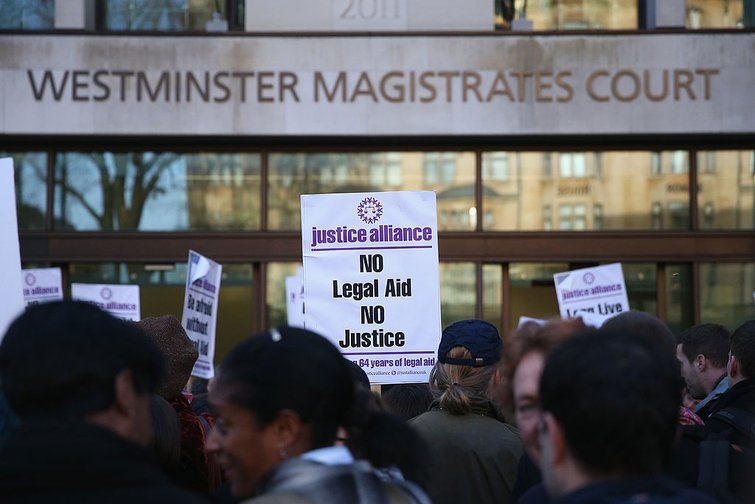
Having an under-funded legal aid system can ruin lives | Oli Scarff/Getty Images
Extra £20m of spending should be celebrated, but it pales in comparison to funding for hostile environment policies
Navigating the UK’s Kafkaesque immigration system is incredibly challenging. One ‘wrong’ turn – a delay in an application, an incorrect form – can quite literally risk a person’s life.
This is deliberate; the system is designed to be hostile. If you’re someone with an immigration or asylum problem, you’ll probably need a lawyer for specialist advice. But what happens if you can’t afford one?
In theory, everyone claiming asylum in this country has the right to access legal aid if they can’t afford it themselves – which is the case for most people seeking asylum, who are not allowed to work. In practice, though, decades of chronic underfunding have left the system in crisis and many people without the necessary legal support. This year only 43% of people claiming asylum had access to a legal aid lawyer, down from an estimated 73% in 2020.
Last month, after years of concerted organising by communities and legal workers, we received a glimmer of hope. Justice secretary Shabana Mahmood announced an extra £20m of funding for the civil legal aid system – the first increase since 1996.
We’ve seen almost 30 years of stagnating salaries for legal workers, legal aid providers shutting down, and more people being forced to face injustices without support. Now, we need to see much bolder action from the new Labour government if we are to get out of the downward spiral that legal aid is in.
How did we get here?
The UK’s legal aid system was created in 1949, on the post-war principle that wherever you are, whatever problems you face and however much money you have, you should be able to have legal advice and representation if you need it.
But while it has never actually been that easy for migrants to access legal aid, the last few years have made it particularly punishing.
In the 2010s, as successive governments’ austerity regimes violently stripped away safety nets for working-class people – migrants and UK citizens alike – legal aid was cut drastically. The appropriately named ‘hostile environment’ policies also meant people whose immigration claims fell through faced losing access to healthcare, housing and jobs.
Legal aid workers, meanwhile, have not just had their salaries slashed, but their public value degraded. Immigration lawyers in particular have been demonised, denigrated by ministers and in the press as ‘lefty lawyers’ – leading to them becoming targets of violent hate crimes.
We are now seeing the predictable and painful impacts of this on the people whom we at Migrants Organise, a charity supporting refugees and migrants, work with every day.
A person seeking asylum who doesn’t have access to legal advice is far less likely to be able to put together the evidence and testimony needed to ‘meet’ the Home Office’s stringent burden of proof.
If their case is refused, they’ll face an even more byzantine appeal system and be expected to represent themselves in front of a judge – still without getting any advice on the regulations that they’re expected to meet. But several large immigration firms have also stopped taking on asylum appeal cases because they don’t get paid enough to do so, forcing many people to tackle gruelling and complex immigration procedures without ever speaking to an adviser.
Then if a person is refused again by the court, because they had a poorly prepared application and no one to advise them, they could be detained and deported to a country where their life is in danger.
Mohammed*, an aspiring barrister and a young migrant advocate at the We Belong charity, has experienced this first-hand. “I waited over five years for a decision on my asylum claim, and then my case got refused and my legal representative dropped me because they’d stopped taking appeals,” he explained. “This was a month into my Masters. It took me almost a year to find another legal aid lawyer, and it was only through the support of community organisations who knew good lawyers and could refer me.
“For people who don’t speak English or have the confidence to seek out support, it’s impossible. Now, after having thought I wouldn’t make it to study anything, I’m able to study law and go into the work that I know will help to fix the problems I myself experienced.”
Pushing back
Having an unsupported legal aid system ruins lives – but it does not need to be this way. Experts, lawyers and the communities who need them have increasingly been speaking out and coming together to document and challenge the impacts of not having access to legal aid.
Organisations and legal aid providers from across the country have been working to have their voices heard. Many contributed to a review of civil legal aid that Sunak’s government launched last year to better understand how well the current system works (or, more to the point, doesn’t). And this year, Young Legal Aid Lawyers and Migrants Organise have run a joint campaign to help those most impacted by the legal aid crisis to educate their MPs on it and demand change.
Researchers such as Jo Wilding, the author of The Legal Aid Market, have also shed light on the extent of the crisis and drawn attention to the expanding ‘legal aid deserts’ where no legal aid is available at all. And legal cases have been brought against the government. Most recently, in June this year, Duncan Lewis Solicitors challenged the government’s violation of its duty to ensure legal aid is available as a result of not increasing fees. The case was settled in September on the basis that the new lord chancellor would decide whether to increase rates in November.
This organised pressure has been impossible for the government to ignore. Finally, the new Labour government has taken heed of the decades of evidence shared, and taken a first step towards positive change by committing new funding.
The additional £20m announced last month, which will be spent over the next four years, is intended to “mark the next step in government plans to rebuild the legal aid sector”. The money will be used to increase legal aid fees for those working in the housing and immigration sectors, with the government saying it is aiming for a 10% uplift in hourly rates, to £65 outside London and £69 in the capital.
Though the final figures have yet to be announced, we at Migrants Organise calculate that the proposed payment fees could increase immigration legal aid work by just over 30%. This, we hope, will open up some capacity amongst legal aid providers to take on cases of people who have been waiting without support.
But in the grand scheme of things, this remains a small injection of cash into two severely neglected areas of legal aid, which will struggle to make any significant indent.
A small uplift in fees isn’t enough to make working in legal aid any more attractive, meaning it won’t address the current crisis in the recruitment and retention of legal aid workers. There is also no sign of a commitment to regularly review funding for legal aid, in order to avoid us ending up in the same position we are now after four more years of inflation.
As successive governments have built a profitable industry out of cruelty, money has been syphoned off to private companies at the expense of public services – housing, transport, legal advice – needed to create better futures for our communities. The hostile environment for migrants remains very much alive, with Labour promising more money for immigration detention centres, increased deportations, and terrorism charges brought against those forced to cross the Channel by boat. Many people still face barriers to accessing justice even with the latest announcement – whether due to language issues, misinformation, or delays.
“Yes, we’re fighting to have more legal aid lawyers. But when will the next increase happen?” asked Mohammed. “We need lawyers now that care, especially when the immigration system is so damaging. Quality work, care and compassion should be the core of legal aid. It’s not just about funding, it’s about the ideology and principle.”
So, whilst we’re celebrating the work that went into this change, we’re under no illusion that for people caught up in the hostile environment – or indeed anyone in the UK in need of a lawyer – life is going to get much easier.
In the short term, we need a legal aid system that is better resourced than the government’s current proposal, for funding to be sustained and raised with inflation (like in many other publicly funded services), and for it to be available to all groups of people who need it.
And ultimately, it is only an end to the hostile environment that will prevent people from being forced into precarious situations in the first place and bring about the dignity and justice that we all deserve.
With renewed hope for change, we need to continue organising with all those impacted by the crisis in legal aid to speak out and call for what’s needed.