I sought safety in the UK. I was sent to prison instead

Spread the love

Original article by Samyar Bani and Melissa Pawson republished from Open Democracy under a Creative Commons Attribution-NonCommercial 4.0 International licence.
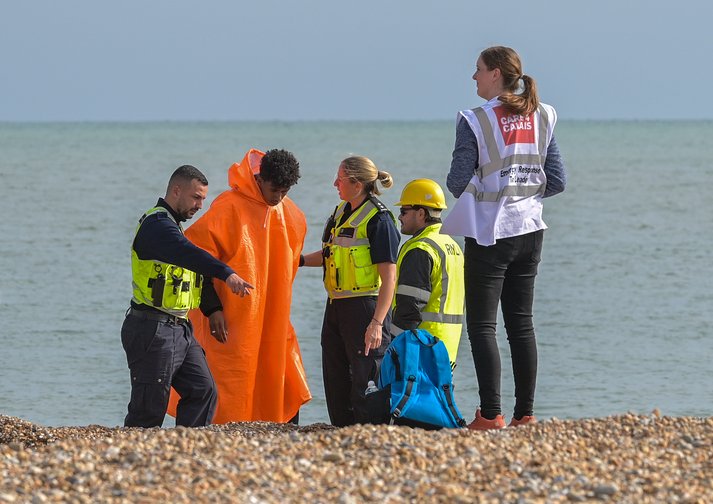
Border force and police officers take people to shore after they arrived in Kent in October 2022
 | Stuart Brock/Anadolu Agency/Getty Images. All rights reserved

I was labelled a ‘smuggler’ and spent over two years in prison for touching the tiller on a dinghy. That’s not justice

Samyar Bani, 42, is an Iranian refugee who travelled to the UK in a dinghy on 1 June 2019. He was arrested on arrival and convicted of assisting unlawful entry into the UK in November 2019. His initial sentence of six years was later reduced to five. An appeal hearing in December 2021 then acquitted him of all charges. The appeals judge determined that the law had been interpreted incorrectly, as Bani and co-passengers had intentionally been picked up by police before disembarking on UK shores. This interview has been edited for clarity and length, and the final transcript was reviewed by Samyar before publication. It is part of the series How migration became a criminal offence.

Melissa Pawson (BTS): Can you tell us why you left Iran?

Samyar Bani: I had a problem with the government there. So I came to England to ask for help as an asylum seeker.

Melissa: What was the journey from Iran like?

Samyar: I left my home country on 1 January 2017. First, I went to Turkey and stayed there for six months. Then I went to Greece. There are so many refugees in Greece. I tried to claim asylum there, but they didn’t accept my claim.

I like Greece. They have good weather, and Athens reminds me of my city, Shiraz. But I wasn’t allowed to stay. So I went to Germany. I was there for four months, but I couldn’t stay there either. They made a mistake in my asylum claim and rejected me as well.

I liked living in Germany, because I have a sister there. But Germany doesn’t like me. So I came to England.

Melissa: Did you travel through Calais?

Samyar: Yes, I lived in the Jungle there for around two months. There were too many people in the Jungle, and everyone was planning to go to England to claim asylum.

Editor’s note: the Jungle was the nickname of a large informal encampment on the outskirts of Calais, France. It was demolished in 2016 but undocumented people continued to live in the area.

When I was going to France from Germany on the train, I was searching on Google and Telegram and Facebook, and I found lots of information telling me that England supports people like me. I read that England understands that Iran isn’t a democracy. Because of that, I thought UK would support me.

So me and four other Iranians bought a boat together to come here.

Melissa: Why did you decide to buy the boat by yourselves?

Samyar: Because smugglers are so expensive. I think they charge around £2,500 per person. I don’t have that kind of money. Instead, each of us put in £500 for the boat to come here. We were six in the boat, including a child around 10 years old.

Melissa: So you crossed the English Channel and were picked up by the UK Border Force boat. Did they arrest you straight away?

Samyar: The police arrested everyone and sent us to the immigration detention centre. We stayed there the first night, and they transferred me to a hotel in London the next day.

They arrested me at the hotel after I’d been there for just one night. It was 6 or 7pm. Six people came to the hotel. One of them had a gun – it was a big one like a machine gun. There was no interpreter. They put my hands behind my back and arrested me. Then they transferred me to Kent police station.

I touched the tiller for maybe four or five seconds, that’s it

Melissa: You must have been very confused and scared.

Samyar: I was really confused. I was lying awake in the cell thinking maybe I’m not in England. Maybe I came to a different country. Every night after that I was talking to myself, asking, why does England think I’m a smuggler, why did England arrest me? This is wrong. This isn’t Iran, it’s not a dictatorship.

I kept thinking maybe the police would come to apologise. They would tell me, Mr. Bani, we were wrong. Sorry, you’re free now. Later, this just became a wish.

I was scared and stressed. It was a very dark time for me. I was alone, with no family or friends. I didn’t speak English.

Melissa: Did an interpreter and a lawyer explain what was happening at any point?

Samyar: After I’d been in the police station for two days, an interpreter came to speak to me. But he was from Afghanistan and spoke Pashto – I speak Farsi, which is a completely different language. Then a solicitor came. Then I got a different solicitor. I wasn’t allowed to choose either of them, they were just assigned to me. The second solicitor didn’t have time for me, he was really busy. He just came once and spoke to me for a short time. My case was very serious, but he barely gave me any time.

Melissa: Did they tell you what you had been accused of?

Samyar: They said I’m a smuggler. But I’m not a smuggler, I’m not trafficking people. They said they had video evidence showing me driving the boat, but the video was very short. When I took the tiller I was just following the orders of the police who were directing our boat. Before they took the video, there were different people driving boat.

We had bought the boat together. I wasn’t in command of this trip. I’m not a boat driver – I don’t even know how to swim, and I’d never seen a boat before the day we bought one. But I sat in the wrong place in the dinghy, near the engine, and ended up touching the tiller for maybe four or five seconds. That’s it. But that was enough.

The police know that real smugglers don’t come to England, but every boat has to be steered somehow. The people on board do that. So why not put everyone in jail? Why just me?

Melissa: Did you see the police recording you while you were in the boat?

Samyar: Yes, we saw them. And when the police took us onto their boat, everybody was scared. But I told them, “the police won’t kill you.” They want to help refugees.

Melissa: Were you able to speak to your family while you were being held?

Samyar: No, because I didn’t have their phone number. I had saved their number on my phone, like anyone else would, but the police took it from me when I went into custody.

I couldn’t speak to my wife for three years. She thought I’d died.

I wrote dozens of applications to ask my caseworker, my solicitor, anyone, to please get me back my mobile. Just so I can write the number down and then they could take back it again.

Melissa: That must’ve been incredibly difficult for you and your family. How did you find her number again?

Samyar: My sentence finished in December 2021, but they didn’t give me my phone back right away. I was living on the streets, with nowhere to go, when I found out about a charity called Care4Calais. They helped me to contact a solicitor and I was transferred to a hotel.

That solicitor wrote to the court so many times. It took maybe five months for the police to give my phone back. Maybe the police just really liked my mobile, I don’t know.

It hadn’t been used in more than two years and wouldn’t turn on at first. But I finally got the phone numbers from it and I called my wife.

Melissa: What was that phone call like?

Samyar: She was very confused. She asked me why I hadn’t spoken to her in three whole years. It was very, very hard.

I was so scared I’d be recognised. All the newspapers said I’m a smuggler. My picture was in the BBC

Melissa: How is your wife now, is she okay?

Samyar: She’s doing better now. She was struggling with depression before because I had disappeared.

Melissa: And how did the sentencing affect you?

Samyar: I changed my hair and my beard because I was so scared I’d be recognised. All the newspapers said I’m a smuggler, and my picture was in the BBC.

That wasn’t all undone when the appeal went through. I didn’t see any big headlines saying, ‘Bani is not guilty, he’s not a smuggler’. So I didn’t feel safe, even though I was free again.

It’s not been easy. I’m doing better now at least – better than prison.

Melissa: Can you tell us what your time in prison was like?

Samyar: I was in prison for just over two years after the sentencing. Including my time in remand, I was in prison for two and a half years.

Prison is bad for everybody. But for people who are not guilty, it’s so much worse. All the time, you’re thinking, why am I here?

I was in there with people who had been jailed for life. Some of them had murdered people, committed rape, attacked people, robbed, laundered money, run drugs operations. I remember asking someone what they’d done and they said, “I just killed one person”.

It was terrible.

Melissa: This sounds like a really scary experience. Can you tell us about the appeal?

Samyar: I went to the Royal Courts of Justice in London, and three judges reviewed my case. Three or four days later, they all agreed that a big mistake had been made because I hadn’t broken the law. They said I hadn’t come here illegally because we were transferred to the port by the police.

So then I was free. But I had to wear an electronic tag on my leg for six months. The Home Office said this is an immigration tag, but if that’s the case then I don’t understand why they don’t make everyone wear one. Surely the law is for everybody?

And when I got to the hotel two weeks later, there were lots of other asylum seekers there. But I was the only one with an electronic tag.

In Iran, if you change your religion the government will put you in prison and you could get the death penalty. That’s if people don’t kill you first

Melissa: You said you were first homeless after you were released – where were you sleeping?

Samyar: I slept on the streets for two weeks. It was rainy and people were everywhere getting ready for Christmas. It was a very hard time.

I went to a church and I told them I’m homeless. I showed them my immigration papers, but they said they couldn’t help because I didn’t have refugee status or a visa. And I wasn’t allowed to rent a house – I could only get support from the Home Office.

Melissa: What happened after that?

Samyar: My solicitor wrote lots of letters to the Home Office, and finally they helped me to get accommodation in a hotel.

But it wasn’t a hotel for asylum seekers, it was a quarantine hotel. So many people had Covid 19, and I caught it too. I had a very high temperature, I felt like I was dying. I was there for maybe two months, and then I was transferred to a hotel in Newcastle. After that they sent me to a shared house in Stockton-on-Tees.

Six months after I was released from prison, the Home Office sent me a letter telling me I have leave to remain for five years. That was in June 2022. I had good evidence and lots of paperwork, because I changed my religion in Iran.

I don’t believe in Islam, so I converted to Christianity. But in Iran, if you change your religion the government will put you in prison and you could get the death penalty. That’s if people don’t kill you first. Some people think that if they kill a convert, they’ll be rewarded by Allah.

This is fake. My religion is for me, and your religion is for you.

Melissa: Was this one of the reasons why you had to leave Iran?

Samyar: Yes, because I was scared that the government would arrest me and kill me. Then I came to England, and it was the same thing I was afraid of in Iran. I wasn’t guilty, but I was in prison anyway.

Melissa: And what’s your situation like now in Birmingham?

Samyar: I had to leave the Home Office accommodation two months after I got my visa, but I had no way of renting a place without help. I needed council support because I don’t have a guarantor.

I went to a charity called Open Door and they supported me to rent a shared room. I was 40 years old at the time – it’s hard to be sharing.

Then later an Iranian person helped me to rent a room in a house in Birmingham.

I haven’t started work yet because of my mental health and the arthritis in my back. I often get flashbacks from my time in prison – maybe one day is good, then the next day is bad. The Job Centre supports me but it’s not very much. I get around £300 in benefits for food and everything, and some of that has to go towards rent.

I’d like to get back into work, and I have lots of skills. I’m a tradesman – I design and fit kitchens. In Iran I had a house fitting company, and we did tiling, plumbing, plastering.

The Job Centre said I should do a very basic job like cleaning, but I can do more than that. I tried to take the certificates for plumbing and carpentry. I tried three times. But they refused me because my English isn’t good enough.

I’m working on that. I’m doing an English course, but my brain is so busy worrying about my family. Maybe after my family comes and we live together, I’ll feel well enough to focus on my courses, and I can get the certificate to do a carpentry job.

Melissa: Are you applying for your wife and daughter to join you in the UK?

Samyar: I already did, but it was refused. It’s because I had an Islamic marriage. I don’t believe in Islam, and I didn’t want an Islamic marriage. But if I’d had a different marriage in Iran, the government would’ve arrested me. My mother and father are Muslim, so I had no choice.

This has created a big problem for me. The Home Office said I didn’t have the right evidence, but I do. I have the marriage contract, and I have pictures and evidence showing that me and my wife lived together for a long time.

I’m appealing, but my solicitor said there’s a waiting list. It could be two years, it could be ten years. I don’t know. I just have to wait.

Melissa: It must be very hard, having been apart from them for so long.

Samyar: I have no choice. I can just talk to my wife on the phone. We can’t live together. The courts and immigration offices in this country, they don’t care about love. All they’re interested in is evidence.

Police understand who a smuggler is, and they don’t sit in the boat. They just do this so they can close the border to refugees

Melissa: We spoke before about how the courts decided you were a smuggler. What does the word ‘smuggler’ mean to you?

Samyar: A smuggler lives in France or a different country. You’ll never see a smuggler. They’re very clever, they won’t sit in the boat because it’s dangerous. A smuggler is someone who just likes money. They just take money.

Police understand who a smuggler is, and they don’t sit in the boat. They just pretend it’s different so they can close the border to refugees. It’s the same as the plan for Rwanda.

It’s not good for human rights. A better plan would be a visa for refugees, so we don’t have to make this journey in the first place.

Melissa: How would life have been different if this kind of visa had been available to you?

Samyar: I didn’t want to sit in the dinghy to come to UK. But I didn’t have a choice. Humans need life. My country wasn’t safe for me, so I came to the UK. That’s why I left my father, my mother, my wife and my daughter. I didn’t come here for money. I just came here to get help because Iran isn’t safe for me.

I had a good job in Iran – I liked my work, I liked my city. Shiraz is very beautiful, and it has good weather. All my family live there too – I have a big family. Now I’m alone here.

I like human rights, and I thought I might have mine respected here. But this is just a wish now. No country has real human rights.


Explore the rest of the series

This series looks at how the UK, EU and bordering countries are increasingly treating migration as a criminal offence, and targeting migrants and solidarity actors in the name of ‘anti-smuggling’ and ‘border control’.

Original article by Samyar Bani and Melissa Pawson republished from Open Democracy under a Creative Commons Attribution-NonCommercial 4.0 International licence.

Continue ReadingI sought safety in the UK. I was sent to prison instead

House GOP Revives Bill to Let Authoritarian Trump Crush Nonprofits

Spread the love

Original article by Jake Johnson republished from Common Dreams under Creative Commons (CC BY-NC-ND 3.0). 

U.S. House Speaker Mike Johnson shakes hands with President-elect Donald Trump at a House Republican conference meeting on November 13, 2024 in Washington, D.C. (Photo: Andrew Harnik/Getty Images)

“We urge the House of Representatives to reject this dangerous bill and to protect our freedom of speech and our right to dissent,” said the president of Oxfam America.

House Republicans have revived and are looking to push through legislation this week that would hand President-elect Donald Trump’s incoming administration sweeping power to investigate and shut down nonprofit organizations, including news outlets and humanitarian groups.

The bill, H.R. 9495, failed to pass the House last week despite bipartisan support because the Republican leadership attempted to pass the measure using a fast-track procedure that requires a two-thirds majority vote. More than 50 Democrats, including Rep. Adam Schiff (D-Calif.) and other prominent members, backed the legislation in last week’s vote, along with 204 Republicans.

This time, the GOP is attempting to advance the bill through regular order, meaning it can pass with a simple majority. The Republican-controlled House Rules Committee is scheduled to hold a markup hearing for H.R. 9495 on Monday.

After learning of the hearing, advocacy organizations that mobilized against the bill redoubled their warnings about its dire implications for free expression and the right to dissent—particularly in the hands of a would-be authoritarian who has vowed to prosecute his political enemies.

“The bill we defeated days ago is back,” the U.S. Campaign for Palestinian Rights wrote on social media over the weekend. “Representatives are trying to ram through H.R. 9495, a repressive bill that could shut down nonprofits & student groups supporting Palestinian rights.”

https://twitter.com/USCPR_/status/1857869312976904687?ref_src=twsrc%5Etfw%7Ctwcamp%5Etweetembed%7Ctwterm%5E1857869312976904687%7Ctwgr%5Ecd48ab1ceea114a2c459ad147cfe399132e0107e%7Ctwcon%5Es1_c10&ref_url=https%3A%2F%2Fwww.commondreams.org%2Fnews%2Ftrump-nonprofits

Sorry, this content could not be embedded.
X

The legislation, if passed, would give the Treasury Department the authority to unilaterally strip nonprofits of their tax-exempt status by designating them supporters of terrorism. As of this writing, Trump has not announced his pick to lead the Treasury Department.

While the bill provides a brief period for an accused nonprofit to defend itself, the ACLU said the provision “is a mere illusion of due process,” noting that the federal government would be able to “deny organizations its reasons and evidence against them, leaving the nonprofit unable to rebut allegations.”

Abby Maxman, president and CEO of Oxfam America, warned in a statement after Republicans revived the bill that H.R. 9495 “would grant the Trump administration, and any future administration, the ability to silence and censor its critics, curb free speech, target political opponents, and punish crucial organizations that speak truth to power and help people in the United States and around the world.”

“This bill would increase the powers of the president at the expense of all of our freedoms, and could impact not only organizations like Oxfam, but other nonprofits, news outlets, or even universities who dare to dissent,” said Maxman. “It could put our ability to respond to some of the worst humanitarian crises at risk and prevent us from delivering lifesaving aid to some of the world’s most marginalized people.”

“This bill follows the same playbook Oxfam has seen other governments around the world use to crush dissent. Now we are seeing it here at home,” Maxman added. “We urge the House of Representatives to reject this dangerous bill and to protect our freedom of speech and our right to dissent.”

It’s not clear whether the U.S. Senate, narrowly controlled by Democrats, would bring H.R. 9495 to the floor for a vote if it passes the House this week, or whether President Joe Biden would sign it into law. But Republicans will gain full control of Congress and the White House starting in January, giving them the ability to push the legislation through at a later date.

“Their rush to reconsider this bill is solely to offer Trump more and more power, while Trump’s nominees for key national security posts this week indicate how he will be using it,” Rep. Lloyd Doggett (D-Texas), a leading opponent of the measure, toldThe Intercept on Friday.

Original article by Jake Johnson republished from Common Dreams under Creative Commons (CC BY-NC-ND 3.0). 

Continue ReadingHouse GOP Revives Bill to Let Authoritarian Trump Crush Nonprofits

Thoughts of the Day :: Apply international law, hold war criminals to account

Spread the love

I urge political parties and trade unions to adopt policies to enact and apply international law, to hold war criminals to account. It is well worth doing even if it takes a decade or more to get to that position.

2.05pm Possibly better to phrase it as uphold and enforce international law.

Current UK Prime Minister Keir Starmer is quoted that he supports Zionism without qualification. He also confirms that his active support and that of UK's air force has been essential in Israel's mass-murdering genocide. Includes URLs https://www.declassifieduk.org/keir-starmers-100-spy-flights-over-gaza-in-support-of-israel/ and https://youtu.be/O74hZCKKdpA
Current UK Prime Minister Keir Starmer is quoted that he supports Zionism without qualification. He also confirms that his active support and that of UK’s air force has been essential in Israel’s mass-murdering genocide. Includes URLs https://www.declassifieduk.org/keir-starmers-100-spy-flights-over-gaza-in-support-of-israel/ and https://youtu.be/O74hZCKKdpA
UK Foreign Secretary David Lammy says that UK is suspending 30 of 350 arms licences to Israel. He also confirms the UK government's support for Israel's Gaza genocide and the UK government and military's active participation in genocide.
UK Foreign Secretary David Lammy says that UK is suspending 30 of 350 arms licences to Israel. He also confirms the UK government’s support for Israel’s Gaza genocide and the UK government and military’s active participation in genocide.
Continue ReadingThoughts of the Day :: Apply international law, hold war criminals to account

Shadow Foreign Secretary Priti Patel Has Ties to Group Behind ‘Extreme’ Trump Agenda

Spread the love

Original article by Sam Bright and Adam Barnett republished from DeSmog.

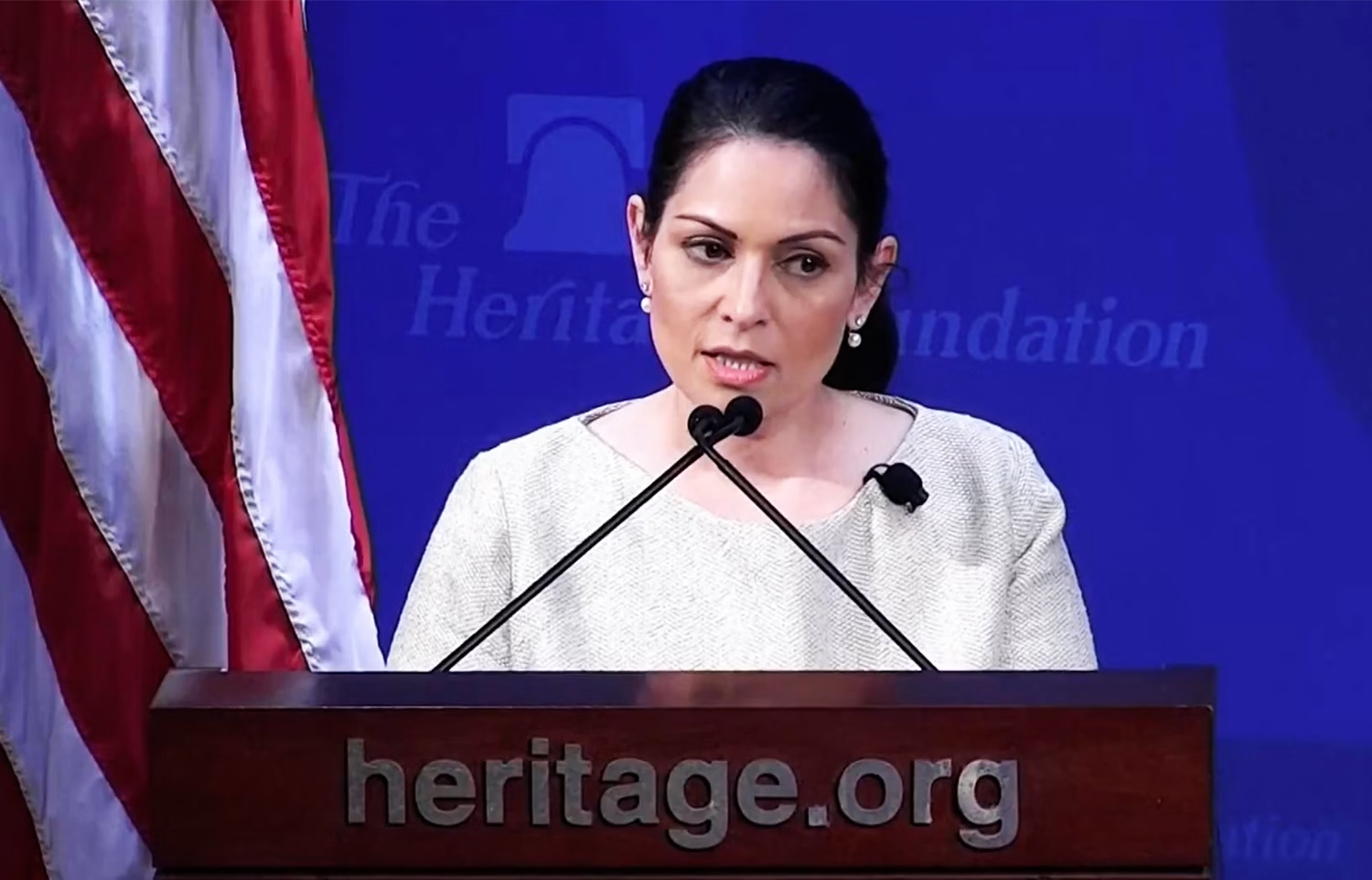
Conservative MP Priti Patel speaking at the Heritage Foundation in 2021. Credit: GB News / Facebook

The Heritage Foundation’s Project 2025 blueprint proposes sweeping anti-climate policies.

New Shadow Foreign Secretary Priti Patel earlier this year welcomed into Parliament a radical U.S. organisation behind Donald Trump’s hard-right plan for a second term as president. 

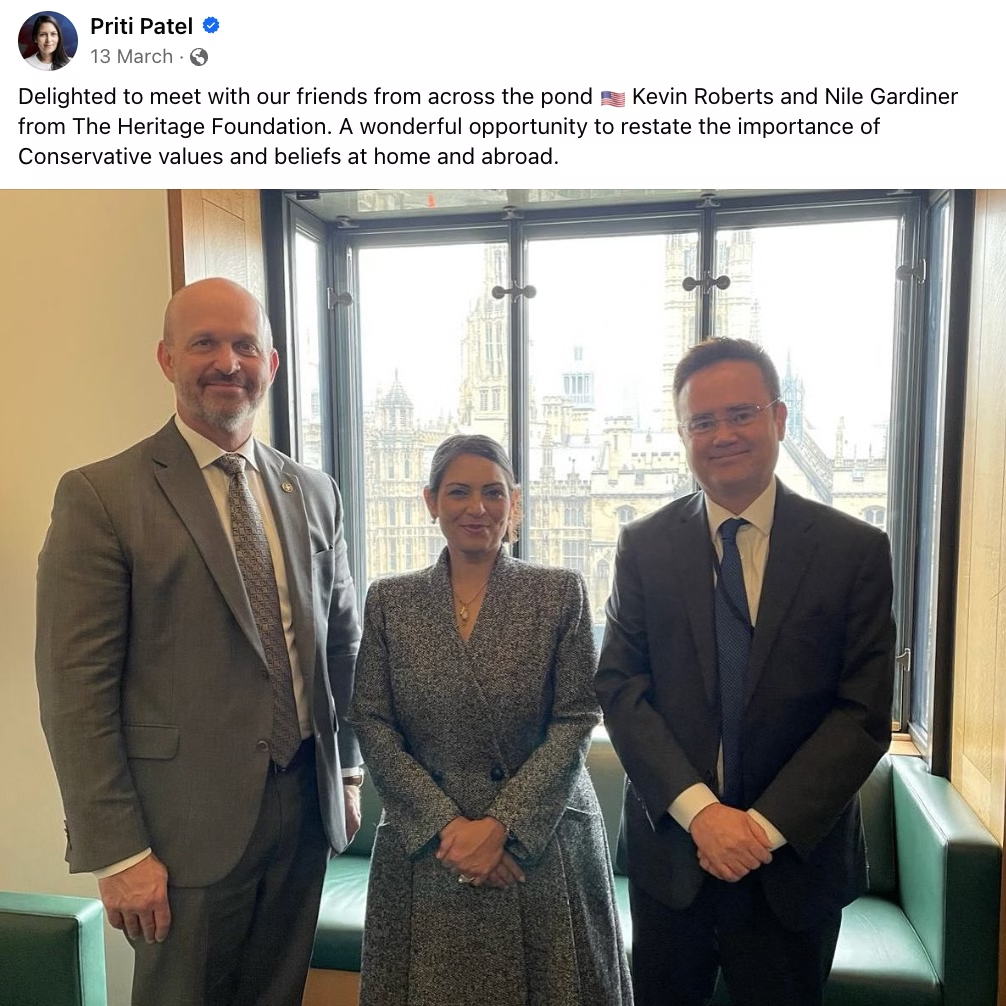
As reported by DeSmog, Conservative MP Patel met with Kevin Roberts and Nile Gardiner of the Heritage Foundation in March, praising the pair on her Facebook page as “our friends across the pond” who stand for “Conservative values and beliefs at home and abroad”. 

Roberts is the president of the Heritage Foundation, while Gardiner is the director of its ‘Margaret Thatcher Center for Freedom’. 

The Heritage Foundation is an ultra-conservative group that authored the controversial Project 2025 blueprint for a second Donald Trump term, which proposes a range of radical anti-climate policies, including slashing restrictions on fossil fuel extraction, scrapping investment in renewable energy, and gutting the Environmental Protection Agency. 

Project 2025 has been accused of being “extreme” and “authoritarian” for setting out a plan to rapidly “reform” the U.S. government by shuttering bureaus and offices, overturning regulations, and replacing thousands of public sector employees with hand-picked political allies of Trump. The agenda also proposes radical tax cuts, and a crackdown on reproductive rights. 

On Wednesday (6 November), following Trump’s victory in the U.S. presidential election, Roberts sent an email on behalf of the foundation, saying that: “starting now, we will execute our plans to dismantle the administrative state.” 

At least 140 authors of Project 2025 worked for the last Trump administration, according to CNN, while several are expected to hold positions in the next Trump White House.

Patel also gave a speech about national security to the Heritage Foundation, hosted by Gardiner, in November 2021. Patel was at the time serving as home secretary, and her address was published on the UK government website. 

This news comes as the Conservative Party realigns itself after the election of new leader Kemi Badenoch, positioning itself as having better relations with the incoming Trump administration. 

In her first Prime Minister’s Questions (PMQs) this week, Badenoch called on Labour not to oppose a Trump address to Parliament, and asked whether Foreign Secretary David Lammy had apologised to the Republican for labelling him as a “neo-Nazi sympathising sociopath” in 2020.

Patel was appointed to Badenoch’s new shadow cabinet earlier this week, alongside Shadow Justice Secretary Robert Jenrick, who also has ties to the Heritage Foundation. 

In February, Jenrick – who came second in the recent Tory leadership election – gave a speech to the Heritage Foundation in Washington DC entitled, “Securing Sovereign Borders in an Age of Mass Migration”.

Project 2025 proposes new sweeping restrictions on immigration into the U.S., while setting the foundations for mass deportations – a key promise of Trump’s 2024 campaign. 

After being introduced by Roberts, Jenrick praised the foundation, and described meeting with and learning from Heritage while working as an intern for Condoleeza Rice, who served as secretary of state under Republican President George W. Bush. 

Jenrick also praised the event’s co-host Gardiner, whom Jenrick described as “the special relationship made flesh”. He said Gardiner, who writes a regular column for the Daily Telegraph, “creates links between conservatives here and in the UK”. 

As revealed by Democracy For Sale and Byline Times, Donald Trump and U.S. Republican campaigns received more than $45 million (£35 million) from donors who have funded the influential network of hard-wing Tufton Street think tanks in the UK. 

“That senior Conservatives would take time out to travel halfway around the world to give talks at a pro-Trump think tanks is very revealing,” said Peter Geoghegan, editor of Democracy For Sale. “We need to be aware that the dark money that fuelled the likes of the Heritage Foundation is washing up in Britain, where secretive Tufton Street think tanks refuse to declare their donors but take millions from pro-Trump U.S. conservatives.”

A Heritage Foundation spokesperson previously told DeSmog: “Project 2025 is a coalition of conservatives who wrote ‘Mandate for Leadership: The Conservative Promise’ which was published in April 2023, before any candidate declared a run for office. Project 2025 does not speak for any candidate or campaign.”

Project 2025 and Climate Denial

Project 2025 proposes replacing green investment with the further deregulation of the oil and gas industry. 

Speaking at an event co-hosted by the Heritage Foundation and the Hungarian Danube Institute in September, key Trump ally Robert Wilkie – who served as U.S. veterans’ affairs secretary from 2018 to 2021 – confirmed that his former boss would “kill” climate budgets. 

The Heritage Foundation received over £4.9 million between 1997 and 2017 from groups linked to the fossil fuel giant Koch Industries. The brothers behind the company, Charles and the late David Koch, have been the principal funders of climate denial groups in the U.S. since the 1980s. 

As revealed by DeSmog, advisory groups working on Project 2025 have received at least $9.6 million from Charles Koch since 2020, along with at least $21.5 million from the Sarah Scaife Foundation, which is funded by the Mellon oil and banking fortune.

The Heritage Foundation has disputed these figures, though has not offered its own calculations. A spokesperson previously told DeSmog: “Heritage research is independent and accurate, these numbers are not.”

At a 2022 Heritage Foundation event, Nile Gardiner said: “I do think the British government needs to rethink the whole green energy agenda. It’s not a conservative agenda, in fact it’s a socialist agenda”. He added: “I think net zero has become basically a form of religion, and anyone who questions the dogma on this immediately is accused of being a heretic.”

As DeSmog has reported, Kemi Badenoch has regularly criticised the UK’s green ambitions, describing herself as a “net zero sceptic” during her Conservative conference speech in October. 

During the leadership contest, Badenoch published a 40-page manifesto that cited the Committee to Unleash Prosperity, a U.S. group led by former advisors to Trump, which has likened climate science to believing the earth is flat. 

Jenrick has also attacked net zero policies and has advocated for increased fossil fuel extraction, including the development of new coal mines. 

Original article by Sam Bright and Adam Barnett republished from DeSmog.

Experienced climbers scale a rock face near the historic Dumbarton castle in Glasgow, releasing a banner that reads “Climate on a Cliff Edge.” One activist, dressed as a globe, symbolically looms near the edge, while another plays the bagpipes on the shores below. | Photo courtesy of Extinction Rebellion and Mark Richards
Orcas comment on killer apes destroying the planet by continuing to burn fossil fuels. Second version, corrected text.
Continue ReadingShadow Foreign Secretary Priti Patel Has Ties to Group Behind ‘Extreme’ Trump Agenda

Trump Spokesperson Affirms Day 1 Plans for Nation’s ‘Largest Mass Deportation Operation’

Spread the love

Original article by Olivia Rosane republished from Common Dreams under Creative Commons (CC BY-NC-ND 3.0). 

A Mexican migrant holds her daughter while being apprehended by U.S. Customs and Border protection officers after crossing over into the U.S. on June 26, 2024 in Ruby, Arizona. (Photo: Brandon Bell/Getty Images)

“As always, we will go to court to challenge illegal policies, but it is equally essential that the public push back, as it did with family separation,” one rights advocate said.

President-elect Donald Trump is set to begin his promised mass deportation of undocumented immigrants as soon as he takes office on January 20, 2025, even as rights groups are mobilizing to stop him.

Trump national press secretary Karoline Leavitt told Fox News Wednesday morning that “the American people delivered a resounding victory for President Trump.”

“It gives him a mandate to govern as he campaigned, to deliver on the promises that he made, which include, on Day 1, launching the largest mass deportation operation of illegal immigrants that Kamala Harris has allowed into this country,” Leavitt said.

“We have a simple message for President-elect Trump or his deputies if they decide to make good on their despicable plans: We will see you in court.”

Trump has pledged to conduct the largest deportation in U.S. history, with running mate and now Vice President-elect JD Vance promising 1 million deportations each year. The plan would likely rely on mobilizing federal agencies, the military, diplomats, and Republican-led states while using federal funds to pressure uncooperative states and cities into complying.

The stocks of private prison companies like GEOGroup and Core Civic rose significantly after Trump’s win, and private contractors had already been discussing ahead of the election how to build enough detention space to accommodate Trump’s plans.

A study released by the American Immigration Council in October found that a massive, one-time deportation program of the estimated 13.3 million migrants in the country without legal status would cost the government at least $315 billion while a 1-million-a-year approach would cost $88 billion a year for a total of $967.9 billion. It would also shrink the nation’s gross domestic product by between 4.2 and 6.8%, not to mention the massive human cost to immigrant families, as around 5.1 million children who are U.S. citizens live with an undocumented family member.

The council also warned that such a program would likely threaten the well-being of all immigrants and increase vigilantism and hate crimes.

“As bad as the first Trump administration was for immigrants, we anticipate it will be much worse this time and are particularly concerned about the use of the military to round up immigrants,” Lee Gelernt, a lawyer with the American Civil Liberties Union who fought the first Trump administration on family separation and other policies, told The Washington Post. “As always, we will go to court to challenge illegal policies, but it is equally essential that the public push back, as it did with family separation.”

Exit polls show that 56% of U.S. voters favor offering immigrants already in the U.S. a pathway to citizenship, while Data for Progress found that survey respondents did not favor deportation for 7 out of 9 categories of people who might be caught up in a mass deportation scheme.

The ACLU has urged cities and states to take steps to protect their undocumented residents ahead of January 20.

“They should prepare for mass deportations because those will wreak havoc on the communities,” Noreen Shah, director of government affairs at the ACLU’s equality division, told Newsweek. “It will mean kids who go to school and their parents are gone and not there to pick them up at the end of the day.”

In particular, legal groups are gearing up for Trump to potentially evoke the Alien Enemies Act of 1798, which authorizes the country to deport noncitizens of a hostile nation. It has only been used three times, most recently to detain Japanese Americans during World War II.

“Many fear that a second Trump administration would seek to use this law to justify indefinite detention and remove people from the country swiftly and without judicial review,” Shah told Reuters.

The Brennan Center for Justice has called on Congress to repeal the act.

“This law was shameful and dangerous back when it was created 200 years ago,” the center’s Marcelo Agudo wrote in October. “It’s even more so today. It must be repealed or overturned.”

Several other organizations pledged to continue defending immigrants and refugees after Trump declared victory.

“We have a simple message for President-elect Trump or his deputies if they decide to make good on their despicable plans: We will see you in court,” Karen Tumlin, founder and director of Justice Action Center, said in a statement. “And, we have a message of love to immigrant communities, we see you, we are you, and we will stand with you.”

Calling Trump’s win “one of the most dangerous moments in our country’s history, National Immigration Law Center president Kica Matos said the organization had led a “movement-wide effort to plan for this moment.”

“Trump and his allies told us what he plans to do: mass deportations, ending birthright citizenship, ending the right to public education for immigrant children, internment camps, and using the military to hunt down immigrants. We should take him at his word,” Matos said.

She continued: “One thing is certain: we cannot and will not retreat. For more than 40 years, NILC has been steadfast in our fight to defend the rights of low-income immigrants and their loved ones. We successfully fought Donald Trump before, and we will do it again.”

The American Immigrant Lawyers Association (AILA) pledged to continue working for its clients.

“If implemented, the anti-immigrant policies avowed by candidate Trump will inflict lasting damage to the American economy, communities, and character,” AILA Executive Director Benjamin Johnson said in a statement. “AILA and its more than 16,000 members will continue to defend the Constitution and stand against laws and policies that violate due process, undermine civil rights, or denigrate the contributions of immigrants. Our future prosperity depends on not giving up. We must stand together and work towards a brighter future.”

Refugees International also promised to continue with its “shared commitment to rights and refuge for people forced from their homes.”

“Amid historic levels of global displacement, the incoming Trump administration plans to enact an anti-refugee, anti-asylum agenda that will endanger millions of people—both those threatened by crises overseas and those who have been welcomed as neighbors into communities across the United States,” the group’s president, Jeremy Konyndyk, said in a message to supporters. “Yet we hold on to hope, even as we are clear-eyed about the daunting struggles ahead.”

Knowndyk added: “As we do under any presidential administration, we will work tirelessly with all of you to defend and advance the rights, protection, and well-being of all people forced to flee their homes.”

United We Dream, the largest U.S. organization led by immigrant youth, committed to building the “largest pro-immigrant movement this country has ever seen.”

“Immigrant young people of United We Dream declare ourselves hopeful and clear eyed about the fight ahead,” said the group’s executive director Greisa Martínez Rosas. “With Trump pledging to carry out the largest deportation effort in our country’s history—activating the military to raid our communities, schools, hospitals, and more in order to round up our people into concentration camps—young, Black, brown, and queer leaders who have been at the vanguard of our movement and of creating meaningful change are ready move mountains to protect our communities.”

Original article by Olivia Rosane republished from Common Dreams under Creative Commons (CC BY-NC-ND 3.0). 

Continue ReadingTrump Spokesperson Affirms Day 1 Plans for Nation’s ‘Largest Mass Deportation Operation’