Burnham aide’s lobby firm met government 38 times – but who did it work for?

Spread the love

Article by Ethan Shone republished from OpenDemocracy under a Creative Commons Attribution-NonCommercial 4.0 International licence.
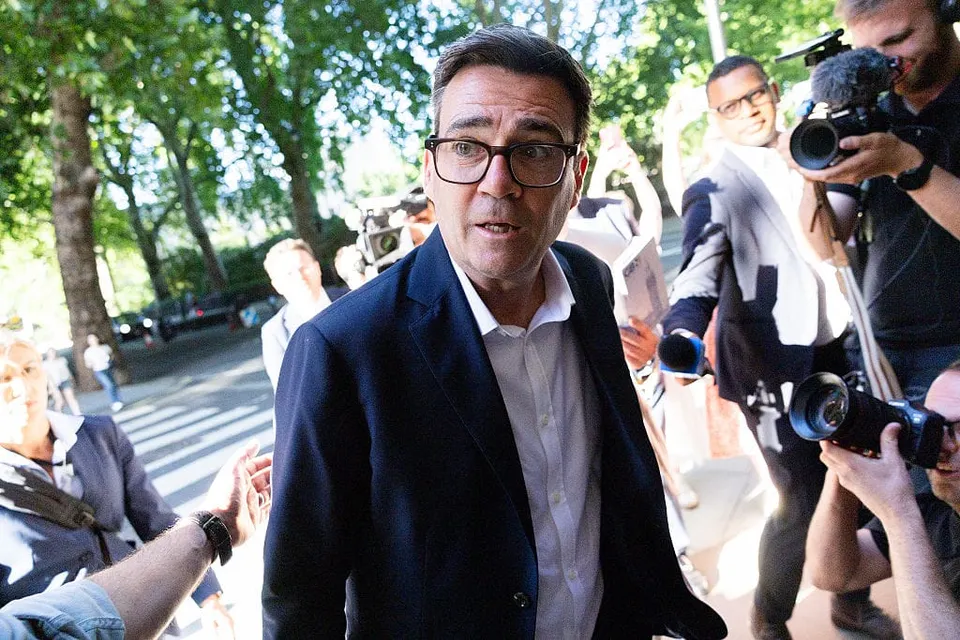
Credit: Toby Shepheard / AFP via Getty Images

UK’s weak lobbying laws leave public in the dark about Flint Global’s vast access to government under James Purnell

Flint Global, the lobbying firm run by Andy Burnham’s incoming chief of staff, James Purnell, held extensive meetings with ministers, senior officials and special advisers with minimal disclosure, openDemocracy can reveal.

Our analysis of public transparency releases revealed Flint’s staff members met with officials from at least nine government departments on 38 occasions – for meetings, breakfasts, lunches, dinners and roundtables – since Labour took office. Attendees included cabinet ministers Jonathan Reynolds, Douglas Alexander and Nick Thomas-Symonds. This figure is likely an undercount as records of such meetings are published months in arrears. 

While Flint Global opts not to reveal its client list in the UK, EU transparency disclosures reveal it has lobbied politicians in Brussels on behalf of  Microsoft, Apple, BP and Uber. In the UK, the firm is known to have advised Thames Water – the utility Burnham has said “should be” nationalised.

Our findings raise fresh questions about the interests of Purnell, a former Blair-era cabinet minister who is poised to become one of the UK’s most powerful unelected officials when Burnham enters No 10, and have sparked fresh calls for the UK’s weak lobbying laws to be reformed.

One government log appears to confirm just how routine its engagements with Flint were. 

A September 2024 meeting between the lobbying firm and the Department for Business and Trade’s then top-ranking civil servant, Gareth Davies, is described as a “regular meeting to discuss latest business updates”. Purnell is also recorded as having hosted “evening drinks to discuss latest business updates” with Davies in March this year.

Yet despite this regular access to government officials, Flint’s quarterly entries to the Office of the Registrar of Consultant Lobbyists have only ever declared lobbying for two clients. The firm said it lobbied on behalf of the British Standards Institution, which produces technical standards on a range of products and services, in late 2024, and Hellen Systems, a tech firm working on long-range navigation, between July and September 2025. 

Across the remaining six quarters that Labour has been in office – covering a total of 18 months – Flint declared having made “no communications which meet the definition of consultant lobbying”.

There is no suggestion that Flint has broken any rules. Rather, its near-empty register reflects major flaws in Westminster’s lobbying transparency rules. While few companies enjoy such extensive access to such wide-ranging government departments, much of Flint’s lobbying activity does not meet the threshold for statutory registration. 

The 2014 Lobbying Act requires consultant lobbyists to register only direct communications with ministers or permanent secretaries made on a client’s behalf. They do not have to declare meetings with government special advisers, director generals and senior officials, nor roundtables and briefings that they attend or organise, nor strategic advice they give clients about who to speak to in government, what to say, and when to say it. 

The result is that a firm such as Flint Global can maintain a regular presence across Whitehall – breakfasting with officials, dining with ministers, pre-briefing advisers – while lawfully declaring that it does no consultant lobbying at all. Many similar lobbying firms sign up to the industry body’s voluntary code of conduct, which requires them to publish a client list, but Flint has not opted to do so. 

This means the public has no way of knowing whether decisions that cross Purnell’s desk in No 10 could benefit his former clients.

Duncan Hames, senior director of policy at Transparency International UK, told openDemocracy: “That a lobbying company can have dozens of meetings across government with so little public information about the purpose of these engagements shows how opaque Westminster remains.

“If the next prime minister wants change from the broken politics-as-usual, they should recognise that keeping things behind closed doors and poorly managing conflicts of interest are recipes for disaster.

“Government should create a firewall between any new appointments and their past interests in the private sector, as well legislating to bring lobbying out of the shadows.”

Vast access to Whitehall

Purnell, who resigned from Flint Global last week, joined the company as chief executive in June 2024 – weeks before Labour’s election win. Although the lobby firm had previously secured meetings with Conservative government officials, its engagement with the government appears to have ramped up that summer.

In July 2024, the firm hosted a roundtable with then-business secretary Jonathan Reynolds alongside Barclays, Google and Virgin Atlantic to discuss “opportunities and challenges relating to business growth”. It is not known whether Flint counts these firms among its UK clients, though EU transparency records reveal it has lobbied for Google in Brussels. 

Over the following 20 months, Flint met ministers or officials from the Department for Business and Trade at least 13 times, including three meetings with trade minister Douglas Alexander and repeated meetings, breakfasts, dinners and drinks with civil servant Gareth Davies. 

Over at the Treasury, Flint discussed the contents of the chancellor’s January 2025 growth speech with a senior official the day it was delivered, attended a roundtable on financial services policy with then City minister Emma Reynolds, and met a senior official to “discuss policy for Autumn Budget” in October 2025.

Department for Transport special adviser Stef Lehmann, who previously worked in Flint’s transport team, accepted lunch or dinner from Flint on three separate occasions, while the department’s permanent secretary, Bernadette Kelly, recorded a “speaking commitment” with the firm.

Flint also hosted or briefed senior officials at the Department for Science, Innovation and Technology on digital policy; met officials from the Department for Energy, Security and Net Zero to discuss new publicly owned energy investment firm Great British Energy; and discussed planning “blockers” with Chris Stark, the head of the government’s clean power mission. 

The firm also had contact with the Cabinet Office, the Department for Education, the Ministry of Housing, Communities and Local Government and the Department for Health and Social Care, whose special adviser, Heather Iqbal – another ex-Flint employee – was taken to breakfast by Purnell in August 2025.

Several of the engagements were roundtables organised around Flint’s corporate network. A March 2025 meeting with Douglas Alexander to discuss “the current trading environment” brought together more than 20 companies, including Amazon, Uber, Diageo, Unilever, GSK and Quadrature – the hedge fund that donated £4m to Labour before the 2024 election. The British Standards Institution, one of the only two clients Flint has ever been required to declare, was also present, although Flint did not declare any consultant lobbying for the company in this quarter.

Speaking to openDemocracy last week, Green Party leader Zack Polanski called for the publication of Flint’s clients if Purnell takes up the key role in No 10

Following Purnell’s resignation, Flint Global said Purnell “has recused himself from all client activity and has no ongoing financial interest in the company of any kind.”

Flint Global and Andy Burnham’s team were approached for comment.

Article by Ethan Shone republished from OpenDemocracy under a Creative Commons Attribution-NonCommercial 4.0 International licence.

Continue ReadingBurnham aide’s lobby firm met government 38 times – but who did it work for?

Corporate Pundits Panic Over Democratic Voters’ Socialist Preferences

Spread the love

Raina Lipsitz

New Yorkers elected progressives and democratic socialists up and down the ballot in June’s Democratic primary, in what even critics acknowledged was “an historic near-sweep” (New York Daily News, 6/27/26). Alarmed by voters’ rejection of corporate media’s preference for moderates (FAIR.org, 8/21/19), establishment media outlets reacted with panicked op-eds and articles downplaying the significance of the results.

New York City “isn’t reflective of the country,” declared a Washington Post editorial (6/24/26) published the day after the election. The paper, which billionaire Amazon founder Jeff Bezos bought in 2013, added that “the base detests anyone perceived as part of the establishment, no matter how progressive their voting record.”

In the Post’s view, voters’ irrational hatred of the establishment “puts pressure on leadership to lurch leftward”—in other words, respond to voters’ demonstrated needs and preferences. It’s voters’ desires, not politicians who repeatedly defy the will of voters, that “will make it harder for Democrats to win in 2028.”

Even US Rep. Dan Goldman’s “liberal voting record” wasn’t “enough to save him,” the Post lamented. Missing from this editorial was any attempt to define its terms (e.g., what makes a voting record progressive or liberal?) or understand what drove these results (why are voters so angry at the establishment?). Instead, it dismissed Democratic voters as clueless members of the “far left,” fueled by inexplicable anger at their sober-minded betters.

Organizing the ‘reasonable’

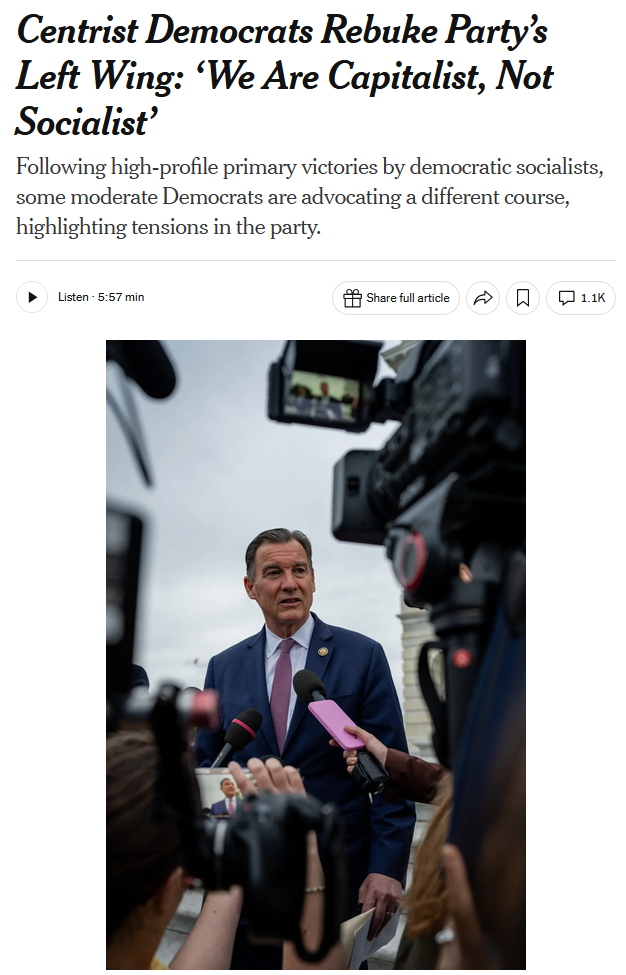
NYT: Centrist Democrats Rebuke Party’s Left Wing: ‘We Are Capitalist, Not Socialist’

The New York Times (6/26/26) quoted a co-founder of the corporate-backed Third Way think tank as saying that DSA victories would allow Republicans to “weaponize the craziest ideas of the activist left.” 

Others in corporate media grasped one key to these wins: the months of organizing and door-knocking that made them possible, some of which I participated in as a member of the Democratic Socialists of America (DSA). But they failed to understand, or pretended not to see, that it’s just as essential to have a policy agenda that excites voters.

CNN political commentator Van Jones tweeted at his fellow moderates that “reasonable” Democrats were going to have to

get off their couches, roll up their sleeves and start organizing…. We can no longer rely only on TV ads, digital spend and endorsements…. If you are a Democrat who believes in opportunity, dignity and democracy for all—but you don’t hate rich people, cops, free enterprise, the West, Israel and the United States of America—I’m talking to you!

Rep. Tom Suozzi of New York, a self-styled moderate, made similar remarks to the New York Times (6/26/26):

The bottom line is that you have to give the DSA and you have to give MAGA credit, because they’re organized…. And the people that don’t agree with their philosophies wring their hands at cocktail parties, but they’re not organized. So we have to get organized.

Can moderates catch up to progressives simply by attending more meetings and fewer cocktail parties? It’s a start, but the election results suggest that their ideas simply do not hold much appeal to rank-and-file Democratic voters. Jones, Suozzi and their fellow “reasonable” Democrats are welcome to go door-to-door to try to interest Democratic voters in policies they see as both pro-rich people, pro-cop, pro-Israel and middle-of-the-road, but recent polls indicate that a majority won’t be interested.

According to a 2026 Siena poll, 54% of all New York voters support a tax increase on New York City residents making over $1 million per year. Support was even higher among New York City voters, 62% of whom favor such a tax hike, and state Democrats, 72% of whom support it.

An exit poll released shortly after New York City’s 2025 mayoral primary revealed that two in three voters listed crime and public safety, along with homelessness, as some of the biggest issues facing the city. But when asked to choose which idea more closely aligned with their views, 75% of respondents said they’d rather address crime and safety by increasing “treatment for mental health and drug addiction and getting illegal guns off the street” versus giving more resources to police, increasing sentences for people convicted of violent crimes and strengthening bail laws.

A 2025 poll conducted by YouGov on behalf of the ACLU also found that 69% of voters think having mental health and addiction specialists rather than cops respond to calls related to mental health, homelessness and substance use would improve community safety.

And according to a 2026 Pew Research Center poll, eight in 10 Democrats and Democratic-leaning independents have an unfavorable view of Israel.

‘Threatening to unleash a debate’

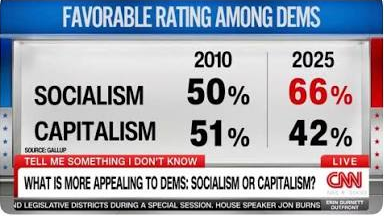
CNN: What is more appealing to Dems: Socialism or Capitalism?

CNN (6/25/26): “Democrats last year had a significantly more favorable view of socialism (66%) than capitalism (42%).”

Despite the fact that solid majorities of Democrats now favor tax hikes on the rich and public safety solutions that reduce the need for cops, prefer socialism to capitalism and hold a negative view of Israel, corporate media outlets are committed to portraying these voters as deeply dividedNew York Times contributor Tim Balk (6/26/26) wrote:

With four months until the midterm elections, the [electoral] outcomes in New York have deepened divisions in the Democratic Party, threatening to unleash a renewed internal debate about electability and how Democrats speak about capitalism.

Speaking of electability, democratic socialists have won races throughout New York City and across the state: in the Hudson Valley, where Sarahana Shrestha has held a state assembly seat since 2023; in Central New York, where Onondaga County legislator Maurice “Mo” Brown just beat one of the area’s longest-serving incumbents in a race for a state assembly seat; and in Western New York, where DSA-backed Buffalo attorney Adam Bojak just won a state assembly seat by a massive margin, and where democratic socialist Brian Nowak has been Cheektowaga town supervisor since 2023.

They are also winning outside of New York: Democratic ⁠socialist Melat Kiros just toppled 15-term US House Rep. Diana DeGette in the primary election in a district that encompasses Denver, Colorado; democratic socialist Janeese Lewis George (FAIR.org6/5/26) is poised to become the mayor of Washington, DC; and Georgia voters sent democratic socialist Gabriel Sanchez to the Georgia General Assembly in 2024.

‘Differed little on policy’

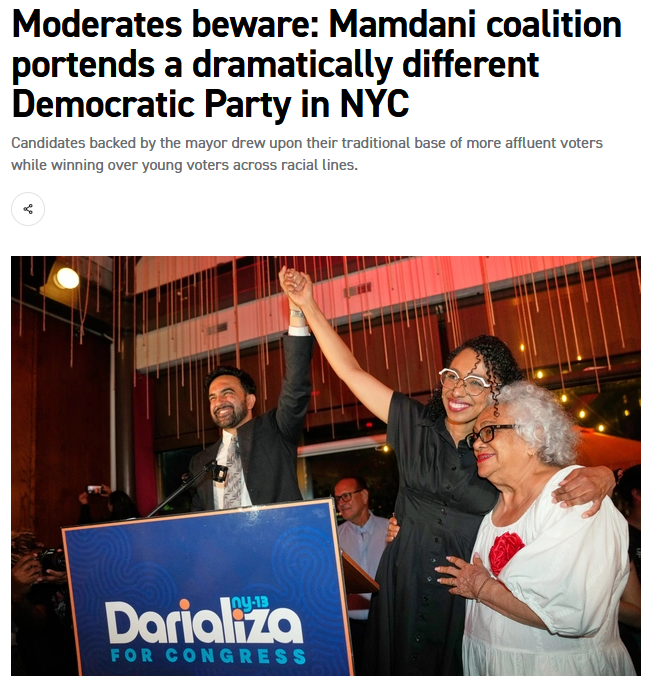
Politico: Moderates beware: Mamdani coalition portends a dramatically different Democratic Party in NYC

Politico (6/26/26) claimed that DSA’s candidates “differed little on policy”—which fails to explain the “staggering” results that ” charted the far left’s broadening appeal and a potential reorientation of the electorate that will influence races for years to come.”

Whether these election results have “deepened” divisions within the Democratic Party or merely exposed them, centrists and their media allies are desperate to neutralize them. According to the Daily News’ Evan Thies (6/27/26):

The issues that the vast majority of those [DSA-aligned] candidates ran on—higher taxes for the wealthy, immigrant rights, a stronger social safety net—are also the issues that ‘establishment’ candidates ran on…. In the congressional races in particular, other than differences on Israel, you would be hard-pressed to find a major part of any insurgent’s platform that was not also a plank of their opponent’s.

Politico (6/26/26) had a similar take:

A series of hotly contested congressional and state elections pit a slate of Mamdani-backed democratic socialists and progressives against establishment candidates who, in several cases, differed little on policy aside from US/Israel relations.

But the “differences on Israel” that pundits are so eager to gloss over were essential, not incidental, to many of these victories. It turns out Democratic voters are really angry at many longtime incumbents for supporting and funding an ongoing genocide, and eager to vote for candidates who have actively worked to stop it.

There were other key differences in policy and governing philosophy between these candidates as well. A New York Times story (6/1/26) about the primary battle between the DSA-backed Claire Valdez and the Working Families Party–backed Antonio Reynoso first stated that “the policy distinctions in the race can be difficult to discern”—before going on to discern:

Where [Reynoso] has advocated reforms within existing systems, [Valdez] wants to shrink the private sector and drastically ramp up the federal government’s role in building housing…. The assemblywoman and her allies have also knocked Mr. Reynoso for accepting tens of thousands of dollars in campaign contributions from people connected to the real estate industry.

In a profile headlined “Like AOC, But to the Left,” City & State (6/15/26) wrote that DSA-backed challenger Darializa Avila Chevalier had “a totally different worldview, with a totally different relationship to the district,” compared with longtime incumbent Adriano Espaillat.

Progressive flukes, centrist acumen

Whether or not these differences mattered to pundits, voters appeared to take note: Valdez won her race by over 20 points, and Chevalier won hers—which many considered a long shot—by a clear but smaller margin.

As usual, corporate media outlets covered these progressive victories as if they were flukes, while treating less significant centrist victories as evidence of political acumen. In his Times story (6/26/26) on centrist Democrats who reject “false choices between extremes on right and left,” Balk described Suozzi as “a New York Democrat who flipped a swing district” on Long Island in 2024.

In 2024, Suozzi beat his Republican opponent by just 3.6 points in the general election; the seat he “flipped” was formerly occupied by Republican George Santos, who was exposed as a serial liar within months of being elected and expelled from Congress about a year later. Santos only won the seat after Suozzi gave it up to challenge Gov. Kathy Hochul from the right in New York’s 2022 gubernatorial primary.

In 2024, Suozzi narrowly regained his old seat by espousing policies that voters in one of the wealthiest congressional districts in the state and country slightly preferred. But when he ran statewide, he won just 13% of the vote—or 6 points less than Jumaane Williams, who also lost to then-Governor Hochul by a wide margin, but earned 56,900 more votes than Suozzi by challenging her from the left.

‘An elite of well-educated professionals’

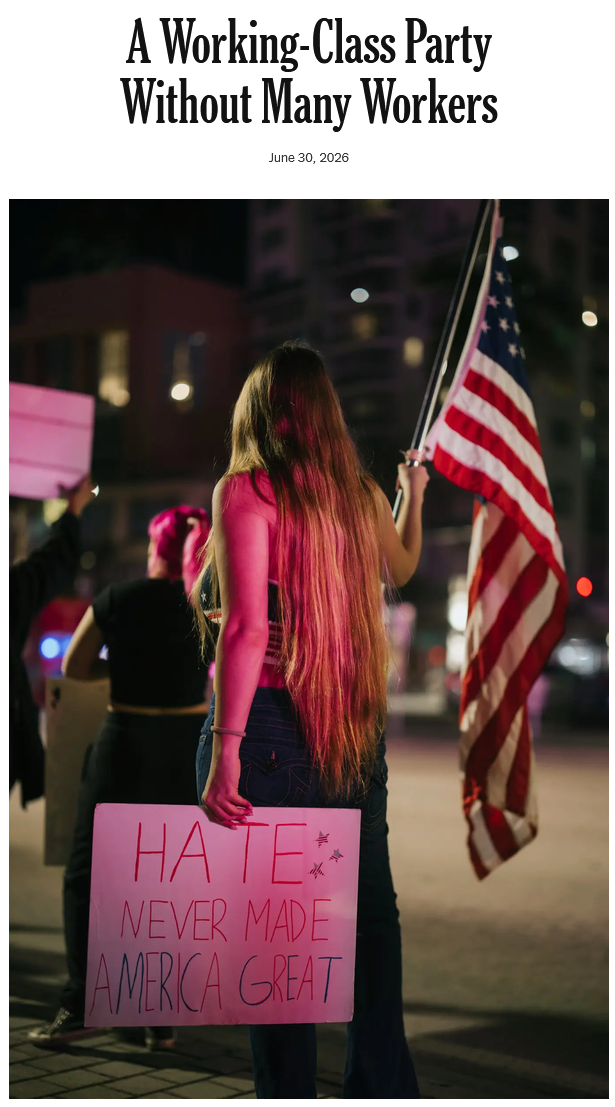
New York Times: A Working-Class Party Without Many Workers

According to the New York Times‘ Thomas Edsall (6/30/26), if you have a college degree, you “are in no way working class.”

Another popular strategy for undermining progressive wins is suggesting that only rich white college kids support them (New York Post6/25/26). As the New York Times’ Thomas Edsall (6/30/26) wrote, “Candidates aligned with the Democratic Socialists of America are surging to victory on the claim that they are proponents of ‘a government by, for and of the working class.’” He countered:

Most of the leadership of the DSA and a majority of voters who back its candidates are in no way working class. Instead, an elite made up of well-educated professionals dominates this insurgency.

Furthermore, he added, DSA’s agenda is

packed with policies supported by left-wing liberals, white progressives in particular, but strongly opposed by both white and minority working-class (defined, in pollster shorthand, as non-college-educated) voters.

Putting aside the larger question of who belongs to “the working class” in the US today, which Edsall addressed only obliquely—when he described DSA’s “key constituency” as “the universe of young people with college degrees struggling to find rewarding work, the so-called precariat,” it sure doesn’t sound like he’s talking about the haute bourgeoisie—it is flatly untrue that voters of color oppose DSA policies and candidates.

As data analyst Michael Lange explained on his blog (Narrative Wars6/29/26), DSA candidate “Darializa Avila Chevalier won Black voters…against a 10-year Democratic incumbent in the historic capital of Black America,” while DSA’s

Claire Valdez won every age bracket and racial group…. This is not the electoral footprint of a gentrifier candidate, squeaking past on margins from Millennial and Gen-Z (white) transplants; it is the signature of a multiracial, cross-generational coalition.

Even Politico (6/26/26) acknowledged that

Congressional candidates backed by the Democratic Socialists of America were able to replicate [Mamdani’s] success by winning younger Latino voters in Brooklyn and a majority of Black voters in Harlem…. The result charted the far left’s broadening appeal and a potential reorientation of the electorate that will influence races for years to come.

The case for cowardice

Edsall declared that DSA’s support for trans rights “would be met with some skepticism if not hostility by working-class voters disdainful” of ideas like “bodily autonomy” and “moving past…conservative norms around gender.” Like many of his colleagues at the Times, Edsall parses voter attitudes toward trans rights at length, without bothering to note that they—like attitudes toward interracial marriage, gay marriage, policing, abortion and immigrants’ rights—have changed quite a bit in the last five to 50 years, in response to movement pressure and shifting social, political and economic conditions.

Should DSA abandon its trans members and siblings because, as Edsall (6/30/26) writes, “surveys consistently show that non-college voters are significantly more opposed to more progressive transgender policies than college-educated voters”? Or should it continue to organize and lead on these and other issues in hopes of building support for human rights across the board?

Even in 2021, when public safety was a top concern of NYC voters, many of whom wanted more cops on the streets, polling showed that the largest share of voters favored reducing crime by “shifting police funding to mental health” (NBC6/14/21). New York elected former cop Eric Adams mayor that year. Four years later, Adams’ support had cratered and, according to Siena College Research Institute’s director, Don Levy, “Crime remain[ed] a concern…but over 90% [of NYC voters surveyed] say just affording life is a problem.”

In 2025, New Yorkers elected democratic socialist Zohran Mamdani in the Democratic mayoral primary by a much larger margin than Adams’. One thing we can learn from the recent wave of progressive wins is that public opinion doesn’t shift in a vacuum; movements and leaders shift it.

FAIR’s work is sustained by our generous contributors, who allow us to remain independent. Donate today to be a part of this important mission.


This work is licensed under a Creative Commons Attribution-NonCommercial-NoDerivs 3.0 Unported License.

Continue ReadingCorporate Pundits Panic Over Democratic Voters’ Socialist Preferences

CNBC Helps SpaceX Pull Off Trillion-Dollar Pump-and-Dump

Spread the love

Wilson Korik

Elon Musk became—at least temporarily—the world’s first trillionaire on June 12 after his space, telecommunications and AI company SpaceX had the largest initial public offering in history. Initially priced at $135 per share for a valuation around $1.77 trillion, shares opened at $150 and peaked on June 16 at $225.64 (a valuation of nearly $3 trillion). The price spiked after Musk announced, before markets reopened on June 15, that he believes “SpaceX might be able to reach approximately $1T revenue in 2030” (CNBC, 6/15/26).

Since its June 16 peak, however, SpaceX’s share price has fallen, steadily declining until June 22 and settling around $160 since. Markets closed on Thursday, July 2, with a share price of $162.00.

SpaceX’s big slump coincided with a mass tech sell-off last week, prompted by mounting concerns that tech firms cannot generate the returns necessary to pay off the colossal debts financing massive AI infrastructure buildouts, especially as companies are beginning to rein in their spending on AI (404 Media6/24/26TechCrunch6/24/26).

That was likely a surprise to viewers of CNBC, whose full-day IPO coverage pumped the stock by inviting sources with vested interests to celebrate Musk’s cult of personality and obfuscate the magical thinking behind the company’s projections.

All in on business-facing Grok

Photo of viewport in space looking down on Earth.

SpaceX‘s prospectus has lots of pictures of space, but the details make clear that it’s really envisioning itself as an AI company.

According to its own S-1 filing with the SEC, SpaceX anticipates that its greatest earnings potential does not come from the rocket business for which it is famous, but from selling AI to other businesses. The breathless CNBC discussions entirely omitted the dubious origins of SpaceX’s gargantuan estimate of its maximum potential revenue—a key investor metric known as total addressable market (TAM).

In its S-1 prospectusSpaceX claims a TAM of $28.5 trillion, larger than the entire GDP of China.

The document separates this figure into SpaceX’s three sectors: space, connectivity and AI. Although the filing argues that space “represents the largest economic frontier in human history,” space makes up just $370 billion, or 1.3%, of SpaceX’s supposed TAM. Meanwhile, AI makes up $26.5 trillion, or 93%, the vast majority of which is for “enterprise applications.”

Enterprise AI is a broad category of business-oriented applications for firms looking to simplify and accelerate workflows, like converting text files into presentation formats, writing and debugging string code, and automating some sales, marketing, HR and IT functions. The most popular AI assistant by far is OpenAI’s ChatGPT, followed by Google’s Google Gemini and Anthropic’s Claude (TechCrunch6/16/26).

A closer reading of SpaceX’s S-1 filing reveals that its $22.7 trillion estimate for enterprise AI applications does not actually represent the TAM of the company’s enterprise AI, but is instead an estimate of the size of the entire digital economy—posing a hypothetical wherein xAI’s Grok Business and Grok Enterprise monopolize all digital commerce. It’s worth noting that xAI currently has extremely limited enterprise AI market share, with a March Enterprise Technology Research survey finding that just 7% of respondents use Grok (Wall Street Journal5/11/26).

Politico: Why Grok fell in love with Hitler

After SpaceX adjusted its chatbot so it would “not shy away from making claims which are politically incorrect,” Grok declared that Adolf Hitler would “spot the pattern” and “handle it decisively, every damn time” (Politico7/10/25).

Note also that subscriptions to xAI‘s consumer AI, SuperGrok, on X (labeled “consumer subscriptions” in the chart) alone make up $760 billion, or 2.7% of SpaceX’s TAM. That’s calculated

based on the global population of individuals aged 10 and over in 2025 … multiplied by the weighted average monthly subscription revenue of $12, resulting in an annualized market opportunity of approximately $760 billion.

So if every person on the planet over the age of 9 sends SpaceX $12 every month to use Grok, the X chatbot that spent four days last year calling itself MechaHitler and promoting the Great Replacement Theory, SpaceX will take in $760 billion per year. Sounds like a business plan!

SpaceX’s public offering has all of the hallmarks of a pump-and-dump scheme, using a “staggered lock-up” schedule that allows insiders to sell off shares much earlier than most other publicly traded firms—enabling them to cash out while the stock is still grossly overvalued. This gambit is also called a “bagholder” scheme, as retail investors are left holding a rapidly depreciating asset.

While most IPOs prevent insiders from selling shares for the first 180 days of public trading, SpaceX uses an expedited schedule that allows most insiders to sell much sooner—selling off overvalued shares to retail customers.

While this pump-and-dump began with retail consumers who bought shares on the first day of public trading, these massive wealth transfers are being thrust upon working people whether they like them or not, as Musk successfully negotiated new rules that fast-track SpaceX’s inclusion in major index funds, including the Russell 1000 and NASDAQ funds—transferring rapidly devaluing stock from SpaceX insiders to working people’s retirement accounts.

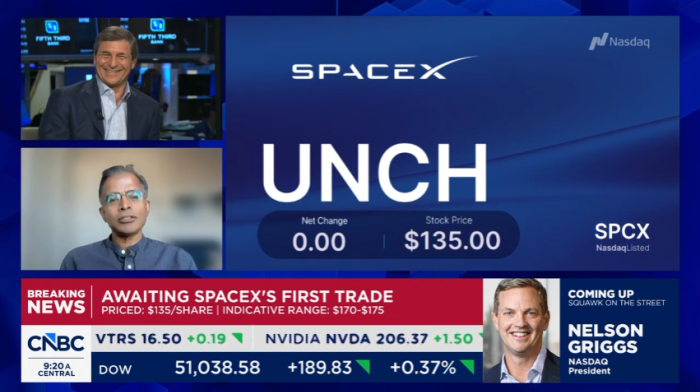
But none of this was explored on CNBC the day of the SpaceX IPO launch. FAIR could find not a single guest or anchor that mentioned that “Elon Musk’s rocket company” valued the potential for SuperGrok X subscriptions at more than twice the total projected TAM for the space industry, nor that SpaceX’s TAM is based on a scenario in which business-facing Grok controls all e-commerce—and certainly not that the IPO would essentially serve as a massive wealth transfer from retail investors to SpaceX insiders.

‘You should have bought as much as you could’

Walter Isaacson on CNBC talking about SpaceX

During a completely uncontentious interview with Squawk Box co-host Andrew Ross Sorkin (6/12/26), Elon Musk biographer Walter Isaacson muses, “Who knows, we may have the mining of rare earth minerals at some point—I guess we can’t call them rare earth if they’re not on earth. But I think what we’re seeing is the beginning of a whole new economy, a space-based economy.”

Instead, in the hours leading up to SpaceX’s first trade, CNBC viewers were primed by Squawk Box co-host Joe Kernen (6/12/26) lamenting that orders were being snatched up by large institutional investors, and hoping that trades would begin at under $300 per share. He assured viewers that, although he’s nervous, “whenever we’ve worried about any of these great tech companies…wherever it was on opening day, you should have bought them as much as you could.”

The rest of the influential three-hour morning program was as much of a commercial for SpaceX as this opening scene. Squawk Box‘s guests included SpaceX COO Gwynne Shotwell (interviewed by Morning Call host Morgan Brennan), Elon Musk biographer Walter Isaacson, long-time Musk investor David George, head of financial technology research at Citizens Bank Devin Ryan, and venture capitalist and investor Ben Narasin.

All but one of these guests have vested interests or are members of Musk’s inner circle, and used their airtime to generate excitement around the stock by focusing on Musk as a visionary key man. Kernen, co-host Andrew Ross Sorkin and guest host Melissa Lee offered no pushback.

During his conversation with Musk’s biographer Isaacson, Sorkin responded to a proposal that Musk could mine rare earth minerals in space: “I’m curious what you think of the valuation itself…. When you talk to investors, a lot of them say, ‘Look, the math may not actually math out on paper.’”

But before letting a question that could be interpreted as contentious hang too long, he answered for Isaacson:

But Elon Musk is the math. He’s been such a success over all these years. And just about everyone who’s invested with him in the past, he has found a way to make money, even if he didn’t plan to make money in a specific way originally. He then pivots and finds a way that also creates a key man risk. But I’m curious how you think about that.

Of eight guests and anchors featured to speak with Squawk Box hosts about the IPO, just one offered a critical perspective: final guest Ben Narasin, a founder of Tenacity Venture and self-described “long-term buyer of SpaceX.” Narasin contended that while he believes that SpaceX is “going to be a phenomenal company,” a bad post-IPO performance could “put a true chill on the market.”

Squawk Box also included almost no discussion of SpaceX’s TAM, with just one observation, about two hours into the broadcast, that David George, a partner at venture capital company Andreessen Horowitz, believes in it wholeheartedly. Musk is the “best entrepreneur of our generation,” George claimed, targeting “two of the most important markets in technology for our society.”

‘Doubt large numbers at your peril’

CNBC's Jim Cramer raving about Elon Musk

Encouraging his audience to buy into SpaceXMad Money host Jim Cramer (6/12/26) pitches, “Musk has the ideas and the execution. Historically, betting against him has been a terrible strategy. Betting with him? Hey, why the heck not? I’m surprised he even lets us tag along.”

Like his colleagues on Squawk BoxCNBC‘s Halftime Report host Scott Wapner (6/12/26) was also seemingly incapable of posing tough questions to those with vested interests—but when one guest expressed skepticism, he was happy to interrupt.

His guests—and SpaceX private shareholders—Altimeter Capital CEO Brad Gerstner, Hightower chief investment strategist Stephanie Link and Newedge Wealth CEO Rob Sechan pitched viewers directly to buy in early. (Link completely ignored Wapner’s question as to whether she bought into the IPO.)

Wapner jumped in to parrot Sequoia Capital partner (and Musk DOGE assistant) Shaun Maguire’s suggestion, during previous program Squawk on the Street, that SpaceX’s $28.5 TAM could be an underestimate. He echoed Maguire’s assertion that “this company has the most important mission of any company in history,” warning prospective retail investors to “doubt those large numbers at your own peril” (Halftime Report6/12/26).

But when Capital Area Planning Group managing partner Malcolm Ethridge expressed some skepticism as to why retail investors shouldn’t doubt the massive TAM—which, he noted, is almost the size of the US’s GDP—or buy equity in a cheaper space or AI firm with better sales, Wapner cut him off twice—once to rebut with a reminder that SpaceX’s largest revenue-generator is Starlink, and once to prompt Gerstner to offer the same explanation. (Starlink’s 2025 revenue was $11.4 billion, or about 0.04% of US GDP.)

Neither answered Ethridge’s question, but once the topic was successfully changed, Wapner and Gerstner continued peddling.

Meanwhile, during his speculative finance advice program Mad Money (6/12/26), host Jim Cramer likened SpaceX going public to putting a man on the Moon and winning the space race (an analogy he also shared during Squawk on the Street and The Exchange):

The SpaceX IPO felt just like when we put a man on the Moon. Most of you aren’t old enough to remember what that was like back then. We’ve been in a race against Russia for global suppremacy…and then we landed on the Moon…a recognition that we weren’t a nation of bozos competing as a nation of geniuses. These days, I feel the same way about China…. Then along comes Elon Musk, who’s winning the space race against the Chinese, and just got the money he needs to complete projects we haven’t even imagined yet. That’s why my emotion is one of pride.

Although he pointed out that SpaceX may be “outrageously overvalued” by “traditional metrics,” Cramer argued that he nonetheless sees it as a “long-term call on space exploration,” encouraging those who got in early to invest even more. He rattled off the often-repeated refrain that “Musk has the ideas and the execution. Historically, betting against [Elon Musk] has been a terrible strategy.” (Very famously, Musk frequently doesn’t deliver on his promises.)

‘A number so large it destroys your credibility’

CNBC's David Faber interviewing NYU's Aswath Damodaran

CNBC‘s David Faber laughs as his guest NYU business school professor Aswath Damodaran jokes, “When I read [the S-1], I thought Grok had written the prospectus, because we know AI is subject to hallucinations.”This isn’t to say that CNBC’s coverage of SpaceX’s IPO was completely without critical perspectives: Squawk on the Street’s David Faber (6/12/26) spent much of his onscreen time grilling insider guests on whether they’ll sell early, and pushing back on vague, aspirational framing around the AI and space industries.

Faber repeatedly reminded his audience that the S-1 prospectus specifically sees most of SpaceX’s potential in enterprise AI. He skeptically took the projected $22.7 trillion TAM for enterprise AI as given, but pointed out that “it’s not clear” how SpaceX’s Grok could compete with other enterprise AI products:

It’s interesting, as much as we talk about SpaceX, as much as we hear Musk talking about space and then Starlink, the real opportunity in terms of addressing this enormous number is actually still the same opportunity that’s being sought after by Anthropic, and OpenAI, and Alphabet and others.

Squawk on the Street also featured the most critical guest by far, NYU business school professor Aswath Damodaran, who came closest to questioning the origin of the TAM of any host or guest on any of the programs:

When I read [the S-1], I thought Grok had written the prospectus, because we know AI is subject to hallucinations…. I don’t know if it’s a banker who wrote it, I would be embarrassed to even put that number out. I mean, it’s a big market. Why do you need to make up a number, a number so large it destroys your credibility?

But even in scrutinizing SpaceX’s prospects, or the true size of the enterprise AI market, Squawk on the Street’s criticism missed the bigger picture: SpaceX’s record-setting IPO is a pump-and-dump, and retail investments provide the exit liquidity for insiders looking to get out of a failing AI company.

Every day, dozens of guests representing various companies advertise their stock on CNBC for retail consumers, who trust the judgment of their favorite program hosts to give completely uncontentious interviews, essentially constituting a series of infomercials, rather than actual financial journalism. FAIR (3/18/092/3/20) has criticized CNBC on this basis for decades.

So when CNBC invites SpaceX insiders with vested interests to pump the valuation of their stock on the air shortly before dumping it on retail consumers, it seems obvious why even the most critical host cannot alert his viewers to what is really going on: because CNBC’s reporting exists to boost stock, rather than protect consumers.

FAIR’s work is sustained by our generous contributors, who allow us to remain independent. Donate today to be a part of this important mission.


This work is licensed under a Creative Commons Attribution-NonCommercial-NoDerivs 3.0 Unported License.

Continue ReadingCNBC Helps SpaceX Pull Off Trillion-Dollar Pump-and-Dump

Elon Musk posted twice as often on UK race and immigration as about SpaceX in IPO run-up

Spread the love

https://www.theguardian.com/technology/2026/jul/04/elon-musk-uk-race-immigration-spacex-ipo

Elon Musk posted 303 times about race and immigration in the period leading up to SpaceX’s listing on the Nasdaq on 12 June. Photograph: Isaac Wasserman/NCAA Photos/Getty Images

Guardian analysis of X feed shows how keen world’s richest person was to air his views and ‘interfere’ in British politics

Elon Musk posted about race and immigration in the UK on his social media network X twice as often as he did about SpaceX, which he also owns, in the run-up to the aerospace and AI company’s initial public offering.

A Guardian analysis of Musk’s posts, replies and reposts between 31 May and 12 June has shown the extent to which the social media activity of the world’s richest person, who lives primarily in the US, has focused on UK politics.

The period was one of heightened tension and concern in the UK about online activity, particularly from rightwing social media accounts, after the sentencing of Vickrum Digwa for the murder of teenager Henry Nowak, which led to claims of “anti-white” policing, and far-right protesters clashing with police. It also coincided with violent riots across Belfast in Northern Ireland, when protests erupted after a knife attack.

While UK ministers were appealing for an end to the violence, in the US Musk was preparing for one of the biggest moments in his business career on 12 June. That was the day SpaceX, his social media, satellite internet and aerospace conglomerate went public, making him the world’s first trillionaire.

Article continues at https://www.theguardian.com/technology/2026/jul/04/elon-musk-uk-race-immigration-spacex-ipo

Elon Musk urges you to be a Fascist like him, says that you can ignore facts and reality then.
A parody ‘Tesla – The Swasticar’ advert posted at a London bus stop. Photograph: People vs Elon
Continue ReadingElon Musk posted twice as often on UK race and immigration as about SpaceX in IPO run-up

Iranian president criticises international silence over Israeli actions

Spread the love

This work by Middle East Monitor is licensed under a Creative Commons Attribution-NonCommercial-ShareAlike 4.0 International License.

Iranian President Masoud Pezeshkian delivers a speech during the “Leader of Resistance: Imam Khomeini International Conference” in Tehran, Iran, on July 4, 2026. [Iranian Presidency / Handout – Anadolu Agency]

Iranian President Masoud Pezeshkian on Saturday criticised international institutions for what he described as their failure to stop Israeli actions in the region, saying global bodies have remained silent while Israel openly speaks of assassinations and targeted killings, Anadolu reports.

Speaking at a conference in Tehran’s Summit Hall held in commemoration of slain former Supreme Leader Ali Khamenei, Pezeshkian said international organisations and human rights advocates were expected to prevent such actions, but instead political and logistical support was being provided.

He said Israel attacked multiple countries in the region and was responsible for many of the crises and instability across the Middle East, adding that Muslim countries had not initiated such aggression.

Pezeshkian also referred to the beginning of a “new leadership” for the Islamic community, saying the current leadership bears a heavy responsibility and that his government would continue working toward the ideals of the revolution, strengthening Islamic unity and expanding solidarity among Muslim nations.

The remarks came as funeral ceremonies for Khamenei got underway in Tehran, where thousands of mourners gathered at the Imam Khomeini Mosalla Mosque.

READ: Iran rejects UK-France Hormuz statement, warns against foreign military presence

Khamenei was killed in joint US-Israeli strikes on Iran on Feb. 28, which triggered weeks of war before a ceasefire was reached under Pakistan’s mediation in April, followed by an interim deal in June.

According to the official schedule, memorial ceremonies will continue in Tehran through the weekend with the participation of heads of state, senior officials and religious figures.

Public farewell ceremonies are scheduled for Saturday and Sunday, followed by the main funeral procession in Tehran on Monday. The funeral rites will then move to Qom on July 7.

On July 8, ceremonies are scheduled in Iraq, including in Baghdad, Najaf and Karbala, where the body will be received by religious and political figures before being transferred to major Shia shrines.

The final funeral and burial ceremony is scheduled for July 9 at the Imam Ali Reza Shrine in the northeastern city of Mashhad, one of Shia Islam’s holiest sites.

This work by Middle East Monitor is licensed under a Creative Commons Attribution-NonCommercial-ShareAlike 4.0 International License.

Keir Starmer explains that UK is actively supporting Israel's genocidal expansion and repeats his previous quotation that he supports Zionism "without qualification". Keir Starmer said “I said it loud and clear – and meant it – that I support Zionism without qualification.” here: https://www.jewishnews.co.uk/keir-starmer-interview-i-will-work-to-eradicate-antisemitism-from-day-one/
Keir Starmer explains that UK is actively supporting Israel’s genocidal expansion and repeats his previous quotation that he supports Zionism “without qualification”. Keir Starmer said “I said it loud and clear – and meant it – that I support Zionism without qualification.” here: https://www.jewishnews.co.uk/keir-starmer-interview-i-will-work-to-eradicate-antisemitism-from-day-one/
Donald Trump explains why he established his Bored of Peace

Continue ReadingIranian president criticises international silence over Israeli actions