Energy Monitor talks to leading climate change economist Dimitri Zenghelis about an open letter from 100 economists lamenting UK Prime Minister Rishi Sunak’s recent net-zero U-turns.
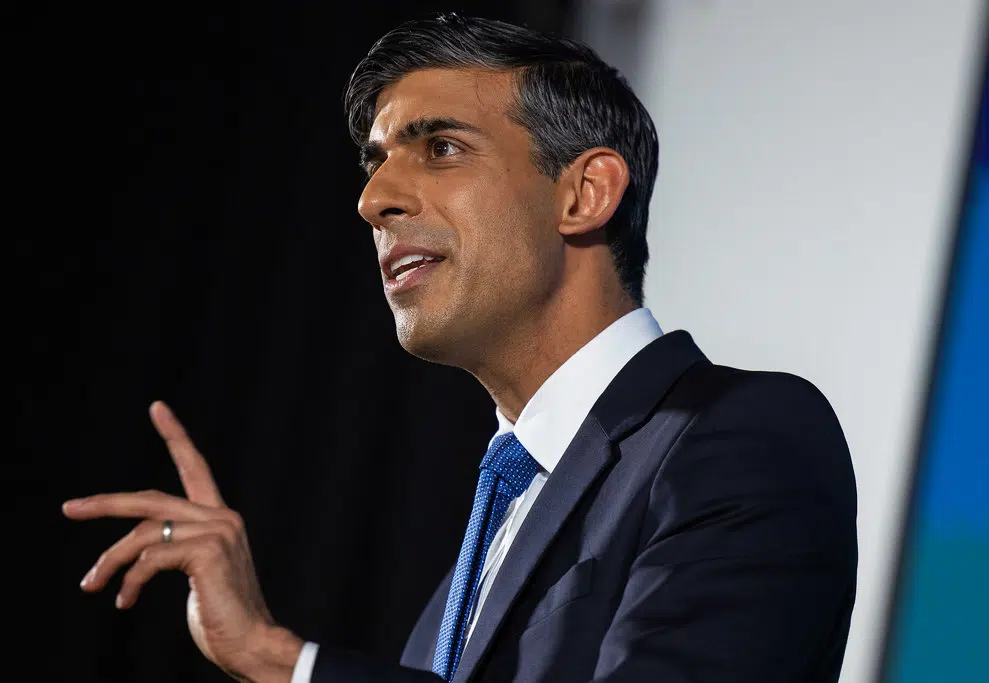
One of the many occasions UK Prime Minister Rishi Sunak uses a private jet.
…
So, what’s behind Sunak’s net-zero moves then?
It’s got nothing to do with cost; it’s pure politics. It’s dog-whistle stuff. He thinks he can turn this issue into an identity politics story. Hence, the “seven bins”. He’s talking about these cosmopolitan elite liberals with their fetishistic recycling (hence the seven bins) and how they’re wanting to take away our cars – from hard-working people who don’t have access to transport. It’s another “us against them” story.
It is true that if you live next to public transport in central London, you can afford to legislate against dirty vehicles, but if you live in a suburb with a terrible bus line, and you can’t afford the latest electric vehicle, yes, it is potentially quite punitive. So, this has to be done in a very careful and fair way. But just removing legislation that doesn’t impose costs sends a signal to the electorate that you’re taking a position, but to businesses that you absolutely haven’t a clue what you’re doing. Because on the one hand, you’re saying you’re committed to net zero by 2050; and on the other hand, you’re providing absolutely zero policy certainty because even when you do apply policies, you then rescind them. It’s economic short-termism.
Sunak’s playing politics with people’s livelihoods, and he’s selling it as if he’s actually trying to help people’s livelihoods instead of actually grappling with the issues of net-zero disruption and figure how we make it easier for people to adjust, how we support people in making their house as energy efficient as possible and transition to heat pumps, how we support people with bad public transport who at the moment can’t afford electric vehicles. But he’s thinking of what happened with ULEZ [Ultra Low Emission Zone] in the Uxbridge vote and what those culture wars can do to turn around his chances in the upcoming election. And if the economy suffers, well that won’t be his problem, because he probably won’t be in government by then. It’s just so cynical.
It’s hard for him to argue this is what economists are saying when both the OBR [Office for Budget Responsibility] and the Treasury have provided numbers that show the cost of delaying this transition is more expensive than the cost of pursuing it, as has the independent Climate Change Committee (CCC).
Rishi Sunak used the word change 30 times in his conference speech. His party has been in power for 13 years
Listening to the PM in Manchester, you’d be forgiven for thinking a different party has been running the country
Moments before Rishi Sunak took to the stage at the Conservative Party Conference, a video flashed on a screen. Images of fields, children, roads and vaccines appeared above the heads of the hundreds waiting for the PM’s speech. “Change is…” the words read. “Change is…the Conservatives.”
In his address in Manchester, the prime minister told his party: “It is time for a change.” He confirmed his intention to scrap HS2, Europe’s largest infrastructure project, claiming “the right thing to do when the facts change, is to have the courage to change.” And speaking about his decision to U-turn on manifesto net zero pledges, he added: “Change is difficult, particularly for those who disagree.”
Altogether, Sunak used the word change 30 times. You would be forgiven for thinking another party has been in power for the last 13 years.
The PM, who also served as chancellor for two and a half years, and before that was a senior minister in the Treasury, seems to be running a re-election strategy on the potential amnesia of the country.
This is someone who governs a party focused on conserving, asking voters to believe that another term of Conservative rule will change what has been a reality for the last 13: rising homelessness, a cost of living crisis, crippling rents, spiralling mortgage rates, attacks on minority communities, months of waiting for essential NHS treatment, and a system that puts corporate interest over workers.
While hoping you’ll forget his impact, the speech also hit some key Tory attack lines. Sunak demonised trans people, in an attempt to curry favour through division, and to outsource blame from those in power to those with none. He attempted to rewrite his own history, painting himself as someone with humble beginnings, rather than as someone who attended a £60,000 a year private school. He also bashed striking workers, pretending to care about a National Health Service he’s admitted to not using.
And then there’s everything that was left out. Housing, arguably one of the most important long-term strategies any government needs to form, was mostly absent from the speech. Sunak briefly mentioned housebuilding, which would have been helpful if he hadn’t ditched housebuilding targets in April. Otherwise, the biggest issue facing most young voters was ignored. Rents are rising at their fastest rate since records began, and no-fault evictions, which were meant to be banned under the delayed Renters Reform Bill, are still a leading cause of homelessness. The absence was deafening.
Ultimately, these contradictory threads of Sunak’s speech could cause his downfall. He offers no solution, just buzzwords. It speaks to an underestimation of the British people, to think that you can tell them you care about long-term decisions while scrapping long-term projects. He even deployed his wife, Akshata Murthy, to introduce him with a gushing speech, but refuses to speak about his family when challenged on things like their non-dom status.
Without a coherent pledge, voters may well feel unsure. Sitting in the hall and listening to him deliver his speech, there was a quiet sense of confusion.
It’s easy for Sunak to forget that we’re in a cost of living crisis. He is, after all, the richest Prime Minister we’ve ever had and is wealthy enough to buy himself out of problems. He sends his children to private schools, uses private healthcare to avoid waiting lists, and flies in a helicopter to avoid train cancellations.
Unfortunately for him, most of the country can’t forget.
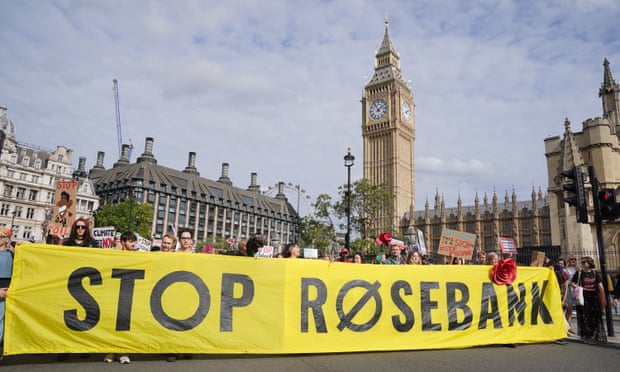
Protesters demonstrate against the British government’s approval of the Rosebank oil field’s development. Photograph: Lucy North/PA
Even if the 2050 goal is still met, postponing action – as the UK has done – will cause more heat and damage
Postponing action and taking a slower route to net zero emissions by 2050 will worsen the climate crisis even if the goal is still reached by that date, the new chair of the Intergovernmental Panel on Climate Change (IPCC) has warned.
Prof Jim Skea also said that approving new oil and gas fields only increased the already large amount of reserves that will have to be kept in the ground if global heating limits are to be reached.
The IPCC is the world’s foremost authority on climate change, under which thousands of the world’s best experts give advice to the 195 nations that founded the body. It does not comment on the climate policies of individual nations, but Skea’s comments on Monday clearly indicate that the recent actions of the UK government has slowed climate action, despite IPCC scientists warning of “a rapidly closing window of opportunity to secure a livable and sustainable future for all”.
The numbers in the sub-sample of 18-24 year olds are frankly hilarious. That sub-sample suggests that only 1 per cent of voters under the age of 25 would vote for the Tories. That puts them well below the Lib Dems on 9 per cent and the Greens on 11 per cent.
While a sub-sample has a bigger margin of error, the Tories attracting near zero support among young people doesn’t bode well for their long term electoral prospects…
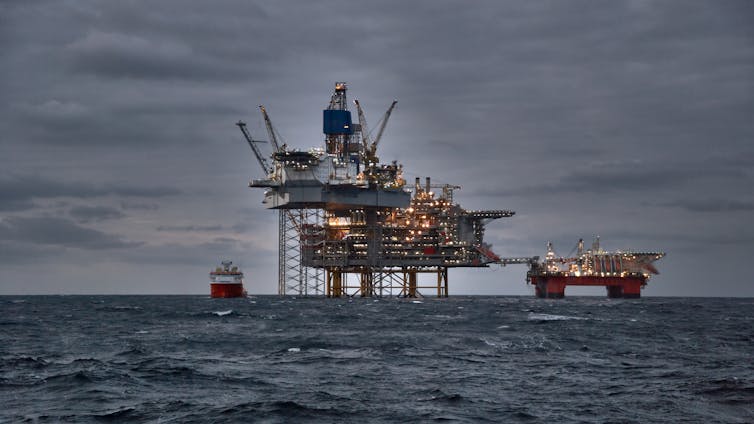
In a four-line statement announcing the approval of the new Rosebank oil field 80 miles west of Shetland, the UK’s offshore oil and gas regulator showed its mission no longer serves the public good.
The announcement by the North Sea Transition Authority (NSTA), which regulates oil and gas extraction in the waters off the British coast, asserted that net zero considerations had been taken into account – a technical definition that makes it appear long-term oil production is compatible with climate goals. This has outraged and dismayed climate scientists, campaigners, and the many other people concerned about the UK’s faltering climate leadership.
The approval greenlights a process that is expected to produce first oil by 2026, and around 300 million barrels of oil (and a smaller amount of gas) over the next two decades. The project’s developers are Equinor, an oil company owned for the most part by the Norwegian state, and Ithaca Energy, owned by the Delek Group listed on the Tel Aviv stock exchange.
The decision is out of step with demands for rapid action on climate change coming from a range of quarters. This includes shareholder activists demanding corporations accelerate decarbonisation, direct action groups such as Just Stop Oil, and financiers concerned about the risks of “asset stranding” as renewables become cheaper than fossil fuels.
Public protests and legal challenges to the NSTA spotlight the irrationality and recklessness in the government’s expressed support for issuing new licenses. Activists are not alone in making this point.
A welter of scientific studies and reports by international agencies confirm that new fossil fuel extraction is incompatible with keeping global temperature increases well below 2℃.
Rosebank has been a major focus for climate activism in the past couple of years, as science, international policy and campaigners turn their attention to stopping new extraction, rather than solely focusing on reducing emissions. Calls to end new licensing for oil and gas are in line with climate science.
But a climate politics focused on new licensing alone misses the point. The thing is, like other North Sea oil fields yet to be approved, Rosebank was licensed for oil and gas extraction years ago.
The NSTA approval process follows licensing, sometimes after considerable time has passed. And it is this approval process that locks the UK into hydrocarbon production for years to come.
End ‘maximising economic recovery’
The core objective of the NSTA is to maximise the economic recovery of UK petroleum – a principle shorthanded as MER – as set out in the 1998 Petroleum Act. In practice, this means the regulator’s primary mission is to facilitate the extraction of oil and gas.
A revised strategy in 2021 paired MER with an obligation to support the UK’s net zero commitments. And the former Oil and Gas Authority changed its name to include an explicit reference to the “transition” in 2022, underpinned by ambitions for emissions reduction and decarbonisation.
NSTA sees its job as effecting the industry’s alignment with these goals. It is now also in charge of licensing for carbon capture and storage and offshore hydrogen storage.
Rosebank’s approval therefore reveals a deeper truth: the regulator’s guiding objective fails the public good test. Regulation aims to avoid economic, environmental and social harms, and ensure the public good through delivering collective benefits and upholding socially-desirable ideals. The Rosebank decision arguably breaches this principle.
Supporters of Rosebank argue it will contribute to the UK’s energy security and deploy decarbonisation technologies that reduce CO₂ emissions overall. These arguments do not stand scrutiny, however: oil from Rosebank, like around 80% of North Sea oil production, will be sold directly into international markets and will not materially affect the price of petrol or diesel for UK motorists.
Much of the value of that oil will flow into the portfolios of Equinor and Ithaca. That value could be harnessed to speed up transition to renewables or ensure its benefits are widely distributed, but that’s largely down to Equinor and Ithaca – not the UK government.
A decade ago, a decision by NSTA would not have raised much attention. Now it highlights a significant problem in need of reform. Piecemeal adaptation has left MER and other core regulatory principles untouched, which is at odds with the climate emergency.
Existing licensed fields escape the weak scrutiny embodied in instruments such as the climate compatibility checkpoint, a series of tests to be applied in decisions about future licensing rounds. What’s more, as a litmus test for approval, Rosebank indicates other licensed projects may get the go-ahead, like Cambo.
Removing NSTA’s central objective to maximise economic recovery requires nothing less than a rewrite of the Petroleum Act. This would be an opportunity to fundamentally revise what the North Sea is for, and whether or how to exploit its resources in the future. A start would be to consider a reversal of direction – a “minimising” of economic recovery, for example – which redefines the “economic” in terms of what is socially necessary.
Such a move will inevitably entail reviewing licences already in place, and will likely generate challenges from the sector and other powerful incumbents. Rosebank exposes, however, how the new mission of the offshore regulator has to be about securing a new public good. This needs wider social debate, and should ultimately be decided through parliament.
Don’t have time to read about climate change as much as you’d like?